
Deep Learning for Dummies Like me Carey Nachenberg
Deep Learning for Dummies (Like me) Carey Nachenberg Deep Learning for Dummies (Like me) – Carey Nachenberg 1
The Goal of this Talk? To provide you with an intuitive (but not necessarily mathematical) understanding of what Deep Learning is and why it works. I’m not a Deep Learning expert, nor a mathematician – so I reserve the right to say “That’s a good question - I don’t know. ” Deep Learning for Dummies (Like me) – Carey Nachenberg 2
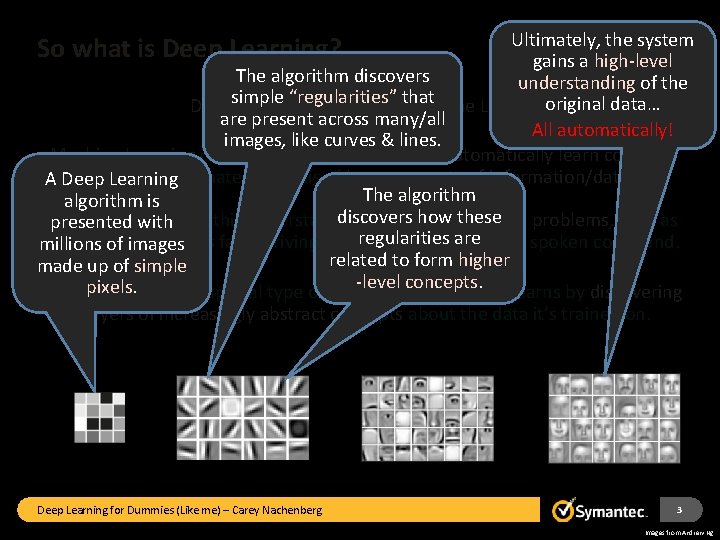
Ultimately, the system gains a high-level The algorithm discovers understanding of the simple “regularities” that Deep Learning is a type of Machine Learning. original data… are present across many/all All automatically! images, like curves & lines. Machine Learning is class of algorithms that can automatically learn concepts through automated analysis of large amounts of information/data. A Deep Learning The algorithm is discovers how these These algorithms use this understanding of the data to solve problems, such as presented with regularities are recognizing a person’s face, driving a car, or understanding a spoken command. millions of images related to form higher made up of simple -level concepts. pixels. Deep Learning is a special type of machine learning that learns by discovering layers of increasingly abstract concepts about the data it’s trained on. So what is Deep Learning? Deep Learning for Dummies (Like me) – Carey Nachenberg 3 Images from Andrew Ng
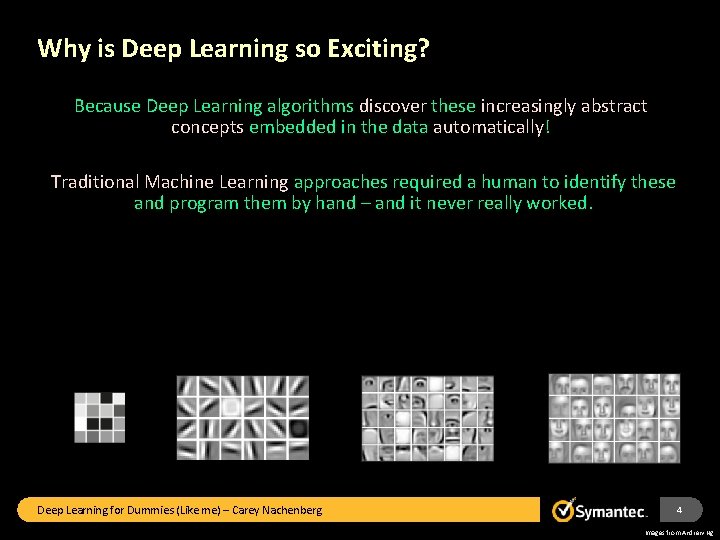
Why is Deep Learning so Exciting? Because Deep Learning algorithms discover these increasingly abstract concepts embedded in the data automatically! Traditional Machine Learning approaches required a human to identify these and program them by hand – and it never really worked. Deep Learning for Dummies (Like me) – Carey Nachenberg 4 Images from Andrew Ng
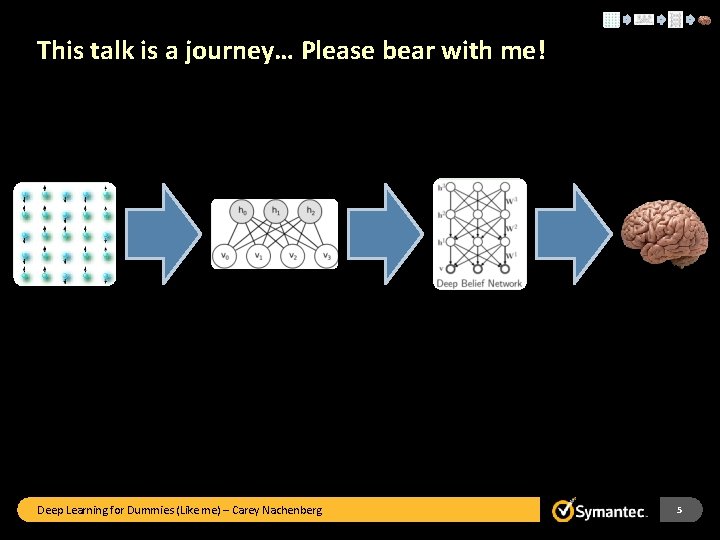
This talk is a journey… Please bear with me! Deep Learning for Dummies (Like me) – Carey Nachenberg 5
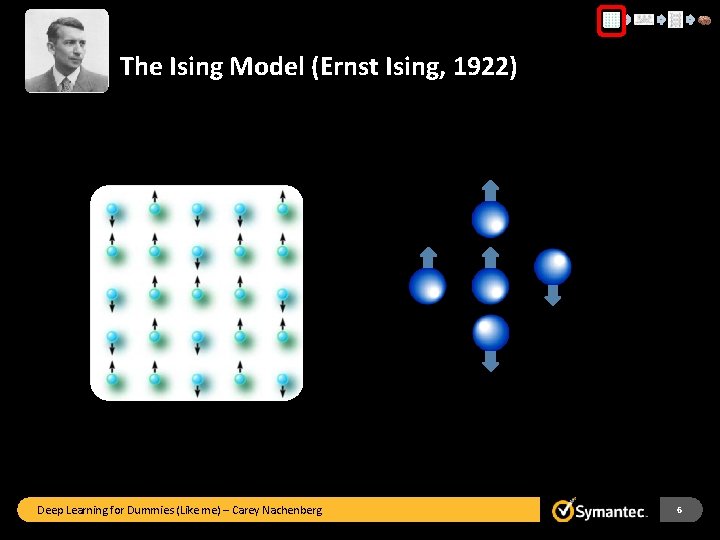
The Ising Model (Ernst Ising, 1922) Deep Learning for Dummies (Like me) – Carey Nachenberg 6
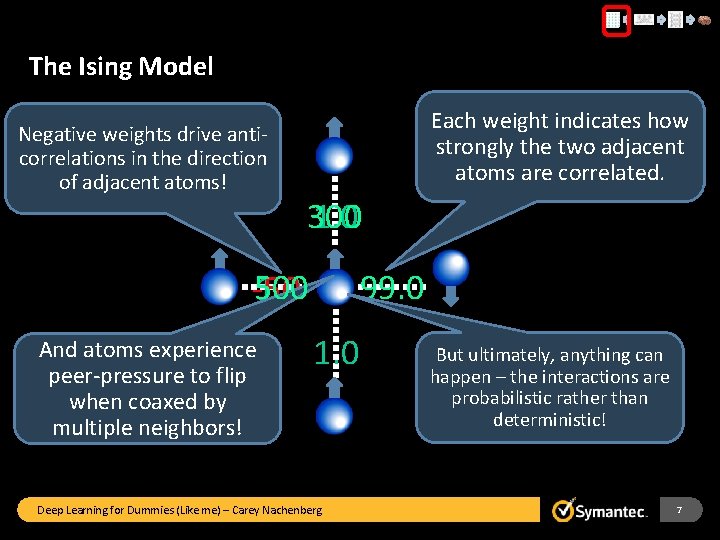
The Ising Model Negative weights drive anticorrelations in the direction of adjacent atoms! Each weight indicates how strongly the two adjacent atoms are correlated. 1. 0 300 500 -50 1. 0 And atoms experience peer-pressure to flip when coaxed by multiple neighbors! 99. 0 1. 0 Deep Learning for Dummies (Like me) – Carey Nachenberg But ultimately, anything can happen – the interactions are probabilistic rather than deterministic! 7
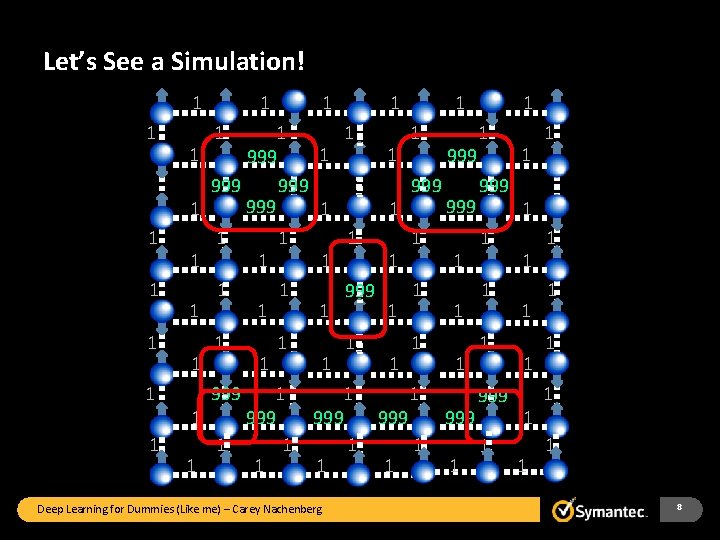
Let’s See a Simulation! 1. 4 1. 75 1 -. 4. 81. 75 1 -. 41 1. 8 1 1 3. 1 -31 -. 22 1 1 -. 10 1 1. 4 1. 24. 41 999 . 75 1. 15 1. 59 -. 4 1. 1 999 -. 9999 1. 7 999 -. 53. 26 5. 8 1 1 1 3. 1 -3 1 -. 22 1 1 -. 10 1. 24. 41 999 1. 15 1. 59 1. 1 999 -. 9999 1. 7 999 -. 53. 26 1 1 5. 8 1. 71 1 8. 1 -. 9 1 . 81 -3. 1 1. 0 1 1. 71 8. 11 -. 9 1 1 -3. 1 1. 0 1 -31 . 24 1 1. 41 . 75 -31. 15 999 1. 59 1 3. 1 . 241 1. 41 . 151 1. 59 1. 1 1 1. 26 1 -. 9 1 -. 53 -. 41 1. 7 1 5. 8 1. 1 1 1. 26 -. 91 1 -. 53 1. 71 1 5. 8 1 8. 1 -. 9 999 1. 8 -3. 1 1. 0 999 1. 71 1 1 . 97 1 1 3. 1 . 97 1 1 999. 71 1 Deep Learning for Dummies (Like me) – Carey Nachenberg . 97 1 . 97 999 1 1 1 999 -3. 1 8. 1 -. 9 1 1. 0 999 1 1 8
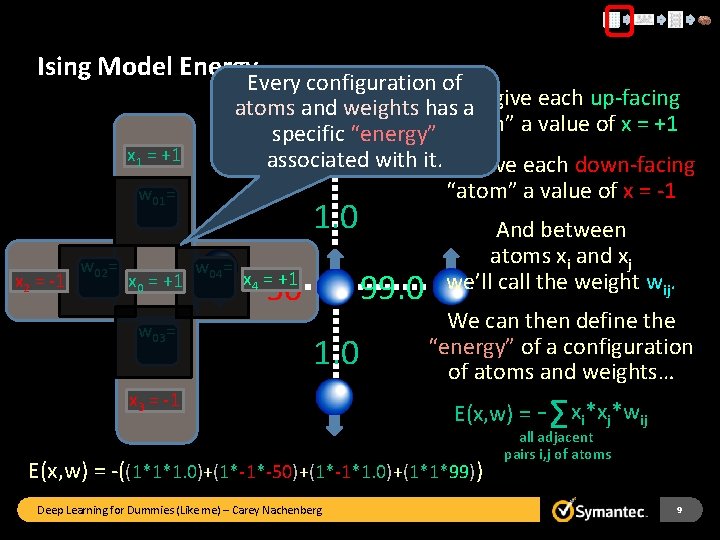
Ising Model Energy Every configuration of Let’s give each up-facing atoms and weights has a specific “energy” “atom” a value of x = +1 associated with it. Let’s give each down-facing “atom” a value of x = -1 x 1 = +1 w 01= x 2 = -1 w 02= x 0 = +1 w 03= 1. 0 w 04= 99. 0 -50 x 4 = +1 1. 0 x 3 = -1 And between atoms xi and xj we’ll call the weight wij. We can then define the “energy” of a configuration of atoms and weights… E(x, w) = -((1*1*1. 0)+(1*-1*-50)+(1*-1*1. 0)+(1*1*99)) Deep Learning for Dummies (Like me) – Carey Nachenberg Σ x *x *w E(x, w) = - i j all adjacent pairs i, j of atoms ij 9
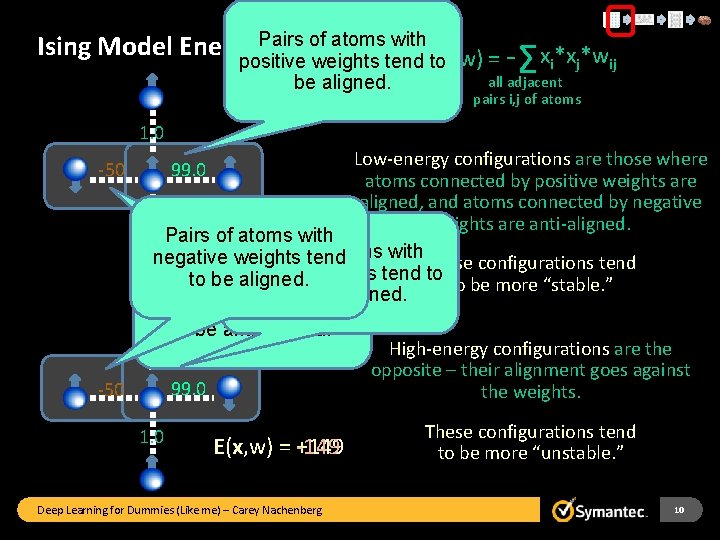
Pairs of atoms with Ising Model Energy - xi*xj*wij positive weights tend. E(x, w) = to Σ be aligned. all adjacent pairs i, j of atoms 1. 0 Low-energy configurations are those where atoms connected by positive weights are aligned, and atoms connected by negative 1. 0 weights are anti-aligned. Pairs. E(x, w) = -151 of atoms with Pairs of atoms with negative weights tend These configurations tend positive weights tend to to be aligned. to be more “stable. ” Pairs of atoms with be anti-aligned. negative weights tend to be anti-aligned. High-energy configurations are the 1. 0 opposite – their alignment goes against 99. 0 -50 the weights. 99. 0 -50 1. 0 E(x, w) = +149 E(x, w) = -149 Deep Learning for Dummies (Like me) – Carey Nachenberg These configurations tend to be more “unstable. ” 10
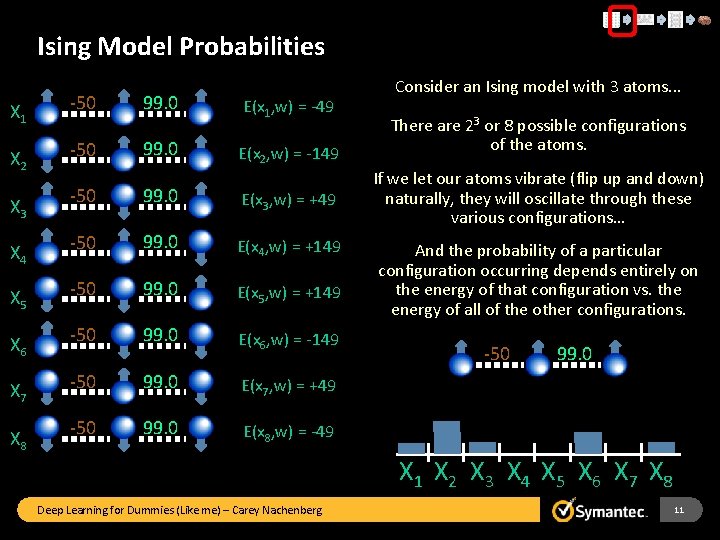
Ising Model Probabilities X 1 -50 99. 0 E(x 1, w) = -49 X 2 -50 99. 0 E(x 2, w) = -149 -50 99. 0 E(x 3, w) = +49 -50 99. 0 E(x 4, w) = +149 X 5 -50 99. 0 E(x 5, w) = +149 X 6 -50 99. 0 E(x 6, w) = -149 X 7 -50 99. 0 E(x 7, w) = +49 -50 99. 0 E(x 8, w) = -49 X 3 X 4 X 8 Consider an Ising model with 3 atoms. . . There are 23 or 8 possible configurations of the atoms. If we let our atoms vibrate (flip up and down) naturally, they will oscillate through these various configurations… And the probability of a particular configuration occurring depends entirely on the energy of that configuration vs. the energy of all of the other configurations. -50 99. 0 X 1 X 2 X 3 X 4 X 5 X 6 X 7 X 8 Deep Learning for Dummies (Like me) – Carey Nachenberg 11
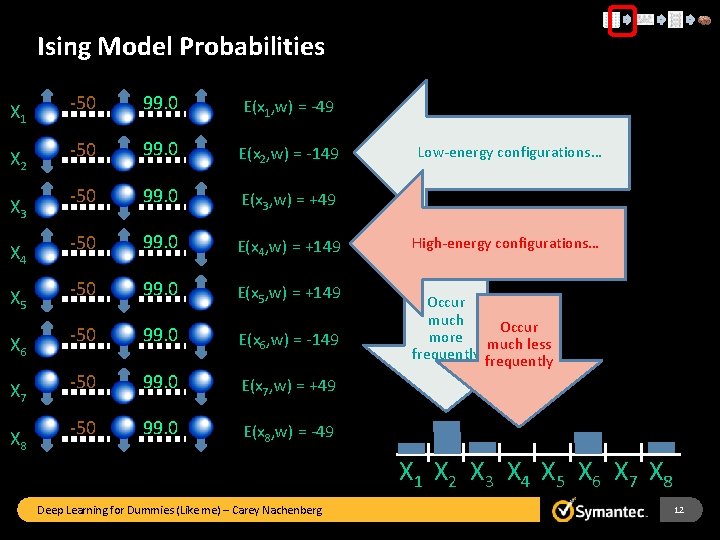
Ising Model Probabilities X 1 -50 99. 0 E(x 1, w) = -49 X 2 -50 99. 0 E(x 2, w) = -149 -50 99. 0 E(x 3, w) = +49 -50 99. 0 E(x 4, w) = +149 X 5 -50 99. 0 E(x 5, w) = +149 X 6 -50 99. 0 E(x 6, w) = -149 X 7 -50 99. 0 E(x 7, w) = +49 -50 99. 0 E(x 8, w) = -49 X 3 X 4 X 8 Low-energy configurations… High-energy configurations… Occur much Occur more much less frequently X 1 X 2 X 3 X 4 X 5 X 6 X 7 X 8 Deep Learning for Dummies (Like me) – Carey Nachenberg 12
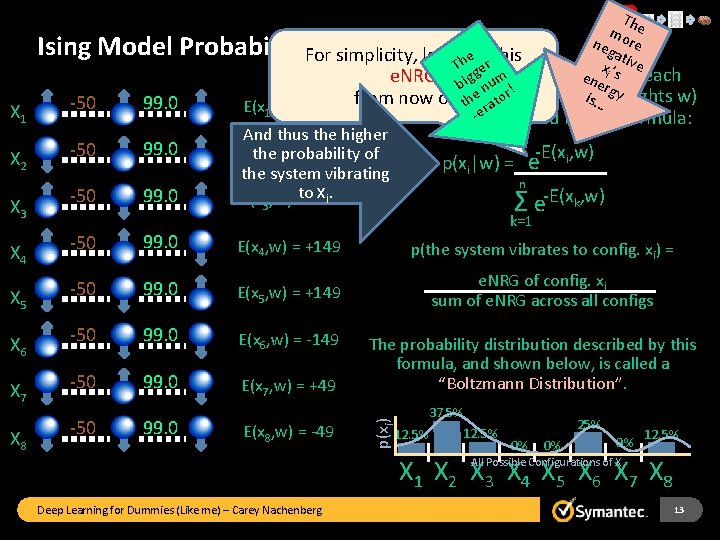
The m neg ore at For simplicity, let’s call this e xi ’s ive Th ger The probability of vibrating to each ene e. NRG big numr! rgy e i configuration x (given fixed weights w) o s from now on… … th rat i E(x 1, w) = -49 -e Ising Model Probabilities X 1 -50 X 2 -50 99. 0 can also be predicted by this formula: -50 99. 0 And thus the higher E(xthe probability of 2, w) = -149 the system vibrating to xi. E(x 3, w) = +49 -50 99. 0 E(x 4, w) = +149 p(the system vibrates to config. xi) = X 5 -50 99. 0 E(x 5, w) = +149 e. NRG of config. xj sum of e. NRG across all configs X 6 -50 99. 0 E(x 6, w) = -149 X 7 -50 99. 0 E(x 7, w) = +49 X 4 X 8 -50 99. 0 E(x 8, w) = -49 -E(x , w) p(xi|w) = e i n Σ e -E(xk, w) k=1 The probability distribution described by this formula, and shown below, is called a “Boltzmann Distribution”. p(xi) X 3 99. 0 37. 5% 12. 5% 25% 0% 0% 0% 12. 5% X 1 X 2 X 3 X 4 X 5 X 6 X 7 X 8 All Possible Configurations of X Deep Learning for Dummies (Like me) – Carey Nachenberg 13
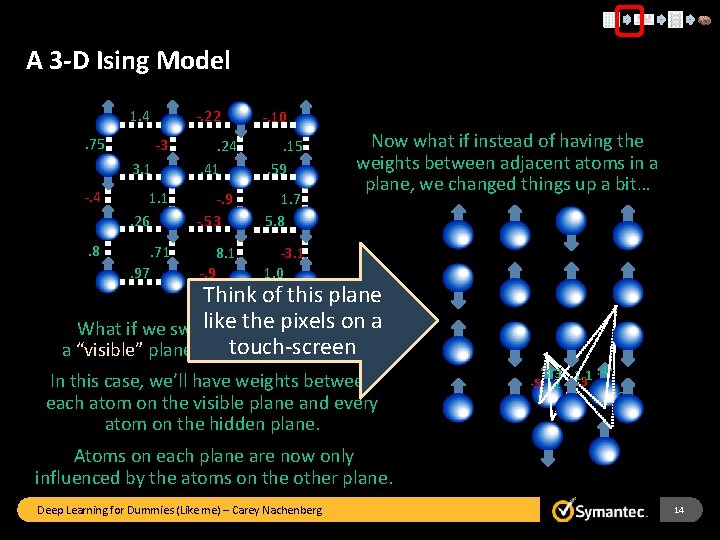
A 3 -D Ising Model -. 22 -. 10 -3 3. 1 . 24. 41 . 15. 59 -. 4 1. 1. 26 -. 9 -. 53 1. 7 5. 8 . 71 8. 1 -. 9 -3. 1 1. 0 1. 4. 75 . 97 Now what if instead of having the weights between adjacent atoms in a plane, we changed things up a bit… Think of this plane like the pixels on a What if we switched to 2 planes… touch-screen a “visible” plane and a “hidden” plane In this case, we’ll have weights between each atom on the visible plane and every atom on the hidden plane. . 83 1. 1. 4 -5. 2 -3. 8. 3 Atoms on each plane are now only influenced by the atoms on the other plane. Deep Learning for Dummies (Like me) – Carey Nachenberg 14
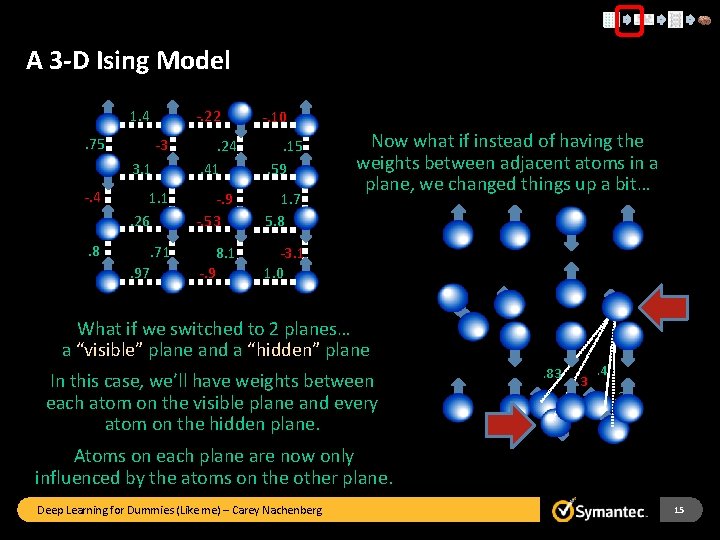
A 3 -D Ising Model -. 22 -. 10 -3 3. 1 . 24. 41 . 15. 59 -. 4 1. 1. 26 -. 9 -. 53 1. 7 5. 8 . 71 8. 1 -. 9 -3. 1 1. 0 1. 4. 75 . 97 Now what if instead of having the weights between adjacent atoms in a plane, we changed things up a bit… What if we switched to 2 planes… a “visible” plane and a “hidden” plane In this case, we’ll have weights between each atom on the visible plane and every atom on the hidden plane. . 83 -3 . 4. 3 Atoms on each plane are now only influenced by the atoms on the other plane. Deep Learning for Dummies (Like me) – Carey Nachenberg 15
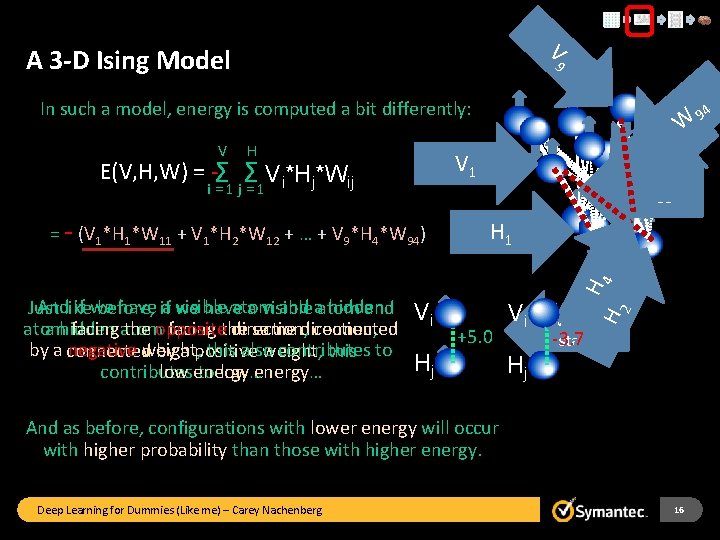
V A 3 -D Ising Model 9 In such a model, energy is computed a bit differently: V H W W W 11 V 1 E(V, H, W) = - Σ Σ Vi*Hj*Wij i = 1 j = 1 H 1 Vi Low energy 2 Vi +5. 0 Hj H And if we have a visible atom and a hidden Just like before, if we have a visible atom and atom facing the opposite direction, connected a hidden atom facing the same direction, by a negative weight, this also contributes to connected by a positive weight, this low energy… contributes to low energy… H 4 = - (V 1*H 1*W 11 + V 1*H 2*W 12 + … + V 9*H 4*W 94) 12 -3. 7 state Hj And as before, configurations with lower energy will occur with higher probability than those with higher energy. Deep Learning for Dummies (Like me) – Carey Nachenberg 16 94
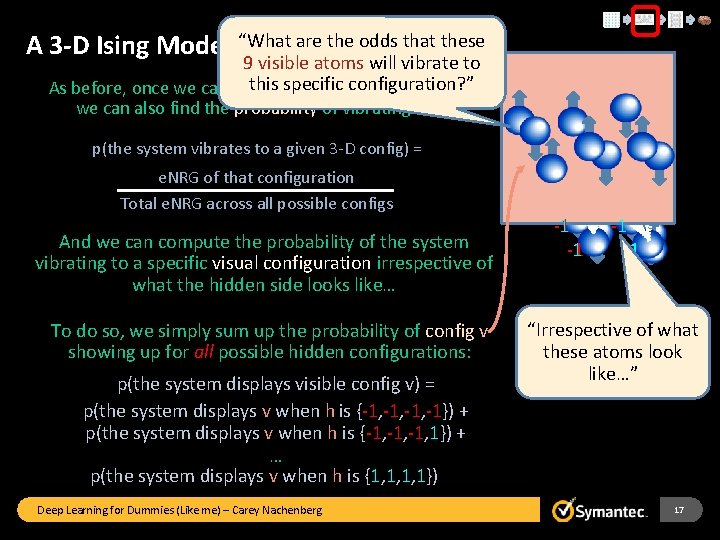
A 3 -D Ising Model “What are the odds that these 9 visible atoms will vibrate to this specific configuration? ” As before, once we can compute the energy of a config, we can also find the probability of vibrating to it. p(the system vibrates to a given 3 -D config) = e. NRG of that configuration Total e. NRG across all possible configs And we can compute the probability of the system vibrating to a specific visual configuration irrespective of what the hidden side looks like… To do so, we simply sum up the probability of config v showing up for all possible hidden configurations: p(the system displays visible config v) = p(the system displays v when h is {-1, -1, -1}) + p(the system displays v when h is {-1, -1, 1}) + … p(the system displays v when h is {1, 1, 1, 1}) Deep Learning for Dummies (Like me) – Carey Nachenberg -1 1 1 -1 “Irrespective of what these atoms look like…” 17
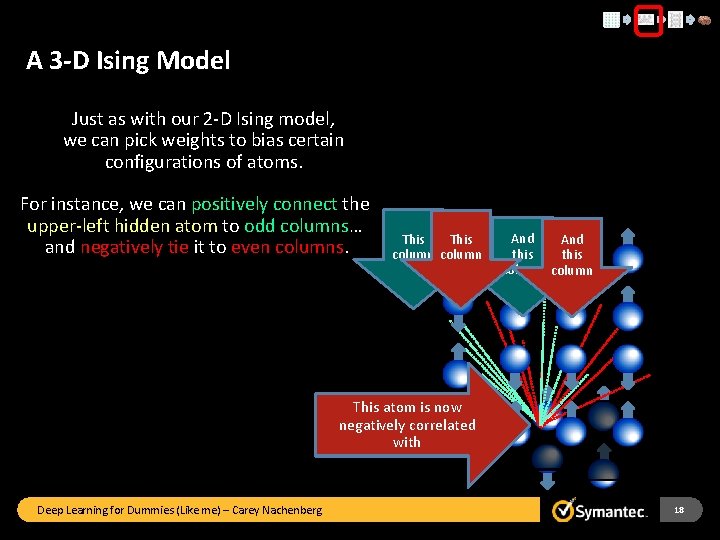
A 3 -D Ising Model Just as with our 2 -D Ising model, we can pick weights to bias certain configurations of atoms. For instance, we can positively connect the upper-left hidden atom to odd columns… and negatively tie it to even columns. This column And this column This atom is now negatively correlated positively correlated with Deep Learning for Dummies (Like me) – Carey Nachenberg 18
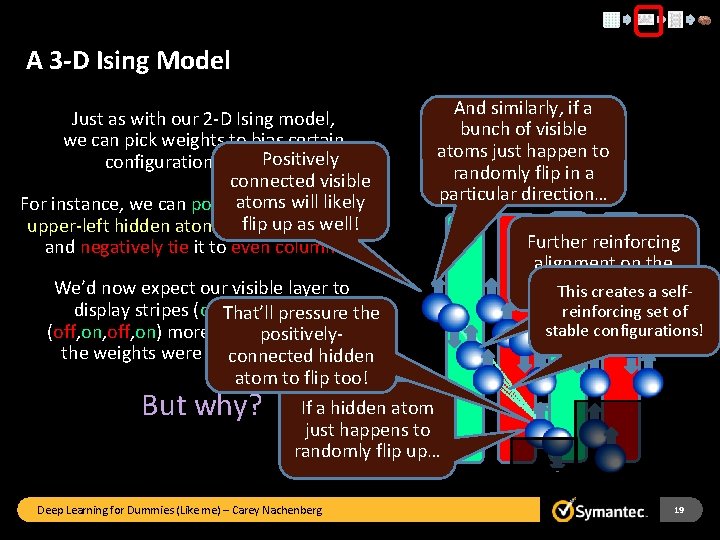
A 3 -D Ising Model Just as with our 2 -D Ising model, we can pick weights to bias certain Positively configurations of atoms. connected visible atoms will likely For instance, we can positively connect the flip up as well! upper-left hidden atom to odd columns… and negatively tie it to even columns. And similarly, if a bunch of visible atoms just happen to randomly flip in a particular direction… We’d now expect our visible layer to display stripes (on, off, on, off) or That’ll pressure the (off, on, off, on) more frequently than if positivelythe weights were entirely random. connected hidden atom to flip too! But why? Further reinforcing alignment on the visible plane! This creates a self- reinforcing set of stable configurations! If a hidden atom just happens to randomly flip up… Deep Learning for Dummies (Like me) – Carey Nachenberg 19
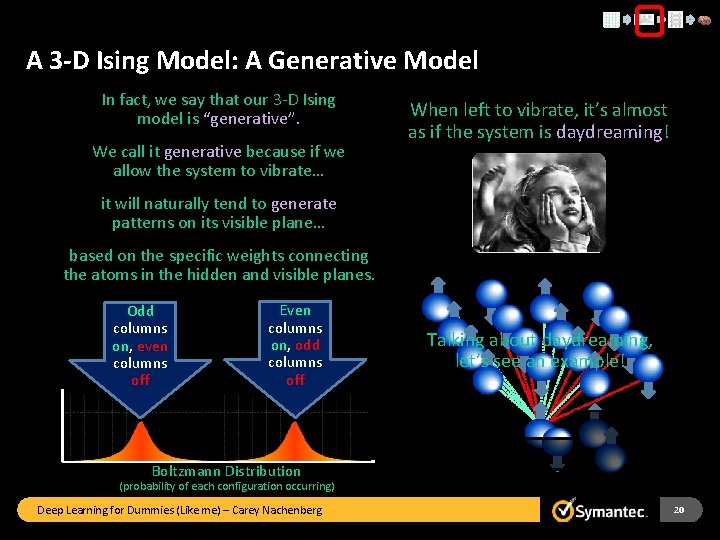
A 3 -D Ising Model: A Generative Model In fact, we say that our 3 -D Ising model is “generative”. We call it generative because if we allow the system to vibrate… When left to vibrate, it’s almost as if the system is daydreaming! it will naturally tend to generate patterns on its visible plane… based on the specific weights connecting the atoms in the hidden and visible planes. Odd columns on, even columns off Even columns on, odd columns off Talking about daydreaming, let’s see an example! Boltzmann Distribution (probability of each configuration occurring) Deep Learning for Dummies (Like me) – Carey Nachenberg 20
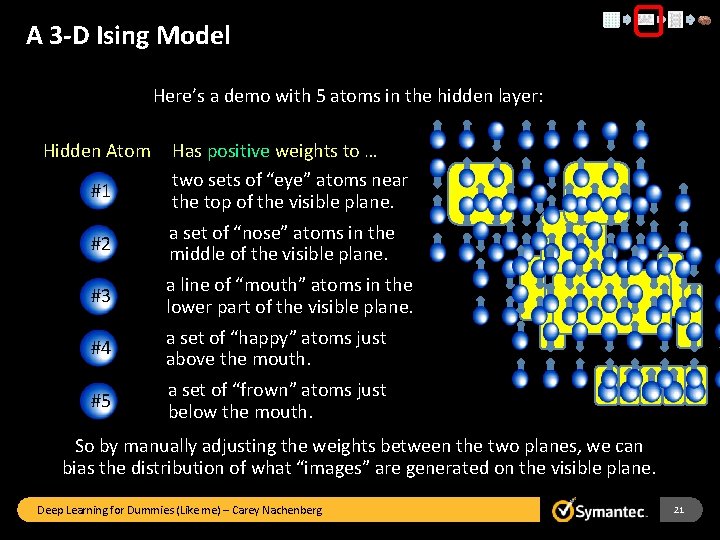
A 3 -D Ising Model Here’s a demo with 5 atoms in the hidden layer: Hidden Atom #1 Has positive weights to … two sets of “eye” atoms near the top of the visible plane. #2 a set of “nose” atoms in the middle of the visible plane. #3 a line of “mouth” atoms in the lower part of the visible plane. #4 a set of “happy” atoms just above the mouth. #5 a set of “frown” atoms just below the mouth. So by manually adjusting the weights between the two planes, we can bias the distribution of what “images” are generated on the visible plane. Deep Learning for Dummies (Like me) – Carey Nachenberg 21
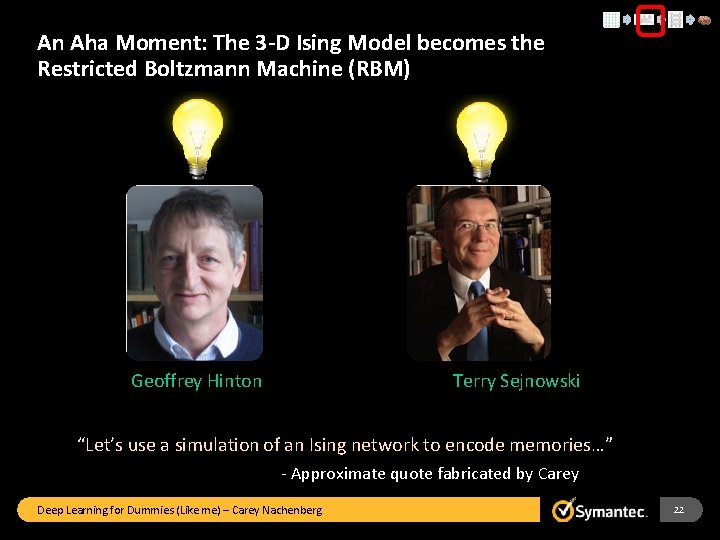
An Aha Moment: The 3 -D Ising Model becomes the Restricted Boltzmann Machine (RBM) Terry Sejnowski Geoffrey Hinton “Let’s use a simulation of an Ising network to encode memories…” - Approximate quote fabricated by Carey Deep Learning for Dummies (Like me) – Carey Nachenberg 22
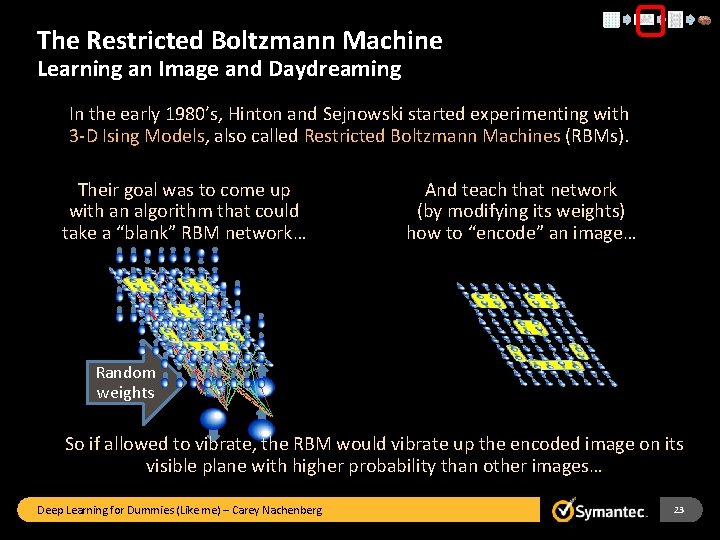
The Restricted Boltzmann Machine Learning an Image and Daydreaming In the early 1980’s, Hinton and Sejnowski started experimenting with 3 -D Ising Models, also called Restricted Boltzmann Machines (RBMs). Their goal was to come up with an algorithm that could take a “blank” RBM network… And teach that network (by modifying its weights) how to “encode” an image… Random weights So if allowed to vibrate, the RBM would vibrate up the encoded image on its visible plane with higher probability than other images… Deep Learning for Dummies (Like me) – Carey Nachenberg 23
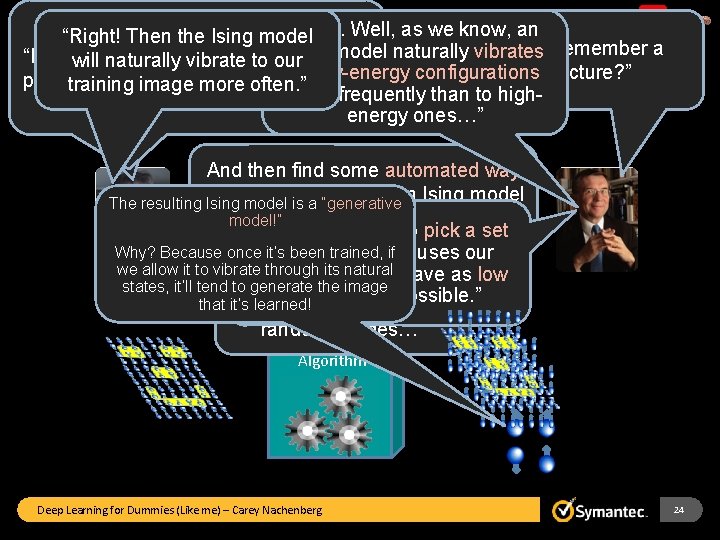
“Iasee. The Restricted Boltzmann Machine “Right! Thenifthe model “Terry, I wonder we Ising can train 3 - Well, as we know, an “To remember a Ising model naturally vibrates “ILearning an Image and Daydreaming want to be able to will naturally vibrate toaour D Ising model to remember to low-energy configurations picture? ” pick an arbitrary image… training image more often. ” picture. ” more frequently than to highenergy ones…” And then find some automated way pick theisweights of an Ising model The resulting to Ising model a “generative so that when it vibrates… model!” “So we just need to pick a set Why? Because onceof it’sweights been trained, thatif causes our we allow it to vibrate throughimage its natural desired to have as low vibrates states, it’ll tend. . . to it generate the more image often to an energy that it’s learned! my image thanas to possible. ” other random images…” Gradient Descent Algorithm Deep Learning for Dummies (Like me) – Carey Nachenberg 24
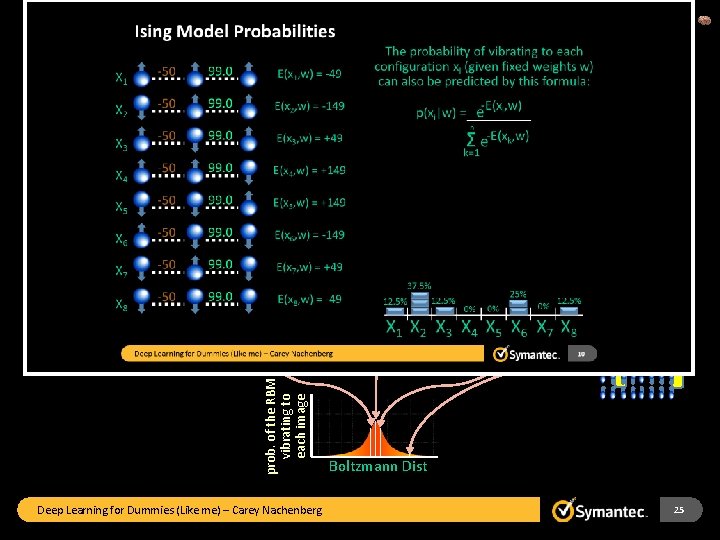
The Restricted Boltzmann Machine Learning an Image and Daydreaming prob. of the RBM vibrating to each image Deep Learning for Dummies (Like me) – Carey Nachenberg Boltzmann Dist 25
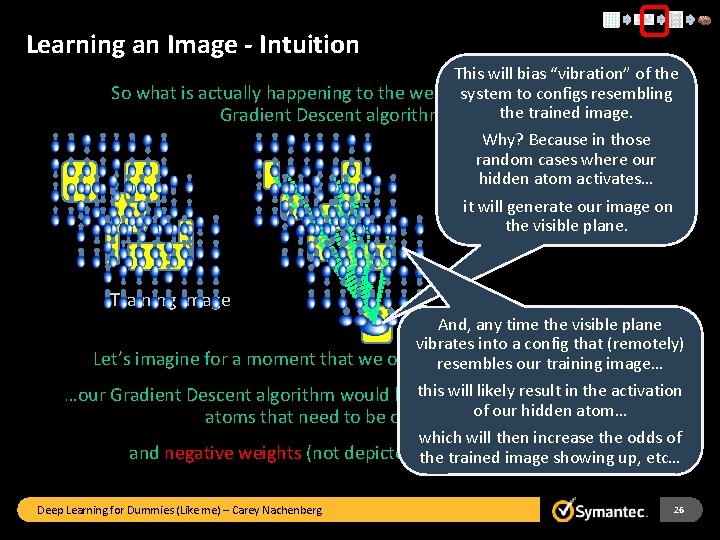
Learning an Image - Intuition This will bias “vibration” of the system to configs resembling So what is actually happening to the weights during our the trained image. Gradient Descent algorithm? Why? Because in those random cases where our hidden atom activates… it will generate our image on the visible plane. Training Image And, any time the visible plane vibrates into a config that (remotely) Let’s imagine for a moment that we only have a single hidden node. resembles our training image… this will likely result in the activation …our Gradient Descent algorithm would likely assign positive weights to all of our hidden atom… atoms that need to be on in the image… which will then increase the odds of and negative weights (not depicted) to all of the off atoms. the trained image showing up, etc… Deep Learning for Dummies (Like me) – Carey Nachenberg 26
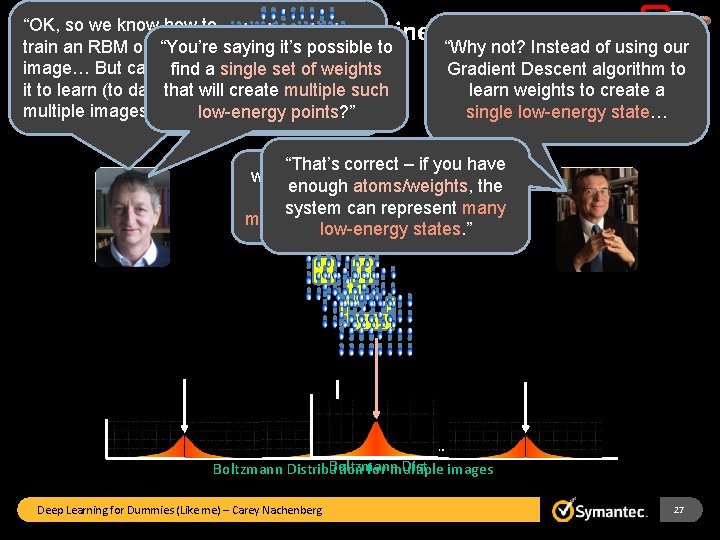
“OK, so we know how to The Restricted Boltzmann Machine train an RBM on a“You’re single saying it’s possible to “Why not? Instead of using our Learning Multiple Images image… But can we train Gradient Descent algorithm to find a single set of weights it to learn (to daydream) learn weights to create a that will create multiple such multiple images? ” single low-energy state… low-energy points? ” “That’s correct – if you have we’ll use it to discover a set enough atoms/weights, the of weights that create system can represent many multiple low-energy states…” low-energy states. ” … Boltzmann Distribution for multiple images Deep Learning for Dummies (Like me) – Carey Nachenberg 27
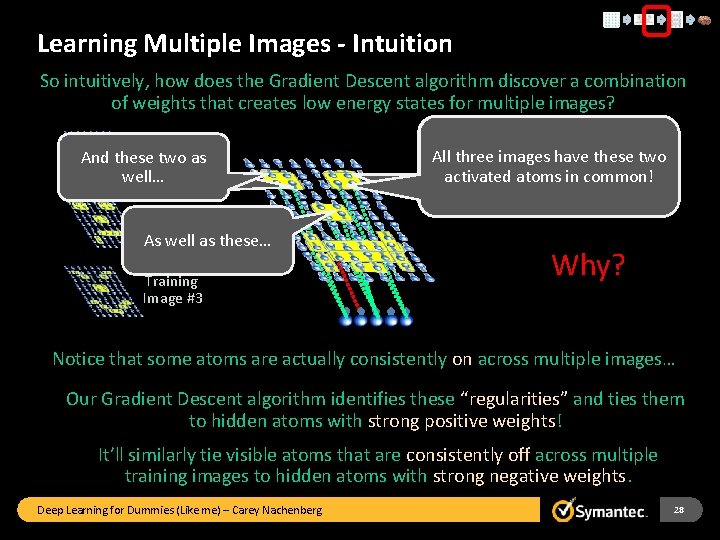
Learning Multiple Images - Intuition So intuitively, how does the Gradient Descent algorithm discover a combination of weights that creates low energy states for multiple images? Training And these two as Image #1 well… Training Image #2 As well as these… Training Image #3 All three images have these two activated atoms in common! Why? Notice that some atoms are actually consistently on across multiple images… Our Gradient Descent algorithm identifies these “regularities” and ties them to hidden atoms with strong positive weights! It’ll similarly tie visible atoms that are consistently off across multiple training images to hidden atoms with strong negative weights. Deep Learning for Dummies (Like me) – Carey Nachenberg 28
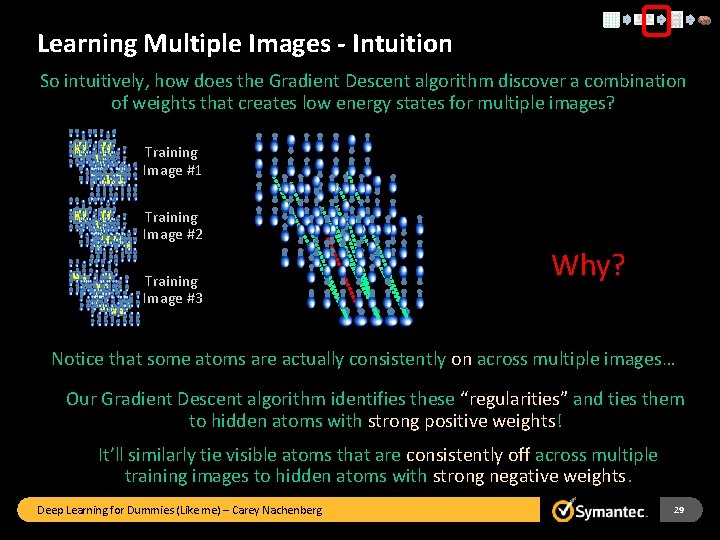
Learning Multiple Images - Intuition So intuitively, how does the Gradient Descent algorithm discover a combination of weights that creates low energy states for multiple images? Training Image #1 Training Image #2 Training Image #3 Why? Notice that some atoms are actually consistently on across multiple images… Our Gradient Descent algorithm identifies these “regularities” and ties them to hidden atoms with strong positive weights! It’ll similarly tie visible atoms that are consistently off across multiple training images to hidden atoms with strong negative weights. Deep Learning for Dummies (Like me) – Carey Nachenberg 29
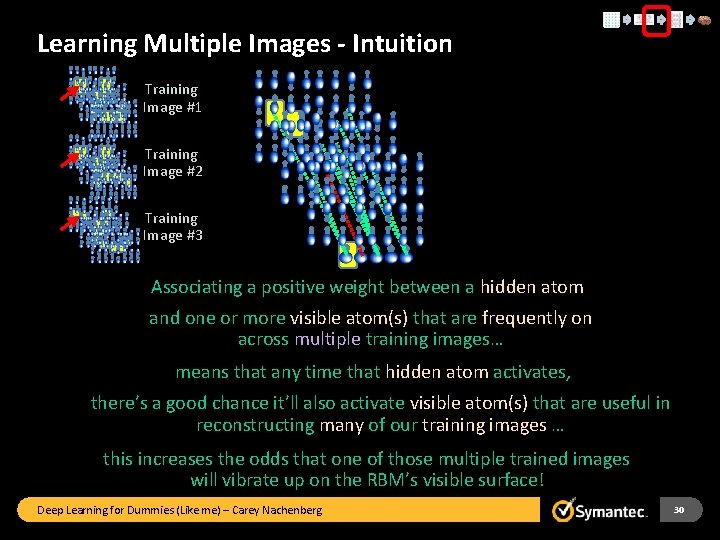
Learning Multiple Images - Intuition Training Image #1 Training Image #2 Training Image #3 Associating a positive weight between a hidden atom and one or more visible atom(s) that are frequently on across multiple training images… means that any time that hidden atom activates, there’s a good chance it’ll also activate visible atom(s) that are useful in reconstructing many of our training images … this increases the odds that one of those multiple trained images will vibrate up on the RBM’s visible surface! Deep Learning for Dummies (Like me) – Carey Nachenberg 30
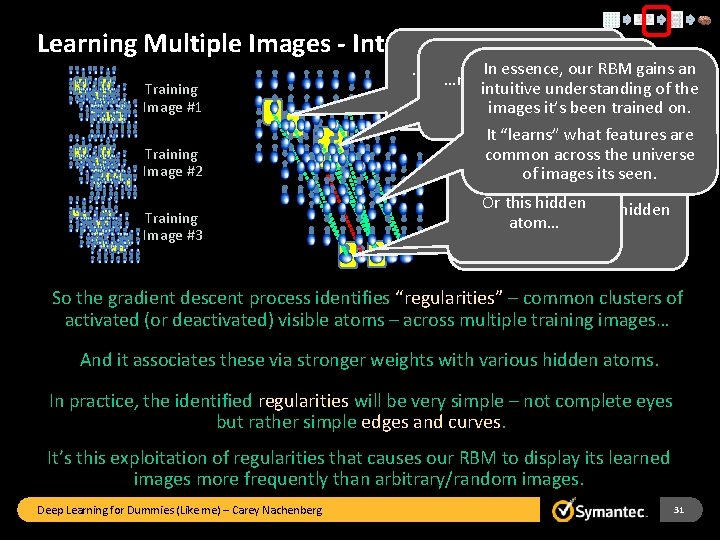
Learning Multiple Images - Intuition Training Image #1 In essence, our RBM gains an …may become associated intuitive understanding of the with (parts of) left eyes. with noses. images it’s been trained on. Training Image #2 It “learns” what features are common across the universe of images its seen. Training Image #3 Or this hidden So, for example, this hidden atom… So the gradient descent process identifies “regularities” – common clusters of activated (or deactivated) visible atoms – across multiple training images… And it associates these via stronger weights with various hidden atoms. In practice, the identified regularities will be very simple – not complete eyes but rather simple edges and curves. It’s this exploitation of regularities that causes our RBM to display its learned images more frequently than arbitrary/random images. Deep Learning for Dummies (Like me) – Carey Nachenberg 31
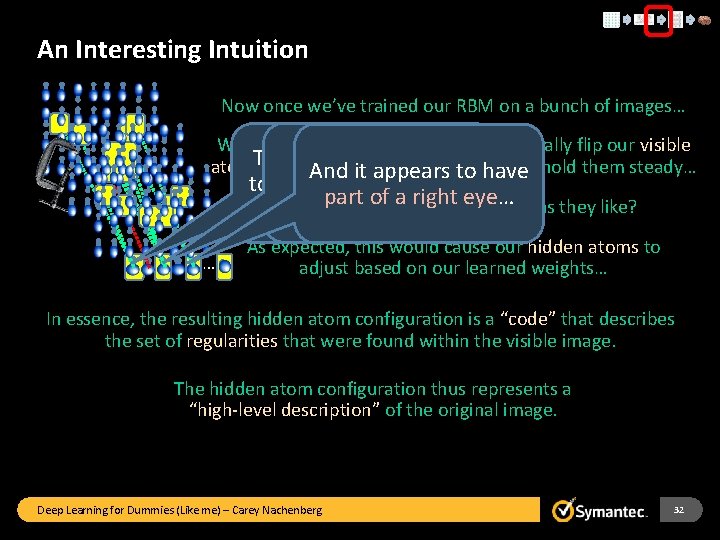
An Interesting Intuition Now once we’ve trained our RBM on a bunch of images… What would happen if we were to manually flip our visible This image appears atoms to one of our training images and hold them steady… And it appears to have at least part have a nose… part of a right eye… but let the hidden atoms vibrate as they like? of a left eye. … As expected, this would cause our hidden atoms to adjust based on our learned weights… In essence, the resulting hidden atom configuration is a “code” that describes the set of regularities that were found within the visible image. The hidden atom configuration thus represents a “high-level description” of the original image. Deep Learning for Dummies (Like me) – Carey Nachenberg 32
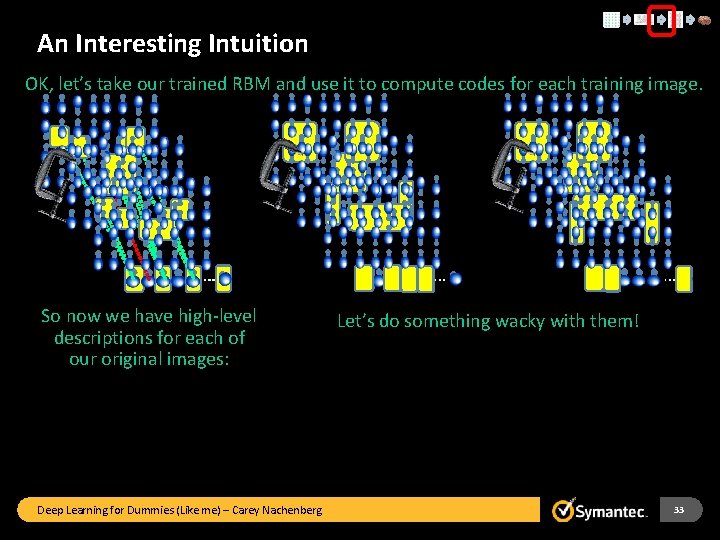
An Interesting Intuition OK, let’s take our trained RBM and use it to compute codes for each training image. … So now we have high-level descriptions for each of our original images: Deep Learning for Dummies (Like me) – Carey Nachenberg … … Let’s do something wacky with them! 33
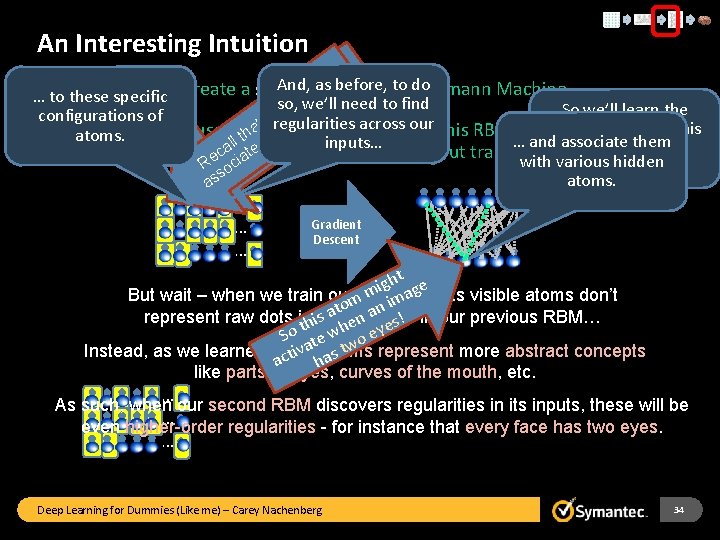
An Interesting Intuition is e. s! And, as before, to do ss Let’s create a second Restricted Boltzmann Machine… tom enyoe … to these specific a so, we’ll need to find So we’ll learn the is lietfht h configurations of t w eith at nregularities across our weights to cause this h atoms. and then use Gradient Descent to train this RBM using our t w o l … and associate them inputs… l sd RBM to vibrate freshly-generated sequences as the input training data. ca tiahtie e with various hidden R nodc frequently… s A s atoms. a … … Gradient Descent ht e g i ag its visible atoms don’t m im But wait – when we train ourmnew RBM, to an a s represent raw dots in a picture, ! in our previous RBM… i hen esas h t y So te w o e tw represent more abstract concepts Instead, as we learned, these iva atoms s t c a a h like parts of eyes, curves of the mouth, etc. … As such, when our second RBM discovers regularities in its inputs, these will be … even higher-order regularities - for instance that every face has two eyes. … Deep Learning for Dummies (Like me) – Carey Nachenberg 34
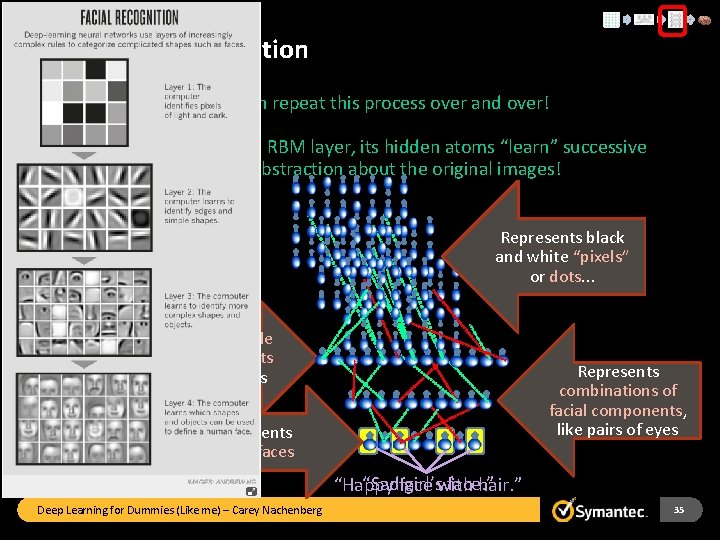
An Interesting Intuition And we can repeat this process over and over! Each time we add an RBM layer, its hidden atoms “learn” successive levels of abstraction about the original images! Represents black and white “pixels” or dots. . . Represents simple facial components like parts of eyes Represents combinations of facial components, like pairs of eyes Represents entire faces “Sad girl’s face. ” “Happy face with hair. ” Deep Learning for Dummies (Like me) – Carey Nachenberg 35
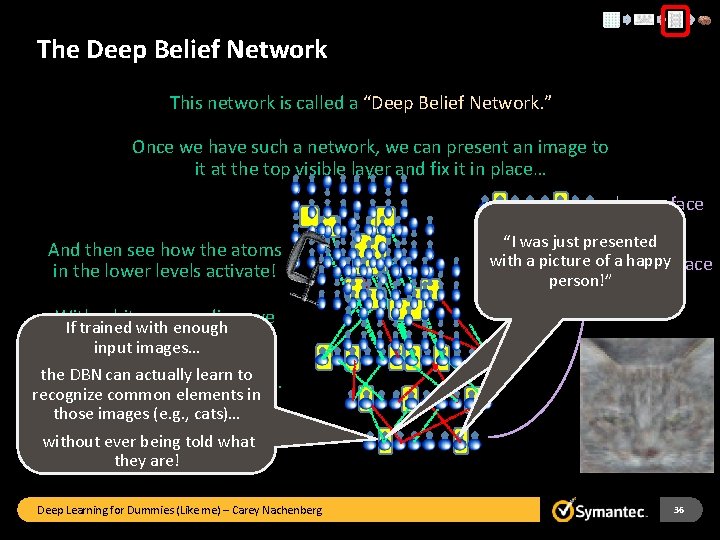
The Deep Belief Network This network is called a “Deep Belief Network. ” Once we have such a network, we can present an image to it at the top visible layer and fix it in place… And then see how the atoms in the lower levels activate! = happy face = sad face “I was just presented … with a picture of a happy = neutral face person!” With a bit more coding, we If trained with enough can determine which atoms input images… in the bottom layer activate the DBN can actually learn to for each type of input image. recognize common elements in those images (e. g. , cats)… And build a classifier that can without ever being told what recognize images! they are! Deep Learning for Dummies (Like me) – Carey Nachenberg 36
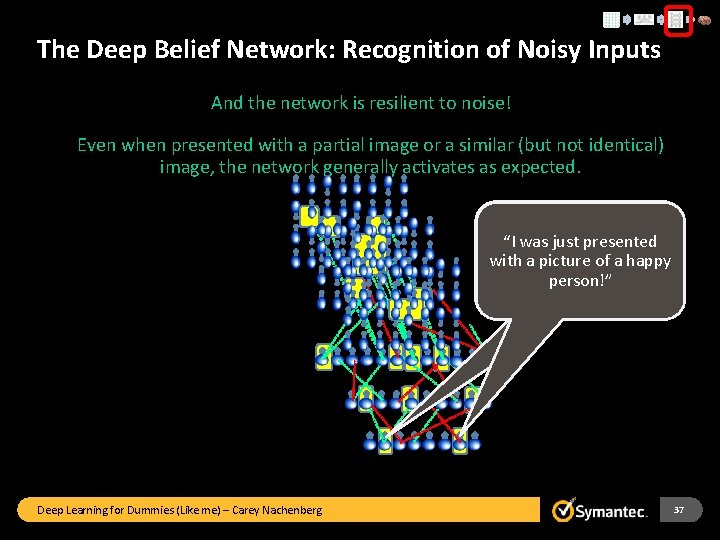
The Deep Belief Network: Recognition of Noisy Inputs And the network is resilient to noise! Even when presented with a partial image or a similar (but not identical) image, the network generally activates as expected. “I was just presented with a picture of a happy person!” Deep Learning for Dummies (Like me) – Carey Nachenberg 37
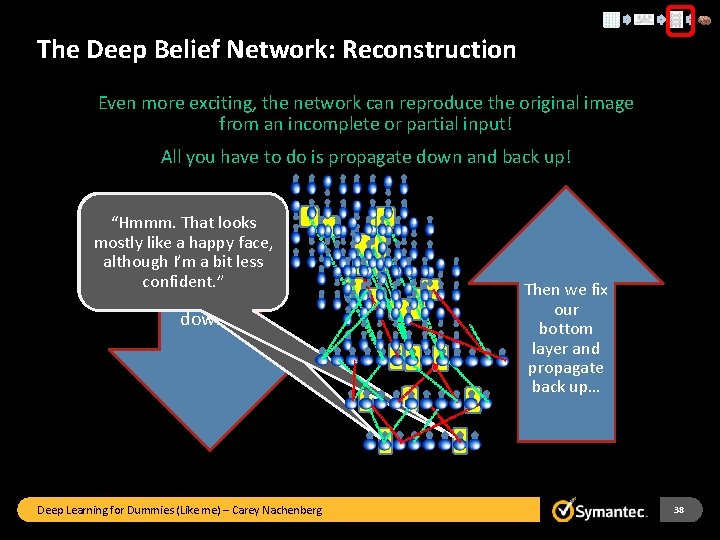
The Deep Belief Network: Reconstruction Even more exciting, the network can reproduce the original image from an incomplete or partial input! All you have to do is propagate down and back up! “Hmmm. That looks mostly like a happy face, although I’m a bit less First we confident. ” propagate down… Deep Learning for Dummies (Like me) – Carey Nachenberg Then we fix our bottom layer and propagate back up… 38
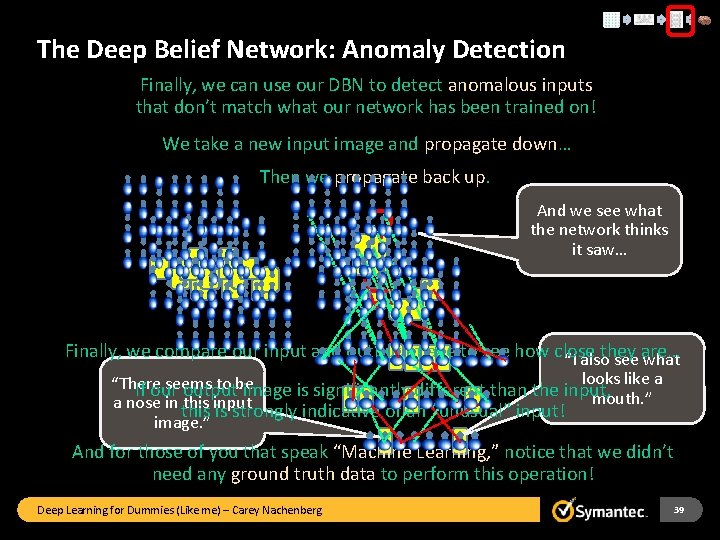
The Deep Belief Network: Anomaly Detection Finally, we can use our DBN to detect anomalous inputs that don’t match what our network has been trained on! We take a new input image and propagate down… Then we propagate back up. ? = And we see what the network thinks it saw… Finally, we compare our input and output image to see how close they are… “I also see what looks like a “There seems to be If our output image is significantly different than the input, mouth. ” a nose in this input this is strongly indicative of an “unusual” input! image. ” And for those of you that speak “Machine Learning, ” notice that we didn’t need any ground truth data to perform this operation! Deep Learning for Dummies (Like me) – Carey Nachenberg 39
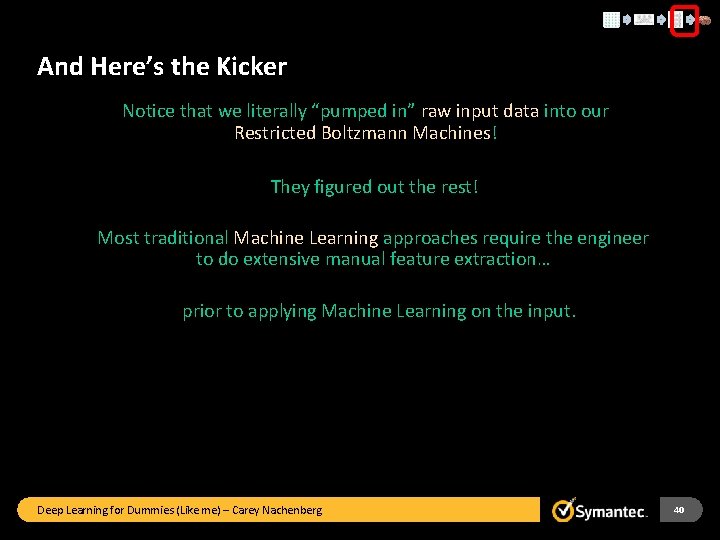
And Here’s the Kicker Notice that we literally “pumped in” raw input data into our Restricted Boltzmann Machines! They figured out the rest! Most traditional Machine Learning approaches require the engineer to do extensive manual feature extraction… prior to applying Machine Learning on the input. Deep Learning for Dummies (Like me) – Carey Nachenberg 40
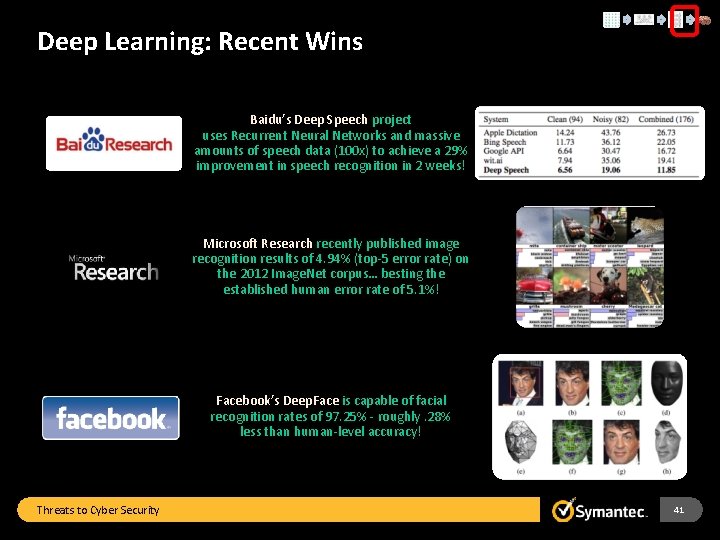
Deep Learning: Recent Wins Baidu’s Deep Speech project uses Recurrent Neural Networks and massive amounts of speech data (100 x) to achieve a 29% improvement in speech recognition in 2 weeks! Microsoft Research recently published image recognition results of 4. 94% (top-5 error rate) on the 2012 Image. Net corpus… besting the established human error rate of 5. 1%! Facebook’s Deep. Face is capable of facial recognition rates of 97. 25% - roughly. 28% less than human-level accuracy! Threats to Cyber Security 41
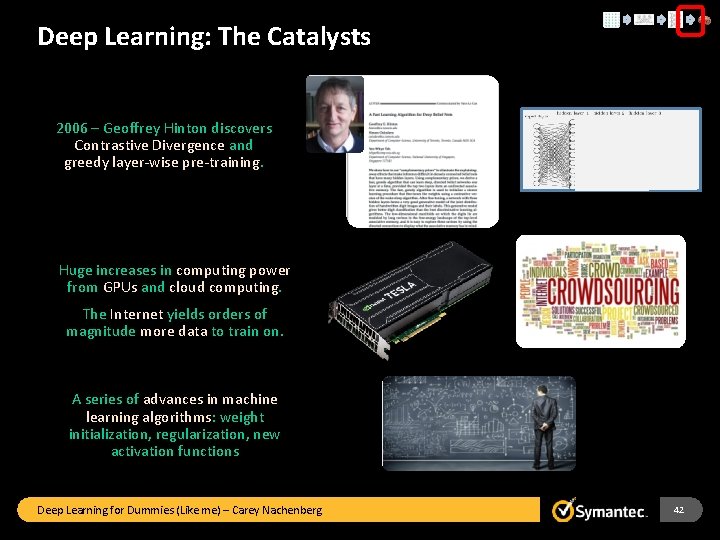
Deep Learning: The Catalysts 2006 – Geoffrey Hinton discovers Contrastive Divergence and greedy layer-wise pre-training. Huge increases in computing power from GPUs and cloud computing. The Internet yields orders of magnitude more data to train on. A series of advances in machine learning algorithms: weight initialization, regularization, new activation functions Deep Learning for Dummies (Like me) – Carey Nachenberg 42
One Last Thought… Have you ever thought about how amazing your visual memory is? Do you think your brain literally stores away high-resolution snapshots of everything it sees? Well maybe not! This could explain why… Given a memory cue you can suddenly remember a whole thought. When viewing a partial image, your brain can visualize the rest… When you see something unusual your brain knows it immediately… After seeing hundreds of cats as a kid, but not knowing what they were called… the moment your mom told you “that’s called a ‘cat’” you could instantly classify every cat you’d ever seen. Deep Learning for Dummies (Like me) – Carey Nachenberg 43
Conclusion Deep Learning is a Machine Learning technique that works by learning multiple levels of abstraction about its inputs. Once a Deep Learning system learns the inherent structure of its inputs, you can use it to… classify items, reconstruct partial inputs, detect anomalies, search for related items, just daydream! And finally, the engineer doesn’t have to do lots of pre-processing to apply Deep Learning to many real-world problems! Deep Learning for Dummies (Like me) – Carey Nachenberg 44
Finally… If you enjoyed this talk… Consider reading my new techno-thriller! Available April 14 th on Amazon, i. Books, and B&N. com. I’ll be donating all proceeds to charities benefiting underprivileged and lowincome students, so it’s an exciting read for a good cause! Deep Learning for Dummies (Like me) – Carey Nachenberg 45
Thank you! Carey Nachenberg cnachenberg@symantec. com Copyright © 2010 Symantec Corporation. All rights reserved. Symantec and the Symantec Logo are trademarks or registered trademarks of Symantec Corporation or its affiliates in the U. S. and other countries. Other names may be trademarks of their respective owners. This document is provided for informational purposes only and is not intended as advertising. All warranties relating to the information in this document, either express or implied, are disclaimed to the maximum extent allowed by law. The information in this document is subject to change without notice. Deep Learning for Dummies (Like me) – Carey Nachenberg 46
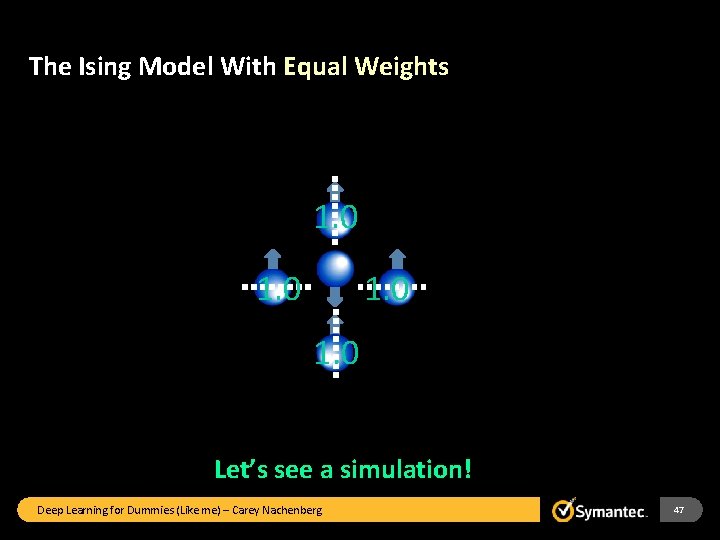
The Ising Model With Equal Weights 1. 0 Let’s see a simulation! Deep Learning for Dummies (Like me) – Carey Nachenberg 47
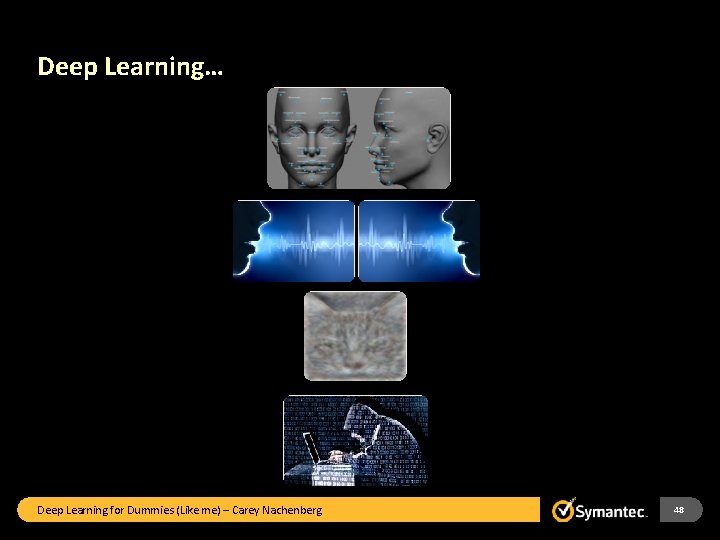
Deep Learning… Deep Learning for Dummies (Like me) – Carey Nachenberg 48
- Slides: 48