
Deep Learning for CT Scan Identification of Temporal


- Slides: 9
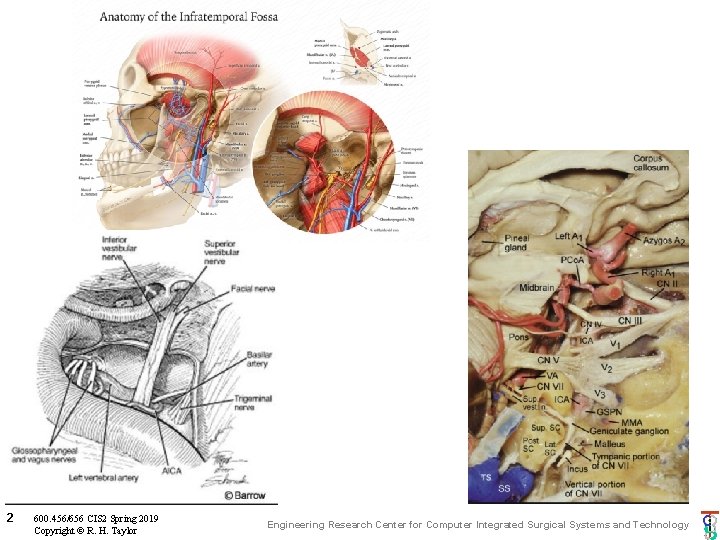
Deep Learning for CT Scan Identification of Temporal Bone and Skull Base Landmarks • The temporal bone and skull base are complex areas that have multiple nerves, arteries, veins and other important structures encased in bone 1 600. 456/656 CIS 2 Spring 2019 Copyright © R. H. Taylor Engineering Research Center for Computer Integrated Surgical Systems and Technology
2 600. 456/656 CIS 2 Spring 2019 Copyright © R. H. Taylor Engineering Research Center for Computer Integrated Surgical Systems and Technology
Deep Learning for CT Scan Identification of Temporal Bone and Skull Base Landmarks • The temporal bone and skull base are complex areas that have multiple nerves, arteries, veins and other important structures encased in bone • Operating in this area is challenging and understanding the relationship between important landmarks is critical for successful surgery 3 600. 456/656 CIS 2 Spring 2019 Copyright © R. H. Taylor Engineering Research Center for Computer Integrated Surgical Systems and Technology
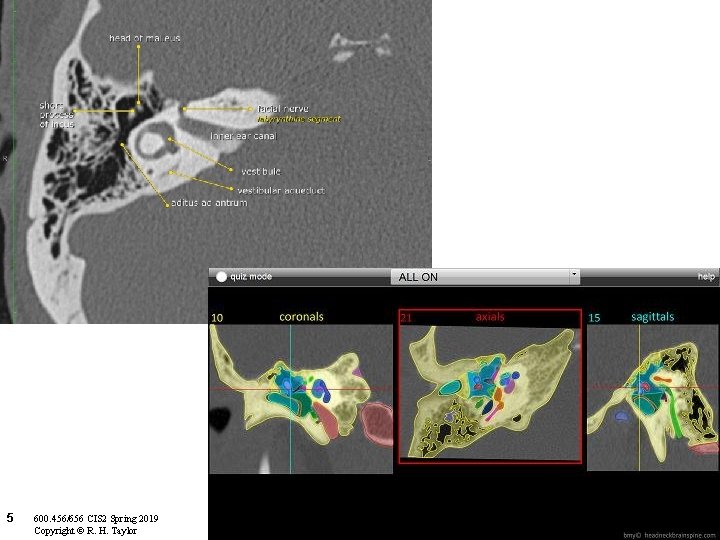
Deep Learning for CT Scan Identification of Temporal Bone and Skull Base Landmarks • The temporal bone and skull base are complex areas that have multiple nerves, arteries, veins and other important structures encased in bone • Operating in this area is challenging and understanding the relationship between important landmarks is critical for successful surgery • Identifying these relationships on CT imaging preoperatively can greatly improve the speed, safety and efficiency of surgery 4 600. 456/656 CIS 2 Spring 2019 Copyright © R. H. Taylor Engineering Research Center for Computer Integrated Surgical Systems and Technology
5 600. 456/656 CIS 2 Spring 2019 Copyright © R. H. Taylor Engineering Research Center for Computer Integrated Surgical Systems and Technology
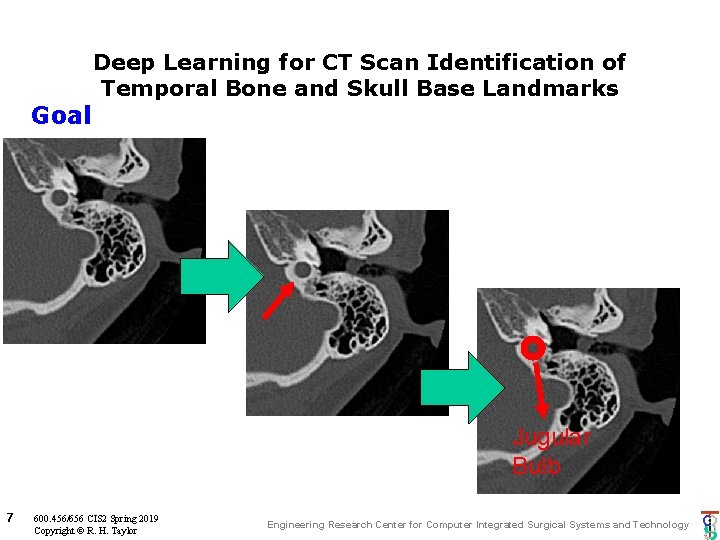
Goal Deep Learning for CT Scan Identification of Temporal Bone and Skull Base Landmarks 1. To use a machine learning system to automated identification of CT landmarks of the skull base and temporal bone 2. To teach that system to measure and detect anatomical relationships between these landmarks 6 600. 456/656 CIS 2 Spring 2019 Copyright © R. H. Taylor Engineering Research Center for Computer Integrated Surgical Systems and Technology
Goal Deep Learning for CT Scan Identification of Temporal Bone and Skull Base Landmarks Jugular Bulb 7 600. 456/656 CIS 2 Spring 2019 Copyright © R. H. Taylor Engineering Research Center for Computer Integrated Surgical Systems and Technology
What Students Will Do • Learn to segment out Basic CT Landmarks of the temporal bone • Use publicly available datasets of the temporal bone and deep learning algorithms to automate identification and segmentation of common temporal bone landmarks – https: //www. smir. ch/objects/204388 – https: //www. radrounds. com/profiles/blogs/list-of-openaccess-medical-imaging-datasets 8 600. 456/656 CIS 2 Spring 2019 Copyright © R. H. Taylor Engineering Research Center for Computer Integrated Surgical Systems and Technology
Deliverables: • Minimum: Develop prototype system that can identify and automate segmentation of at least one landmark in the temporal bone • Expected: Identify and segment common temporal bone land marks (facial nerve, carotid, cochlea, semicircular canals, ossicles) resulting in a usable. stl file • Maximum: Automate measurements of anatomical relationships between these landmarks Group Size: 1 -2 Skills: • Programming skills such as C++ and Python/MATLAB • Knowledge of image segmentation and deep/machine learning • Prior experience with DICOM datasets is a plus Mentors: Dr. Mathias Unberath, Dr. Russell Taylor, Dr. Francis Creighton, Dr. Deepa Galaiya, Dr. Chris Razavi Contact: unberath@jhu. edu rht@jhu. edu, francis. creighton@jhmi. edu, 9 crazavi 1@jhmi. edu 600. 456/656 CIS 2 Spring 2019 Copyright © R. H. Taylor Engineering Research Center for Computer Integrated Surgical Systems and Technology