
Deep Learning Based BCI Control of a Robotic
Deep Learning Based BCI Control of a Robotic Service Assistant Using Intelligent Goal Formulation Presented by Bingqing Wei
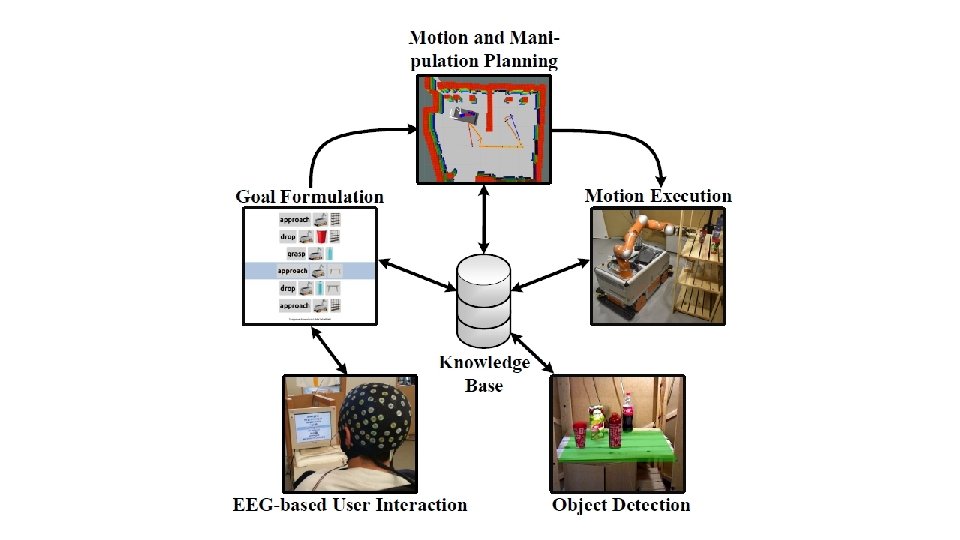
Key Components • BCI – brain control interface • non-invasive neuronal signal recording • co-adaptive deep learning for prediction • Goal Formulation Planning • Domain-independent planning • Adaptive graphical goal formulation interface • Dynamic knowledge base • Robot motion generation • Perception
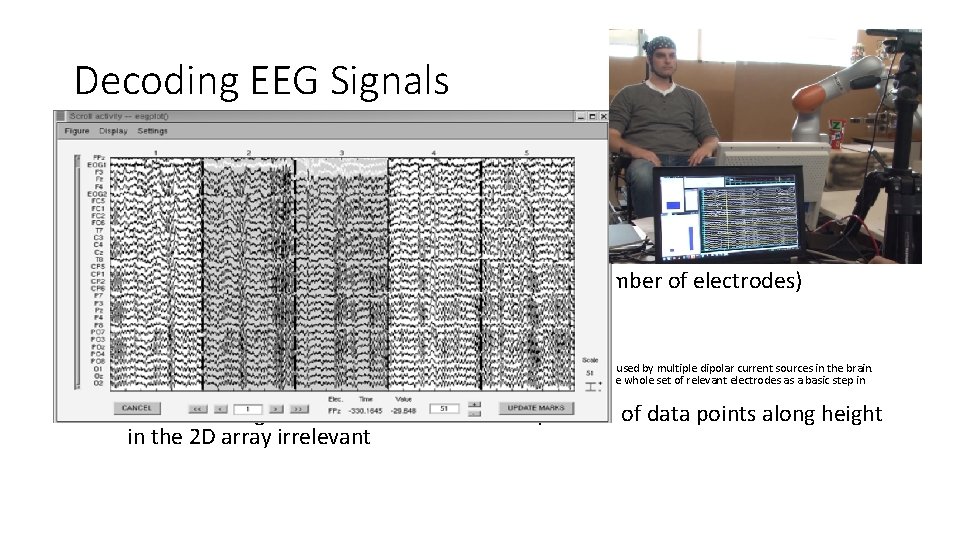
Decoding EEG Signals • Preprocessing • 40 Hz lowpass filtered EEG data • eliminates all signals below 40 Hz (mostly noise) • EEG data representation • 2 D array (width: number of time steps, height: number of electrodes) • M(i, j) – voltage of jth electrode at time i • Assumption: • EEG signals are assumed to approximate a linear superposition of spatially global voltage patterns caused by multiple dipolar current sources in the brain. Unmixing of these global patterns using a number of spatial filters is therefore typically applied to the whole set of relevant electrodes as a basic step in many successful examples of EEG decoding. • In short: using Conv 2 D makes the relative position of data points along height in the 2 D array irrelevant
Deep Learning --- Conv. Net • Targets— 5 mental tasks – 5 most discernible brain patterns • • • Sequential right-hand finger tapping: select Synchronous movement of all toes: go down Object rotation: go back Word generation: go up Rest: rest (do nothing) • Problems • What if a user is left handed (include that in the dataset and pray that the model can learn to generalize) • Noises in EEG: blinking, swallowing • During data collection: forbidden. During evaluation, a t-test is performed
Structure of Conv. Net - Input • Crops & Super-crop • Using shifted time windows (crops), crop size is ~2 s (522 samples (data points) @ 250 Hz) • Speed up training: 239 crops combined into one super-crop, generates 239 predictions • One training batch consists of 60 super-crops • What the heck is happening here? – Multi-crop prediction
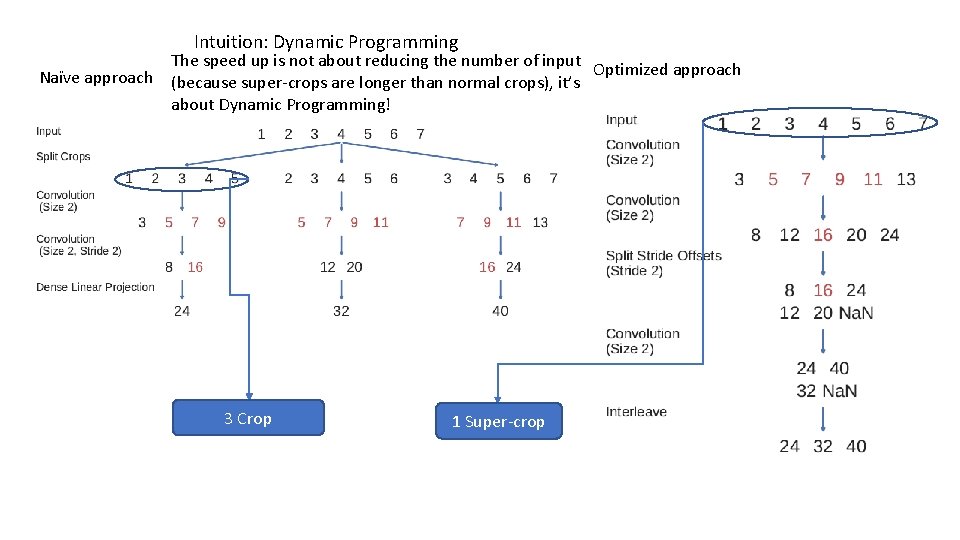
Intuition: Dynamic Programming Naïve approach The speed up is not about reducing the number of input Optimized approach (because super-crops are longer than normal crops), it’s about Dynamic Programming! 3 Crop 1 Super-crop
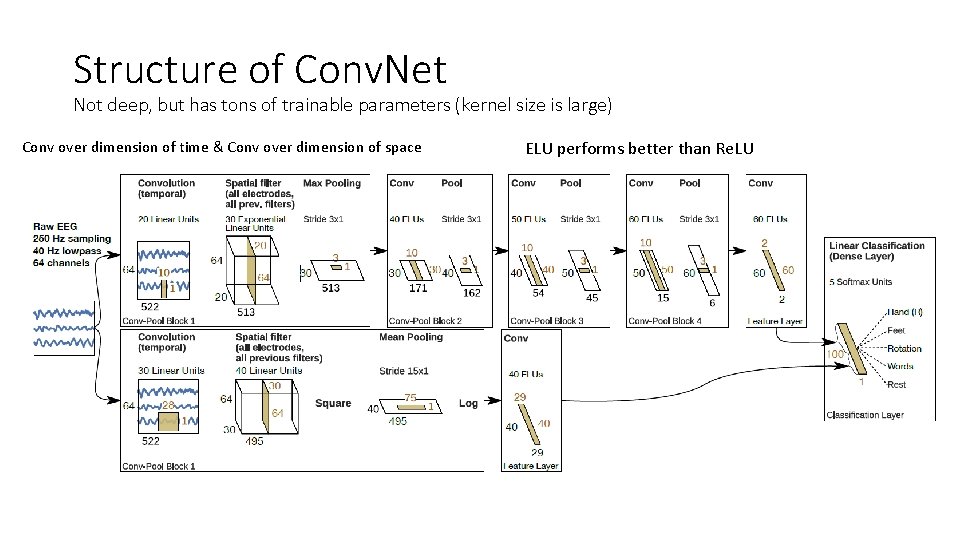
Structure of Conv. Net Not deep, but has tons of trainable parameters (kernel size is large) Conv over dimension of time & Conv over dimension of space ELU performs better than Re. LU
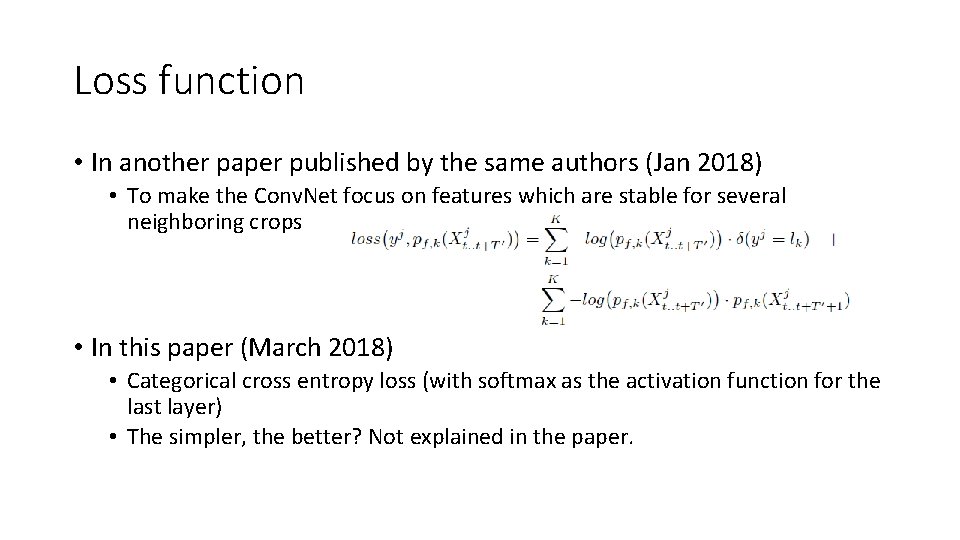
Loss function • In another paper published by the same authors (Jan 2018) • To make the Conv. Net focus on features which are stable for several neighboring crops • In this paper (March 2018) • Categorical cross entropy loss (with softmax as the activation function for the last layer) • The simpler, the better? Not explained in the paper.
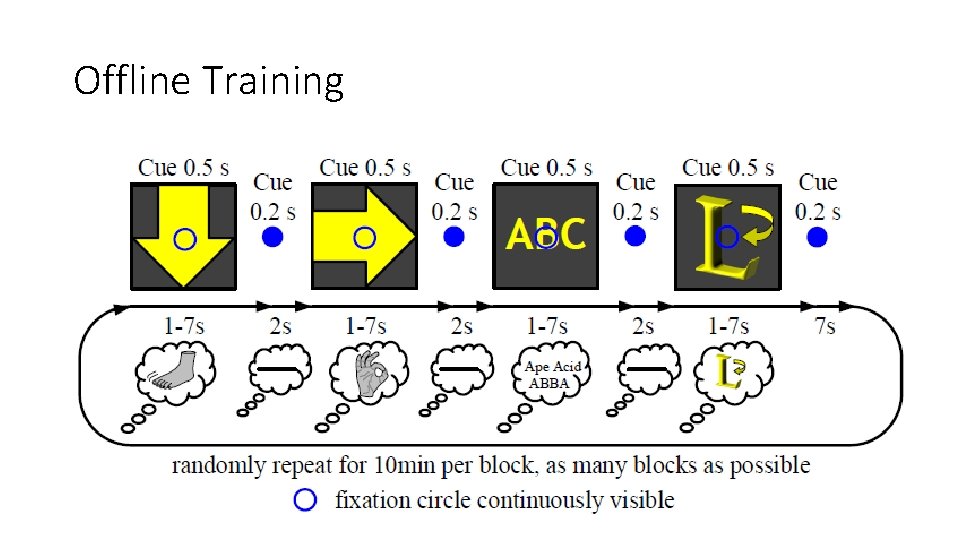
Offline Training • *Cued* • Adam optimizer, Learning rate 1 e-3, 100 epochs, 80/20 dataset split. 60 super-crops per batch. • To keep training realistic, the training process include a 20% error rate, i. e. on average every fifth action is purposefully erroneous. (I presume this paves way for online training when the labels of the data can be erroneous) • Collecting Data • • Participants are aware of not in control of GUI Minimize eye movements – participants are instructed to look at a fixation circle At the same time GUI action corresponding to the cued mental task is displayed The ‘rest’ mental task is implicitly taking place for 2 s after every other task to allow users to blink and swallow.
Online Co-Adaptive Training • *Cued* • Online: collecting data while training • Co-Adaptive: • Participants are aware of being in control of GUI and instructed to count the errors they make. Participants and Conv. Net adapt to each other. • ‘In doing so, the participants are aware of their performance, which potentially triggers learning processes and asserts their vigilance’ • Learning rate 1 e-4 • 45 super-crops per batch.
Online Training • The authors seem to have made a mistake here, it’s not really ‘training’, it should be called Online Evaluation • It’s used to evaluate online co-adaptive training • No cues for the mental tasks and let the participants select instructed goals in the GUI. • Participants have to confirm the execution of every planned action, BCI decoding accuracies for label-less instructed tasks are assessed by manually rating each decoding.
Online Decoding Pipeline • GPU Nvidia Titan Black 6 GB vram (trash GPU) • GPU server stores 600 samples until the decoding process is initiated • Subsequent decoding steps are performed whenever 125 new samples have accumulated • Predictions are stored in a ring buffer (max size: 14 predictions – 7 s of data). The algorithm extracts the mental task with the largest mean prediction. Buffer continues to grow if significance level is not reached • Two sample t-test is used to determine if the predictions significant deviate from 0. 05. Once significance is reached then action is performed and the ring buffer is cleared
Why the decoder works: the magic of ring-buffer • Two sample t-test: • Gives you a value to determine if two groups of data points have the same mean (regardless of variance). • Once the significance level is reached, the null hypothesis that the predictions have same mean is rejected. • The author is very obscure about how the operations are actually implemented. It should be their focus.
Goal Formulation Planning • Why do we need it • Whereas many automated planning approaches seek to find a sequence of actions to accomplish a predefined task, the intended goal in this paper is determined by the user. • By using a dynamic knowledge base that contains the current world state and referring expressions that describe objects based on their type and attributes • The knowledge base is able to adapt the set of possible goals to changes in the environment • 5 cameras in the experiment • PDDL files (describes the environment) are updated constantly
Planning Domain Definition Language • Planning domain D = (T, C_d, P, O) • T is the type system, i. e. a type hierarchy, e. g. furniture and robot are of super-type base, and bottle and cup. • C_d contains a set of domain constant symbols • P specifies attributes or relations between objects, e. g. position (describes the relation between objects of type vessel and base) • O defines the actions such as grasp and move • Problem Description ∏=(D, C_t, I) • D is the planning domain • C_t are the additional task-dependent constant symbols • I is the initial state, e. g. cup 01 of type cup and relation between cup 01 and shelf 01 • Example • Action(put, x, y) ^ cup(x) ^ shelf(y) • Just like Lambda Expression
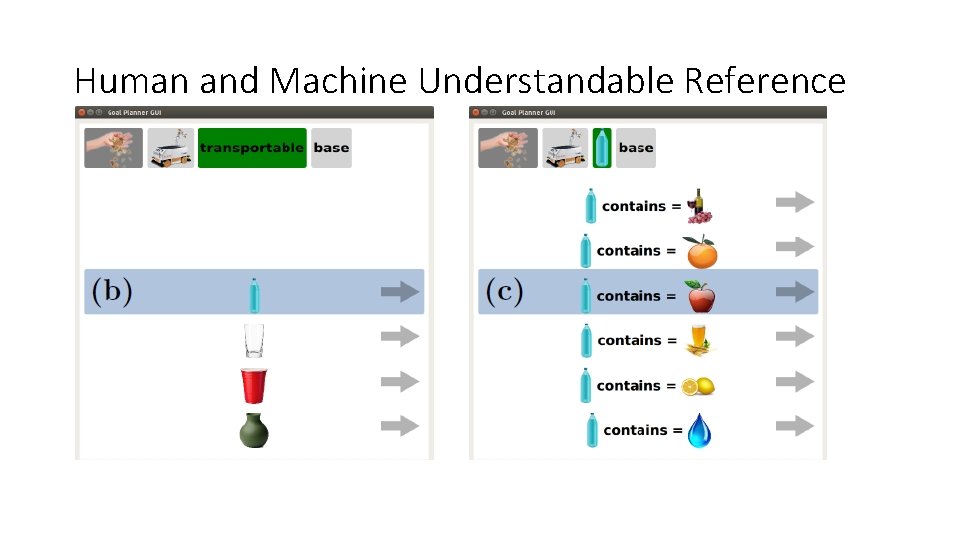
Human and Machine Understandable Reference • Building a reference: Which cup? Which shelf? • E. g. We want to refer to cup 01 by cup(x) ^contains(x, water) • Given a set (denote as A) of sets: • green cup(cup_01, cup_02), cup with water(cup_02, cup_03), cup on the floor(cup_01, cup_03)…. • Find a subset of A that has no intersection among any pairs of them • NP-Hard • Domain Independent: no ‘hard-code’ • How to test it? Simulation. • Solution: Greedy Selection + Reference Number + Random Selection
Robot Motion Generating • Navigation planning of the mobile base, the authors used the sampling-based planning framework BI^2 RRT. • Probabilistic roadmap planner to realize pick, place, pour and drink motions • Sample poses in the task space which contains all possible end-effector poses. • Poses are then connected by edges based on a user-defined radius • Apply an A^* based graph search to find an optimal path between two nodes using Euclidean distance as the cost and heuristic function • Used robot’s Jacobian matrix to compute the joint velocities based on endeffector velocities. • Collision checks ensures there are no undesired contacts between the environment and the robot.
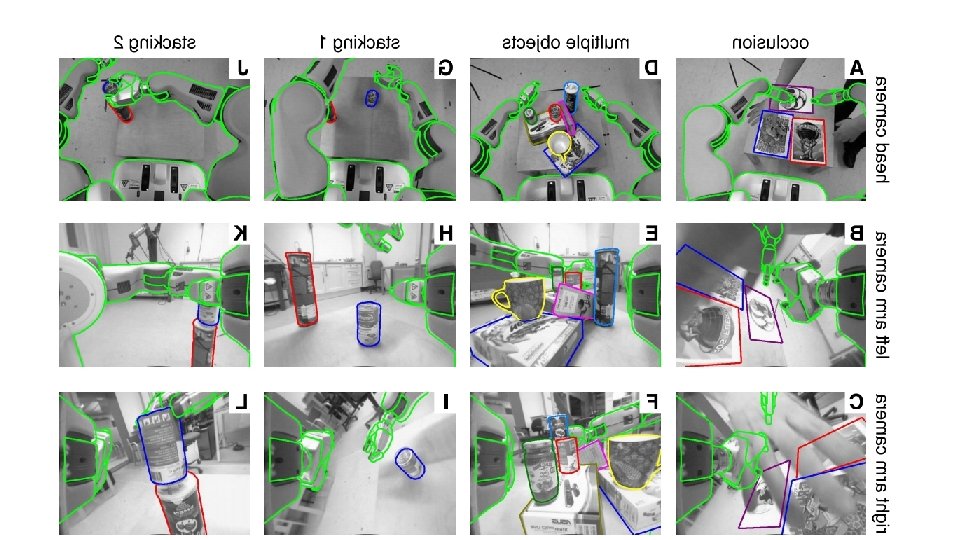
Perception • Object detection: using Sim. Track • Tracking objects in realtime • Knowledge base provides data storage (of PDDL files) and establishes the communication by a domain and problem description based PDDL files • The poses and locations are stored and continuously updated in the knowledge base
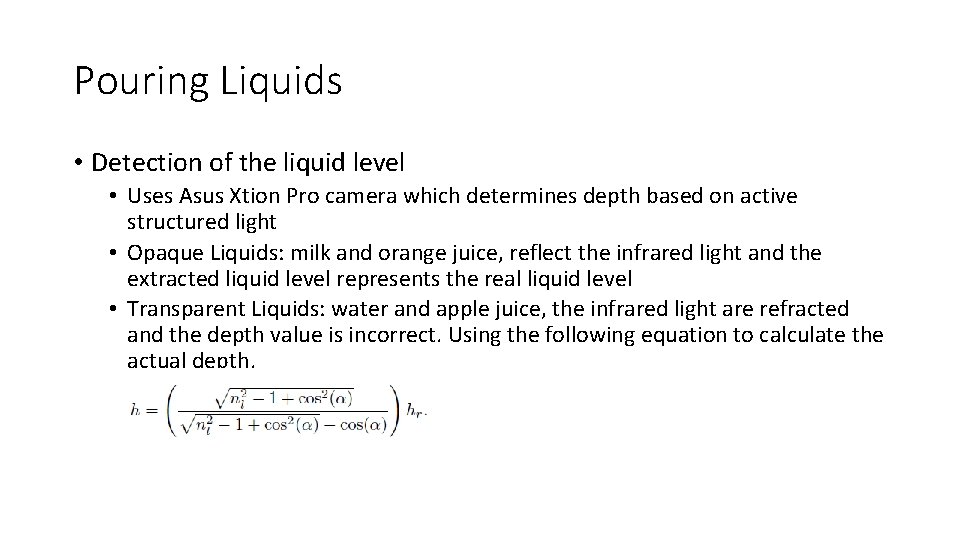
Pouring Liquids • Detection of the liquid level • Uses Asus Xtion Pro camera which determines depth based on active structured light • Opaque Liquids: milk and orange juice, reflect the infrared light and the extracted liquid level represents the real liquid level • Transparent Liquids: water and apple juice, the infrared light are refracted and the depth value is incorrect. Using the following equation to calculate the actual depth.
Face Detection • Segment the image based on the output of a face detection algorithm that uses Haar cascades • Detect the position of the mouth of the user, considering only the obtained image batch. The paper additionally considered the position of the eyes in order to obtain a robust estimation of the face orientation, hence compensating for changing angles of the head • Result: Not so good, needs the user to adjust his/her head.
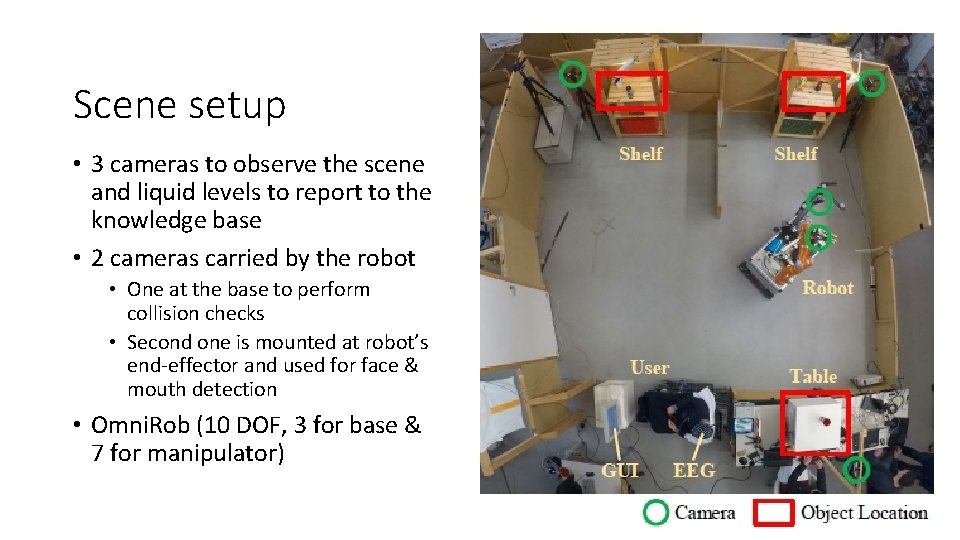
Scene setup • 3 cameras to observe the scene and liquid levels to report to the knowledge base • 2 cameras carried by the robot • One at the base to perform collision checks • Second one is mounted at robot’s end-effector and used for face & mouth detection • Omni. Rob (10 DOF, 3 for base & 7 for manipulator)
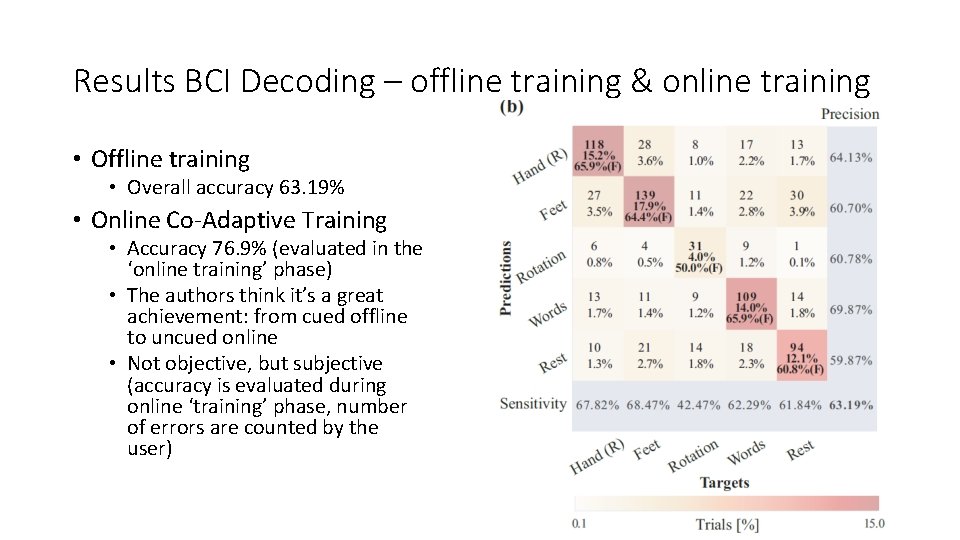
Results BCI Decoding – offline training & online training • Offline training • Overall accuracy 63. 19% • Online Co-Adaptive Training • Accuracy 76. 9% (evaluated in the ‘online training’ phase) • The authors think it’s a great achievement: from cued offline to uncued online • Not objective, but subjective (accuracy is evaluated during online ‘training’ phase, number of errors are counted by the user)
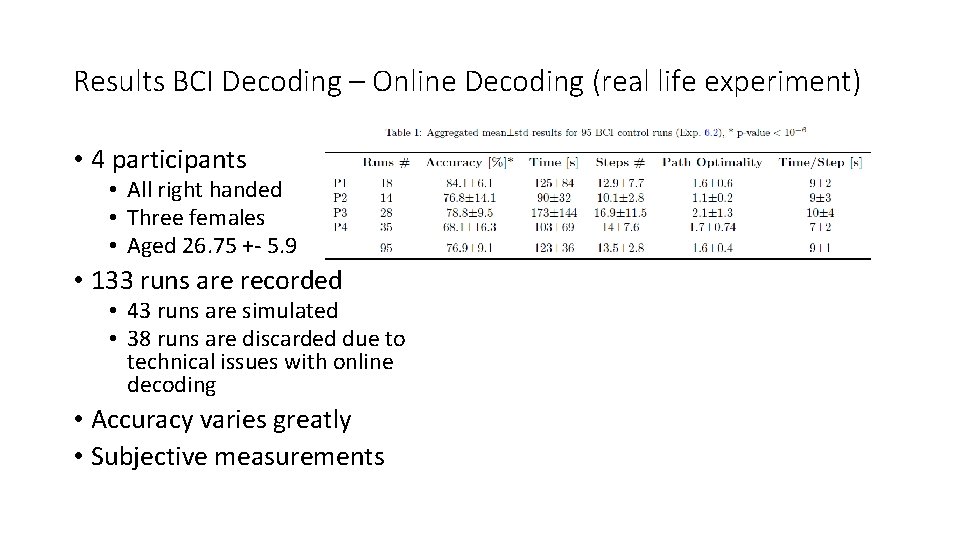
Results BCI Decoding – Online Decoding (real life experiment) • 4 participants • All right handed • Three females • Aged 26. 75 +- 5. 9 • 133 runs are recorded • 43 runs are simulated • 38 runs are discarded due to technical issues with online decoding • Accuracy varies greatly • Subjective measurements
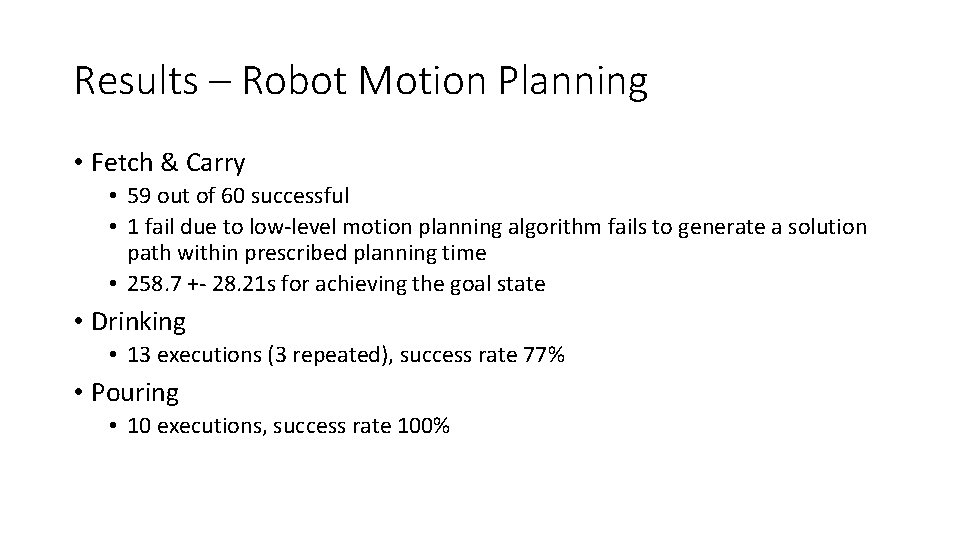
Results – Robot Motion Planning • Fetch & Carry • 59 out of 60 successful • 1 fail due to low-level motion planning algorithm fails to generate a solution path within prescribed planning time • 258. 7 +- 28. 21 s for achieving the goal state • Drinking • 13 executions (3 repeated), success rate 77% • Pouring • 10 executions, success rate 100%

Videos • https: //www. youtube. com/watch? v=Ccor_RNHUAA
Reference • EEGLAB: an open source toolbox for analysis of single-trial EEG dynamics including independent component analysis • Deep learning with convolutional neural networks for brain mapping and decoding of movement-related information from the human EEG • Deep Learning Based BCI Control of a Robotic Service Assistant Using Intelligent Goal Formulation • Sim. Track: A Simulation-based Framework for Scalable Real-time Object Pose Detection and Tracking
- Slides: 27