
Deep Inelastic Scattering at High Energy Max Klein
![Deep Inelastic Scattering [eh e’X] e+e HERA-LHe. C-FCC-eh: finest microscopes with resolution varying like](https://slidetodoc.com/presentation_image/35ed6455c2f5bb5a3e898ccaa8e22906/image-3.jpg "Deep Inelastic Scattering [eh e’X] e+e HERA-LHe. C-FCC-eh: finest microscopes with resolution varying like")
![Deep Inelastic Scattering [eh e’X] e+e HERA-LHe. C-FCC-eh: finest microscopes with resolution varying like](https://slidetodoc.com/presentation_image/35ed6455c2f5bb5a3e898ccaa8e22906/image-33.jpg "Deep Inelastic Scattering [eh e’X] e+e HERA-LHe. C-FCC-eh: finest microscopes with resolution varying like")
- Slides: 48
Deep Inelastic Scattering at High Energy Max Klein University of Liverpool For the ep/e. A study group FCC Meeting. 14. 2. 2014 University of Geneva http: //cern. ch/lhec 60 Ge. V x 7 Te. V (LHC) 60 … 175 Ge. V x 50 Te. V (FCC-h)
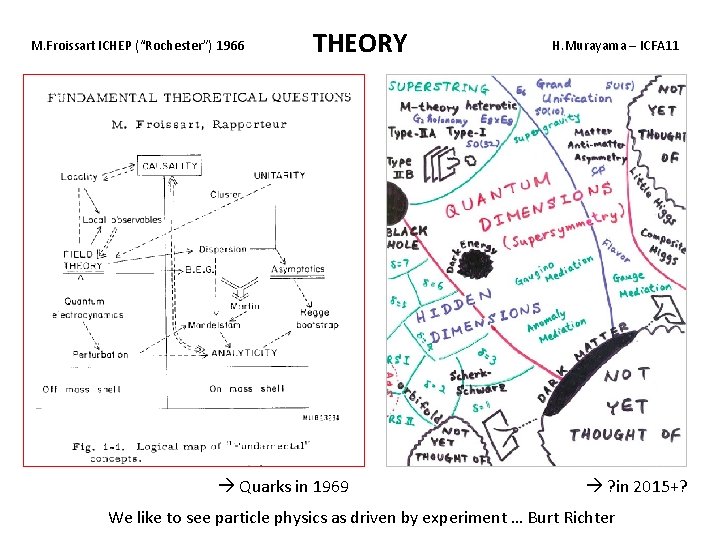
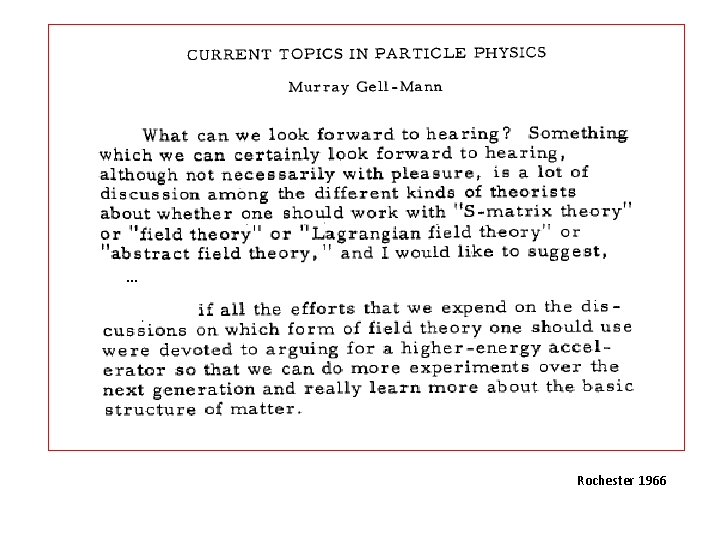
M. Froissart ICHEP (“Rochester”) 1966 THEORY Quarks in 1969 H. Murayama – ICFA 11 ? in 2015+? We like to see particle physics as driven by experiment … Burt Richter
Deep Inelastic Scattering [eh e’X] e+e HERA-LHe. C-FCC-eh: finest microscopes with resolution varying like 1/√Q 2 eh Finite p Radius X hh Parton momentum fixed by electron kinematics Stanford Quarks SLAC FNAL CERN Quark Gluon Dynamics Incl. NC (γ, Z) and CC (W±) independent of hadronisation Rigorous theory: Operator expansion (lightcone) HERA LHe. C Parton momentum distributions to be measured in DIS ? FCC-he Collider- HERA: yh=ye : Redundant kinematics electromagnetic radius
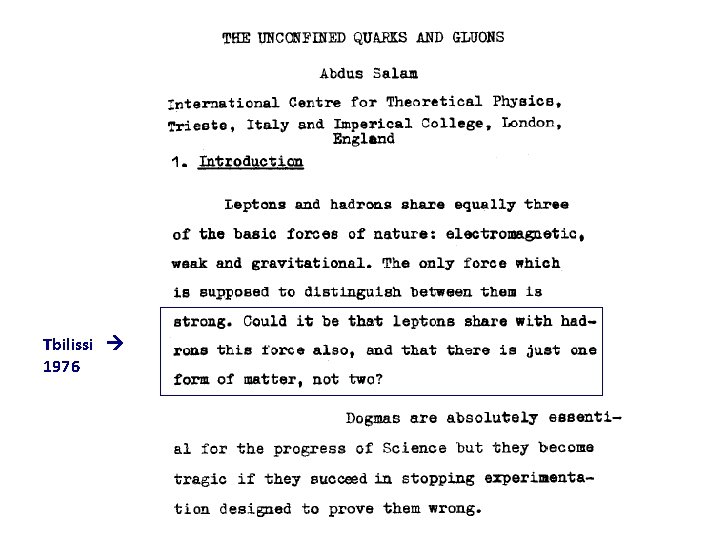
Tbilissi 1976
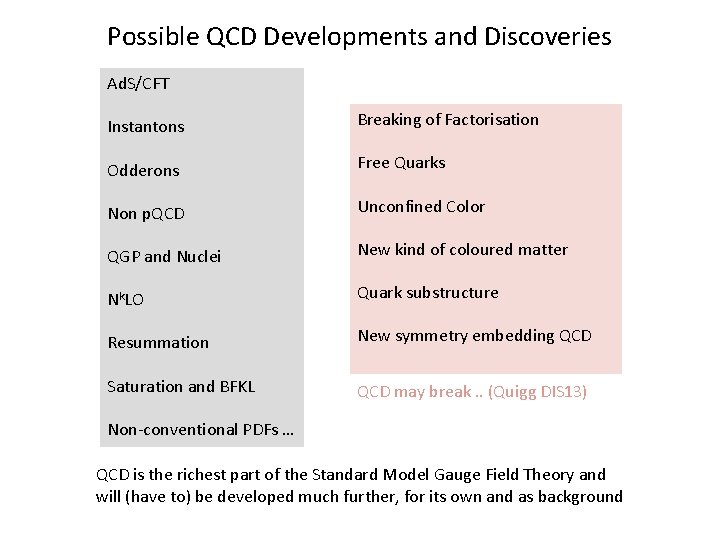
Possible QCD Developments and Discoveries Ad. S/CFT Instantons Breaking of Factorisation Odderons Free Quarks Non p. QCD Unconfined Color QGP and Nuclei New kind of coloured matter Nk. LO Quark substructure Resummation New symmetry embedding QCD Saturation and BFKL QCD may break. . (Quigg DIS 13) Non-conventional PDFs … QCD is the richest part of the Standard Model Gauge Field Theory and will (have to) be developed much further, for its own and as background
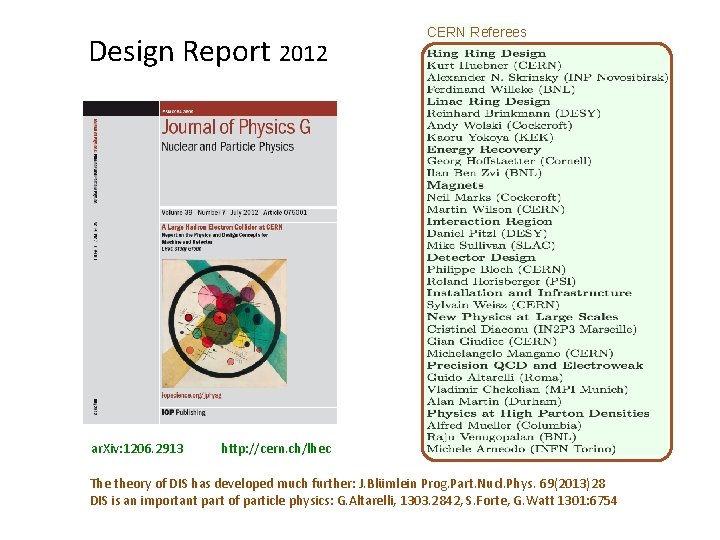
Design Report 2012 CERN Referees ar. Xiv: 1206. 2913 http: //cern. ch/lhec The theory of DIS has developed much further: J. Blümlein Prog. Part. Nucl. Phys. 69(2013)28 DIS is an important part of particle physics: G. Altarelli, 1303. 2842, S. Forte, G. Watt 1301: 6754
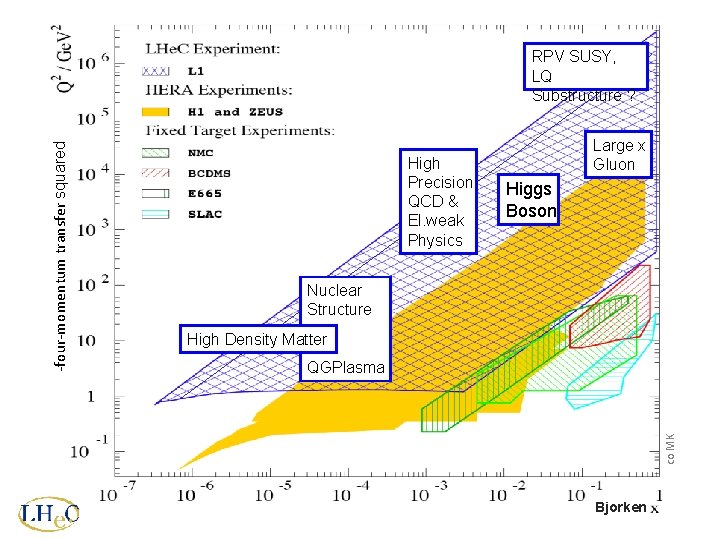
High Precision QCD & El. weak Physics RPV SUSY, LQ Substructure ? Large x Gluon Higgs Boson Nuclear Structure High Density Matter QGPlasma co MK -four-momentum transfer squared Physics and Range Bjorken
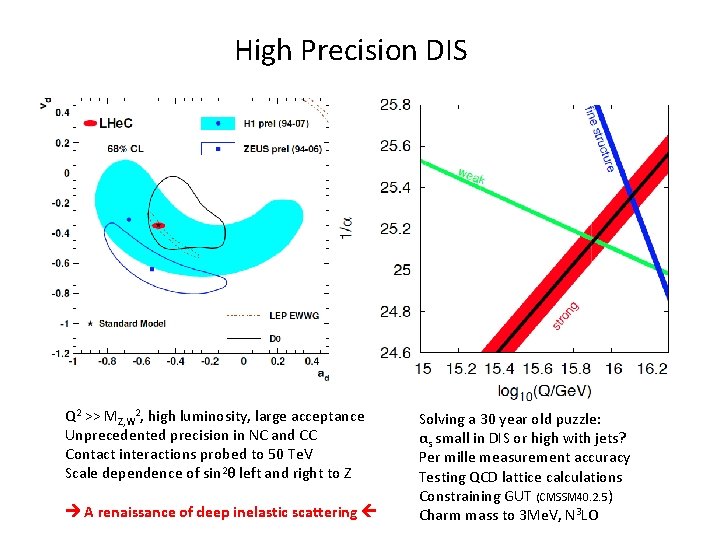
High Precision DIS Q 2 >> MZ, W 2, high luminosity, large acceptance Unprecedented precision in NC and CC Contact interactions probed to 50 Te. V Scale dependence of sin 2θ left and right to Z A renaissance of deep inelastic scattering Solving a 30 year old puzzle: αs small in DIS or high with jets? Per mille measurement accuracy Testing QCD lattice calculations Constraining GUT (CMSSM 40. 2. 5) Charm mass to 3 Me. V, N 3 LO
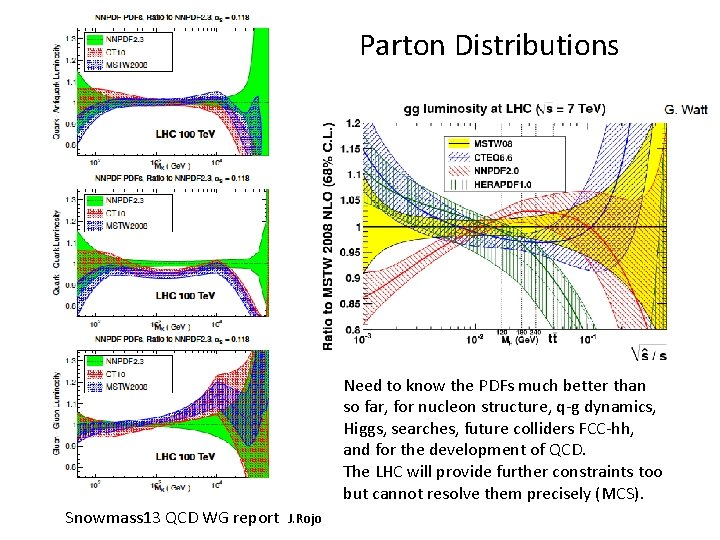
Parton Distributions Need to know the PDFs much better than so far, for nucleon structure, q-g dynamics, Higgs, searches, future colliders FCC-hh, and for the development of QCD. The LHC will provide further constraints too but cannot resolve them precisely (MCS). Snowmass 13 QCD WG report J. Rojo
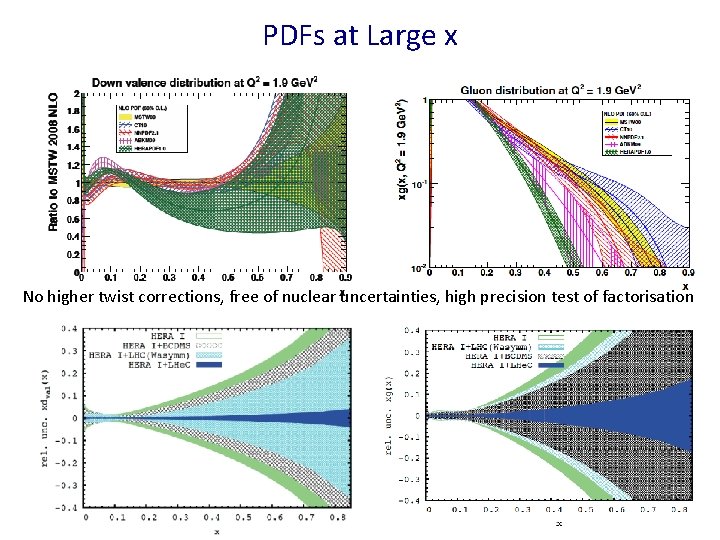
PDFs at Large x No higher twist corrections, free of nuclear uncertainties, high precision test of factorisation
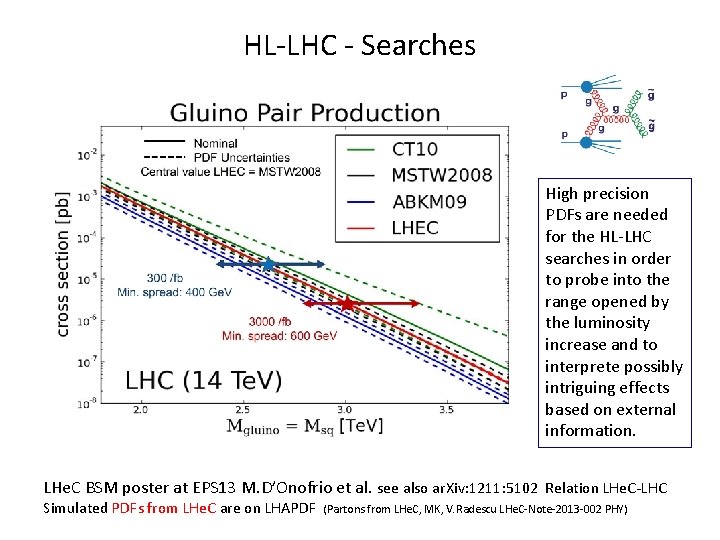
HL-LHC - Searches High precision PDFs are needed for the HL-LHC searches in order to probe into the range opened by the luminosity increase and to interprete possibly intriguing effects based on external information. LHe. C BSM poster at EPS 13 M. D’Onofrio et al. see also ar. Xiv: 1211: 5102 Relation LHe. C-LHC Simulated PDFs from LHe. C are on LHAPDF (Partons from LHe. C, MK, V. Radescu LHe. C-Note-2013 -002 PHY)
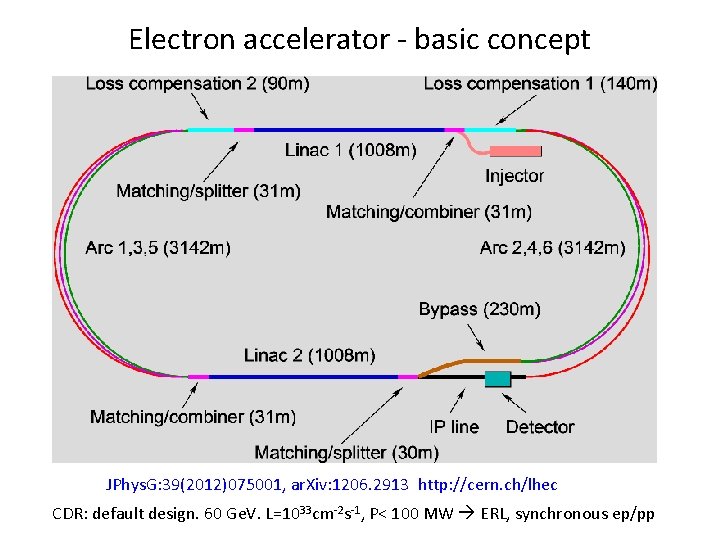
Electron accelerator - basic concept JPhys. G: 39(2012)075001, ar. Xiv: 1206. 2913 http: //cern. ch/lhec CDR: default design. 60 Ge. V. L=1033 cm-2 s-1, P< 100 MW ERL, synchronous ep/pp
http: //cern. ch/lhec Present (May 13) - LHe. C Study group and CDR authors Thanks to all above, to CERN and the IAC, and for the rush to this kickoff special thanks to Alessandra Valoni, Monica D’Onofrio, Uta Klein, Voica Radescu and a similar number of men
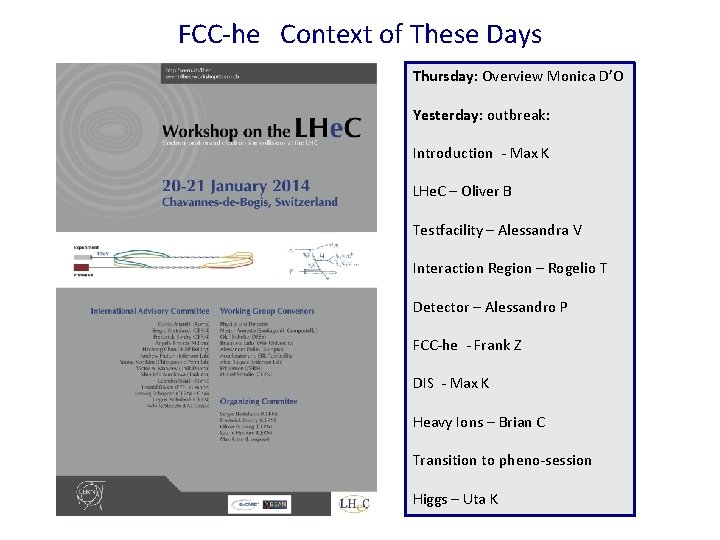
FCC-he Context of These Days Thursday: Overview Monica D’O Yesterday: outbreak: Introduction - Max K LHe. C – Oliver B Testfacility – Alessandra V Interaction Region – Rogelio T Detector – Alessandro P FCC-he - Frank Z DIS - Max K Heavy Ions – Brian C Transition to pheno-session Higgs – Uta K
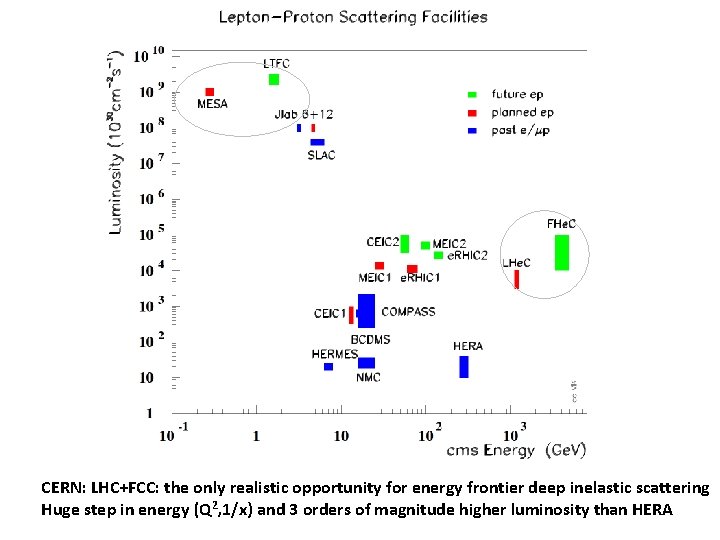
CERN: LHC+FCC: the only realistic opportunity for energy frontier deep inelastic scattering Huge step in energy (Q 2, 1/x) and 3 orders of magnitude higher luminosity than HERA
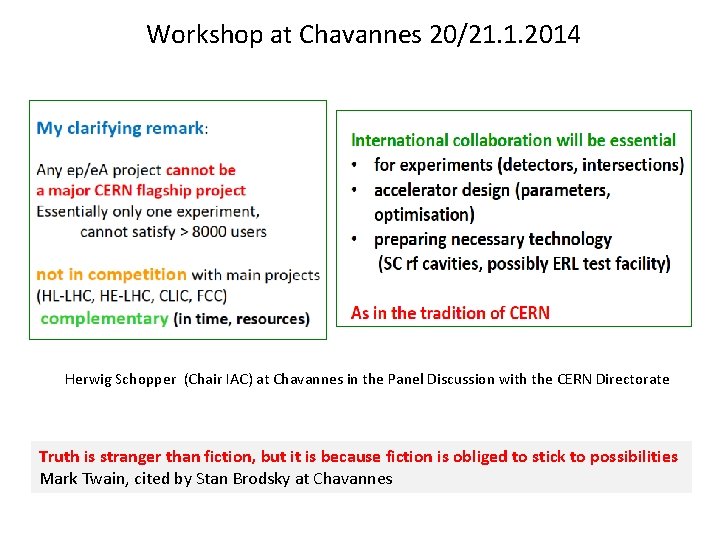
Workshop at Chavannes 20/21. 1. 2014 Herwig Schopper (Chair IAC) at Chavannes in the Panel Discussion with the CERN Directorate Truth is stranger than fiction, but it is because fiction is obliged to stick to possibilities Mark Twain, cited by Stan Brodsky at Chavannes
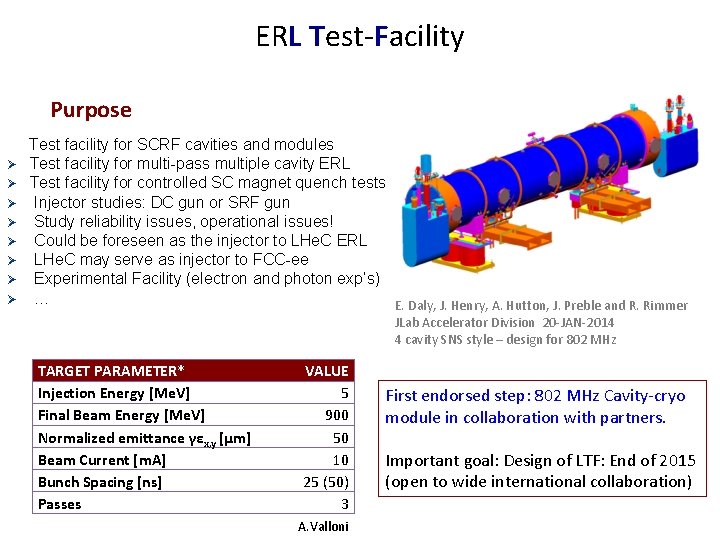
ERL Test-Facility Purpose Ø Ø Ø Ø Test facility for SCRF cavities and modules Test facility for multi-pass multiple cavity ERL Test facility for controlled SC magnet quench tests Injector studies: DC gun or SRF gun Study reliability issues, operational issues! Could be foreseen as the injector to LHe. C ERL LHe. C may serve as injector to FCC-ee Experimental Facility (electron and photon exp’s) … E. Daly, J. Henry, A. Hutton, J. Preble and R. Rimmer JLab Accelerator Division 20 -JAN-2014 4 cavity SNS style – design for 802 MHz TARGET PARAMETER* Injection Energy [Me. V] Final Beam Energy [Me. V] Normalized emittance γεx, y [μm] Beam Current [m. A] Bunch Spacing [ns] Passes VALUE 5 900 50 10 25 (50) 3 A. Valloni First endorsed step: 802 MHz Cavity-cryo module in collaboration with partners. Important goal: Design of LTF: End of 2015 (open to wide international collaboration)
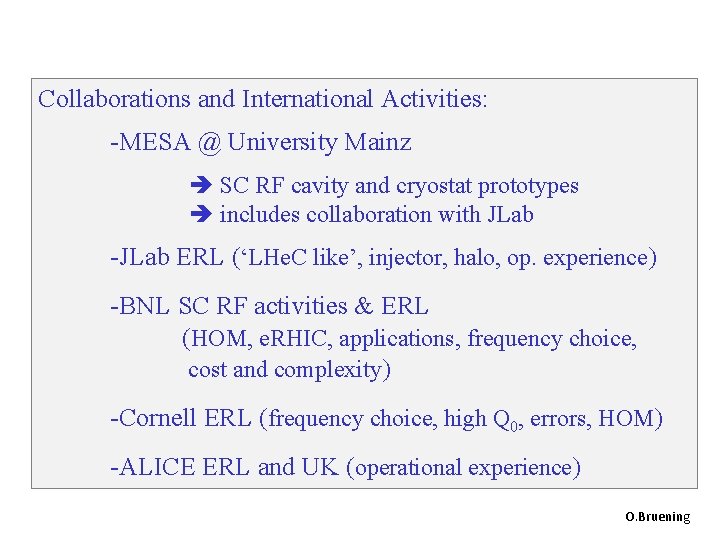
Collaborations and International Activities: -MESA @ University Mainz SC RF cavity and cryostat prototypes includes collaboration with JLab -JLab ERL (‘LHe. C like’, injector, halo, op. experience) -BNL SC RF activities & ERL (HOM, e. RHIC, applications, frequency choice, cost and complexity) -Cornell ERL (frequency choice, high Q 0, errors, HOM) -ALICE ERL and UK (operational experience) O. Bruening
Introduction
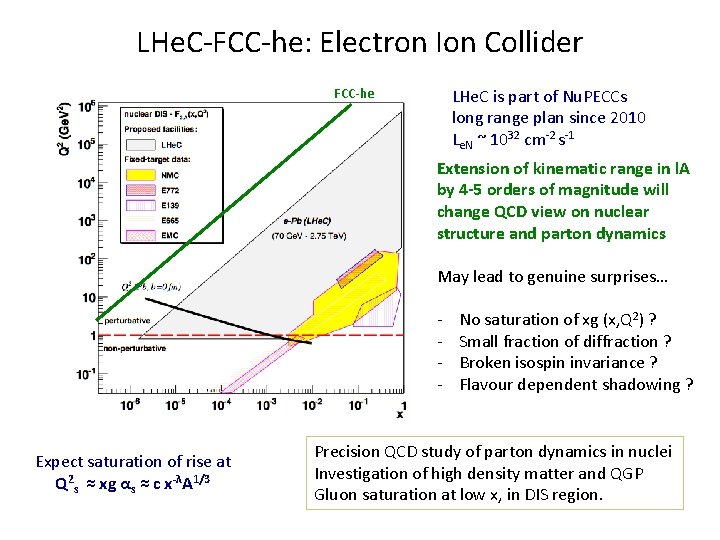
LHe. C-FCC-he: Electron Ion Collider LHe. C is part of Nu. PECCs long range plan since 2010 Le. N ~ 1032 cm-2 s-1 FCC-he Extension of kinematic range in l. A by 4 -5 orders of magnitude will change QCD view on nuclear structure and parton dynamics May lead to genuine surprises… - Expect saturation of rise at Q 2 s ≈ xg αs ≈ c x-λA 1/3 No saturation of xg (x, Q 2) ? Small fraction of diffraction ? Broken isospin invariance ? Flavour dependent shadowing ? Precision QCD study of parton dynamics in nuclei Investigation of high density matter and QGP Gluon saturation at low x, in DIS region.
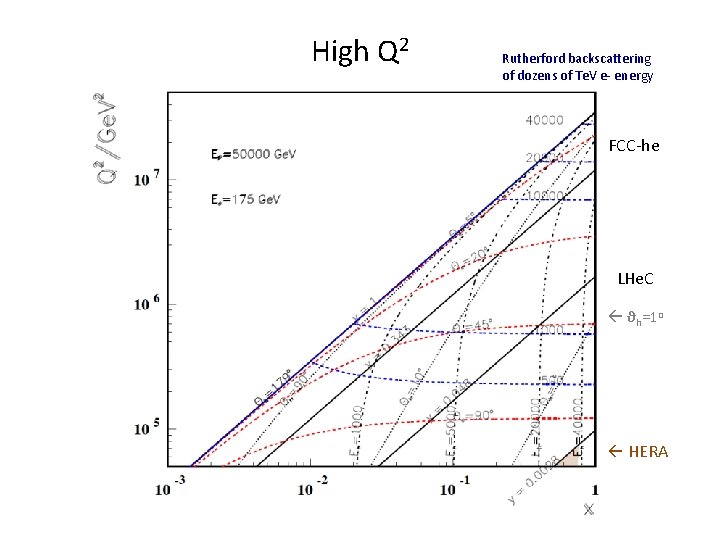
High Q 2 Rutherford backscattering of dozens of Te. V e- energy FCC-he LHe. C ϑh=1 o HERA
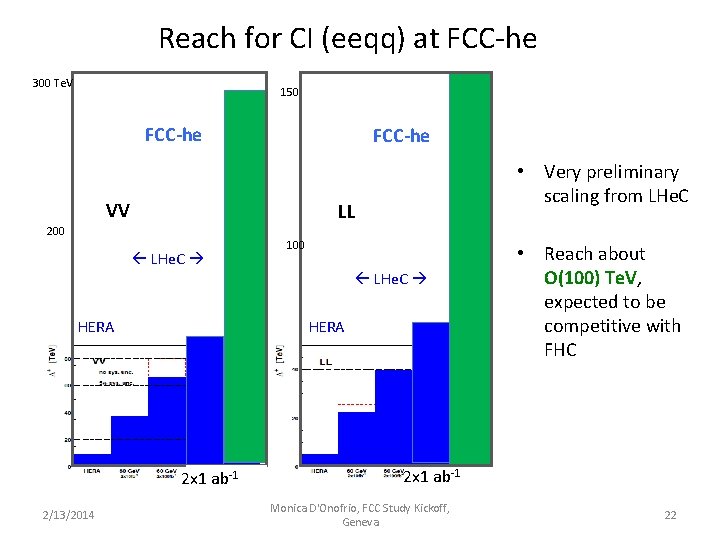
Reach for CI (eeqq) at FCC-he 300 Te. V 150 FCC-he VV • Very preliminary scaling from LHe. C LL 200 LHe. C 100 - LHe. C HERA 2 x 1 ab-1 2/13/2014 • Reach about O(100) Te. V, expected to be competitive with FHC 2 x 1 ab-1 Monica D'Onofrio, FCC Study Kickoff, Geneva 22
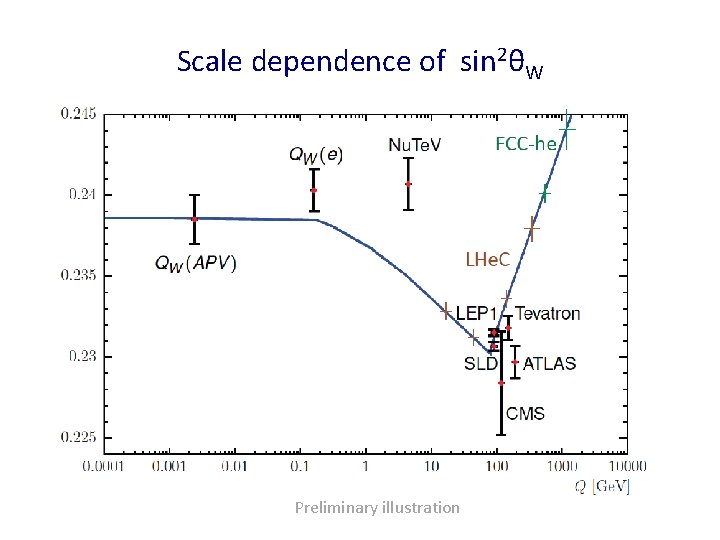
Scale dependence of sin 2θW Preliminary illustration
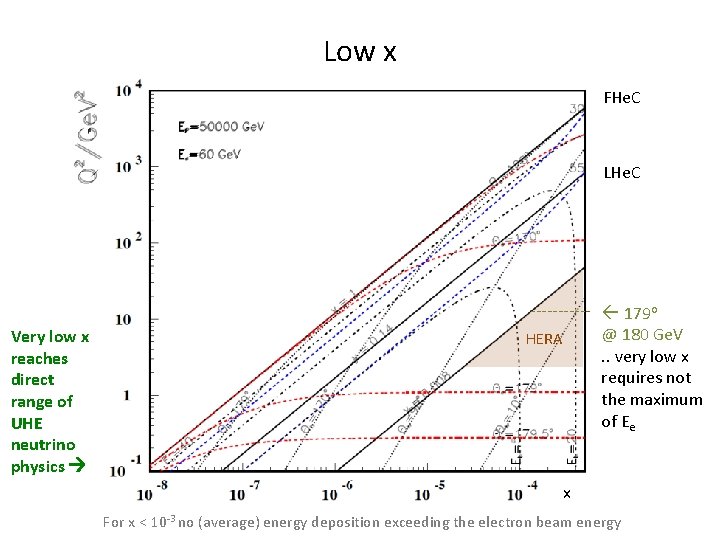
Low x FHe. C LHe. C Very low x reaches direct range of UHE neutrino physics ------ 179 o @ 180 Ge. V HERA. . very low x requires not the maximum of Ee x For x < 10 -3 no (average) energy deposition exceeding the electron beam energy
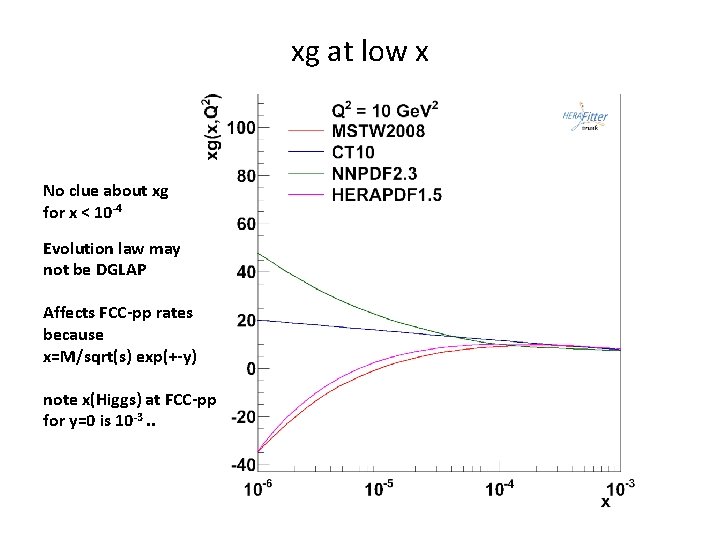
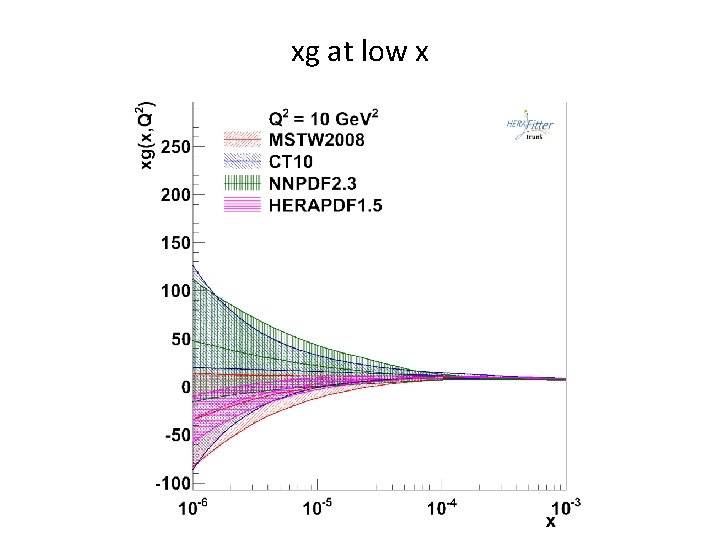
xg at low x No clue about xg for x < 10 -4 Evolution law may not be DGLAP Affects FCC-pp rates because x=M/sqrt(s) exp(+-y) note x(Higgs) at FCC-pp for y=0 is 10 -3. .
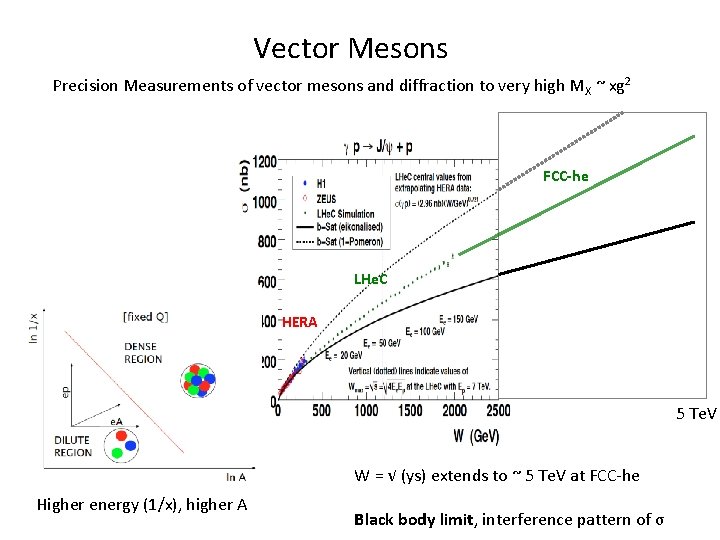
Vector Mesons Precision Measurements of vector mesons and diffraction to very high M X ~ xg 2 FCC-he LHe. C HERA 5 Te. V W = √ (ys) extends to ~ 5 Te. V at FCC-he Higher energy (1/x), higher A Black body limit, interference pattern of σ
Introduction
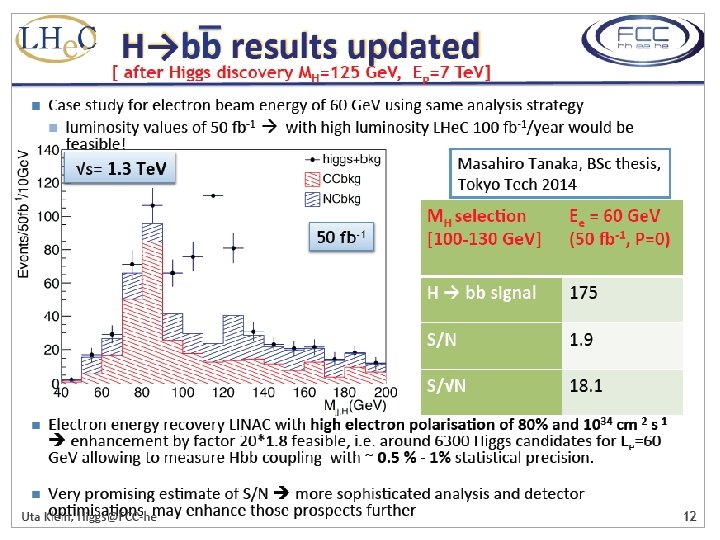
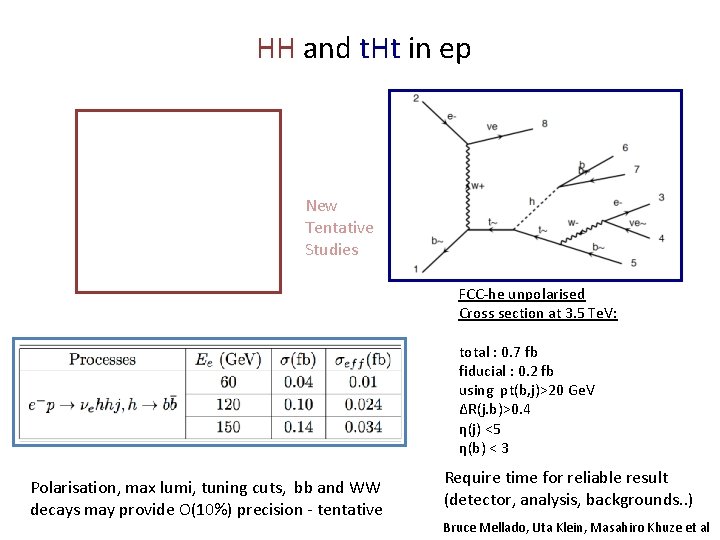
HH and t. Ht in ep New Tentative Studies FCC-he unpolarised Cross section at 3. 5 Te. V: total : 0. 7 fb fiducial : 0. 2 fb using pt(b, j)>20 Ge. V ΔR(j. b)>0. 4 η(j) <5 η(b) < 3 Polarisation, max lumi, tuning cuts, bb and WW decays may provide O(10%) precision - tentative Require time for reliable result (detector, analysis, backgrounds. . ) Bruce Mellado, Uta Klein, Masahiro Khuze et al
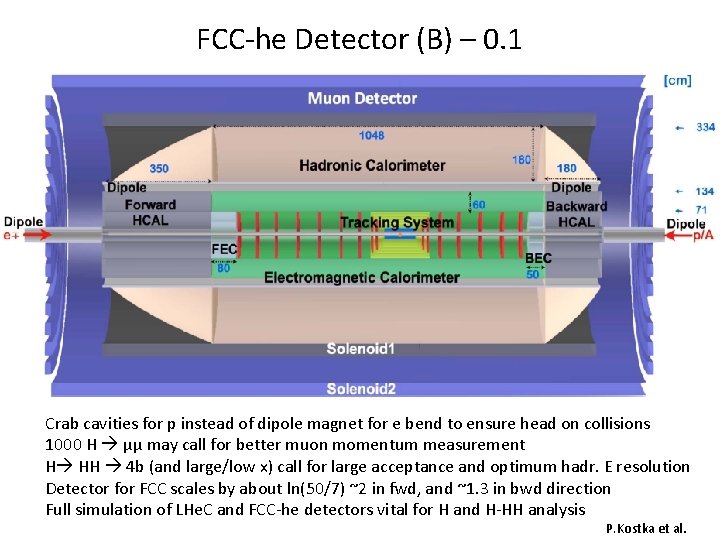
FCC-he Detector (B) – 0. 1 Crab cavities for p instead of dipole magnet for e bend to ensure head on collisions 1000 H μμ may call for better muon momentum measurement H HH 4 b (and large/low x) call for large acceptance and optimum hadr. E resolution Detector for FCC scales by about ln(50/7) ~2 in fwd, and ~1. 3 in bwd direction Full simulation of LHe. C and FCC-he detectors vital for H and H-HH analysis P. Kostka et al.
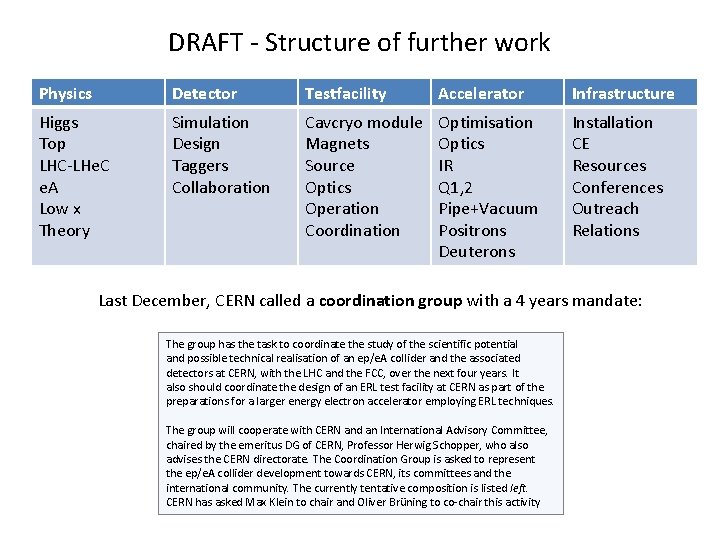
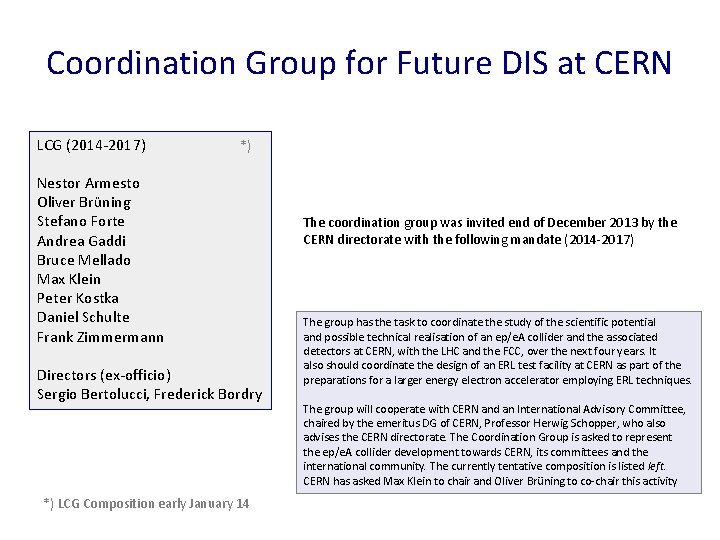
DRAFT - Structure of further work Physics Detector Testfacility Accelerator Infrastructure Higgs Top LHC-LHe. C e. A Low x Theory Simulation Design Taggers Collaboration Cavcryo module Magnets Source Optics Operation Coordination Optimisation Optics IR Q 1, 2 Pipe+Vacuum Positrons Deuterons Installation CE Resources Conferences Outreach Relations Last December, CERN called a coordination group with a 4 years mandate: The group has the task to coordinate the study of the scientific potential and possible technical realisation of an ep/e. A collider and the associated detectors at CERN, with the LHC and the FCC, over the next four years. It also should coordinate the design of an ERL test facility at CERN as part of the preparations for a larger energy electron accelerator employing ERL techniques. The group will cooperate with CERN and an International Advisory Committee, chaired by the emeritus DG of CERN, Professor Herwig Schopper, who also advises the CERN directorate. The Coordination Group is asked to represent the ep/e. A collider development towards CERN, its committees and the international community. The currently tentative composition is listed left. CERN has asked Max Klein to chair and Oliver Brüning to co-chair this activity
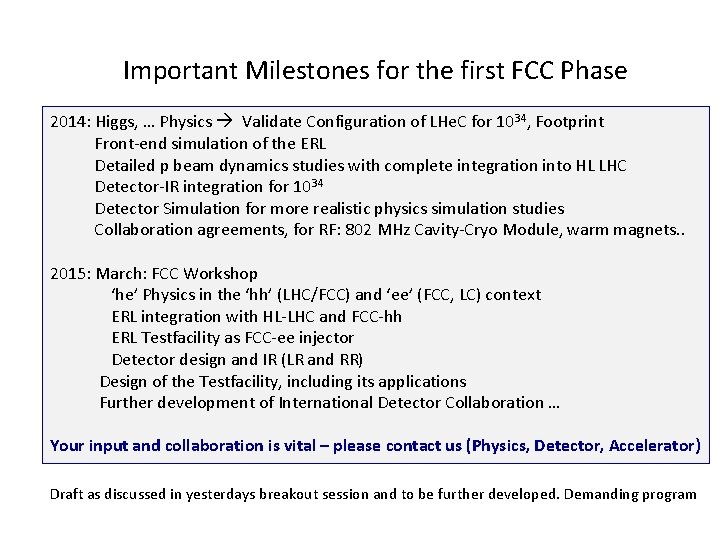
Important Milestones for the first FCC Phase 2014: Higgs, … Physics Validate Configuration of LHe. C for 1034, Footprint Front-end simulation of the ERL Detailed p beam dynamics studies with complete integration into HL LHC Detector-IR integration for 1034 Detector Simulation for more realistic physics simulation studies Collaboration agreements, for RF: 802 MHz Cavity-Cryo Module, warm magnets. . 2015: March: FCC Workshop ‘he’ Physics in the ‘hh’ (LHC/FCC) and ‘ee’ (FCC, LC) context ERL integration with HL-LHC and FCC-hh ERL Testfacility as FCC-ee injector Detector design and IR (LR and RR) Design of the Testfacility, including its applications Further development of International Detector Collaboration … Your input and collaboration is vital – please contact us (Physics, Detector, Accelerator) Draft as discussed in yesterdays breakout session and to be further developed. Demanding program
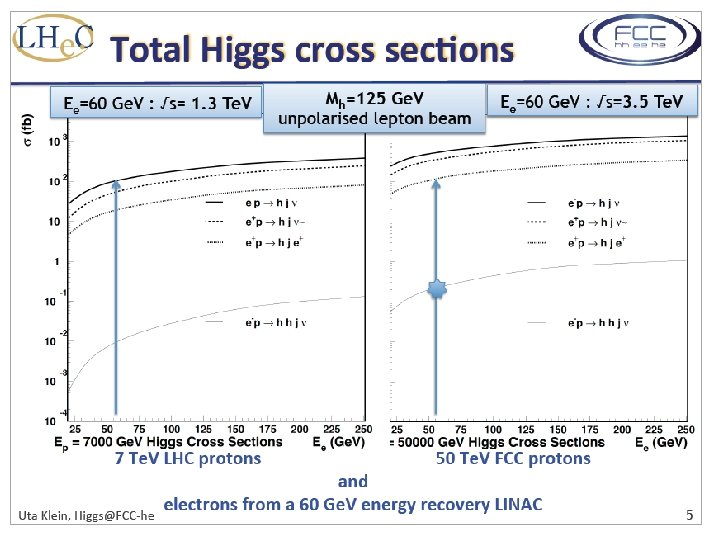
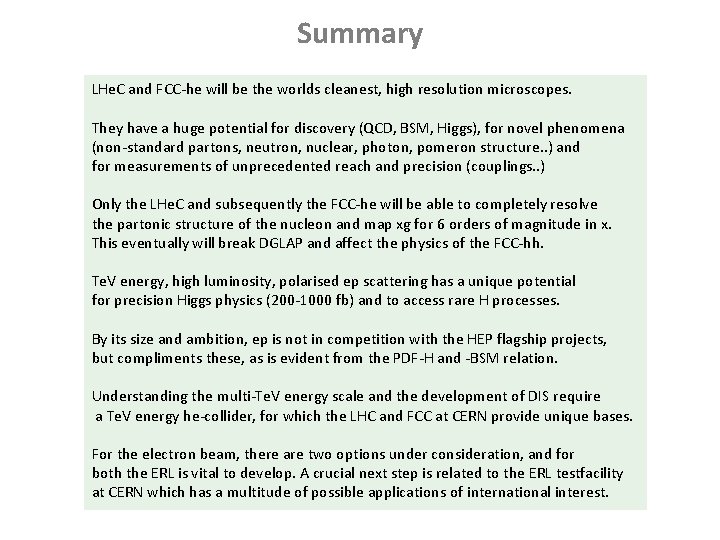
Summary LHe. C and FCC-he will be the worlds cleanest, high resolution microscopes. They have a huge potential for discovery (QCD, BSM, Higgs), for novel phenomena (non-standard partons, neutron, nuclear, photon, pomeron structure. . ) and for measurements of unprecedented reach and precision (couplings. . ) Only the LHe. C and subsequently the FCC-he will be able to completely resolve the partonic structure of the nucleon and map xg for 6 orders of magnitude in x. This eventually will break DGLAP and affect the physics of the FCC-hh. Te. V energy, high luminosity, polarised ep scattering has a unique potential for precision Higgs physics (200 -1000 fb) and to access rare H processes. By its size and ambition, ep is not in competition with the HEP flagship projects, but compliments these, as is evident from the PDF-H and -BSM relation. Understanding the multi-Te. V energy scale and the development of DIS require a Te. V energy he-collider, for which the LHC and FCC at CERN provide unique bases. For the electron beam, there are two options under consideration, and for both the ERL is vital to develop. A crucial next step is related to the ERL testfacility at CERN which has a multitude of possible applications of international interest.
Deep Inelastic Scattering [eh e’X] e+e HERA-LHe. C-FCC-eh: finest microscopes with resolution varying like 1/√Q 2 eh Finite p Radius X Parton momentum fixed by electron kinematics Incl. NC (γ, Z) and CC (W±) independent of hadronisation Rigorous theory: Operator expansion (lightcone) Parton momentum distributions to be measured in DIS Quarks SLAC FNAL Quark Gluon Dynamics g rin tte ude sca it lp agn of m r rs of te ea rs at 0 y de o m 10 5 or r int epe de hh Stanford CERN HERA LHe. C ? FCC-he Collider- HERA: yh=ye : Redundant kinematics electromagnetic radius
backup
Introduction Brian Cole
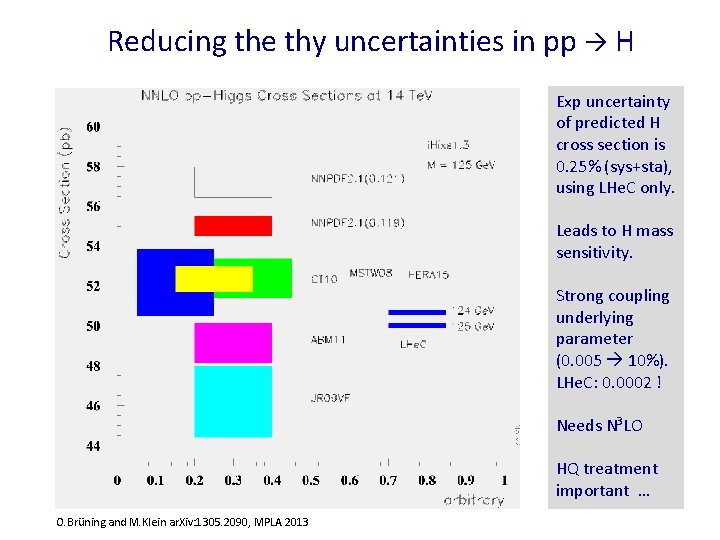
Reducing the thy uncertainties in pp H Exp uncertainty of predicted H cross section is 0. 25% (sys+sta), using LHe. C only. Leads to H mass sensitivity. Strong coupling underlying parameter (0. 005 10%). LHe. C: 0. 0002 ! Needs N 3 LO HQ treatment important … O. Brüning and M. Klein ar. Xiv: 1305. 2090, MPLA 2013
xg at low x
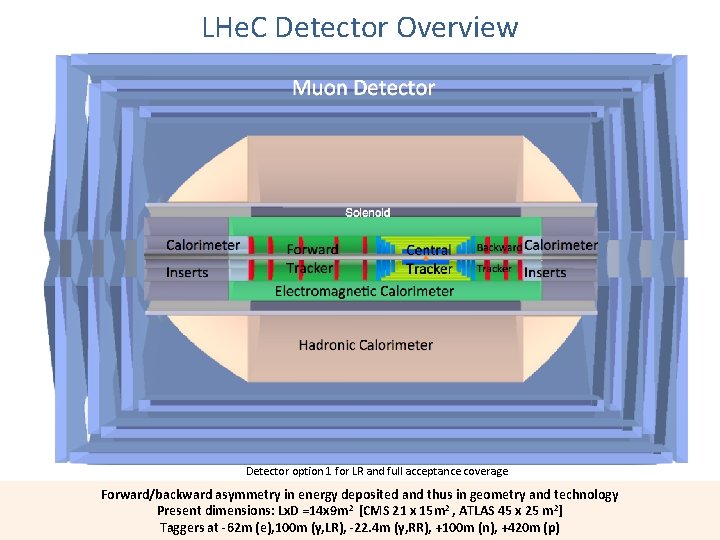
LHe. C Detector Overview LAr electromagnetic calorimeter Tile Calorimeter Detector option 1 for LR and full acceptance coverage Forward/backward asymmetry in energy deposited and thus in geometry and technology Present dimensions: Lx. D =14 x 9 m 2 [CMS 21 x 15 m 2 , ATLAS 45 x 25 m 2] Taggers at -62 m (e), 100 m (γ, LR), -22. 4 m (γ, RR), +100 m (n), +420 m (p)
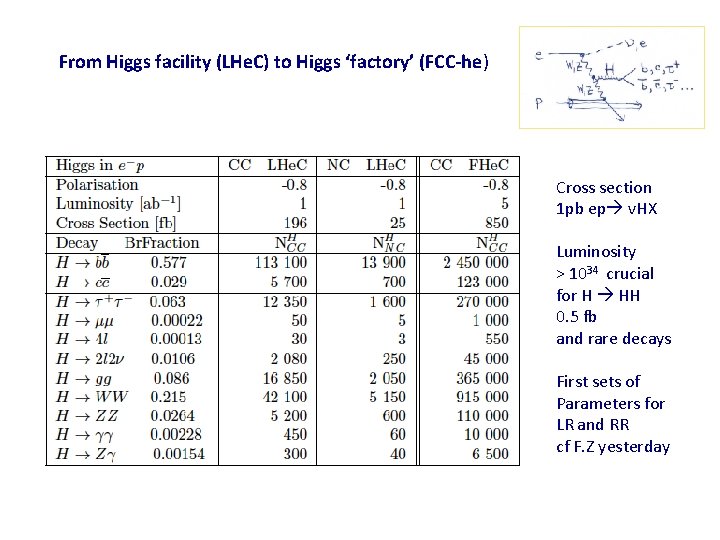
From Higgs facility (LHe. C) to Higgs ‘factory’ (FCC-he) Cross section 1 pb ep v. HX Luminosity > 1034 crucial for H HH 0. 5 fb and rare decays First sets of Parameters for LR and RR cf F. Z yesterday
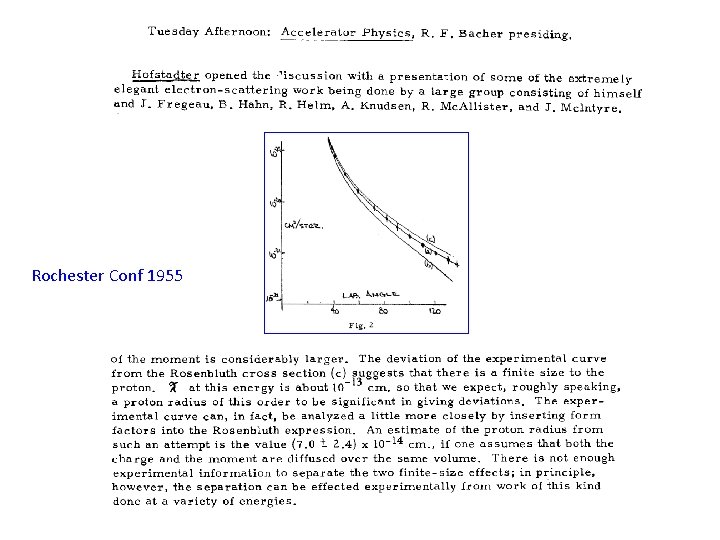
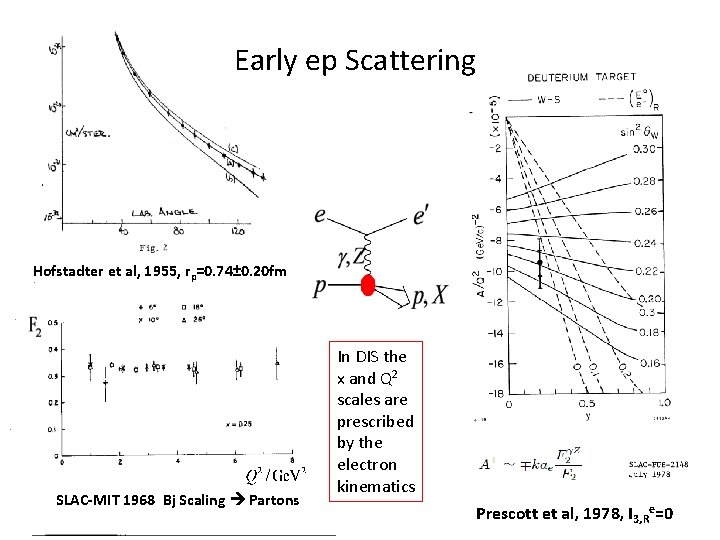
Hofstadter Rochester Conf 1955
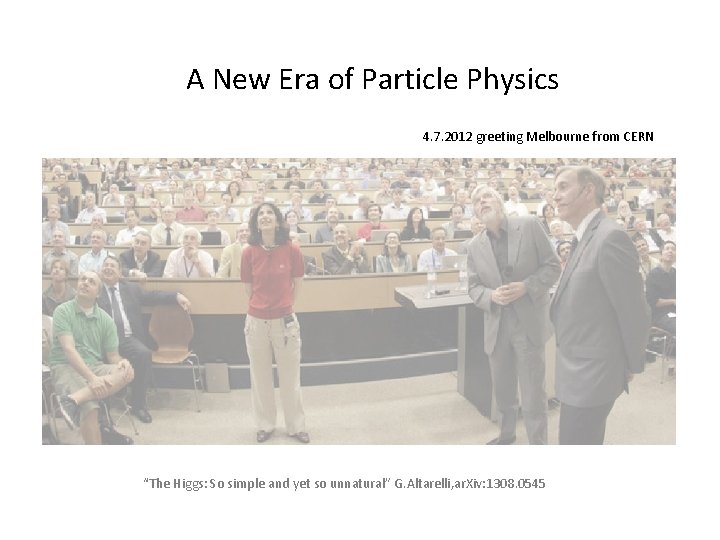
A New Era of Particle Physics 4. 7. 2012 greeting Melbourne from CERN “The Higgs: So simple and yet so unnatural” G. Altarelli, ar. Xiv: 1308. 0545
Further Path Determined with IAC Mandate Guido Altarelli (Rome) *) Sergio Bertolucci (CERN) Frederick Bordry (CERN) Stan Brodsky (SLAC) Hesheng Chen (IHEP Beijing) Andrew Hutton (Jefferson Lab) Young-Kee Kim (Chicago) Victor A Matveev (JINR Dubna) Shin-Ichi Kurokawa (Tsukuba) Leandro Nisati (Rome) Leonid Rivkin (Lausanne) Herwig Schopper (CERN) – Chair Jurgen Schukraft (CERN) Achille Stocchi (LAL Orsay) *) IAC Composition End of January 2014 + Oliver Brüning Max Klein ex officio The IAC was invited in 12/13 by the DG with the following Mandate 2014 -2017 Advice to the LHe. C Coordination Group and the CERN directorate by following the development of options of an ep/e. A collider at the LHC and at FCC, especially with: Provision of scientific and technical direction for the physics potential of the ep/e. A collider, both at LHC and at FCC, as a function of the machine parameters and of a realistic detector design, as well as for the design and possible approval of an ERL test facility at CERN. Assistance in building the international case for the accelerator and detector developments as well as guidance to the resource, infrastructure and science policy aspects of the ep/e. A collider.
Coordination Group for Future DIS at CERN LCG (2014 -2017) *) Nestor Armesto Oliver Brüning Stefano Forte Andrea Gaddi Bruce Mellado Max Klein Peter Kostka Daniel Schulte Frank Zimmermann Directors (ex-officio) Sergio Bertolucci, Frederick Bordry *) LCG Composition early January 14 The coordination group was invited end of December 2013 by the CERN directorate with the following mandate (2014 -2017) The group has the task to coordinate the study of the scientific potential and possible technical realisation of an ep/e. A collider and the associated detectors at CERN, with the LHC and the FCC, over the next four years. It also should coordinate the design of an ERL test facility at CERN as part of the preparations for a larger energy electron accelerator employing ERL techniques. The group will cooperate with CERN and an International Advisory Committee, chaired by the emeritus DG of CERN, Professor Herwig Schopper, who also advises the CERN directorate. The Coordination Group is asked to represent the ep/e. A collider development towards CERN, its committees and the international community. The currently tentative composition is listed left. CERN has asked Max Klein to chair and Oliver Brüning to co-chair this activity
Gell Mann 1966 … Rochester 1966
Early ep Scattering Hofstadter et al, 1955, rp=0. 74± 0. 20 fm SLAC-MIT 1968 Bj Scaling Partons In DIS the x and Q 2 scales are prescribed by the electron kinematics Prescott et al, 1978, I 3, Re=0
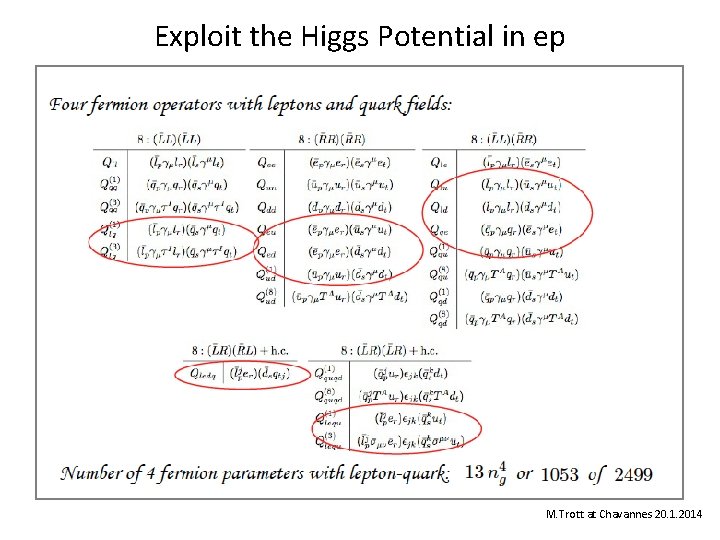
Exploit the Higgs Potential in ep M. Trott at Chavannes 20. 1. 2014
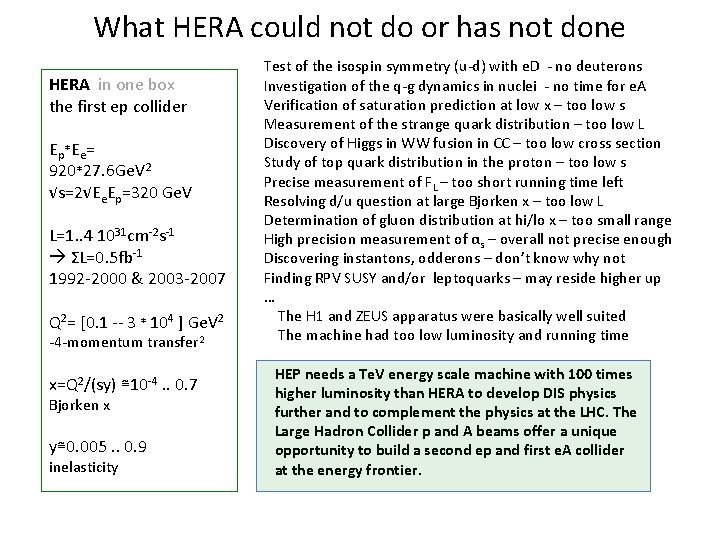
What HERA could not do or has not done HERA in one box the first ep collider Ep*Ee= 920*27. 6 Ge. V 2 √s=2√Ee. Ep=320 Ge. V L=1. . 4 1031 cm-2 s-1 ΣL=0. 5 fb-1 1992 -2000 & 2003 -2007 Q 2= [0. 1 -- 3 * 104 ] Ge. V 2 -4 -momentum transfer 2 x=Q 2/(sy) ≅10 -4. . 0. 7 Bjorken x y≅0. 005. . 0. 9 inelasticity Test of the isospin symmetry (u-d) with e. D - no deuterons Investigation of the q-g dynamics in nuclei - no time for e. A Verification of saturation prediction at low x – too low s Measurement of the strange quark distribution – too low L Discovery of Higgs in WW fusion in CC – too low cross section Study of top quark distribution in the proton – too low s Precise measurement of FL – too short running time left Resolving d/u question at large Bjorken x – too low L Determination of gluon distribution at hi/lo x – too small range High precision measurement of αs – overall not precise enough Discovering instantons, odderons – don’t know why not Finding RPV SUSY and/or leptoquarks – may reside higher up … The H 1 and ZEUS apparatus were basically well suited The machine had too low luminosity and running time HEP needs a Te. V energy scale machine with 100 times higher luminosity than HERA to develop DIS physics further and to complement the physics at the LHC. The Large Hadron Collider p and A beams offer a unique opportunity to build a second ep and first e. A collider at the energy frontier.
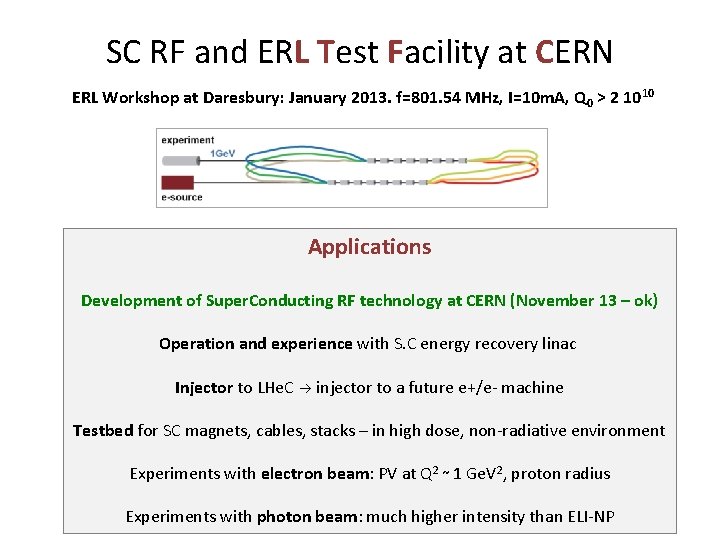
SC RF and ERL Test Facility at CERN ERL Workshop at Daresbury: January 2013. f=801. 54 MHz, I=10 m. A, Q 0 > 2 1010 Applications Development of Super. Conducting RF technology at CERN (November 13 – ok) Operation and experience with S. C energy recovery linac Injector to LHe. C injector to a future e+/e- machine Testbed for SC magnets, cables, stacks – in high dose, non-radiative environment Experiments with electron beam: PV at Q 2 ~ 1 Ge. V 2, proton radius Experiments with photon beam: much higher intensity than ELI-NP