
Deep Inelastic Electron Scattering energy available to produce
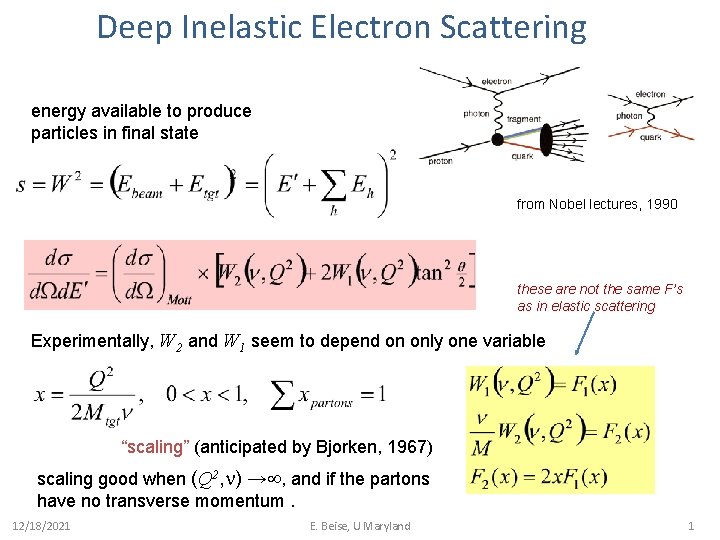
Deep Inelastic Electron Scattering energy available to produce particles in final state from Nobel lectures, 1990 these are not the same F’s as in elastic scattering Experimentally, W 2 and W 1 seem to depend on only one variable “scaling” (anticipated by Bjorken, 1967) scaling good when (Q 2, n) → , and if the partons have no transverse momentum. 12/18/2021 E. Beise, U Maryland 1
Hadron Physics Lecture #1: The quark model, QCD, and hadron spectroscopy Lecture #2: Internal structure of hadrons: momentum and spin Lecture #3: Internal structure of hadrons: charge, magnetism, polarizability Lecture #4: Hadrons in nuclei, hadrons as laboratories (and miscellaneous topics) NNPSS 2009 E. Beise, U Maryland 2
references Halzen & Martin: Quarks and Leptons Xiangdong Ji: Graduate nuclear physics lecture notes http: //www. physics. umd. edu/courses/Phys 741/xji/lecture_notes. htm Review articles: C. F. Perdrisat, V. Punjabi and M. Vanderhaegen, Prog. Part. Nucl. Phys. 59 (2007) 694 -764, ar. Xiv: hep-ph/0612014. J. Arrington, C. D. Roberts and J. M Zanotti, J. Phys. G 34 (2007) S 23, ar. Xiv: nucl-th/0611050 Donnelly and Raskin: T. W. Donnelly and A. S. Raskin, Ann. Phys. 169, 247 (1986). NNPSS 2009 E. Beise, U Maryland 3
Properties of Hadrons: charge, magnetism, polarizability Nucleon electromagnetic form factors 2 -g exchange Meson form factors Nucleon polarizabilities (maybe…) NNPSS 2009 E. Beise, U Maryland 4
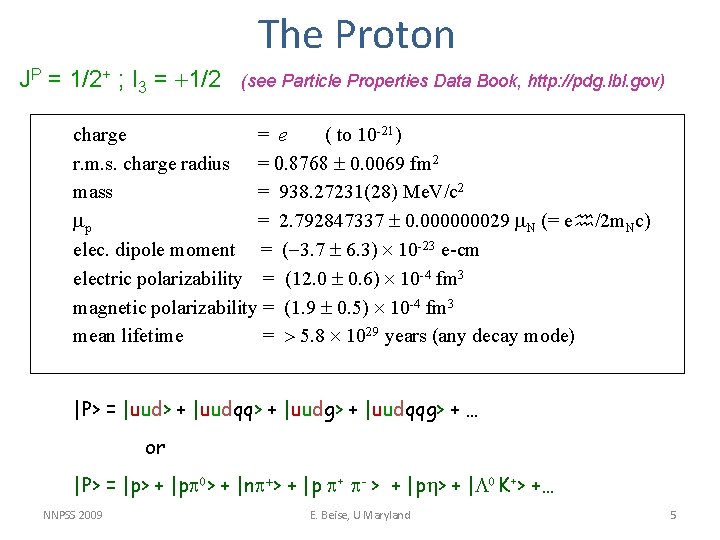
The Proton JP = 1/2+ ; I 3 = +1/2 (see Particle Properties Data Book, http: //pdg. lbl. gov) charge = e ( to 10 -21) r. m. s. charge radius = 0. 8768 0. 0069 fm 2 mass = 938. 27231(28) Me. V/c 2 mp = 2. 792847337 0. 000000029 m. N (= e /2 m. Nc) elec. dipole moment = (-3. 7 6. 3) 10 -23 e-cm electric polarizability = (12. 0 0. 6) 10 -4 fm 3 magnetic polarizability = (1. 9 0. 5) 10 -4 fm 3 mean lifetime = > 5. 8 1029 years (any decay mode) |P> = |uud> + |uudqq> + |uudg> + |uudqqg> + … or |P> = |p> + |pp 0> + |np+> + |p p+ p- > + |ph> + |L 0 K+> +… NNPSS 2009 E. Beise, U Maryland 5
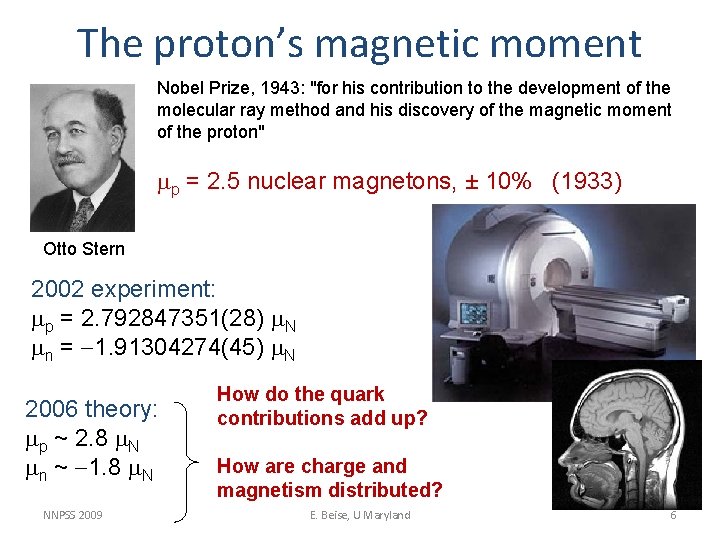
The proton’s magnetic moment Nobel Prize, 1943: "for his contribution to the development of the molecular ray method and his discovery of the magnetic moment of the proton" mp = 2. 5 nuclear magnetons, ± 10% (1933) Otto Stern 2002 experiment: mp = 2. 792847351(28) m. N mn = -1. 91304274(45) m. N 2006 theory: mp ~ 2. 8 m. N mn ~ -1. 8 m. N NNPSS 2009 How do the quark contributions add up? How are charge and magnetism distributed? E. Beise, U Maryland 6
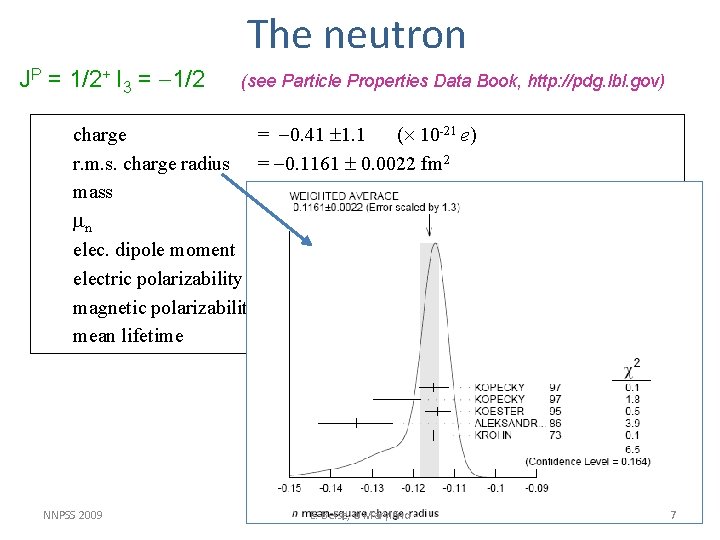
The neutron JP = 1/2+ I 3 = -1/2 (see Particle Properties Data Book, http: //pdg. lbl. gov) charge = -0. 41 1. 1 ( 10 -21 e) r. m. s. charge radius = -0. 1161 0. 0022 fm 2 mass = 939. 565346(23) Me. V/c 2 mn = -1. 913042793 0. 000000023 m. N (= e /2 m. Nc) elec. dipole moment = < 0. 29 10 -25 e-cm (90% C. L. ) electric polarizability = (11. 6 1. 5) 10 -4 fm 3 magnetic polarizability = (3. 7 2. 0) 10 -4 fm 3 mean lifetime = 885. 7 0. 8 sec NNPSS 2009 E. Beise, U Maryland 7
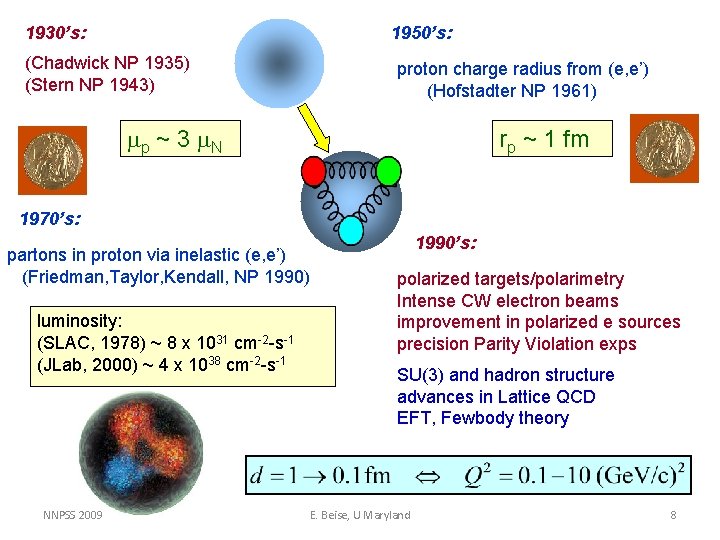
1930’s: 1950’s: (Chadwick NP 1935) (Stern NP 1943) proton charge radius from (e, e’) (Hofstadter NP 1961) mp ~ 3 m. N rp ~ 1 fm 1970’s: partons in proton via inelastic (e, e’) (Friedman, Taylor, Kendall, NP 1990) luminosity: (SLAC, 1978) ~ 8 x 1031 cm-2 -s-1 (JLab, 2000) ~ 4 x 1038 cm-2 -s-1 NNPSS 2009 1990’s: polarized targets/polarimetry Intense CW electron beams improvement in polarized e sources precision Parity Violation exps SU(3) and hadron structure advances in Lattice QCD EFT, Fewbody theory E. Beise, U Maryland 8
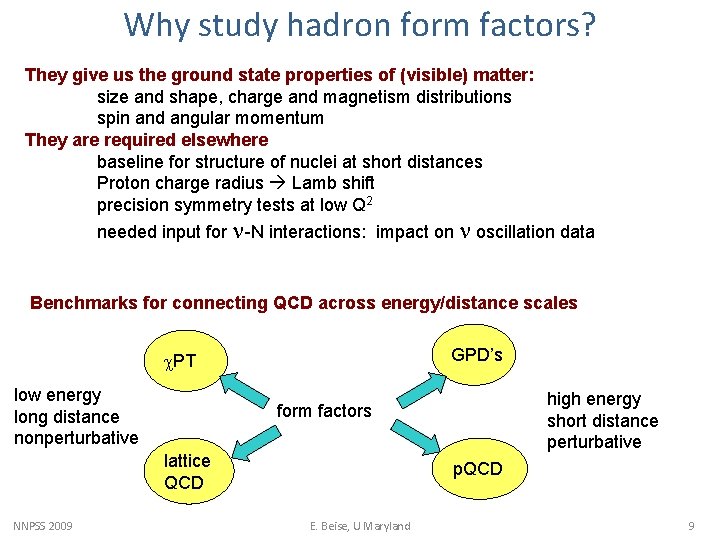
Why study hadron form factors? They give us the ground state properties of (visible) matter: size and shape, charge and magnetism distributions spin and angular momentum They are required elsewhere baseline for structure of nuclei at short distances Proton charge radius Lamb shift precision symmetry tests at low Q 2 needed input for n-N interactions: impact on n oscillation data Benchmarks for connecting QCD across energy/distance scales GPD’s c. PT low energy long distance nonperturbative lattice QCD NNPSS 2009 high energy short distance perturbative form factors p. QCD E. Beise, U Maryland 9
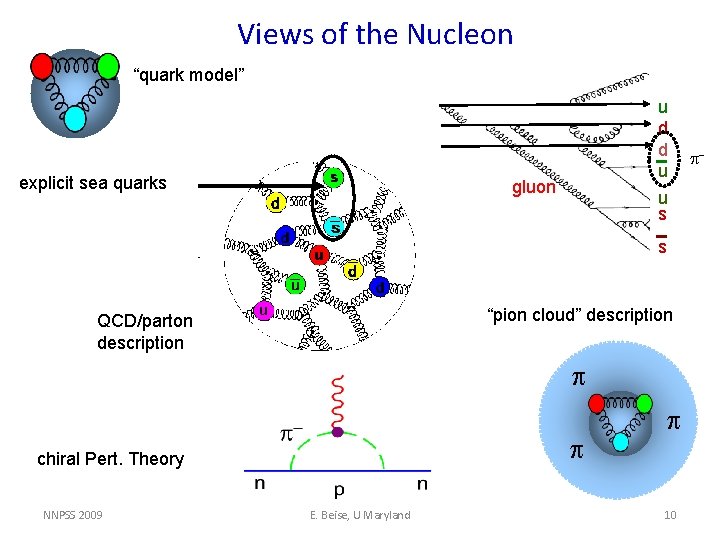
Views of the Nucleon “quark model” explicit sea quarks u d d u u s gluon s “pion cloud” description QCD/parton description p p chiral Pert. Theory NNPSS 2009 E. Beise, U Maryland p 10 p-
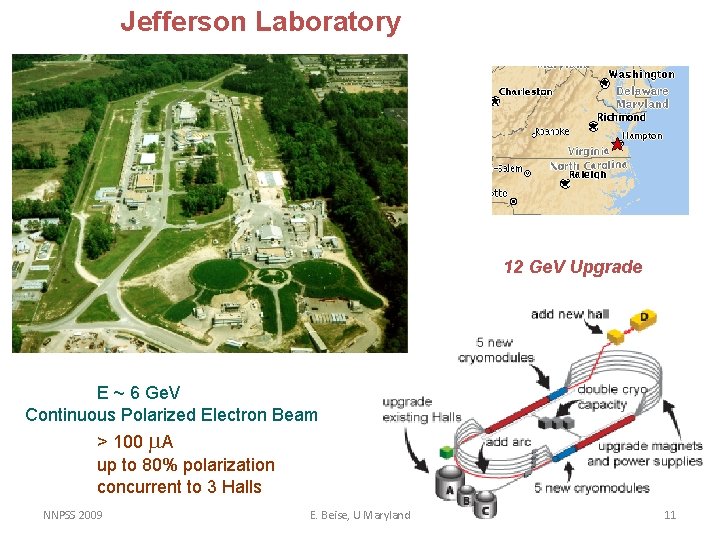
Jefferson Laboratory 12 Ge. V Upgrade E ~ 6 Ge. V Continuous Polarized Electron Beam > 100 m. A up to 80% polarization concurrent to 3 Halls NNPSS 2009 E. Beise, U Maryland 11
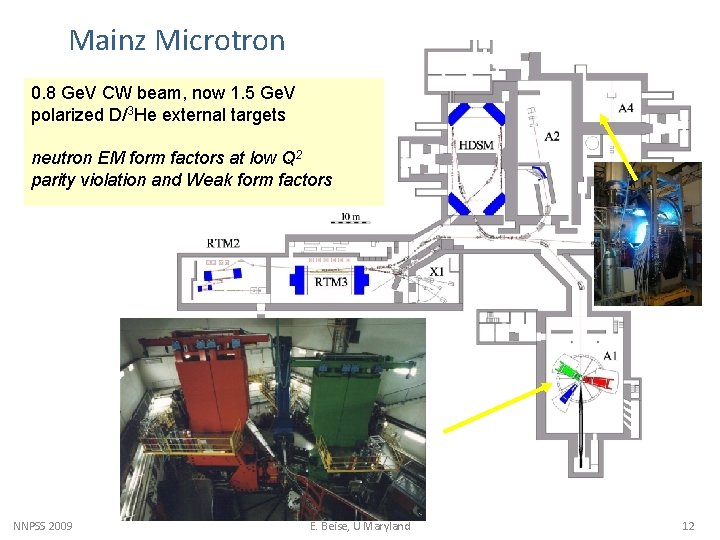
Mainz Microtron 0. 8 Ge. V CW beam, now 1. 5 Ge. V polarized D/3 He external targets neutron EM form factors at low Q 2 parity violation and Weak form factors NNPSS 2009 E. Beise, U Maryland 12
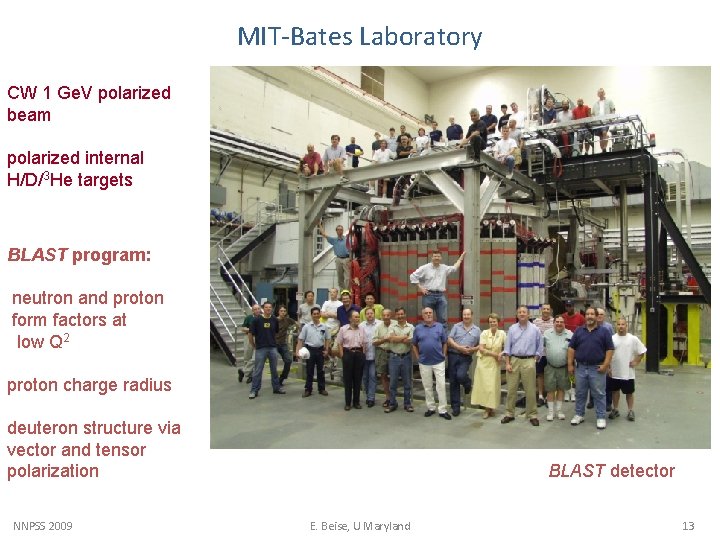
MIT-Bates Laboratory CW 1 Ge. V polarized beam polarized internal H/D/3 He targets BLAST program: neutron and proton form factors at low Q 2 proton charge radius deuteron structure via vector and tensor polarization NNPSS 2009 BLAST detector E. Beise, U Maryland 13
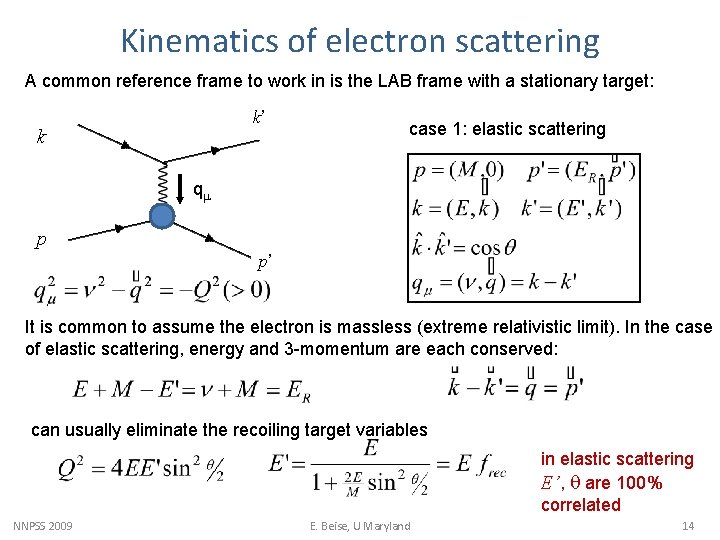
Kinematics of electron scattering A common reference frame to work in is the LAB frame with a stationary target: k’ k case 1: elastic scattering qm p p’ It is common to assume the electron is massless (extreme relativistic limit). In the case of elastic scattering, energy and 3 -momentum are each conserved: can usually eliminate the recoiling target variables in elastic scattering E’, q are 100% correlated NNPSS 2009 E. Beise, U Maryland 14
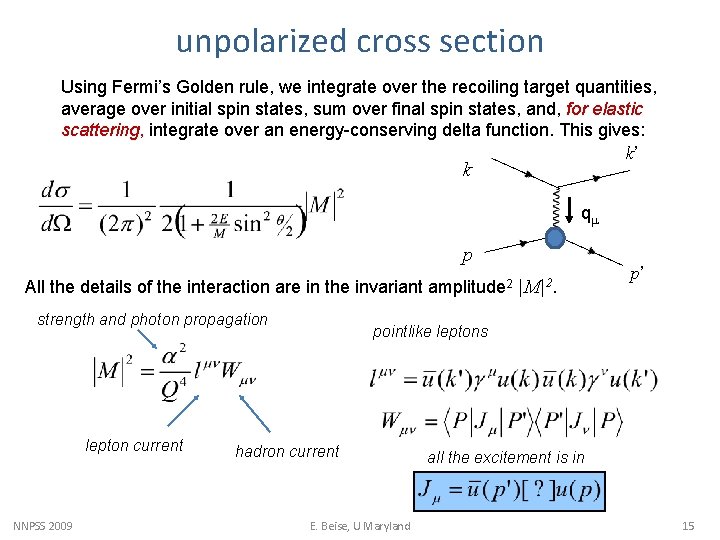
unpolarized cross section Using Fermi’s Golden rule, we integrate over the recoiling target quantities, average over initial spin states, sum over final spin states, and, for elastic scattering, integrate over an energy-conserving delta function. This gives: k’ k qm p All the details of the interaction are in the invariant strength and photon propagation lepton current NNPSS 2009 amplitude 2 |M|2. p’ pointlike leptons hadron current E. Beise, U Maryland all the excitement is in 15
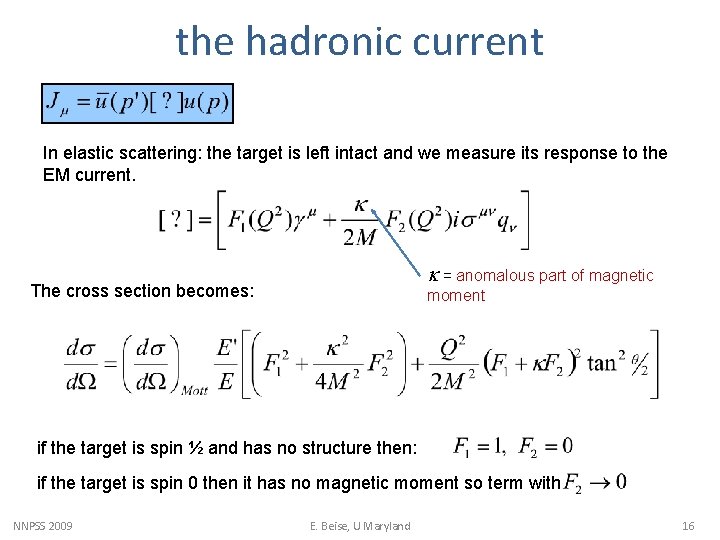
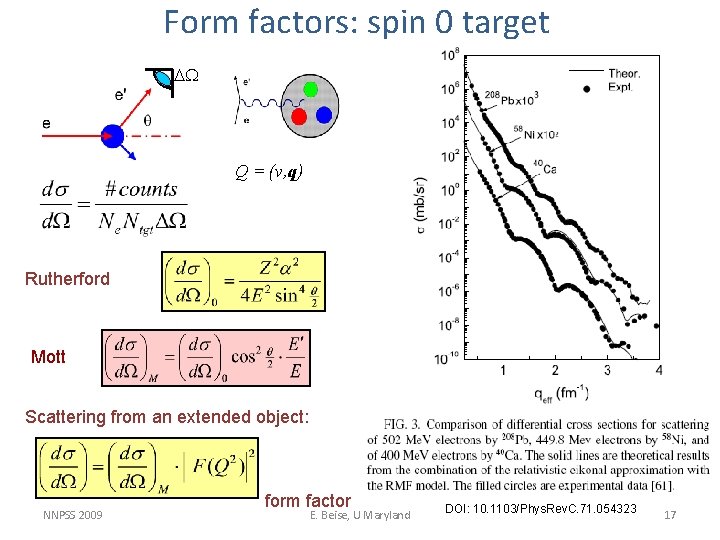
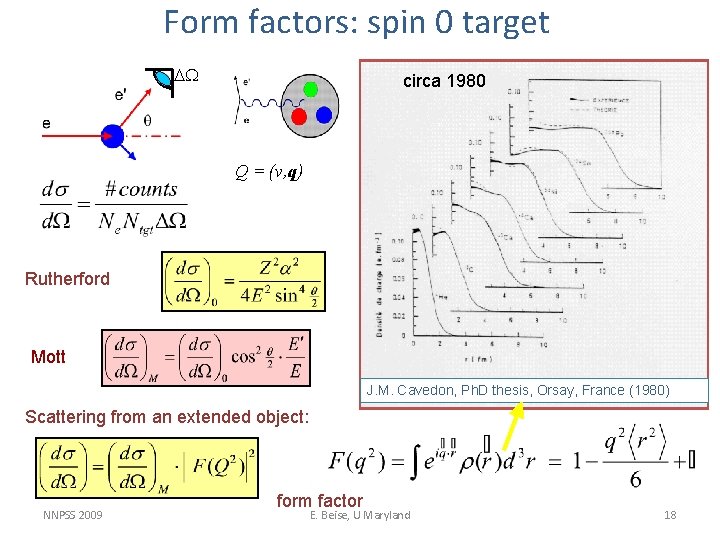
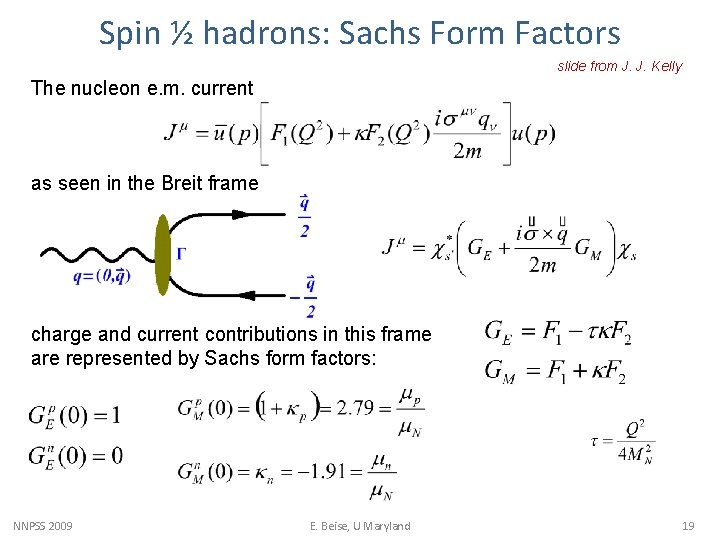
the hadronic current In elastic scattering: the target is left intact and we measure its response to the EM current. k = anomalous part of magnetic The cross section becomes: moment if the target is spin ½ and has no structure then: if the target is spin 0 then it has no magnetic moment so term with NNPSS 2009 E. Beise, U Maryland 16
Form factors: spin 0 target DW Q = (v, q) Rutherford Mott Scattering from an extended object: NNPSS 2009 form factor E. Beise, U Maryland DOI: 10. 1103/Phys. Rev. C. 71. 054323 17
Form factors: spin 0 target DW circa 1980 Q = (v, q) Rutherford Mott J. M. Cavedon, Ph. D thesis, Orsay, France (1980) Scattering from an extended object: NNPSS 2009 form factor E. Beise, U Maryland 18
Spin ½ hadrons: Sachs Form Factors slide from J. J. Kelly The nucleon e. m. current as seen in the Breit frame charge and current contributions in this frame are represented by Sachs form factors: NNPSS 2009 E. Beise, U Maryland 19
“Rosenbluth” Separation intercept slope • GM dominates for large t. • Must control kinematics, acceptances, and radiative corrections very accurately because coefficient is strong function of angle. • As Q 2 increases, the contribution from e. GE 2 gets very small (even for the proton) NNPSS 2009 slide from J. J. Kelly SLAC NE 11, Bosted et al. E. Beise, U Maryland 20
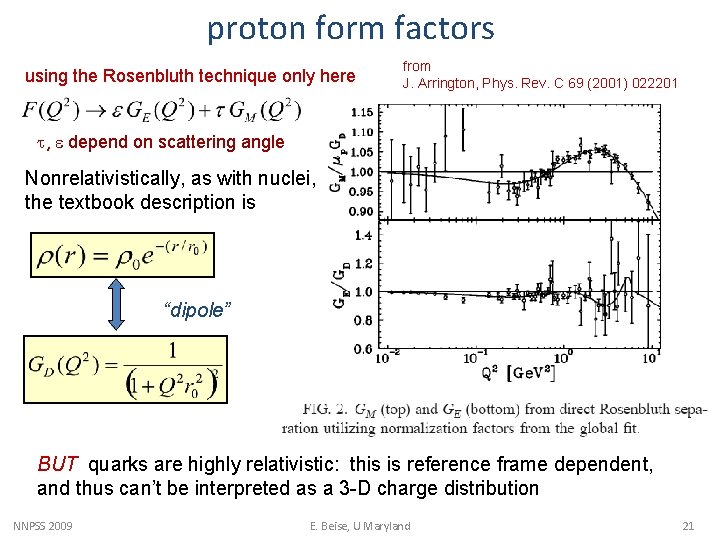
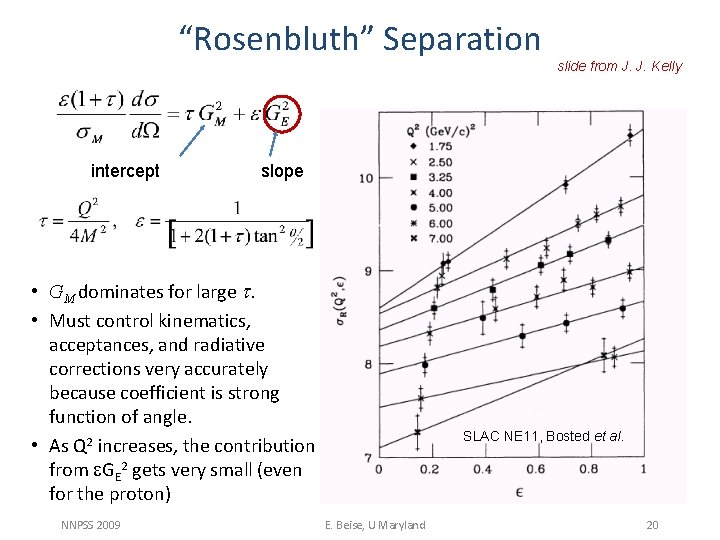
proton form factors using the Rosenbluth technique only here from J. Arrington, Phys. Rev. C 69 (2001) 022201 t, e depend on scattering angle Nonrelativistically, as with nuclei, the textbook description is “dipole” BUT quarks are highly relativistic: this is reference frame dependent, and thus can’t be interpreted as a 3 -D charge distribution NNPSS 2009 E. Beise, U Maryland 21
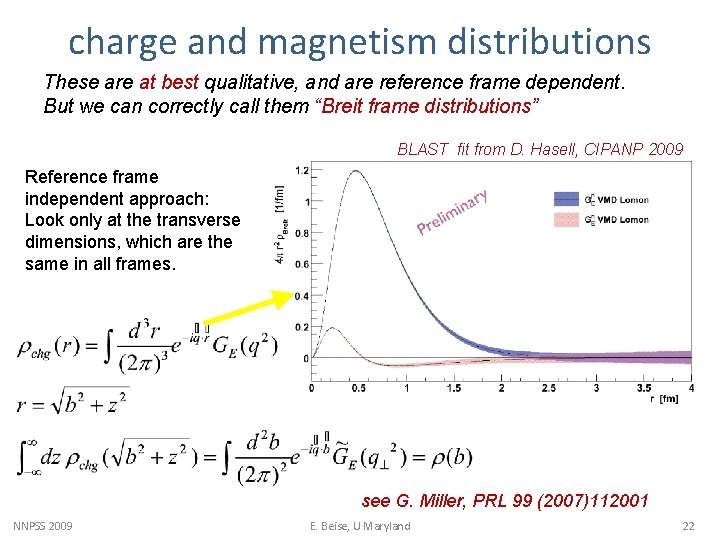
charge and magnetism distributions These are at best qualitative, and are reference frame dependent. But we can correctly call them “Breit frame distributions” BLAST fit from D. Hasell, CIPANP 2009 Reference frame independent approach: Look only at the transverse dimensions, which are the same in all frames. see G. Miller, PRL 99 (2007)112001 NNPSS 2009 E. Beise, U Maryland 22
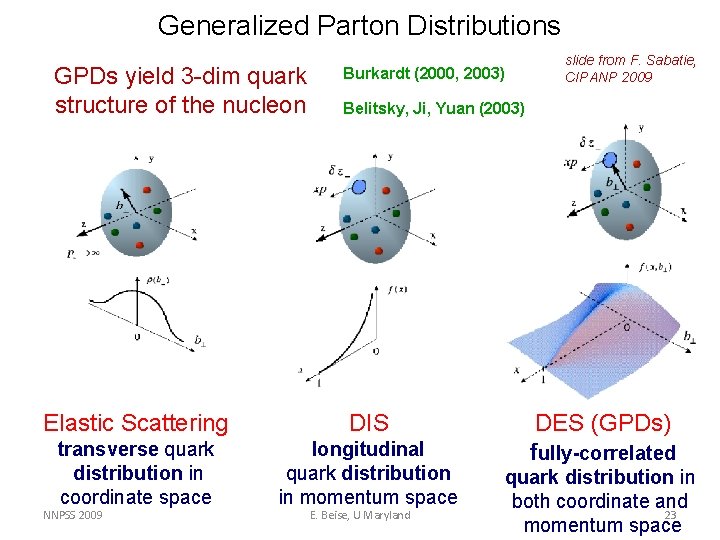
Generalized Parton Distributions GPDs yield 3 -dim quark structure of the nucleon Burkardt (2000, 2003) Belitsky, Ji, Yuan (2003) Elastic Scattering DIS transverse quark distribution in coordinate space longitudinal quark distribution in momentum space NNPSS 2009 slide from F. Sabatie, CIPANP 2009 E. Beise, U Maryland DES (GPDs) fully-correlated quark distribution in both coordinate and 23 momentum space
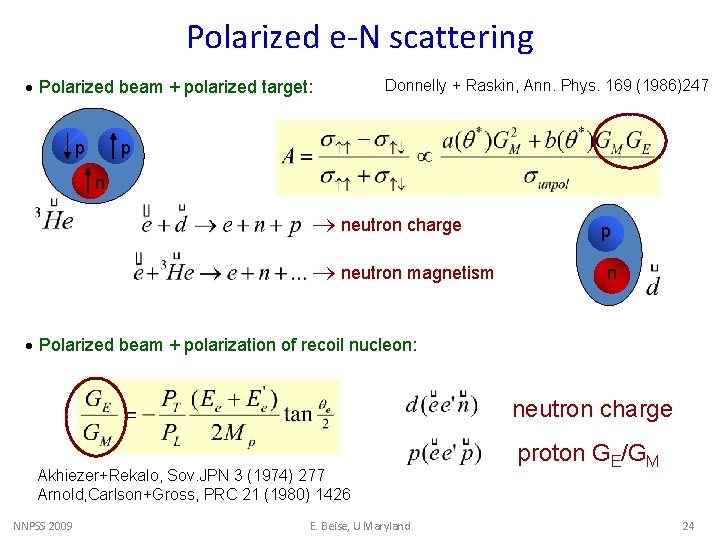
Polarized e-N scattering · Polarized beam + polarized target: p Donnelly + Raskin, Ann. Phys. 169 (1986)247 p n neutron charge neutron magnetism p n · Polarized beam + polarization of recoil nucleon: neutron charge Akhiezer+Rekalo, Sov. JPN 3 (1974) 277 Arnold, Carlson+Gross, PRC 21 (1980) 1426 NNPSS 2009 E. Beise, U Maryland proton GE/GM 24
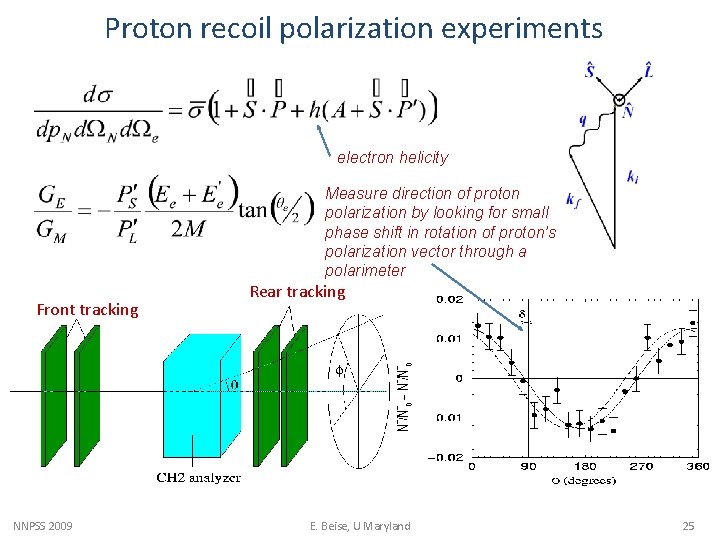
Proton recoil polarization experiments electron helicity Measure direction of proton polarization by looking for small phase shift in rotation of proton’s polarization vector through a polarimeter Front tracking NNPSS 2009 Rear tracking E. Beise, U Maryland 25
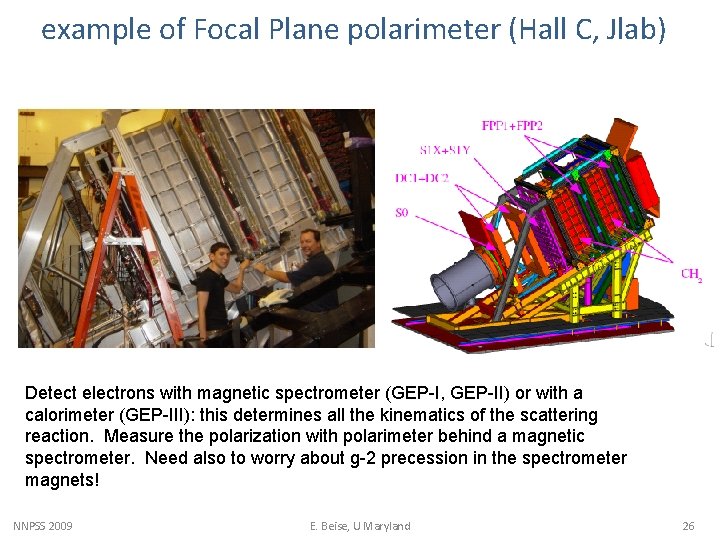
example of Focal Plane polarimeter (Hall C, Jlab) Detect electrons with magnetic spectrometer (GEP-I, GEP-II) or with a calorimeter (GEP-III): this determines all the kinematics of the scattering reaction. Measure the polarization with polarimeter behind a magnetic spectrometer. Need also to worry about g-2 precession in the spectrometer magnets! NNPSS 2009 E. Beise, U Maryland 26
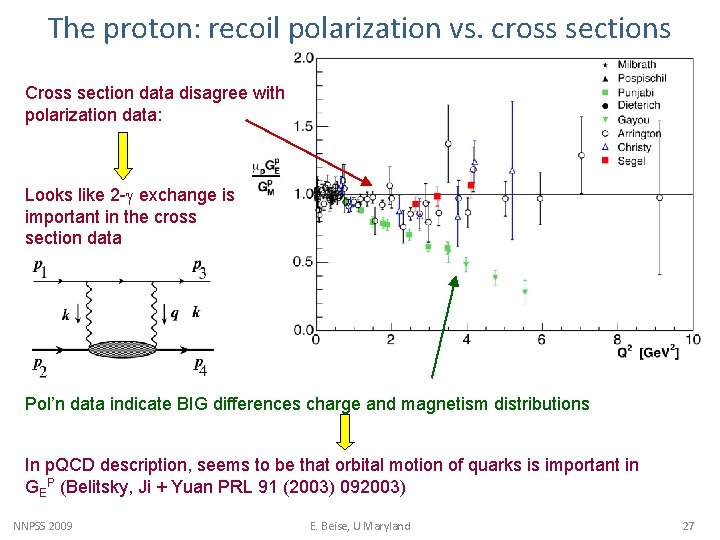
The proton: recoil polarization vs. cross sections Cross section data disagree with polarization data: Looks like 2 -g exchange is important in the cross section data Pol’n data indicate BIG differences charge and magnetism distributions In p. QCD description, seems to be that orbital motion of quarks is important in GEP (Belitsky, Ji + Yuan PRL 91 (2003) 092003) NNPSS 2009 E. Beise, U Maryland 27
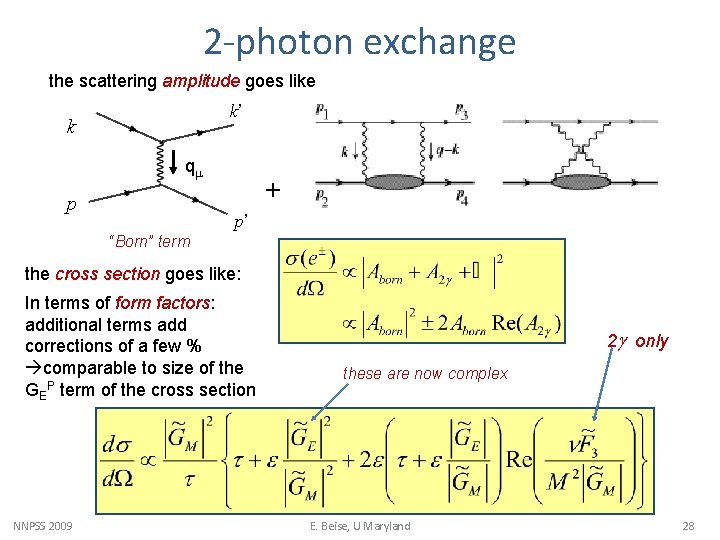
2 -photon exchange the scattering amplitude goes like k’ k qm p + p’ “Born” term the cross section goes like: In terms of form factors: additional terms add corrections of a few % comparable to size of the GEP term of the cross section NNPSS 2009 2 g only these are now complex E. Beise, U Maryland 28
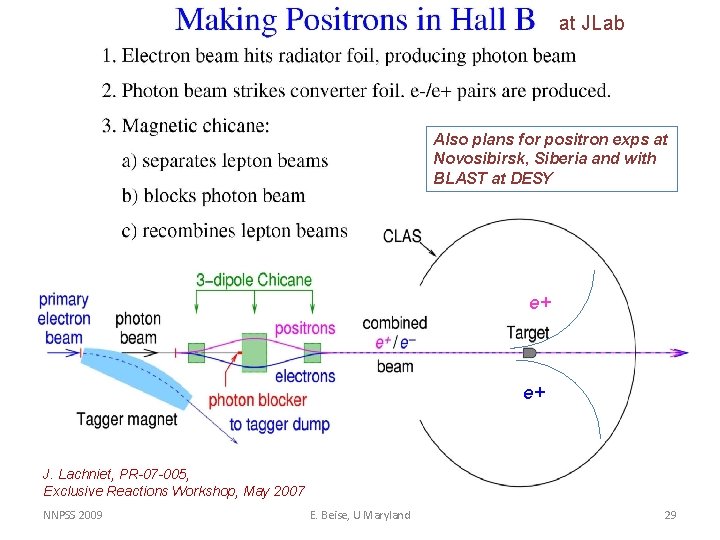
at JLab Also plans for positron exps at Novosibirsk, Siberia and with BLAST at DESY e+ e+ J. Lachniet, PR-07 -005, Exclusive Reactions Workshop, May 2007 NNPSS 2009 E. Beise, U Maryland 29
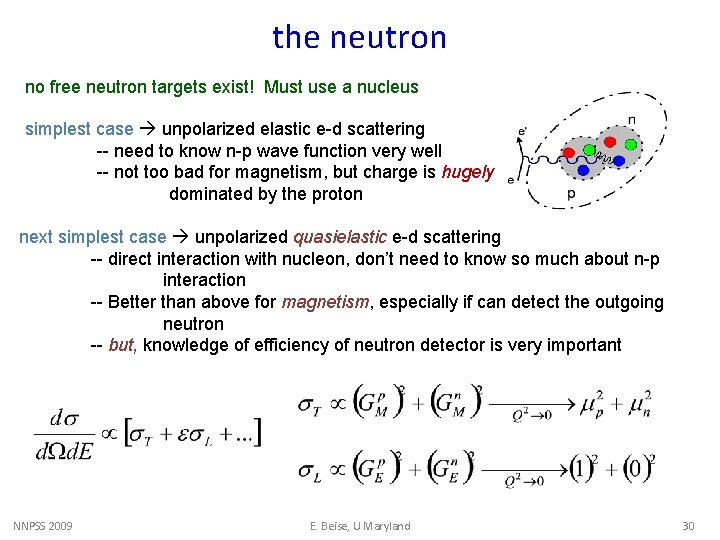
the neutron no free neutron targets exist! Must use a nucleus simplest case unpolarized elastic e-d scattering -- need to know n-p wave function very well -- not too bad for magnetism, but charge is hugely dominated by the proton next simplest case unpolarized quasielastic e-d scattering -- direct interaction with nucleon, don’t need to know so much about n-p interaction -- Better than above for magnetism, especially if can detect the outgoing neutron -- but, knowledge of efficiency of neutron detector is very important NNPSS 2009 E. Beise, U Maryland 30
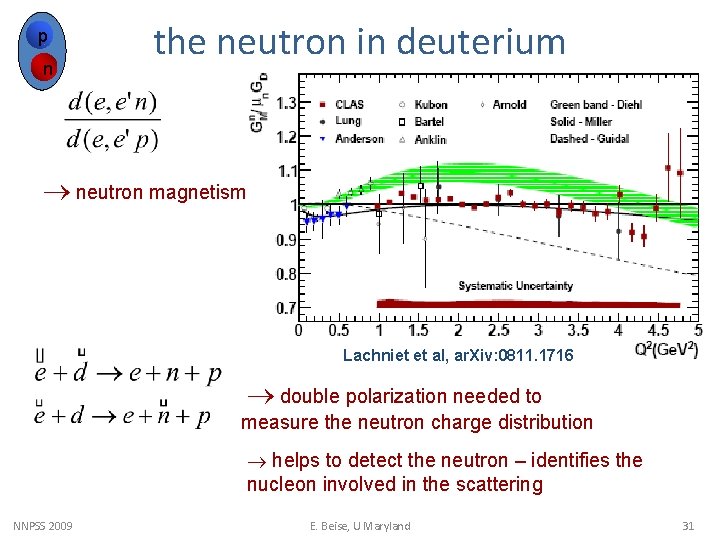
p n the neutron in deuterium neutron magnetism Lachniet et al, ar. Xiv: 0811. 1716 double polarization needed to measure the neutron charge distribution helps to detect the neutron – identifies the nucleon involved in the scattering NNPSS 2009 E. Beise, U Maryland 31
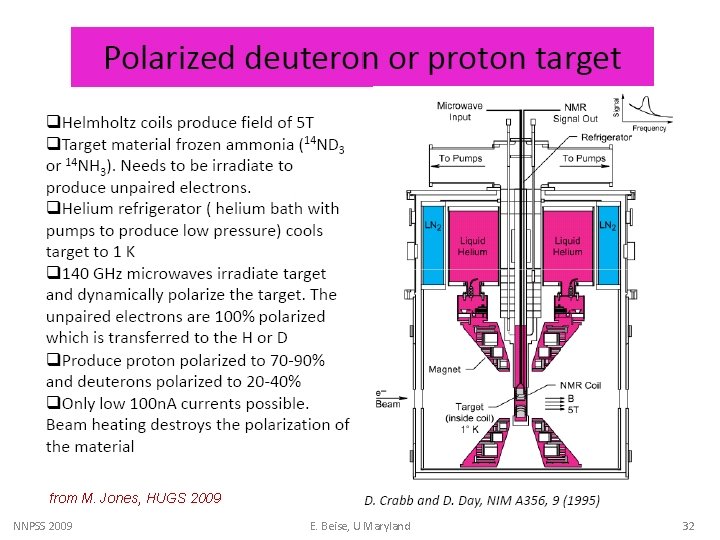
from M. Jones, HUGS 2009 NNPSS 2009 E. Beise, U Maryland 32
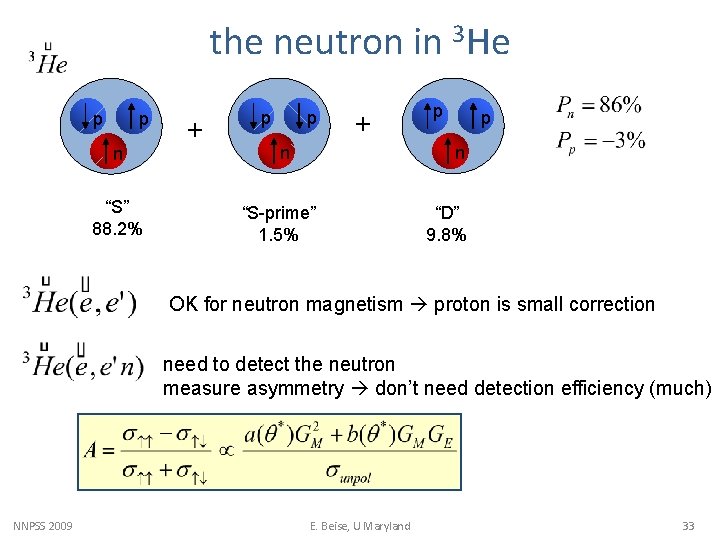
the neutron in 3 He p p n “S” 88. 2% + p p n n “S-prime” 1. 5% “D” 9. 8% OK for neutron magnetism proton is small correction need to detect the neutron measure asymmetry don’t need detection efficiency (much) NNPSS 2009 E. Beise, U Maryland 33
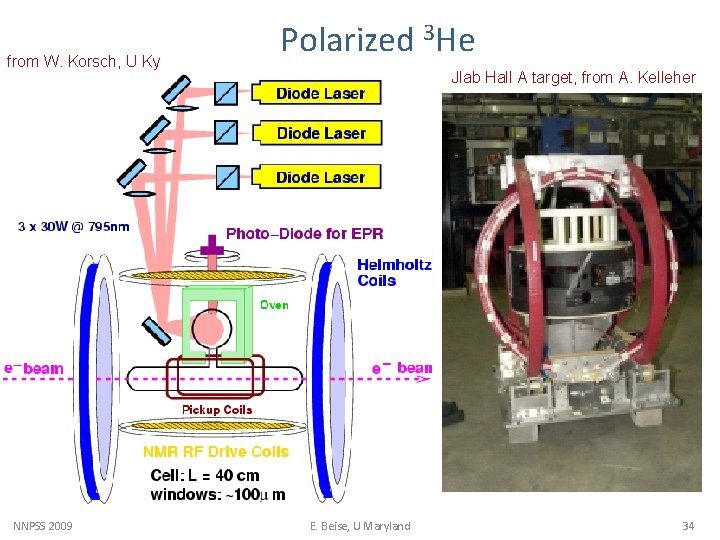
from W. Korsch, U Ky NNPSS 2009 Polarized 3 He Jlab Hall A target, from A. Kelleher E. Beise, U Maryland 34
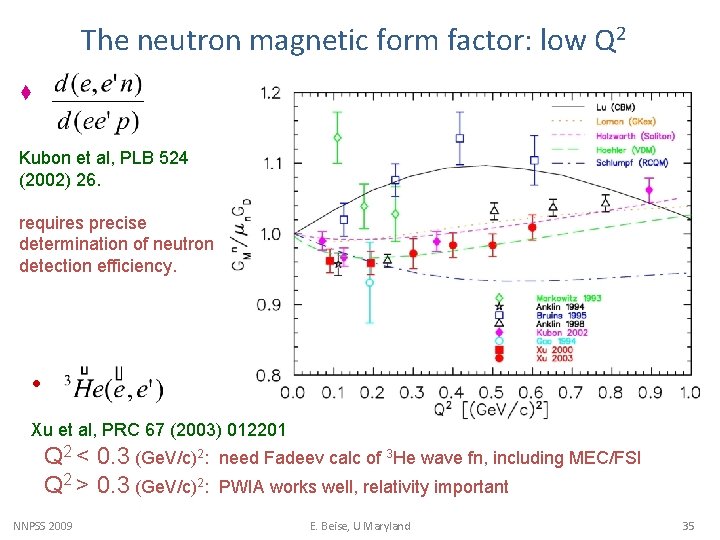
The neutron magnetic form factor: low Q 2 t Kubon et al, PLB 524 (2002) 26. requires precise determination of neutron detection efficiency. • Xu et al, PRC 67 (2003) 012201 Q 2 < 0. 3 (Ge. V/c)2: Q 2 > 0. 3 (Ge. V/c)2: NNPSS 2009 need Fadeev calc of 3 He wave fn, including MEC/FSI PWIA works well, relativity important E. Beise, U Maryland 35
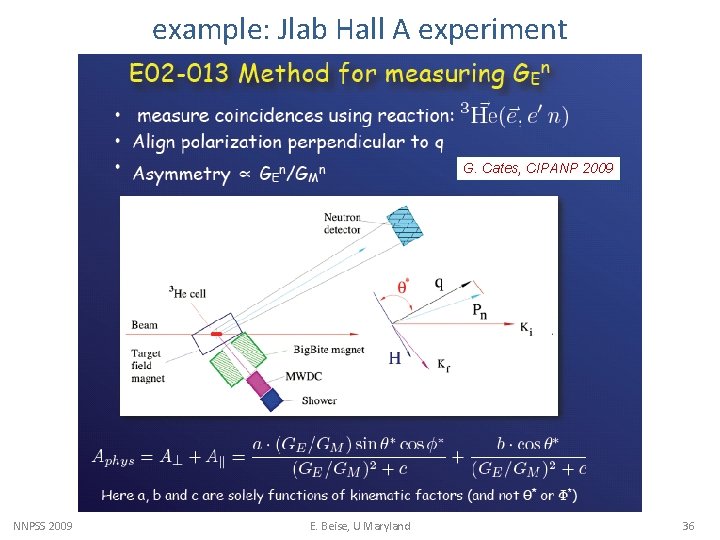
example: Jlab Hall A experiment G. Cates, CIPANP 2009 NNPSS 2009 E. Beise, U Maryland 36
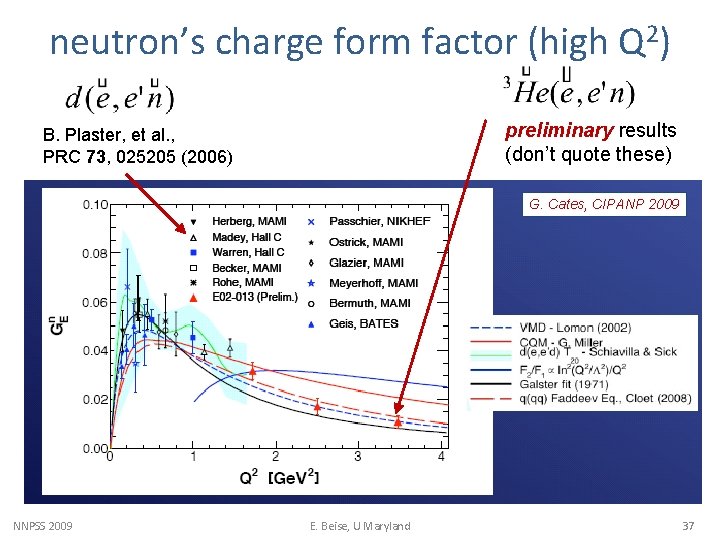
neutron’s charge form factor (high Q 2) preliminary results (don’t quote these) B. Plaster, et al. , PRC 73, 025205 (2006) G. Cates, CIPANP 2009 NNPSS 2009 E. Beise, U Maryland 37
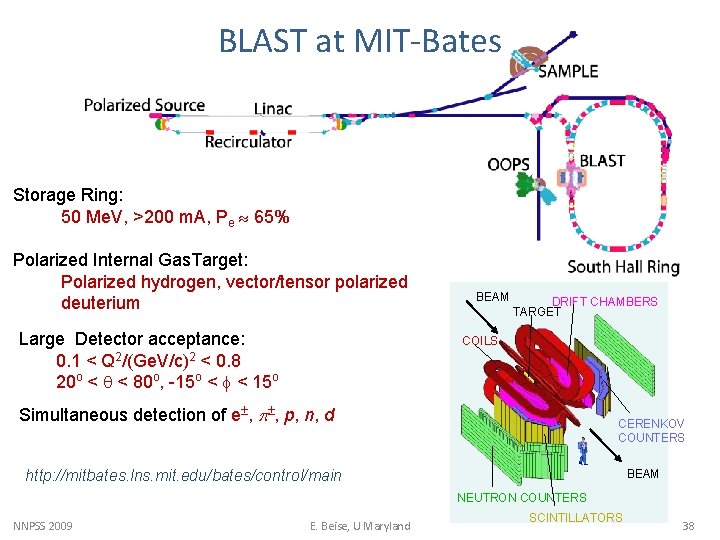
BLAST at MIT-Bates Storage Ring: 50 Me. V, >200 m. A, Pe 65% Polarized Internal Gas. Target: Polarized hydrogen, vector/tensor polarized deuterium Large Detector acceptance: 0. 1 < Q 2/(Ge. V/c)2 < 0. 8 20 o < q < 80 o, -15 o < < 15 o BEAM DRIFT CHAMBERS TARGET COILS Simultaneous detection of e , p, n, d CERENKOV COUNTERS http: //mitbates. lns. mit. edu/bates/control/main BEAM NEUTRON COUNTERS NNPSS 2009 E. Beise, U Maryland SCINTILLATORS 38
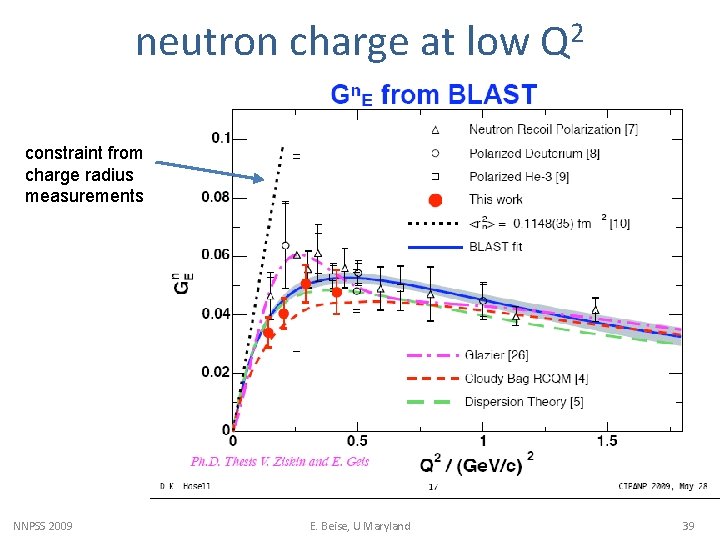
neutron charge at low Q 2 constraint from charge radius measurements NNPSS 2009 E. Beise, U Maryland 39
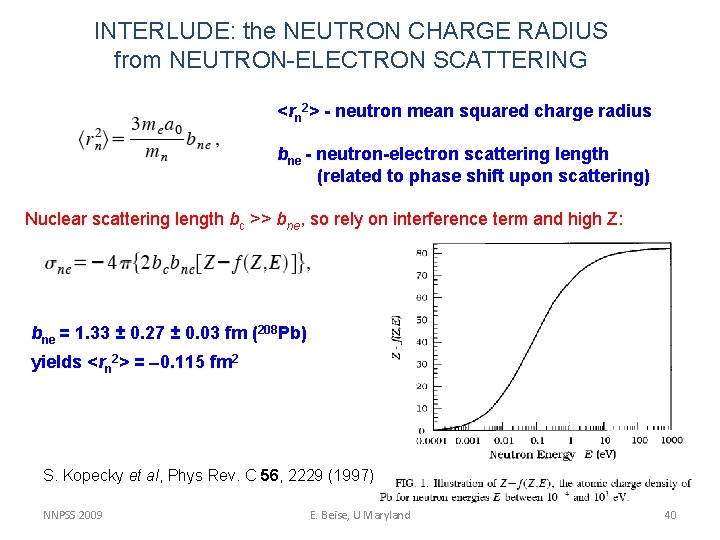
INTERLUDE: the NEUTRON CHARGE RADIUS from NEUTRON-ELECTRON SCATTERING <rn 2> - neutron mean squared charge radius bne - neutron-electron scattering length (related to phase shift upon scattering) Nuclear scattering length bc >> bne, so rely on interference term and high Z: bne = 1. 33 ± 0. 27 ± 0. 03 fm (208 Pb) yields <rn 2> = -0. 115 fm 2 S. Kopecky et al, Phys Rev. C 56, 2229 (1997) NNPSS 2009 E. Beise, U Maryland 40
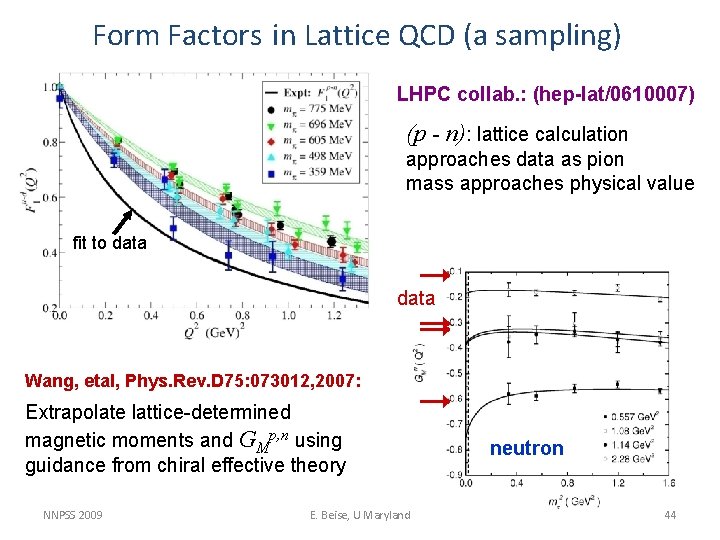
Form Factors in Lattice QCD (a sampling) LHPC collab. : (hep-lat/0610007) (p - n): lattice calculation approaches data as pion mass approaches physical value fit to data Wang, etal, Phys. Rev. D 75: 073012, 2007: Extrapolate lattice-determined magnetic moments and GMp, n using guidance from chiral effective theory NNPSS 2009 E. Beise, U Maryland neutron 44
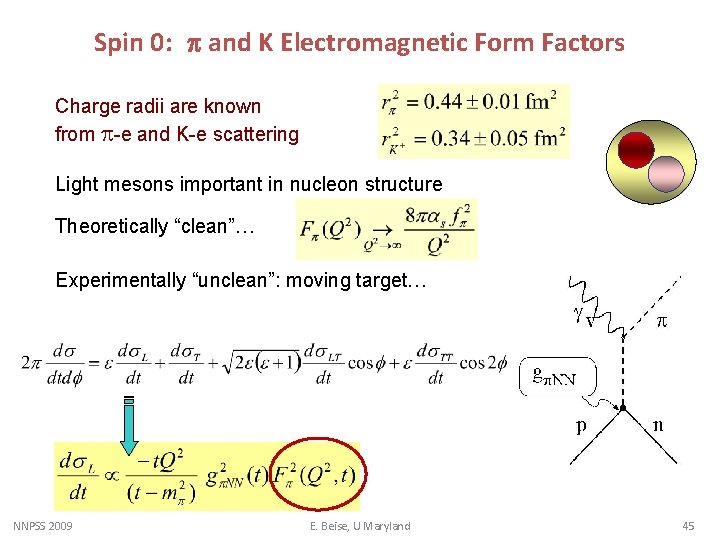
Spin 0: p and K Electromagnetic Form Factors Charge radii are known from p-e and K-e scattering Light mesons important in nucleon structure Theoretically “clean”… Experimentally “unclean”: moving target… NNPSS 2009 E. Beise, U Maryland 45
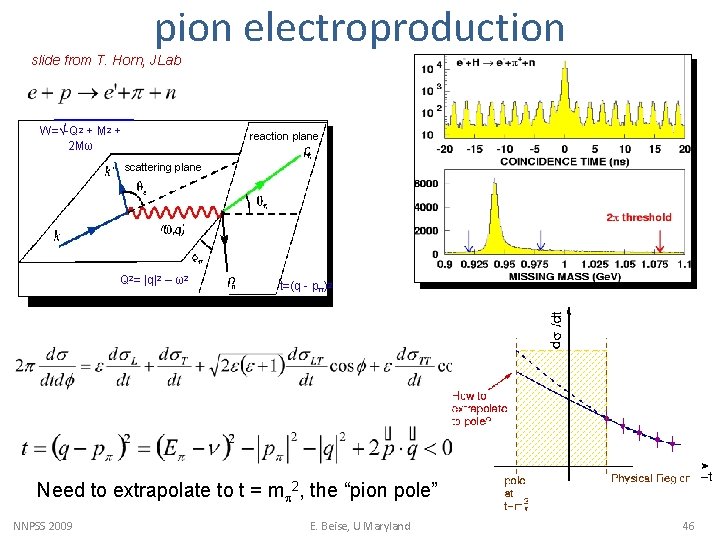
pion electroproduction slide from T. Horn, JLab W=√-Q 2 + M 2 + 2 Mω reaction plane scattering plane Q 2= |q|2 – ω2 t=(q - pπ)2 Need to extrapolate to t = mp 2, the “pion pole” NNPSS 2009 E. Beise, U Maryland 46
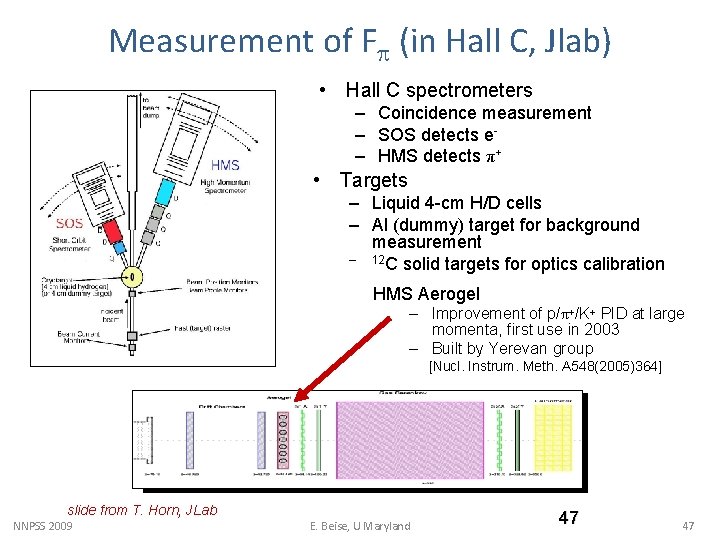
Measurement of Fp (in Hall C, Jlab) • Hall C spectrometers – Coincidence measurement – SOS detects e– HMS detects π+ • Targets – Liquid 4 -cm H/D cells – Al (dummy) target for background measurement – 12 C solid targets for optics calibration HMS Aerogel – Improvement of p/π+/K+ PID at large momenta, first use in 2003 – Built by Yerevan group [Nucl. Instrum. Meth. A 548(2005)364] slide from T. Horn, JLab NNPSS 2009 E. Beise, U Maryland 47 47
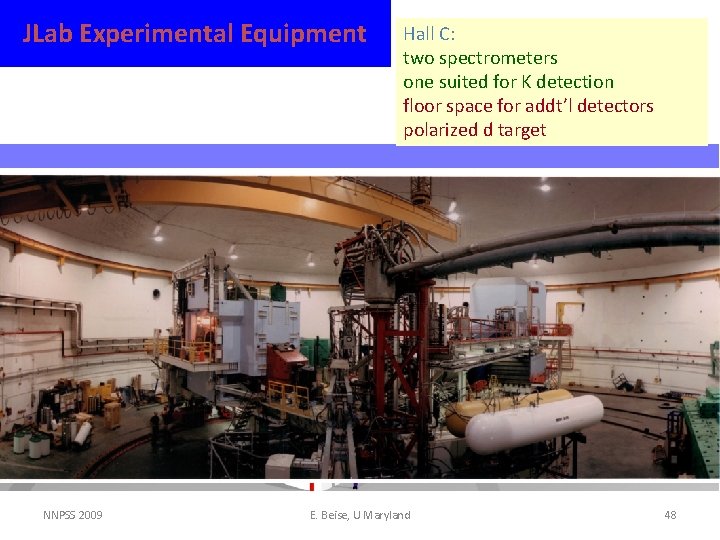
JLab Experimental Equipment Hall C: two spectrometers one suited for K detection floor space for addt’l detectors polarized d target G 0 detector NNPSS 2009 E. Beise, U Maryland 48
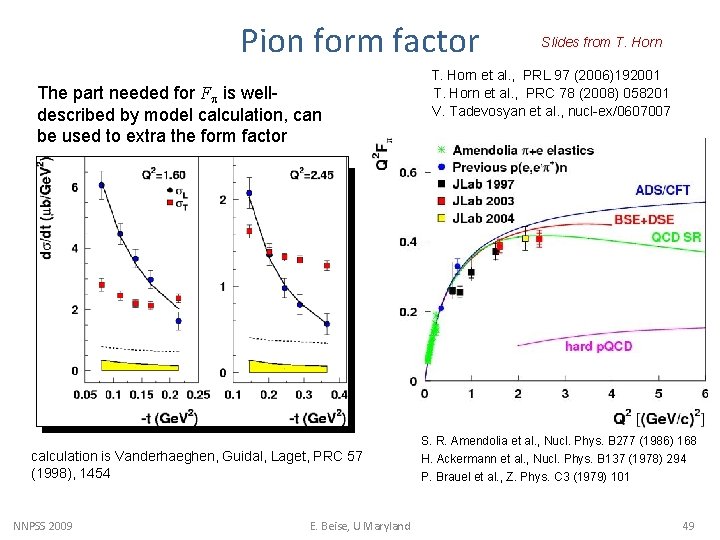
Pion form factor The part needed for Fp is welldescribed by model calculation, can be used to extra the form factor calculation is Vanderhaeghen, Guidal, Laget, PRC 57 (1998), 1454 NNPSS 2009 E. Beise, U Maryland Slides from T. Horn et al. , PRL 97 (2006)192001 T. Horn et al. , PRC 78 (2008) 058201 V. Tadevosyan et al. , nucl-ex/0607007 S. R. Amendolia et al. , Nucl. Phys. B 277 (1986) 168 H. Ackermann et al. , Nucl. Phys. B 137 (1978) 294 P. Brauel et al. , Z. Phys. C 3 (1979) 101 49
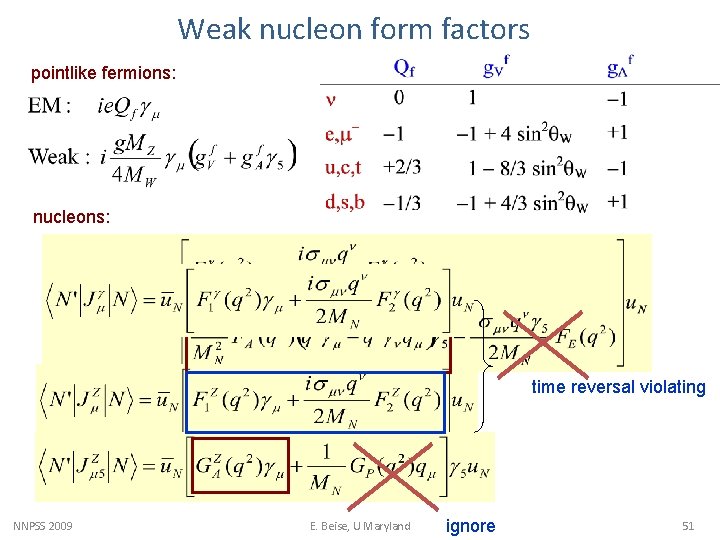
Weak nucleon form factors pointlike fermions: nucleons: time reversal violating NNPSS 2009 E. Beise, U Maryland ignore 51
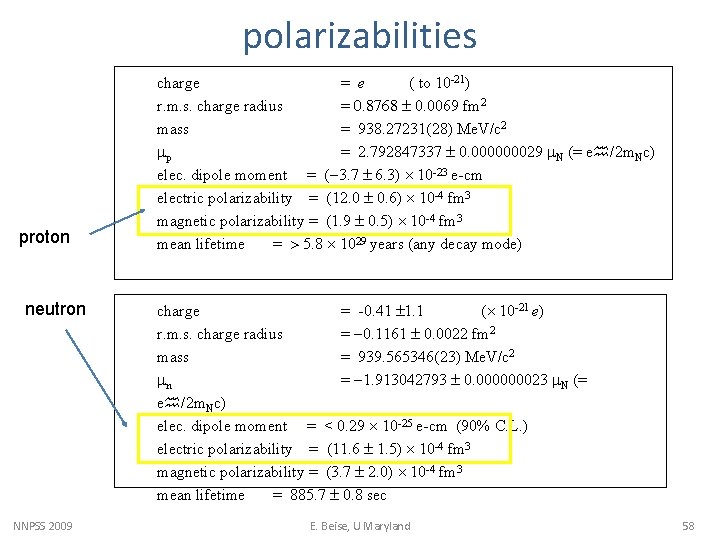
polarizabilities proton neutron NNPSS 2009 charge = e ( to 10 -21) r. m. s. charge radius = 0. 8768 0. 0069 fm 2 mass = 938. 27231(28) Me. V/c 2 mp = 2. 792847337 0. 000000029 m. N (= e /2 m. Nc) elec. dipole moment = (-3. 7 6. 3) 10 -23 e-cm electric polarizability = (12. 0 0. 6) 10 -4 fm 3 magnetic polarizability = (1. 9 0. 5) 10 -4 fm 3 mean lifetime = > 5. 8 1029 years (any decay mode) charge = -0. 41 1. 1 ( 10 -21 e) r. m. s. charge radius = -0. 1161 0. 0022 fm 2 mass = 939. 565346(23) Me. V/c 2 mn = -1. 913042793 0. 000000023 m. N (= e /2 m. Nc) elec. dipole moment = < 0. 29 10 -25 e-cm (90% C. L. ) electric polarizability = (11. 6 1. 5) 10 -4 fm 3 magnetic polarizability = (3. 7 2. 0) 10 -4 fm 3 mean lifetime = 885. 7 0. 8 sec E. Beise, U Maryland 58
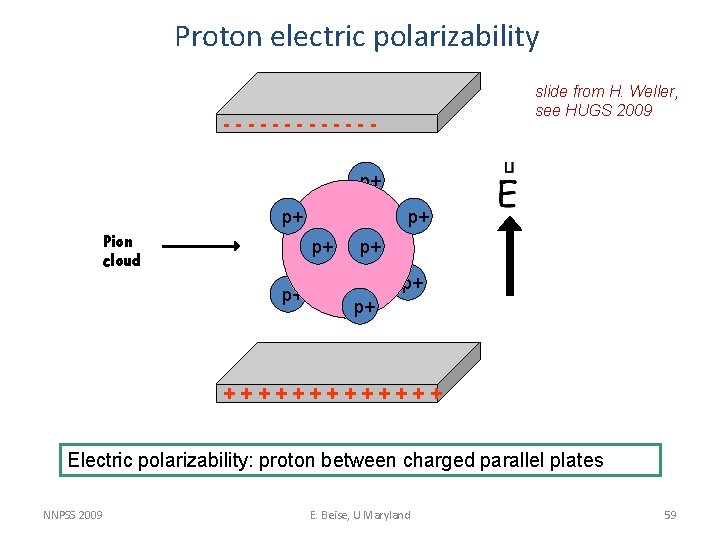
Proton electric polarizability slide from H. Weller, see HUGS 2009 ------p+ p+ Pion cloud p+ p+ p+ +++++++ Electric polarizability: proton between charged parallel plates NNPSS 2009 E. Beise, U Maryland 59
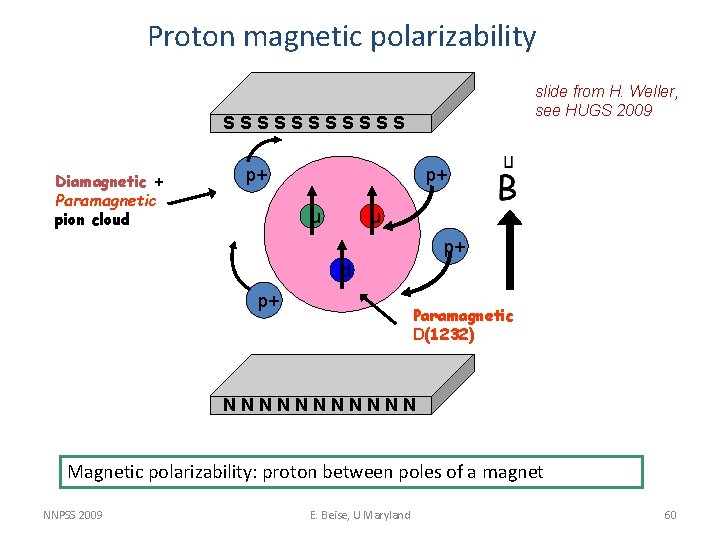
Proton magnetic polarizability slide from H. Weller, see HUGS 2009 SSSSSS Diamagnetic + Paramagnetic pion cloud p+ p+ u u p+ d p+ Paramagnetic D(1232) NNNNNN Magnetic polarizability: proton between poles of a magnet NNPSS 2009 E. Beise, U Maryland 60
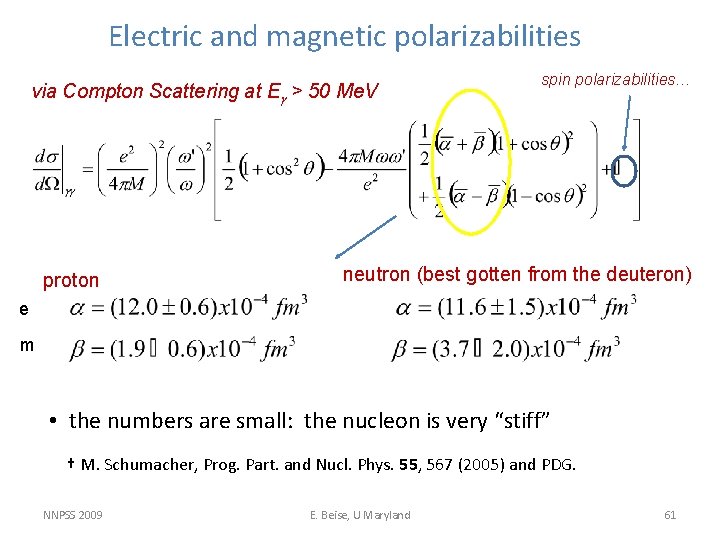
Electric and magnetic polarizabilities via Compton Scattering at Eg > 50 Me. V proton spin polarizabilities… neutron (best gotten from the deuteron) e m • the numbers are small: the nucleon is very “stiff” † M. Schumacher, Prog. Part. and Nucl. Phys. 55, 567 (2005) and PDG. NNPSS 2009 E. Beise, U Maryland 61
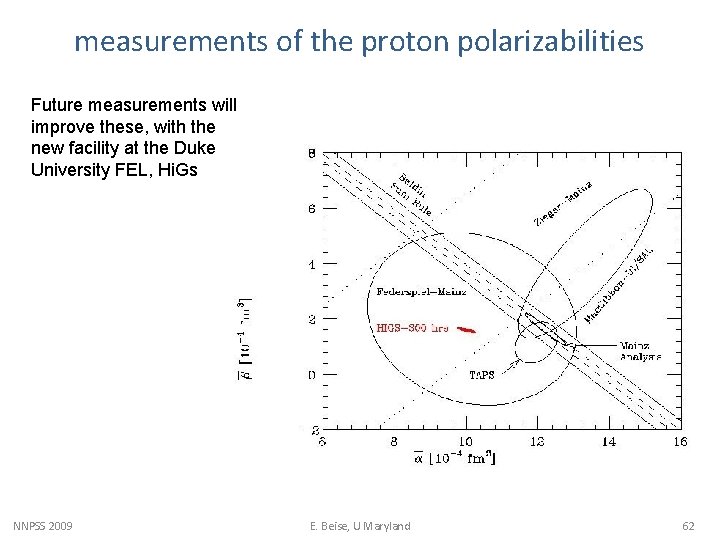
measurements of the proton polarizabilities Future measurements will improve these, with the new facility at the Duke University FEL, Hi. Gs NNPSS 2009 E. Beise, U Maryland 62
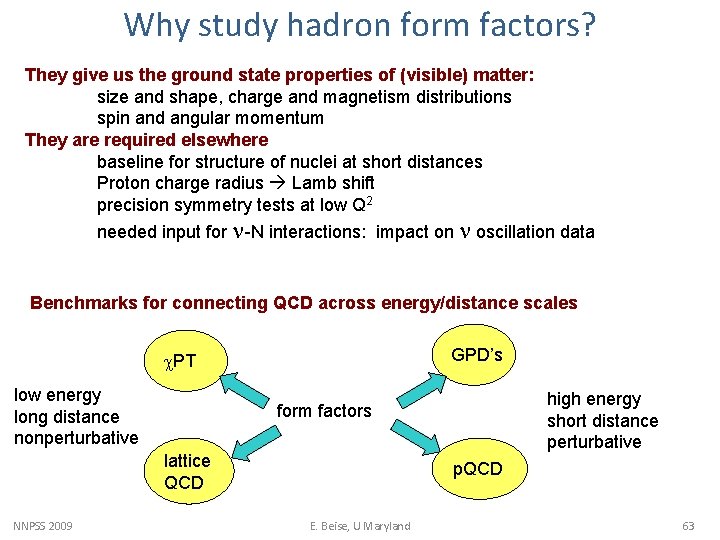
Why study hadron form factors? They give us the ground state properties of (visible) matter: size and shape, charge and magnetism distributions spin and angular momentum They are required elsewhere baseline for structure of nuclei at short distances Proton charge radius Lamb shift precision symmetry tests at low Q 2 needed input for n-N interactions: impact on n oscillation data Benchmarks for connecting QCD across energy/distance scales GPD’s c. PT low energy long distance nonperturbative lattice QCD NNPSS 2009 high energy short distance perturbative form factors p. QCD E. Beise, U Maryland 63
- Slides: 53