
DEEP EARTHQUAKES SPATIAL DISTRIBUTION NUMERICAL MODELING OF STRESSES
DEEP EARTHQUAKES SPATIAL DISTRIBUTION: NUMERICAL MODELING OF STRESSES WITHIN THE SUBDUCTING LITHOSPHERE Prasanna Gunawardana Gabriele Morra Department of Physics University of Louisiana at Lafayette
EARTHQUAKE DISTRIBUTION WITH DEPTH • Earthquakes hypocenters have been detected from the surface to the maximum depth of 650 km to 700 km • Hypocenters form a 2 D surface zone (“Wadati-Benioff”) within subducting slabs (Isacks & Molnar 1971) • It appears that there are no earthquakes in the lower mantle (Stark & Frohlich 1985)
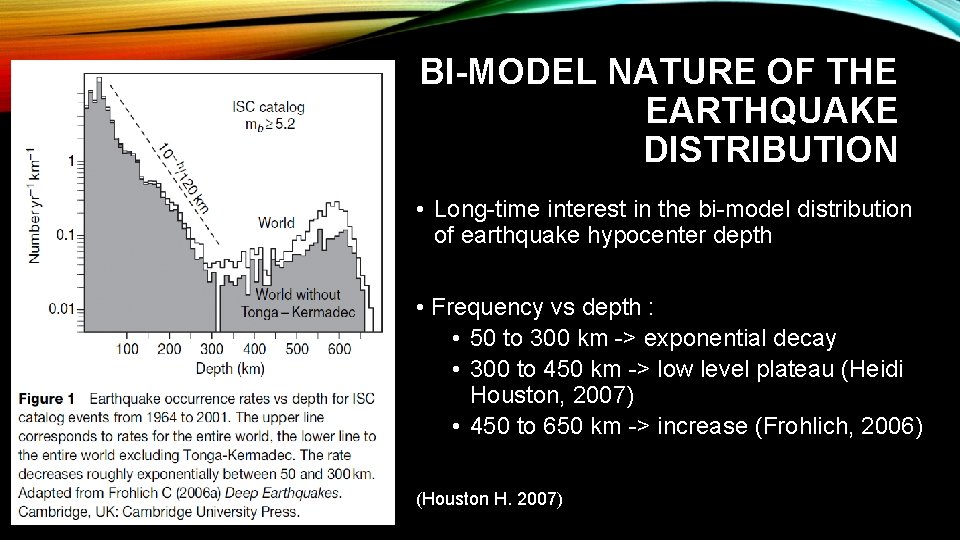
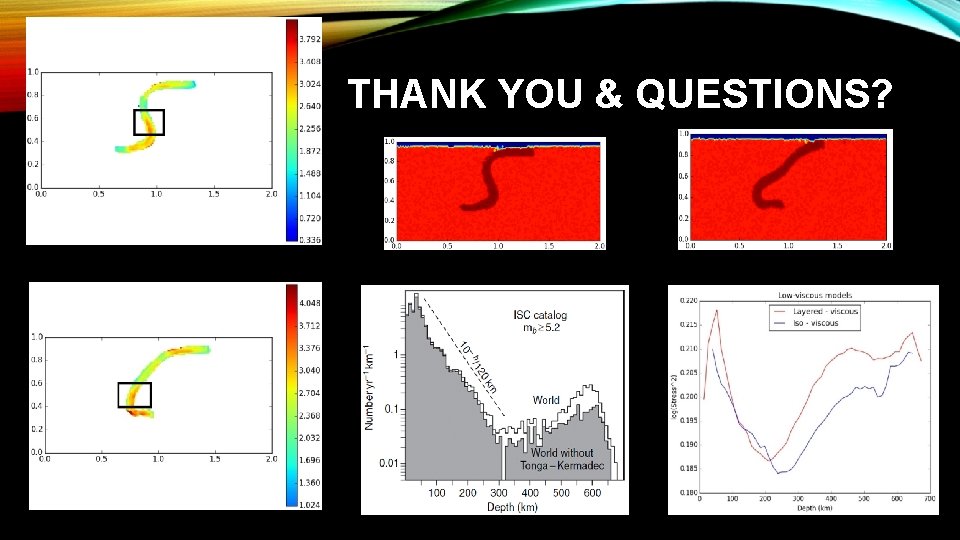
BI-MODEL NATURE OF THE EARTHQUAKE DISTRIBUTION • Long-time interest in the bi-model distribution of earthquake hypocenter depth • Frequency vs depth : • 50 to 300 km -> exponential decay • 300 to 450 km -> low level plateau (Heidi Houston, 2007) • 450 to 650 km -> increase (Frohlich, 2006) (Houston H. 2007)
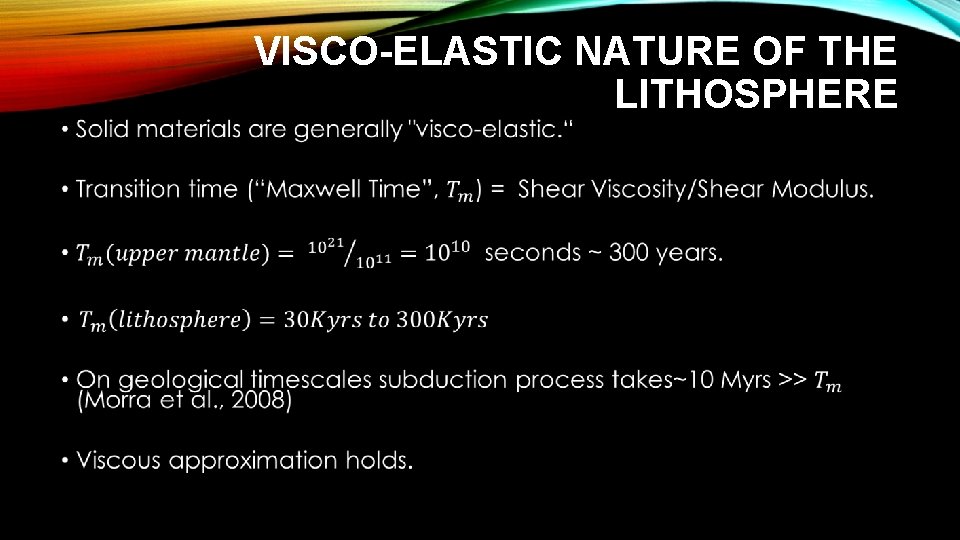
VISCO-ELASTIC NATURE OF THE LITHOSPHERE •
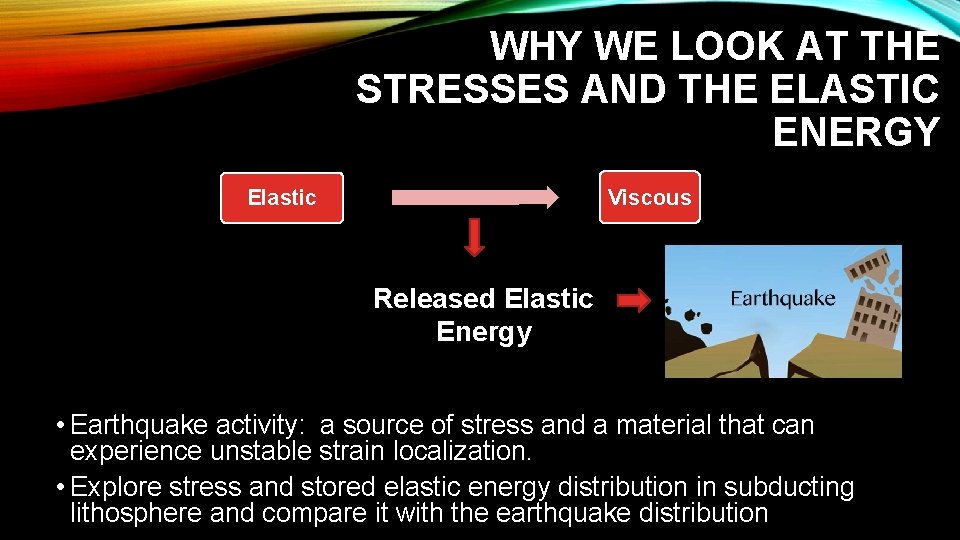
WHY WE LOOK AT THE STRESSES AND THE ELASTIC ENERGY Viscous Elastic Released Elastic Energy • Earthquake activity: a source of stress and a material that can experience unstable strain localization. • Explore stress and stored elastic energy distribution in subducting lithosphere and compare it with the earthquake distribution
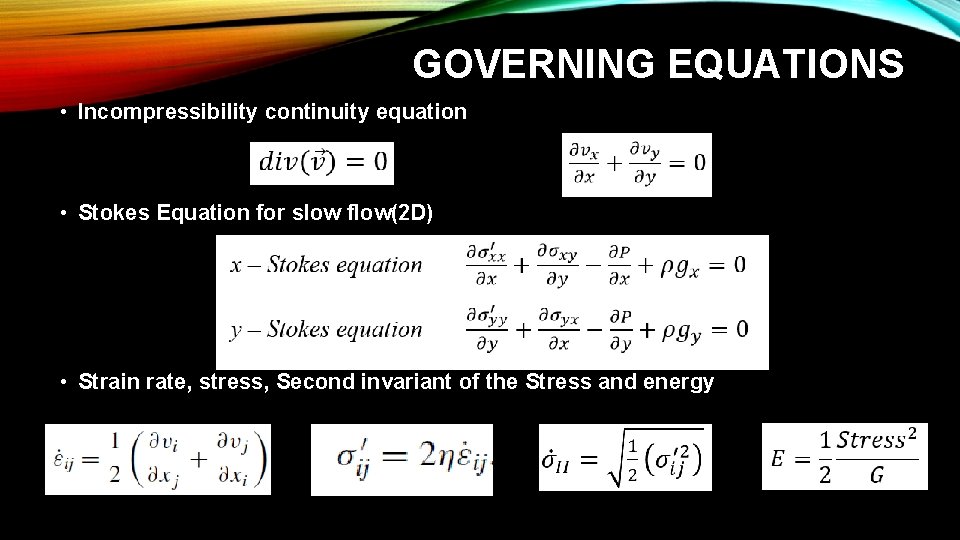
GOVERNING EQUATIONS • Incompressibility continuity equation • Stokes Equation for slow flow(2 D) • Strain rate, stress, Second invariant of the Stress and energy
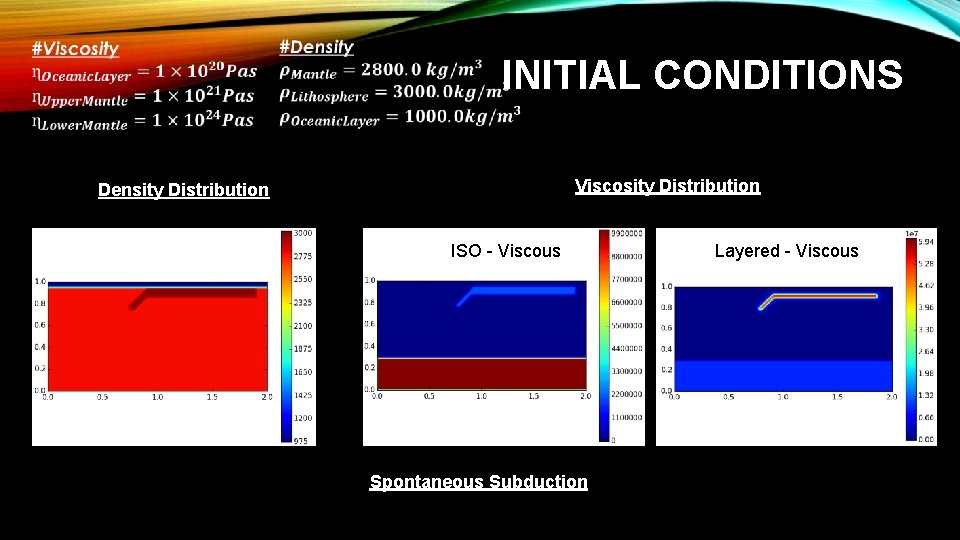
INITIAL CONDITIONS Viscosity Distribution Density Distribution ISO - Viscous Spontaneous Subduction Layered - Viscous
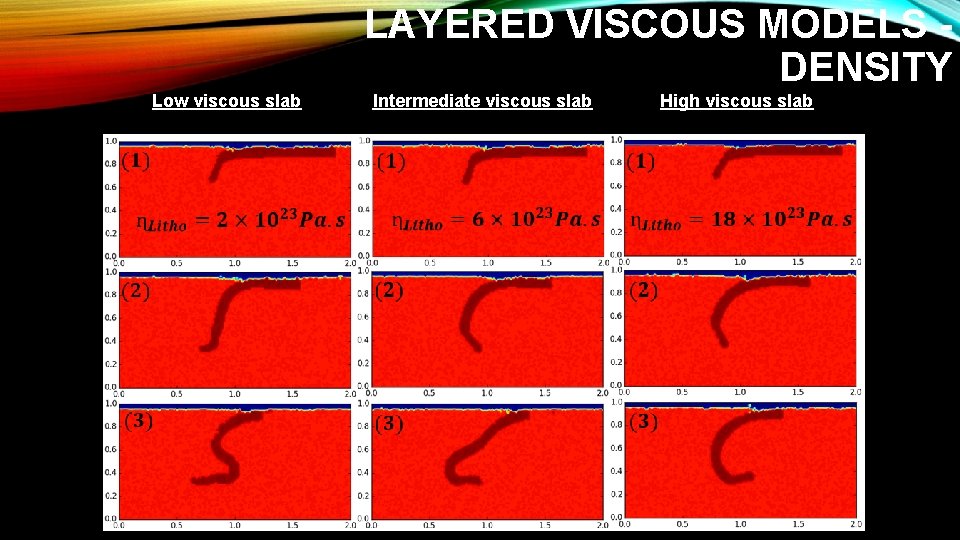
LAYERED VISCOUS MODELS DENSITY Low viscous slab Intermediate viscous slab High viscous slab
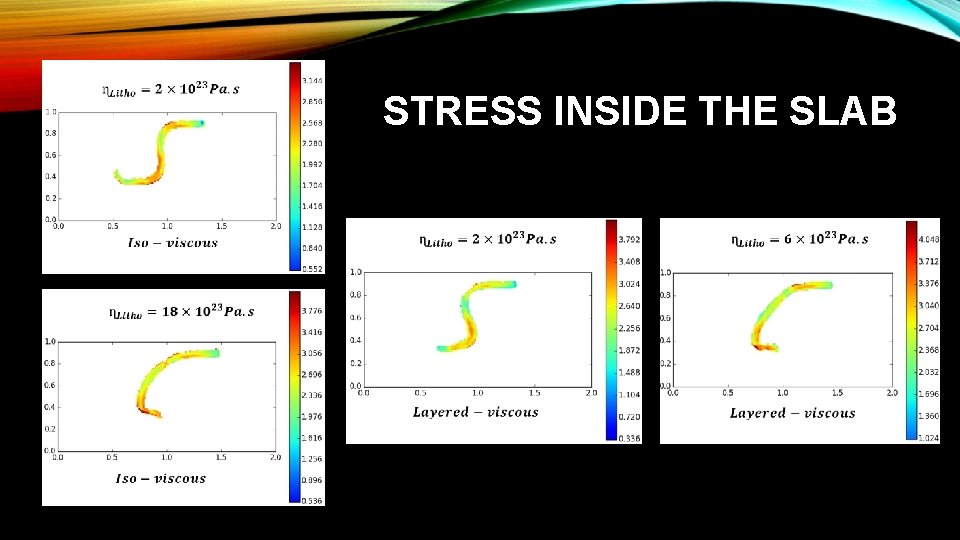
STRESS INSIDE THE SLAB
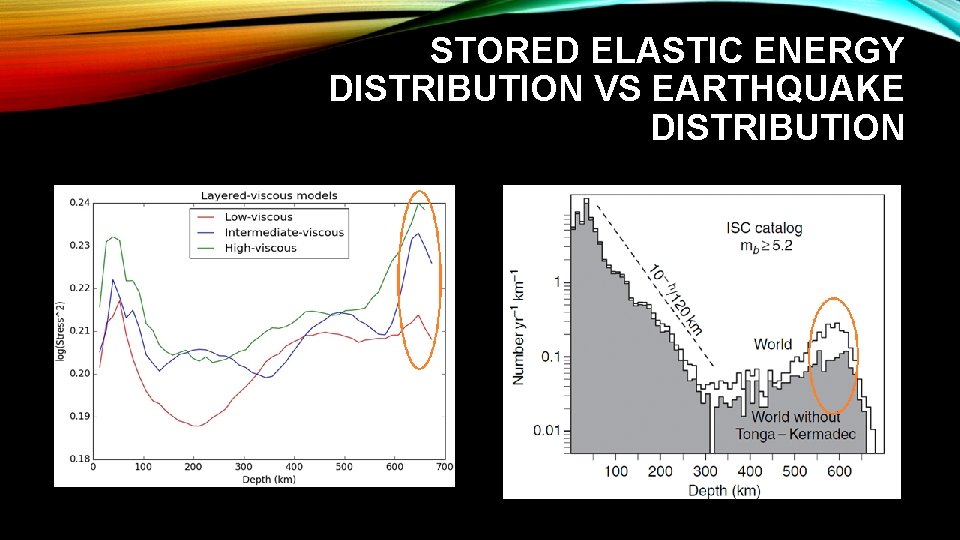
STORED ELASTIC ENERGY DISTRIBUTION VS EARTHQUAKE DISTRIBUTION
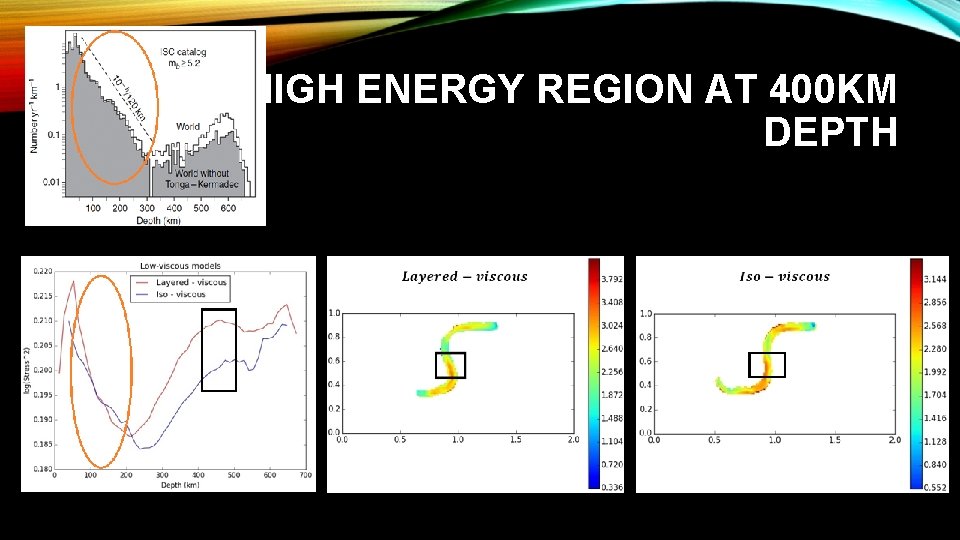
HIGH ENERGY REGION AT 400 KM DEPTH
FUTURE WORKS • Mid Continental Rift modeling using the Geodynamic techniques under the supervision of Professor Robert Moucha, Earth Science Department, Syracuse University.
CONCLUSIONS • New numerical model to calculate the stored elastic energy in the subducting lithosphere • Slab bending at the upper lower mantle transition zone causes the deeper peak of the earthquake frequency-depth distribution. • The decay of earthquake frequency-depth distribution at the intermediate depth is closer to exponential for a high viscous stiff core inside the slab. • Bending of the slab creates a “minor peak” at the 400 km depth for all the models with the layered-viscous lithospheric models.

ACKNOWLEDGEMENT • Professor Robert Moucha, Earth Science Department, Syracuse University
REFERENCES • Frohlich C (2006 a). , Deep Earthquakes. Cambridge, UK: Cambridge University Press. • Houston, H. , 2007. Deep earthquakes. In: Schubert, G. (Ed. ), Treatise on Geophysics, vol. 4. Elsevier, pp. 321– 350. • Isacks, B. & Molnar, P. , 1971. Distribution of stresses in the descending lithosphere from a global survey of focal-mechanism solutions of mantleearthquakes, Rev. geophys. Space Phys. , 9, 103– 174. • Morra, G. , Goes, S. , Fabio A. C. , 2008. Evidence of lower-mantle slab penetration phases in plate motions, Nature 451, 981 -984. • Myhill R. 2012. , Slab buckling and its effect on the distributions and focal mechanisms of deep-focus earthquakes Schemling H. , Kaus B. J. P. , Morra G. , Schmalholz S. M. , 2008, A benchmark comparison of spontaneous subduction models - Towards a free surface. • Stark, P. B. & Frohlich, C. , 1985. The depths of the deepest deep earthquakes, J. geophys. Res. , 90, 1859– 1870. • Taras V. Gerya , David A. Yuen, 2003, Characteristics-based marker-in-cell method with conservative finite-differences schemes for modeling geological flows with strongly variable transport properties. Physics of the Earth and Planetary Interiors 140 (2003) 293– 318
THANK YOU & QUESTIONS?
- Slides: 16