
Deep Dive into the Math Shifts Understanding Focus




- Slides: 35
Deep Dive into the Math Shifts Understanding Focus, Coherence, and Rigor in the Common Core State Standards for Mathematics
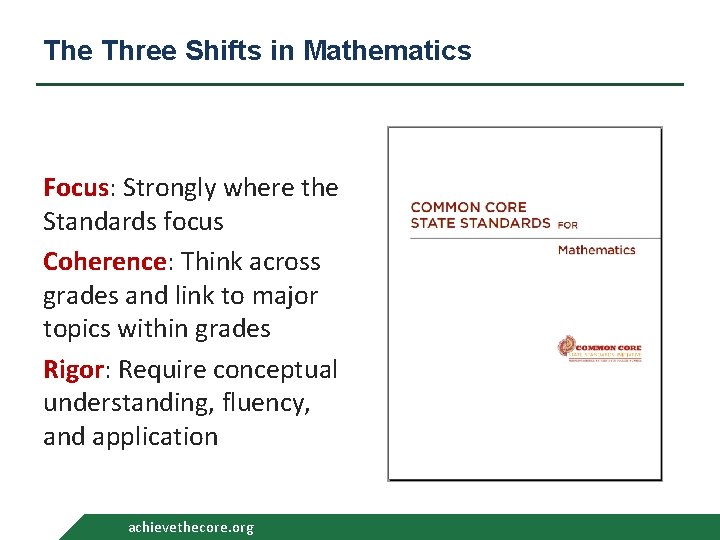
The Three Shifts in Mathematics Focus: Strongly where the Standards focus Coherence: Think across grades and link to major topics within grades Rigor: Require conceptual understanding, fluency, and application achievethecore. org
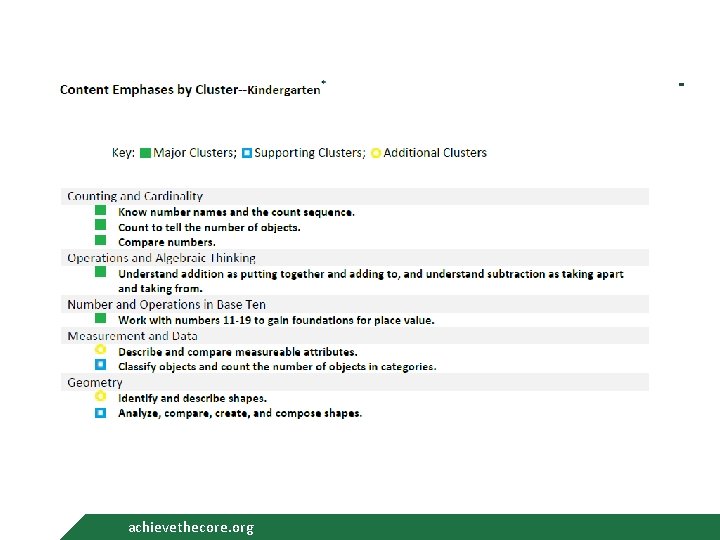
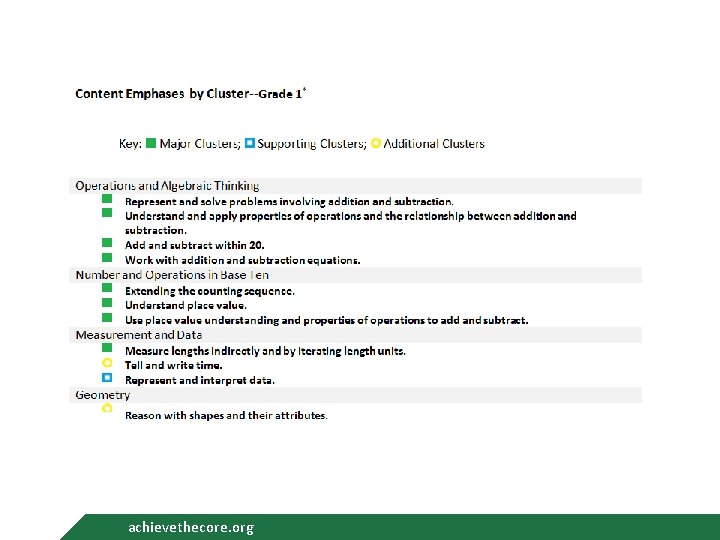
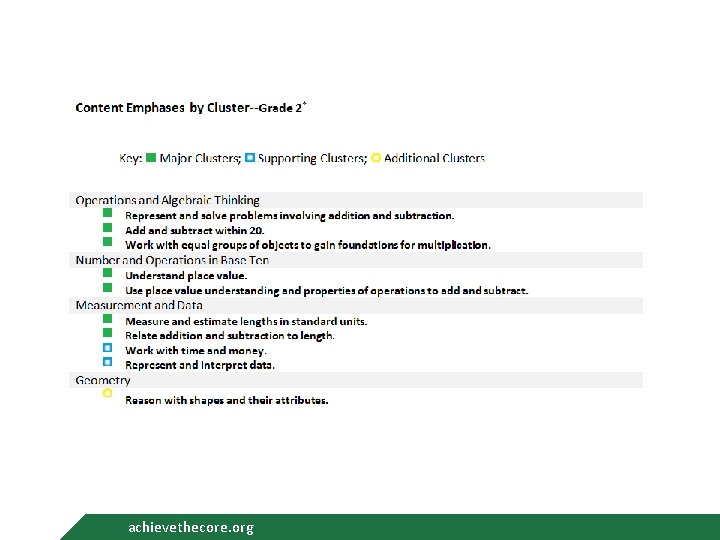
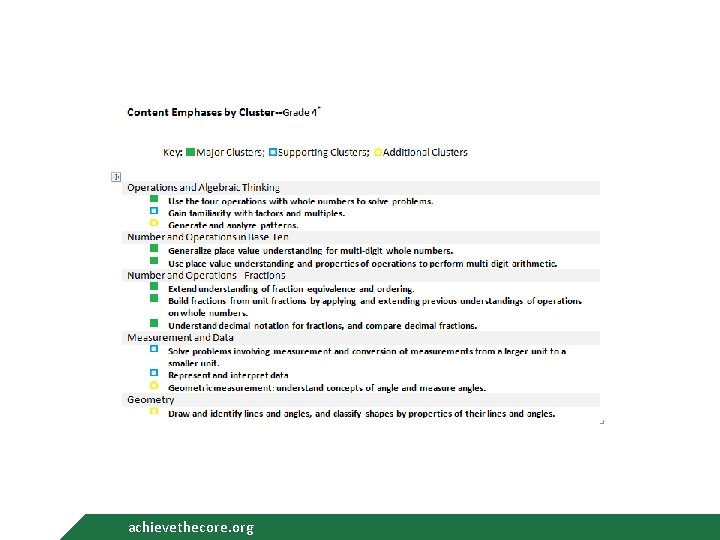
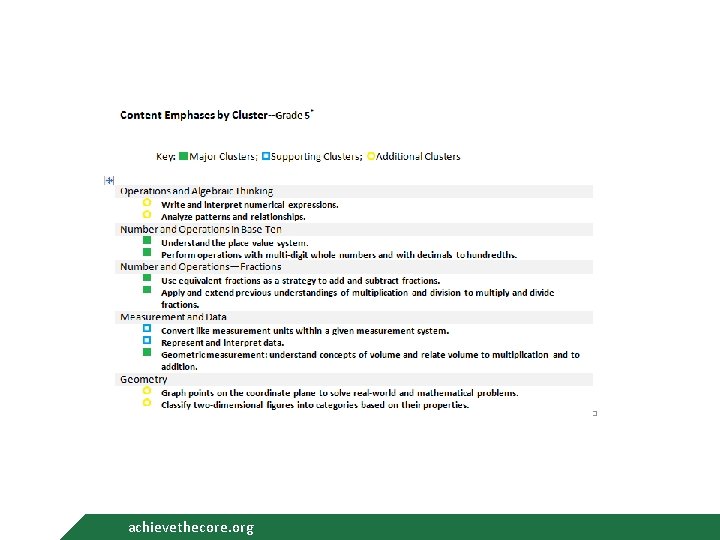
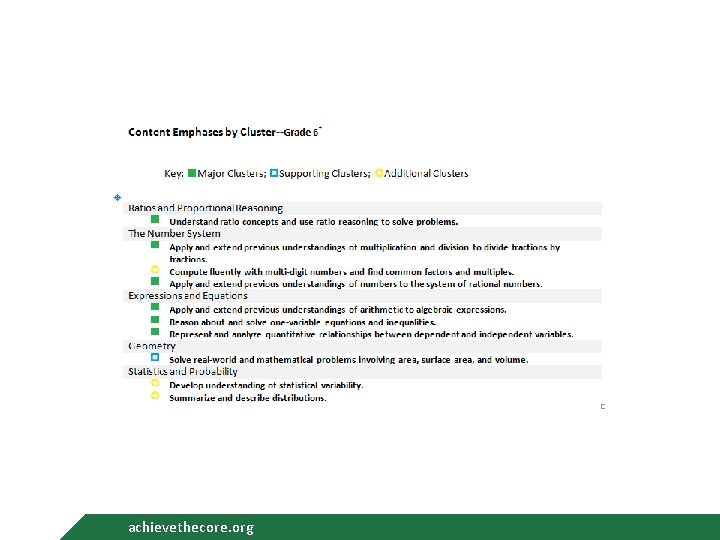
Focus on the Major Work of the Grade Two levels of focus: • What’s in/What’s out • The shape of the content that is in achievethecore. org
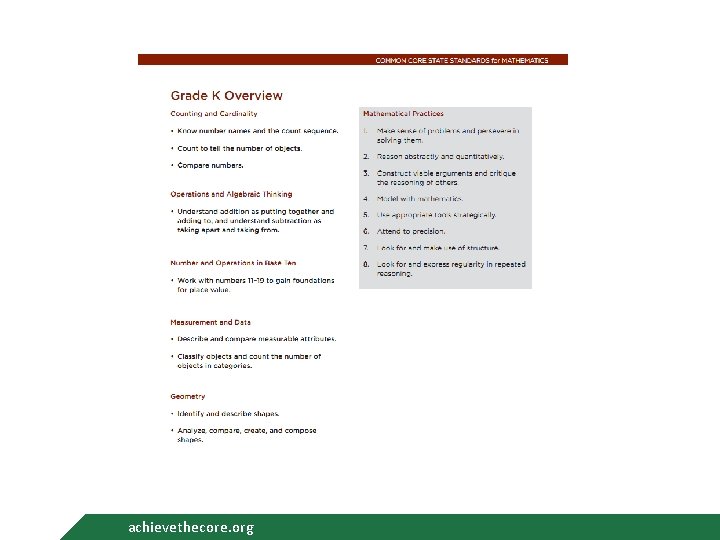
achievethecore. org
achievethecore. org
achievethecore. org
achievethecore. org
achievethecore. org
achievethecore. org
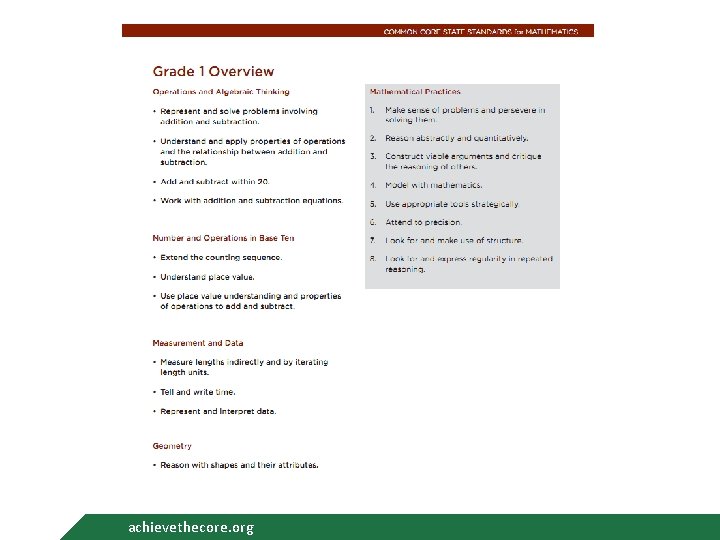
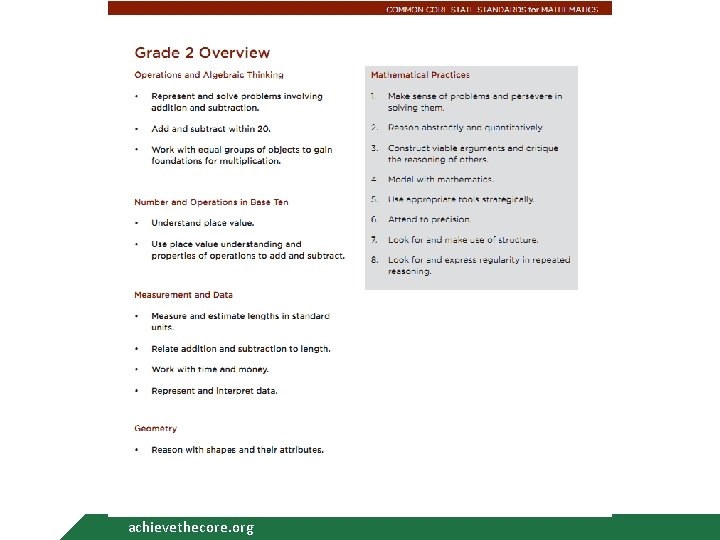
Engaging with the K-2 Content How would you summarize the major work of K-2? What would you have expected to be a part of the major work that is not? Give an example of how you would approach something differently in your teaching if you thought of it as supporting the major work, instead of being a separate, discrete topic. achievethecore. org
achievethecore. org
achievethecore. org
achievethecore. org
achievethecore. org
achievethecore. org
achievethecore. org
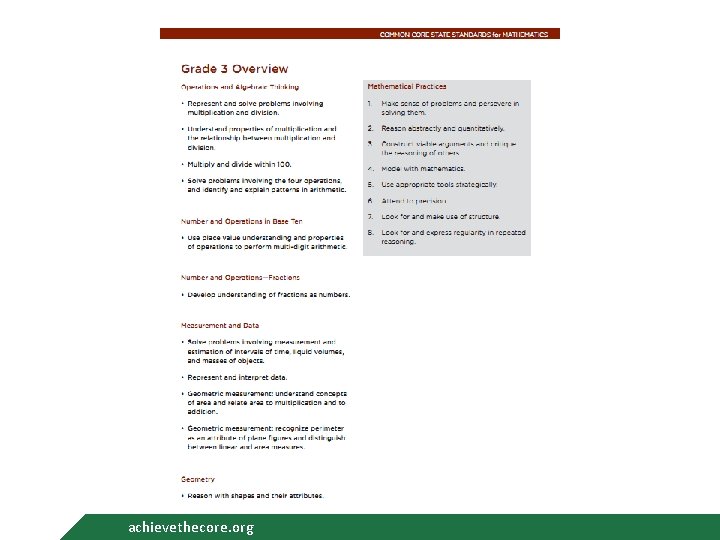
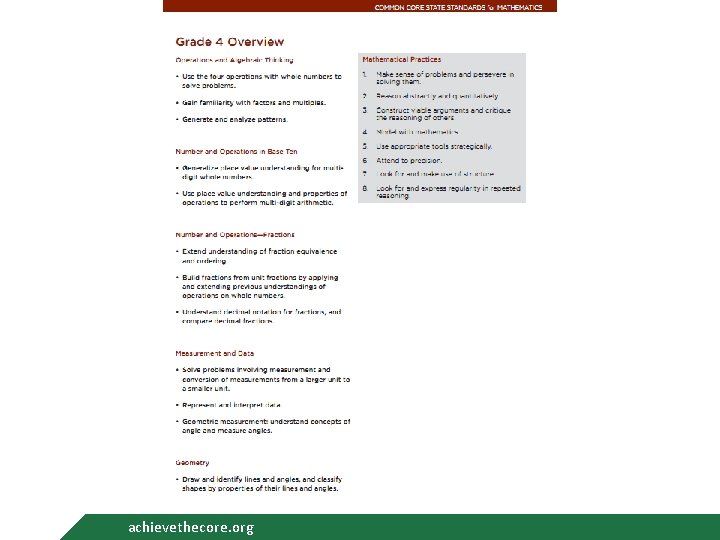
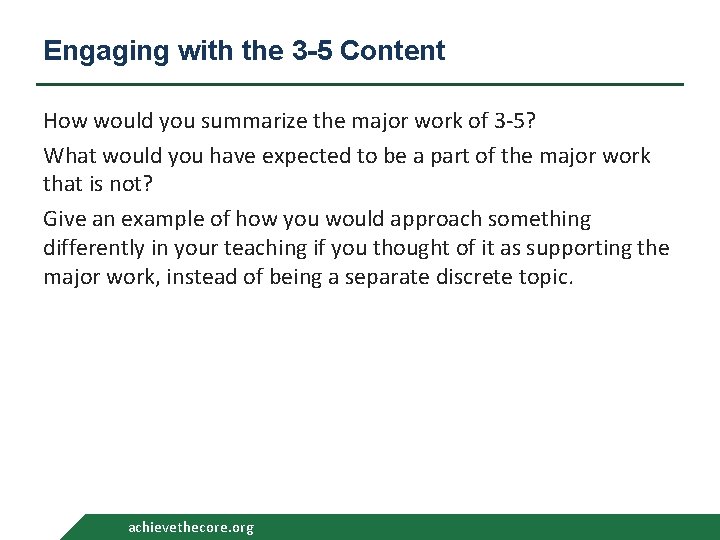
Engaging with the 3 -5 Content How would you summarize the major work of 3 -5? What would you have expected to be a part of the major work that is not? Give an example of how you would approach something differently in your teaching if you thought of it as supporting the major work, instead of being a separate discrete topic. achievethecore. org
achievethecore. org
achievethecore. org
achievethecore. org
achievethecore. org
achievethecore. org
achievethecore. org
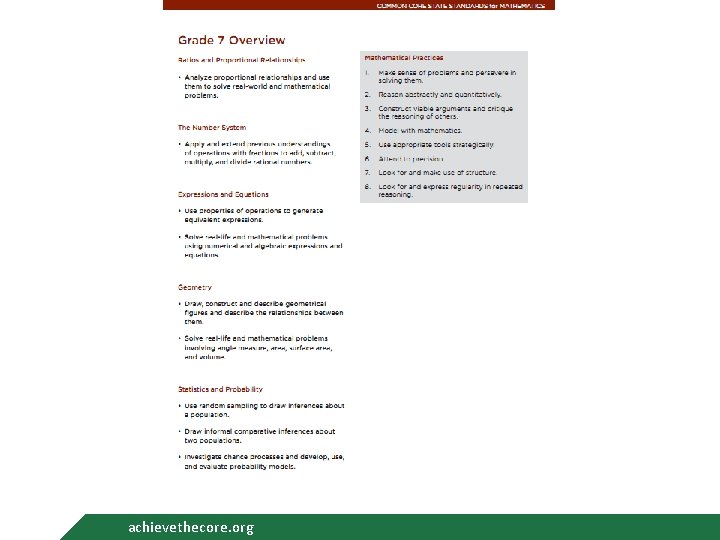
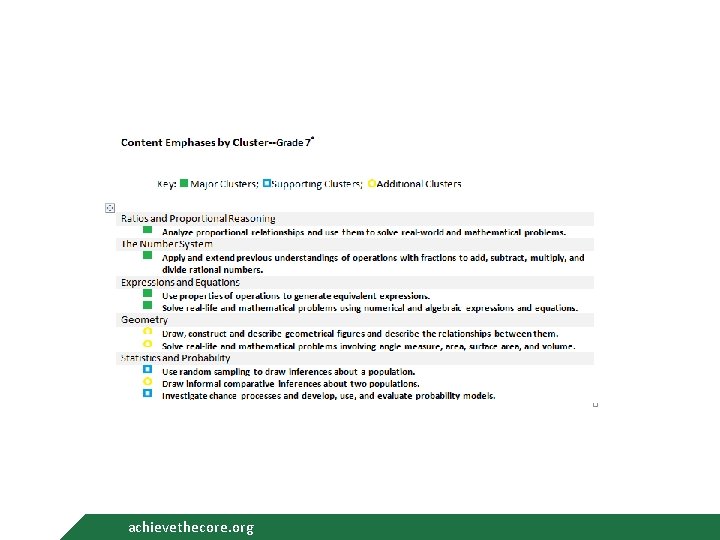
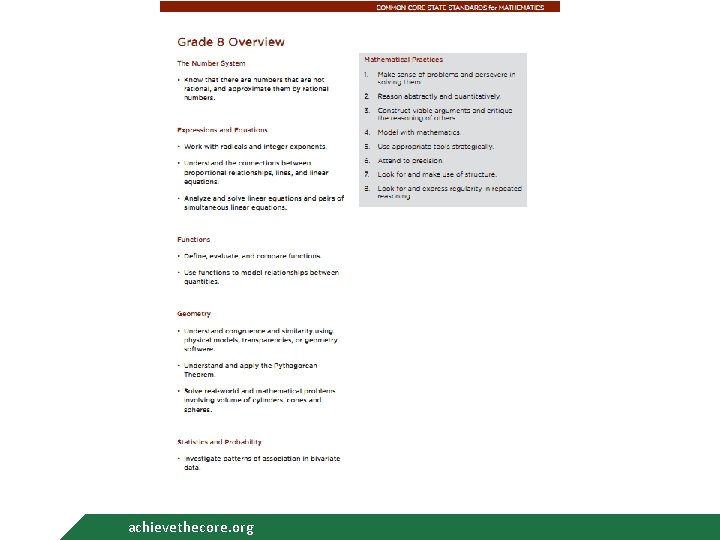
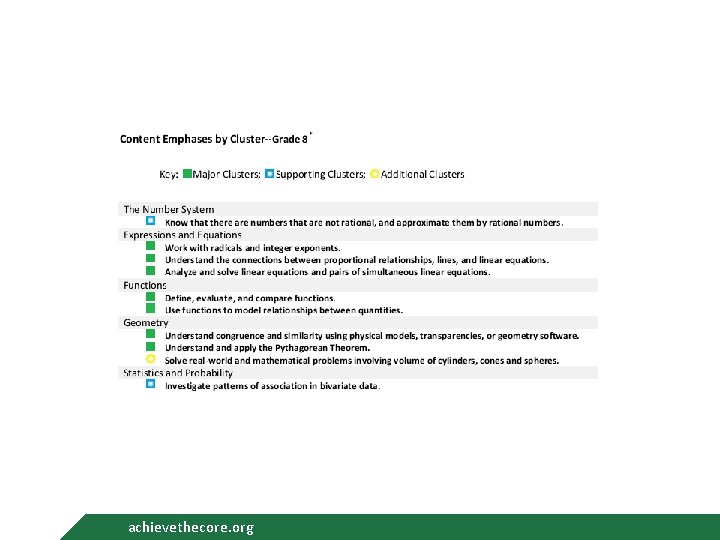
Engaging with the 6 -8 Content How would you summarize the major work of 6 -8? What would you have expected to be a part of the major work that is not? Give an example of how you would approach something differently in your teaching if you thought of it as supporting the major work, instead of being a separate, discrete topic. achievethecore. org
Coherence Across and Within Grades It’s about math making sense. The power and elegance of math comes out through carefully laid progressions and connections within grades. achievethecore. org
Looking For Coherence Within Grades Examples: § 1 st grade – 5 th grade: Represent and Interpret Data § 3 rd grade & 5 th grade: “Relate area (volume) to multiplication and to addition. ” § 6 th grade: Solve problems by graphing in all 4 quadrants. (1 st year of rational numbers) § 8 th grade: “Understand the connections between proportional relationships, lines and linear equations. ” achievethecore. org
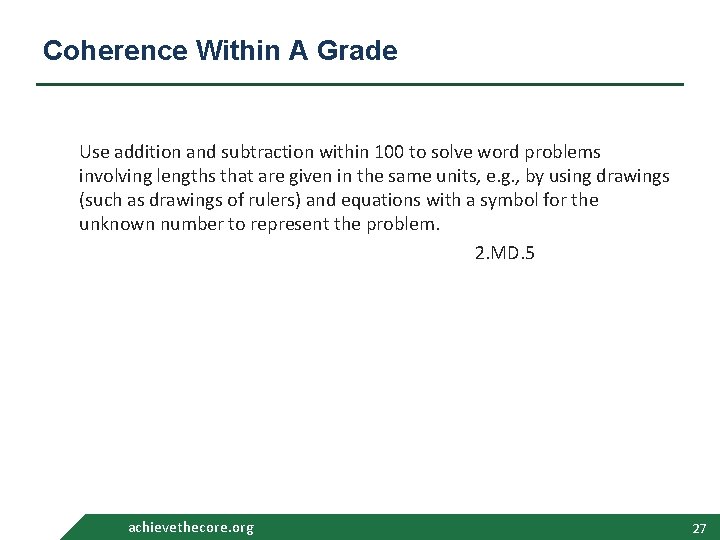
Coherence Within A Grade Use addition and subtraction within 100 to solve word problems involving lengths that are given in the same units, e. g. , by using drawings (such as drawings of rulers) and equations with a symbol for the unknown number to represent the problem. 2. MD. 5 achievethecore. org 27
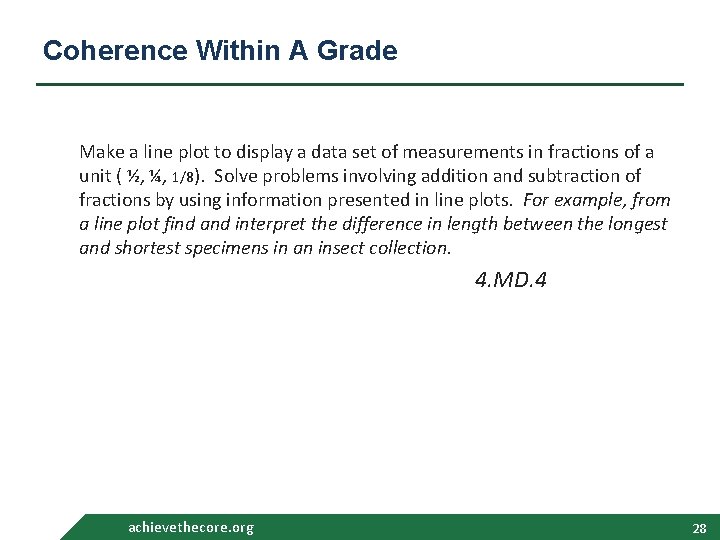
Coherence Within A Grade Make a line plot to display a data set of measurements in fractions of a unit ( ½, ¼, 1/8). Solve problems involving addition and subtraction of fractions by using information presented in line plots. For example, from a line plot find and interpret the difference in length between the longest and shortest specimens in an insect collection. 4. MD. 4 achievethecore. org 28
Looking for Coherence Across Grades Coherence is an important design element of the standards. “The Standards are not so much built from topics as they are woven out of progressions. ” Structure is the Standards, Publishers’ Criteria for Mathematics, Appendix achievethecore. org
Coherence Card Activity: Place the standards of each color under the appropriate grade (K-8). • Determine a “theme” for each color. • No grade has two of the same color card. • Some “themes” that have only a few cards might represent consecutive grades and some may not. • Read each card in it’s entirety to help determine placement. • Do not check your Standards until you and your colleagues agree on the final product. • Discuss horizontal and vertical observations with your partners. achievethecore. org 30
Rigor: Illustrations of Conceptual Understanding, Fluency, and Application Here rigor does not mean “hard problems. ” It’s a balance of three fundamental components that result in deep mathematical understanding. There must be variety in what students are asked to produce. achievethecore. org
Frequently Asked Questions § How can we assess fluency other than giving a timed test? § Is it really possible to assess conceptual understanding? What does it look like? § Aren’t the Common Core State Standards for Math all about application and meaningful tasks? achievethecore. org
Rigor Conceptual Understanding: 3. NF. 1 Understand a fraction 1/b as the quantity formed by 1 part when a whole is partitioned into b equal parts; understand a fraction a/b as the quantity formed by a parts of size 1/b. Procedural Skill and Fluency: 5. NBT. 5 Fluently multiply multi-digit whole numbers using the standard algorithm. Application: 7. NS. 3 Solve real-world and mathematical problems involving the four operations with rational numbers. achievethecore. org 33
Sample Problems Activity Work on a few problems from each aspect of rigor. Be prepared to discuss something you observed from one of the problems you tried. How can assessing (with tests, HW problems, exit tickets) all 3 aspects of rigor affect student learning? What does it look like when we are asking students to work on procedural skill and fluency, conceptual understanding, or application? achievethecore. org
The Three Shifts in Mathematics Focus: strongly where the standards focus Coherence: Think across grades and link to major topics within grades Rigor: Require conceptual understanding, fluency, and application achievethecore. org