
Deep Dive into the Math Shifts of the




- Slides: 45
Deep Dive into the Math Shifts of the Common Core State Standards Christa Lemily
Purpose of Today 1. Understand “how” to implement the common core as the writers intended 1. Give you resources to do this without guessing 2. “HOW” involves understanding 3 Shifts: 1. Focus (most important of the three) 2. Coherence 3. Rigor 3. Think vertically today – strategic grouping today www. achievethecore. org
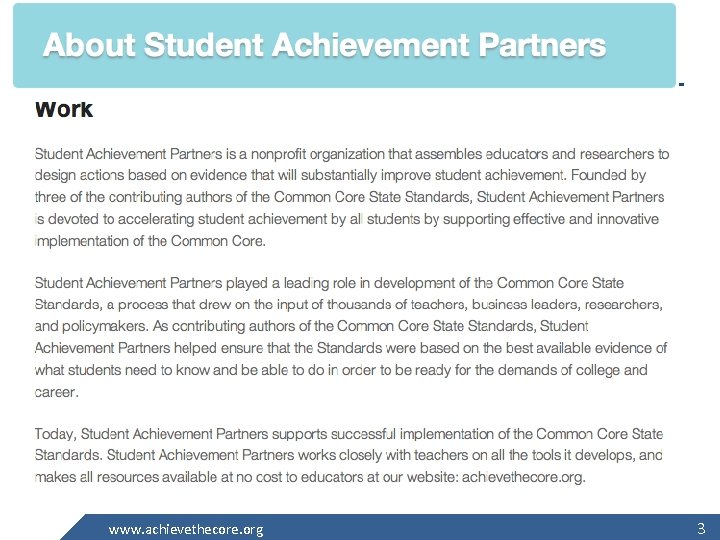
www. achievethecore. org 3
The Background of the Common Core Initiated by the National Governors Association (NGA) and Council of Chief State School Officers (CCSSO) with the following design principles: • Result in College and Career Readiness • Based on solid research and practice evidence • Fewer, higher, and clearer www. achievethecore. org 4
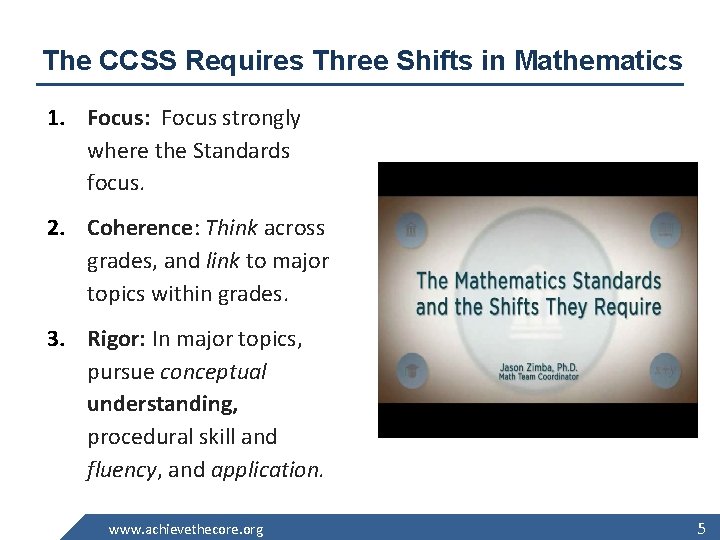
The CCSS Requires Three Shifts in Mathematics 1. Focus: Focus strongly where the Standards focus. 2. Coherence: Think across grades, and link to major topics within grades. 3. Rigor: In major topics, pursue conceptual understanding, procedural skill and fluency, and application. www. achievethecore. org 5
Shift #1: Focus Strongly where the Standards Focus • Significantly narrow the scope of content and deepen how time and energy is spent in the math classroom. • Focus deeply on what is emphasized in the standards, so that students gain strong foundations. www. achievethecore. org 6
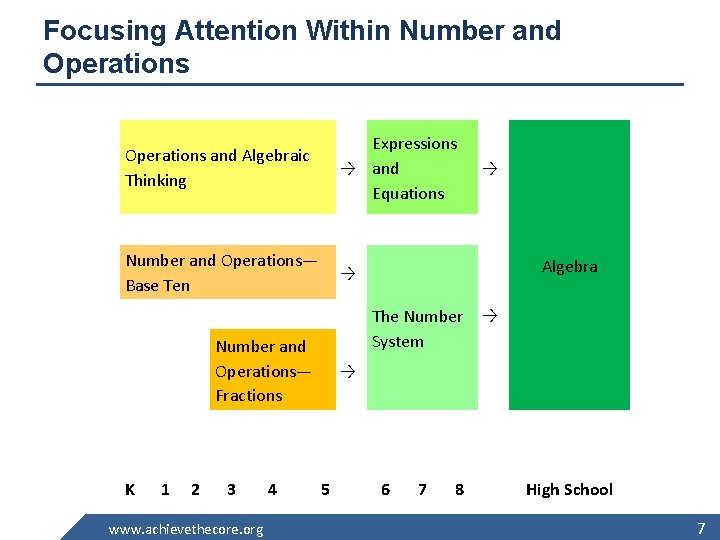
Focusing Attention Within Number and Operations and Algebraic Thinking Expressions → and Equations Number and Operations— Base Ten → K 1 2 3 www. achievethecore. org 4 Algebra The Number System Number and Operations— Fractions → → → 5 6 7 8 High School 7
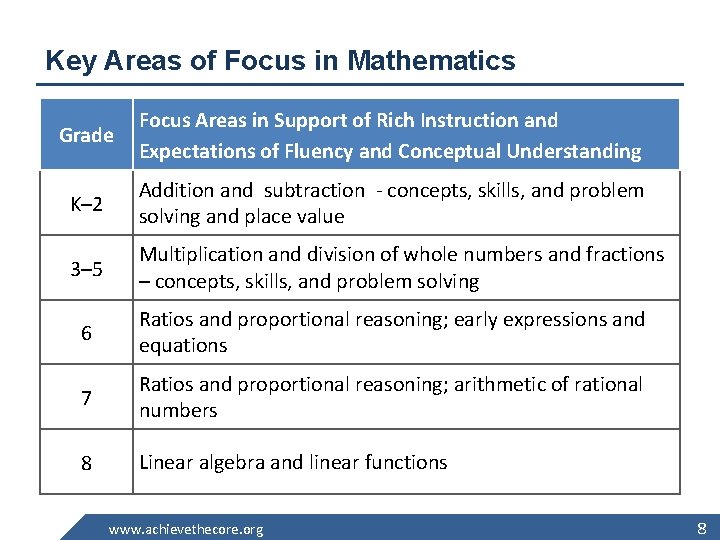
Key Areas of Focus in Mathematics Grade Focus Areas in Support of Rich Instruction and Expectations of Fluency and Conceptual Understanding K– 2 Addition and subtraction - concepts, skills, and problem solving and place value 3– 5 Multiplication and division of whole numbers and fractions – concepts, skills, and problem solving 6 Ratios and proportional reasoning; early expressions and equations 7 Ratios and proportional reasoning; arithmetic of rational numbers 8 Linear algebra and linear functions www. achievethecore. org 8
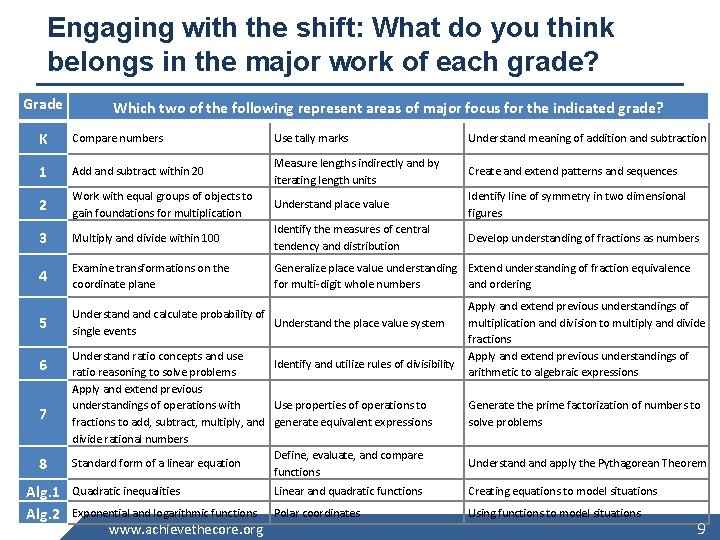
Engaging with the shift: What do you think belongs in the major work of each grade? Grade Which two of the following represent areas of major focus for the indicated grade? K Compare numbers Use tally marks Understand meaning of addition and subtraction 1 Add and subtract within 20 Measure lengths indirectly and by iterating length units Create and extend patterns and sequences 2 Work with equal groups of objects to gain foundations for multiplication Understand place value Identify line of symmetry in two dimensional figures 3 Multiply and divide within 100 Identify the measures of central tendency and distribution Develop understanding of fractions as numbers 4 Examine transformations on the coordinate plane Generalize place value understanding Extend understanding of fraction equivalence for multi-digit whole numbers and ordering 5 Understand calculate probability of Understand the place value system single events 6 7 8 Alg. 1 Alg. 2 Understand ratio concepts and use Identify and utilize rules of divisibility ratio reasoning to solve problems Apply and extend previous Use properties of operations to understandings of operations with fractions to add, subtract, multiply, and generate equivalent expressions divide rational numbers Define, evaluate, and compare Standard form of a linear equation functions Apply and extend previous understandings of multiplication and division to multiply and divide fractions Apply and extend previous understandings of arithmetic to algebraic expressions Generate the prime factorization of numbers to solve problems Understand apply the Pythagorean Theorem Quadratic inequalities Linear and quadratic functions Creating equations to model situations Exponential and logarithmic functions Polar coordinates Using functions to model situations www. achievethecore. org 9
www. achievethecore. org
www. achievethecore. org
www. achievethecore. org
www. achievethecore. org
www. achievethecore. org
www. achievethecore. org
www. achievethecore. org
www. achievethecore. org
www. achievethecore. org
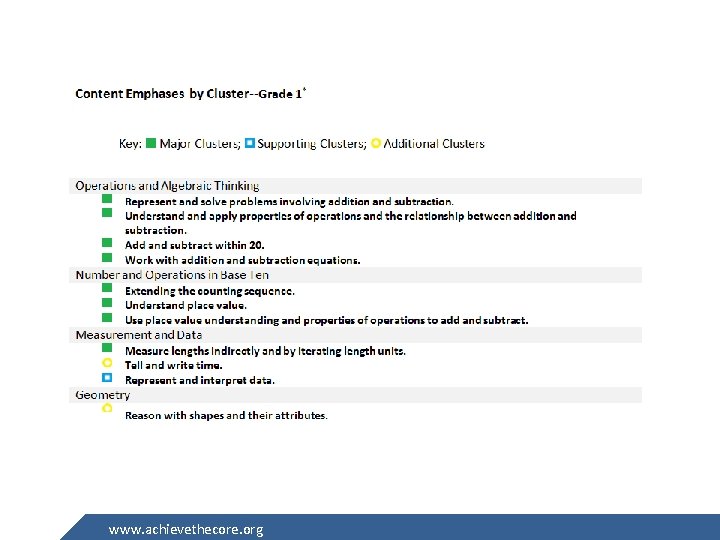
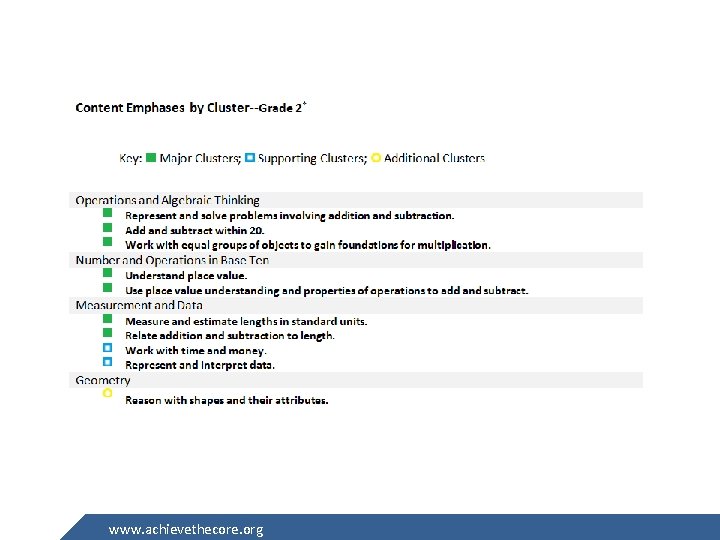
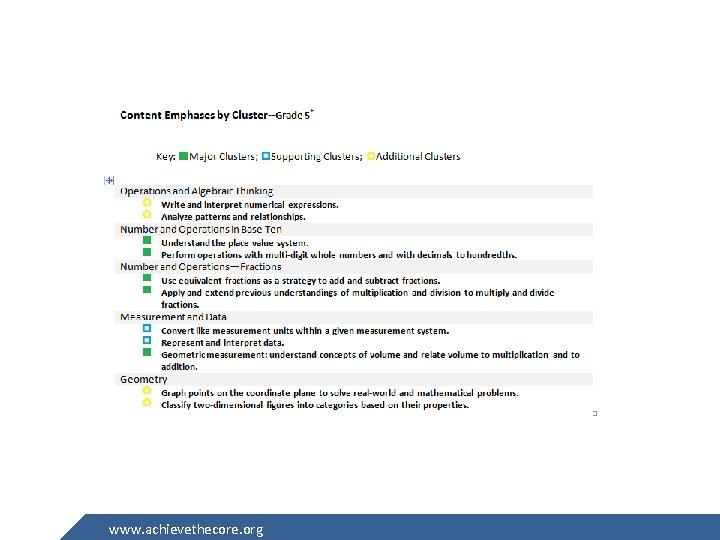
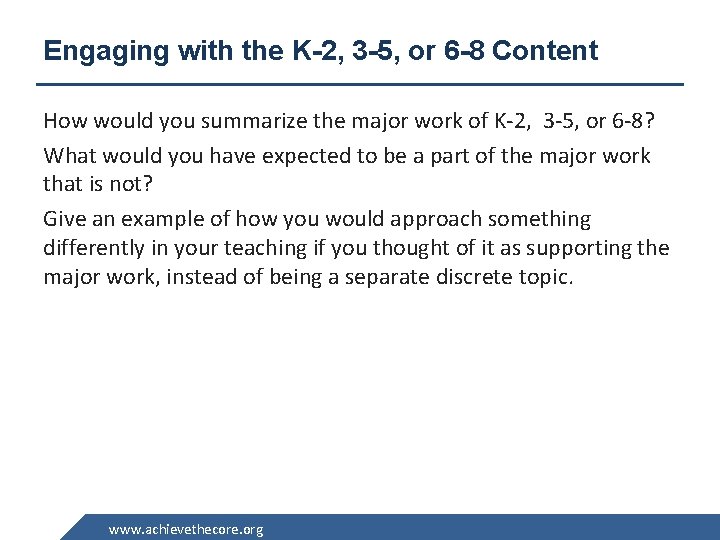
Engaging with the K-2, 3 -5, or 6 -8 Content How would you summarize the major work of K-2, 3 -5, or 6 -8? What would you have expected to be a part of the major work that is not? Give an example of how you would approach something differently in your teaching if you thought of it as supporting the major work, instead of being a separate discrete topic. www. achievethecore. org
Respond with Technology Laptop or I-Pad: Poll. Ev. com/lemily Text 295233 and your message to 37607 www. achievethecore. org 20
Shift #2: Coherence: Think Across Grades, and Link to Major Topics Within Grades • Carefully connect the learning within and across grades so that students can build new understanding on foundations built in previous years. • Begin to count on solid conceptual understanding of core content and build on it. Each standard is not a new event, but an extension of previous learning. www. achievethecore. org 21
www. achievethecore. org 22
Coherence: Think Across Grades Example: Fractions “The coherence and sequential nature of mathematics dictate the foundational skills that are necessary for the learning of algebra. The most important foundational skill not presently developed appears to be proficiency with fractions (including decimals, percents, and negative fractions). The teaching of fractions must be acknowledged as critically important and improved before an increase in student achievement in algebra can be expected. ” Final Report of the National Mathematics Advisory Panel (2008, p. 18) www. achievethecore. org 23
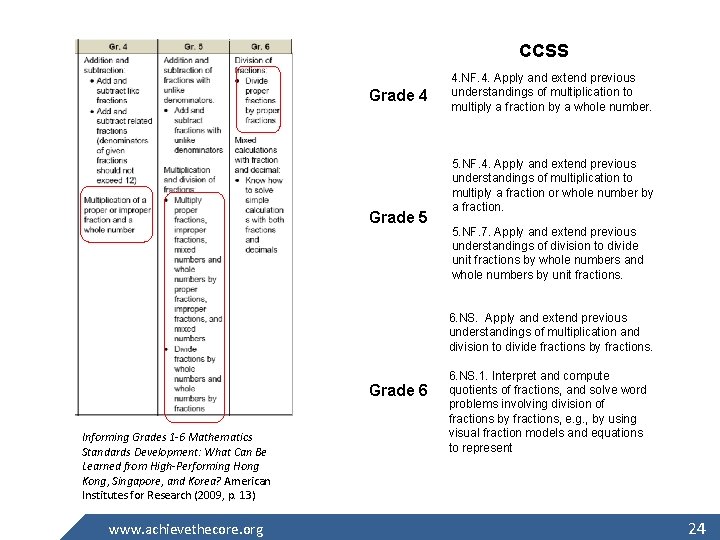
CCSS Grade 4 Grade 5 4. NF. 4. Apply and extend previous understandings of multiplication to multiply a fraction by a whole number. 5. NF. 4. Apply and extend previous understandings of multiplication to multiply a fraction or whole number by a fraction. 5. NF. 7. Apply and extend previous understandings of division to divide unit fractions by whole numbers and whole numbers by unit fractions. 6. NS. Apply and extend previous understandings of multiplication and division to divide fractions by fractions. Grade 6 Informing Grades 1 -6 Mathematics Standards Development: What Can Be Learned from High-Performing Hong Kong, Singapore, and Korea? American Institutes for Research (2009, p. 13) www. achievethecore. org 6. NS. 1. Interpret and compute quotients of fractions, and solve word problems involving division of fractions by fractions, e. g. , by using visual fraction models and equations to represent the problem. 24
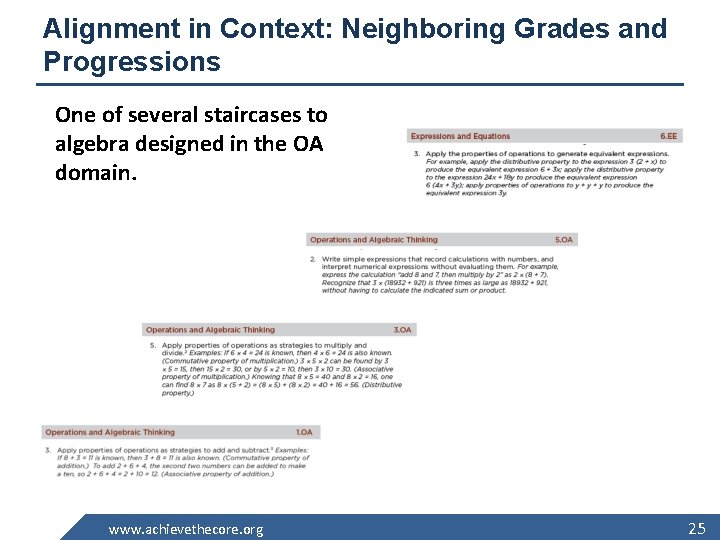
Alignment in Context: Neighboring Grades and Progressions One of several staircases to algebra designed in the OA domain. www. achievethecore. org 25
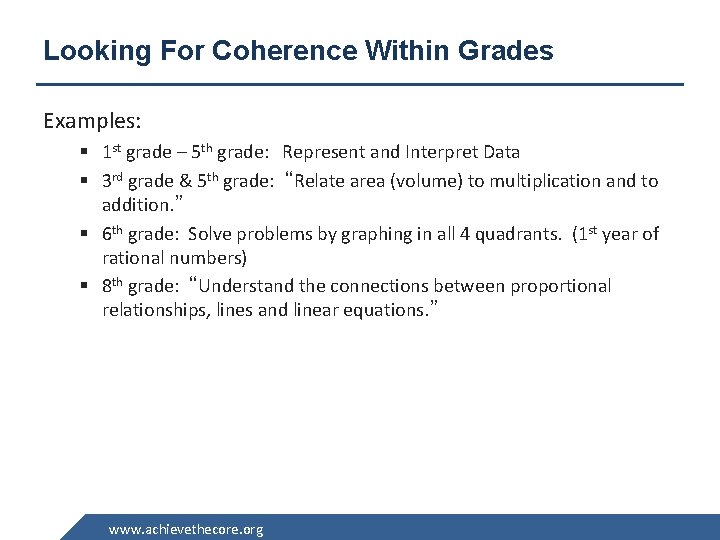
Looking For Coherence Within Grades Examples: § 1 st grade – 5 th grade: Represent and Interpret Data § 3 rd grade & 5 th grade: “Relate area (volume) to multiplication and to addition. ” § 6 th grade: Solve problems by graphing in all 4 quadrants. (1 st year of rational numbers) § 8 th grade: “Understand the connections between proportional relationships, lines and linear equations. ” www. achievethecore. org
Coherence Card Activity: Place the standards of each color under the appropriate grade (K-8). • Determine a “theme” for each color. • No grade has two of the same color card. • Some “themes” that have only a few cards might represent consecutive grades and some may not. • Read each card in it’s entirety to help determine placement. • Do not check your Standards until you and your colleagues agree on the final product. • Discuss horizontal and vertical observations with your partners. www. achievethecore. org 27
Respond with Technology Laptop or I-Pad: Poll. Ev. com/lemily Text 295233 and your message to 37607 www. achievethecore. org 28
Rigor • The CCSSM require a balance of: § Solid conceptual understanding § Procedural skill and fluency § Application of skills in problem solving situations • Pursuit of all three requires equal intensity in time, activities, and resources. www. achievethecore. org 29
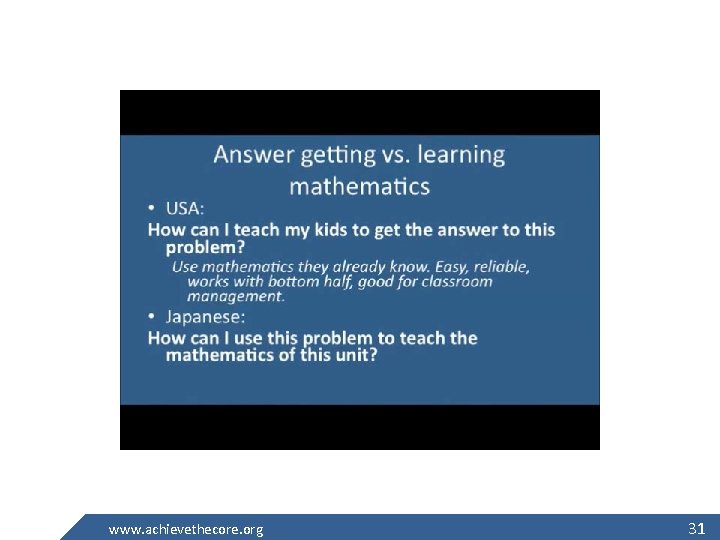
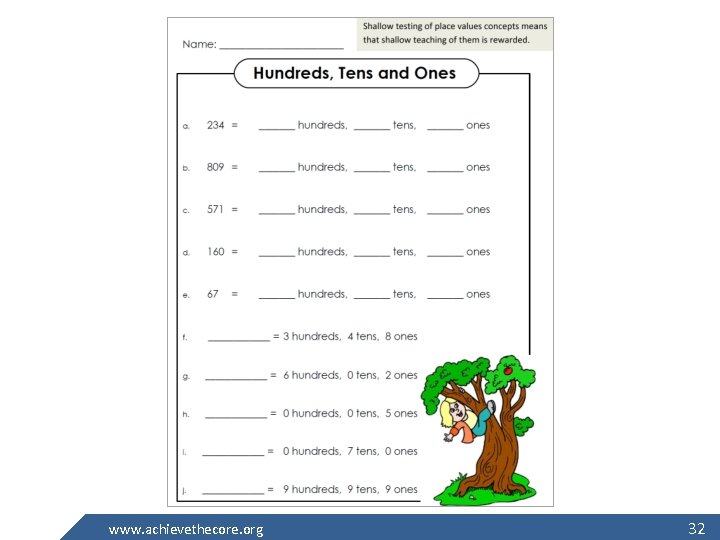
Solid Conceptual Understanding • Teach more than “how to get the answer” and instead support students’ ability to access concepts from a number of perspectives • Students are able to see math as more than a set of mnemonics or discrete procedures • Conceptual understanding supports the other aspects of rigor (fluency and application) www. achievethecore. org 30
www. achievethecore. org 31
www. achievethecore. org 32
Fluency • The standards require speed and accuracy in calculation. • Teachers structure class time and/or homework time for students to practice core functions such as singledigit multiplication so that they are more able to understand manipulate more complex concepts www. achievethecore. org 33
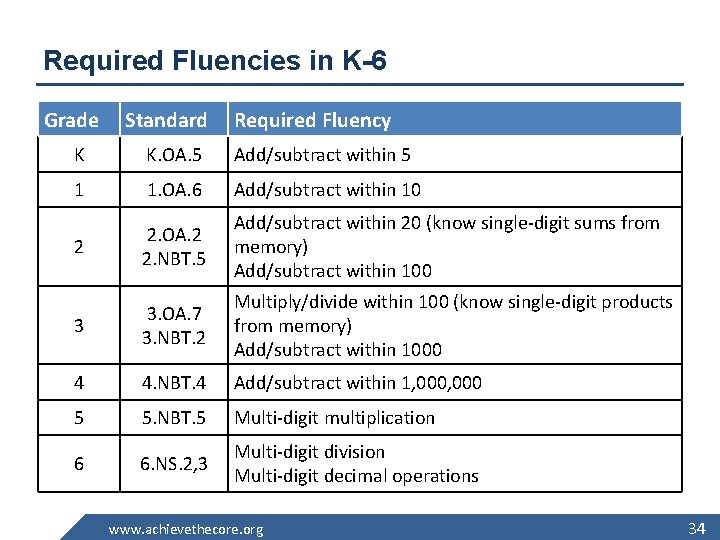
Required Fluencies in K-6 Grade Standard Required Fluency K K. OA. 5 Add/subtract within 5 1 1. OA. 6 Add/subtract within 10 2 2. OA. 2 2. NBT. 5 Add/subtract within 20 (know single-digit sums from memory) Add/subtract within 100 3 3. OA. 7 3. NBT. 2 Multiply/divide within 100 (know single-digit products from memory) Add/subtract within 1000 4 4. NBT. 4 Add/subtract within 1, 000 5 5. NBT. 5 Multi-digit multiplication 6 6. NS. 2, 3 Multi-digit division Multi-digit decimal operations www. achievethecore. org 34
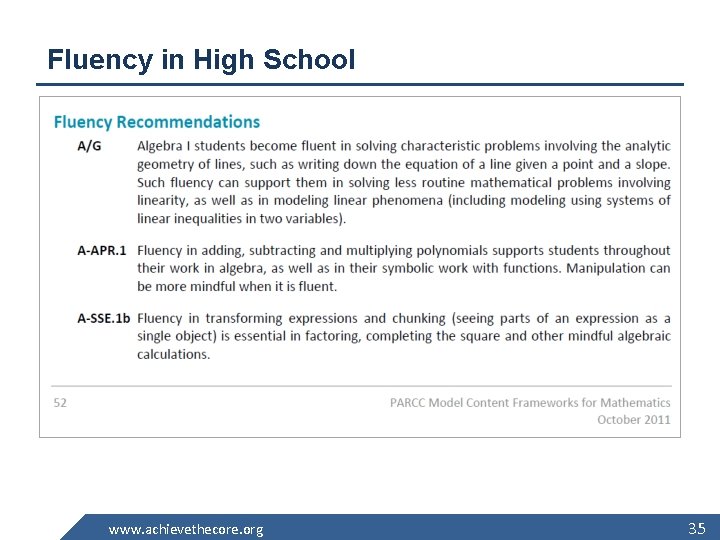
Fluency in High School www. achievethecore. org 35
Application • Students can use appropriate concepts and procedures for application even when not prompted to do so. • Teachers provide opportunities at all grade levels for students to apply math concepts in “real world” situations, recognizing this means different things in K-5, 6 -8, and HS. • Teachers in content areas outside of math, particularly science, ensure that students are using grade-levelappropriate math to make meaning of and access science content. www. achievethecore. org 36
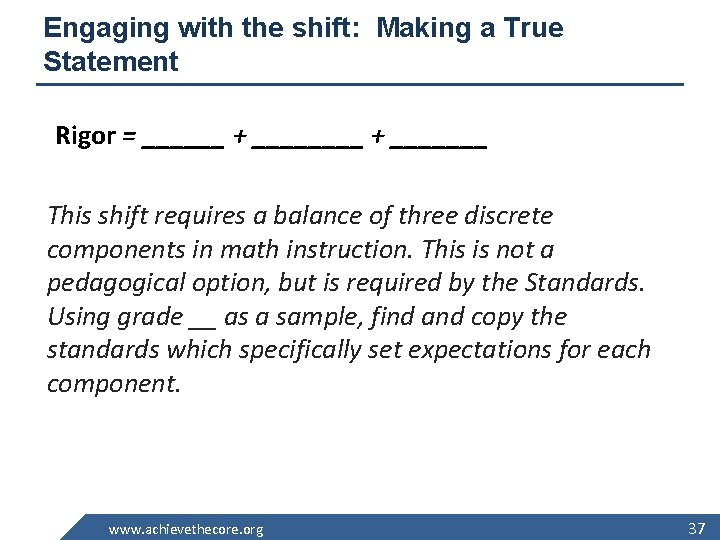
Engaging with the shift: Making a True Statement Rigor = ______ + _______ This shift requires a balance of three discrete components in math instruction. This is not a pedagogical option, but is required by the Standards. Using grade __ as a sample, find and copy the standards which specifically set expectations for each component. www. achievethecore. org 37
Respond with Technology Laptop or I-Pad: Poll. Ev. com/lemily Text 295233 and your message to 37607 www. achievethecore. org 38
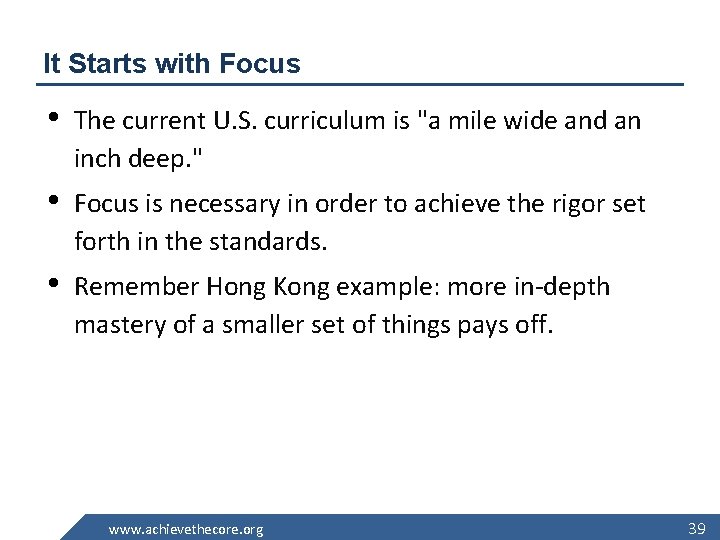
It Starts with Focus • The current U. S. curriculum is "a mile wide and an inch deep. " • Focus is necessary in order to achieve the rigor set forth in the standards. • Remember Hong Kong example: more in-depth mastery of a smaller set of things pays off. www. achievethecore. org 39
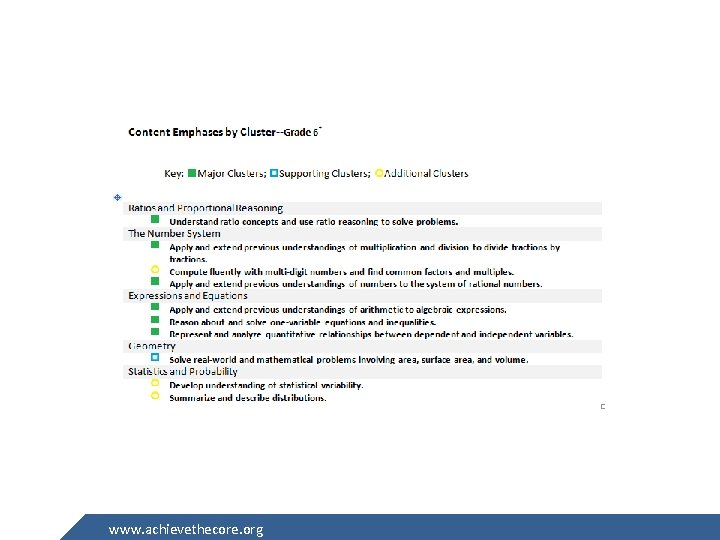
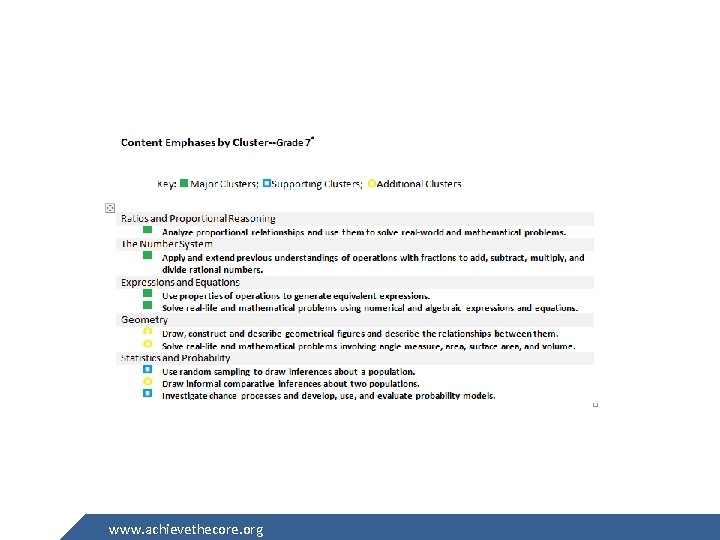
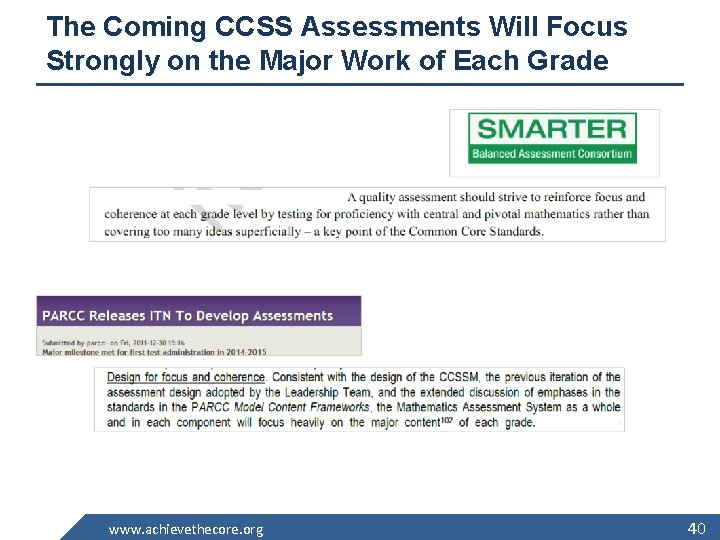
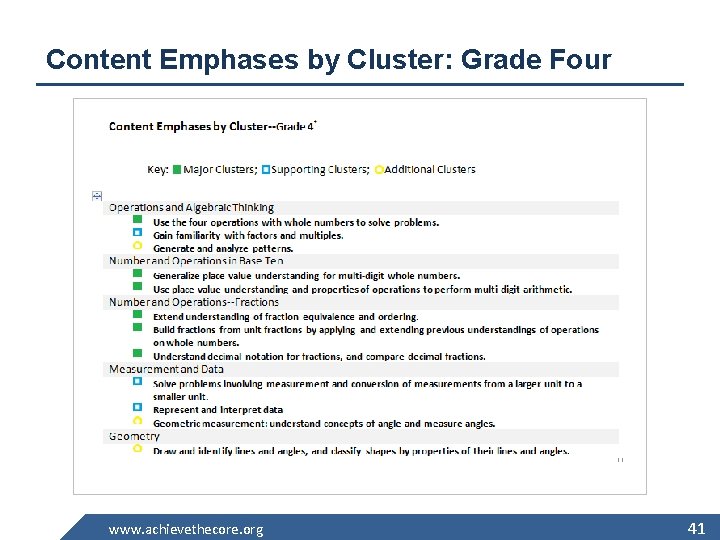
The Coming CCSS Assessments Will Focus Strongly on the Major Work of Each Grade www. achievethecore. org 40
Content Emphases by Cluster: Grade Four Key: Major Clusters; Clusters www. achievethecore. org Supporting Clusters; Additional 41
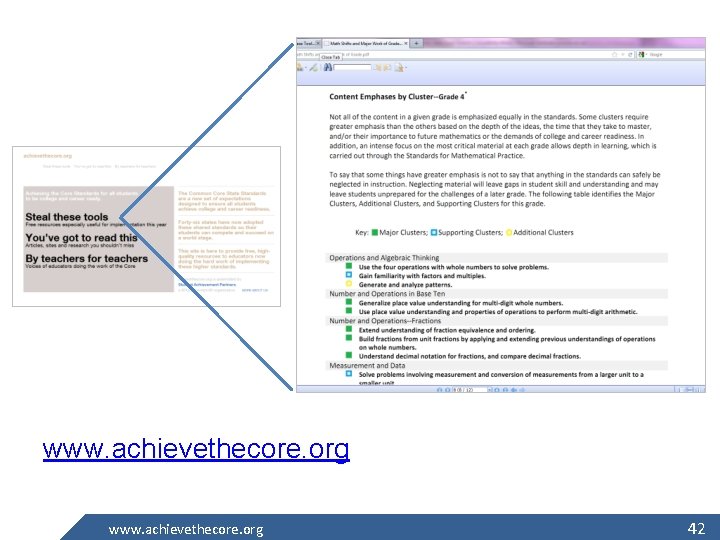
www. achievethecore. org 42
Cautions: Implementing the CCSS is. . . • • Not about “gap analysis” Not about buying a text series Not a march through the standards Not about breaking apart each standard www. achievethecore. org 43
Resources www. achievethecore. org www. illustrativemathematics. org http: //pta. org/parents/content. cfm? Item. Number=2583&RDtok en=51120&user. ID commoncoretools. me www. corestandards. org http: //parcconline. org/parcc-content-frameworks http: //www. smarterbalanced. org/k-12 -education/commoncore-state-standards-tools-resources/ www. achievethecore. org 44
Respond with Technology Laptop or I-Pad: Poll. Ev. com/lemily Text 295233 and your message to 37607 www. achievethecore. org 45