
Deductive Reasoning Why People Are Not Always Logical

- Slides: 28
Deductive Reasoning: Why People Are Not Always Logical Pavle Valerjev Department of psychology University of Zadar
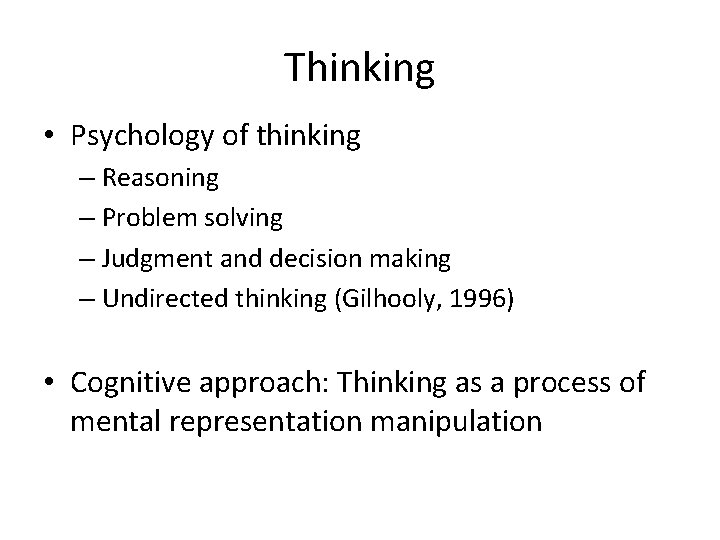
Thinking • Psychology of thinking – Reasoning – Problem solving – Judgment and decision making – Undirected thinking (Gilhooly, 1996) • Cognitive approach: Thinking as a process of mental representation manipulation
Deductive reasoning - examples Conditional reasoning Modus ponens (MP) Syllogistic reasoning Barbara (AAA) conclusion If it rains, the streets are wet. It rains. Therefore, the streets are wet. All men are mortal. Socrates is a man. Therefore, Socrates is mortal. Logical form of MP: Logical form: P <implicates> Q P Therefore, Q. Major premise: Ma. P Minor premise: Sa. M Conclusion: Sa. P
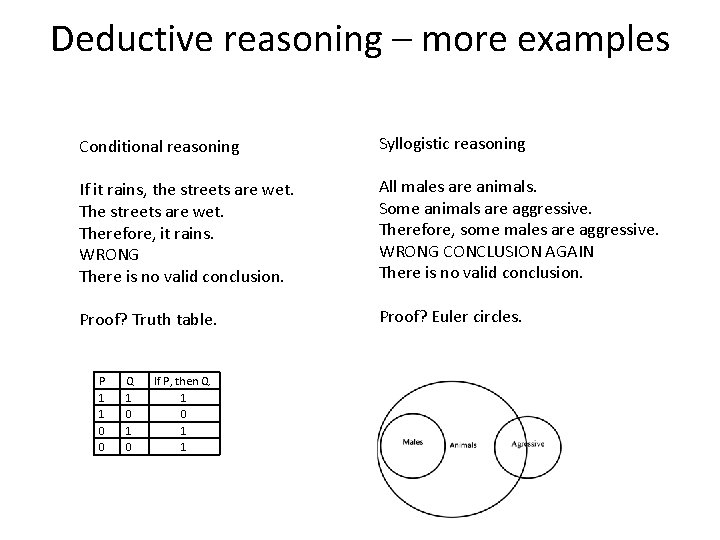
Deductive reasoning – more examples Conditional reasoning Syllogistic reasoning If it rains, the streets are wet. Therefore, it rains. WRONG There is no valid conclusion. All males are animals. Some animals are aggressive. Therefore, some males are aggressive. WRONG CONCLUSION AGAIN There is no valid conclusion. Proof? Truth table. Proof? Euler circles. P 1 1 0 0 Q 1 0 If P, then Q. 1 0 1 1
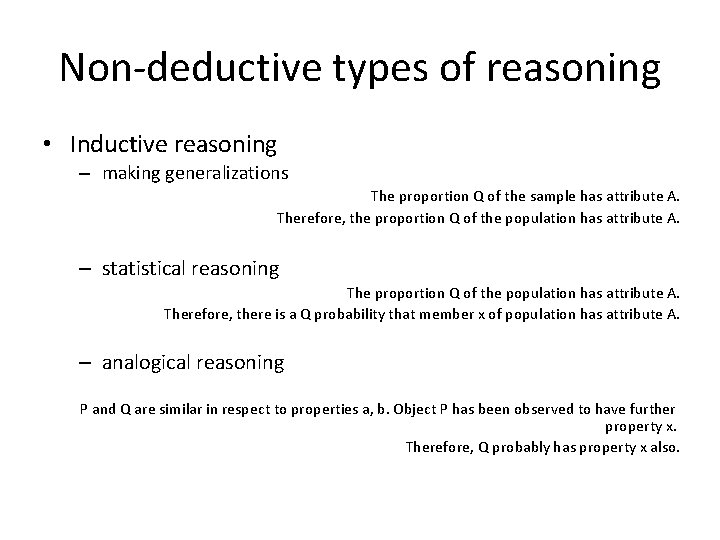
Non-deductive types of reasoning • Inductive reasoning – making generalizations The proportion Q of the sample has attribute A. Therefore, the proportion Q of the population has attribute A. – statistical reasoning The proportion Q of the population has attribute A. Therefore, there is a Q probability that member x of population has attribute A. – analogical reasoning P and Q are similar in respect to properties a, b. Object P has been observed to have further property x. Therefore, Q probably has property x also.
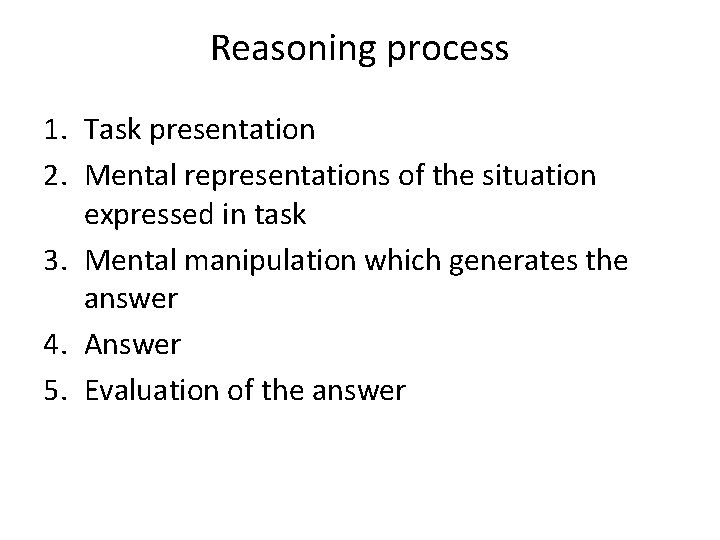
Reasoning process 1. Task presentation 2. Mental representations of the situation expressed in task 3. Mental manipulation which generates the answer 4. Answer 5. Evaluation of the answer
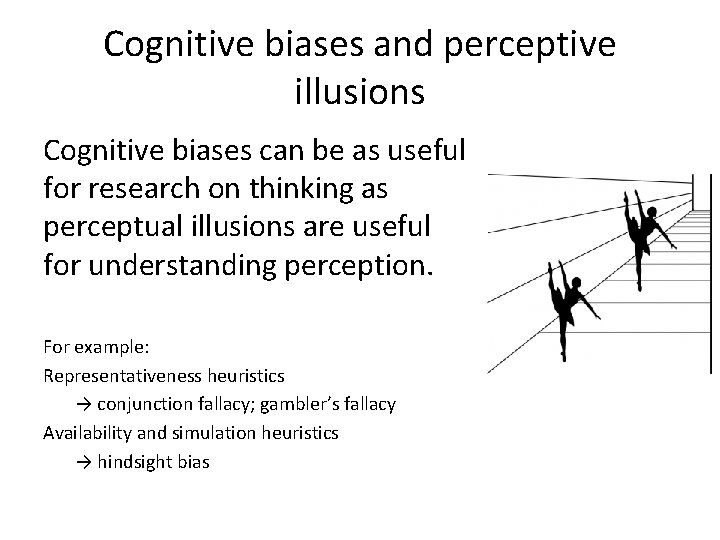
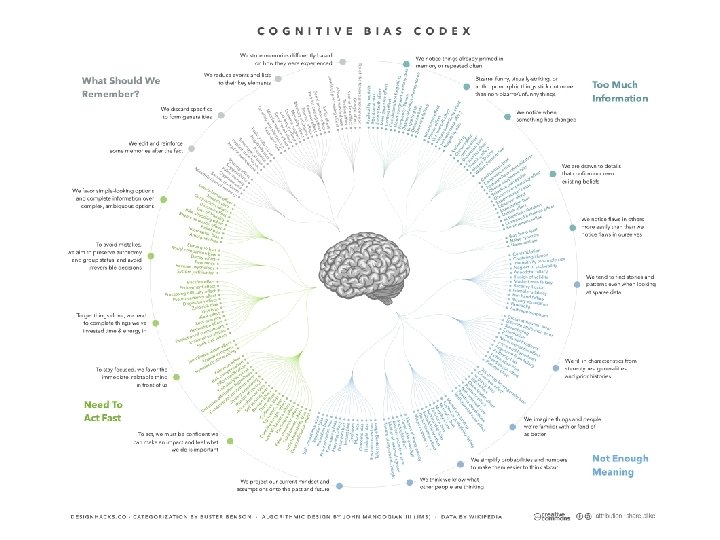
Cognitive biases and perceptive illusions Cognitive biases can be as useful for research on thinking as perceptual illusions are useful for understanding perception. For example: Representativeness heuristics → conjunction fallacy; gambler’s fallacy Availability and simulation heuristics → hindsight bias
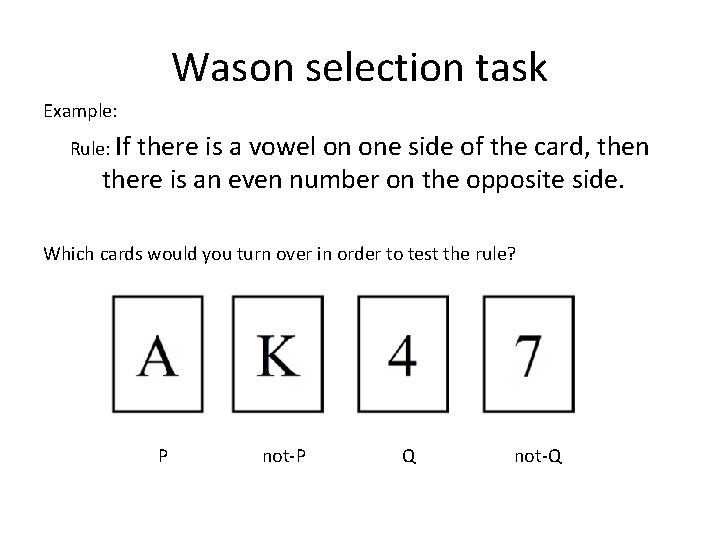
Wason selection task Example: Rule: If there is a vowel on one side of the card, then there is an even number on the opposite side. Which cards would you turn over in order to test the rule? P not-P Q not-Q
Wason selection task • Original research: • Wason (1966) – 4% of valid answers (P and not-Q) • Some other evidence of the classic effect: • Valerjev & Pedisić (2001) – 4 -8% valid (depending on condition); 47 -49% typical error (P and Q) • Valerjev (2000) – 14% valid; 74% typical error (participants were instructed to choose TWO cards) • Valerjev & Dujmović (2016) – 4% valid; 58% typical error; and on average 85% confidence rating that they choose the right answer.
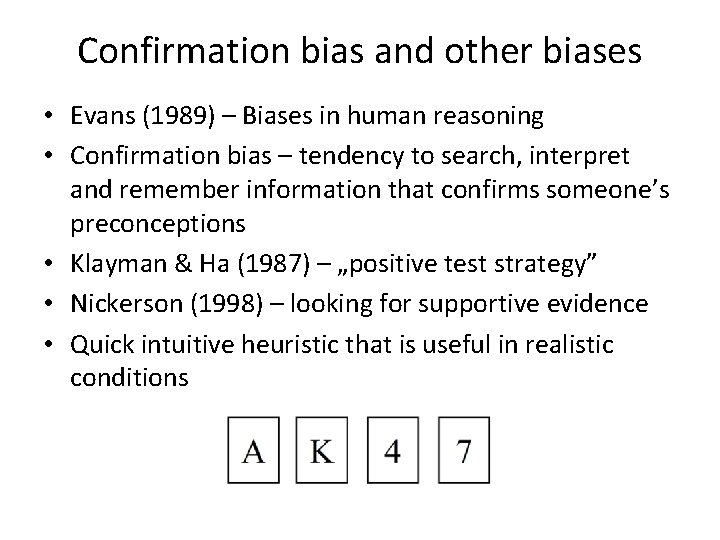
Confirmation bias and other biases • Evans (1989) – Biases in human reasoning • Confirmation bias – tendency to search, interpret and remember information that confirms someone’s preconceptions • Klayman & Ha (1987) – „positive test strategy” • Nickerson (1998) – looking for supportive evidence • Quick intuitive heuristic that is useful in realistic conditions
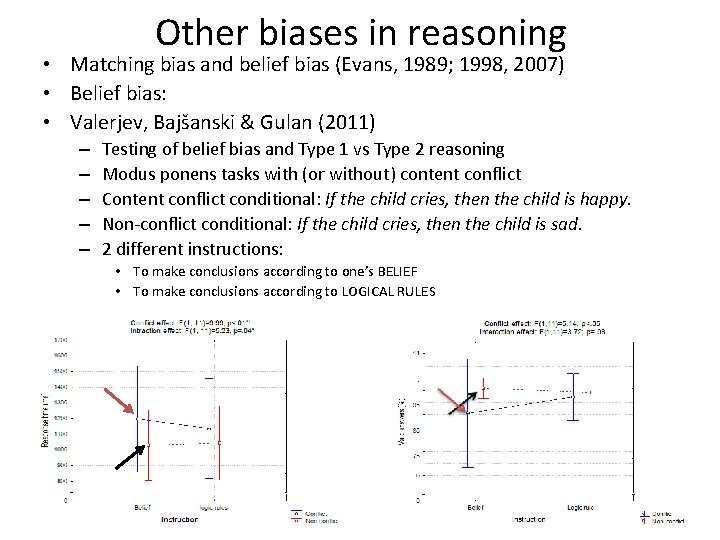
Other biases in reasoning • Matching bias and belief bias (Evans, 1989; 1998, 2007) • Belief bias: • Valerjev, Bajšanski & Gulan (2011) – – – Testing of belief bias and Type 1 vs Type 2 reasoning Modus ponens tasks with (or without) content conflict Content conflict conditional: If the child cries, then the child is happy. Non-conflict conditional: If the child cries, then the child is sad. 2 different instructions: • To make conclusions according to one’s BELIEF • To make conclusions according to LOGICAL RULES
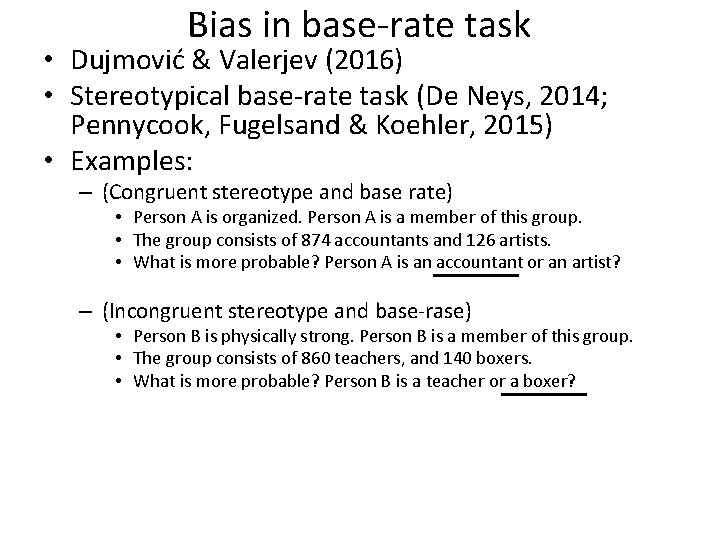
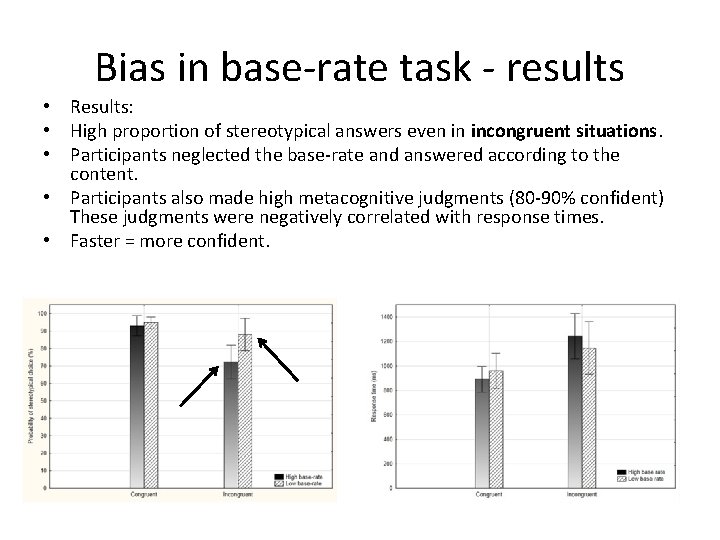
Bias in base-rate task • Dujmović & Valerjev (2016) • Stereotypical base-rate task (De Neys, 2014; Pennycook, Fugelsand & Koehler, 2015) • Examples: – (Congruent stereotype and base rate) • Person A is organized. Person A is a member of this group. • The group consists of 874 accountants and 126 artists. • What is more probable? Person A is an accountant or an artist? – (Incongruent stereotype and base-rase) • Person B is physically strong. Person B is a member of this group. • The group consists of 860 teachers, and 140 boxers. • What is more probable? Person B is a teacher or a boxer?
Bias in base-rate task - results • Results: • High proportion of stereotypical answers even in incongruent situations. • Participants neglected the base-rate and answered according to the content. • Participants also made high metacognitive judgments (80 -90% confident) These judgments were negatively correlated with response times. • Faster = more confident.
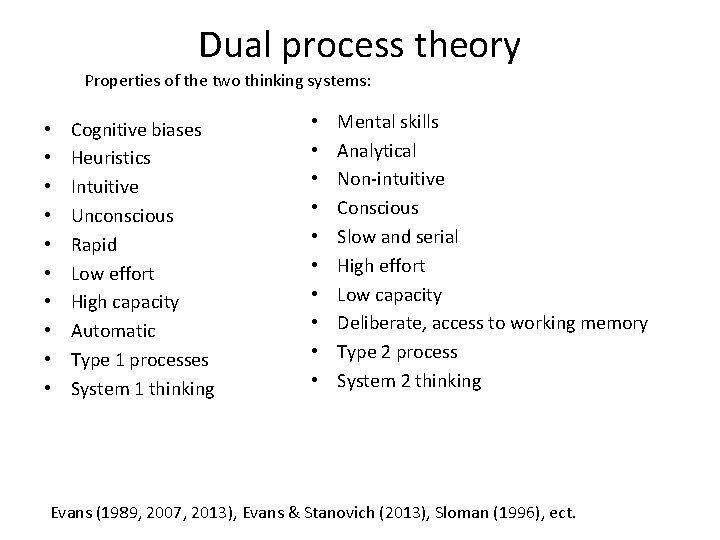
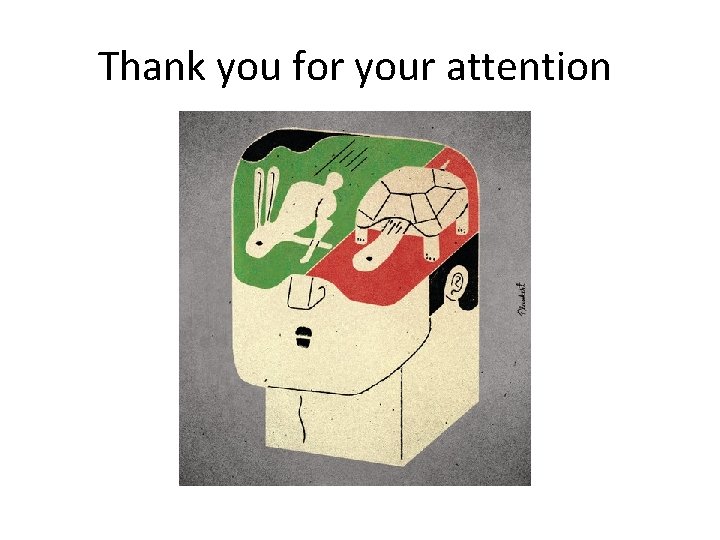
Dual process theory Properties of the two thinking systems: • • • Cognitive biases Heuristics Intuitive Unconscious Rapid Low effort High capacity Automatic Type 1 processes System 1 thinking • • • Mental skills Analytical Non-intuitive Conscious Slow and serial High effort Low capacity Deliberate, access to working memory Type 2 process System 2 thinking Evans (1989, 2007, 2013), Evans & Stanovich (2013), Sloman (1996), ect.
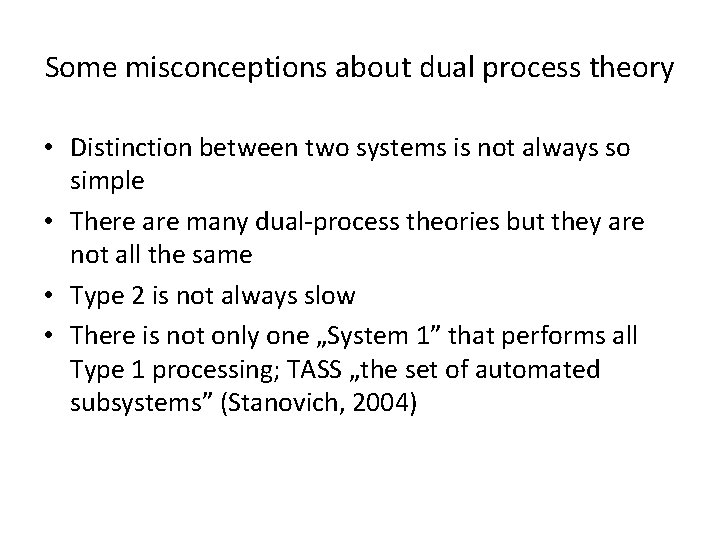
Some misconceptions about dual process theory • Distinction between two systems is not always so simple • There are many dual-process theories but they are not all the same • Type 2 is not always slow • There is not only one „System 1” that performs all Type 1 processing; TASS „the set of automated subsystems” (Stanovich, 2004)
Theories of deductive reasoning • • Formal rules theories Domain-specific reasoning theories Probability theories Mental model theory
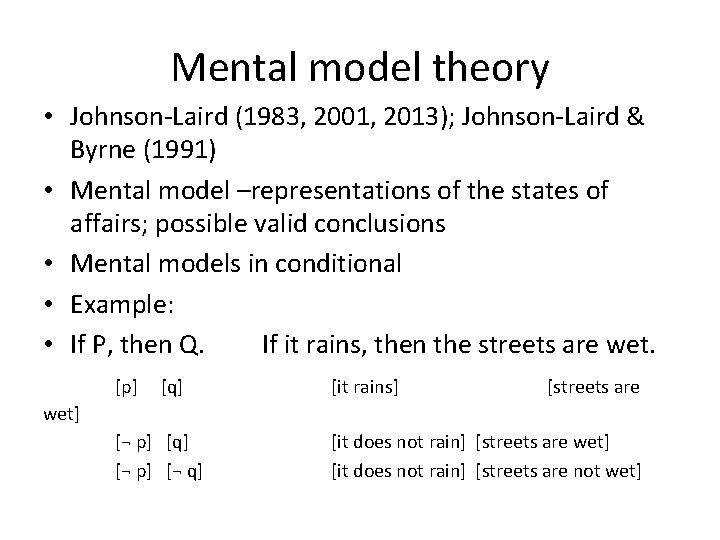
Mental model theory • Johnson-Laird (1983, 2001, 2013); Johnson-Laird & Byrne (1991) • Mental model –representations of the states of affairs; possible valid conclusions • Mental models in conditional • Example: • If P, then Q. If it rains, then the streets are wet. [p] [q] [it rains] [streets are wet] [¬ p] [q] [¬ p] [¬ q] [it does not rain] [streets are wet] [it does not rain] [streets are not wet]
Computational constraints and limitations described by mental model theory • • Initial model representation Number of models Content of models Arrangement of models
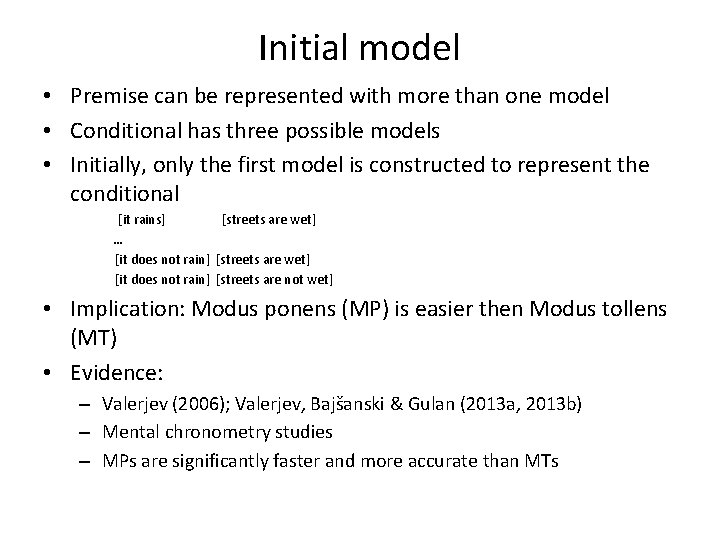
Initial model • Premise can be represented with more than one model • Conditional has three possible models • Initially, only the first model is constructed to represent the conditional [it rains] [streets are wet] … [it does not rain] [streets are wet] [it does not rain] [streets are not wet] • Implication: Modus ponens (MP) is easier then Modus tollens (MT) • Evidence: – Valerjev (2006); Valerjev, Bajšanski & Gulan (2013 a, 2013 b) – Mental chronometry studies – MPs are significantly faster and more accurate than MTs
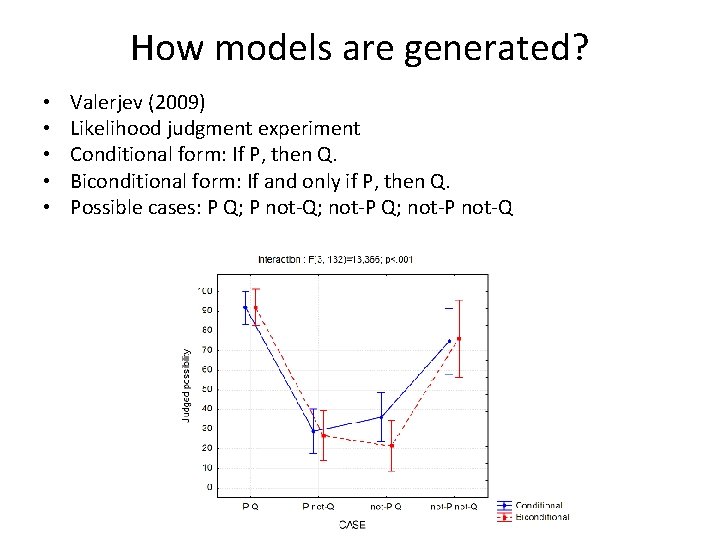
How models are generated? • • • Valerjev (2009) Likelihood judgment experiment Conditional form: If P, then Q. Biconditional form: If and only if P, then Q. Possible cases: P Q; P not-Q; not-P not-Q
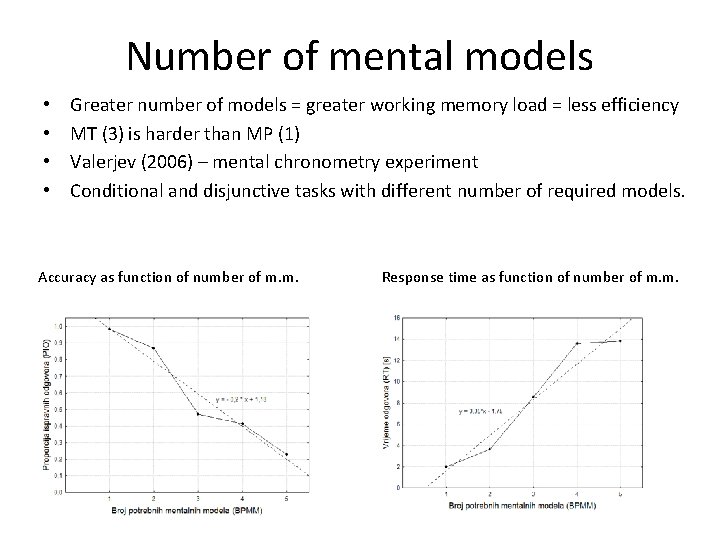
Number of mental models • • Greater number of models = greater working memory load = less efficiency MT (3) is harder than MP (1) Valerjev (2006) – mental chronometry experiment Conditional and disjunctive tasks with different number of required models. Accuracy as function of number of m. m. Response time as function of number of m. m.
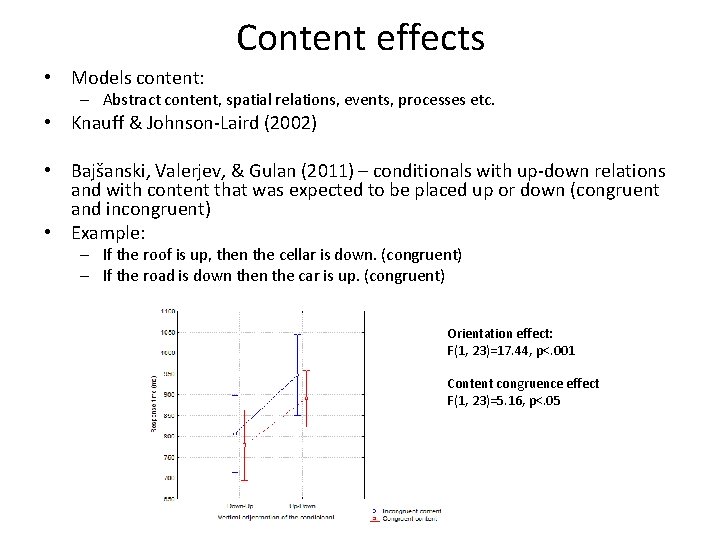
Content effects • Models content: – Abstract content, spatial relations, events, processes etc. • Knauff & Johnson-Laird (2002) • Bajšanski, Valerjev, & Gulan (2011) – conditionals with up-down relations and with content that was expected to be placed up or down (congruent and incongruent) • Example: – If the roof is up, then the cellar is down. (congruent) – If the road is down the car is up. (congruent) Orientation effect: F(1, 23)=17. 44, p<. 001 Content congruence effect F(1, 23)=5. 16, p<. 05
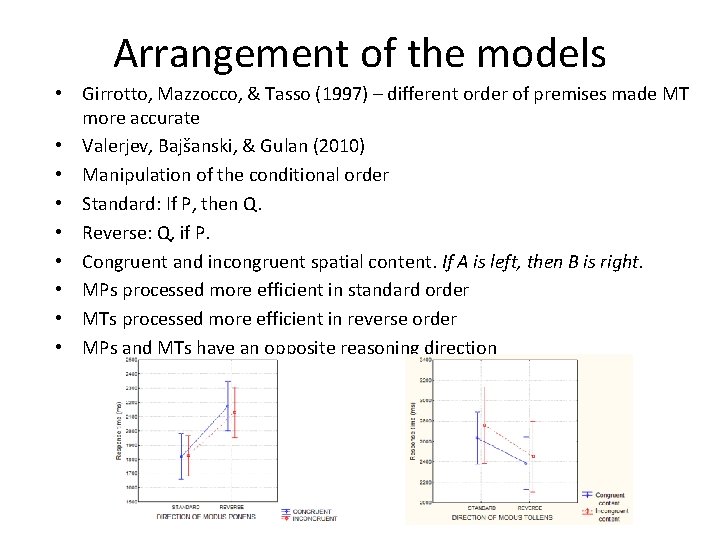
Arrangement of the models • Girrotto, Mazzocco, & Tasso (1997) – different order of premises made MT more accurate • Valerjev, Bajšanski, & Gulan (2010) • Manipulation of the conditional order • Standard: If P, then Q. • Reverse: Q, if P. • Congruent and incongruent spatial content. If A is left, then B is right. • MPs processed more efficient in standard order • MTs processed more efficient in reverse order • MPs and MTs have an opposite reasoning direction
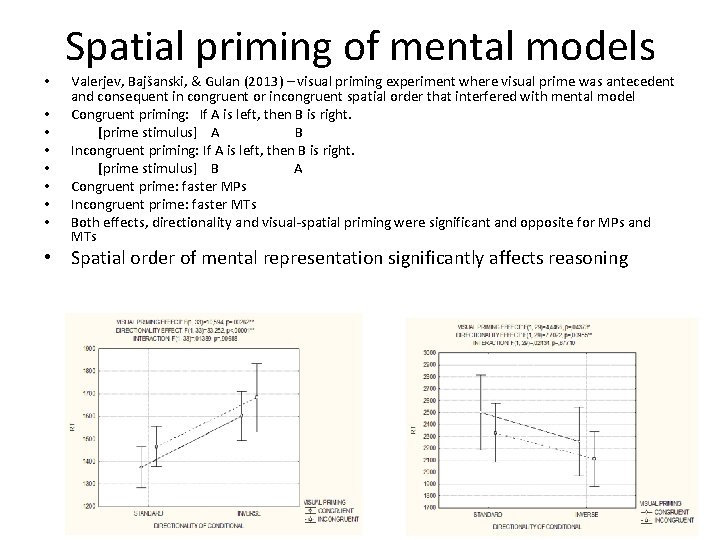
Spatial priming of mental models • • Valerjev, Bajšanski, & Gulan (2013) – visual priming experiment where visual prime was antecedent and consequent in congruent or incongruent spatial order that interfered with mental model Congruent priming: If A is left, then B is right. [prime stimulus] A B Incongruent priming: If A is left, then B is right. [prime stimulus] B A Congruent prime: faster MPs Incongruent prime: faster MTs Both effects, directionality and visual-spatial priming were significant and opposite for MPs and MTs • Spatial order of mental representation significantly affects reasoning
Conclusion • Many biases and computational constraints affect reasoning • Two important properties of mind: • Bounded rationality which is fast – System 1 • Flexibility – opportunity to switch from system 1 to system 2 if needed
• • • • • • References De Neys, W. (2014). Conflict detection, dual processes, and logical intuitions: Some clarifications. Thinking & Reasoning, 20, 169 -187. Dobelli, R. (2013): The Art of Thinking Clearly. New York: Harper Collins Publishers. Dujmović, M. , & Valerjev, P. (2016). Metacognitive assessment in a base-rate task: The effect of Type 1 and Type 2 processing. 20 th Days of Psychology in Zadar, 19 -21. 05. 2016. Evans, J. St. B. T. (1989). Bias in Human Reasoning: Causes and Consequences. Hove: LEA. Evans, J. St. B. T. (1998). Matching Bias in Conditional Reasoning: Do We Understand it After 25 Years? Thinking & Reasoning, 4, 1, 45 -110. Evans, J. St. B. T. (2007). Hypothetical Thinking : Dual Processes in Reasoning and Judgement - Essays in Cognitive Psychology. Hove: Psychology Press. Evans, J. St. B. T. (2009). How many dual-process theories do we need? One, two, or many? In J. S. B. T. Evans & K. Frankish (Eds. ), In two minds: Dual processes and beyond (pp. 33 -54). New York, NY, US: Oxford University Press. Evans, J. St. B. T. (2012). Questions and challenges for the new psychology of reasoning. Thinking & Reasoning, 18, 1, 5– 31. Evans, J. St. B. T. (2013). Dual-process theories of deductive reasoning: Facts and fallacies. In K. J. Holyoak and R. G. Morrison (Eds. ), The Oxford Handbook of Thinking and Reasoning. Oxford: Oxford University Press. Evans, J. St. B. T. , & Stanovich, K. E. (2013). Dual-Process Theories of Higher Cognition: Advancing the Debate. Perspectives on Psychological Science, 8, 3, 223– 241. Gilhooly, K. J. (1996). Thinking: Directed, Undirected and Creative. London: Academic Press. Johnson-Laird, P. N. , & Byrne, R. M. J. (1991). Deduction. Hillsdale: Erlbaum. Johnson-Laird, P. N. (2013). Inference with mental models. In K. J. Holyoak and R. G. Morrison (Eds. ), The Oxford Handbook of Thinking and Reasoning. Oxford: Oxford University Press. Nickerson, R. S. (1998). Confirmation bias: A ubiquitous phenomenon in many guises. Review of General Psychology, 2, 2, 175 -220. Sloman, S. A. (1996) The empirical case for two systems of reasoning. Psychological Bulletin, 119, 3– 22. Valerjev, P. (2000). Wasonov izborni zadatak: Stabilnost efekata pristranosti i tematskog materijala. [Wason selection task: Stability of bias and thematic material effects]. Radovi: Razdio filozofije, psihologije, sociologije i pedagogije, 39, 16, 97 -111. Valerjev, P. (2006). Deduction and Conditionals: A Mental Chronometry Experiment. Psihologijske teme. 15, 1, 151 -176. Valerjev, P. , Bajšanski, I. , & Gulan, T. (2011). Logičko i sadržajno zaključivanje: efekti upute i sadržajne konfliktnosti [Logical and content reasoning: the effects of instruction and content conflict]. Savremeni trendovi u psihologiji. Novi Sad, 14 -16. 10. 2011. Valerjev, P. , Bajšanski, I. , & Gulan, T. (2013 a). Directionality of conditional and accuracy of reasoning. Suvremena psihologija 16, 1, 49 -62. Valerjev, P. , Bajšanski, I. , & Gulan, T. (2013 b). Directionality of conditionals in the context of visual priming. Review of psychology 20, 1, 61 -68. Valerjev, P. & Dujmović, M. (2016). Metacognitive judgments during solving of Wason selection task. Unpublished. Valerjev, P. & Pedisić, A. (2002). Wasonov izborni zadatak - utjecaj upute, tipova kondicionala i tematskog materijala. [Wason Selection Task Influence of Instruction, Conditional Types and Thematic Material]. Radovi: Razdio filozofije, psihologije, sociologije i pedagogije 40, 17, 45 -64 Wason, P. C. (1966). Reasoning. In B. M. Foss, (Ed. ), New Horizons in psychology 1. Harmondsworth: Penguin. Wason, P. C. (1968). Reasoning about the rule. Quarterly Journal of Experimental Psychology, 20, 3, 273 -281.
Thank you for your attention