
Deducing the Three Dimensional Structure of the Corona
- Slides: 1
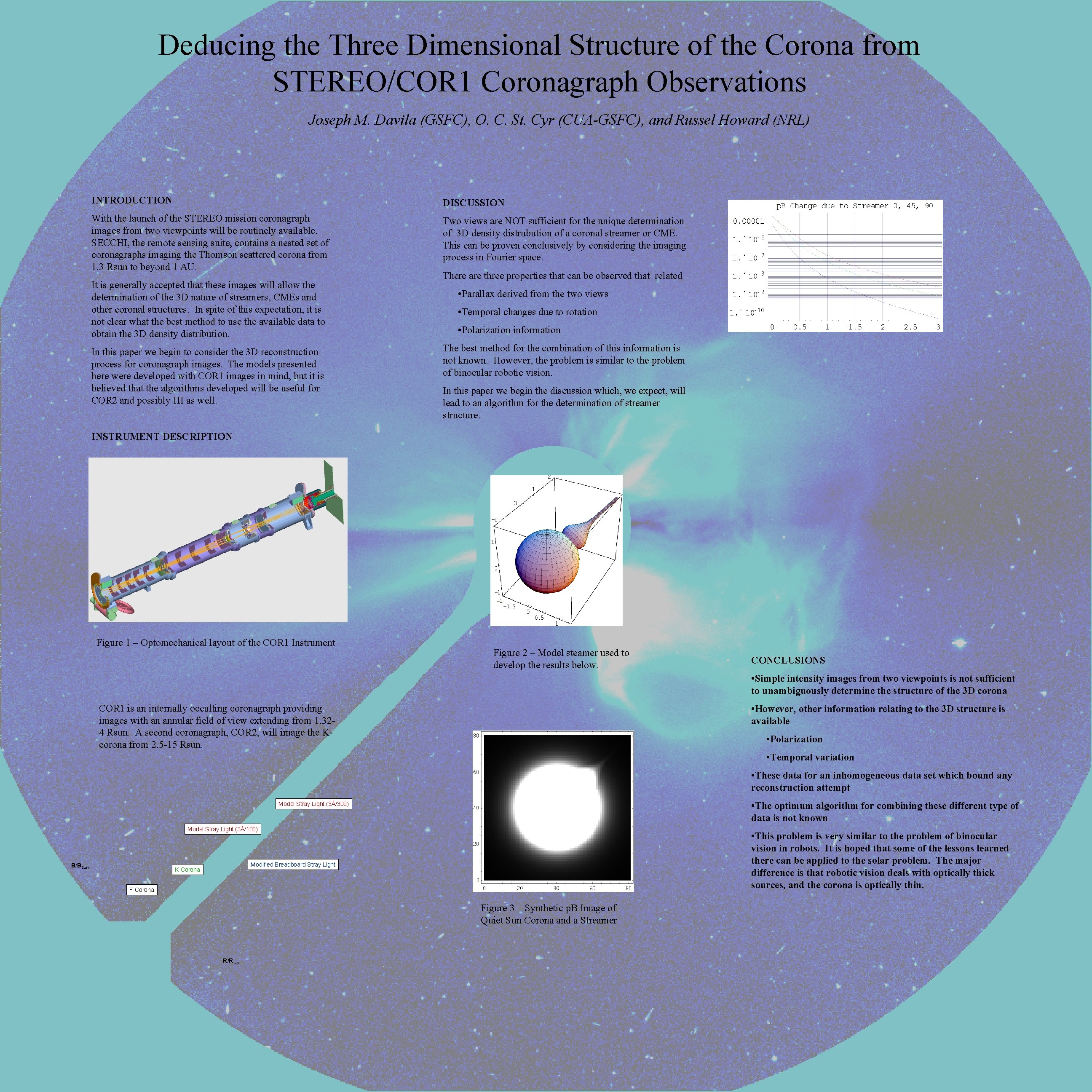
Deducing the Three Dimensional Structure of the Corona from STEREO/COR 1 Coronagraph Observations Joseph M. Davila (GSFC), O. C. St. Cyr (CUA-GSFC), and Russel Howard (NRL) INTRODUCTION DISCUSSION With the launch of the STEREO mission coronagraph images from two viewpoints will be routinely available. SECCHI, the remote sensing suite, contains a nested set of coronagraphs imaging the Thomson scattered corona from 1. 3 Rsun to beyond 1 AU. Two views are NOT sufficient for the unique determination of 3 D density distrubution of a coronal streamer or CME. This can be proven conclusively by considering the imaging process in Fourier space. It is generally accepted that these images will allow the determination of the 3 D nature of streamers, CMEs and other coronal structures. In spite of this expectation, it is not clear what the best method to use the available data to obtain the 3 D density distribution. In this paper we begin to consider the 3 D reconstruction process for coronagraph images. The models presented here were developed with COR 1 images in mind, but it is believed that the algorithms developed will be useful for COR 2 and possibly HI as well. There are three properties that can be observed that related • Parallax derived from the two views • Temporal changes due to rotation • Polarization information The best method for the combination of this information is not known. However, the problem is similar to the problem of binocular robotic vision. In this paper we begin the discussion which, we expect, will lead to an algorithm for the determination of streamer structure. INSTRUMENT DESCRIPTION Figure 1 – Optomechanical layout of the COR 1 Instrument Figure 2 – Model steamer used to develop the results below. CONCLUSIONS • Simple intensity images from two viewpoints is not sufficient to unambiguously determine the structure of the 3 D corona COR 1 is an internally occulting coronagraph providing images with an annular field of view extending from 1. 324 Rsun. A second coronagraph, COR 2, will image the Kcorona from 2. 5 -15 Rsun. • However, other information relating to the 3 D structure is available • Polarization • Temporal variation • These data for an inhomogeneous data set which bound any reconstruction attempt • The optimum algorithm for combining these different type of data is not known Model Stray Light (3Å/300) Model Stray Light (3Å/100) B/BSun • This problem is very similar to the problem of binocular vision in robots. It is hoped that some of the lessons learned there can be applied to the solar problem. The major difference is that robotic vision deals with optically thick sources, and the corona is optically thin. Modified Breadboard Stray Light K Corona Figure 3 – Synthetic p. B Image of Quiet Sun Corona and a Streamer R/RSun