
Dedicated Short Range Communication What is DSRC A

- Slides: 15
Dedicated Short Range Communication
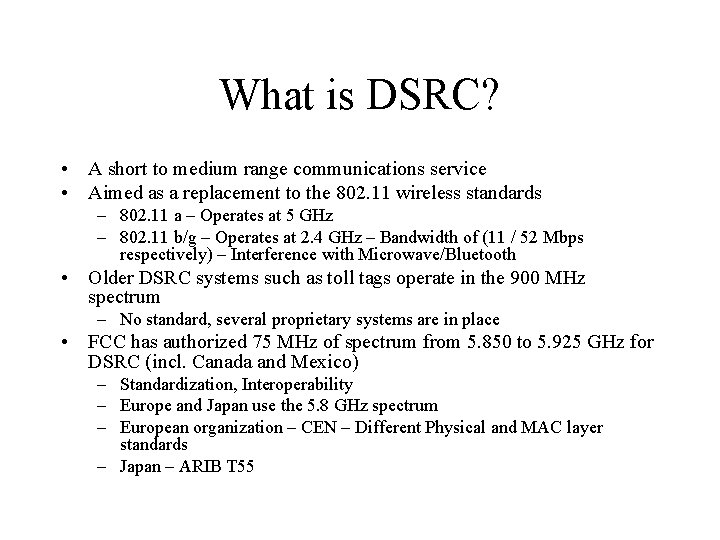
What is DSRC? • A short to medium range communications service • Aimed as a replacement to the 802. 11 wireless standards – 802. 11 a – Operates at 5 GHz – 802. 11 b/g – Operates at 2. 4 GHz – Bandwidth of (11 / 52 Mbps respectively) – Interference with Microwave/Bluetooth • Older DSRC systems such as toll tags operate in the 900 MHz spectrum – No standard, several proprietary systems are in place • FCC has authorized 75 MHz of spectrum from 5. 850 to 5. 925 GHz for DSRC (incl. Canada and Mexico) – Standardization, Interoperability – Europe and Japan use the 5. 8 GHz spectrum – European organization – CEN – Different Physical and MAC layer standards – Japan – ARIB T 55
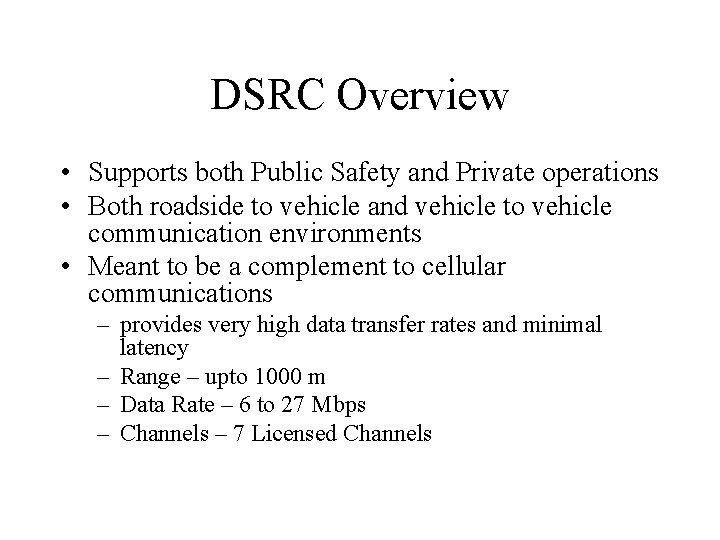
DSRC Overview • Supports both Public Safety and Private operations • Both roadside to vehicle and vehicle to vehicle communication environments • Meant to be a complement to cellular communications – provides very high data transfer rates and minimal latency – Range – upto 1000 m – Data Rate – 6 to 27 Mbps – Channels – 7 Licensed Channels
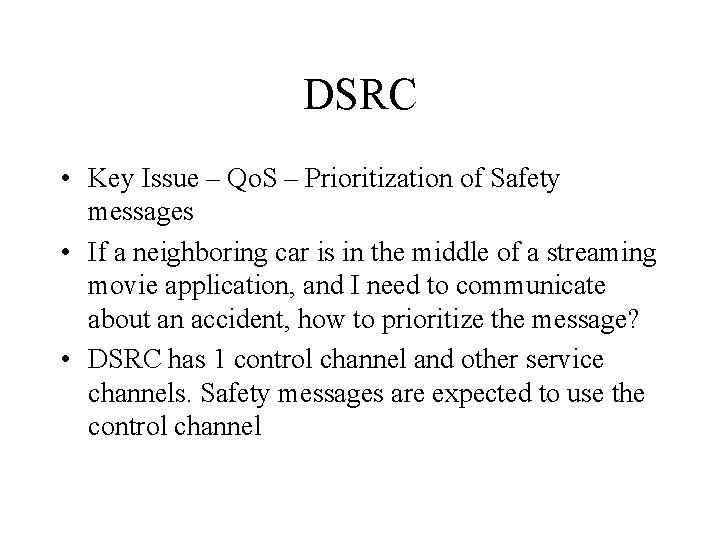
DSRC • Key Issue – Qo. S – Prioritization of Safety messages • If a neighboring car is in the middle of a streaming movie application, and I need to communicate about an accident, how to prioritize the message? • DSRC has 1 control channel and other service channels. Safety messages are expected to use the control channel
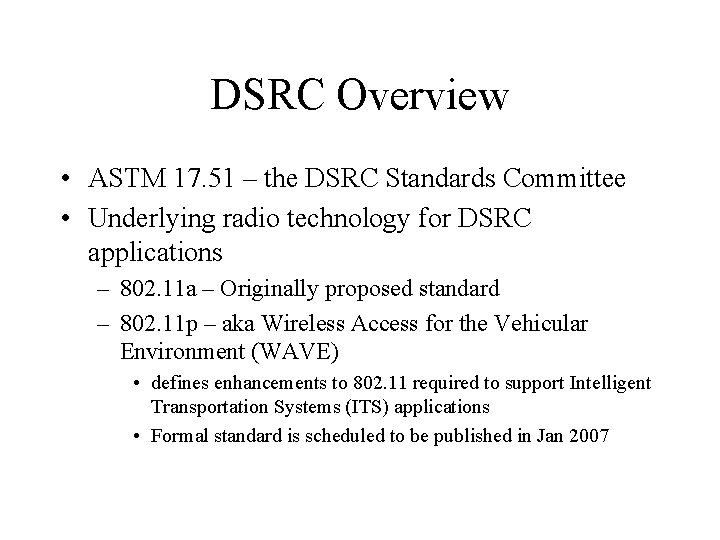
DSRC Overview • ASTM 17. 51 – the DSRC Standards Committee • Underlying radio technology for DSRC applications – 802. 11 a – Originally proposed standard – 802. 11 p – aka Wireless Access for the Vehicular Environment (WAVE) • defines enhancements to 802. 11 required to support Intelligent Transportation Systems (ITS) applications • Formal standard is scheduled to be published in Jan 2007
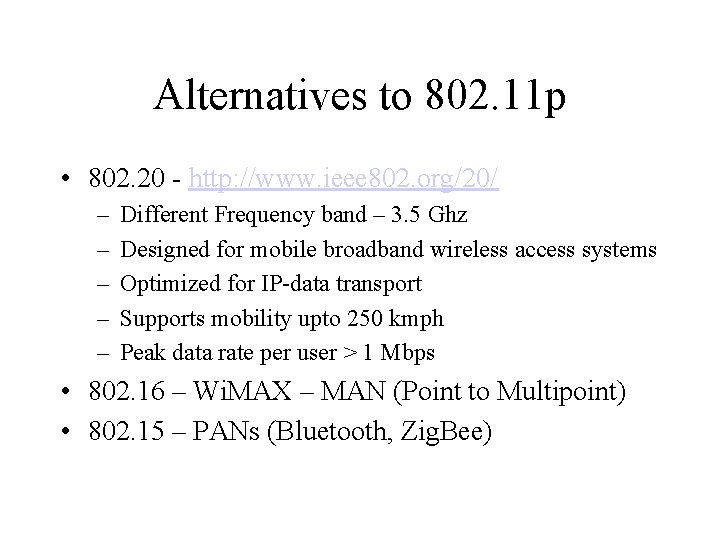
Alternatives to 802. 11 p • 802. 20 - http: //www. ieee 802. org/20/ – – – Different Frequency band – 3. 5 Ghz Designed for mobile broadband wireless access systems Optimized for IP-data transport Supports mobility upto 250 kmph Peak data rate per user > 1 Mbps • 802. 16 – Wi. MAX – MAN (Point to Multipoint) • 802. 15 – PANs (Bluetooth, Zig. Bee)
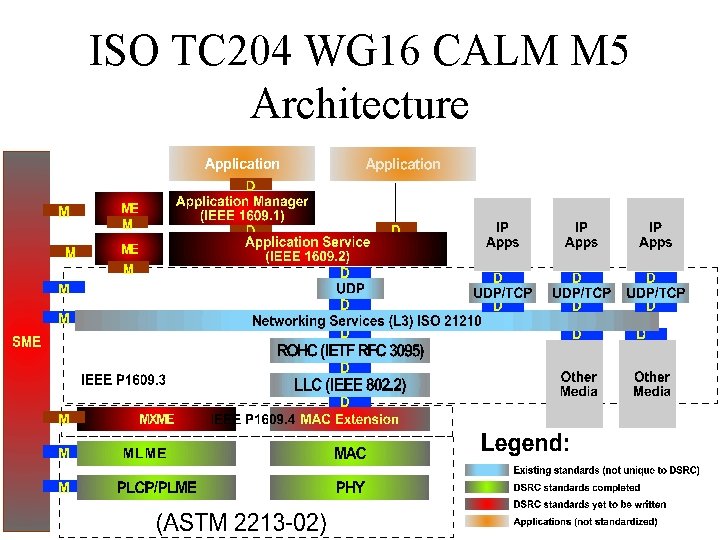
ISO TC 204 WG 16 CALM M 5 Architecture
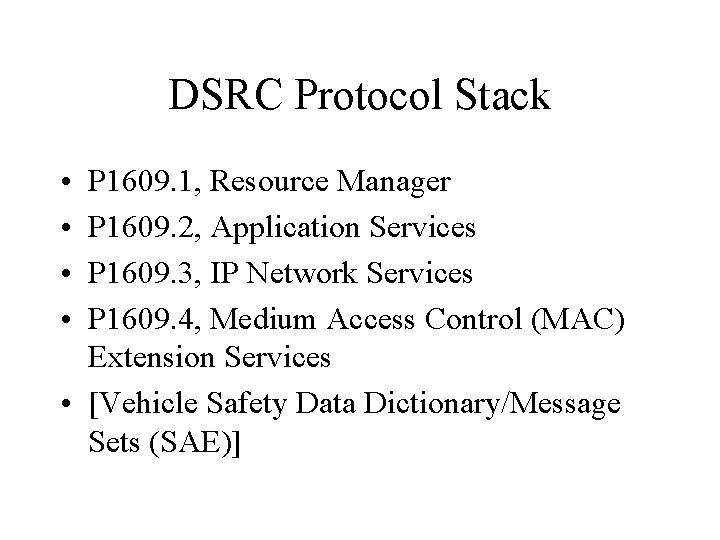
DSRC Protocol Stack • • P 1609. 1, Resource Manager P 1609. 2, Application Services P 1609. 3, IP Network Services P 1609. 4, Medium Access Control (MAC) Extension Services • [Vehicle Safety Data Dictionary/Message Sets (SAE)]
IEEE P 1609. 1 Scope • Modified version of the Resource Manager standard originally defined in IEEE Std 1455 -1999 • P 1609 Resource Manager supports DSRC applications using the IEEE 802. 11 a communication technology
IEEE P 1609. 2 Scope • An Application Services (Layer 7) standard for 5. 9 GHz DSRC applications • Supports several protocol stacks, including one representing traditional DSRC systems, TCP/IP, and streaming audio/video • Describes interfaces with the lower layer standards being developed by ASTM
IEEE P 1609. 3 Scope • Defines interfaces between the multiple communication stacks and the lower layer services of ASTM 2213 -02 (IEEE 802. 11 a R/A) • Support multiple protocol stacks, one for the traditional DSRC, one for streaming audio/video, and another for TCP/IP • The North American DSRC Architecture is evolving
IEEE P 1609. 4 Scope • Standard for the Media Access Control Extension sub-layer (Layer 2) that defines interfaces between these multiple applications and communication stacks that interface with ASTM 2213 -02 (IEEE 802. 11 a) • Interface with the public safety applications community through National Public Safety Telecommunication Council (NPSTC) • NPSTC cooperation is expected to result in potential use of the ITS Radio (DSRC) by ITS and public safety
IEEE DSRC DD/MST • Standardization of the Data Dictionary and Message Set (DD/MS) definitions • DD/MST was present in IEEE Standard 1455 -1999, being ported to 5. 9 GHz DSRC standards • Auto manufacturers - on-board vehicle safety messages – need for standardization
References • DSRC http: //www. leearmstrong. com/DSRCHomeset. htm • IEEE 802. 11 Task Group status http: //grouper. ieee. org/groups/802/11/Reports/tgp_update. htm • AMI-C http: //www. ami-c. org • NPSTC http: //www. npstc. org
Brake-light communication system • Related work – Performance Evaluation of Safety Applications over DSRC Vehicular Ad Hoc Networks , VANET 2004. Based on simulations, no real hardware. – Few other papers from PATH, Europe, etc.