
Decolonization SOUTH ASIA AFTER 1945 Indian selfrule British
Decolonization
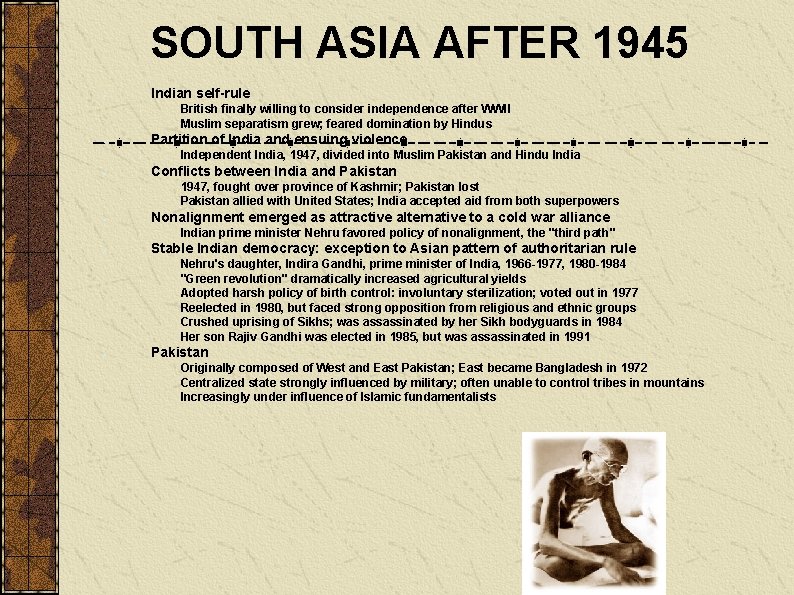
SOUTH ASIA AFTER 1945 Indian self-rule British finally willing to consider independence after WWII Muslim separatism grew; feared domination by Hindus Partition of India and ensuing violence Independent India, 1947, divided into Muslim Pakistan and Hindu India Conflicts between India and Pakistan 1947, fought over province of Kashmir; Pakistan lost Pakistan allied with United States; India accepted aid from both superpowers Nonalignment emerged as attractive alternative to a cold war alliance Indian prime minister Nehru favored policy of nonalignment, the "third path" Stable Indian democracy: exception to Asian pattern of authoritarian rule Nehru's daughter, Indira Gandhi, prime minister of India, 1966 -1977, 1980 -1984 "Green revolution" dramatically increased agricultural yields Adopted harsh policy of birth control: involuntary sterilization; voted out in 1977 Reelected in 1980, but faced strong opposition from religious and ethnic groups Crushed uprising of Sikhs; was assassinated by her Sikh bodyguards in 1984 Her son Rajiv Gandhi was elected in 1985, but was assassinated in 1991 Pakistan Originally composed of West and East Pakistan; East became Bangladesh in 1972 Centralized state strongly influenced by military; often unable to control tribes in mountains Increasingly under influence of Islamic fundamentalists
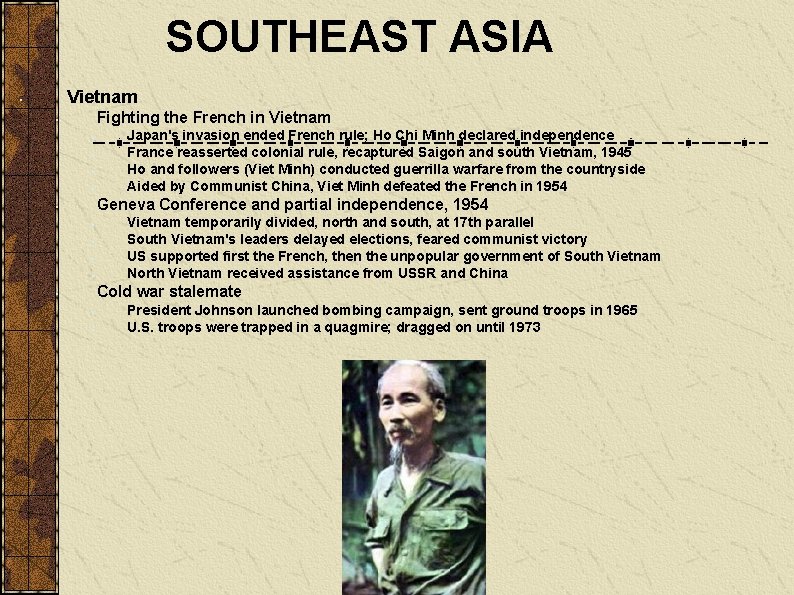
SOUTHEAST ASIA Vietnam Fighting the French in Vietnam Japan's invasion ended French rule; Ho Chi Minh declared independence France reasserted colonial rule, recaptured Saigon and south Vietnam, 1945 Ho and followers (Viet Minh) conducted guerrilla warfare from the countryside Aided by Communist China, Viet Minh defeated the French in 1954 Geneva Conference and partial independence, 1954 Vietnam temporarily divided, north and south, at 17 th parallel South Vietnam's leaders delayed elections, feared communist victory US supported first the French, then the unpopular government of South Vietnam North Vietnam received assistance from USSR and China Cold war stalemate President Johnson launched bombing campaign, sent ground troops in 1965 U. S. troops were trapped in a quagmire; dragged on until 1973
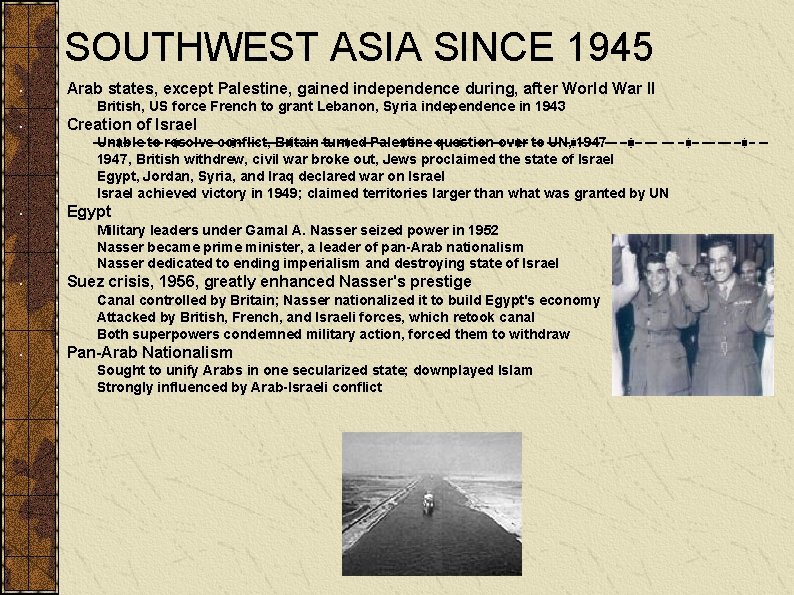
SOUTHWEST ASIA SINCE 1945 Arab states, except Palestine, gained independence during, after World War II British, US force French to grant Lebanon, Syria independence in 1943 Creation of Israel Unable to resolve conflict, Britain turned Palestine question over to UN, 1947, British withdrew, civil war broke out, Jews proclaimed the state of Israel Egypt, Jordan, Syria, and Iraq declared war on Israel achieved victory in 1949; claimed territories larger than what was granted by UN Egypt Military leaders under Gamal A. Nasser seized power in 1952 Nasser became prime minister, a leader of pan-Arab nationalism Nasser dedicated to ending imperialism and destroying state of Israel Suez crisis, 1956, greatly enhanced Nasser's prestige Canal controlled by Britain; Nasser nationalized it to build Egypt's economy Attacked by British, French, and Israeli forces, which retook canal Both superpowers condemned military action, forced them to withdraw Pan-Arab Nationalism Sought to unify Arabs in one secularized state; downplayed Islam Strongly influenced by Arab-Israeli conflict

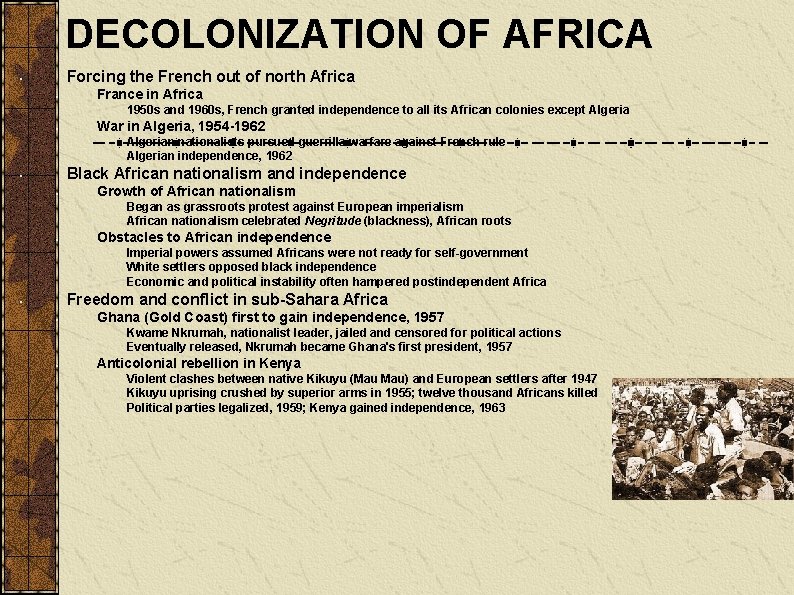
DECOLONIZATION OF AFRICA Forcing the French out of north Africa France in Africa 1950 s and 1960 s, French granted independence to all its African colonies except Algeria War in Algeria, 1954 -1962 Algerian nationalists pursued guerrilla warfare against French rule Algerian independence, 1962 Black African nationalism and independence Growth of African nationalism Began as grassroots protest against European imperialism African nationalism celebrated Negritude (blackness), African roots Obstacles to African independence Imperial powers assumed Africans were not ready for self-government White settlers opposed black independence Economic and political instability often hampered postindependent Africa Freedom and conflict in sub-Sahara Africa Ghana (Gold Coast) first to gain independence, 1957 Kwame Nkrumah, nationalist leader, jailed and censored for political actions Eventually released, Nkrumah became Ghana's first president, 1957 Anticolonial rebellion in Kenya Violent clashes between native Kikuyu (Mau Mau) and European settlers after 1947 Kikuyu uprising crushed by superior arms in 1955; twelve thousand Africans killed Political parties legalized, 1959; Kenya gained independence, 1963
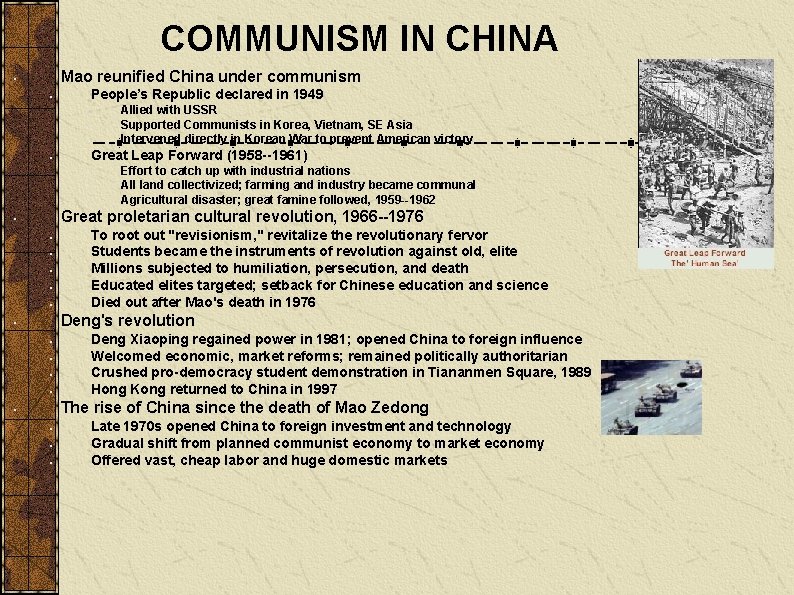
COMMUNISM IN CHINA Mao reunified China under communism People’s Republic declared in 1949 Allied with USSR Supported Communists in Korea, Vietnam, SE Asia Intervened directly in Korean War to prevent American victory Great Leap Forward (1958 --1961) Effort to catch up with industrial nations All land collectivized; farming and industry became communal Agricultural disaster; great famine followed, 1959 --1962 Great proletarian cultural revolution, 1966 --1976 To root out "revisionism, " revitalize the revolutionary fervor Students became the instruments of revolution against old, elite Millions subjected to humiliation, persecution, and death Educated elites targeted; setback for Chinese education and science Died out after Mao's death in 1976 Deng's revolution Deng Xiaoping regained power in 1981; opened China to foreign influence Welcomed economic, market reforms; remained politically authoritarian Crushed pro-democracy student demonstration in Tiananmen Square, 1989 Hong Kong returned to China in 1997 The rise of China since the death of Mao Zedong Late 1970 s opened China to foreign investment and technology Gradual shift from planned communist economy to market economy Offered vast, cheap labor and huge domestic markets

ARAB-ISRAELI CONFLICT ● Arab-Israeli Conflict 1947: Began over partition of Israel, Arab invasions 1956: Israeli invasion of the Sinai 1967: Seven Day War ● ● ● Founding of Palestinian Liberation Organization ● ● ● ● Hundreds of thousands of Palestinians displaced 1947 -67 Camps set up in Lebanon, Syria, Jordan, elsewhere Goal was to destroy Israel, create Arab state in Palestine Used terrorism as means to an end 1973 Yom Kippur War nearly destroyed Israel ● Egypt planned to annihilate Israel struck first annihilating armies and airforces of Syria, Egypt, and Jordan Capture West Bank, Sinai, Jerusalem, Golan Heights Israelis recover with US help, key Israeli ally; nearly destroy Egyptian army Arabs retaliate with Oil Embargo through OPEC US brokers Camp David Accords ending Egyptian, Israeli hostilities 1982 Israel invasion of Lebanon to evict PLO attacking Israel Beginning of the End Jordan, Lebanon, Morocco agree in principal to Camp David Accords 1990 s ● ● ● Arab Intifada in West Bank against Israeli occupation Oslo Accords leads to Israeli withdrawal of most settlers, troops Israelis hand over much of area to Palestinian Authority Palestinian self-rule over much of Gaza, West Bank Issues left unresolved: Israeli security, status of Golan Heights, Jerusalem
ISLAMIC RESURRGENCE Muslim revival and Arab disunity Cold war split Arab-Muslim world; pan-Arab unity did not materialize Israel became a staunch ally of United States; many Arab-Islamic states allied with USSR Islamism: revival of Muslim traditions Reasserting Islamic values in Muslim politics Resentment at European and American societies Extremists embraced jihad, or duty to defend Islam from attack; justified terrorism Represented by Islamic Brotherhood (Islamic world), Hezbollah (Lebanon), Taliban (Afghanistan) Activities, funding reach around the world The Iranian revolution, 1979 CIA helped anticommunist Shah Mohammed Pahlavi gain power, 1953 Shah supported anti-communism of US, armed Iran to status of a regional power Became major oil supplier of the US, increasing westernization of Iranian society Repressive rule overthrown by Islamist followers of Ayatollah Khomeini, 1979 Khomeini attacked United States for support of the shah Militants held sixty-nine Americans hostage for 444 days; shut down U. S. military bases Movement encouraged other Muslims to undertake terrorist actions Islamic Republic of Iran 1979 – Present is a radical opponent of western influence Afghanistan USSR invades in 1980 to prop of pro-Soviet regime which was threatened Nine year guerrilla warfare follows between Soviets, Muslim guerrillas USSR withdrew in 1989 leaving Mujahedeen, Taliban in control of radical Muslim state US destroys Taliban state, invades in 2002 after Taliban supports September 11 terrorist attacks on USA Pro-Western regime installed Iran-Iraq war, 1980 -1988 Iraqi president Saddam Hussein launched attack on Iran in 1980 War dragged on till 1988; killed one million soldiers Next, Iraqis invaded Kuwait in 1990, inciting Gulf War, 1991 Gulf Wars 1990 -91, 2002 -3 and Iraq Saddam Hussein annexes Kuwait; UN coalition drives him out in 1991 UN sanctions fail to disarm Iraq; eventually US led effort topples Hussein in 2003 Democratic, representative regime trying to form now but threatened by civil war, guerrilla war, terrorism
LATIN AMERICA: 1914 - PRESENT Latin America Changes World War I Led to upsurge in exports Development of industries 1920 s – 1940 s Depression, World War II hurt economic growth US initiates Good Neighbor Policy to try to improve US-Latin relations Some sympathy for fascists especially in Argentina, Brazil Mexico after the revolution Liberal constitution of 1917 guaranteed land liberty to Mexico Subsoil assets claimed by Mexican government; redistribution of land to peasants After 1930 s, conservative governments dominated by Institutional Revolutionary Party (PRI) In 1990 s, PRI dictatorship challenged in open, free elections Argentina: return to military rule Leader of Latin American struggle against U. S. and European intervention Gradual shift to free elections, but often reverted to military rulers Militarist Juan Peron was elected president, 1946; immensely popular His wife, Eva Peron, was national heroine for her service to the poor Peron ousted in 1955; three decades of military dictators followed Late 1970 s, death squads conducted "dirty war" against dissidents Patterns of economic dependence in Latin America Need to reorient economies from export to internal development Much of Latin America exported raw minerals, food stuffs, oil to Western World Need to develop domestic industry, consumer industries rather than import Raul Prebisch, Argentine economist, crafted theory of "economic dependency" Developed nations controlled world economy at expense of undeveloped ones Developing nations needed to protect domestic industries Spread of Democracy Liberalization begins in 1980 s as elections becomes freer, open to opposition Mexico, Argentina, Chile, Brazil, Venezuela, Peru, Colombia are all part of trend
AFRICA AFTER 1945 Aftermath of decolonization Organization of African Unity created 1963 to maintain peace, promote pan-African unity Artificial boundaries imposed by colonialism were ruled inviolable Ghana and many other states became one-party military dictatorships South Africa Transformation of South Africa Apartheid: harsh legal system imposed in 1948, designed to keep races separate Gained independence in 1901, but denied civil rights to black population South African economy strong, both mining and industry; prospered during WWII Black workers demanded political change 87 peercent of South African land was for white residents, others classified by race African National Congress, led by Nelson Mandela, launched campaign to protest apartheid Black agitation and international sanctions brought end to apartheid in 1989 1994, under new constitution, Mandela won free election as first black president Democratic Republic of Congo (Zaire) First prime minister, a Marxist, killed in a CIA-backed coup, 1961 Dictator Mobutu ruled from 1965 to 1997; plundered Zaire's economy Mobutu ruled Zaire in dictatorial fashion and amassed huge personal fortune Lawrence Kabila ousted Mobutu in 1997, changed country's name back to the Congo Kabila killed, 2001; replaced by his son Joseph; no elections yet Developing economies of Africa has 10 percent of world's population but less than 1 percent of industrial output Rich in minerals, raw materials, agricultural resources Lacking in capital, technology, foreign markets, and managerial class Rapid population growth compounds problems
- Slides: 12