
DECOLONIZATION Postwar Themes Cold War Decolonization SelfDetermination Nationalism


- Slides: 8
DECOLONIZATION
Postwar Themes – • Cold War • Decolonization • Self-Determination? • Nationalism? • Communism? USSR • Supports masses USA/West • Support local elites • Fear communism
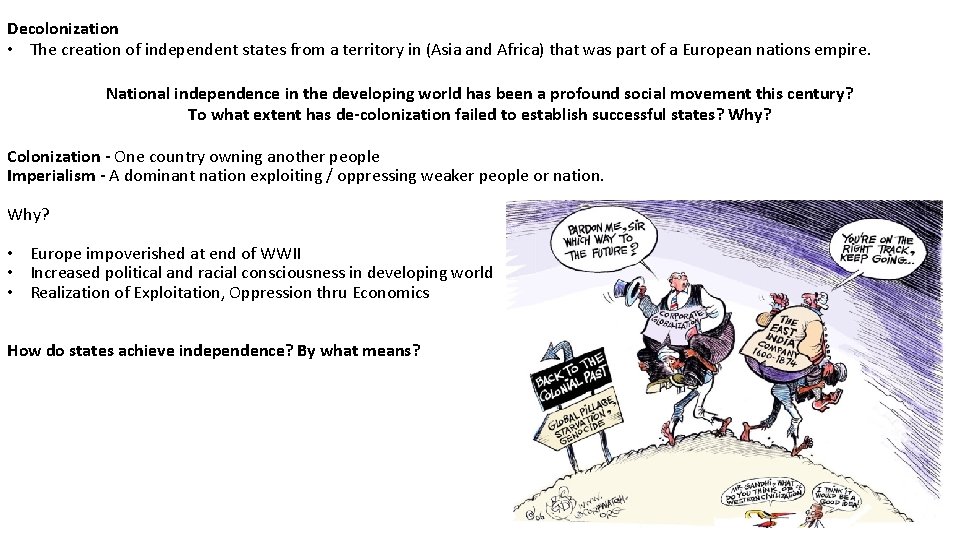
Decolonization • The creation of independent states from a territory in (Asia and Africa) that was part of a European nations empire. National independence in the developing world has been a profound social movement this century? To what extent has de-colonization failed to establish successful states? Why? Colonization - One country owning another people Imperialism - A dominant nation exploiting / oppressing weaker people or nation. Why? • Europe impoverished at end of WWII • Increased political and racial consciousness in developing world • Realization of Exploitation, Oppression thru Economics How do states achieve independence? By what means?
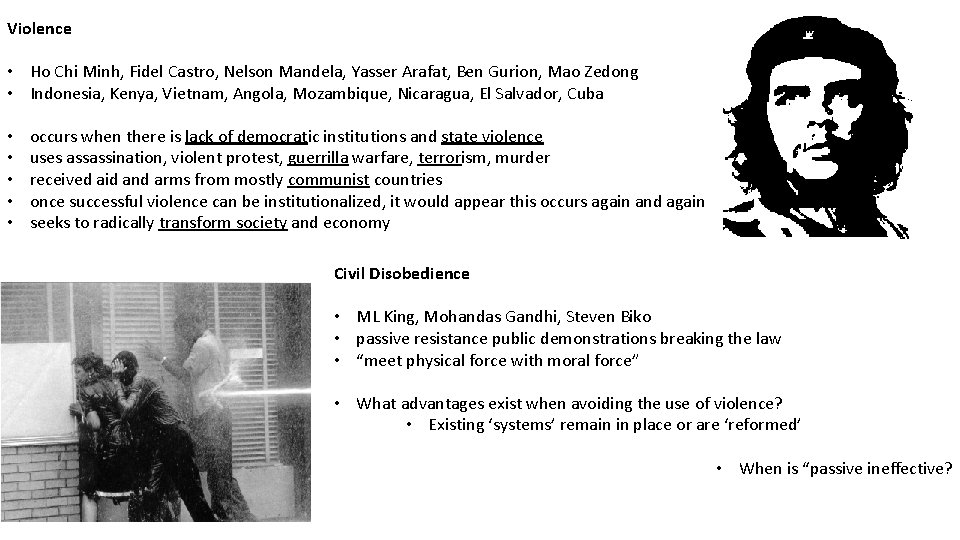
Violence • Ho Chi Minh, Fidel Castro, Nelson Mandela, Yasser Arafat, Ben Gurion, Mao Zedong • Indonesia, Kenya, Vietnam, Angola, Mozambique, Nicaragua, El Salvador, Cuba • • • occurs when there is lack of democratic institutions and state violence uses assassination, violent protest, guerrilla warfare, terrorism, murder received aid and arms from mostly communist countries once successful violence can be institutionalized, it would appear this occurs again and again seeks to radically transform society and economy Civil Disobedience • ML King, Mohandas Gandhi, Steven Biko • passive resistance public demonstrations breaking the law • “meet physical force with moral force” • What advantages exist when avoiding the use of violence? • Existing ‘systems’ remain in place or are ‘reformed’ • When is “passive ineffective?
Transfer of Power to “friendly” local elites: Egypt, Iraq, Jordan, Cambodia, Vietnam, etc… New governments were eventually accused of collaborating with Colonial powers and the USA. Many are overthrown by Nationalists Nasser (Egypt) personifies this movement In 1960 s Rapid transfers of Power These transfers occurred without initial violence. The rapid transfer of power often led inefficiency and corruption. In Zaire only 30 University graduates in the country Many cases European nations control new nations economically and through local elite’s “Nationalist” coups, rebellions, and the entrenchment of dictators followed. Congo (Mobuto), Uganda (Amin), Indonesia (Suharto), Phillippines (Marcos), ( by 1970 most of Africa and Latin America ruled by military elites)
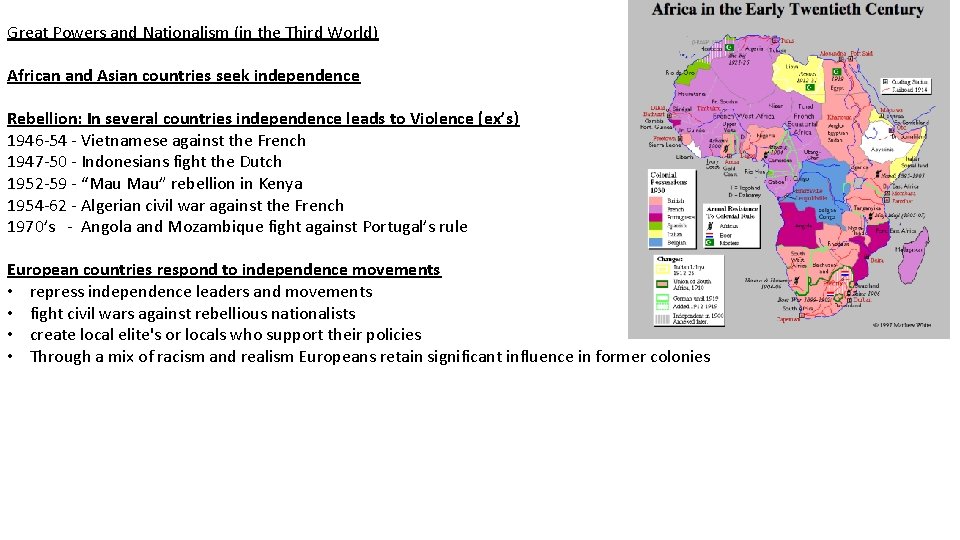
Great Powers and Nationalism (in the Third World) African and Asian countries seek independence Rebellion: In several countries independence leads to Violence (ex’s) 1946 -54 - Vietnamese against the French 1947 -50 - Indonesians fight the Dutch 1952 -59 - “Mau Mau” rebellion in Kenya 1954 -62 - Algerian civil war against the French 1970’s - Angola and Mozambique fight against Portugal’s rule European countries respond to independence movements • repress independence leaders and movements • fight civil wars against rebellious nationalists • create local elite's or locals who support their policies • Through a mix of racism and realism Europeans retain significant influence in former colonies
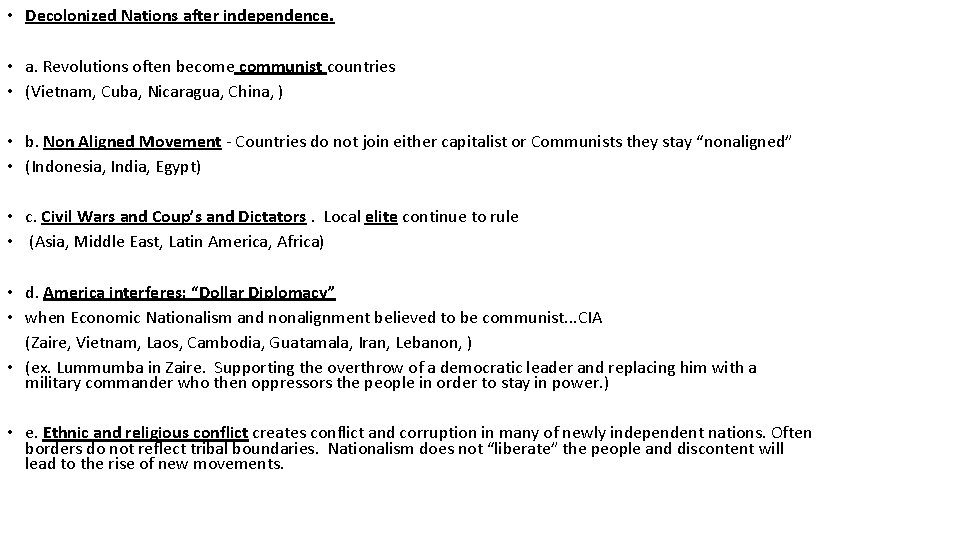
• Decolonized Nations after independence. • a. Revolutions often become communist countries • (Vietnam, Cuba, Nicaragua, China, ) • b. Non Aligned Movement - Countries do not join either capitalist or Communists they stay “nonaligned” • (Indonesia, India, Egypt) • c. Civil Wars and Coup’s and Dictators. Local elite continue to rule • (Asia, Middle East, Latin America, Africa) • d. America interferes: “Dollar Diplomacy” • when Economic Nationalism and nonalignment believed to be communist. . . CIA (Zaire, Vietnam, Laos, Cambodia, Guatamala, Iran, Lebanon, ) • (ex. Lummumba in Zaire. Supporting the overthrow of a democratic leader and replacing him with a military commander who then oppressors the people in order to stay in power. ) • e. Ethnic and religious conflict creates conflict and corruption in many of newly independent nations. Often borders do not reflect tribal boundaries. Nationalism does not “liberate” the people and discontent will lead to the rise of new movements.
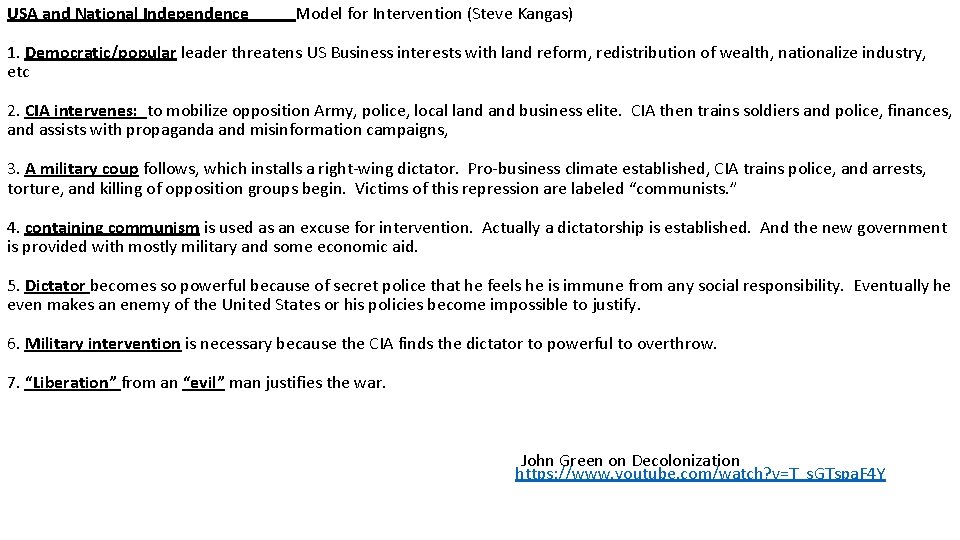
USA and National Independence Model for Intervention (Steve Kangas) 1. Democratic/popular leader threatens US Business interests with land reform, redistribution of wealth, nationalize industry, etc 2. CIA intervenes: to mobilize opposition Army, police, local land business elite. CIA then trains soldiers and police, finances, and assists with propaganda and misinformation campaigns, 3. A military coup follows, which installs a right-wing dictator. Pro-business climate established, CIA trains police, and arrests, torture, and killing of opposition groups begin. Victims of this repression are labeled “communists. ” 4. containing communism is used as an excuse for intervention. Actually a dictatorship is established. And the new government is provided with mostly military and some economic aid. 5. Dictator becomes so powerful because of secret police that he feels he is immune from any social responsibility. Eventually he even makes an enemy of the United States or his policies become impossible to justify. 6. Military intervention is necessary because the CIA finds the dictator to powerful to overthrow. 7. “Liberation” from an “evil” man justifies the war. John Green on Decolonization https: //www. youtube. com/watch? v=T_s. GTspa. F 4 Y