
DECOLONIZATION ON TWO SCALES scale switching QUESTIONING DECOLONIZATION

- Slides: 19
DECOLONIZATION ON TWO SCALES (scale switching) QUESTIONING DECOLONIZATION 2. 1 Presentation created by Trevor R. Getz. Permission given to use freely and adapt for education purposes
SCALE 1: GLOBAL
WWII: A WATERSHED? • Opening : To what degree did WWII cause or facilitate the rise of nationalist parties, and eventual independence?
WWII AND COLONIAL AUTHORITY AND CONTROL • Military exhaustion and the thinner white line • Breaking the myth of white superiority and invincibility • Promises – of self rule, to veterans, etc • Increased exploitation and cottage industries in the colonies
IMPERIAL DEFEATS AND POWER “VACUUMS” • Effect of Japanese interregnum on imperial authority in South-East Asia • China as a belligerent • Italian defeat – Libya and the Horn of Africa • Vichy France and the forced retreat from the eastern Mediterranean
THE GLOBAL POLITICAL AFTERMATH OF WWII • The bi-polar world and Soviet/US attitudes towards formal Empire. • The discourse of liberal “morality” (where did this come from? ) • Communications shifts and the rise of “public opinion”
SHIFTING ECONOMICS • Ruin and bankruptcy in Europe • 1944 Bretton Woods agreement • Marshall Plan for Europe • IMF • World Bank • Enforcement of political liberalization • Socialism • The EEC/European Union as a focus after late 1950 s • Shifting of manufacturing (first from Europe to US/USSR, then to Asia)
THE UNITED NATIONS • A model proposed by Churchill during WWII as a way to organize the post-war world. • Sponsored by US as a way to manage the movement of the world towards liberal nation-statism and capitalism. • Used by newly-independent states, by 1960, as a pathway towards decolonization. • The Non-Aligned Movement largely operated through the UN (1955 -).
THE DEMONSTRATION EFFECT • Libya (war’s end) • India (1947/1948) • Ghana and sub-Saharan Africa • Dien Bien Phu! (Impact in Algeria and elsewhere)
GLOBAL INTELLECTUAL FLOWS AND MODELS OF DECOLONIZATION • Students in western universities. • Cuba/USSR/Warsaw Pact scholarship and university programs. • Mass publishing of key tracts. • Reading Fanon in Zimbabwe • “Cultural” organizations operate to co-opt potential leaders to one side or the other.
COLD WAR PROXIES • France plays on US fears of communism in Indochina. • Roxas administration in Philippines granted independence in exchange for US bases. • US limits Dutch in Indonesia as sponsors of Sukarno as anti-communist alternative. • Angola!!
SCALE 2: “NATION” AND “STATE”
COLONIAL CONTRADICTIONS: THE PROCONSULAR STATE • Query: what is the state? • Designed to approximate the metropolitan structure. • Self contained – has all of the agencies needed for governance. • Thus: whomever captures the “state” can control the colony
COLONIAL CONTRADICTIONS: INDIRECT RULE • What was indirect rule? • Colonizers were generally too weak to rule colonial subjects on their own. • Thus they relied on subaltern classes: armed with understanding of the system in which they had worked • In the post-war years, the clerk classes were increasingly frozen out of authority, yet they carried the preponderance of power because they were key to the running of the apparatus of the state.
WHAT IS NATIONALISM? The distinctive feature of nationalism is that it applies the notion of the nation (and hence ‘sovereignty’ not only to an elite, but to the people’. This semantic transformation launched the era of nationalism. [BUT t] he adoption of national identity must have been, in one way or another, in the interest of the groups which imported it. --- Liah Greenfeld
How do you imagine a nation? • • Common suffering Common language? Common history Common dress Common values Common struggle Shared identity! Question: Who articulates the nation?
WHO IMAGINED THE NATION? • In other words, who were the leading nationalists? – Often western educated – Often professionals or intellectuals – But with an ability to reach out to the people • These individuals were initially reformers, but became nationalists: – frustration at their exclusion. – opportunities and wealth evaporated. – move into the colonial cities in a process of urbanization coupled with a lack of job prospects. – The new middling class was also partly formed of exservicemen
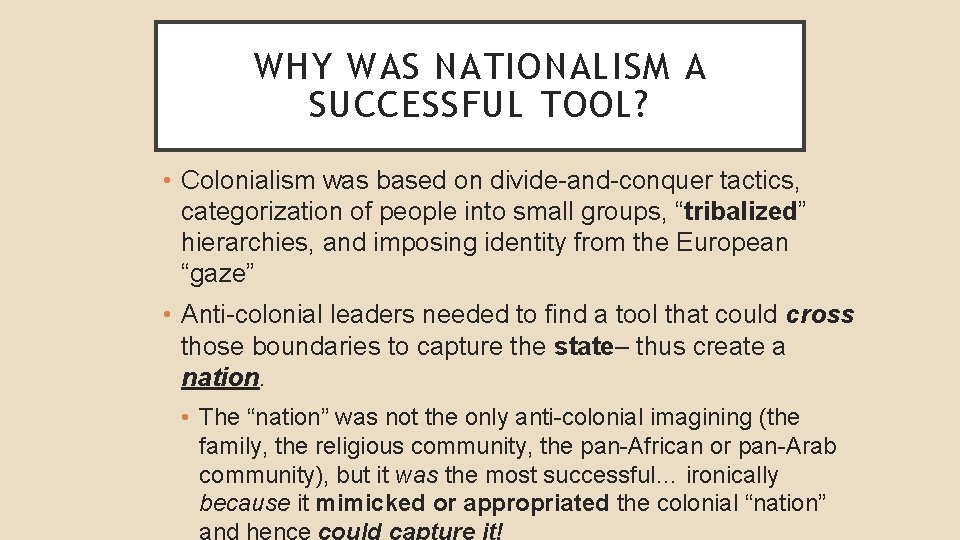
WHY WAS NATIONALISM A SUCCESSFUL TOOL? • Colonialism was based on divide-and-conquer tactics, categorization of people into small groups, “tribalized” hierarchies, and imposing identity from the European “gaze” • Anti-colonial leaders needed to find a tool that could cross those boundaries to capture the state– thus create a nation. • The “nation” was not the only anti-colonial imagining (the family, the religious community, the pan-African or pan-Arab community), but it was the most successful… ironically because it mimicked or appropriated the colonial “nation”
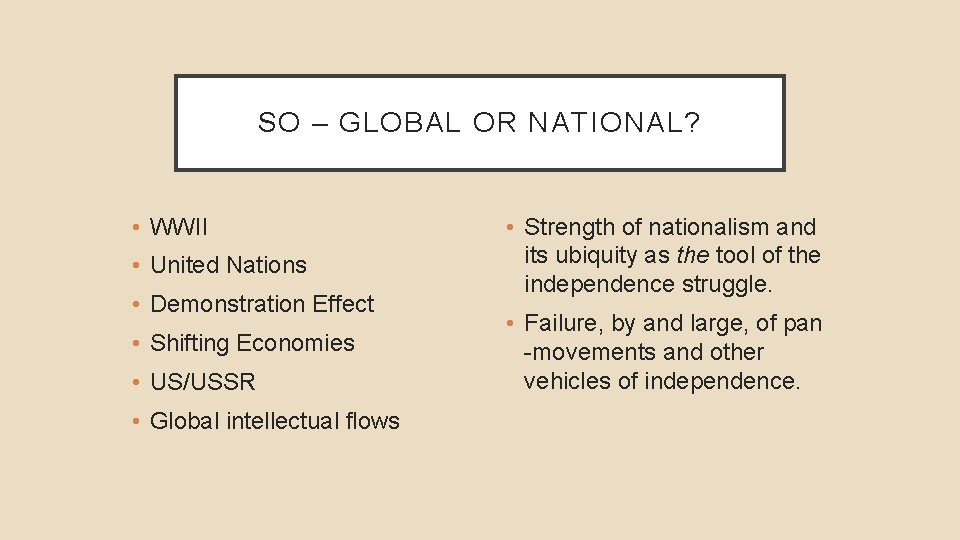
SO – GLOBAL OR NATIONAL? • WWII • United Nations • Demonstration Effect • Shifting Economies • US/USSR • Global intellectual flows • Strength of nationalism and its ubiquity as the tool of the independence struggle. • Failure, by and large, of pan -movements and other vehicles of independence.