
DECOLONIZATION OF INDIA History 12 Ms Leslie 3
- Slides: 44
DECOLONIZATION OF INDIA History 12 Ms Leslie
3 main factors to decolonization: Britain and France bankrupt after WWI. 2. Colonial subjects do not was things to return to how they were. 3. New super-powers were ideologically opposed to the concept of empires 1.
India India is a colony of Britain for 200 years Provides Britain with cotton The Indian Civil Service was the most desirable of all foreign service postings. Britain provided education for the middle class Majority are Hindu with a large minority of Muslims - A Sikh population as well
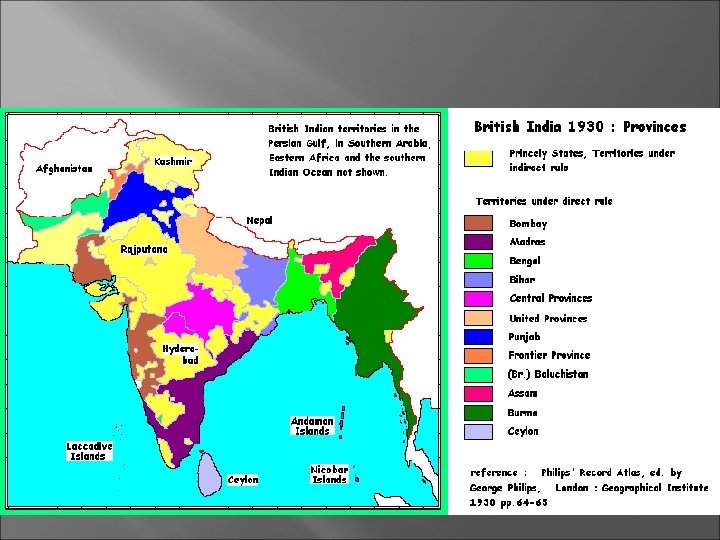
India sub-continent Included modern states of: Pakistan India Bangladesh Burma Islands in the Indian Ocean
Managing India Huge country = lots of bureaucracy So educated Indians ran the country This fostered nationalism
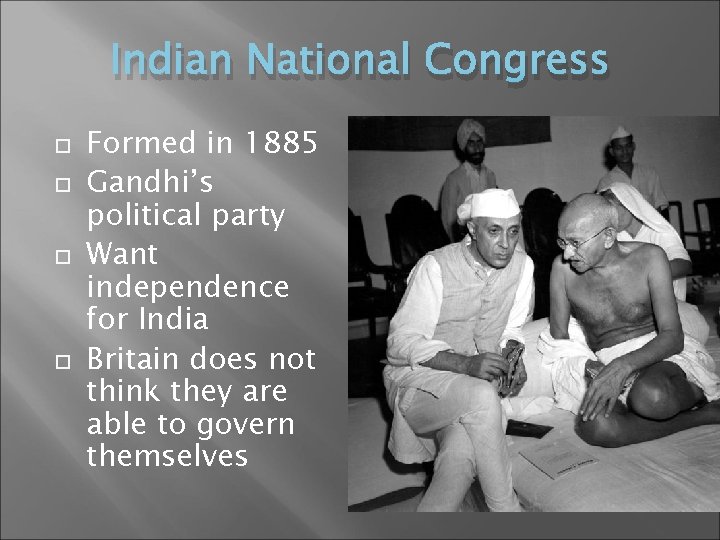
Indian National Congress Formed in 1885 Gandhi’s political party Want independence for India Britain does not think they are able to govern themselves
When Gandhi was leaer it was refered to as the ‘congress party’ Jawaharlal Nehru was his right hand man Takes over when Gandhi Died Both believed in a united, free India with Muslims Not everyone in the Congress Party agreed Some did not want to share with the Muslims
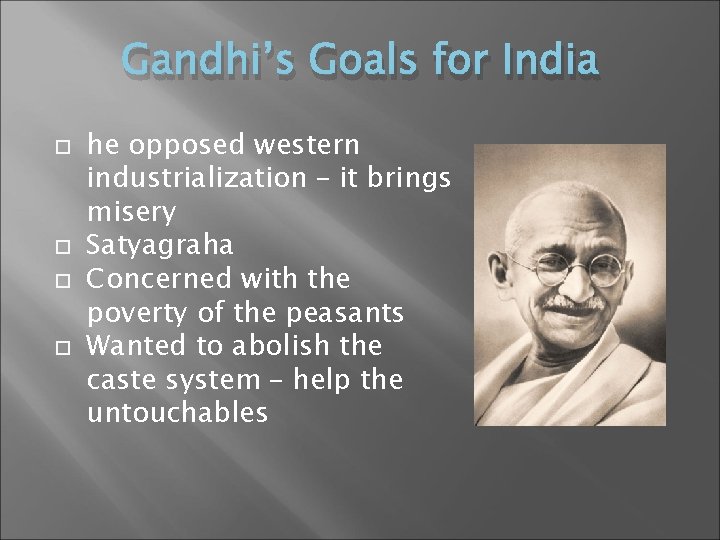
Gandhi’s Goals for India he opposed western industrialization – it brings misery Satyagraha Concerned with the poverty of the peasants Wanted to abolish the caste system – help the untouchables
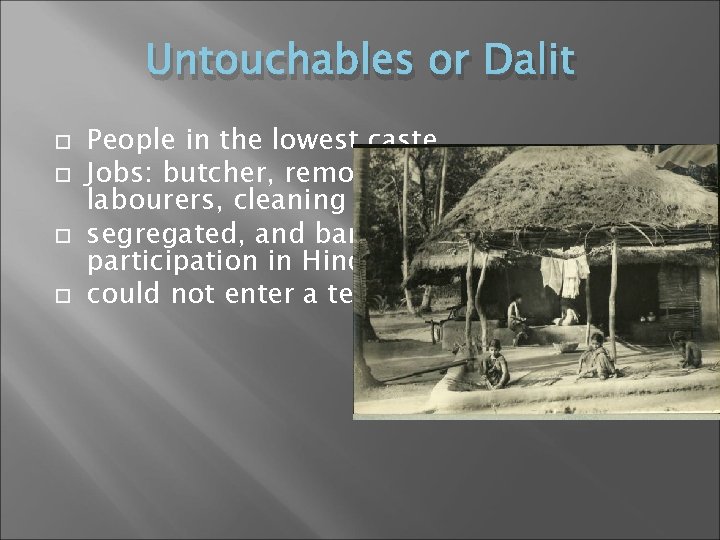
Untouchables or Dalit People in the lowest caste Jobs: butcher, removal of rubbish, manual labourers, cleaning latrines and sewers. segregated, and banned from full participation in Hindu social life. could not enter a temple or a school,
Political Party founded in 1906 Lead by Muhammad Ali Jinnah By the 1930’s they were calling for a separate Muslim state of Pakistan In direct opposition of Gandhi’s goals
Indian contribution made nationalism stronger Woodrow Wilson’s talk of selfdetermination and Lenin’s views on national self-determination provided ample encouragement. 1917 promised self-government in the future Churchill opposed to this
1919 Created a dyarchy Created 11 provinces in India More government control provincially but not federally Provincial = Indian controlled - Health, Education and agricuture Federal = British = Finance, Law and Order Promise to consider more concessions in 10 years
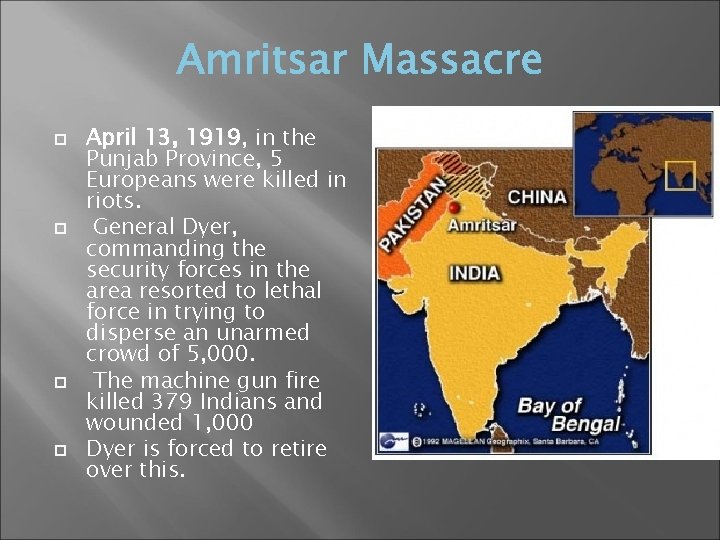
April 13, 1919, in the Punjab Province, 5 Europeans were killed in riots. General Dyer, commanding the security forces in the area resorted to lethal force in trying to disperse an unarmed crowd of 5, 000. The machine gun fire killed 379 Indians and wounded 1, 000 Dyer is forced to retire over this.
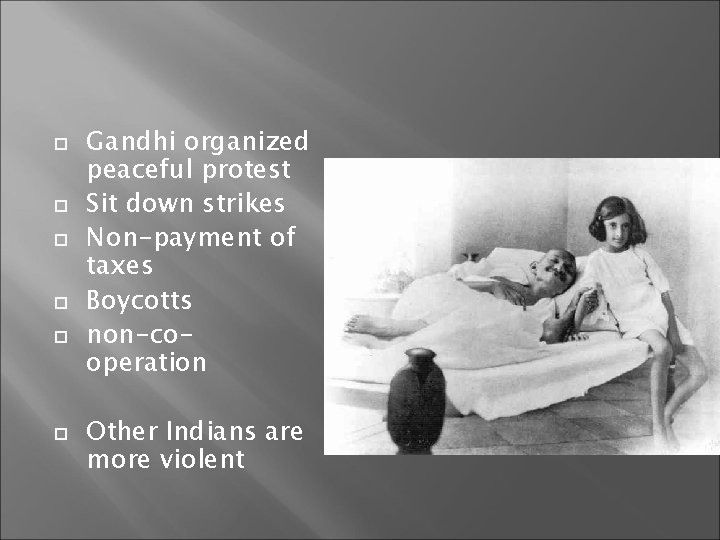
Gandhi organized peaceful protest Sit down strikes Non-payment of taxes Boycotts non-cooperation Other Indians are more violent
Soon Indians of all backgrounds echoed the slogan of the Congress Party, “Quit India”.
The Simon Commission in 1928 recommended self government for the Provinces. The Congress wanted dominion status to be on par with Canada, Australia, New Zealand South Africa.
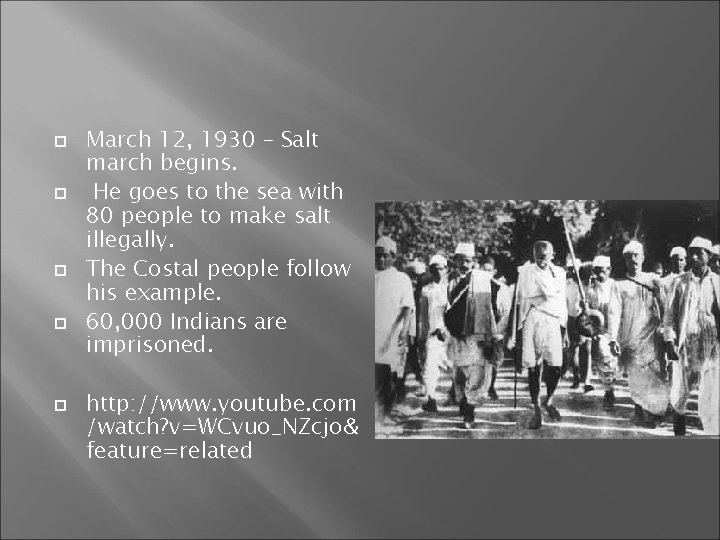
March 12, 1930 – Salt march begins. He goes to the sea with 80 people to make salt illegally. The Costal people follow his example. 60, 000 Indians are imprisoned. http: //www. youtube. com /watch? v=WCvuo_NZcjo& feature=related
Gandhi, recently released from jail, led his famed march to the sea to produce salt – in violation of the law. Gandhi returned to jail where he goes on a hunger strike to protest the treatment of the untouchables.
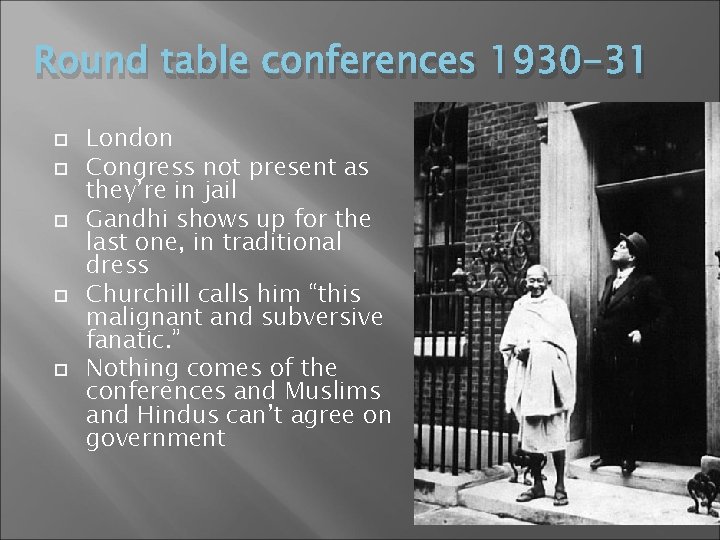
Round table conferences 1930 -31 London Congress not present as they’re in jail Gandhi shows up for the last one, in traditional dress Churchill calls him “this malignant and subversive fanatic. ” Nothing comes of the conferences and Muslims and Hindus can’t agree on government
Gave full control of 11 provinces to Indians Britain and India to share Federal powers Only Defense and Foreign affairs was to remain in British hands. Yet, once again Congress Party was unsatisfied. The Princes who continued to rule their own states within India also refused to cooperate.
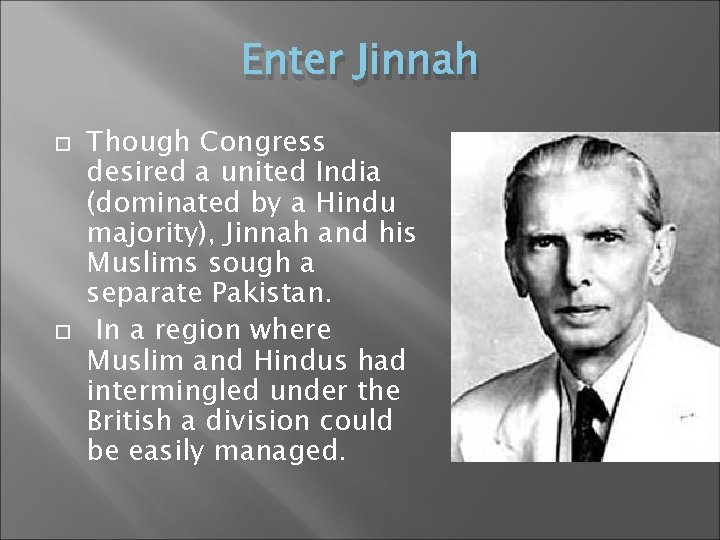
Enter Jinnah Though Congress desired a united India (dominated by a Hindu majority), Jinnah and his Muslims sough a separate Pakistan. In a region where Muslim and Hindus had intermingled under the British a division could be easily managed.
1937 provincial elections had the Congress party dominating in 6 provinces, The Muslim League in 2, the other 3 were undecided India’s struggle for independence was put on hold during WWII
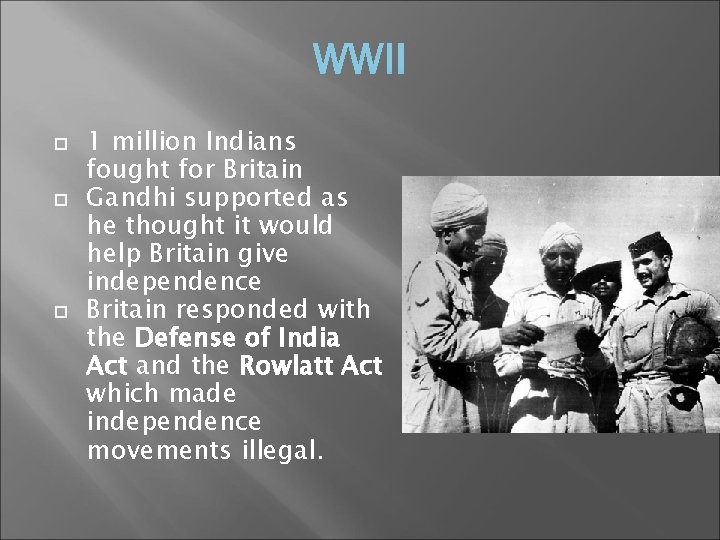
1 million Indians fought for Britain Gandhi supported as he thought it would help Britain give independence Britain responded with the Defense of India Act and the Rowlatt Act which made independence movements illegal.
India was put into WWII by Viceroy Linlithgrow without approval from domestic political leaders. Britain is distracted by the war to pay any attention to India By 1942 Britain is forced to consider independence
Congress leaders and thrown in jail for speaking against the British As the Congress leaders re-emerged from jail, negotiations were opened again, but Congress leaders found that the Muslim League had now established themselves in important political positions in several provinces. The struggle between the two parties intensified.
Gandhi was opposed to the very concept of division. Nehru found it distasteful, but accepted the political necessity. Jinnah would consider nothing else.
Struggle between the Muslim minority and the Hindu majority Britain turned heir back on India and instructs Viceroy Mountbatten to prepare India for Independence India to divide into 2 – India for Hindus and Sikhs and Pakistan (East and West) for Muslims. Gandhi against this.
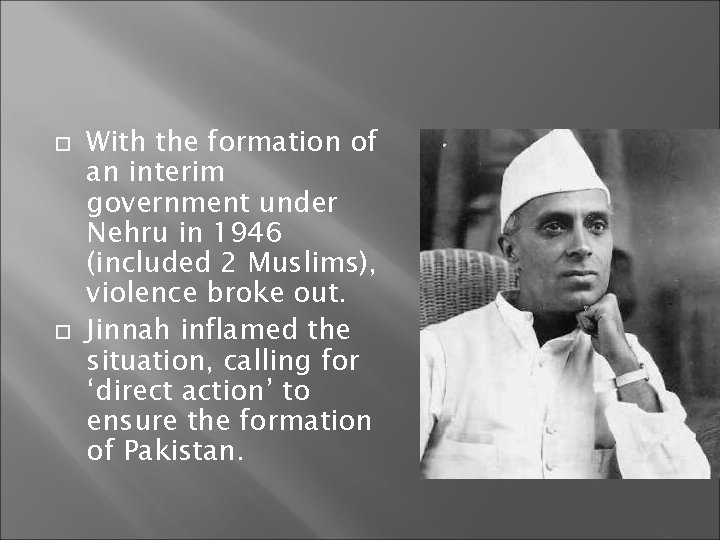
With the formation of an interim government under Nehru in 1946 (included 2 Muslims), violence broke out. Jinnah inflamed the situation, calling for ‘direct action’ to ensure the formation of Pakistan.
5, 000 people were killed in Calcutta, and the troubles spread to Bengal. Muslims killed Hindus, who retaliated and were in turn retaliated against.
The British announced, in early 1947, that the British would withdraw no later than June 1948. Viceroy Mountbatten was now well aware that partition was the only thing that could prevent civil war. Fearing that delay would only foster greater violence, Mountbatten shortened the length of time before independence, settling on August 1947 – Gandhi opposed, but most of the Congress Agreed
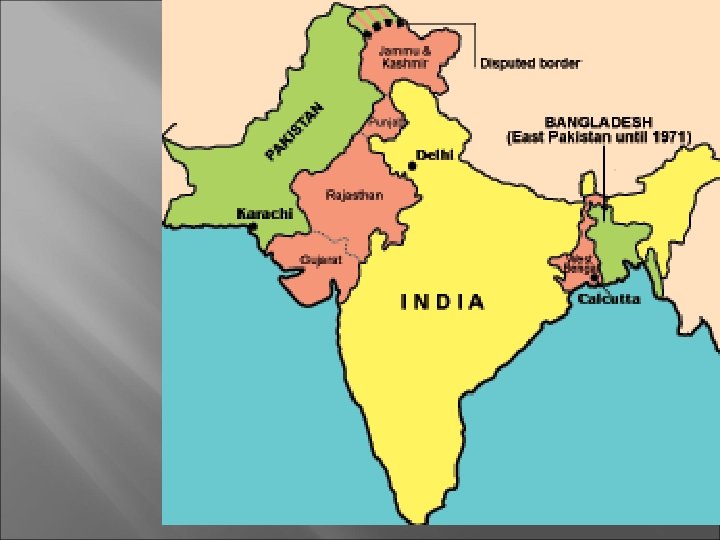
Partition the problem of how to divide the intermixed religious groups was a nightmare. Hindu and Muslim minorities existed in practically all parts of the sub-continent. The majority Muslim areas were furthermore located in two sections, more that 2, 000 miles apart.
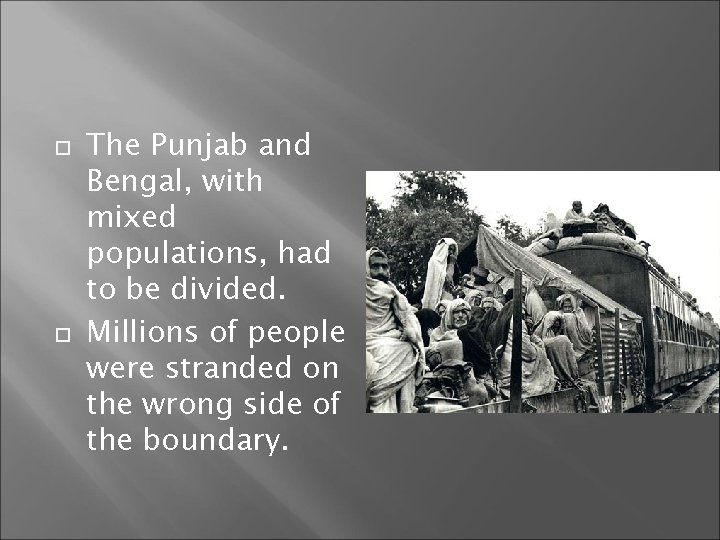
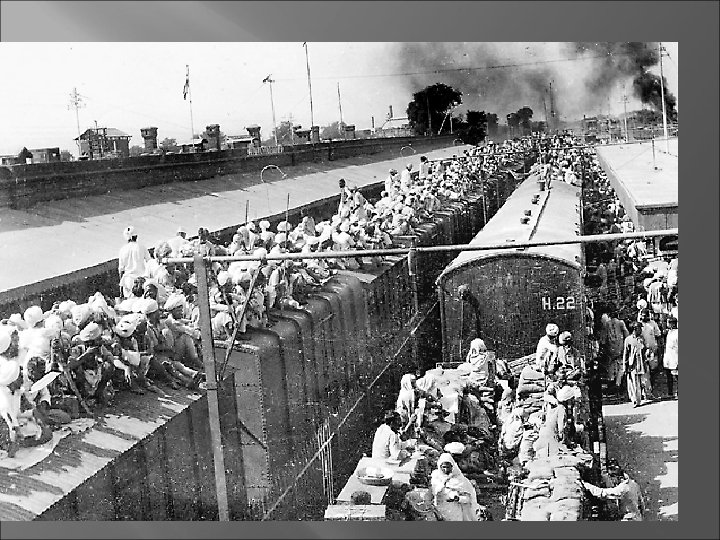
The Punjab and Bengal, with mixed populations, had to be divided. Millions of people were stranded on the wrong side of the boundary.
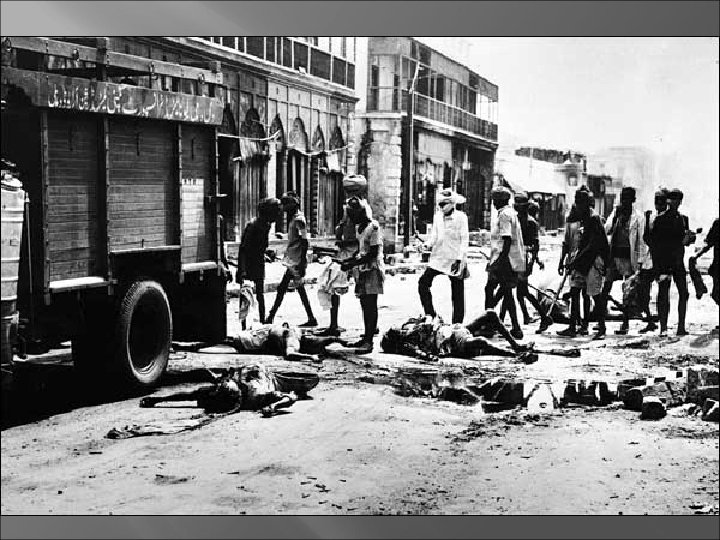
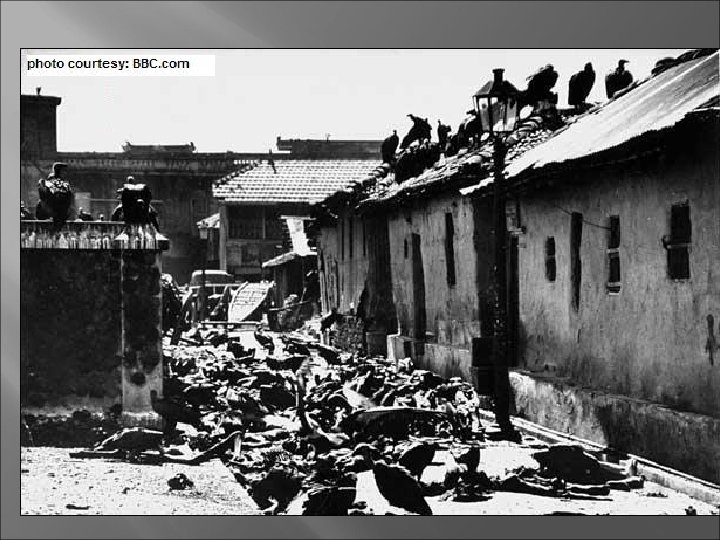
10 million flee Pakistan. Violent clashes occurred and horrendous slaughter took place. In the Punjab about ¼ million people were killed. About 1 million die in Bengal. Gandhi is able to stop the violence by going a hunger strike.
It was not until the end of 1947 that the violence began to die down it was the assassination of Gandhi (by a Hindu fanatic) in 1948 during a second hunger strike against violence that brought the terrible cost of the violence home to all.
The Indian Civil Service, one of the finest organization of its kind anywhere, was split in two. 80% when to India and 20% to Pakistan. So too was the Indian army Officers and men were given the choice of which successor state they would serve.
All assets – cash and material goods – along with India’s national debt, were divided between the two Some Muslims even called for the Taj Mahal to be dismantled and shipped to Pakistan, since a Muslim ruler had constructed it. No consideration given to Sikhs
India since indepenence o In 1962 India fought a border conflict with China In 1965 war broke out between the two states. Border clashes escalated into full scale war. With China threatening India on its northern borders, India was unable to press the full weight of its superior military strength against Pakistan. Eventually the USSR helped arranged a peace based on a return to the status quo.
In 1971 Pakistan was divided by civil war. East Pakistani opposition to the political dominance to the West encouraged a call for separation. The ravaged of a disastrous cyclone and tidal wave increased the misery. India intervened, launching an invasion of East Pakistan in December, 1971, winning easily to make Bangladeshi independence a reality.
India today - Democracy Mass unemployment, poverty and corruption AIDS 80, 000 Untouchables Army loyal to government Gandhi honoured for how he was not his politics A Nuclear power