
Decolonization of Africa What is Decolonization Decolonization the

- Slides: 28
Decolonization of Africa
What is Decolonization? • Decolonization: the process of becoming free of colonial status and achieving statehood • Between WWI and WWII, movements for independence begun in earnest in Africa and Asia • Dominance of colonial powers seemed at odds with Allied goals in WWII. • Call for national self-determination – fight for independence. • Empires reluctant to let colonies go.
Why Decolonization Occurred
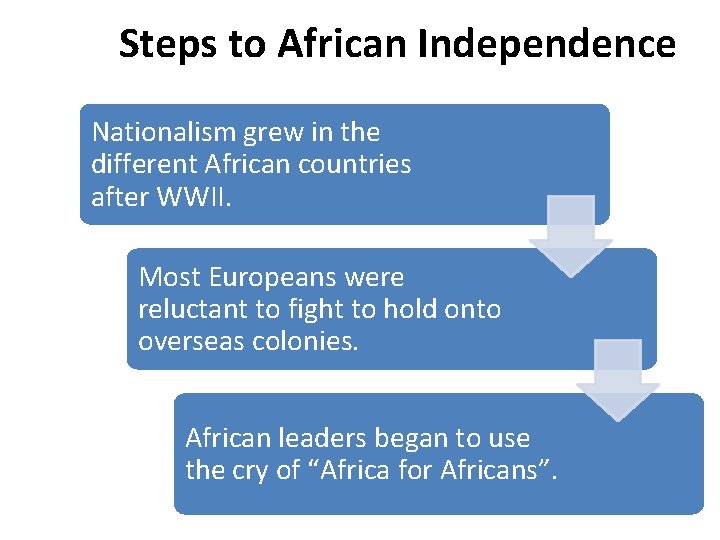
Steps to African Independence Nationalism grew in the different African countries after WWII. Most Europeans were reluctant to fight to hold onto overseas colonies. African leaders began to use the cry of “Africa for Africans”.
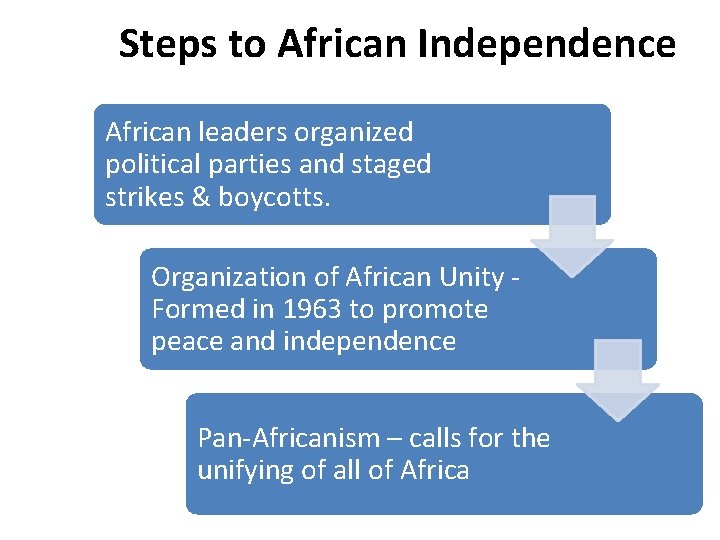
Steps to African Independence African leaders organized political parties and staged strikes & boycotts. Organization of African Unity Formed in 1963 to promote peace and independence Pan-Africanism – calls for the unifying of all of Africa
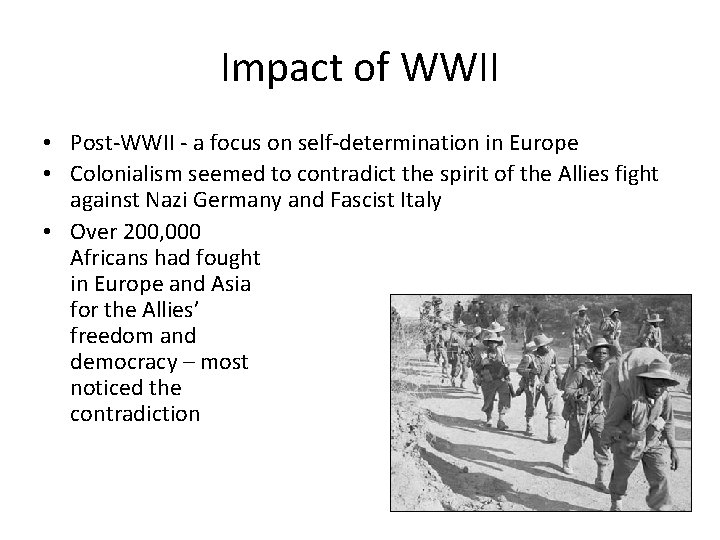
Impact of WWII • Post-WWII - a focus on self-determination in Europe • Colonialism seemed to contradict the spirit of the Allies fight against Nazi Germany and Fascist Italy • Over 200, 000 Africans had fought in Europe and Asia for the Allies’ freedom and democracy – most noticed the contradiction
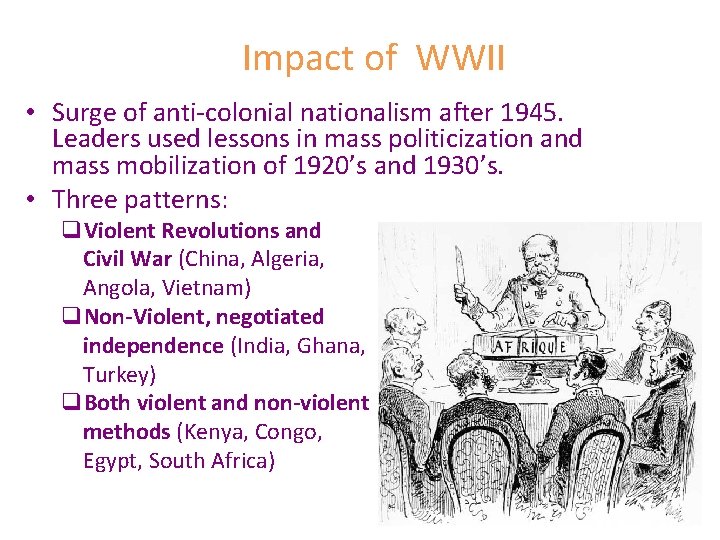
Impact of WWII • Surge of anti-colonial nationalism after 1945. Leaders used lessons in mass politicization and mass mobilization of 1920’s and 1930’s. • Three patterns: q. Violent Revolutions and Civil War (China, Algeria, Angola, Vietnam) q. Non-Violent, negotiated independence (India, Ghana, Turkey) q. Both violent and non-violent methods (Kenya, Congo, Egypt, South Africa)
Impact of the Cold War • Soviet pushed anti-colonial movement offered assistance • United States wanted access to African markets (why were they closed before? ) AND to prevent the spread of communism. • When West refused to help nationalists, they turned to the Soviet Union
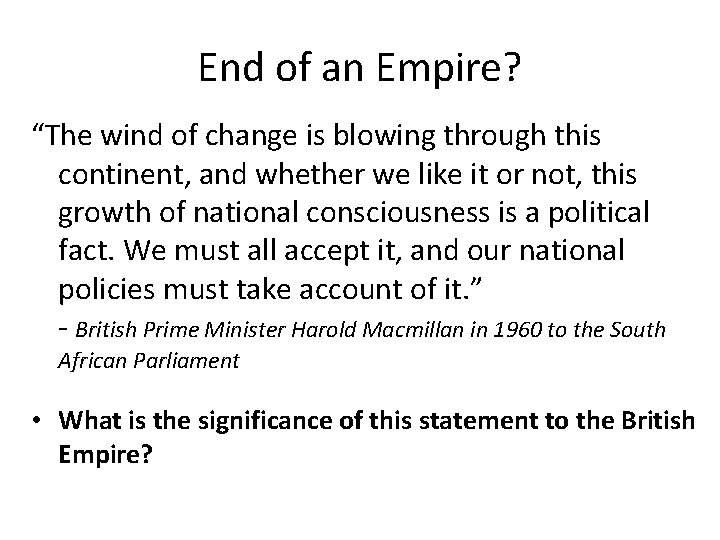
End of an Empire? “The wind of change is blowing through this continent, and whether we like it or not, this growth of national consciousness is a political fact. We must all accept it, and our national policies must take account of it. ” - British Prime Minister Harold Macmillan in 1960 to the South African Parliament • What is the significance of this statement to the British Empire?
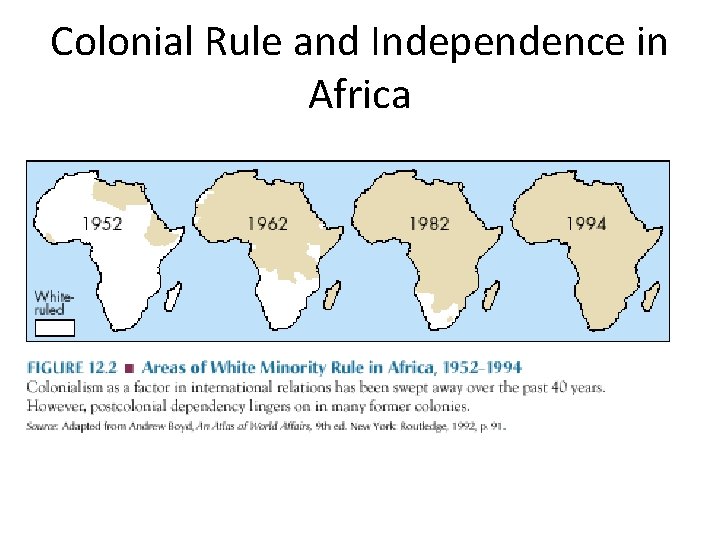
Colonial Rule and Independence in Africa
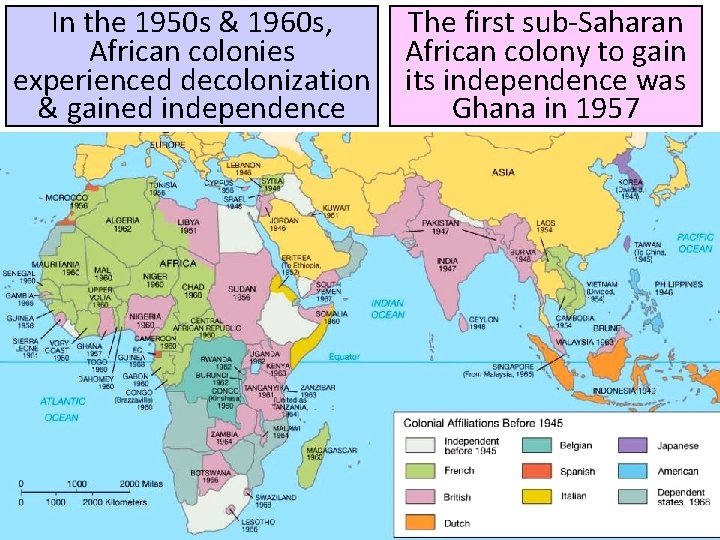
In the 1950 s & 1960 s, African colonies experienced decolonization & gained independence The first sub-Saharan African colony to gain its independence was Ghana in 1957
Phases of Decolonization in Africa
Phases of Decolonization • Phase One: roughly 19571973 (most of West and East Africa) • Phase Two: roughly 19741994 (mostly Southern/Central Africa)
Phase One---The 1960 s: Optimism and Compromise • Some violence, but it included many examples of a peaceful, smooth transfer of power • Colonial powers maintain some control over the terms of decolonization
Phase Two of Decolonization • Violence was far more common than in the first phase of decolonization • Decolonization tended to be grounded in the propaganda rhetoric of liberation and social transformation • Tied closely with the Cold War---were allied with USA or USSR
Independence: Three Routes/Paths • Three major routes: – Peaceful / Negotiated Independence • Typically achieved in non-settler colonies, ex = Ghana – Violent • Typically occurred in settler colonies, ex = Kenya, Algeria – Incomplete • White settler minority population given political power in decolonization, ex = S. Africa
Results of Decolonization
Varying Transitions of Freedom in Africa • For the most part, decolonization in the parts of African that had been British and French went smoothly. • Both Britain and France prepared their colonies for freedom by educating native elites, allowing greater native representation in transitional governments, and minimizing the possibility of interethnic conflict. • The worst transitions to independence were made by Belgian and Portuguese colonies who had been exploitative and did not prepare colonies for independence.
Overall Internal Challenges • Tribal allegiances • Illiteracy / under developed education system • No tradition of ongoing political leadership in modern times • Religious differences • Diverse geography and climate • Established social hierarchies
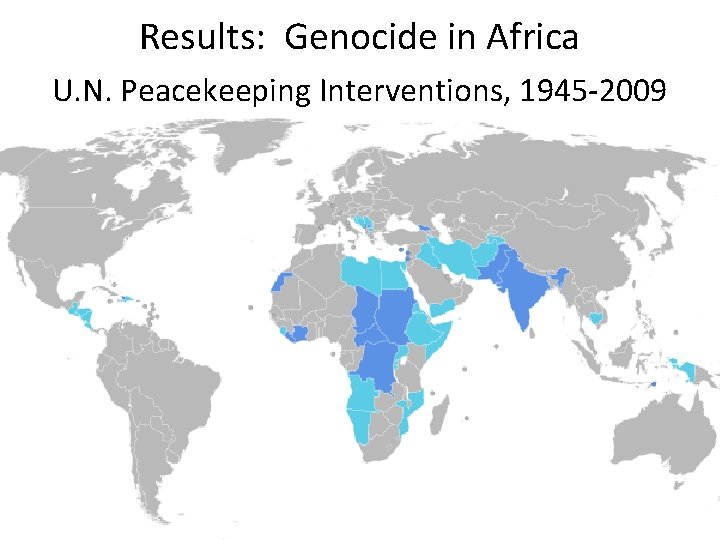
Results: Genocide in Africa U. N. Peacekeeping Interventions, 1945 -2009
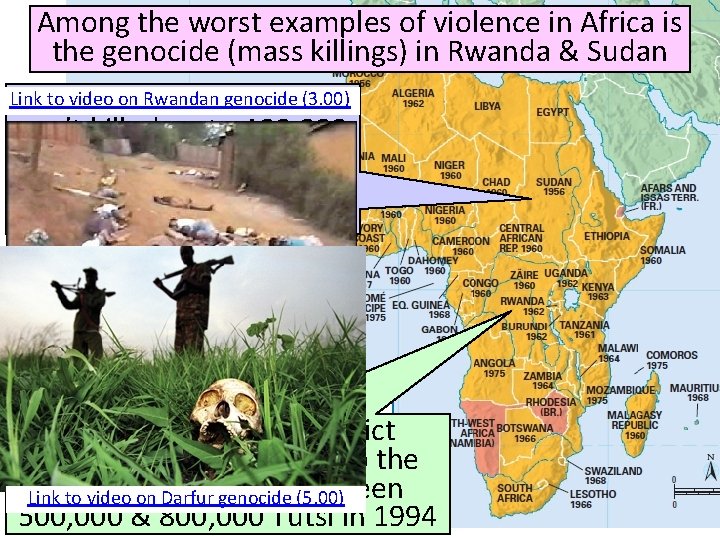
Among the worst examples of violence in Africa is the genocide (mass killings) in Rwanda & Sudan In Darfur, the Sudanese gov’t killed up to 400, 000 Muslims in an attempt to destroy an anti-gov’t rebel movement Link to video on Rwandan genocide (3. 00) In Rwanda, ethnic conflict between rival clans led to the massacring Link. Hutus to video on Darfur genocidebetween (5. 00) 500, 000 & 800, 000 Tutsi in 1994
Results: Economic Issues • Economic dependence on West coupled with political corruption cripples attempts to diversify economy – Stuck in cash crop agriculture & extraction of resources – Large loans to modernize economies squandered by those in power - leave little progress, lots of debt
Results: Corrupt Political Parties and Leaders • Nationalist parties & African elites gain power – Use anti-colonial legacy to maintain power & cloud ineptitude & favoritism • Initial political parties reflected ethnic, regional, or religious groups - few true national parties • Power often gained by corrupt African “strongmen” (dictators) who ignored the social needs of people
Conclusions • Decolonization was sometimes a violent process- dependent in large part on how many settlers had come to the colony. • In many parts of world, decolonization was not revolutionary. Power passed from one class of elites to another. Little economic and social reform occurred. • Significant challenges faced independent nations. • Western economic dominance of the global trade system continued unabated. WHY?
Decolonization of Africa Mrs. Armstrong 7808 https: //www. youtube. com/watch? v=Rtjl Owa 5 AUQ Published on Jan 28, 2015 Running Time of 3: 37 Minutes Crash Course Decolonization of Africa clip
• • Africa: States of independence - the scramble for Africa Al Jazeera English Uploaded on Sep 2, 2010 Running Time of 44: 54 Minutes---But Decolonization Starts at 19: 00 Minutes You must go directly to YOUTUBE. It would not insert. Seventeen African nations gained their independence in 1960, but the dreams of the independence era were short-lived. Africa states of independence tells the story of some of those countries - stories of mass exploitation, of the ecstasy of independence and of how - with liberation - a new, covert scramble for resources was born. [September 2, 2010]
• • • Congo and Africa's World War: Crash Course World History 221 Crash. Course https: //www. youtube. com/watch? v=4 u. Ar. Rzw. KHv. E Published on Jan 16, 2015 Go to separately in YOUTUBE. Insert would not work. • In which John Green teaches you about the Democratic Republic of the Congo, which used to be Zaire, which used to be The Belgian Congo, which used to be the Congo Free State, which used to be the region surrounding the Congo River Basin in central Africa. So the history of this place is a little convoluted. The history of Congo is central to the history of central Africa, and the Congo Wars embroiled neighboring countries like Uganda and Rwanda. John will talk you through the history of Congo and the region.