
DECOLONISATION POSTCOLONIAL ISSUES Identity Culture and tradition Belief

DECOLONISATION POSTCOLONIAL ISSUES: • Identity • Culture and tradition • Belief and religion • Language • Location or sense of displacement Process of revealing and dismantling colonist power in al its forms political independence ≠ cultural independence Britain’s national identity is conditioned by: • Post-war migration • Globalisation • Long-term decline as «world power» • Britain’s role in and out of Europe • Devolution • End of Empire • Rapid advance of social pluralism Devolution: transference, as of rights, powers, property or responsibility, to another; the surrender of powers to local authorities by a central government. Pluralism: a social organisation in which diversity of racial, religious, ethnic or cultural groups is tolerated; pluralistic societies place strong expectations of integration on members, rather than expectations of assimilation.
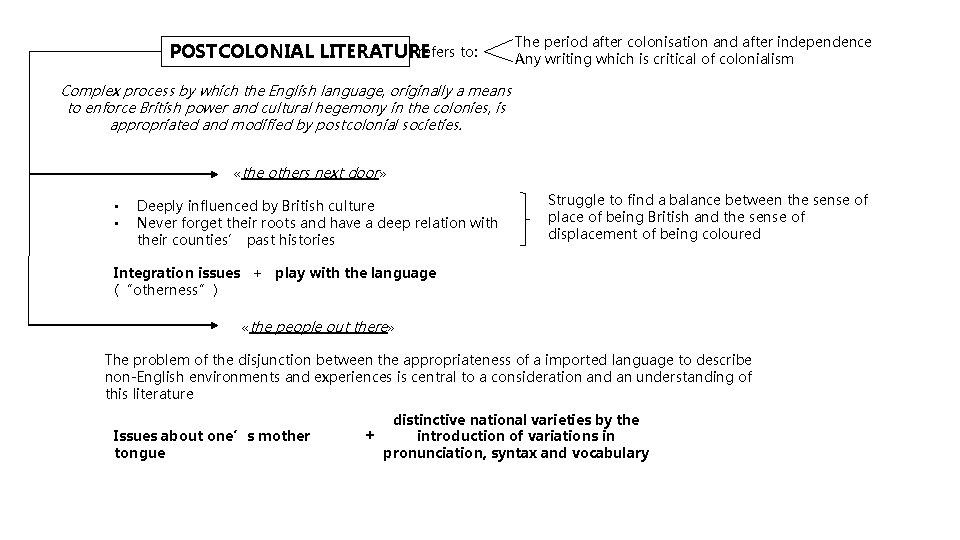
refers to: POSTCOLONIAL LITERATURE The period after colonisation and after independence Any writing which is critical of colonialism Complex process by which the English language, originally a means to enforce British power and cultural hegemony in the colonies, is appropriated and modified by postcolonial societies. «the others next door» • • Deeply influenced by British culture Never forget their roots and have a deep relation with their counties’ past histories Struggle to find a balance between the sense of place of being British and the sense of displacement of being coloured Integration issues + play with the language (“otherness”) « the people out there» The problem of the disjunction between the appropriateness of a imported language to describe non-English environments and experiences is central to a consideration and an understanding of this literature Issues about one’s mother tongue + distinctive national varieties by the introduction of variations in pronunciation, syntax and vocabulary
- Slides: 2