
DECODING DOUBLE TAXATION AVOIDANCE AGREEMENTS DTAA SOME FUNDAMENTALS

DECODING DOUBLE TAXATION AVOIDANCE AGREEMENTS (DTAA)
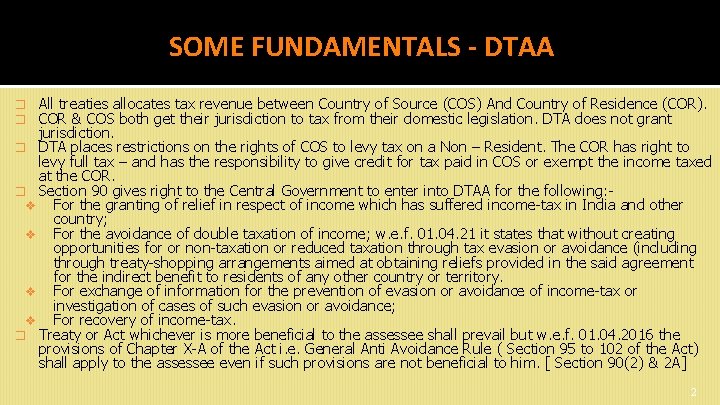
SOME FUNDAMENTALS - DTAA All treaties allocates tax revenue between Country of Source (COS) And Country of Residence (COR). COR & COS both get their jurisdiction to tax from their domestic legislation. DTA does not grant jurisdiction. � DTA places restrictions on the rights of COS to levy tax on a Non – Resident. The COR has right to levy full tax – and has the responsibility to give credit for tax paid in COS or exempt the income taxed at the COR. � Section 90 gives right to the Central Government to enter into DTAA for the following: v For the granting of relief in respect of income which has suffered income-tax in India and other country; v For the avoidance of double taxation of income; w. e. f. 01. 04. 21 it states that without creating opportunities for or non-taxation or reduced taxation through tax evasion or avoidance (including through treaty-shopping arrangements aimed at obtaining reliefs provided in the said agreement for the indirect benefit to residents of any other country or territory. v For exchange of information for the prevention of evasion or avoidance of income-tax or investigation of cases of such evasion or avoidance; v For recovery of income-tax. � Treaty or Act whichever is more beneficial to the assessee shall prevail but w. e. f. 01. 04. 2016 the provisions of Chapter X-A of the Act i. e. General Anti Avoidance Rule ( Section 95 to 102 of the Act) shall apply to the assessee even if such provisions are not beneficial to him. [ Section 90(2) & 2 A] � � 2
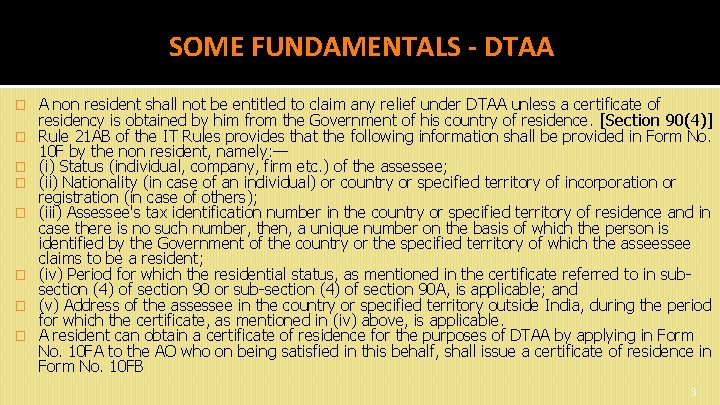
SOME FUNDAMENTALS - DTAA � � � � A non resident shall not be entitled to claim any relief under DTAA unless a certificate of residency is obtained by him from the Government of his country of residence. [Section 90(4)] Rule 21 AB of the IT Rules provides that the following information shall be provided in Form No. 10 F by the non resident, namely: — (i) Status (individual, company, firm etc. ) of the assessee; (ii) Nationality (in case of an individual) or country or specified territory of incorporation or registration (in case of others); (iii) Assessee's tax identification number in the country or specified territory of residence and in case there is no such number, then, a unique number on the basis of which the person is identified by the Government of the country or the specified territory of which the assee claims to be a resident; (iv) Period for which the residential status, as mentioned in the certificate referred to in subsection (4) of section 90 or sub-section (4) of section 90 A, is applicable; and (v) Address of the assessee in the country or specified territory outside India, during the period for which the certificate, as mentioned in (iv) above, is applicable. A resident can obtain a certificate of residence for the purposes of DTAA by applying in Form No. 10 FA to the AO who on being satisfied in this behalf, shall issue a certificate of residence in Form No. 10 FB 3
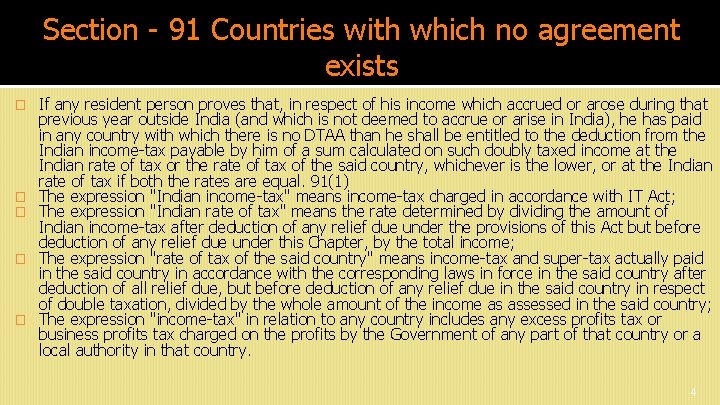
Section - 91 Countries with which no agreement exists � � � If any resident person proves that, in respect of his income which accrued or arose during that previous year outside India (and which is not deemed to accrue or arise in India), he has paid in any country with which there is no DTAA than he shall be entitled to the deduction from the Indian income-tax payable by him of a sum calculated on such doubly taxed income at the Indian rate of tax or the rate of tax of the said country, whichever is the lower, or at the Indian rate of tax if both the rates are equal. 91(1) The expression "Indian income-tax" means income-tax charged in accordance with IT Act; The expression "Indian rate of tax" means the rate determined by dividing the amount of Indian income-tax after deduction of any relief due under the provisions of this Act but before deduction of any relief due under this Chapter, by the total income; The expression "rate of tax of the said country" means income-tax and super-tax actually paid in the said country in accordance with the corresponding laws in force in the said country after deduction of all relief due, but before deduction of any relief due in the said country in respect of double taxation, divided by the whole amount of the income as assessed in the said country; The expression "income-tax" in relation to any country includes any excess profits tax or business profits tax charged on the profits by the Government of any part of that country or a local authority in that country. 4
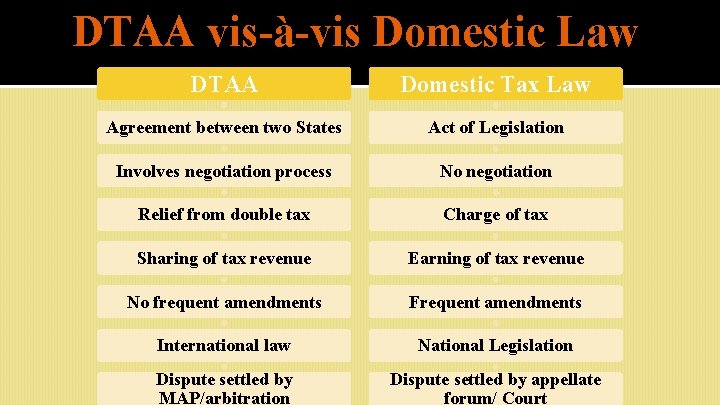
DTAA vis-à-vis Domestic Law DTAA Domestic Tax Law Agreement between two States Act of Legislation Involves negotiation process No negotiation Relief from double tax Charge of tax Sharing of tax revenue Earning of tax revenue No frequent amendments Frequent amendments International law National Legislation Dispute settled by MAP/arbitration Dispute settled by appellate forum/ Court
DTAA – Protocols and Notes q The double tax treaties are generally accompanied by one or more exchanges of notes and/or protocols, which clarify/expand/restrict application of the main DTAA. q When two countries want to change their double tax DTAA, they can do so in either of two ways: q q q enter into a new DTAA and terminate the old DTAA; or make amendments to the existing DTAA. If (ii) is followed, a protocol is used to make the relevant amendments.
TYPES OF TAX TREATIES • Limited Treaties – which cover – a) income from operation of aircrafts and ships, b) estates, c) inheritance and d) Gifts. • Comprehensive Treaties – which are wider in scope addressing all sources of income
Organization for Economic Cooperation & Development (‘OECD’) MODEL q Starting with the 1963 edition, the OECD model Treaty has been published with a commentary to each article q The OECD Model is essentially a model Treaty between two developed nations. q This model advocates residence principle, that is to say, it lays emphasis on the right of state of residence to tax. q The OECD Commentaries have been referred to as an aid to interpretation by the courts in many OECD countries and in some non. OECD countries (e. g. Malaysia).
United Nations (‘UN’) MODEL q Focused on double tax treaties between developed and developing countries. q Gives more weight to the source principle as against the residence principle of the OECD model allowing greater source country taxation q Commentaries on UN model treaties – more or less similar to OECD model Treaty commentaries
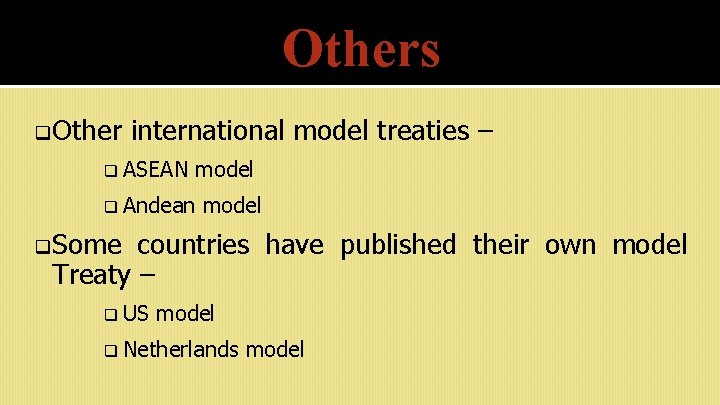
Others q. Other international model treaties – q ASEAN model q Andean model q. Some countries have published their own model Treaty – q US model q Netherlands model

Important Concepts to understand a DTAA Term Meaning Contracting States The Countries that are parties to a Tax Treaty. Credit Methods Foreign taxes paid by a resident of a country are credited against the residence country’s tax on the resident’s foreign-source income. Deduction Method Foreign taxes paid by a resident of a country are deductible in computing the resident’s taxable income in the resident country. Dual-resident taxpayers A taxpayers who is a tax resident of two or more countries for the same tax year. Exemption method Exemption from domestic tax of some or all foreign-source income derived by residents. Exemption with progression An exemption method under which certain foreign-source income is exempt from tax but is taken into account in determining the rates of tax applicable to other income.
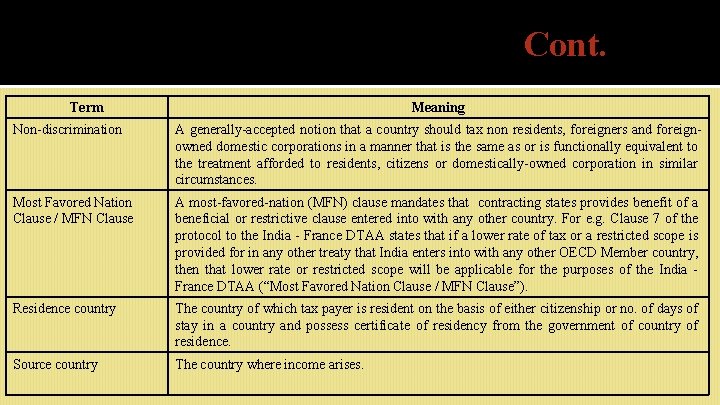
Cont. Term Meaning Non-discrimination A generally-accepted notion that a country should tax non residents, foreigners and foreignowned domestic corporations in a manner that is the same as or is functionally equivalent to the treatment afforded to residents, citizens or domestically-owned corporation in similar circumstances. Most Favored Nation Clause / MFN Clause A most-favored-nation (MFN) clause mandates that contracting states provides benefit of a beneficial or restrictive clause entered into with any other country. For e. g. Clause 7 of the protocol to the India - France DTAA states that if a lower rate of tax or a restricted scope is provided for in any other treaty that India enters into with any other OECD Member country, then that lower rate or restricted scope will be applicable for the purposes of the India France DTAA (“Most Favored Nation Clause / MFN Clause”). Residence country The country of which tax payer is resident on the basis of either citizenship or no. of days of stay in a country and possess certificate of residency from the government of country of residence. Source country The country where income arises.
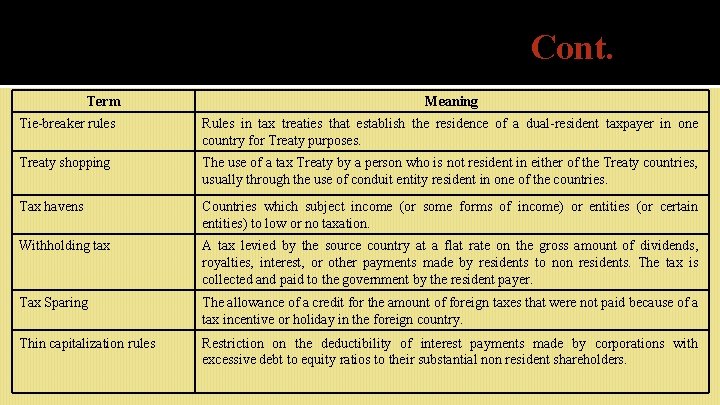
Cont. Term Meaning Tie-breaker rules Rules in tax treaties that establish the residence of a dual-resident taxpayer in one country for Treaty purposes. Treaty shopping The use of a tax Treaty by a person who is not resident in either of the Treaty countries, usually through the use of conduit entity resident in one of the countries. Tax havens Countries which subject income (or some forms of income) or entities (or certain entities) to low or no taxation. Withholding tax A tax levied by the source country at a flat rate on the gross amount of dividends, royalties, interest, or other payments made by residents to non residents. The tax is collected and paid to the government by the resident payer. Tax Sparing The allowance of a credit for the amount of foreign taxes that were not paid because of a tax incentive or holiday in the foreign country. Thin capitalization rules Restriction on the deductibility of interest payments made by corporations with excessive debt to equity ratios to their substantial non resident shareholders.
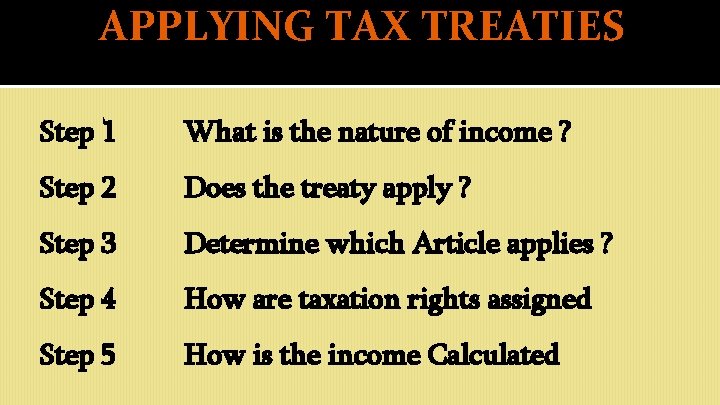
APPLYING TAX TREATIES Step 1 What is the nature of income ? Step 2 Does the treaty apply ? Step 3 Determine which Article applies ? Step 4 How are taxation rights assigned Step 5 How is the income Calculated
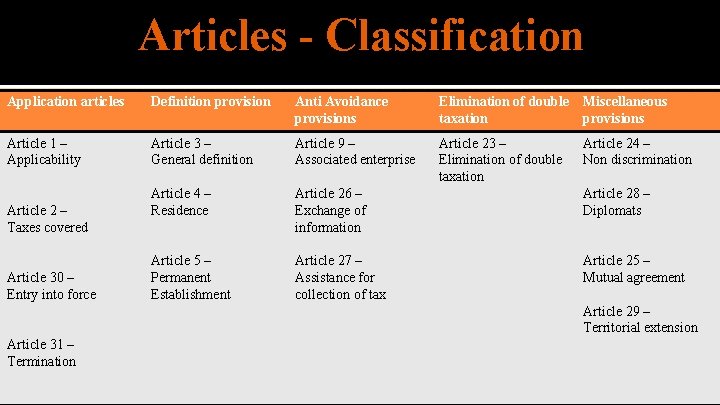
Articles - Classification Application articles Definition provision Anti Avoidance provisions Elimination of double taxation Miscellaneous provisions Article 1 – Applicability Article 3 – General definition Article 9 – Associated enterprise Article 23 – Elimination of double taxation Article 24 – Non discrimination Article 4 – Residence Article 26 – Exchange of information Article 28 – Diplomats Article 5 – Permanent Establishment Article 27 – Assistance for collection of tax Article 25 – Mutual agreement Article 2 – Taxes covered Article 30 – Entry into force Article 29 – Territorial extension Article 31 – Termination
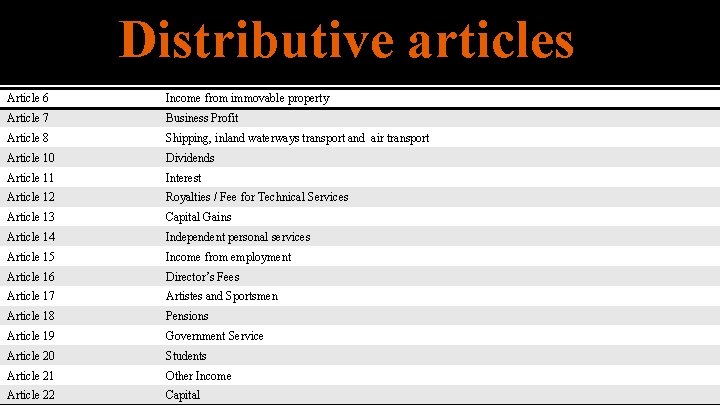
Distributive articles Article 6 Income from immovable property Article 7 Business Profit Article 8 Shipping, inland waterways transport and air transport Article 10 Dividends Article 11 Interest Article 12 Royalties / Fee for Technical Services Article 13 Capital Gains Article 14 Independent personal services Article 15 Income from employment Article 16 Director’s Fees Article 17 Artistes and Sportsmen Article 18 Pensions Article 19 Government Service Article 20 Students Article 21 Other Income Article 22 Capital
- Slides: 16