
Decoding and other NLG examples CSE 490 U
- Slides: 28
Decoding and other NLG examples CSE 490 U – Section Week 10
Outline • Decoding from RNNs: • Greedy decoding (in HW 5) • How to sample from a probability distribution • Beam search on RNNs • Applications of decoding/MT ideas in non-MT domains: • Stylistic paraphrasing • Twitter Conversation
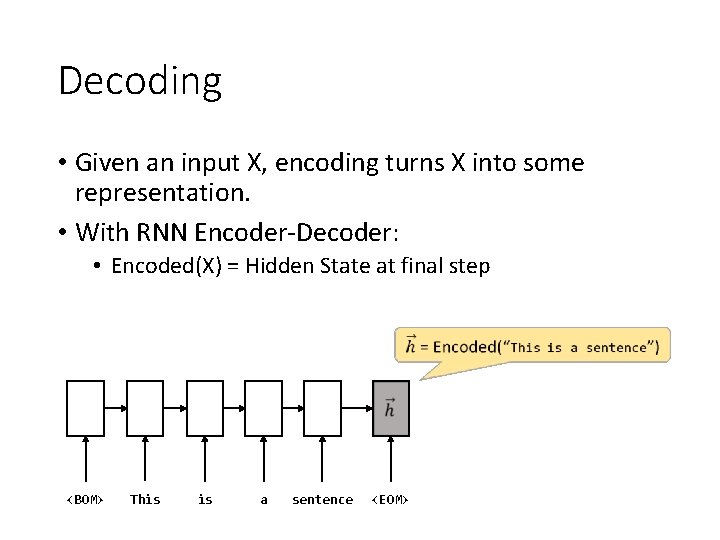
Decoding • Given an input X, encoding turns X into some representation. • With RNN Encoder-Decoder: • Encoded(X) = Hidden State at final step <BOM> This is a sentence <EOM>
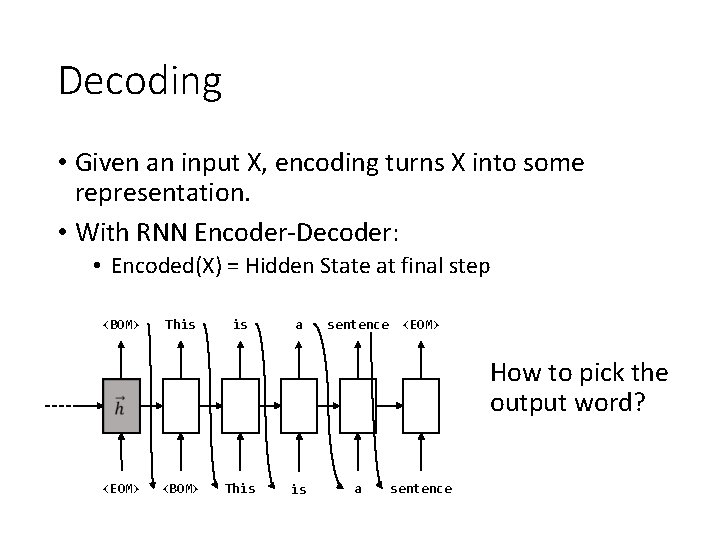
Decoding • Given an input X, encoding turns X into some representation. • With RNN Encoder-Decoder: • Encoded(X) = Hidden State at final step <BOM> This is a sentence <EOM> How to pick the output word? <EOM> <BOM> This is a sentence
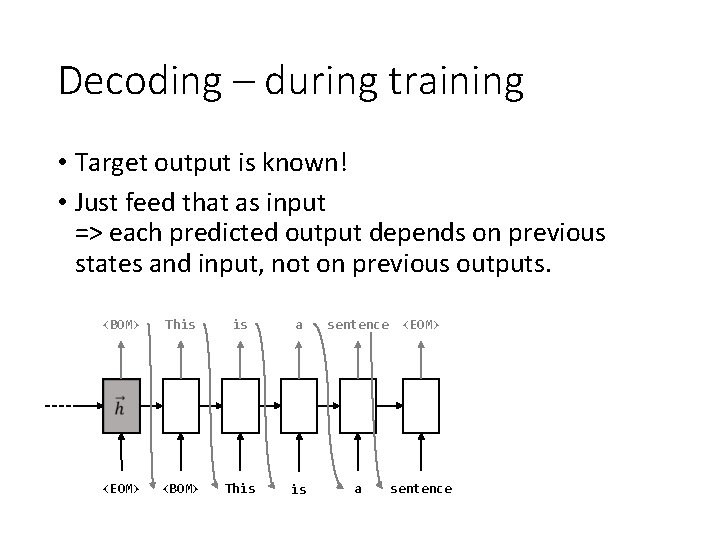
Decoding – during training • Target output is known! • Just feed that as input => each predicted output depends on previous states and input, not on previous outputs. <BOM> This is a <BOM> This is sentence <EOM> a sentence
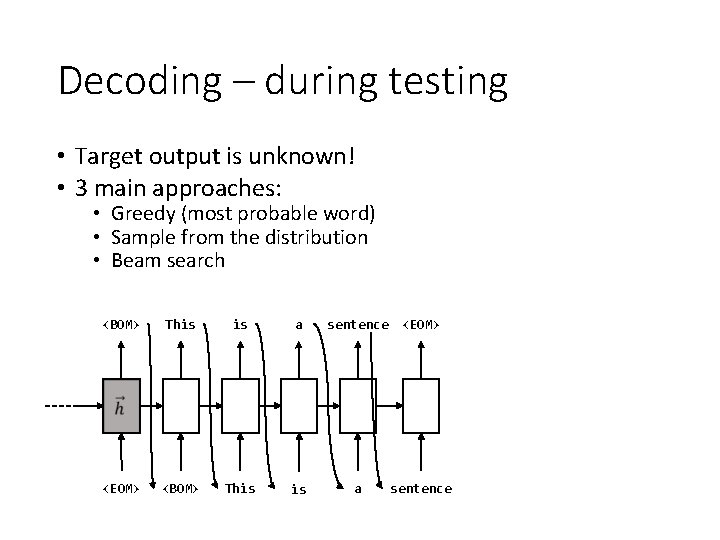
Decoding – during testing • Target output is unknown! • 3 main approaches: • Greedy (most probable word) • Sample from the distribution • Beam search <BOM> This is a <BOM> This is sentence <EOM> a sentence
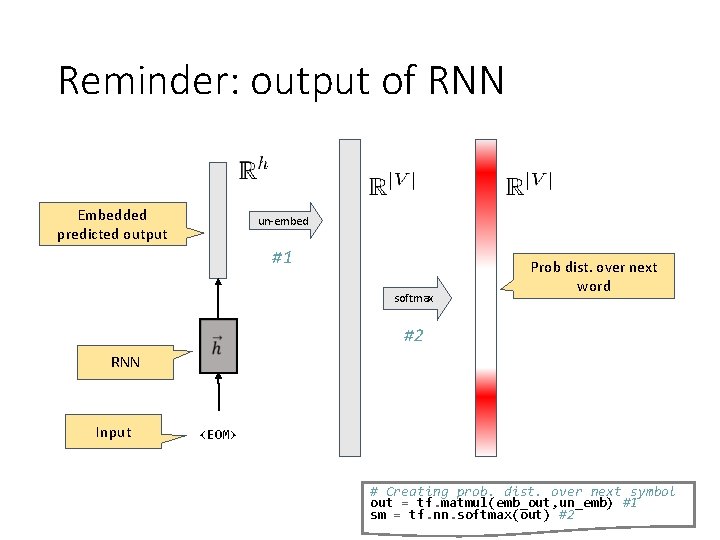
Reminder: output of RNN Embedded predicted output un-embed #1 softmax Prob dist. over next word #2 RNN Input <EOM> # Creating prob. dist. over next symbol out = tf. matmul(emb_out, un_emb) #1 sm = tf. nn. softmax(out) #2
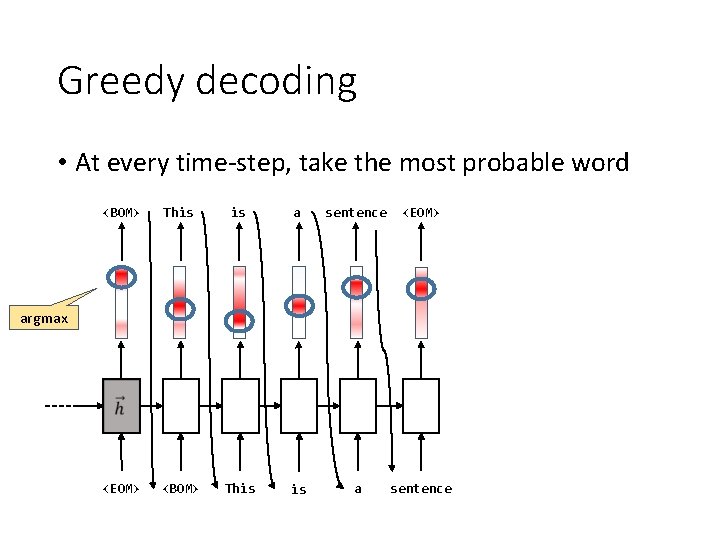
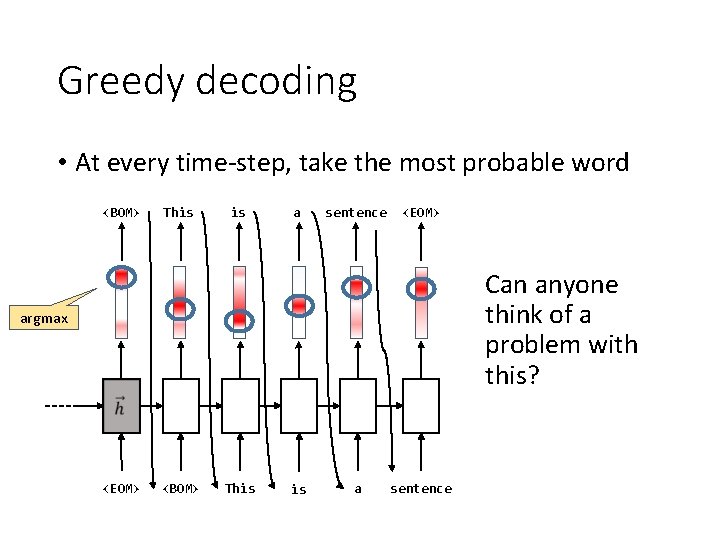
Greedy decoding • At every time-step, take the most probable word <BOM> This is a sentence <EOM> <BOM> This is a sentence argmax <EOM>
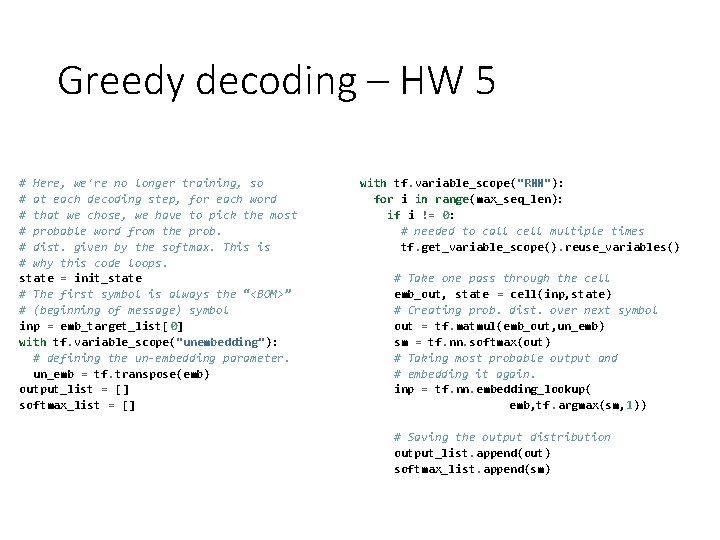
Greedy decoding – HW 5 # Here, we're no longer training, so # at each decoding step, for each word # that we chose, we have to pick the most # probable word from the prob. # dist. given by the softmax. This is # why this code loops. state = init_state # The first symbol is always the “<BOM>” # (beginning of message) symbol inp = emb_target_list[0] with tf. variable_scope("unembedding"): # defining the un-embedding parameter. un_emb = tf. transpose(emb) output_list = [] softmax_list = [] with tf. variable_scope("RNN"): for i in range(max_seq_len): if i != 0: # needed to call cell multiple times tf. get_variable_scope(). reuse_variables() # Take one pass through the cell emb_out, state = cell(inp, state) # Creating prob. dist. over next symbol out = tf. matmul(emb_out, un_emb) sm = tf. nn. softmax(out) # Taking most probable output and # embedding it again. inp = tf. nn. embedding_lookup( emb, tf. argmax(sm, 1)) # Saving the output distribution output_list. append(out) softmax_list. append(sm)
Greedy decoding • At every time-step, take the most probable word <BOM> This is a sentence <EOM> Can anyone think of a problem with this? argmax <EOM> <BOM> This is a sentence
Greedy decoding • What if two words were p(word 1) =. 49, p(word 2)=. 51? • What about the future? • Usually, greedy decoding is acceptable (especially to save time), but not preferred. • Alternative: Random sampling
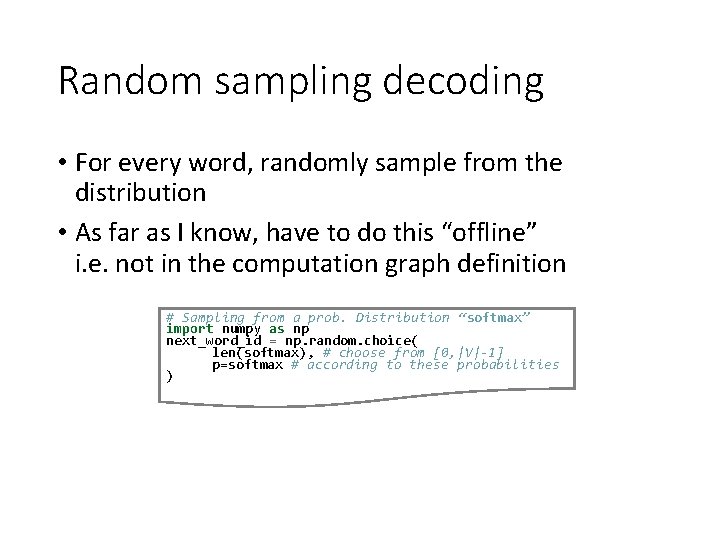
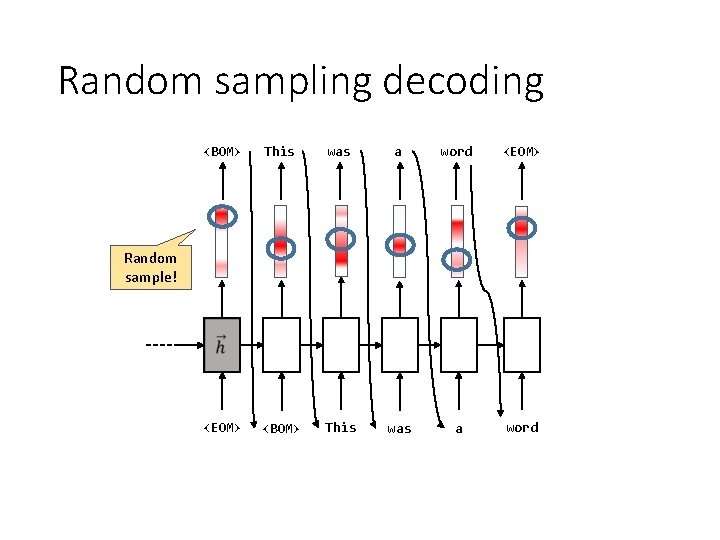
Random sampling decoding • For every word, randomly sample from the distribution • As far as I know, have to do this “offline” i. e. not in the computation graph definition # Sampling from a prob. Distribution “softmax” import numpy as np next_word_id = np. random. choice( len(softmax), # choose from [0, |V|-1] p=softmax # according to these probabilities )
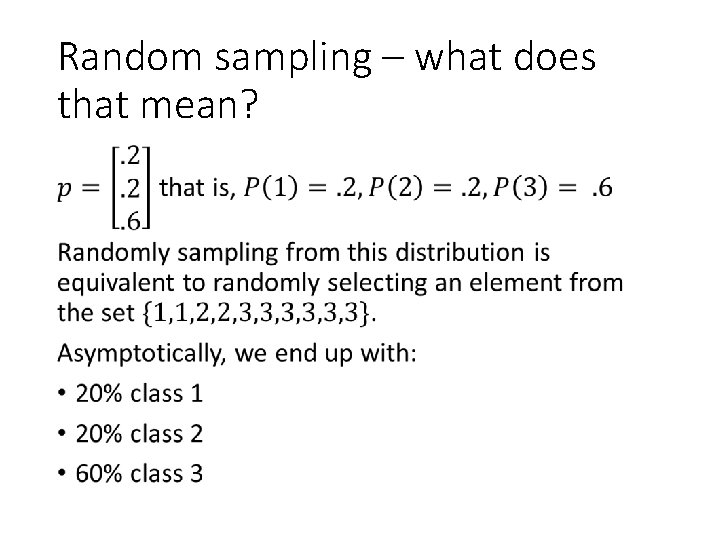
Random sampling – what does that mean? •
Random sampling decoding <BOM> This was a word <EOM> <BOM> This was a word Random sample! <EOM>
Random sampling decoding • Only considering one possible output • Randomness usually picks some of the most probable words • Why not consider multiple probably options? • Does choice at time t impact future? • Hint: remember HMMs & transition probabilities?
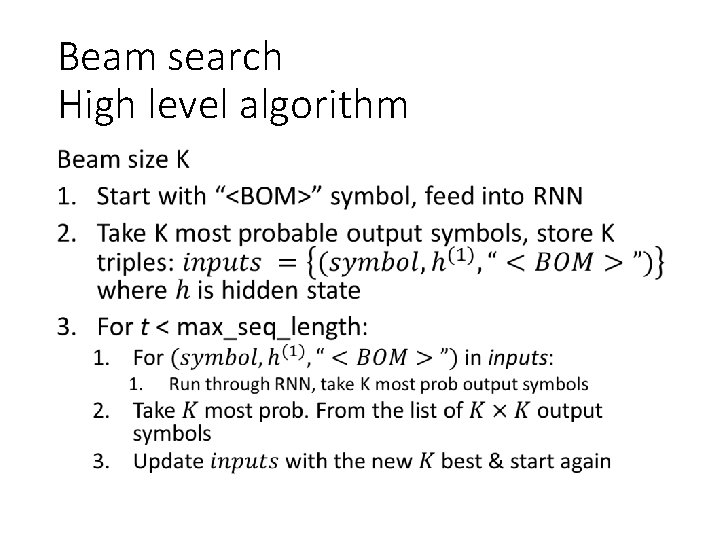
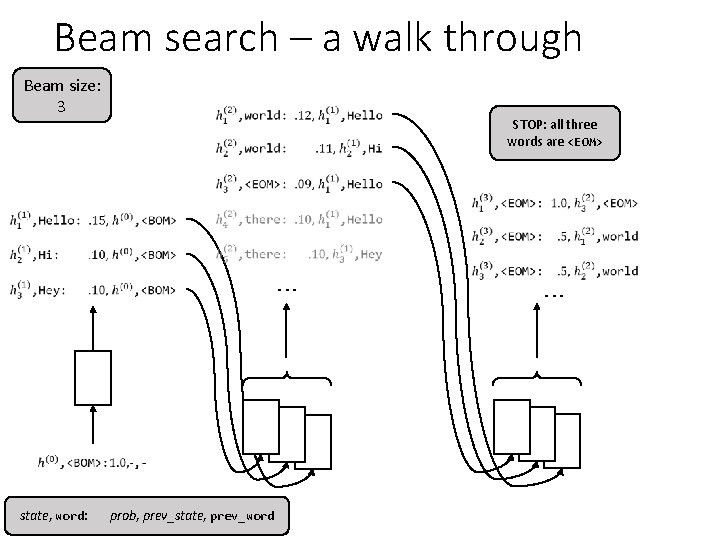
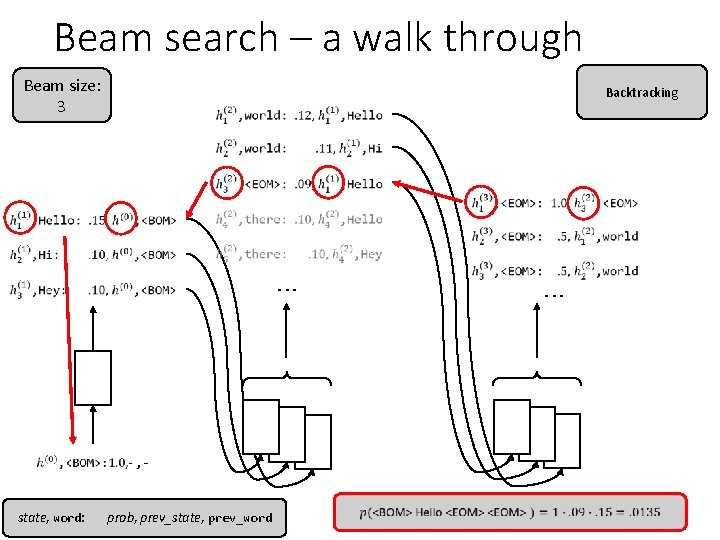
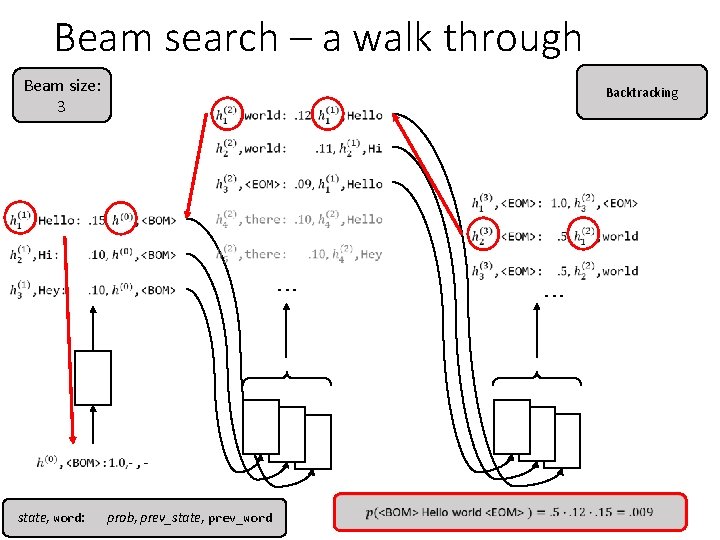
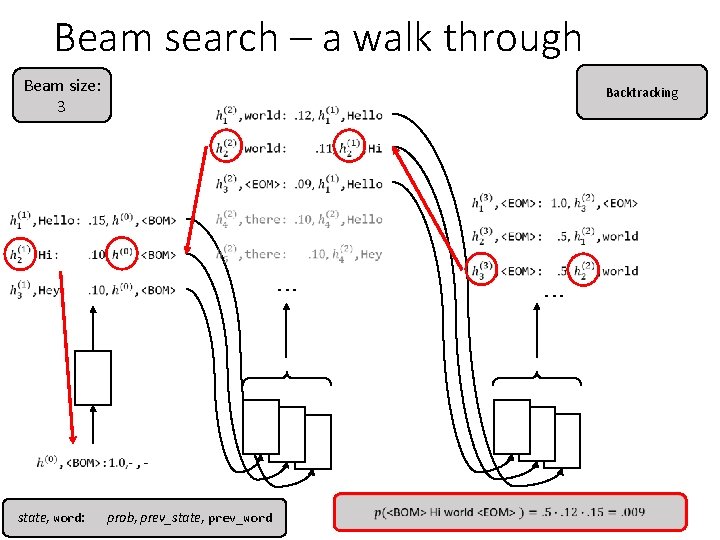
Beam search decoding • Instead of using one output per time-step, use the top K most probable. • Intuition: • Ruling out the 2 nd most probable can have devastating consequences in the end. • Decisions at earlier time-steps can impact probability of entire sequence. • Similar intuition to Viterbi for HMMs.
Beam search High level algorithm •
Beam search – a walk through Beam size: 3 STOP: all three words are <EOM> . . . state, word: prob, prev_state, prev_word . . .
Beam search – a walk through Beam size: 3 Backtracking . . . state, word: prob, prev_state, prev_word
Beam search – a walk through Beam size: 3 Backtracking . . . state, word: prob, prev_state, prev_word
Beam search – a walk through Beam size: 3 Backtracking . . . state, word: prob, prev_state, prev_word
Beam search • Store O(K*max_seq_length) elements • Fast if you can parallelize the computation • Usually gives a boost in accuracy! Any questions on beam search or decoding?
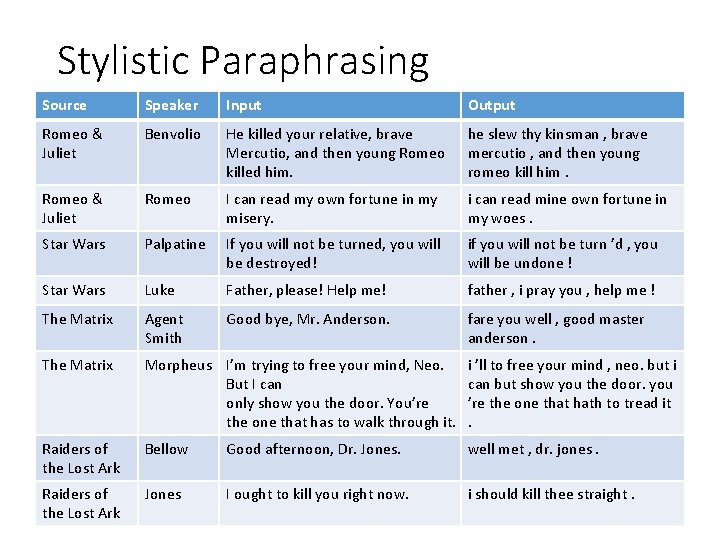
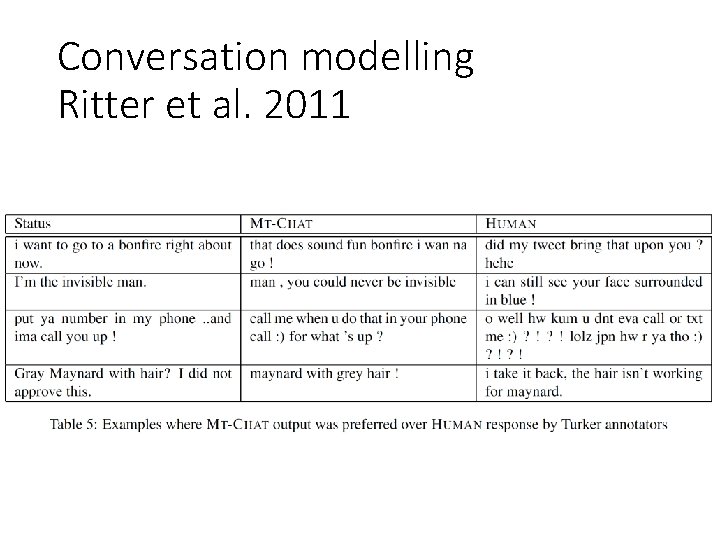
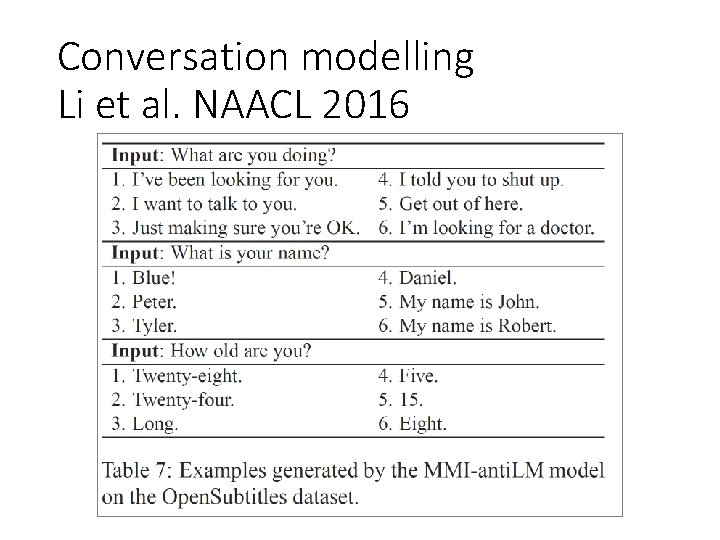
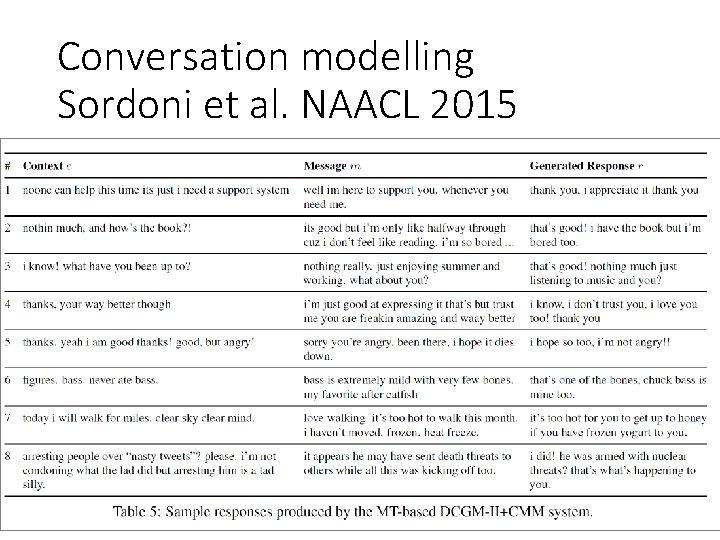
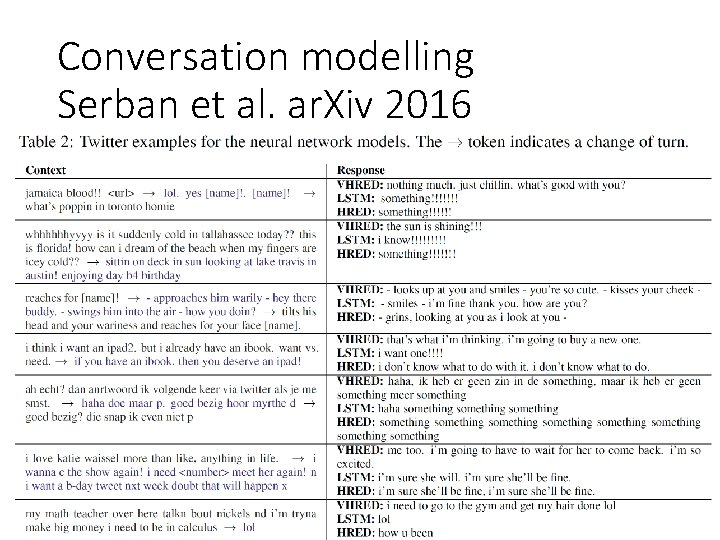
Natural Language Generation • Stylistic Paraphrasing • Xu et al. COLING 2012 – Paraphrasing for Style • Conversation modelling • Ritter et al. EMNLP 2011 – Data-driven Response Generation in Social Media • Li et al. NAACL 2016 – A Diversity Promoting Objective Function for Neural Conversation • Sordoni et al. NAACL 2015 – A Neural Network Approach to Context. Sensitive Generation of Conversational Responses • Serban et al. ar. Xiv 2016 – A Hierarchical Latent Variable Encoder. Decoder Model for Generating Dialogues
Stylistic Paraphrasing Source Speaker Input Output Romeo & Juliet Benvolio He killed your relative, brave Mercutio, and then young Romeo killed him. he slew thy kinsman , brave mercutio , and then young romeo kill him. Romeo & Juliet Romeo I can read my own fortune in my misery. i can read mine own fortune in my woes. Star Wars Palpatine If you will not be turned, you will be destroyed! if you will not be turn ’d , you will be undone ! Star Wars Luke Father, please! Help me! father , i pray you , help me ! The Matrix Agent Smith Good bye, Mr. Anderson. fare you well , good master anderson. The Matrix Morpheus I’m trying to free your mind, Neo. But I can only show you the door. You’re the one that has to walk through it. i ’ll to free your mind , neo. but i can but show you the door. you ’re the one that hath to tread it . Raiders of the Lost Ark Bellow Good afternoon, Dr. Jones. well met , dr. jones. Raiders of the Lost Ark Jones I ought to kill you right now. i should kill thee straight.
Conversation modelling Ritter et al. 2011
Conversation modelling Li et al. NAACL 2016
Conversation modelling Sordoni et al. NAACL 2015
Conversation modelling Serban et al. ar. Xiv 2016