
Decoction Mashing for the Homebrewer Kevin A Kutskill
Decoction Mashing for the Homebrewer Kevin A. Kutskill June, 2005
For a copy of this talk: www. feathercraft. net/decoction June, 2005 2
Decoction Mashing for the Homebrewer Overview of talk Decoction Background “Contemporary Decoction”—Specialty Malts Decoction Mashing Getting the Flavors an Easier Way: Pseudo-Decoction Techniques Pressure Cooker Decoction Mash No-Sparge Technique June, 2005 3
Basic premise of the beer samples or What am I drinking and why? Style: Oktoberfest Four batches: -all brewed within 24 hours of each other -same base grains, same water, same hopping schedule, same yeast -same fermentation conditions June, 2005 4
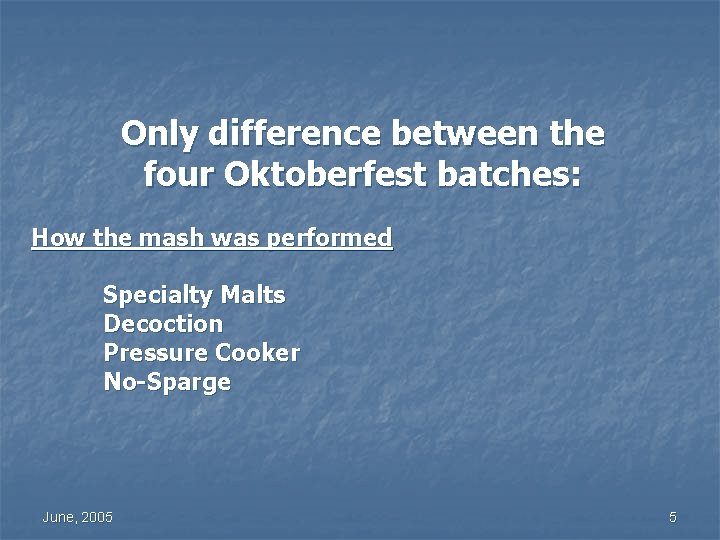
Only difference between the four Oktoberfest batches: How the mash was performed Specialty Malts Decoction Pressure Cooker No-Sparge June, 2005 5
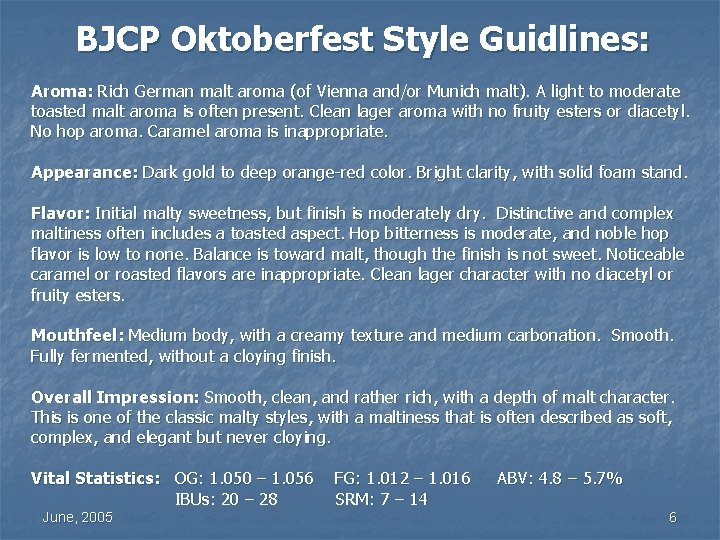
BJCP Oktoberfest Style Guidlines: Aroma: Rich German malt aroma (of Vienna and/or Munich malt). A light to moderate toasted malt aroma is often present. Clean lager aroma with no fruity esters or diacetyl. No hop aroma. Caramel aroma is inappropriate. Appearance: Dark gold to deep orange-red color. Bright clarity, with solid foam stand. Flavor: Initial malty sweetness, but finish is moderately dry. Distinctive and complex maltiness often includes a toasted aspect. Hop bitterness is moderate, and noble hop flavor is low to none. Balance is toward malt, though the finish is not sweet. Noticeable caramel or roasted flavors are inappropriate. Clean lager character with no diacetyl or fruity esters. Mouthfeel: Medium body, with a creamy texture and medium carbonation. Smooth. Fully fermented, without a cloying finish. Overall Impression: Smooth, clean, and rather rich, with a depth of malt character. This is one of the classic malty styles, with a maltiness that is often described as soft, complex, and elegant but never cloying. Vital Statistics: OG: 1. 050 – 1. 056 IBUs: 20 – 28 June, 2005 FG: 1. 012 – 1. 016 SRM: 7 – 14 ABV: 4. 8 – 5. 7% 6
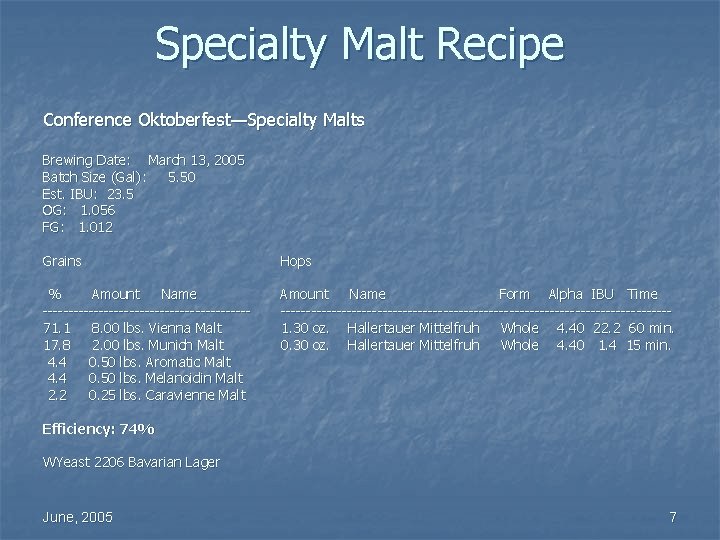
Specialty Malt Recipe Conference Oktoberfest—Specialty Malts Brewing Date: March 13, 2005 Batch Size (Gal): 5. 50 Est. IBU: 23. 5 OG: 1. 056 FG: 1. 012 Grains Hops % Amount Name --------------------71. 1 8. 00 lbs. Vienna Malt 17. 8 2. 00 lbs. Munich Malt 4. 4 0. 50 lbs. Aromatic Malt 4. 4 0. 50 lbs. Melanoidin Malt 2. 2 0. 25 lbs. Caravienne Malt Amount Name Form Alpha IBU Time --------------------------------------1. 30 oz. Hallertauer Mittelfruh Whole 4. 40 22. 2 60 min. 0. 30 oz. Hallertauer Mittelfruh Whole 4. 40 1. 4 15 min. Efficiency: 74% WYeast 2206 Bavarian Lager June, 2005 7
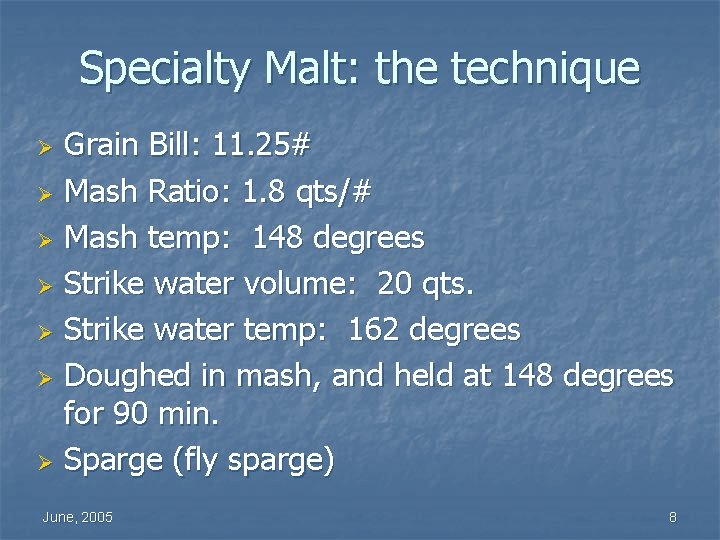
Specialty Malt: the technique Grain Bill: 11. 25# Ø Mash Ratio: 1. 8 qts/# Ø Mash temp: 148 degrees Ø Strike water volume: 20 qts. Ø Strike water temp: 162 degrees Ø Doughed in mash, and held at 148 degrees for 90 min. Ø Sparge (fly sparge) Ø June, 2005 8
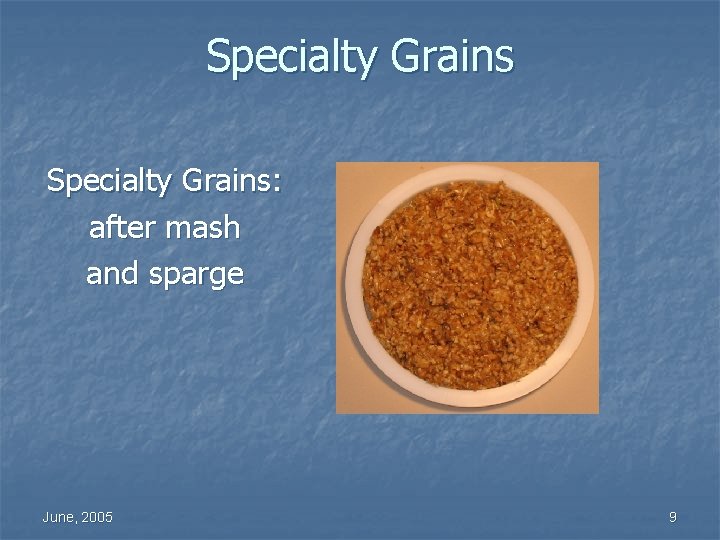
Specialty Grains: after mash and sparge June, 2005 9
Decoction Mashing for the Homebrewer Overview of talk Decoction Background “Contemporary Decoction”—Specialty Malts Decoction Mashing Getting the Flavors an Easier Way: Pseudo-Decoction Techniques Pressure Cooker Decoction Mash No-Sparge Technique June, 2005 10
What is decoction? n n n Decoction is a special type of step mashing procedure The difference is in the way the heat is applied to raise the mash temperature —a portion of the mash is removed, brought to boil, and returned to the main mash No additional infusions or direct heat is needed June, 2005 11
The History Behind Decoction n n Originally developed in central Europe, especially Germany & Czech Republic, in the late 18 th/early 19 th century Used primarily in lager brewing Actual reason behind the development of the decoction technique is widely debated Development of decoction technique before well-documented history June, 2005 12
The History Behind Decoction n Likely evolved due to a combination of several factors: n n June, 2005 Lack of accurate temperature measurements (no thermometer) Inconsistent and poor modification of continental malts Inconsistent product Poor efficiency 13
Why Decoct? n n Decoction allows the brewer to create a complex collection of chemical compounds known as melanoidins, which will not only add color and darken the beer, but give it an improved aroma and flavor (malty, bread-crust, and caramel-like) Decoction improves mash efficiency Decoction allows additional protein coagulation, resulting in a more crystal clear beer Decoction allows step mashing without a direct heat source June, 2005 14
Is decoction still practiced in brewing? Germany & Czech Republic: ? ? USA: Samuel Adams Boston Lager Craftbrewing Homebrewing **With today’s well-modified malts, decoction is not necessary for good efficiency and quality of final product June, 2005 15
What happens during decoction? Main players: sugars, amino acids and heat Caramelization Øsimple sugars + water + heat Øresults in caramel notes in resulting beer Maillard Reaction Øsimple sugars + amino acid +water + heat Øresults in formation of melanoidins ***No enzymes involved! June, 2005 16
The Maillard Reaction n n The Maillard reaction, discovered in 1912 by the French chemist Louis Camille Maillard takes place between amino acids (the building blocks of proteins) and sugars. He discovered that when he heated sugars and amino acids together, the mixture slowly turned brown. When heated together, sugars and amino acids rapidly produce a whole range of highly flavored molecules that are responsible for the brown color, flavor, and aroma of foods cooked over a flame or in the oven. June, 2005 17
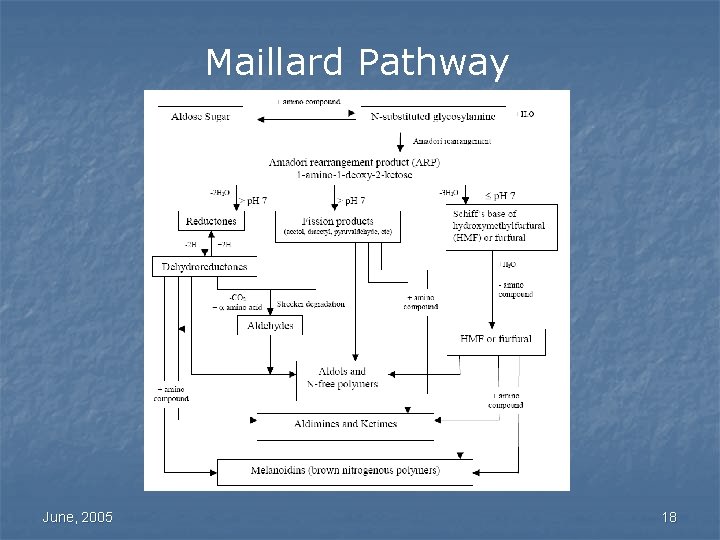
Maillard Pathway June, 2005 18
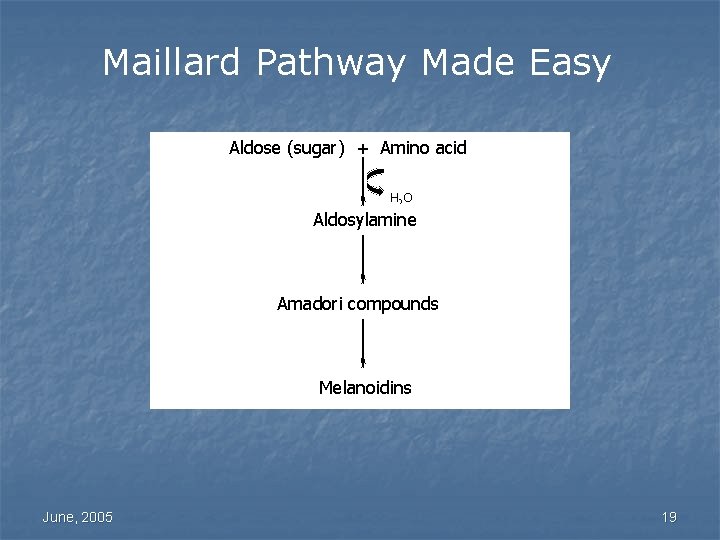
Maillard Pathway Made Easy Aldose (sugar) + Amino acid H 2 O Aldosylamine Amadori compounds Melanoidins June, 2005 19
What affects the Maillard Reaction? Temperature “Water Activity” Time p. H June, 2005 20
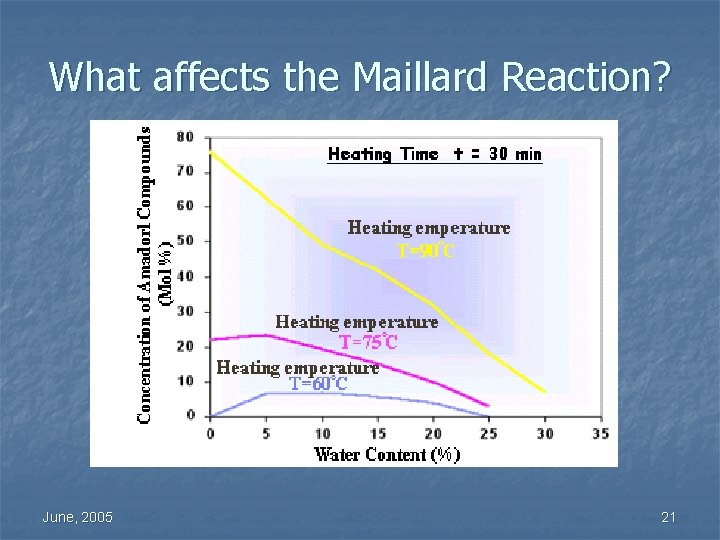
What affects the Maillard Reaction? June, 2005 21
Where Maillard Reactions Occur Malting Storage Mashing (decoction) Boil June, 2005 22
Decoction Mashing for the Homebrewer Overview of talk Decoction Background “Contemporary Decoction”—Specialty Malts Decoction Mashing Getting the Flavors an Easier Way: Pseudo-Decoction Techniques Pressure Cooker Decoction Mash No-Sparge Technique June, 2005 23
Malts That Contain Increased Maillard Products n n n Melanoidin Malt Aromatic Malt Munich Malt Vienna Malt Caramel Malts June, 2005 24
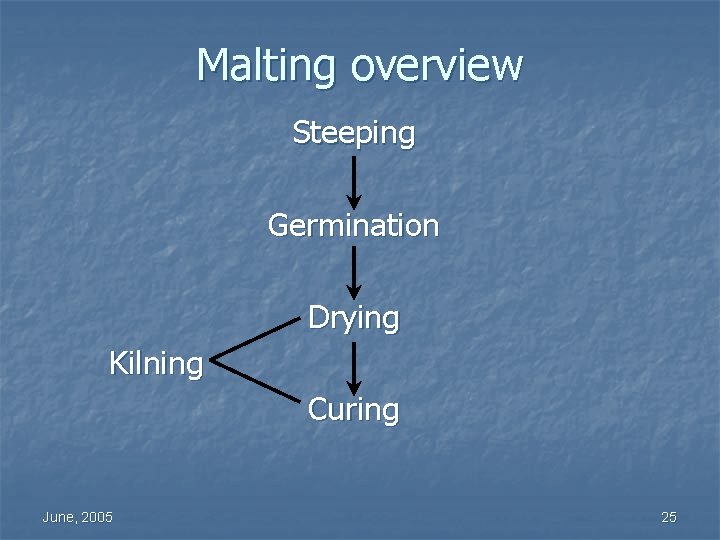
Malting overview Steeping Germination Drying Kilning Curing June, 2005 25
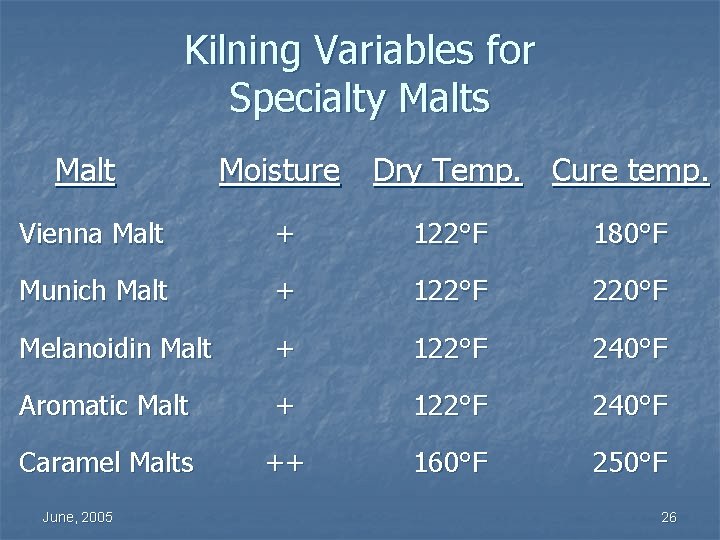
Kilning Variables for Specialty Malts Malt Moisture Vienna Malt + 122°F 180°F Munich Malt + 122°F 220°F Melanoidin Malt + 122°F 240°F Aromatic Malt + 122°F 240°F Caramel Malts ++ 160°F 250°F June, 2005 Dry Temp. Cure temp. 26
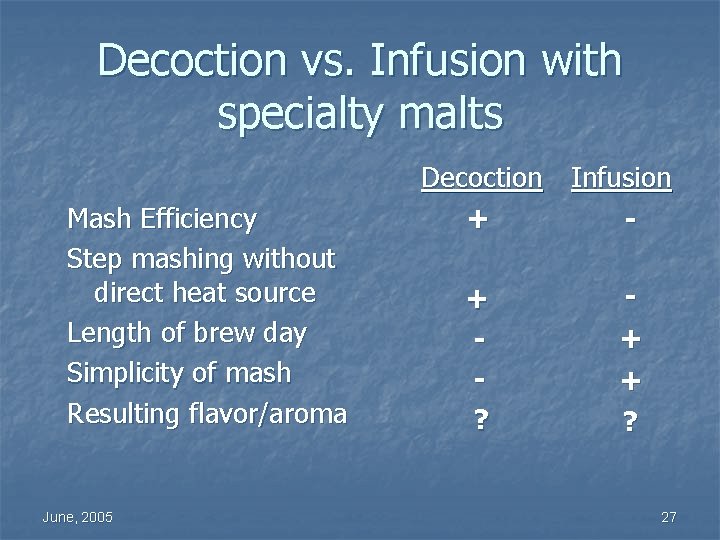
Decoction vs. Infusion with specialty malts Mash Efficiency Step mashing without direct heat source Length of brew day Simplicity of mash Resulting flavor/aroma June, 2005 Decoction Infusion + + ? 27
Decoction Mashing for the Homebrewer Overview of talk Decoction Background “Contemporary Decoction”—Specialty Malts Decoction Mashing Getting the Flavors an Easier Way: Pseudo-Decoction Techniques Pressure Cooker Decoction Mash No-Sparge Technique June, 2005 28
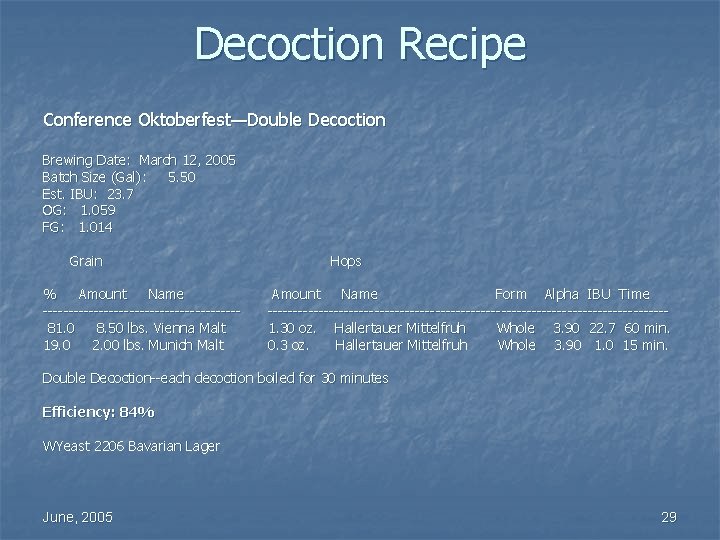
Decoction Recipe Conference Oktoberfest—Double Decoction Brewing Date: March 12, 2005 Batch Size (Gal): 5. 50 Est. IBU: 23. 7 OG: 1. 059 FG: 1. 014 Grain % Amount Name -------------------81. 0 8. 50 lbs. Vienna Malt 19. 0 2. 00 lbs. Munich Malt Hops Amount Name Form Alpha IBU Time ---------------------------------------1. 30 oz. Hallertauer Mittelfruh Whole 3. 90 22. 7 60 min. 0. 3 oz. Hallertauer Mittelfruh Whole 3. 90 1. 0 15 min. Double Decoction--each decoction boiled for 30 minutes Efficiency: 84% WYeast 2206 Bavarian Lager June, 2005 29
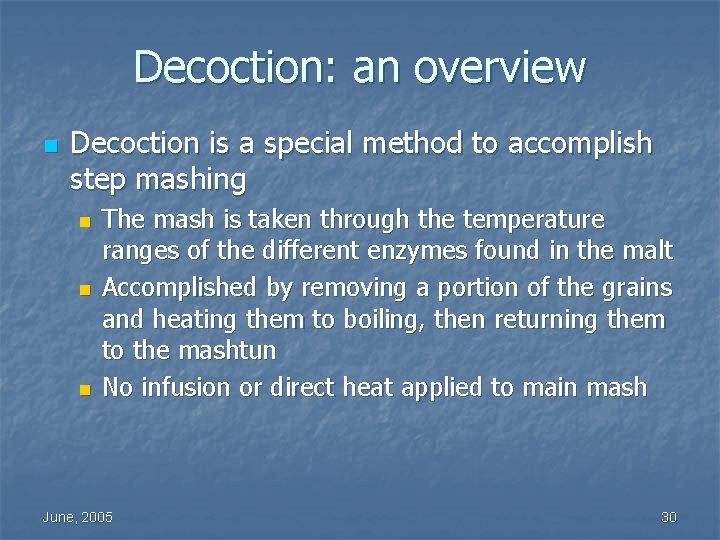
Decoction: an overview n Decoction is a special method to accomplish step mashing n n n The mash is taken through the temperature ranges of the different enzymes found in the malt Accomplished by removing a portion of the grains and heating them to boiling, then returning them to the mashtun No infusion or direct heat applied to main mash June, 2005 30
BUT WAIT! BOIL THE GRAINS? Won’t boiling the grains during decoction cause tannin extraction? June, 2005 31
BUT WAIT! BOIL THE GRAINS? Boiling the grains during a decoction is ok-tannin extraction is limited due to the relative low-water environment, and the extra tannins extracted during decoction are bound up in extra hot-break of the decoction and subsequent boil. Additionally, the typical prolonged lagering period of these beer styles helps smooth the resulting beer June, 2005 32
BUT WAIT! BOIL THE ENZYMES? Won’t boiling the mash during decoction cause the mash enzymes to denature and deactivate? June, 2005 33
BUT WAIT! BOIL THE ENZYMES? Not a problem here, either. Most of the enzymes are left back in the liquid of the main mash, and most of what you are boiling is the grain, starch, sugar, and amino acids. June, 2005 34
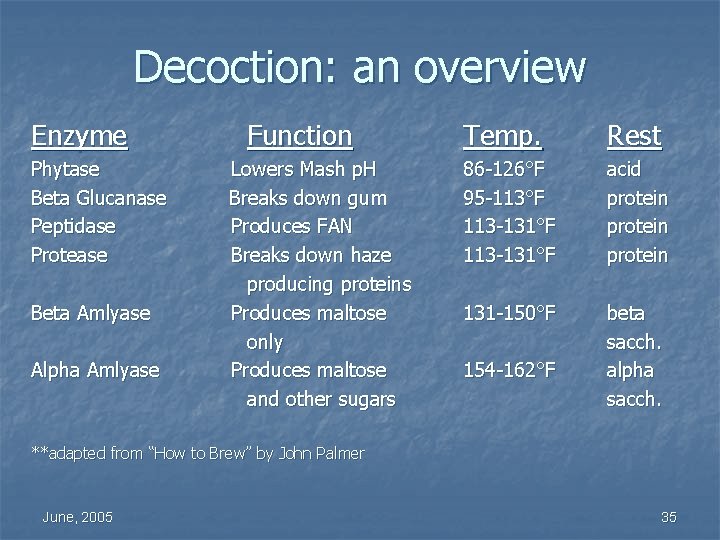
Decoction: an overview Enzyme Phytase Beta Glucanase Peptidase Protease Beta Amlyase Alpha Amlyase Function Lowers Mash p. H Breaks down gum Produces FAN Breaks down haze producing proteins Produces maltose only Produces maltose and other sugars Temp. Rest 86 -126°F 95 -113°F 113 -131°F acid protein 131 -150°F beta sacch. alpha sacch. 154 -162°F **adapted from “How to Brew” by John Palmer June, 2005 35
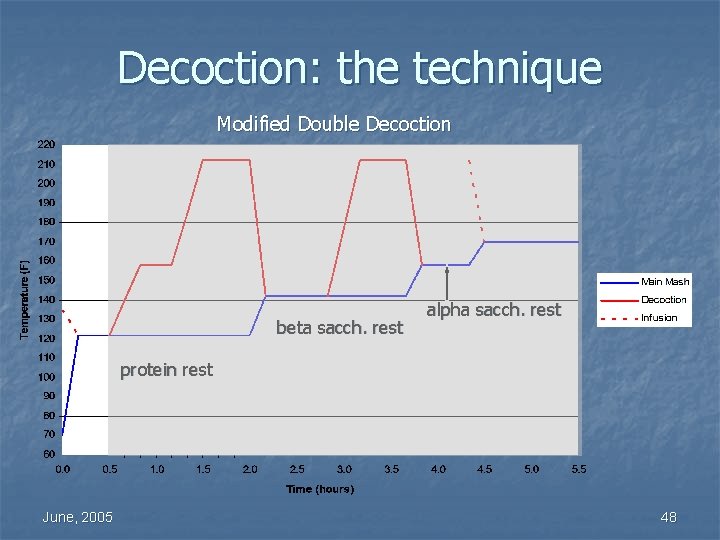
Decoction: an overview Basic steps in a decoction mash: 1. Remove grains from main mash 2. Bring grains to boil, and boil for at least 15 -20 minutes 3. Return boiled grains to main mash, thereby increasing the mash temperature to the next level 4. Repeat June, 2005 36
Decoction: an overview Types of traditional decoction mashes: 1. Single decoction step from protein rest to a single saccharification rest 2. Double decoction step from protein rest to single saccharification rest, then from saccharification rest to mashout temp. 3. Triple decoction step from acid rest to protein rest, then from protein rest to saccharification rest, then from saccharification rest to mashout temp. June, 2005 37
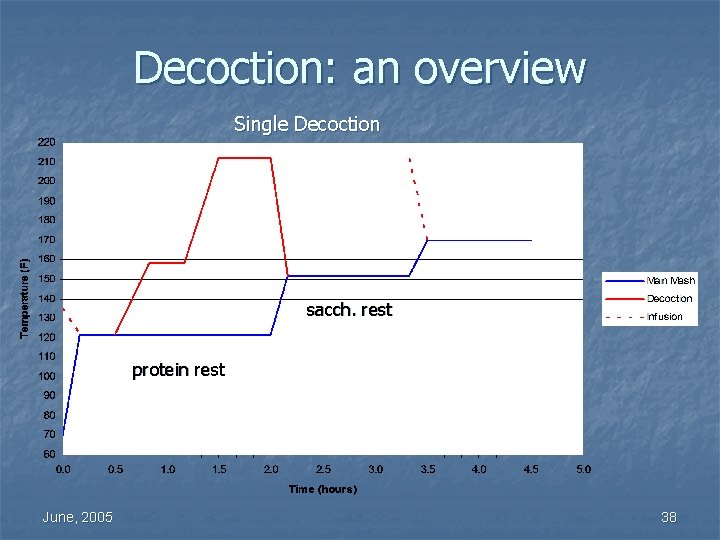
Decoction: an overview Single Decoction sacch. rest protein rest June, 2005 38
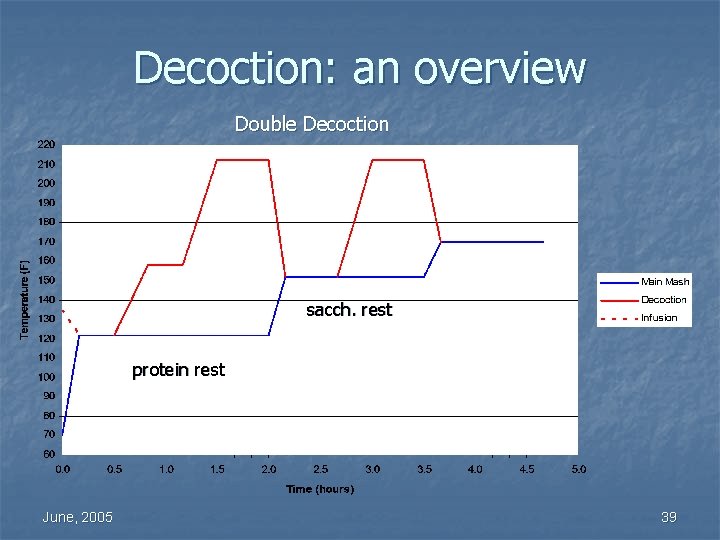
Decoction: an overview Double Decoction sacch. rest protein rest June, 2005 39
Decoction: an overview Triple Decoction sacch. rest protein rest acid rest June, 2005 40
Some basic rules about decoction: 1. Remove only the thickest part of the mash for a decoction 2. STIR! Don’t let the decoction stick/scorch/burn 3. If taking a decoction to reach mashout temperature, take liquid only 4. Don’t return entire decoction to the mash immediately—check mash temp. after returning 80 -90% of the decoction 5. Keep hot and cold water nearby to correct any temperature overshoots June, 2005 41
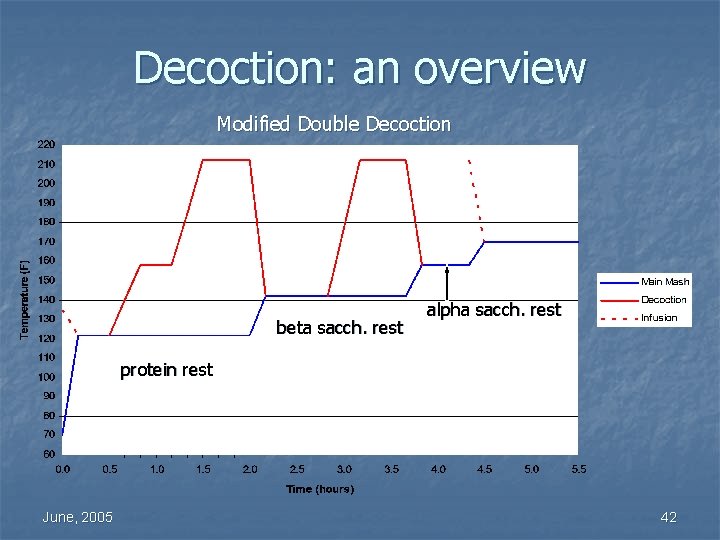
Decoction: an overview Modified Double Decoction beta sacch. rest alpha sacch. rest protein rest June, 2005 42
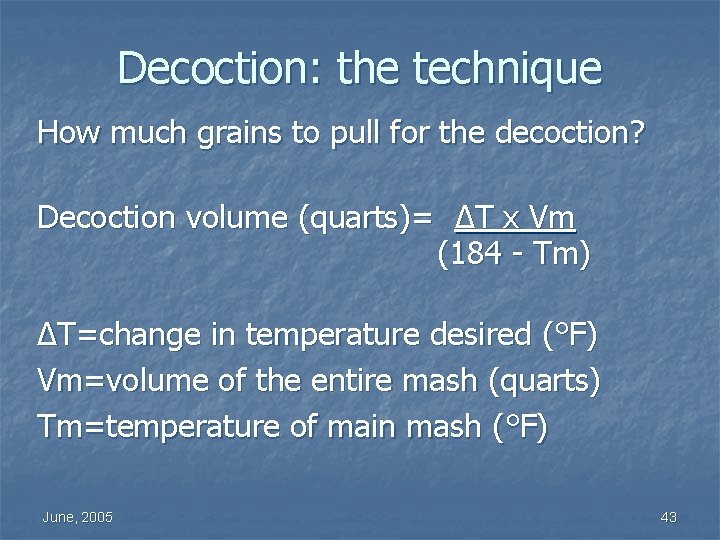
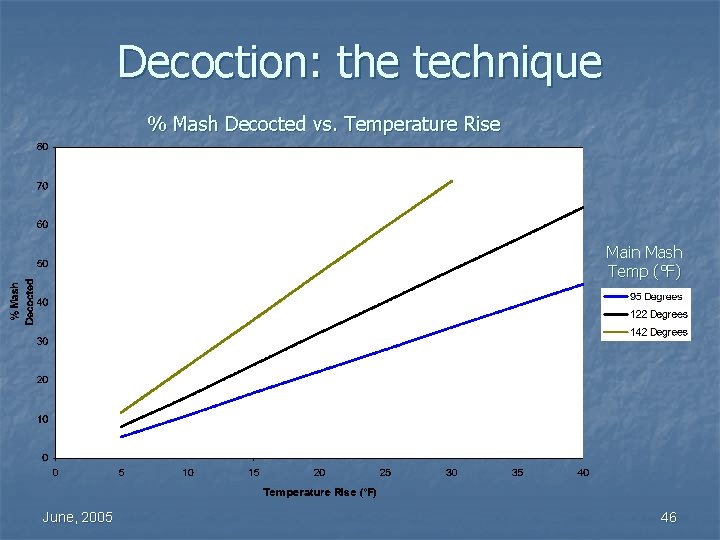
Decoction: the technique How much grains to pull for the decoction? Decoction volume (quarts)= ∆T x Vm (184 - Tm) ∆T=change in temperature desired (°F) Vm=volume of the entire mash (quarts) Tm=temperature of main mash (°F) June, 2005 43
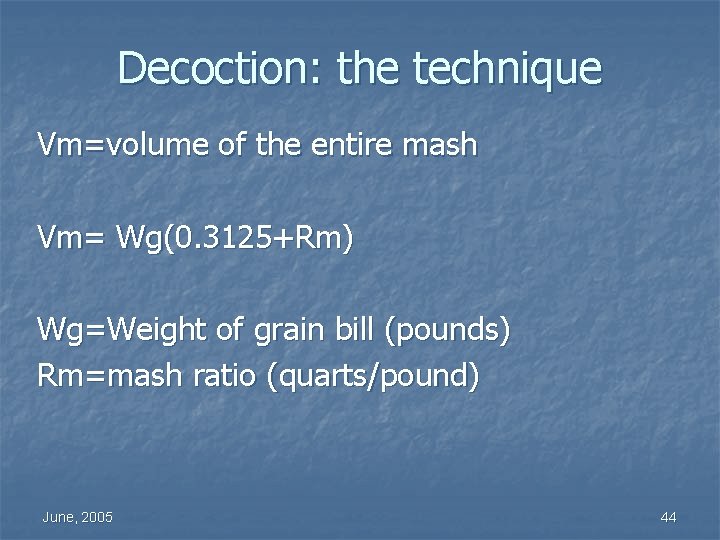
Decoction: the technique Vm=volume of the entire mash Vm= Wg(0. 3125+Rm) Wg=Weight of grain bill (pounds) Rm=mash ratio (quarts/pound) June, 2005 44
Decoction: the technique Decoction Calculator: Decoction Volume Calculator. xls June, 2005 45
Decoction: the technique % Mash Decocted vs. Temperature Rise Main Mash Temp (°F) June, 2005 46
Decoction: the technique How much grains to pull for the decoction? Or, keeping it simple (KISS), decoction volume can be estimated at 1/3 -1/2 of entire mash volume. June, 2005 47
Decoction: the technique Modified Double Decoction beta sacch. rest alpha sacch. rest protein rest June, 2005 48
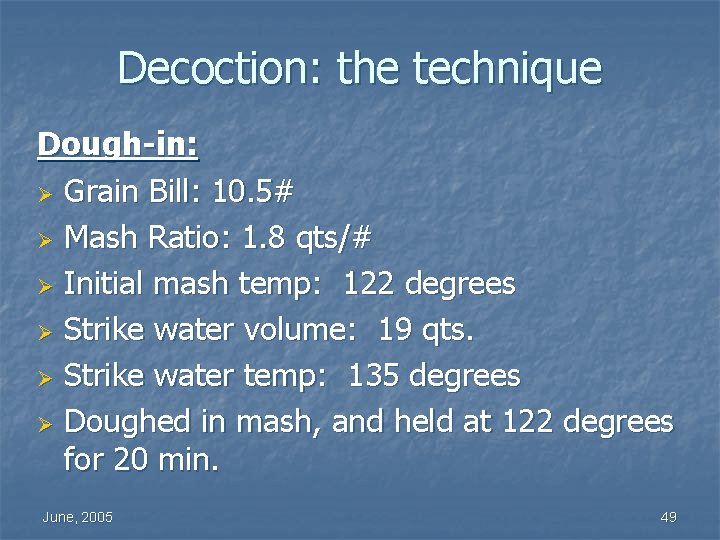
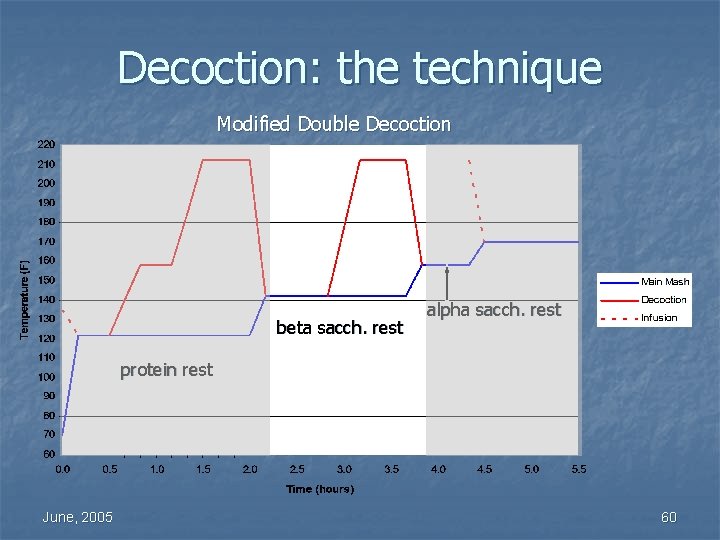
Decoction: the technique Dough-in: Ø Grain Bill: 10. 5# Ø Mash Ratio: 1. 8 qts/# Ø Initial mash temp: 122 degrees Ø Strike water volume: 19 qts. Ø Strike water temp: 135 degrees Ø Doughed in mash, and held at 122 degrees for 20 min. June, 2005 49
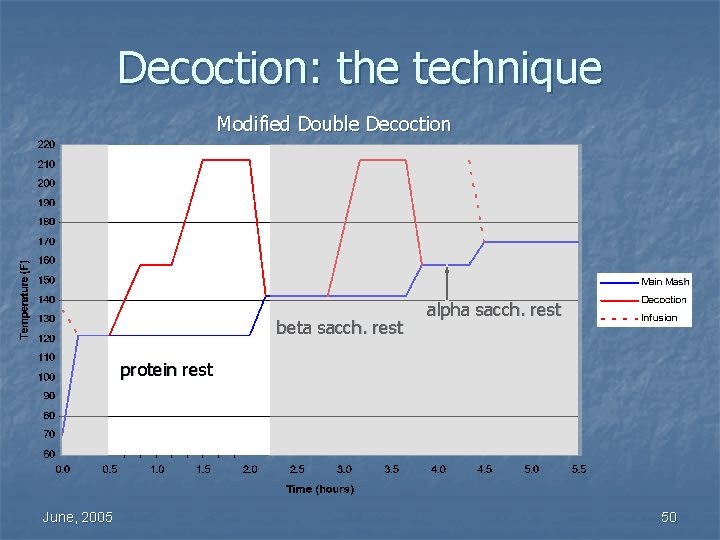
Decoction: the technique Modified Double Decoction beta sacch. rest alpha sacch. rest protein rest June, 2005 50
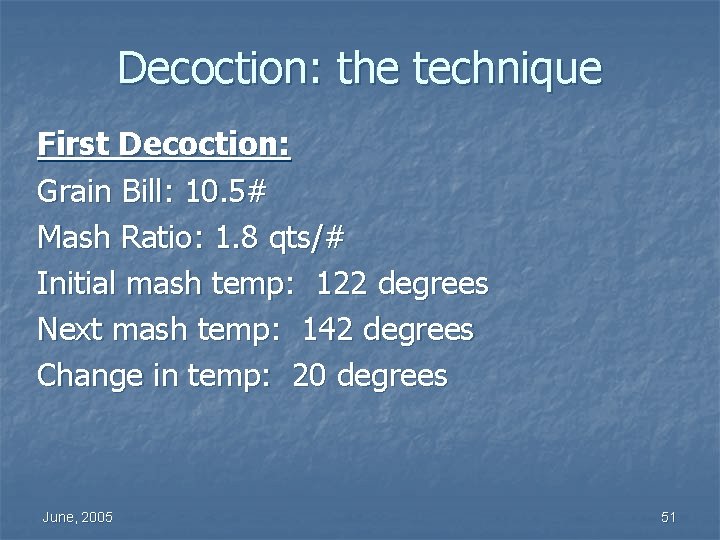
Decoction: the technique First Decoction: Grain Bill: 10. 5# Mash Ratio: 1. 8 qts/# Initial mash temp: 122 degrees Next mash temp: 142 degrees Change in temp: 20 degrees June, 2005 51
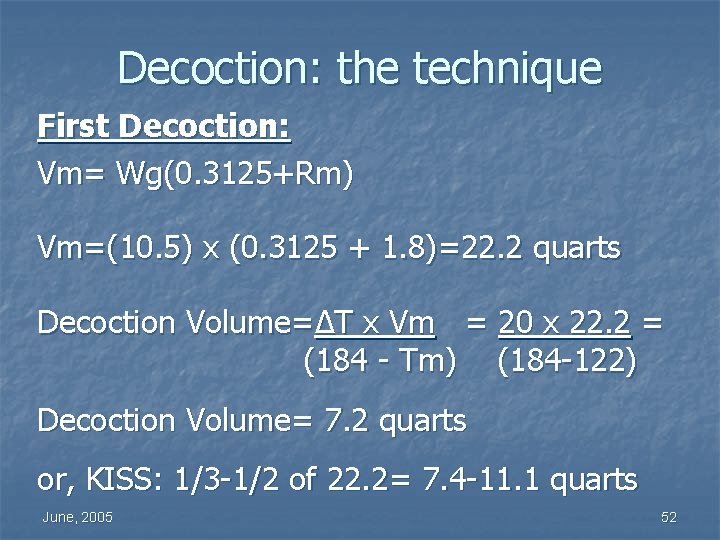
Decoction: the technique First Decoction: Vm= Wg(0. 3125+Rm) Vm=(10. 5) x (0. 3125 + 1. 8)=22. 2 quarts Decoction Volume=∆T x Vm = 20 x 22. 2 = (184 - Tm) (184 -122) Decoction Volume= 7. 2 quarts or, KISS: 1/3 -1/2 of 22. 2= 7. 4 -11. 1 quarts June, 2005 52
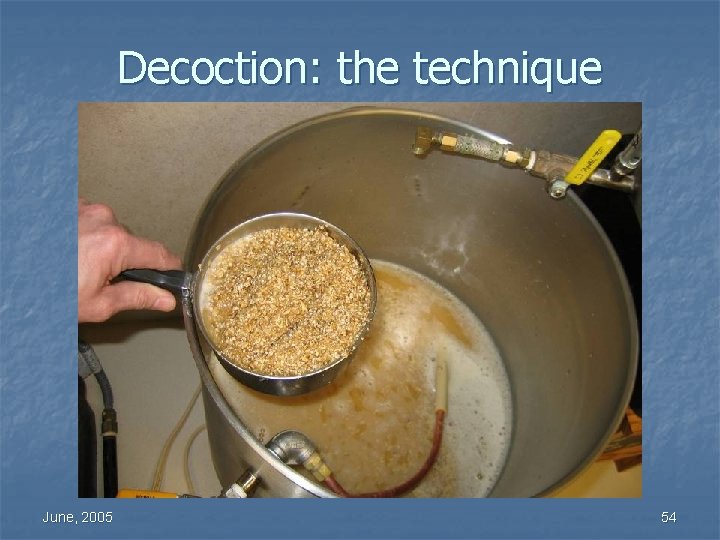
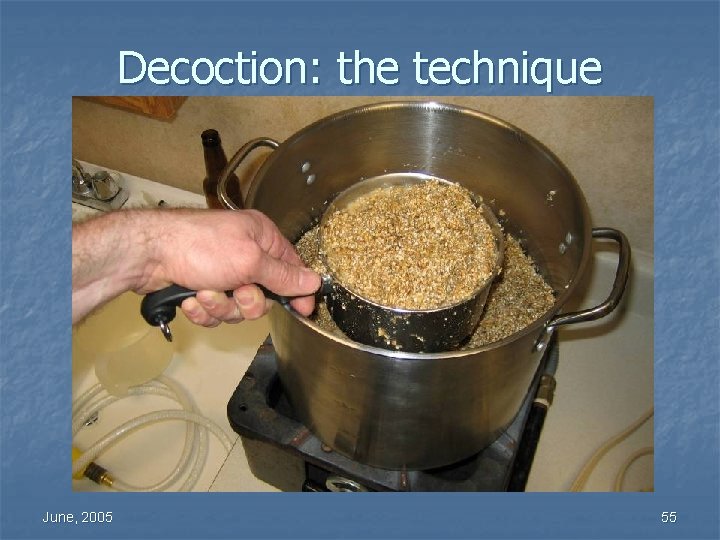
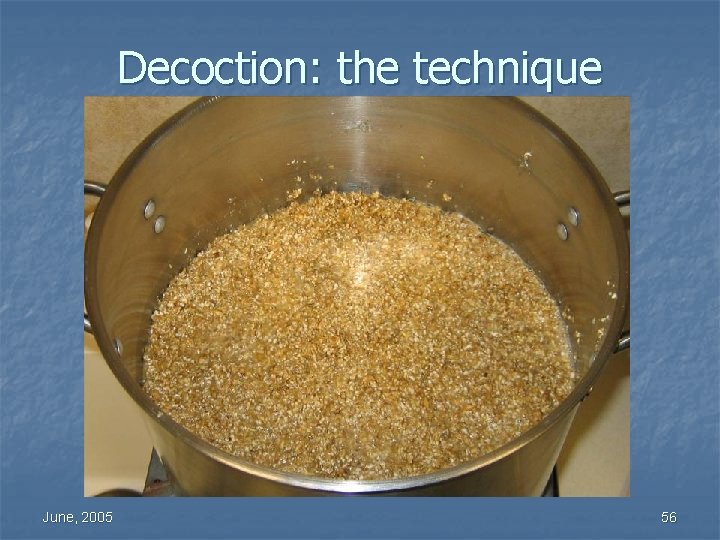
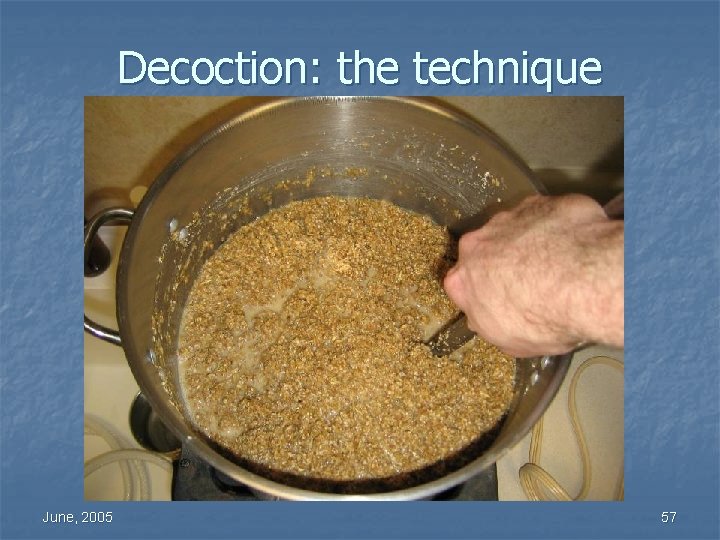
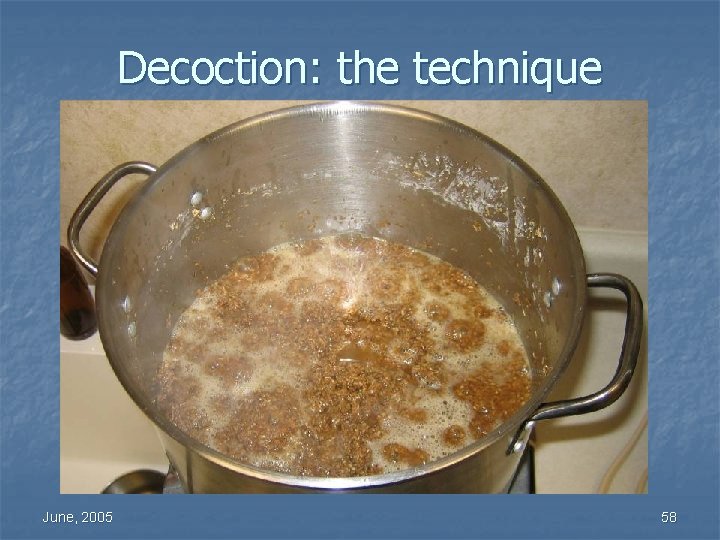
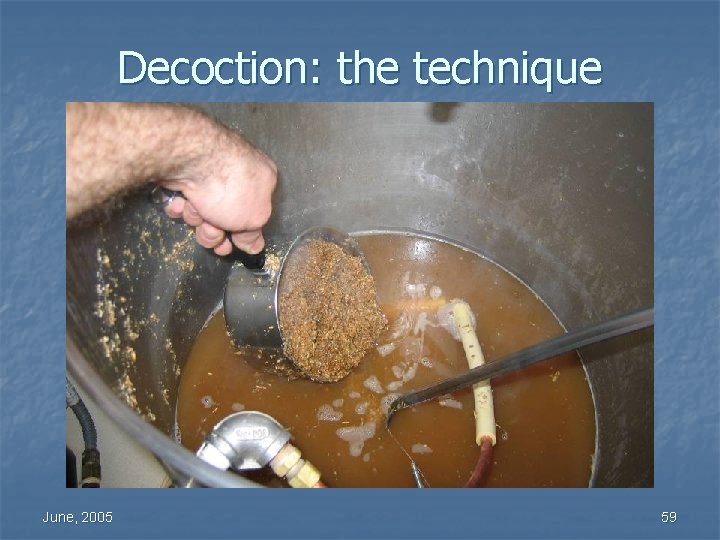
Decoction: the technique First Decoction Pulled 7 quarts of thick mash Ø Heated to 155 degrees and held for 20 min. Ø Then heated to boiling, and boiled for 30 min. Ø Returned decoction to main mash Ø June, 2005 53
Decoction: the technique June, 2005 54
Decoction: the technique June, 2005 55
Decoction: the technique June, 2005 56
Decoction: the technique June, 2005 57
Decoction: the technique June, 2005 58
Decoction: the technique June, 2005 59
Decoction: the technique Modified Double Decoction beta sacch. rest alpha sacch. rest protein rest June, 2005 60
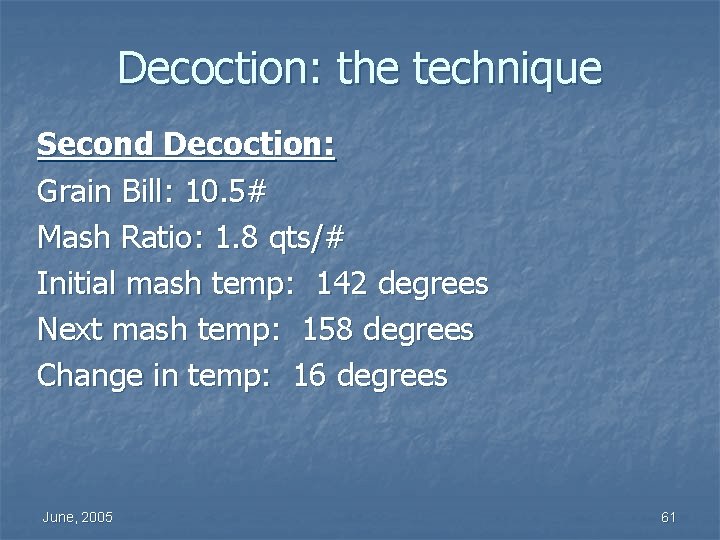
Decoction: the technique Second Decoction: Grain Bill: 10. 5# Mash Ratio: 1. 8 qts/# Initial mash temp: 142 degrees Next mash temp: 158 degrees Change in temp: 16 degrees June, 2005 61
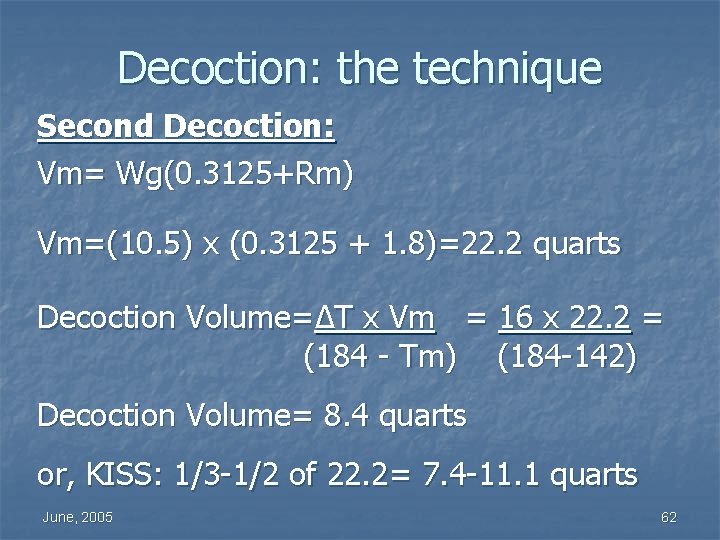
Decoction: the technique Second Decoction: Vm= Wg(0. 3125+Rm) Vm=(10. 5) x (0. 3125 + 1. 8)=22. 2 quarts Decoction Volume=∆T x Vm = 16 x 22. 2 = (184 - Tm) (184 -142) Decoction Volume= 8. 4 quarts or, KISS: 1/3 -1/2 of 22. 2= 7. 4 -11. 1 quarts June, 2005 62
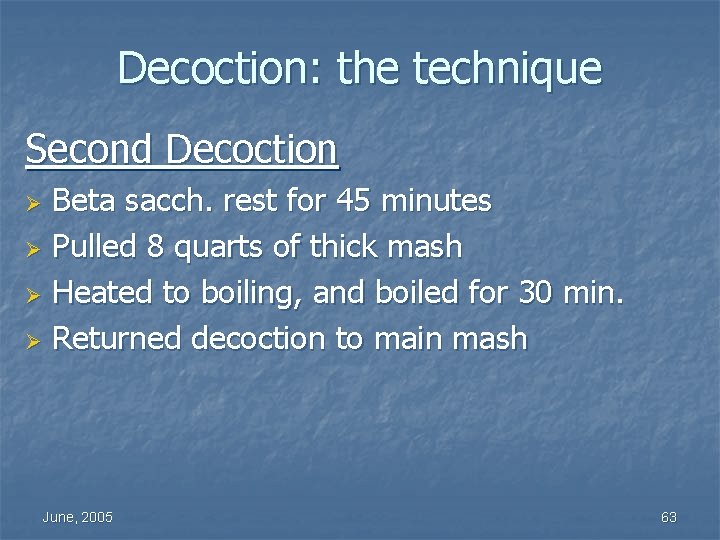
Decoction: the technique Second Decoction Beta sacch. rest for 45 minutes Ø Pulled 8 quarts of thick mash Ø Heated to boiling, and boiled for 30 min. Ø Returned decoction to main mash Ø June, 2005 63
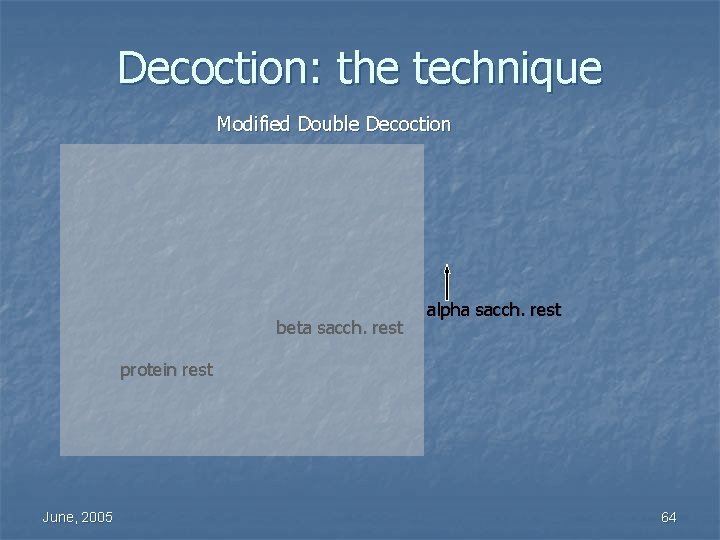
Decoction: the technique Modified Double Decoction beta sacch. rest alpha sacch. rest protein rest June, 2005 64
Decoction: the technique Mashout Alpha sacch. rest for 30 minutes Ø Added 2 gallons of boiling water to mash Ø Recirculated at 170 degrees for 10 -15 min. Ø Sparge (fly sparge) Ø June, 2005 65
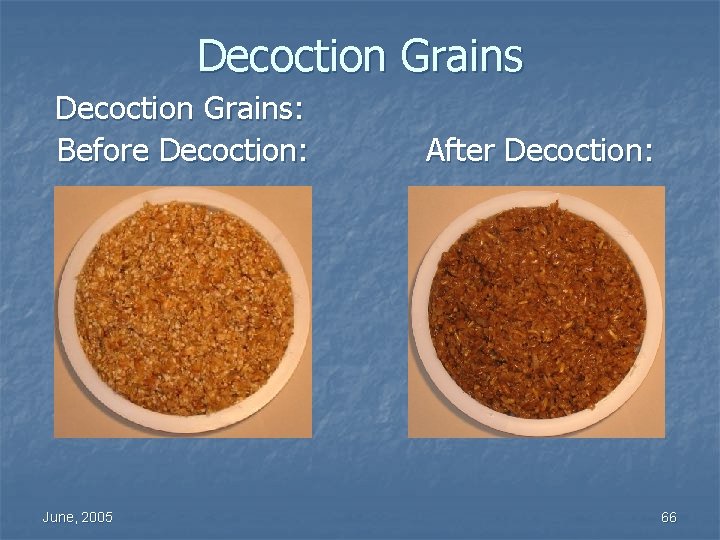
Decoction Grains: Before Decoction: June, 2005 After Decoction: 66
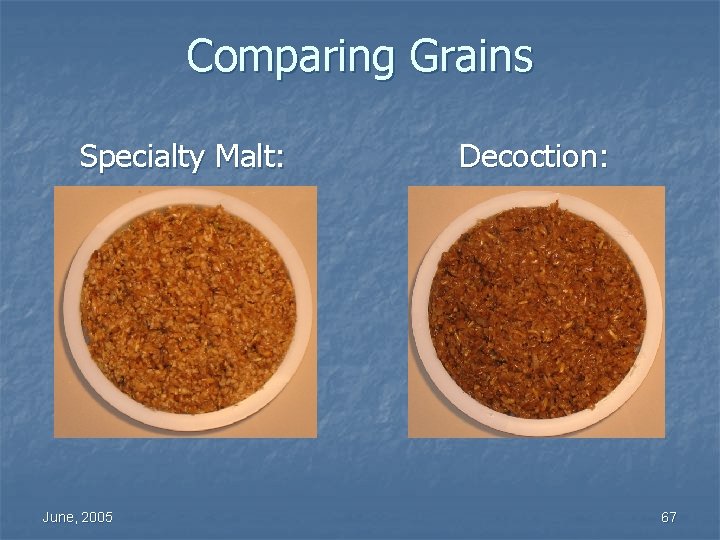
Comparing Grains Specialty Malt: June, 2005 Decoction: 67
Decoction Mashing for the Homebrewer Overview of talk Decoction Background “Contemporary Decoction”—Specialty Malts Decoction Mashing Getting the Flavors an Easier Way: Pseudo-Decoction Techniques Pressure Cooker Decoction Mash No-Sparge Technique June, 2005 68
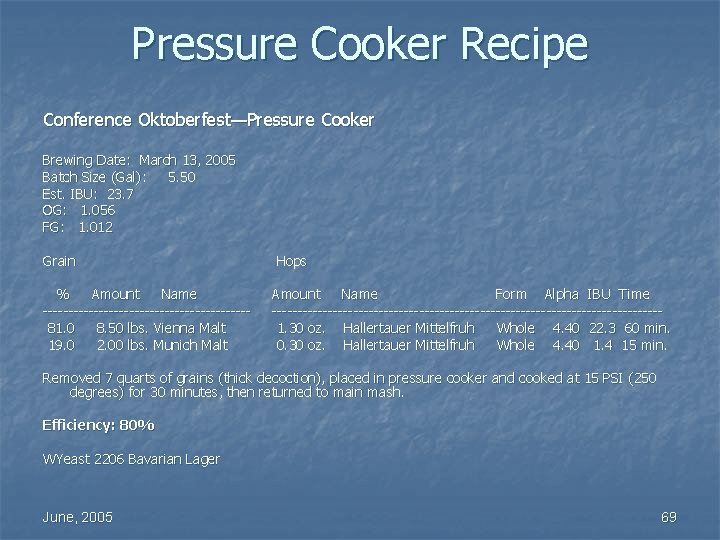
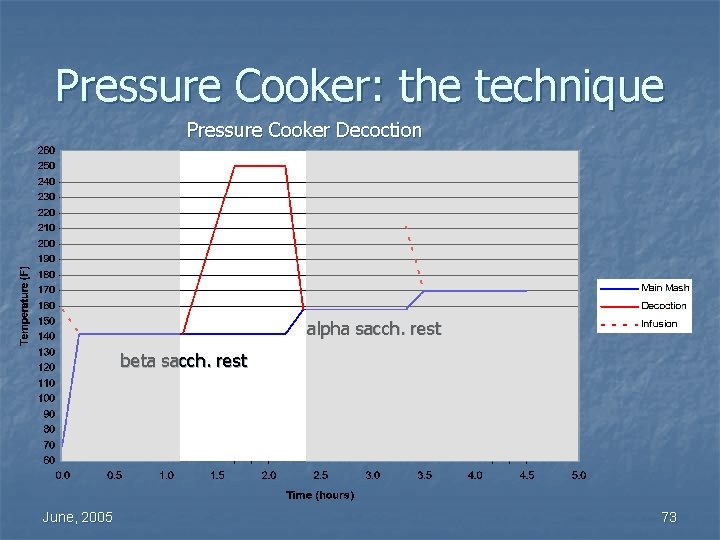
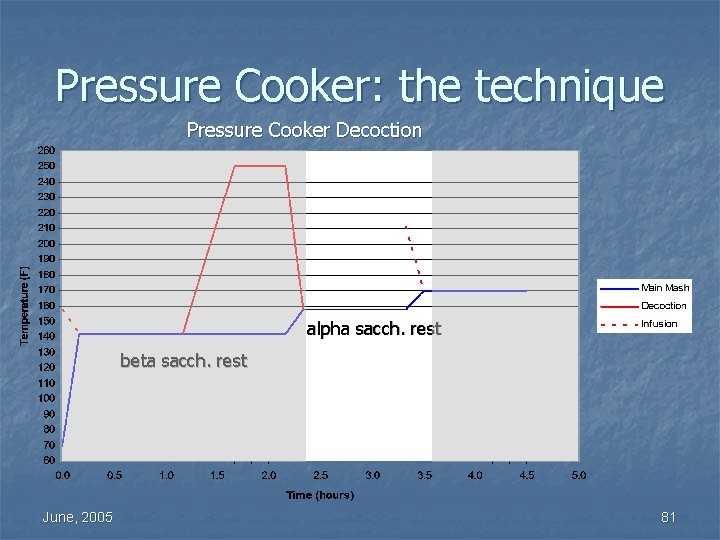
Pressure Cooker Recipe Conference Oktoberfest—Pressure Cooker Brewing Date: March 13, 2005 Batch Size (Gal): 5. 50 Est. IBU: 23. 7 OG: 1. 056 FG: 1. 012 Grain % Amount Name --------------------81. 0 8. 50 lbs. Vienna Malt 19. 0 2. 00 lbs. Munich Malt Hops Amount Name Form Alpha IBU Time --------------------------------------1. 30 oz. Hallertauer Mittelfruh Whole 4. 40 22. 3 60 min. 0. 30 oz. Hallertauer Mittelfruh Whole 4. 40 1. 4 15 min. Removed 7 quarts of grains (thick decoction), placed in pressure cooker and cooked at 15 PSI (250 degrees) for 30 minutes, then returned to main mash. Efficiency: 80% WYeast 2206 Bavarian Lager June, 2005 69
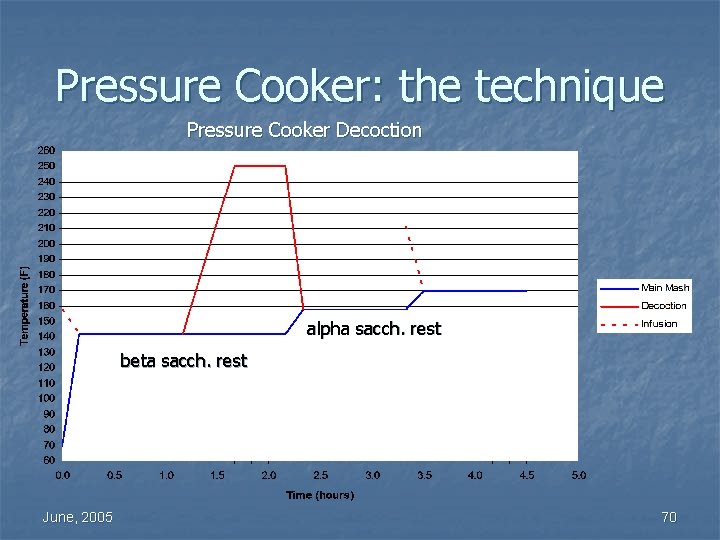
Pressure Cooker: the technique Pressure Cooker Decoction alpha sacch. rest beta sacch. rest June, 2005 70
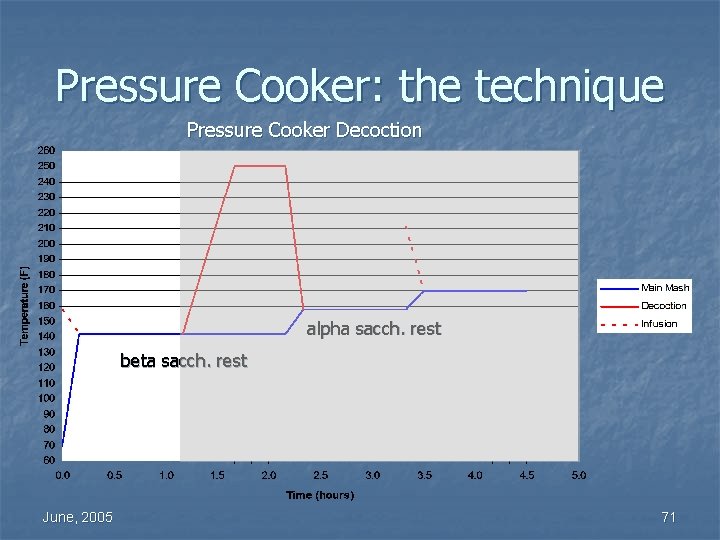
Pressure Cooker: the technique Pressure Cooker Decoction alpha sacch. rest beta sacch. rest June, 2005 71
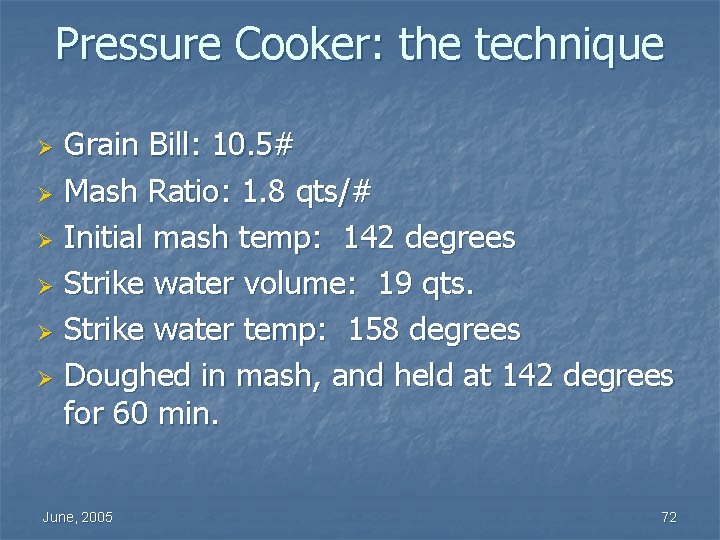
Pressure Cooker: the technique Grain Bill: 10. 5# Ø Mash Ratio: 1. 8 qts/# Ø Initial mash temp: 142 degrees Ø Strike water volume: 19 qts. Ø Strike water temp: 158 degrees Ø Doughed in mash, and held at 142 degrees for 60 min. Ø June, 2005 72
Pressure Cooker: the technique Pressure Cooker Decoction alpha sacch. rest beta sacch. rest June, 2005 73
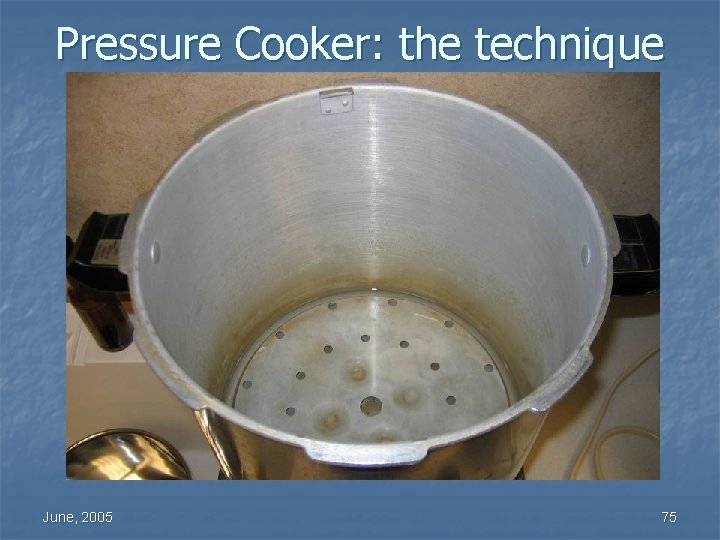
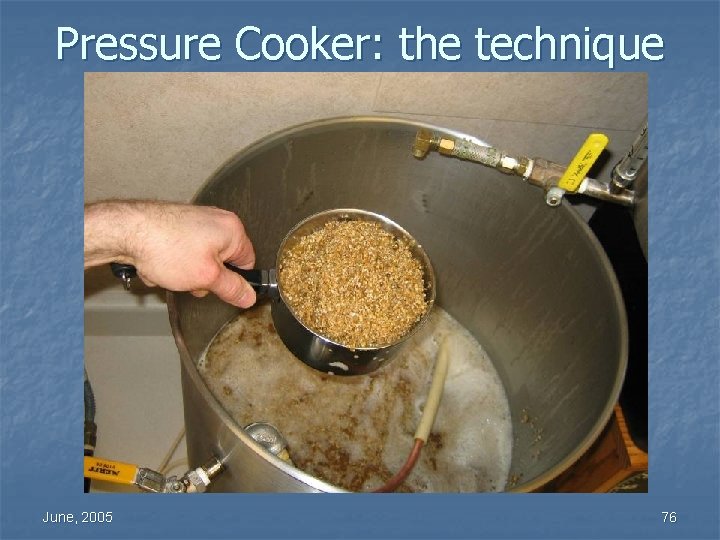
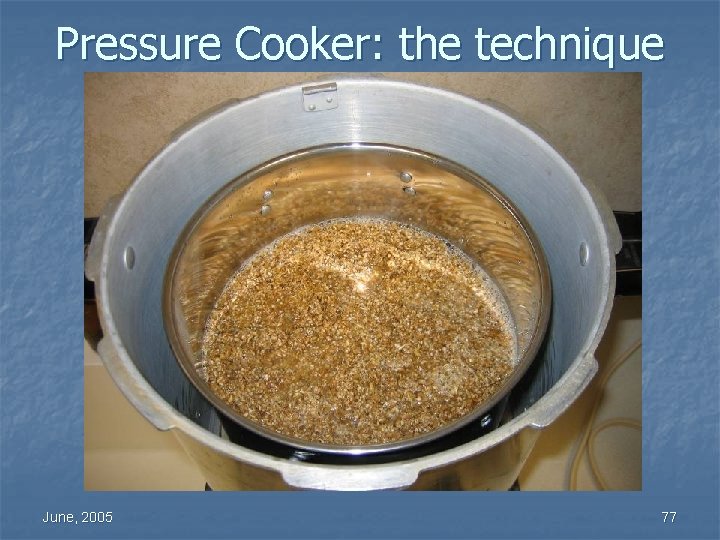
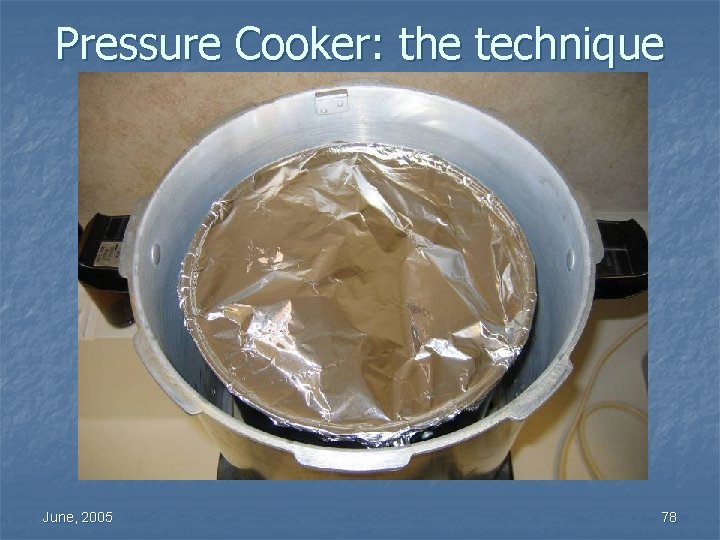
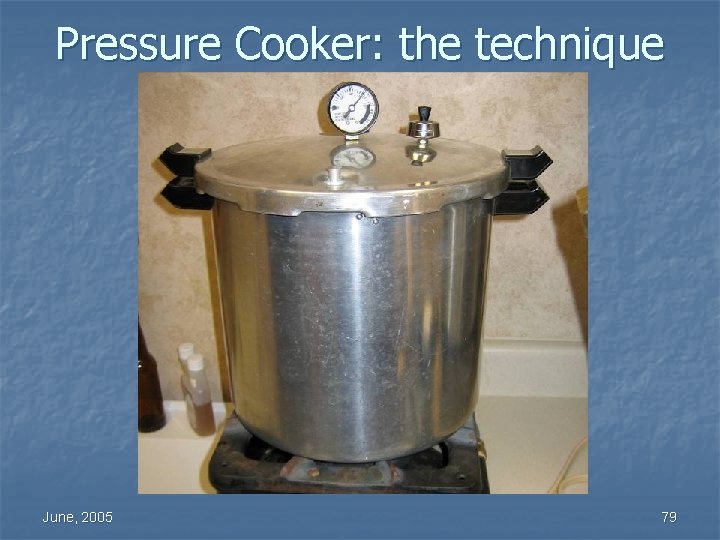
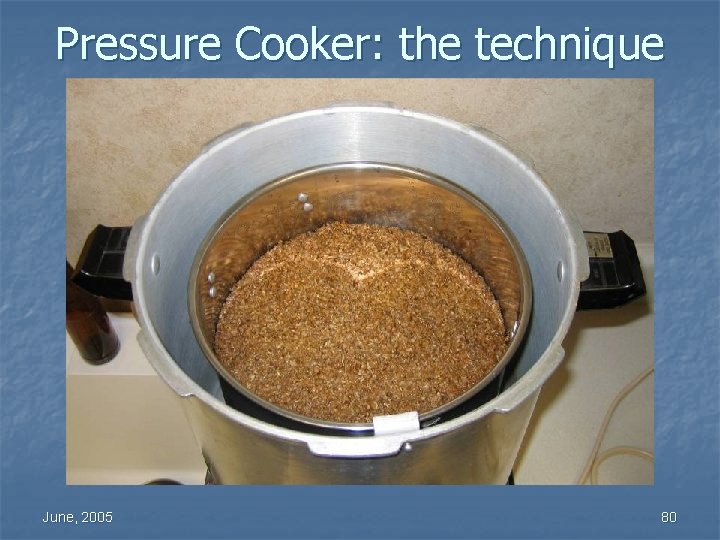
Pressure Cooker: the technique “Decoction” Pulled 7 quarts of thick mash, placed in pot Ø Placed pot in pressure cooker, sealed, and brought pressure cooker up to 15 PSI (250 °F) Ø Cooked decoction in pressure cooker for 30 min. , then removed from heat and let pressure drop Ø Returned decoction to main mash Ø June, 2005 74
Pressure Cooker: the technique June, 2005 75
Pressure Cooker: the technique June, 2005 76
Pressure Cooker: the technique June, 2005 77
Pressure Cooker: the technique June, 2005 78
Pressure Cooker: the technique June, 2005 79
Pressure Cooker: the technique June, 2005 80
Pressure Cooker: the technique Pressure Cooker Decoction alpha sacch. rest beta sacch. rest June, 2005 81
Pressure Cooker: the technique Mashout Alpha sacch. rest for 30 minutes Ø Added 2 gallons of boiling water to mash Ø Recirculated at 170 degrees for 10 -15 min. Ø Sparge (fly sparge) Ø June, 2005 82
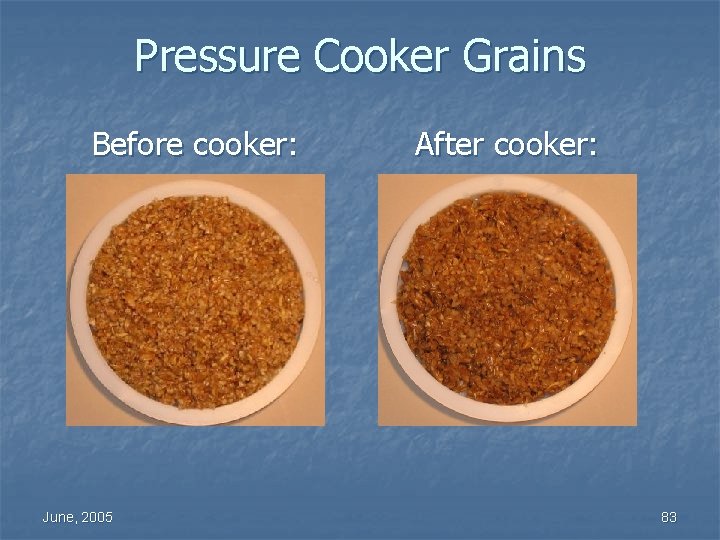
Pressure Cooker Grains Before cooker: June, 2005 After cooker: 83
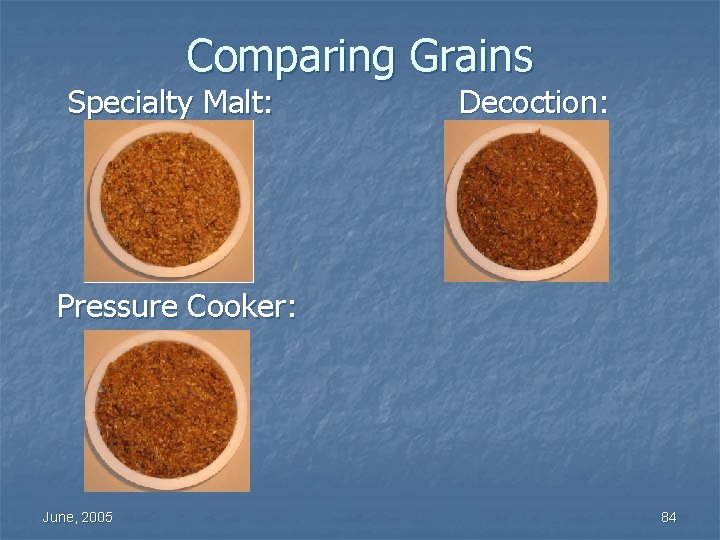
Comparing Grains Specialty Malt: Decoction: Pressure Cooker: June, 2005 84
Decoction Mashing for the Homebrewer Overview of talk Decoction Background “Contemporary Decoction”—Specialty Malts Decoction Mashing Getting the Flavors an Easier Way: Pseudo-Decoction Techniques Pressure Cooker Decoction Mash No-Sparge Technique June, 2005 85
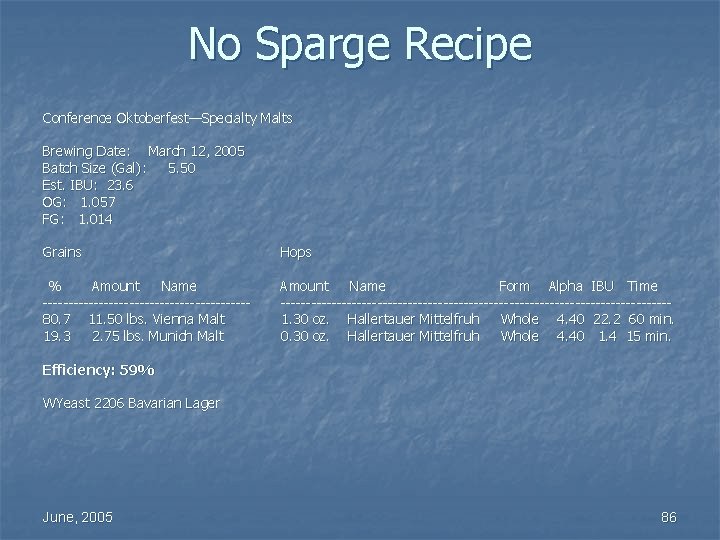
No Sparge Recipe Conference Oktoberfest—Specialty Malts Brewing Date: March 12, 2005 Batch Size (Gal): 5. 50 Est. IBU: 23. 6 OG: 1. 057 FG: 1. 014 Grains Hops % Amount Name --------------------80. 7 11. 50 lbs. Vienna Malt 19. 3 2. 75 lbs. Munich Malt Amount Name Form Alpha IBU Time --------------------------------------1. 30 oz. Hallertauer Mittelfruh Whole 4. 40 22. 2 60 min. 0. 30 oz. Hallertauer Mittelfruh Whole 4. 40 1. 4 15 min. Efficiency: 59% WYeast 2206 Bavarian Lager June, 2005 86
What is No Sparge? A mash technique where an infusion mash is performed, then just enough additional water is added to the mash so that when the wort is completely drained from the mashtun, enough wort is collected for the boil without additional water additions or sparging. June, 2005 87
Why No Sparge? 1. Same amounts of sugars, melanoidins, dextrins, etc. using No Sparge vs. traditional fly sparging 2. Less extraction of tannins and other polyphenols with No Sparge technique 3. #1 & #2 result in a richer, maltier tasting beer 4. Shorter brewday! June, 2005 88
No Sparge disadvantages 1. 2. 3. Reduced mash efficiency Requires more grain (more cost) Requires larger mashtun June, 2005 89
No Sparge: the technique Several things need to be determined: Ø How much extra grain is needed (typically quoted as being 1/4 - 1/3 more grains)? Ø How much water needs to be added at mashout to obtain entire pre-boil wort volume? Ø How big of a mashtun is required? June, 2005 90
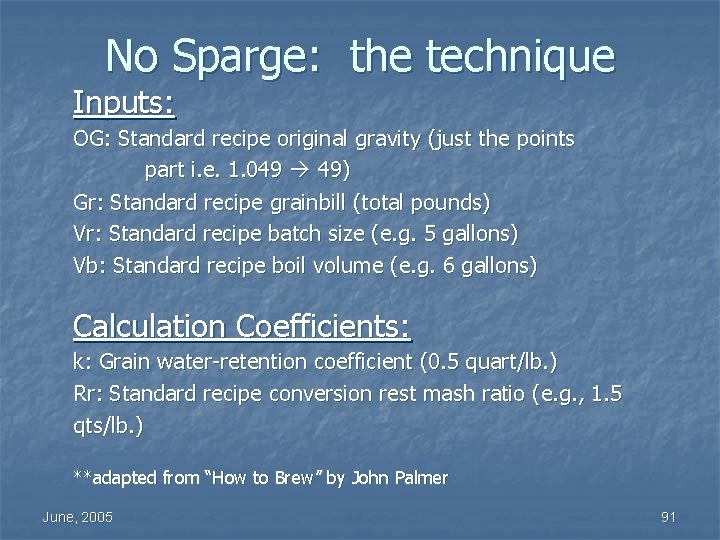
No Sparge: the technique Inputs: OG: Standard recipe original gravity (just the points part i. e. 1. 049 49) Gr: Standard recipe grainbill (total pounds) Vr: Standard recipe batch size (e. g. 5 gallons) Vb: Standard recipe boil volume (e. g. 6 gallons) Calculation Coefficients: k: Grain water-retention coefficient (0. 5 quart/lb. ) Rr: Standard recipe conversion rest mash ratio (e. g. , 1. 5 qts/lb. ) **adapted from “How to Brew” by John Palmer June, 2005 91
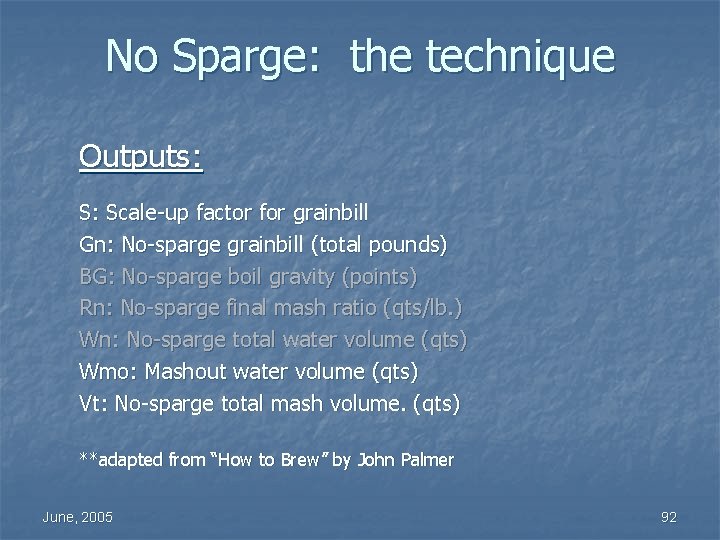
No Sparge: the technique Outputs: S: Scale-up factor for grainbill Gn: No-sparge grainbill (total pounds) BG: No-sparge boil gravity (points) Rn: No-sparge final mash ratio (qts/lb. ) Wn: No-sparge total water volume (qts) Wmo: Mashout water volume (qts) Vt: No-sparge total mash volume. (qts) **adapted from “How to Brew” by John Palmer June, 2005 92
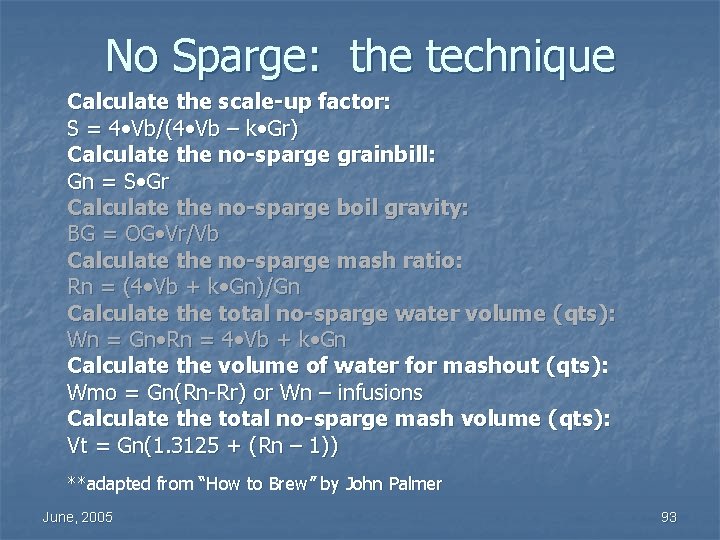
No Sparge: the technique Calculate the scale-up factor: S = 4 • Vb/(4 • Vb – k • Gr) Calculate the no-sparge grainbill: Gn = S • Gr Calculate the no-sparge boil gravity: BG = OG • Vr/Vb Calculate the no-sparge mash ratio: Rn = (4 • Vb + k • Gn)/Gn Calculate the total no-sparge water volume (qts): Wn = Gn • Rn = 4 • Vb + k • Gn Calculate the volume of water for mashout (qts): Wmo = Gn(Rn-Rr) or Wn – infusions Calculate the total no-sparge mash volume (qts): Vt = Gn(1. 3125 + (Rn – 1)) **adapted from “How to Brew” by John Palmer June, 2005 93
No Sparge: the technique Much easier method: No Sparge Calculator June, 2005 94
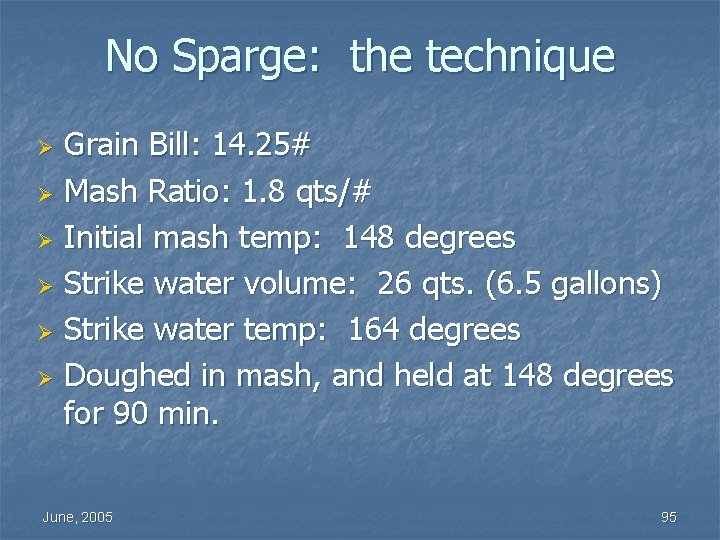
No Sparge: the technique Grain Bill: 14. 25# Ø Mash Ratio: 1. 8 qts/# Ø Initial mash temp: 148 degrees Ø Strike water volume: 26 qts. (6. 5 gallons) Ø Strike water temp: 164 degrees Ø Doughed in mash, and held at 148 degrees for 90 min. Ø June, 2005 95
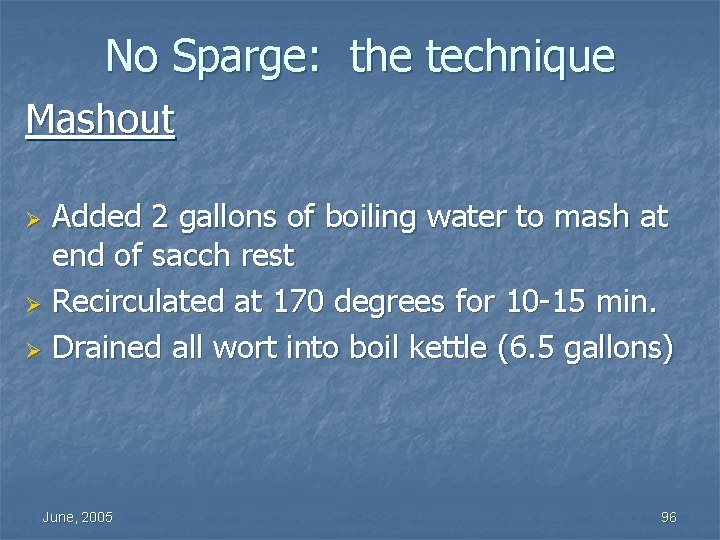
No Sparge: the technique Mashout Added 2 gallons of boiling water to mash at end of sacch rest Ø Recirculated at 170 degrees for 10 -15 min. Ø Drained all wort into boil kettle (6. 5 gallons) Ø June, 2005 96
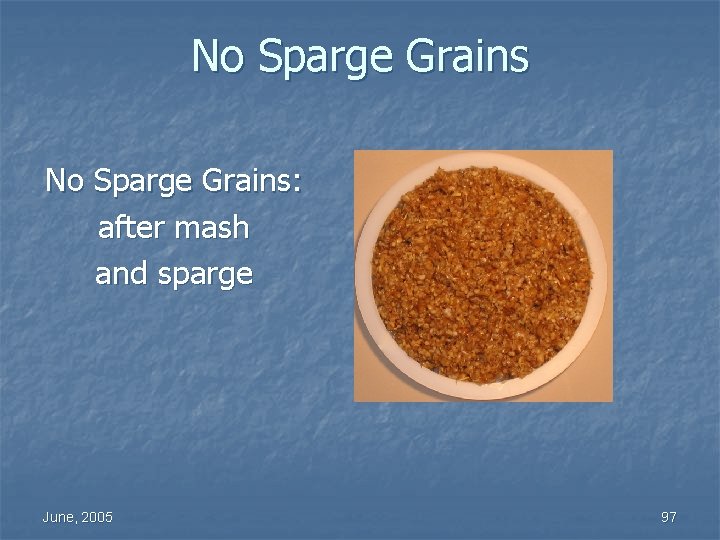
No Sparge Grains: after mash and sparge June, 2005 97
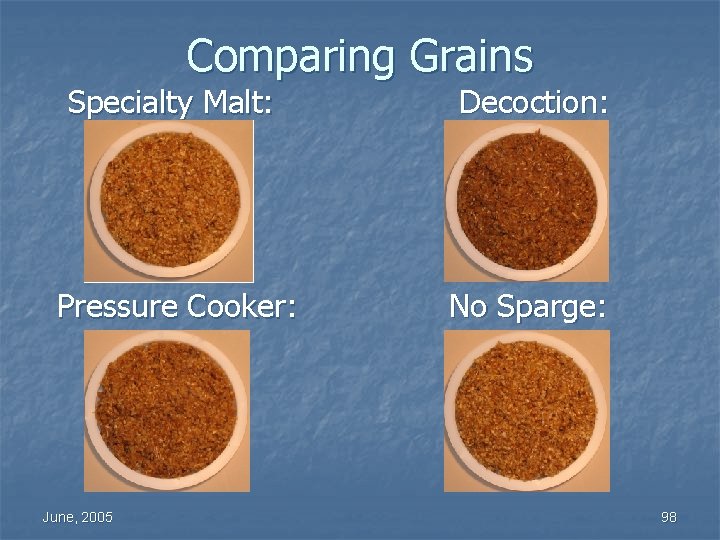
Comparing Grains Specialty Malt: Decoction: Pressure Cooker: No Sparge: June, 2005 98
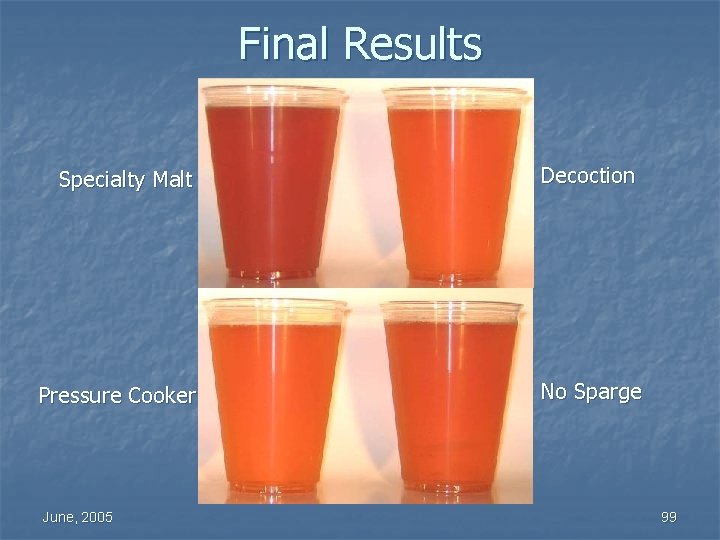
Final Results Specialty Malt Decoction Pressure Cooker No Sparge June, 2005 99
Summary ØDecoction can add small amount of additional flavor and aroma character to finished beer Ø“Pseudo-decoction” techniques are viable alternatives to traditional decoction ØTry these techniques in your brewery and decide for yourself! June, 2005 100
- Slides: 100