
Decline of the Soviet Union The Brezhnev Era
Decline of the Soviet Union
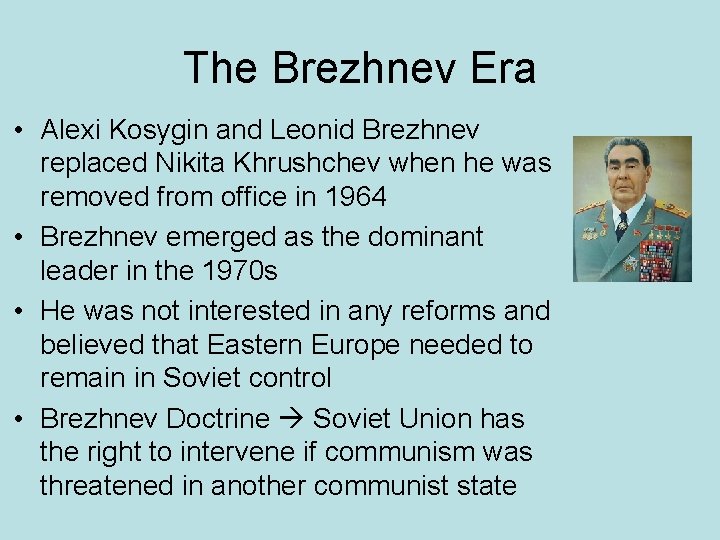
The Brezhnev Era • Alexi Kosygin and Leonid Brezhnev replaced Nikita Khrushchev when he was removed from office in 1964 • Brezhnev emerged as the dominant leader in the 1970 s • He was not interested in any reforms and believed that Eastern Europe needed to remain in Soviet control • Brezhnev Doctrine Soviet Union has the right to intervene if communism was threatened in another communist state
The Brezhnev Era • Brezhnev benefitted from détente (a relaxation of tensions and improved relations between the United States and the Soviet Union • In the 1970 s, the two superpowers signed SALT (strategic arms limitation treaty) I and II and the Ballistic Missile Treaty, which limited nuclear arms • With the feeling of being more secure, Soviet leaders relaxed their authoritarian rule and allowed more access to Western music, dress, and art • However, dissidents (people who spoke out against the regime) were still suppressed
The Brezhnev Era • In his economics policies, Brezhnev continued to emphasize heavy industry • However, two problems weakened the Soviet economy: – The central government was a huge, complex, but inefficient bureaucracy that led to indifference – Many collective farmers preferred working their own small private plots to laboring the collective work brigades • By the 1970 s, the Communist ruling class become complacent and corrupt • Party and state leaders, army leaders, and secret police (KGB), enjoyed a high standard of living • However, Brezhnev did not want to tamper with the party leadership and state bureaucracy
The Cold War Intensifies • By the 1970 s, détente allowed U. S. grain and consumer goods to be sold to the Soviet Union • However, détente collapsed in 1979 when the Soviet Union invaded Afghanistan • The Soviet Union wanted to restore a pro-Soviet regime in Afghanistan and the U. S. viewed it as an act of expansion • To show his disapproval, president Jimmy Carter canceled U. S. participation in the 1980 summer Olympics in Moscow • He also placed an embargo on the shipment of U. S. gain to the Soviets
The Cold War Intensifies • Relations worsened when Ronald Reagan became president • He called the Soviet Union an “evil empire” and began a military buildup and a new arms race • Regan also gave military aid to the Afghan rebels, helping to maintain a war that the Soviet Union could not win
Gorbachev and Perestroika • By 1980, the Soviet Union had a declining economy, a rise in infant mortality rates, a dramatic surge in alcoholism, and poor working conditions • A small group of reformers emerged and, eventually, Mikhail Gorbachev was chosen as leader in March 1985 • Perestroika restructuring of the Soviet system – At first, this meant restructuring the economy – Gorbachev wanted a market economy that was more responsive to consumers – It would have limited free enterprise so that some businesses would be privately owned and operated – However, he realized that this would not work in the established political system
Gorbachev and Perestroika • Glasnost a policy of perestroika that encouraged Soviet citizens and officials to discuss openly the strengths and weaknesses of the Soviet Union • At the 1988 Communist Party conference, Gorbachev set up a new Soviet parliament of elected members, the Congress of People’s Deputies • It met in 1989, the first such meeting in the country since 1918 • He then created a new state presidency – Under the old system, the most important position was the first secretary of the Communist Party
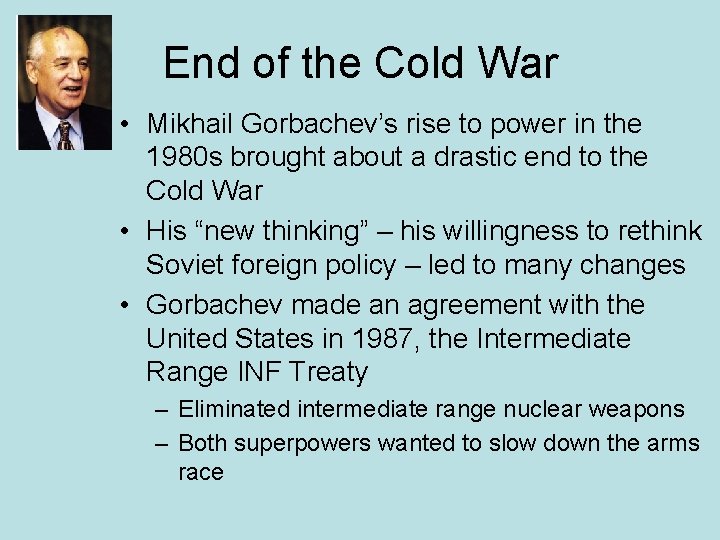
End of the Cold War • Mikhail Gorbachev’s rise to power in the 1980 s brought about a drastic end to the Cold War • His “new thinking” – his willingness to rethink Soviet foreign policy – led to many changes • Gorbachev made an agreement with the United States in 1987, the Intermediate Range INF Treaty – Eliminated intermediate range nuclear weapons – Both superpowers wanted to slow down the arms race
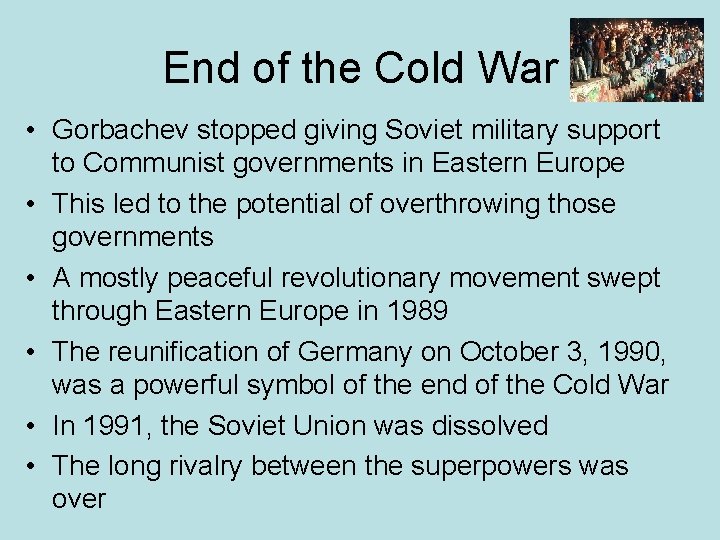
End of the Cold War • Gorbachev stopped giving Soviet military support to Communist governments in Eastern Europe • This led to the potential of overthrowing those governments • A mostly peaceful revolutionary movement swept through Eastern Europe in 1989 • The reunification of Germany on October 3, 1990, was a powerful symbol of the end of the Cold War • In 1991, the Soviet Union was dissolved • The long rivalry between the superpowers was over
End of the Soviet Union • The Soviet Union included 92 ethnic groups and 112 languages • As Gorbachev relaxed the control of the Soviet Union, old ethnic tensions grew • Nationalist movements began throughout the former republics of the Soviet Union • The conservative leaders of the traditional Soviet institutions – the army, government, KGB, and military industries – were worried that the breakup of the Soviet Union would end their privileges
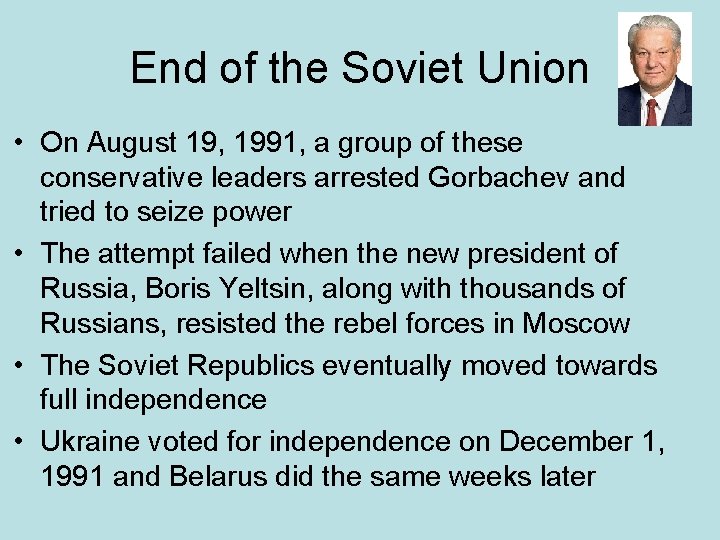
End of the Soviet Union • On August 19, 1991, a group of these conservative leaders arrested Gorbachev and tried to seize power • The attempt failed when the new president of Russia, Boris Yeltsin, along with thousands of Russians, resisted the rebel forces in Moscow • The Soviet Republics eventually moved towards full independence • Ukraine voted for independence on December 1, 1991 and Belarus did the same weeks later
Russia Under Yeltsin • Gorbachev resigned on December 25, 1991 and he turned over his responsibilities to Boris Yeltsin, the new president of Russia • Yeltsin was committed to introducing a free market economy as quickly as possible • Economic hardships and social disarray were made worse by a rise in organized crime
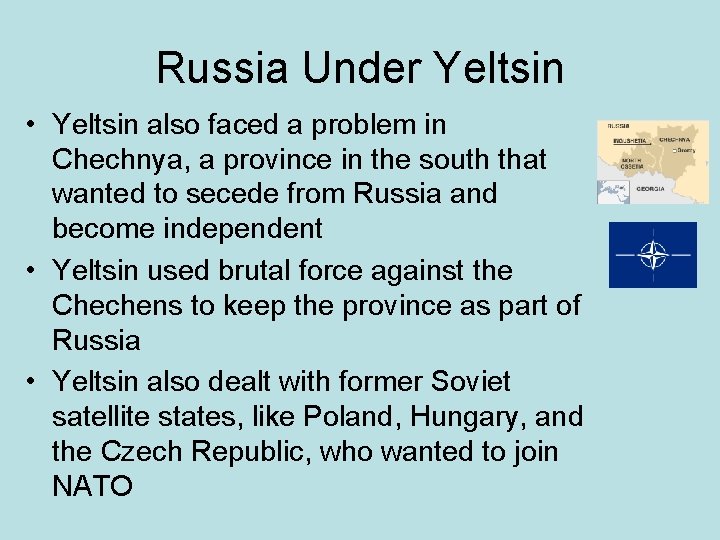
Russia Under Yeltsin • Yeltsin also faced a problem in Chechnya, a province in the south that wanted to secede from Russia and become independent • Yeltsin used brutal force against the Chechens to keep the province as part of Russia • Yeltsin also dealt with former Soviet satellite states, like Poland, Hungary, and the Czech Republic, who wanted to join NATO
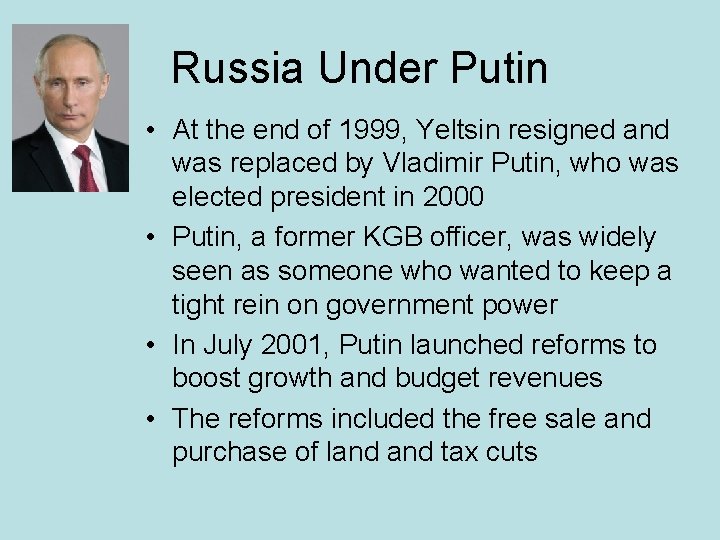
Russia Under Putin • At the end of 1999, Yeltsin resigned and was replaced by Vladimir Putin, who was elected president in 2000 • Putin, a former KGB officer, was widely seen as someone who wanted to keep a tight rein on government power • In July 2001, Putin launched reforms to boost growth and budget revenues • The reforms included the free sale and purchase of land tax cuts
Russia Under Putin • Putin also applied for Russia’s admission to the World Trade Organization and worked out a special partnership with the European Union • Despite the changes, the business climate remained somewhat uncertain, and this stifled foreign investment • Since Putin’s reforms, Russia experienced a budget surplus and a growing economy • Much of this growth is due to oil and gas exports
Russia Under Putin • Russia often uses its supplies of oil and gas as a political lever to wield power over former Soviet states and to influence world energy prices • A trans-Siberian oil pipeline, which was completed in 2009, had Asia more dependent on Russian oil • Chechnya and terrorism also continues to be a problem for Russia • In 2002, Chechen terrorists took about 600 Russian hostage in a Moscow theater • Between 2002 -2004, terrorist attacks in Russia killed an estimated 500 people
A New Russia • Russia still faces problems like rising alcoholism, criminal activities, and a decline of the traditional family system • In 2008, Dmitry Medvedev became president of Russia • Putin could not run for reelection because of limit’s in Russia’s constitution • Many question the validity of the 2008 presidential because few opposition candidates participated • Putin became prime minister and it is unclear how much power they share • In 2012, Putin became president of Russia once again
- Slides: 18