
DECLARATORY JUDGMENTS INTERVENTION Anatomy of a Complex CGL

- Slides: 31
DECLARATORY JUDGMENTS & INTERVENTION Anatomy of a Complex CGL Claim November 2, 2012
Federal Declaratory Judgment Act District Court “may declare the rights and other legal relations of any interested party seeking such declaration” – 28 U. S. C. § 2201(a)
Travelers v. Bowling Green Prof’l Assocs. • District Court has “discretion” even when suit otherwise satisfies subject matter jurisdiction • District Court’s determination will be reviewed for “an abuse of discretion” • Generally a very deferential standard
Travelers v. Bowling Green Prof’l Assocs. • Sixth Circuit may not give as much deference as expected • Five Factors: 1. Does Declaratory action settle controversy? 2. Does Declaratory action clarify legal relations? 3. Is Declaratory action being used for procedural fencing?
Travelers v. Bowling Green Prof’l Assocs. 4. Would Declaratory action increase friction between federal and state courts? • whether the underlying factual issues are important to resolution; • whether the state trial court is in a better position to evaluate factual issues; • whethere is a close nexus between the underlying factual and legal issues and state law or public policy; and 5. Is there an alternative remedy?
Travelers v. Bowling Green Prof’l Assocs. Court reasoned: • Declaratory relief settles only duty to defend and indemnify between insured and insurer • Declaratory relief does not settle controversy between insured/alleged tortfeasor and third-party claimants because third-parties were not parties and are not bound by the declaration • The Sixth Circuit found that the District Court had abused its discretion in accepting jurisdiction
Estate of Heintzelman v. Air Experts, Inc. • R. C. 2721. 12(B) requires declaration action brought by insured to be binding on third-parties not party to declaratory action • R. C. 3929. 06 “the holder of the policy commences a declaratory judgment action” • “As we have already concluded, that ‘binding legal effect’ applies to declaratory judgments brought by a policyholder, not by an insurer. ” Estate of Heintzelman v. Air Experts, Inc. , 126 Ohio St. 3 d 138, 143 (2010)
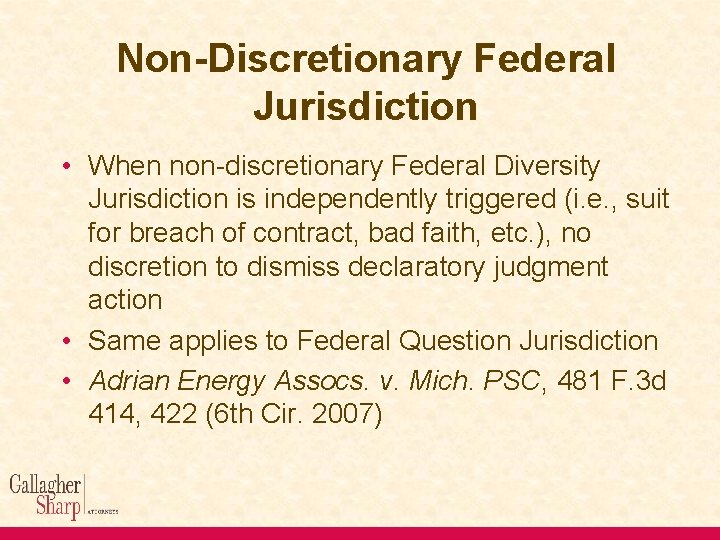
Non-Discretionary Federal Jurisdiction • 28 U. S. C. § 2201 “may declare the rights and other legal relations” • 28 U. S. C. § 1332(a)(1) “shall have original jurisdiction of all civil actions where the matter in controversy exceeds the sum or value of $75, 000, exclusive of interest and costs, and is between. . . Citizens of different States”
Non-Discretionary Federal Jurisdiction • When non-discretionary Federal Diversity Jurisdiction is independently triggered (i. e. , suit for breach of contract, bad faith, etc. ), no discretion to dismiss declaratory judgment action • Same applies to Federal Question Jurisdiction • Adrian Energy Assocs. v. Mich. PSC, 481 F. 3 d 414, 422 (6 th Cir. 2007)
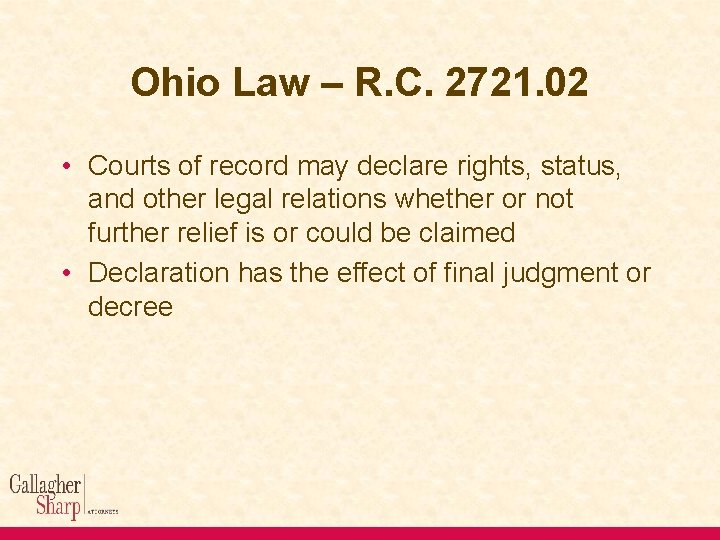
Ohio Law – R. C. 2721. 02 • Courts of record may declare rights, status, and other legal relations whether or not further relief is or could be claimed • Declaration has the effect of final judgment or decree
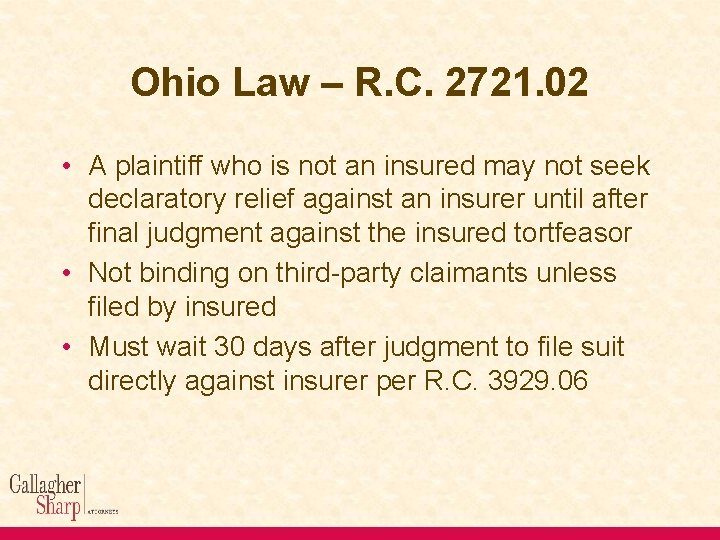
Ohio Law – R. C. 2721. 02 • A plaintiff who is not an insured may not seek declaratory relief against an insurer until after final judgment against the insured tortfeasor • Not binding on third-party claimants unless filed by insured • Must wait 30 days after judgment to file suit directly against insurer per R. C. 3929. 06
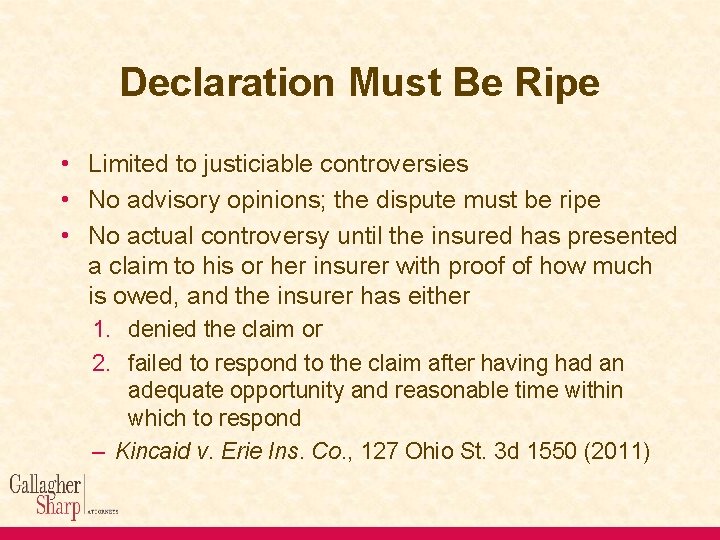
Declaration Must Be Ripe • Limited to justiciable controversies • No advisory opinions; the dispute must be ripe • No actual controversy until the insured has presented a claim to his or her insurer with proof of how much is owed, and the insurer has either 1. denied the claim or 2. failed to respond to the claim after having had an adequate opportunity and reasonable time within which to respond – Kincaid v. Erie Ins. Co. , 127 Ohio St. 3 d 1550 (2011)
ADDITIONAL CONSIDERATION: Jurisdictional Priority • Two State Courts: – The first filed case has exclusive jurisdiction – The second action is properly dismissed for want of subject matter jurisdiction – State ex rel. Phillips v. Polcar, 50 Ohio St. 2 d 279, syllabus (1977)
ADDITIONAL CONSIDERATION: Jurisdictional Priority • Filing in the courts of two different sovereigns (two different states or state and federal): race to judgment • Proceed concurrently with the litigation until judgment which may be raised as res judicata as to the other. Efros v. Nationwide Corp. (1984), 12 Ohio St. 3 d 191, 193
Considerations to Filing for Declaratory Relief • Allows plaintiff to pick venue • May not be binding on third-party claimants unless they are joined as defendants • May initiate race to judgment
Considerations to Filing for Declaratory Relief • May file and seek consolidation, is an alternative to direct intervention (or to avoid an adverse ruling on intervention) • Only option if: – No suit is pending against insured – Intervention has been denied in State Court
Considerations to Filing for Declaratory Relief • May be dismissed as unripe if claim for coverage has not been made and denied • Where both declaratory judgment and damages/coverage is sought – State Court: not appealable until damages determined, Walburn v. Dunlap, 121 Ohio St. 3 d 373, 373 -374, syllabus (2009) – Federal Court: immediate appeal may be available
Considerations to Filing for Declaratory Relief • Bad faith claim may be waived if not asserted as compulsory counterclaim to insurer’s declaratory judgment action • Insurer’s good faith belief of no coverage must be supported by evidence at time declaratory judgment action is filed
Intervention – Civ. R. 24 • Generally same standards in State and Federal Court • Intervention of Right: interest is so situated that disposition may impair or impede ability to protect interest • Permissive Intervention: claim or defense and the main action contain question of law or fact in common • Both must be timely
Intervention and Diversity • Federal diversity jurisdiction not destroyed by intervention of party not essential to original dispute • Note: this rule generally applies to intervention by a non-diverse party for a limited purpose, rather than where the nondiverse party is added as a new named defendant by plaintiff
Intervention – Civ. R. 24 • Permissive Intervention is generally allowed for limited purposes: – Jury interrogatories as to damages – Jury interrogatories as to state of mind – Jury instructions • Intervention liberally allowed
Timeliness • Timeliness of intervention is highly fact sensitive • Two facets of timeliness: – First: Statute of limitations: insurer’s motion to intervene relates back to insured’s initial suit • Thus, if insured’s suit was not barred by statute of limitations, then neither is insurer’s
Timeliness – Second: Trial proceedings – Five factors: 1. the point to which the suit had progressed; 2. the purpose for which intervention is sought; 3. the length of time the proposed intervener knew or should have known of interest; 4. the prejudice to the original parties; and 5. the existence of unusual circumstances militating against or in favor of intervention – Prejudice does not include allowing the insurer to establish facts which will allow it to dispute coverage
Trial Binding on Insurer • If insurer does not intervene, it will be bound by findings of fact as to insured’s liability and basis for liability – Insured’s mental state is binding – Factual determinations are binding – Damages determinations against insured are binding – Howell v. Richardson, 45 Ohio St. 3 d 365 (1989)
Intervention Denied If intervention is denied: • Generally, not immediately appealable in State Court – Denial of the motion to intervene for the sole purpose of submitting interrogatories does not affect a substantial right, Gehm v. Timberline Post & Frame, 112 Ohio St. 3 d 514, 518 -519 (2007) – Denial is appealable where issue cannot be litigated in separate action, Southside Cmty. Dev. Corp. v. Levin, 116 Ohio St. 3 d 1209 (2007)
Intervention Denied (cont’d) – May file separate declaratory action in lieu of immediate appeal in State Court – Becomes appealable when final judgment is entered • Appeal may be necessary if separate declaratory action remains pending • Denial of intervention is generally immediately appealable in Federal Court, Bhd. of R. R. Trainmen v. Balt. & Ohio R. R. , 331 U. S. 519 (1947)
Intervention Considerations • May be more advantageous than filing a separate declaratory action – – – cost savings not duplicative litigation binding on all parties but generally limited to facts/damages coverage issues may remain coverage may be determined later under a supplemental complaint filed by plaintiff pursuant to R. C. 3929. 06 (A) (2)
Intervention Considerations • Insured, not insurer, chooses venue • Can be effective in determining controlling facts as to coverage issues closer to trial • Sought on a more limited basis than a declaration as to coverage
Intervention Considerations • Insurer does not act in bad faith by intervening so long as there is reason to intervene • Declaratory action may be preferred if coverage issue arises early in litigation – Monitoring and defense expenses may be saved if coverage is determined not to apply early on
Intervention Considerations • Intervention may be more advantageous when the coverage issue arises late in litigation brought by (or against) the insured – Determine facts to avoid being bound by a blanket general verdict • As a practical matter, the scope and substance of jury interrogatories remain fluid until the close of trial – continual modification up until the time of submission to the jury is required
Rich Rezie rrezie@gallaghersharp. com