
Declarative Computation Model Kernel language semantics NonSuspendable statements
Declarative Computation Model Kernel language semantics (Non-)Suspendable statements (VRH 2. 4. 3 -2. 4. 4) Carlos Varela RPI October 11, 2007 Adapted with permission from: Seif Haridi KTH Peter Van Roy UCL C. Varela; Adapted w/permission from S. Haridi and P. Van Roy 1

Sequential declarative computation model • The kernel language semantics – The environment: maps textual variable names (variable identifiers) into entities in the store – Abstract machine consists of an execution stack of semantic statements transforming the store – Interpretation (execution) of the kernel language elements (statements) by the use of an abstract machine • Non-suspendable statements • Suspendable statements C. Varela; Adapted w/permission from S. Haridi and P. Van Roy 2
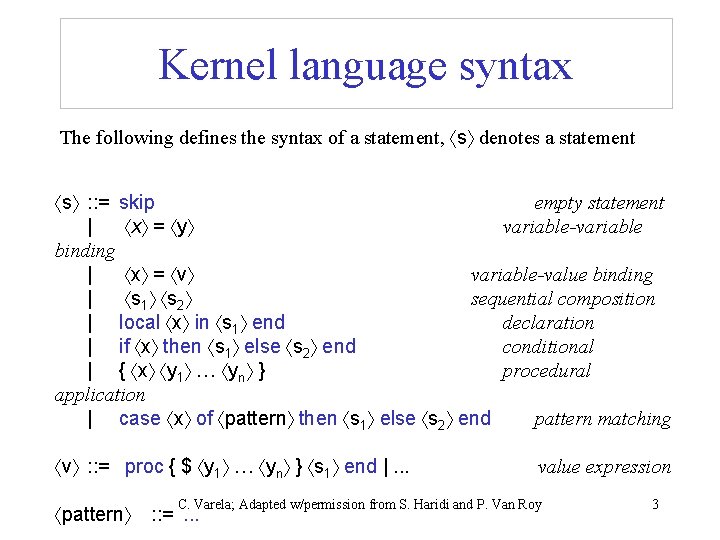
Kernel language syntax The following defines the syntax of a statement, s denotes a statement s : : = skip empty statement | x = y variable-variable binding | x = v variable-value binding | s 1 s 2 sequential composition | local x in s 1 end declaration | if x then s 1 else s 2 end conditional | { x y 1 … yn } procedural application | case x of pattern then s 1 else s 2 end pattern matching v : : = proc { $ y 1 … yn } s 1 end |. . . pattern value expression C. Varela; Adapted w/permission from S. Haridi and P. Van Roy : : =. . . 3
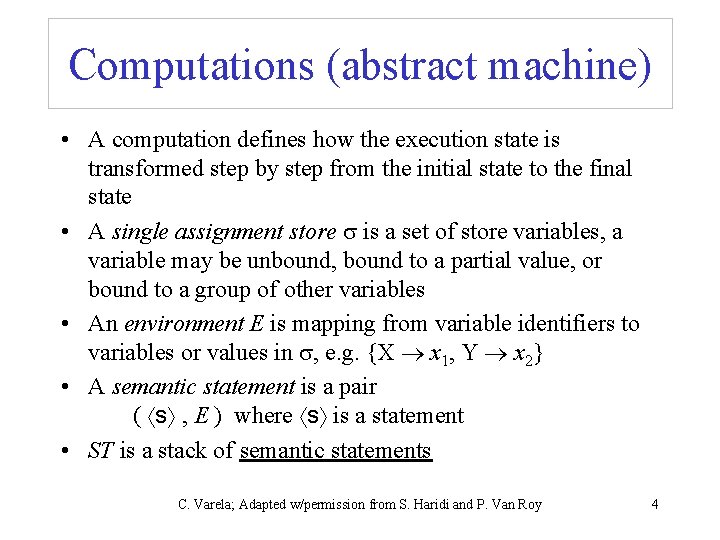
Computations (abstract machine) • A computation defines how the execution state is transformed step by step from the initial state to the final state • A single assignment store is a set of store variables, a variable may be unbound, bound to a partial value, or bound to a group of other variables • An environment E is mapping from variable identifiers to variables or values in , e. g. {X x 1, Y x 2} • A semantic statement is a pair ( s , E ) where s is a statement • ST is a stack of semantic statements C. Varela; Adapted w/permission from S. Haridi and P. Van Roy 4

Computations (abstract machine) • A computation defines how the execution state is transformed step by step from the initial state to the final state • The execution state is a pair ( ST , ) – where ST is a stack of semantic statements and is a single assignment store • A computation is a sequence of execution states ( ST 0 , 0 ) ( ST 1 , 1 ) ( ST 2 , 2 ) . . . C. Varela; Adapted w/permission from S. Haridi and P. Van Roy 5

Semantics • To execute a program (i. e. , a statement) s the initial execution state is ( [ ( s , ) ] , ) • ST has a single semantic statement ( s , ) • The environment E is empty, and the store is empty • [. . . ] denotes the stack • At each step the first element of ST is popped and execution proceeds according to the form of the element • The final execution state (if any) is a state in which ST is empty C. Varela; Adapted w/permission from S. Haridi and P. Van Roy 6
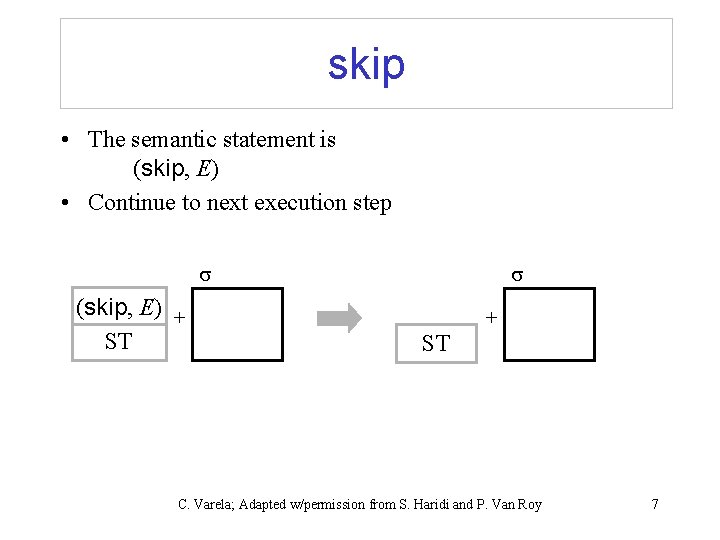
skip • The semantic statement is (skip, E) • Continue to next execution step (skip, E) + ST C. Varela; Adapted w/permission from S. Haridi and P. Van Roy 7

Sequential composition • The semantic statement is ( s 1 s 2 , E) • Push ( s 2 , E) and then push ( s 1 , E) on ST • Continue to next execution step ( s 1 s 2 , E) ST + ( s 1 , E) ( s 2 , E) ST + C. Varela; Adapted w/permission from S. Haridi and P. Van Roy 8
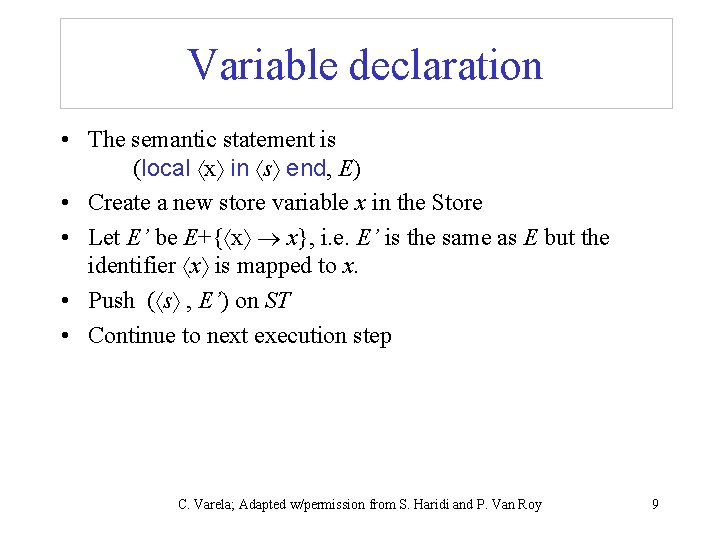
Variable declaration • The semantic statement is (local x in s end, E) • Create a new store variable x in the Store • Let E’ be E+{ x x}, i. e. E’ is the same as E but the identifier x is mapped to x. • Push ( s , E’) on ST • Continue to next execution step C. Varela; Adapted w/permission from S. Haridi and P. Van Roy 9
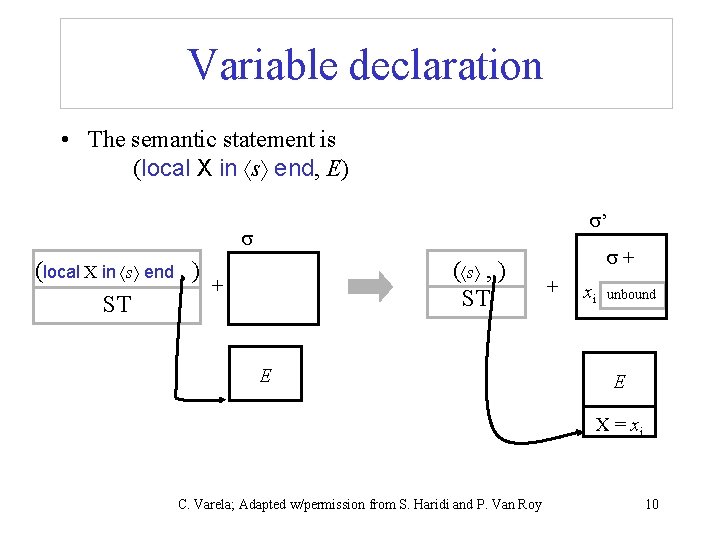
Variable declaration • The semantic statement is (local X in s end, E) ’ (local X in s end , ) + ST ( s , ) ST E + + xi unbound E X = xi C. Varela; Adapted w/permission from S. Haridi and P. Van Roy 10
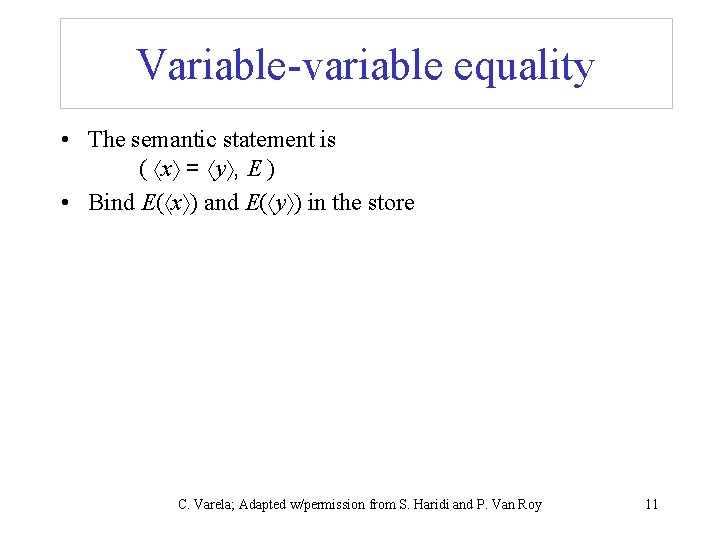
Variable-variable equality • The semantic statement is ( x = y , E ) • Bind E( x ) and E( y ) in the store C. Varela; Adapted w/permission from S. Haridi and P. Van Roy 11
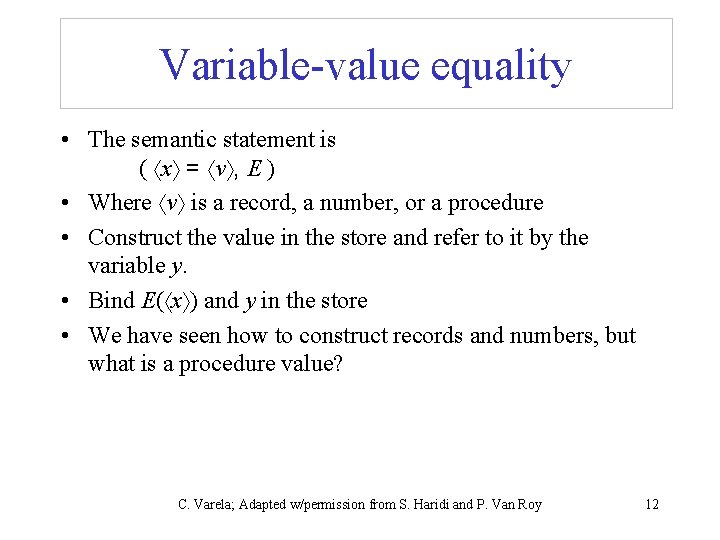
Variable-value equality • The semantic statement is ( x = v , E ) • Where v is a record, a number, or a procedure • Construct the value in the store and refer to it by the variable y. • Bind E( x ) and y in the store • We have seen how to construct records and numbers, but what is a procedure value? C. Varela; Adapted w/permission from S. Haridi and P. Van Roy 12
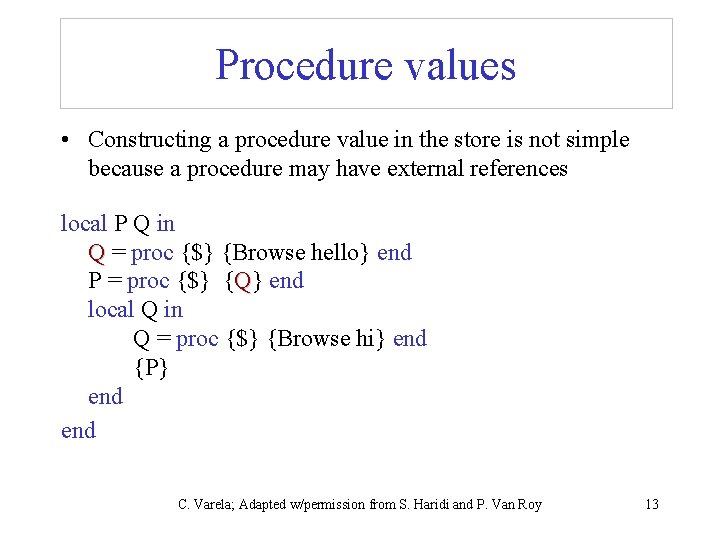
Procedure values • Constructing a procedure value in the store is not simple because a procedure may have external references local P Q in Q = proc {$} {Browse hello} end P = proc {$} {Q} end local Q in Q = proc {$} {Browse hi} end {P} end C. Varela; Adapted w/permission from S. Haridi and P. Van Roy 13
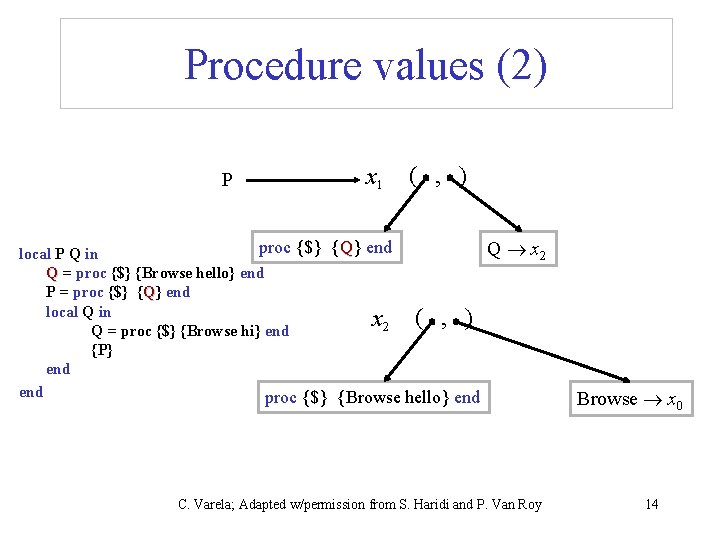
Procedure values (2) P x 1 ( , ) proc {$} {Q} end local P Q in Q = proc {$} {Browse hello} end P = proc {$} {Q} end local Q in x 2 ( , ) Q = proc {$} {Browse hi} end {P} end proc {$} {Browse hello} end Q x 2 C. Varela; Adapted w/permission from S. Haridi and P. Van Roy Browse x 0 14
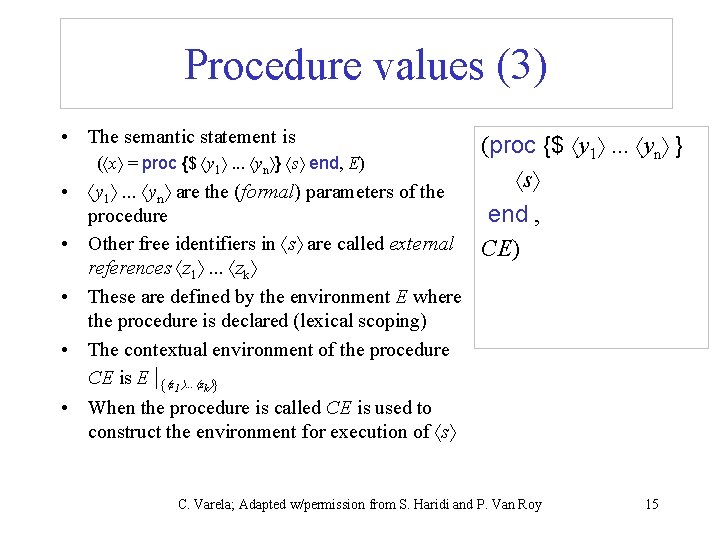
Procedure values (3) • The semantic statement is ( x = proc {$ y 1 . . . yn } s end, E) • y 1 . . . yn are the (formal) parameters of the procedure • Other free identifiers in s are called external references z 1 . . . zk • These are defined by the environment E where the procedure is declared (lexical scoping) • The contextual environment of the procedure CE is E |{ z 1 . . . zk } • When the procedure is called CE is used to construct the environment for execution of s (proc {$ y 1 . . . yn } s end , CE) C. Varela; Adapted w/permission from S. Haridi and P. Van Roy 15
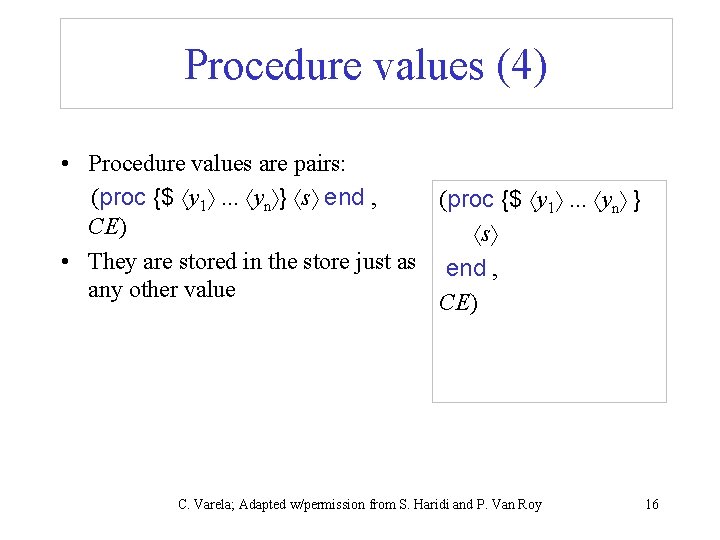
Procedure values (4) • Procedure values are pairs: (proc {$ y 1 . . . yn } s end , (proc {$ y 1 . . . yn } CE) s • They are stored in the store just as end , any other value CE) C. Varela; Adapted w/permission from S. Haridi and P. Van Roy 16
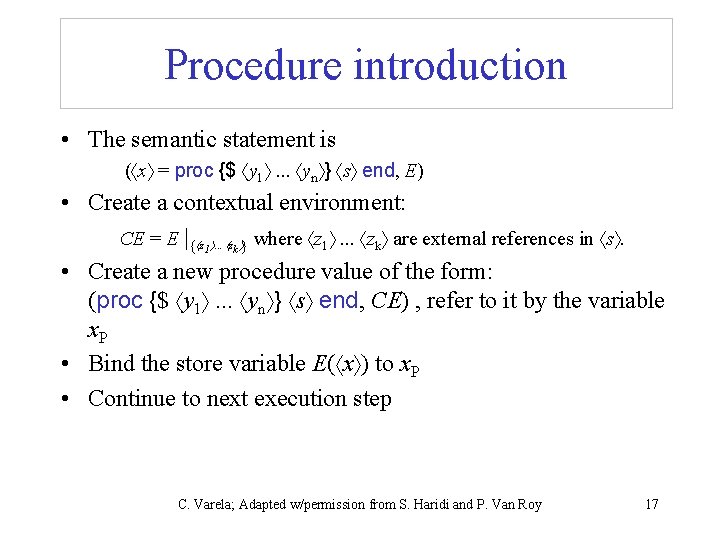
Procedure introduction • The semantic statement is ( x = proc {$ y 1 . . . yn } s end, E) • Create a contextual environment: CE = E |{ z 1 . . . zk } where z 1 . . . zk are external references in s. • Create a new procedure value of the form: (proc {$ y 1 . . . yn } s end, CE) , refer to it by the variable x. P • Bind the store variable E( x ) to x. P • Continue to next execution step C. Varela; Adapted w/permission from S. Haridi and P. Van Roy 17
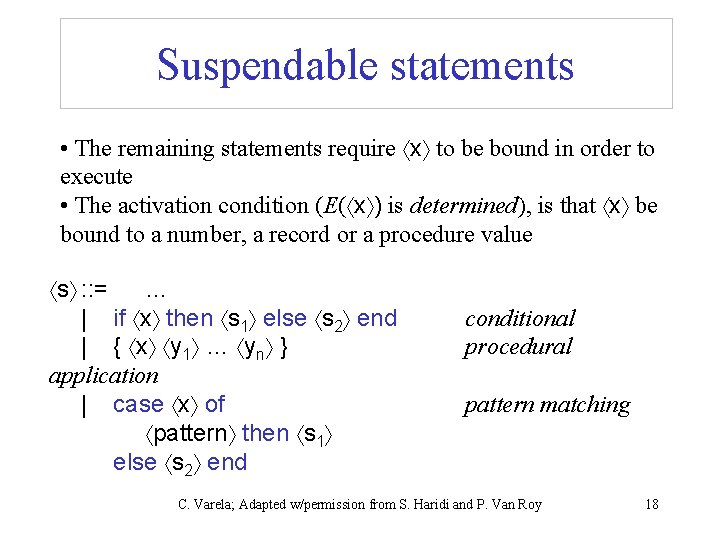
Suspendable statements • The remaining statements require x to be bound in order to execute • The activation condition (E( x ) is determined), is that x be bound to a number, a record or a procedure value s : : = … | if x then s 1 else s 2 end | { x y 1 … yn } application | case x of pattern then s 1 else s 2 end conditional procedural pattern matching C. Varela; Adapted w/permission from S. Haridi and P. Van Roy 18
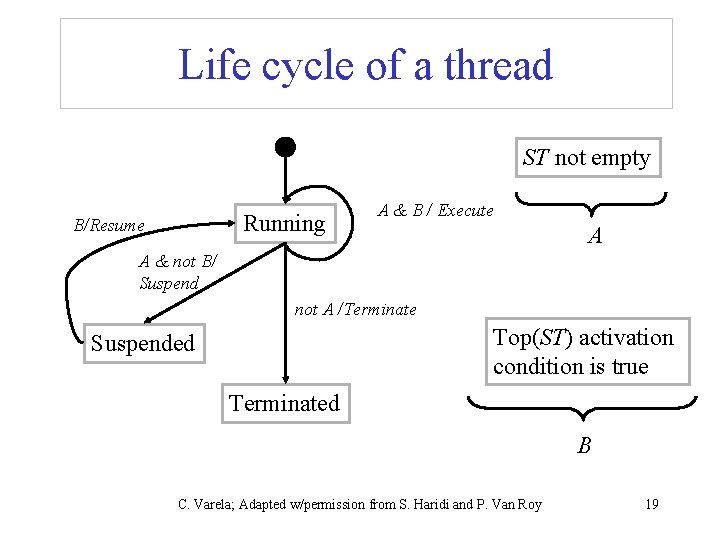
Life cycle of a thread ST not empty Running B/Resume A & B / Execute A A & not B/ Suspend not A /Terminate Top(ST) activation condition is true Suspended Terminated B C. Varela; Adapted w/permission from S. Haridi and P. Van Roy 19
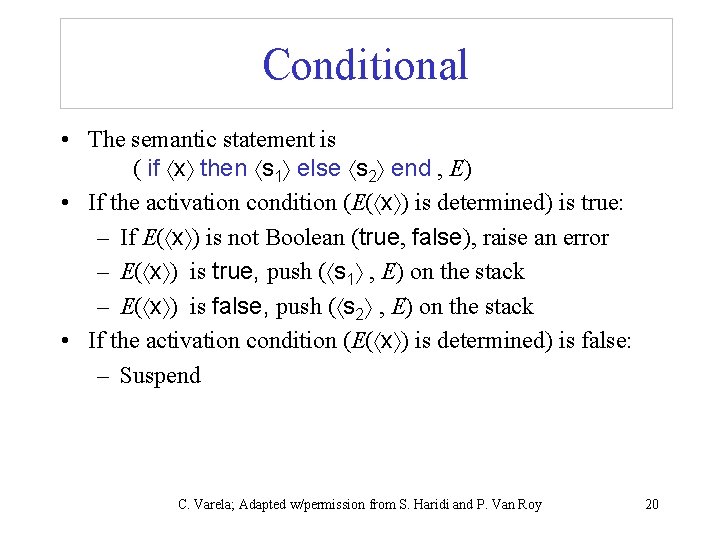
Conditional • The semantic statement is ( if x then s 1 else s 2 end , E) • If the activation condition (E( x ) is determined) is true: – If E( x ) is not Boolean (true, false), raise an error – E( x ) is true, push ( s 1 , E) on the stack – E( x ) is false, push ( s 2 , E) on the stack • If the activation condition (E( x ) is determined) is false: – Suspend C. Varela; Adapted w/permission from S. Haridi and P. Van Roy 20
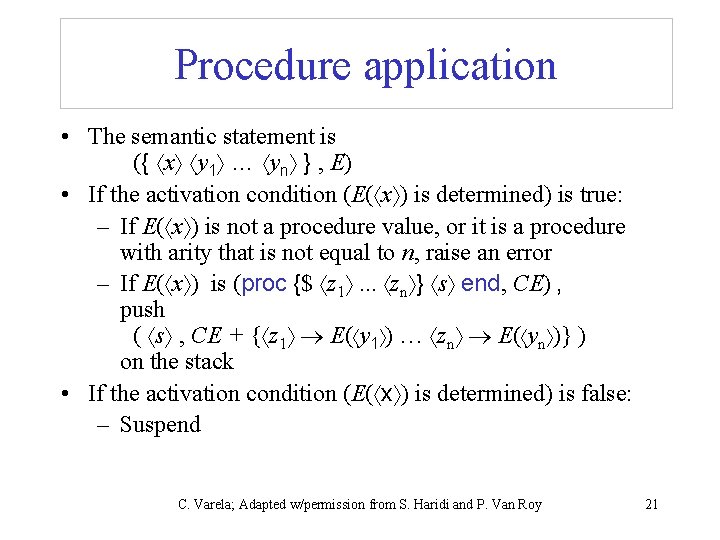
Procedure application • The semantic statement is ({ x y 1 … yn } , E) • If the activation condition (E( x ) is determined) is true: – If E( x ) is not a procedure value, or it is a procedure with arity that is not equal to n, raise an error – If E( x ) is (proc {$ z 1 . . . zn } s end, CE) , push ( s , CE + { z 1 E( y 1 ) … zn E( yn )} ) on the stack • If the activation condition (E( x ) is determined) is false: – Suspend C. Varela; Adapted w/permission from S. Haridi and P. Van Roy 21
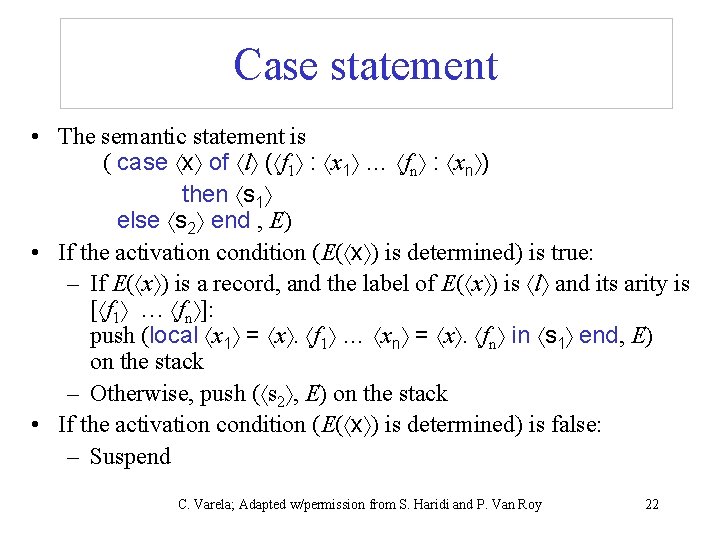
Case statement • The semantic statement is ( case x of l ( f 1 : x 1 … fn : xn ) then s 1 else s 2 end , E) • If the activation condition (E( x ) is determined) is true: – If E( x ) is a record, and the label of E( x ) is l and its arity is [ f 1 … fn ]: push (local x 1 = x. f 1 … xn = x. fn in s 1 end, E) on the stack – Otherwise, push ( s 2 , E) on the stack • If the activation condition (E( x ) is determined) is false: – Suspend C. Varela; Adapted w/permission from S. Haridi and P. Van Roy 22
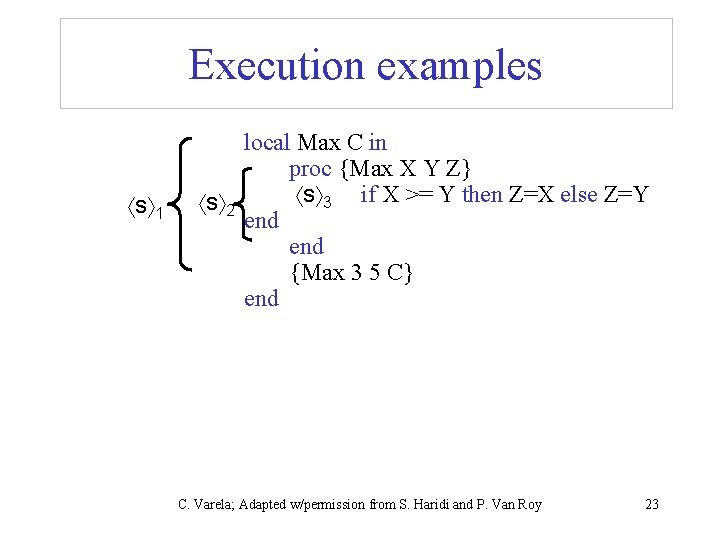
Execution examples s 1 local Max C in proc {Max X Y Z} s 3 if X >= Y then Z=X else Z=Y s 2 end {Max 3 5 C} end C. Varela; Adapted w/permission from S. Haridi and P. Van Roy 23
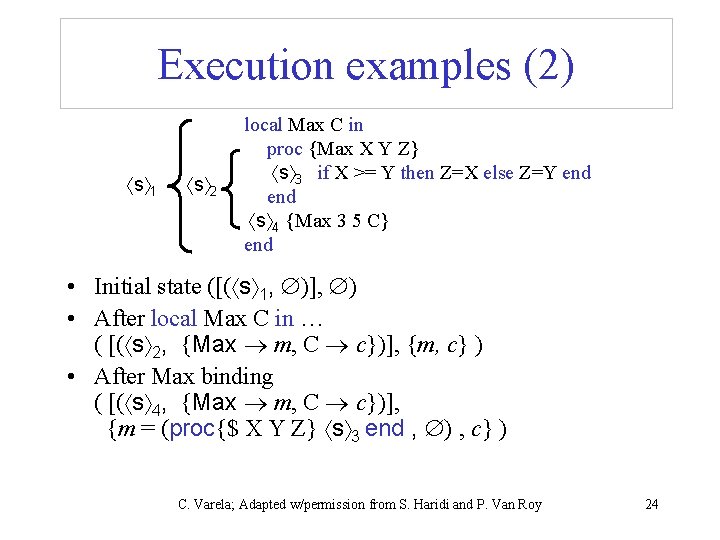
Execution examples (2) s 1 s 2 local Max C in proc {Max X Y Z} s 3 if X >= Y then Z=X else Z=Y end s 4 {Max 3 5 C} end • Initial state ([( s 1, )], ) • After local Max C in … ( [( s 2, {Max m, C c})], {m, c} ) • After Max binding ( [( s 4, {Max m, C c})], {m = (proc{$ X Y Z} s 3 end , ) , c} ) C. Varela; Adapted w/permission from S. Haridi and P. Van Roy 24
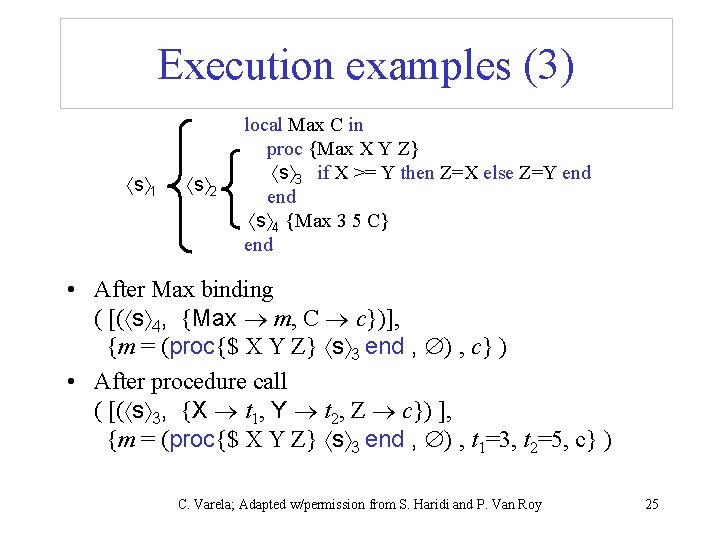
Execution examples (3) s 1 s 2 local Max C in proc {Max X Y Z} s 3 if X >= Y then Z=X else Z=Y end s 4 {Max 3 5 C} end • After Max binding ( [( s 4, {Max m, C c})], {m = (proc{$ X Y Z} s 3 end , ) , c} ) • After procedure call ( [( s 3, {X t 1, Y t 2, Z c}) ], {m = (proc{$ X Y Z} s 3 end , ) , t 1=3, t 2=5, c} ) C. Varela; Adapted w/permission from S. Haridi and P. Van Roy 25
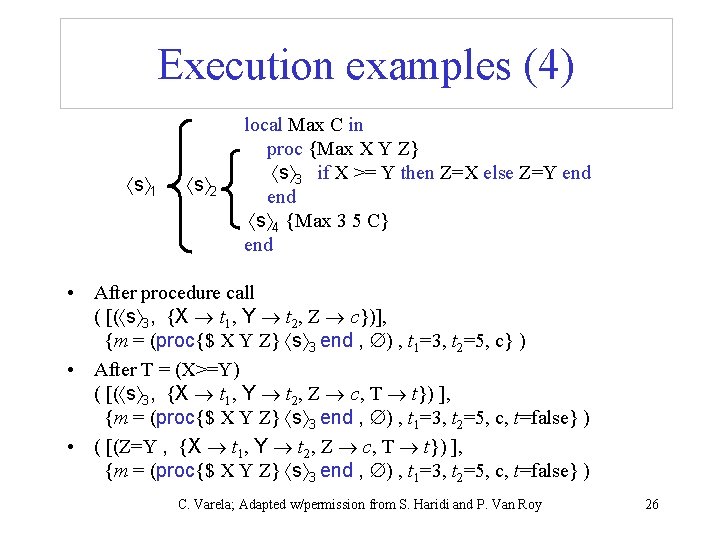
Execution examples (4) s 1 s 2 local Max C in proc {Max X Y Z} s 3 if X >= Y then Z=X else Z=Y end s 4 {Max 3 5 C} end • After procedure call ( [( s 3, {X t 1, Y t 2, Z c})], {m = (proc{$ X Y Z} s 3 end , ) , t 1=3, t 2=5, c} ) • After T = (X>=Y) ( [( s 3, {X t 1, Y t 2, Z c, T t}) ], {m = (proc{$ X Y Z} s 3 end , ) , t 1=3, t 2=5, c, t=false} ) • ( [(Z=Y , {X t 1, Y t 2, Z c, T t}) ], {m = (proc{$ X Y Z} s 3 end , ) , t 1=3, t 2=5, c, t=false} ) C. Varela; Adapted w/permission from S. Haridi and P. Van Roy 26
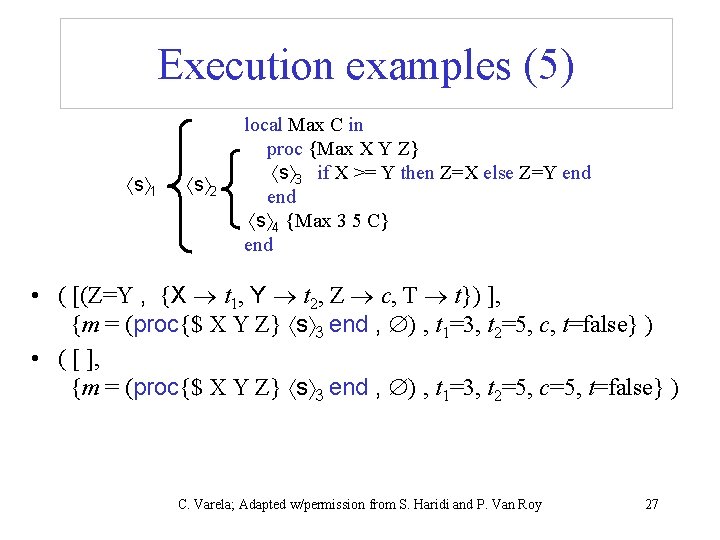
Execution examples (5) s 1 s 2 local Max C in proc {Max X Y Z} s 3 if X >= Y then Z=X else Z=Y end s 4 {Max 3 5 C} end • ( [(Z=Y , {X t 1, Y t 2, Z c, T t}) ], {m = (proc{$ X Y Z} s 3 end , ) , t 1=3, t 2=5, c, t=false} ) • ( [ ], {m = (proc{$ X Y Z} s 3 end , ) , t 1=3, t 2=5, c=5, t=false} ) C. Varela; Adapted w/permission from S. Haridi and P. Van Roy 27
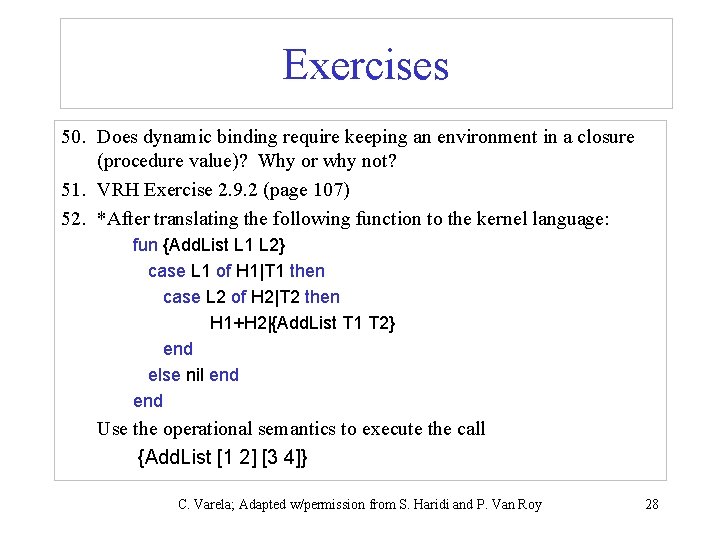
Exercises 50. Does dynamic binding require keeping an environment in a closure (procedure value)? Why or why not? 51. VRH Exercise 2. 9. 2 (page 107) 52. *After translating the following function to the kernel language: fun {Add. List L 1 L 2} case L 1 of H 1|T 1 then case L 2 of H 2|T 2 then H 1+H 2|{Add. List T 1 T 2} end else nil end Use the operational semantics to execute the call {Add. List [1 2] [3 4]} C. Varela; Adapted w/permission from S. Haridi and P. Van Roy 28
- Slides: 28