
DecisionTheoretic Planning Markov Decision Processes MDPs Computer Science
![Example MDP: Sequence of actions Can the sequence [Up, Right, Right ] take the](https://slidetodoc.com/presentation_image_h2/5fa55b623bfb471200711c3081f222e9/image-15.jpg "Example MDP: Sequence of actions Can the sequence [Up, Right, Right ] take the")
- Slides: 21
Decision-Theoretic Planning: Markov Decision Processes (MDPs) Computer Science cpsc 322, Lecture 36 (Textbook Chpt 9. 5) April, 6, 2009 Slide 1
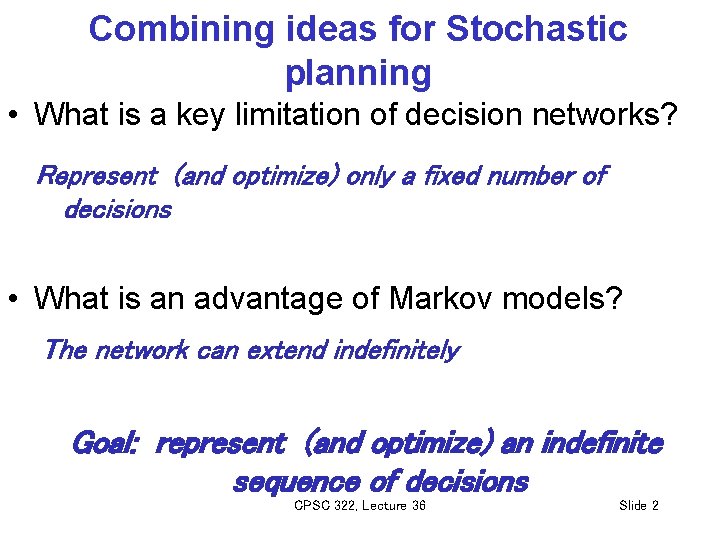
Combining ideas for Stochastic planning • What is a key limitation of decision networks? Represent (and optimize) only a fixed number of decisions • What is an advantage of Markov models? The network can extend indefinitely Goal: represent (and optimize) an indefinite sequence of decisions CPSC 322, Lecture 36 Slide 2
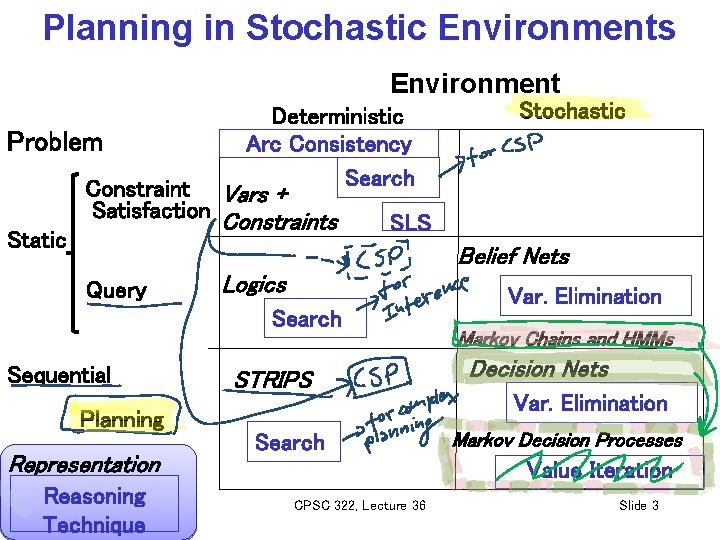
Planning in Stochastic Environments Environment Problem Static Deterministic Arc Consistency Search Constraint Vars + Satisfaction Constraints Stochastic SLS Belief Nets Query Logics Search Sequential Planning Representation Reasoning Technique STRIPS Search Var. Elimination Markov Chains and HMMs Decision Nets Var. Elimination Markov Decision Processes Value Iteration CPSC 322, Lecture 36 Slide 3
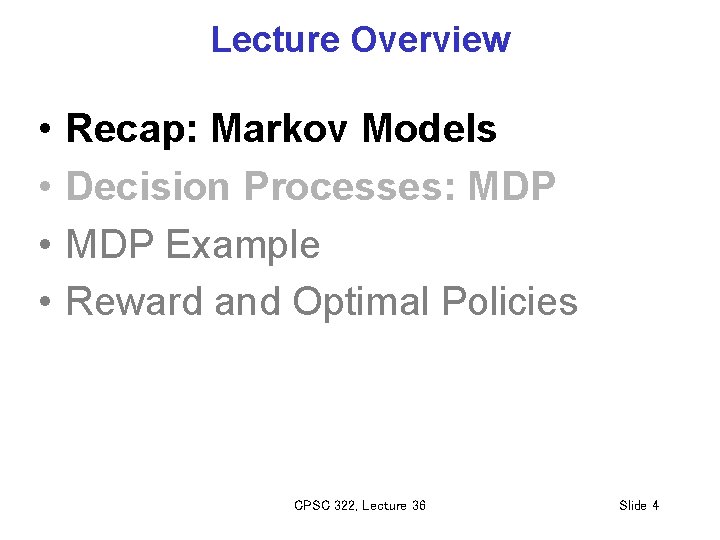
Lecture Overview • • Recap: Markov Models Decision Processes: MDP Example Reward and Optimal Policies CPSC 322, Lecture 36 Slide 4
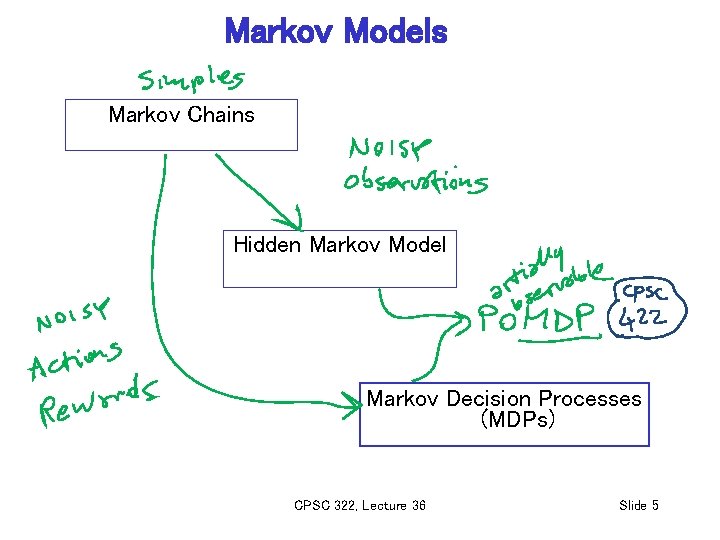
Markov Models Markov Chains Hidden Markov Model Markov Decision Processes (MDPs) CPSC 322, Lecture 36 Slide 5
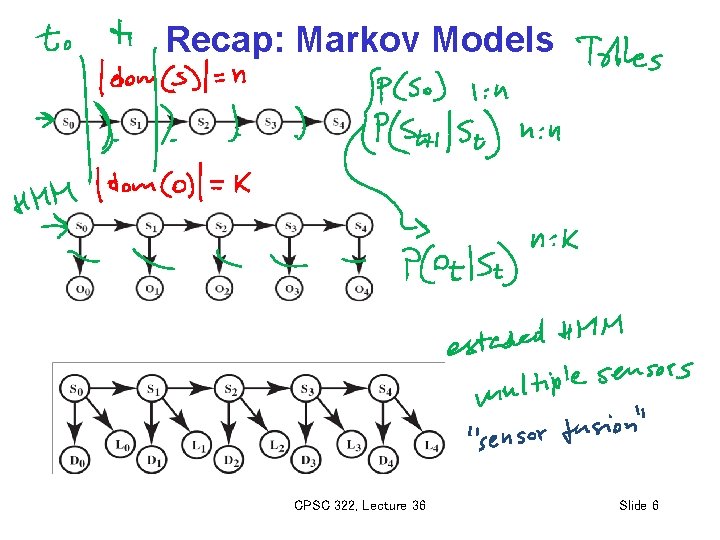
Recap: Markov Models CPSC 322, Lecture 36 Slide 6
Lecture Overview • • Recap: Markov Models Decision Processes: MDP Example Reward and Optimal Policies CPSC 322, Lecture 36 Slide 7
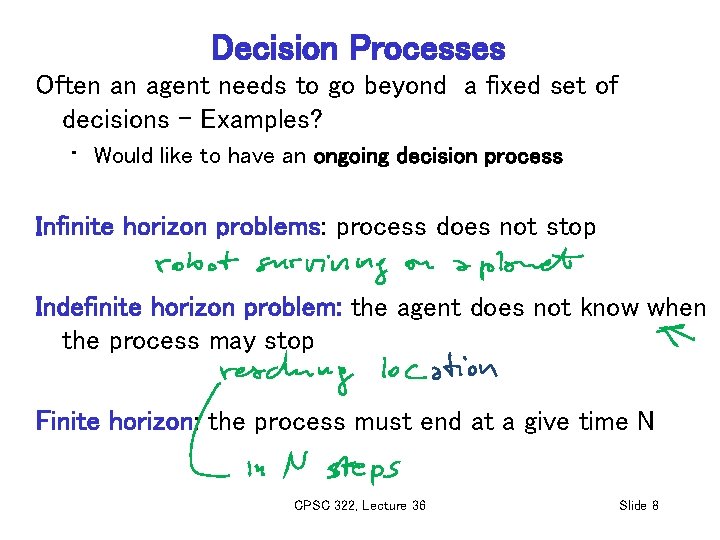
Decision Processes Often an agent needs to go beyond a fixed set of decisions – Examples? • Would like to have an ongoing decision process Infinite horizon problems: process does not stop Indefinite horizon problem: the agent does not know when the process may stop Finite horizon: the process must end at a give time N CPSC 322, Lecture 36 Slide 8
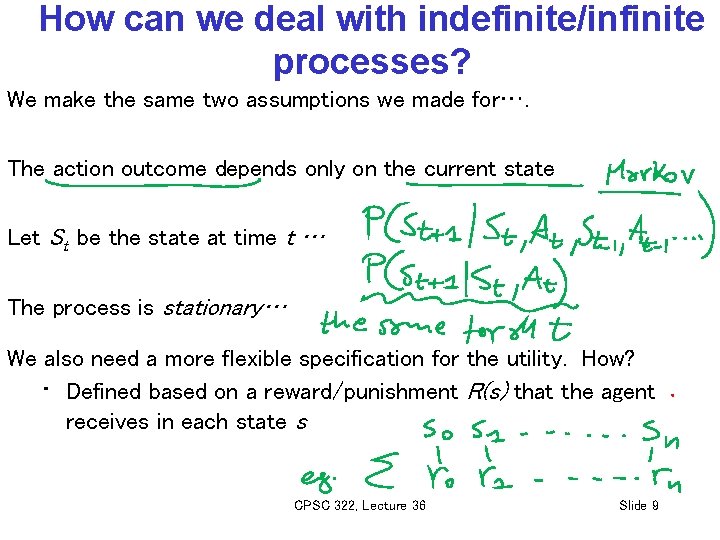
How can we deal with indefinite/infinite processes? We make the same two assumptions we made for…. The action outcome depends only on the current state Let St be the state at time t … The process is stationary… We also need a more flexible specification for the utility. How? • Defined based on a reward/punishment R(s) that the agent receives in each state s CPSC 322, Lecture 36 Slide 9
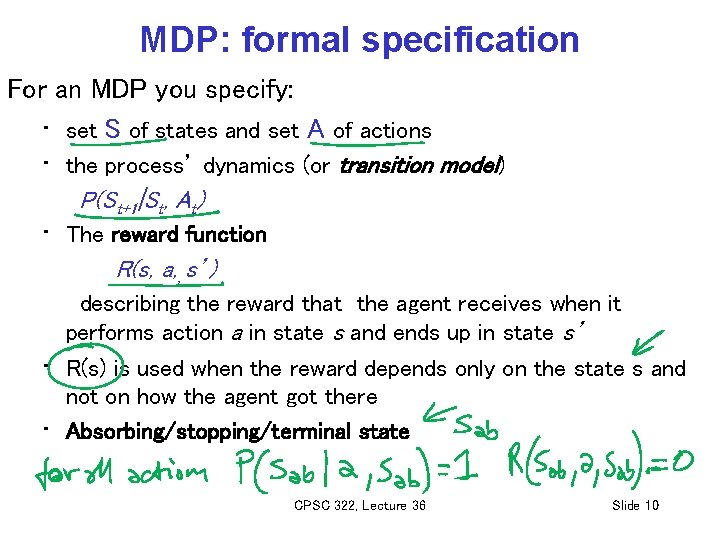
MDP: formal specification For an MDP you specify: • set S of states and set A of actions • the process’ dynamics (or transition model) P(St+1|St, At) • The reward function R(s, a, , s’) • • describing the reward that the agent receives when it performs action a in state s and ends up in state s’ R(s) is used when the reward depends only on the state s and not on how the agent got there Absorbing/stopping/terminal state CPSC 322, Lecture 36 Slide 10
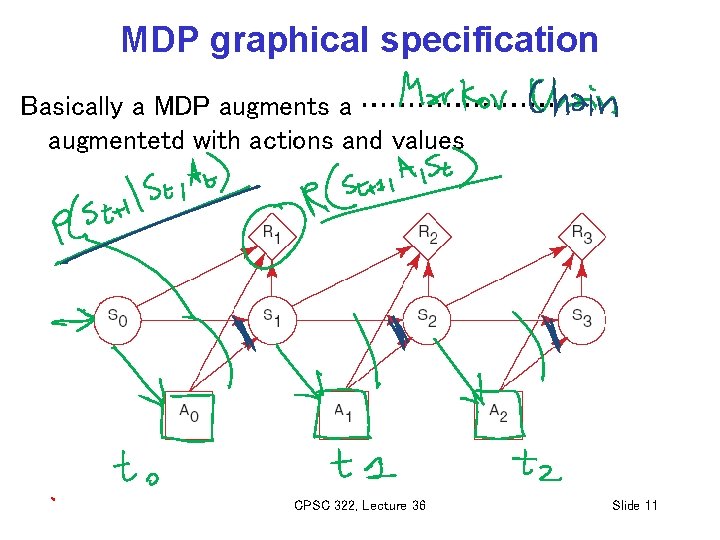
MDP graphical specification Basically a MDP augments a ………………… augmentetd with actions and values CPSC 322, Lecture 36 Slide 11
Lecture Overview • • Recap: Markov Models Decision Processes: MDP Example Reward and Optimal Policies CPSC 322, Lecture 36 Slide 12
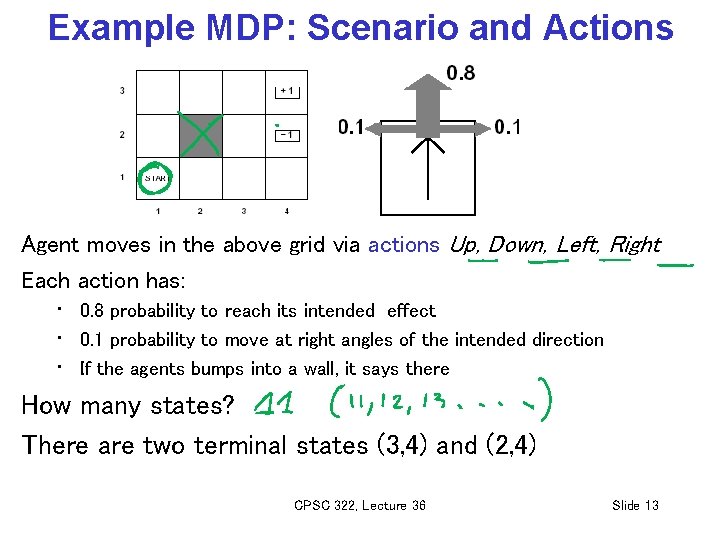
Example MDP: Scenario and Actions Agent moves in the above grid via actions Up, Down, Left, Right Each action has: • 0. 8 probability to reach its intended effect • 0. 1 probability to move at right angles of the intended direction • If the agents bumps into a wall, it says there How many states? There are two terminal states (3, 4) and (2, 4) CPSC 322, Lecture 36 Slide 13
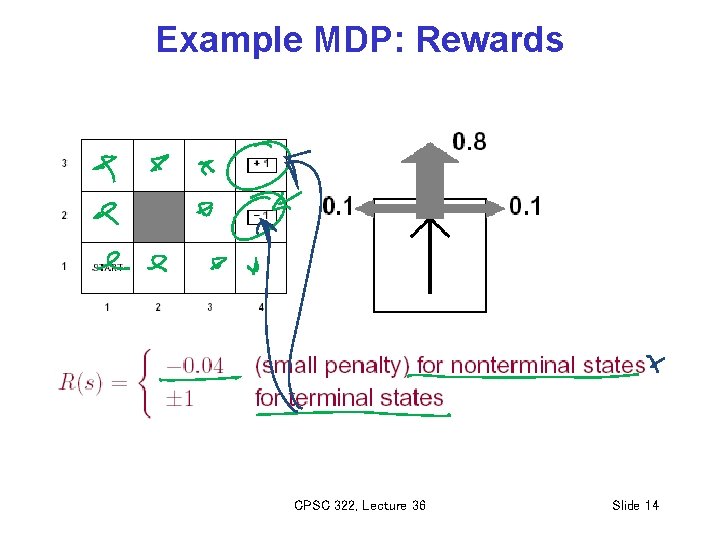
Example MDP: Rewards CPSC 322, Lecture 36 Slide 14
Example MDP: Sequence of actions Can the sequence [Up, Right, Right ] take the agent in terminal state (3, 4)? Can the sequence reach the goal in any other way? CPSC 322, Lecture 36 Slide 15
Lecture Overview • • Recap: Markov Models Decision Processes: MDP Example Reward and Optimal Policies CPSC 322, Lecture 36 Slide 16
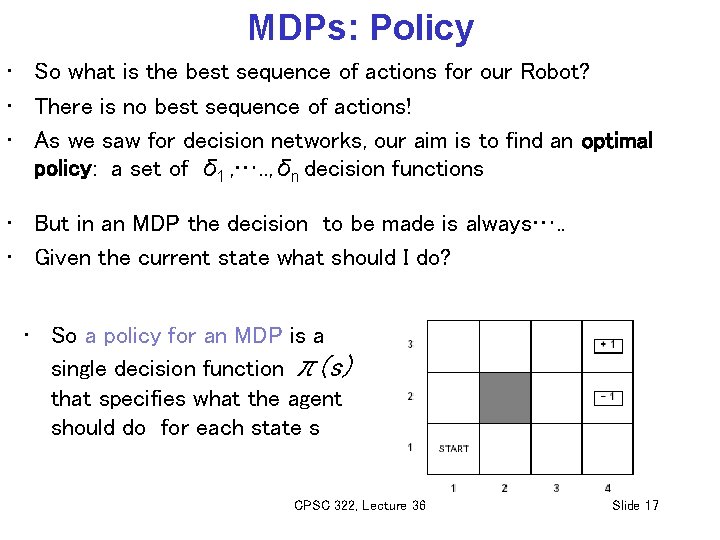
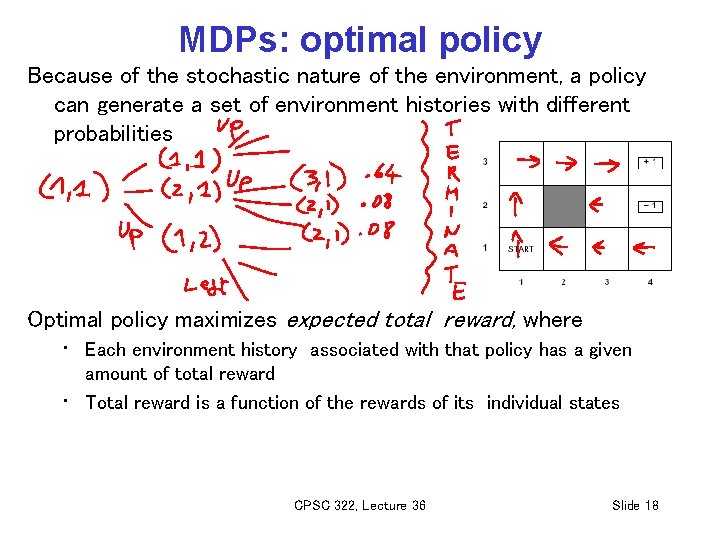
MDPs: Policy • So what is the best sequence of actions for our Robot? • There is no best sequence of actions! • As we saw for decision networks, our aim is to find an optimal policy: a set of δ 1 , …. . , δn decision functions • But in an MDP the decision to be made is always…. . • Given the current state what should I do? • So a policy for an MDP is a single decision function π(s) that specifies what the agent should do for each state s CPSC 322, Lecture 36 Slide 17
MDPs: optimal policy Because of the stochastic nature of the environment, a policy can generate a set of environment histories with different probabilities Optimal policy maximizes expected total reward, where • Each environment history associated with that policy has a given • amount of total reward Total reward is a function of the rewards of its individual states CPSC 322, Lecture 36 Slide 18
Learning Goals for today’s class You can: • Effectively represent indefinite/infinite decision processes • Compute the probability of a sequence of actions in an Markov Decision Process (MDP) • Compute the utility of a policy for an MDP CPSC 322, Lecture 36 Slide 19
TAs evaluation form • Evaluations are not obligatory • Please evaluate only TAs you interacted with • TAs and Instructor won’t see the evaluations until after marks are submitted • Keep your comment specific and constructive CPSC 322, Lecture 36 Slide 20
Next Class • Finish MDPs – Last Class Announcements • Assign 4 due on Wed CPSC 322, Lecture 36 Slide 21