
Decision Trees Today Formalizing Learning Consistency Simplicity Decision
- Slides: 31
Decision Trees
Today § Formalizing Learning § Consistency § Simplicity § Decision Trees § Expressiveness § Information Gain § Overfitting
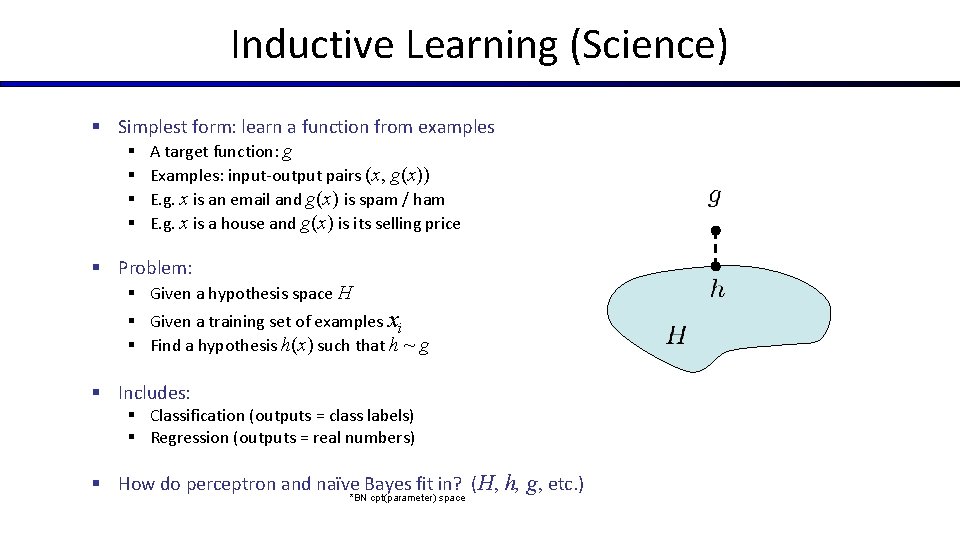
Inductive Learning (Science) § Simplest form: learn a function from examples § A target function: g § Examples: input-output pairs (x, g(x)) § E. g. x is an email and g(x) is spam / ham § E. g. x is a house and g(x) is its selling price § Problem: § Given a hypothesis space H § Given a training set of examples xi § Find a hypothesis h(x) such that h ~ g § Includes: § Classification (outputs = class labels) § Regression (outputs = real numbers) § How do perceptron and naïve Bayes fit in? (H, h, g, etc. ) *BN cpt(parameter) space
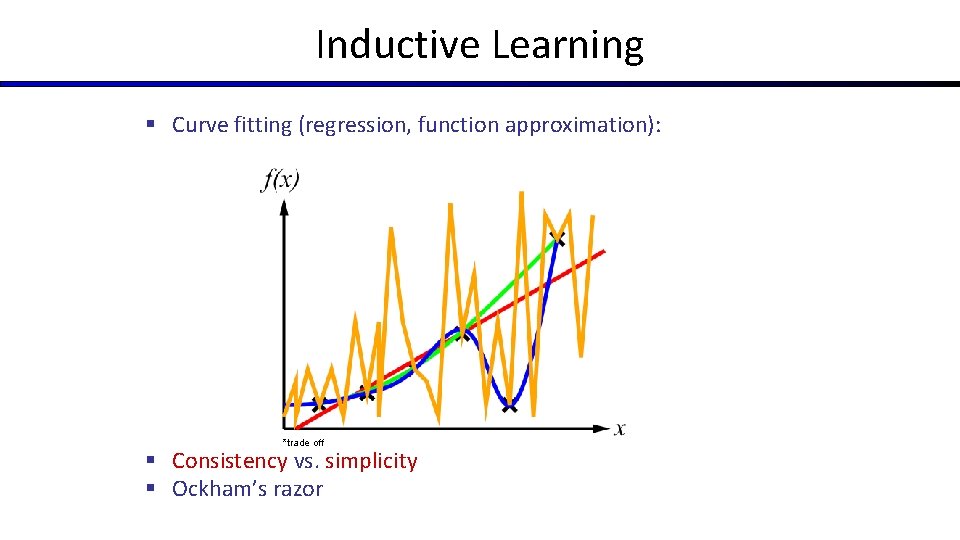
Inductive Learning § Curve fitting (regression, function approximation): *trade off § Consistency vs. simplicity § Ockham’s razor
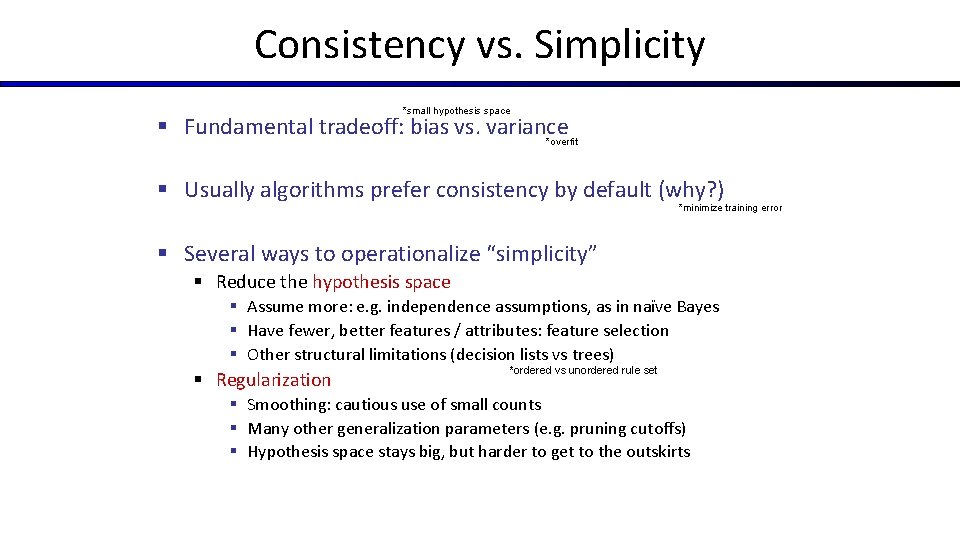
Consistency vs. Simplicity *small hypothesis space § Fundamental tradeoff: bias vs. variance *overfit § Usually algorithms prefer consistency by default (why? ) *minimize training error § Several ways to operationalize “simplicity” § Reduce the hypothesis space § Assume more: e. g. independence assumptions, as in naïve Bayes § Have fewer, better features / attributes: feature selection § Other structural limitations (decision lists vs trees) § Regularization *ordered vs unordered rule set § Smoothing: cautious use of small counts § Many other generalization parameters (e. g. pruning cutoffs) § Hypothesis space stays big, but harder to get to the outskirts
Decision Trees
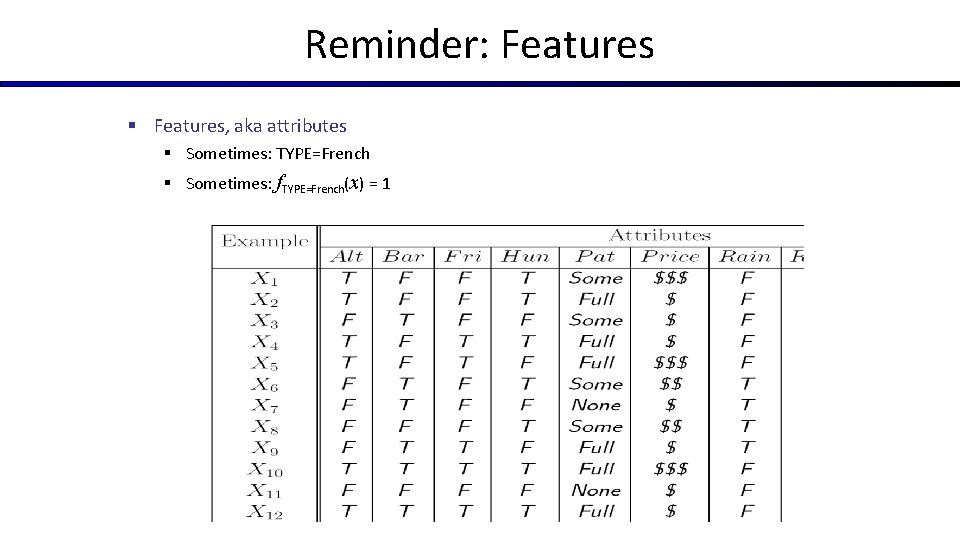
Reminder: Features § Features, aka attributes § Sometimes: TYPE=French § Sometimes: f. TYPE=French(x) = 1
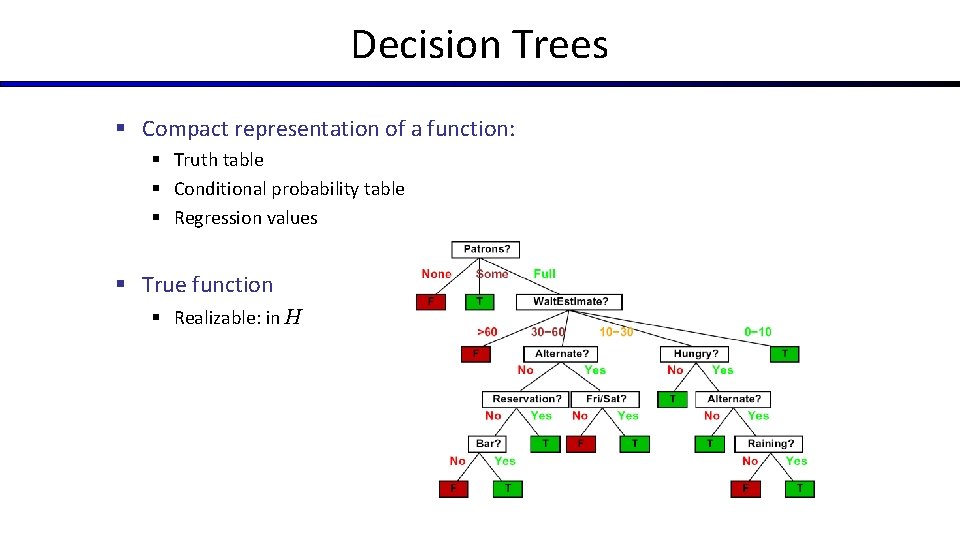
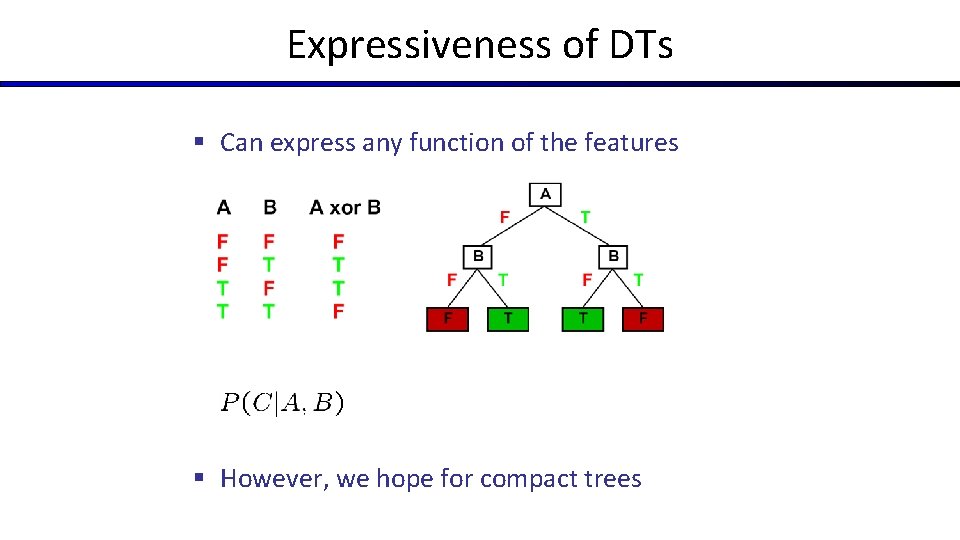
Decision Trees § Compact representation of a function: § Truth table § Conditional probability table § Regression values § True function § Realizable: in H
Expressiveness of DTs § Can express any function of the features § However, we hope for compact trees
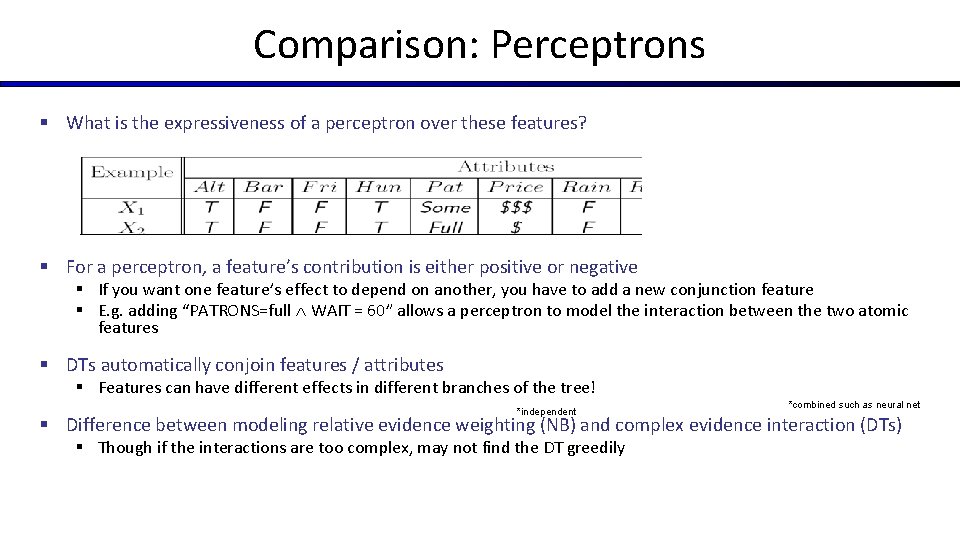
Comparison: Perceptrons § What is the expressiveness of a perceptron over these features? § For a perceptron, a feature’s contribution is either positive or negative § If you want one feature’s effect to depend on another, you have to add a new conjunction feature § E. g. adding “PATRONS=full WAIT = 60” allows a perceptron to model the interaction between the two atomic features § DTs automatically conjoin features / attributes § Features can have different effects in different branches of the tree! *independent *combined such as neural net § Difference between modeling relative evidence weighting (NB) and complex evidence interaction (DTs) § Though if the interactions are too complex, may not find the DT greedily
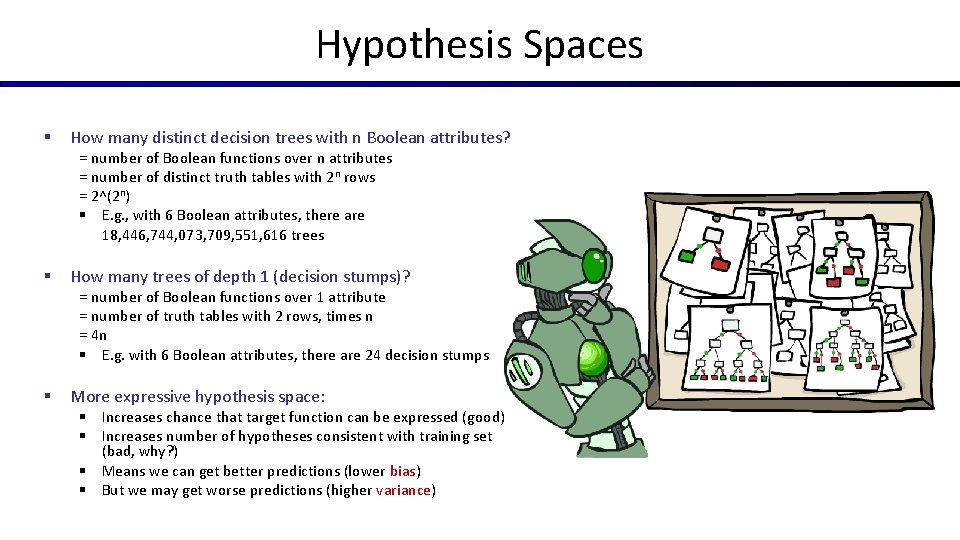
Hypothesis Spaces § How many distinct decision trees with n Boolean attributes? = number of Boolean functions over n attributes = number of distinct truth tables with 2 n rows = 2^(2 n) § E. g. , with 6 Boolean attributes, there are 18, 446, 744, 073, 709, 551, 616 trees § How many trees of depth 1 (decision stumps)? = number of Boolean functions over 1 attribute = number of truth tables with 2 rows, times n = 4 n § E. g. with 6 Boolean attributes, there are 24 decision stumps § More expressive hypothesis space: § Increases chance that target function can be expressed (good) § Increases number of hypotheses consistent with training set (bad, why? ) § Means we can get better predictions (lower bias) § But we may get worse predictions (higher variance)
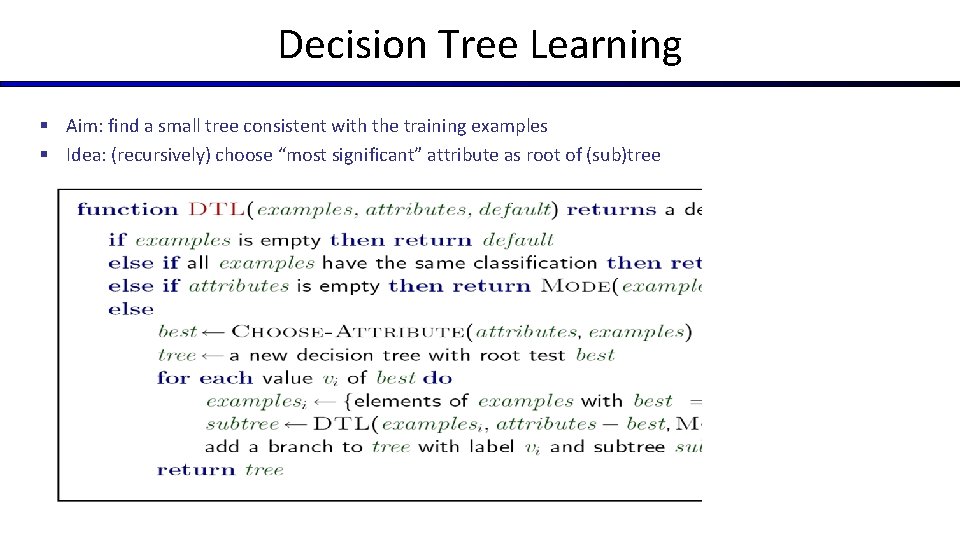
Decision Tree Learning § Aim: find a small tree consistent with the training examples § Idea: (recursively) choose “most significant” attribute as root of (sub)tree
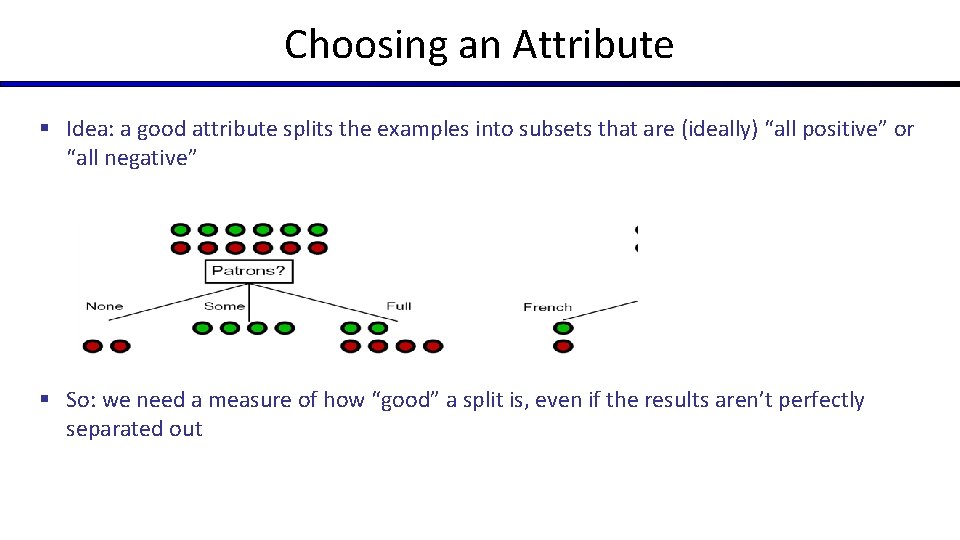
Choosing an Attribute § Idea: a good attribute splits the examples into subsets that are (ideally) “all positive” or “all negative” § So: we need a measure of how “good” a split is, even if the results aren’t perfectly separated out
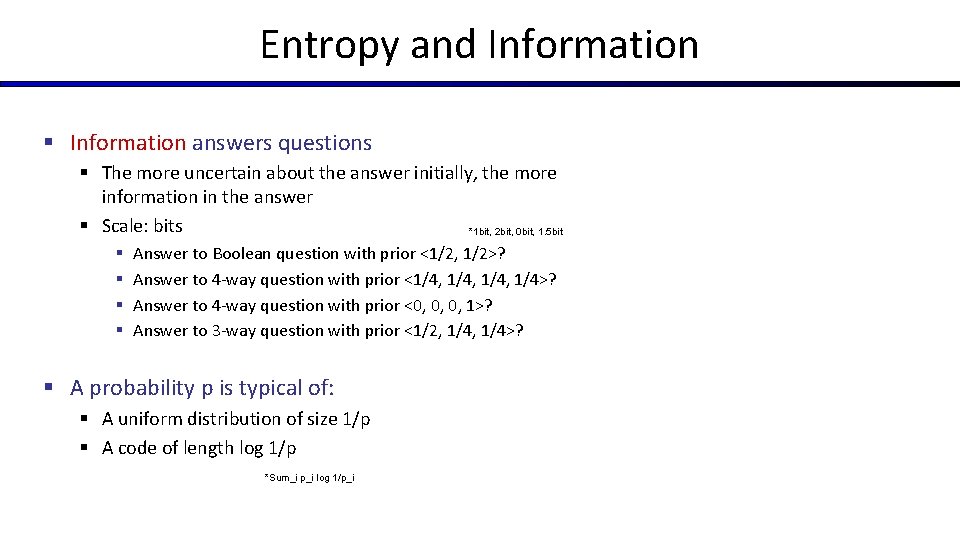
Entropy and Information § Information answers questions § The more uncertain about the answer initially, the more information in the answer § Scale: bits *1 bit, 2 bit, 0 bit, 1. 5 bit § § Answer to Boolean question with prior <1/2, 1/2>? Answer to 4 -way question with prior <1/4, 1/4>? Answer to 4 -way question with prior <0, 0, 0, 1>? Answer to 3 -way question with prior <1/2, 1/4>? § A probability p is typical of: § A uniform distribution of size 1/p § A code of length log 1/p *Sum_i p_i log 1/p_i
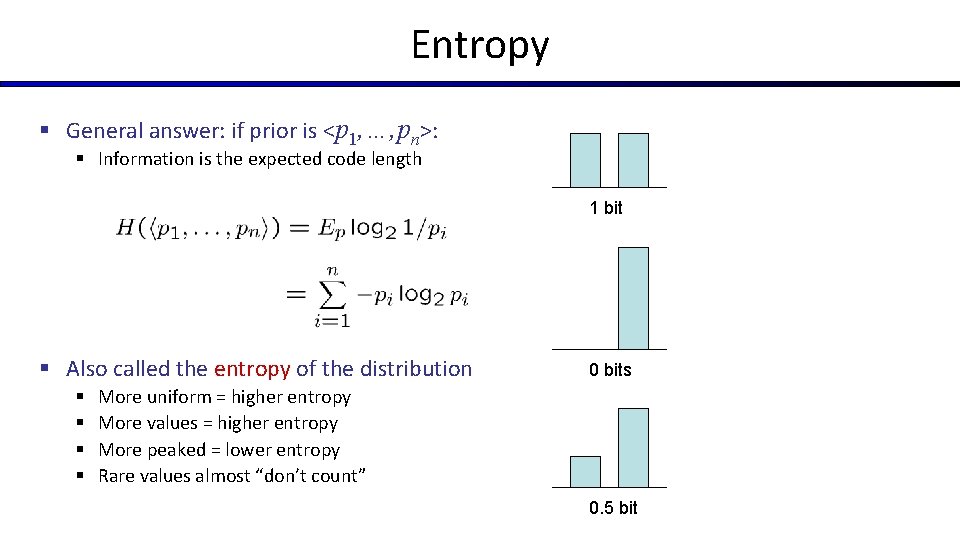
Entropy § General answer: if prior is <p 1, …, pn>: § Information is the expected code length 1 bit § Also called the entropy of the distribution § § 0 bits More uniform = higher entropy More values = higher entropy More peaked = lower entropy Rare values almost “don’t count” 0. 5 bit
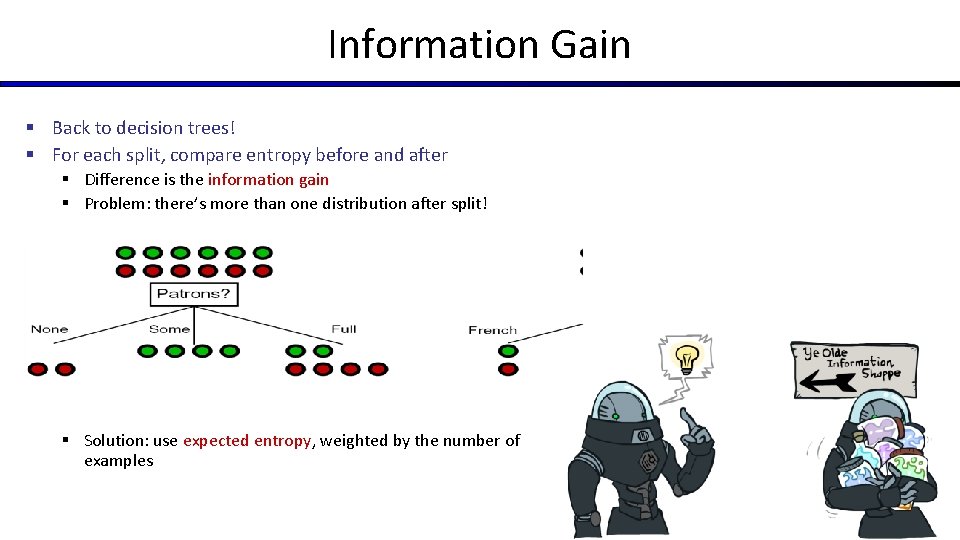
Information Gain § Back to decision trees! § For each split, compare entropy before and after § Difference is the information gain § Problem: there’s more than one distribution after split! § Solution: use expected entropy, weighted by the number of examples
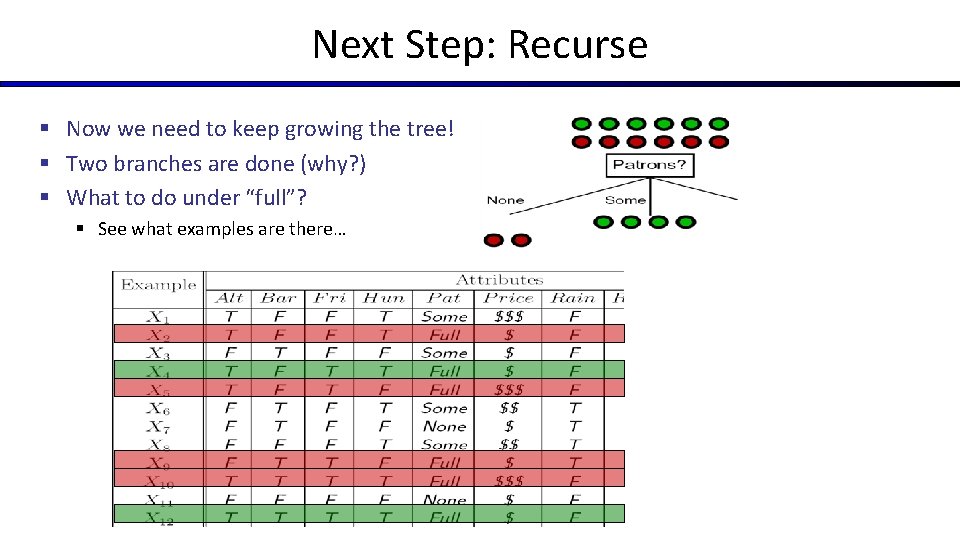
Next Step: Recurse § Now we need to keep growing the tree! § Two branches are done (why? ) § What to do under “full”? § See what examples are there…
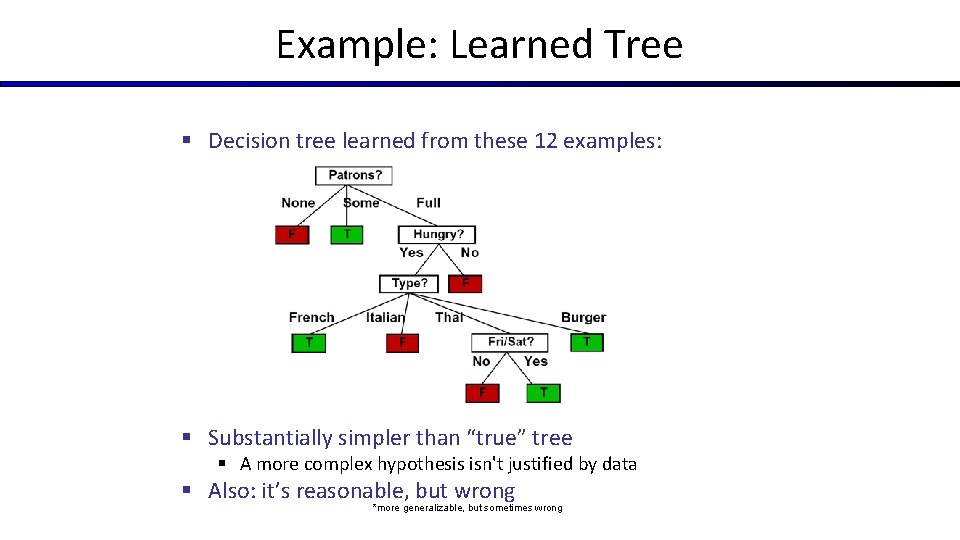
Example: Learned Tree § Decision tree learned from these 12 examples: § Substantially simpler than “true” tree § A more complex hypothesis isn't justified by data § Also: it’s reasonable, but wrong *more generalizable, but sometimes wrong
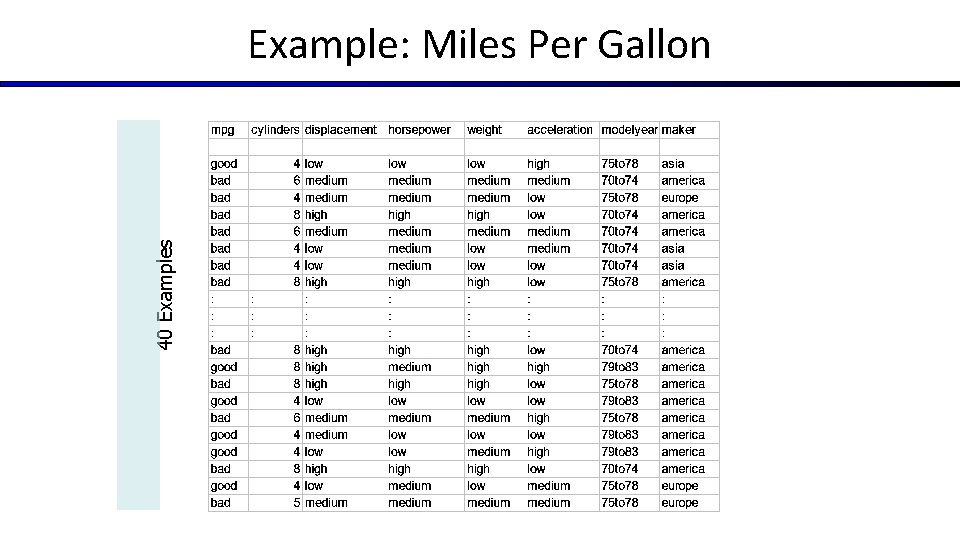
40 Examples Example: Miles Per Gallon
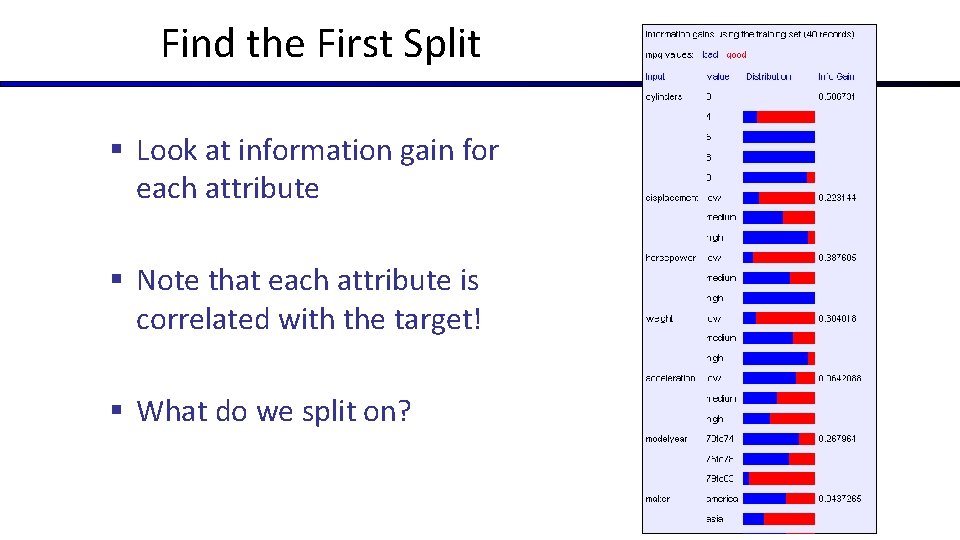
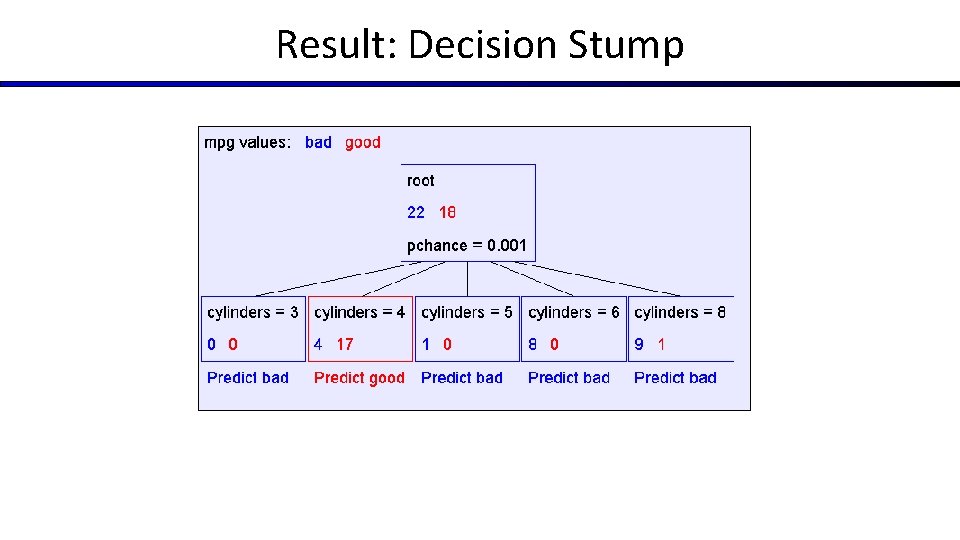
Find the First Split § Look at information gain for each attribute § Note that each attribute is correlated with the target! § What do we split on?
Result: Decision Stump
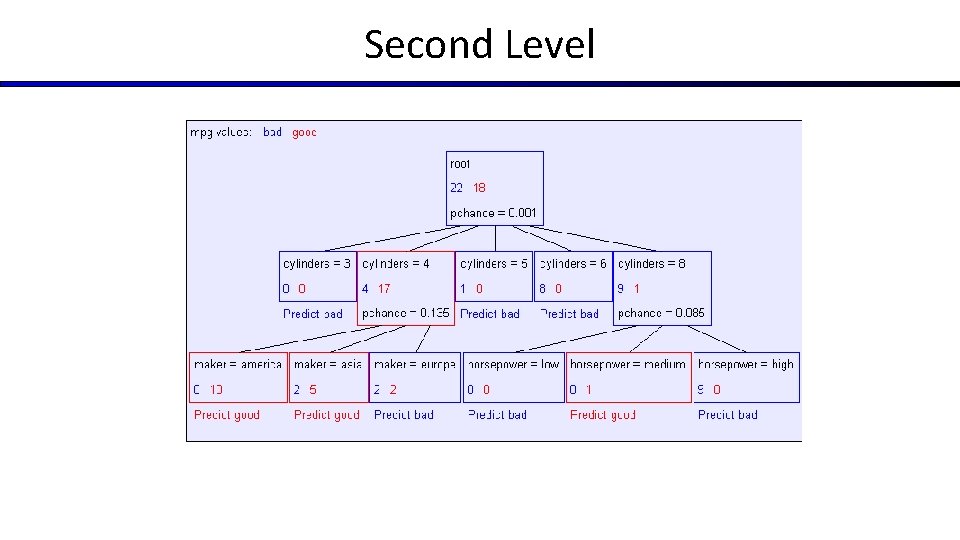
Second Level
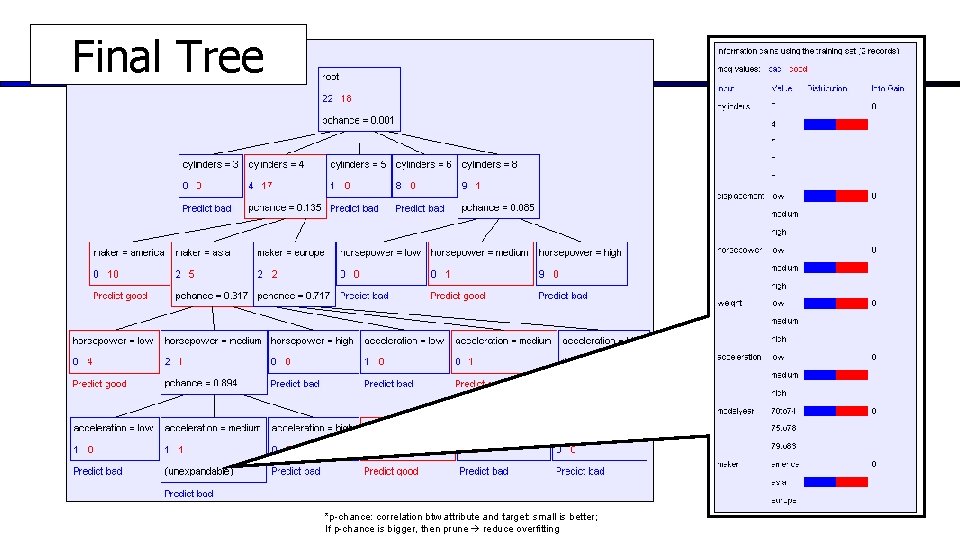
Final Tree *p-chance: correlation btw attribute and target: small is better; If p-chance is bigger, then prune reduce overfitting
Reminder: Overfitting § Overfitting: § When you stop modeling the patterns in the training data (which generalize) § And start modeling the noise (which doesn’t) § We had this before: § Naïve Bayes: needed to smooth § Perceptron: early stopping
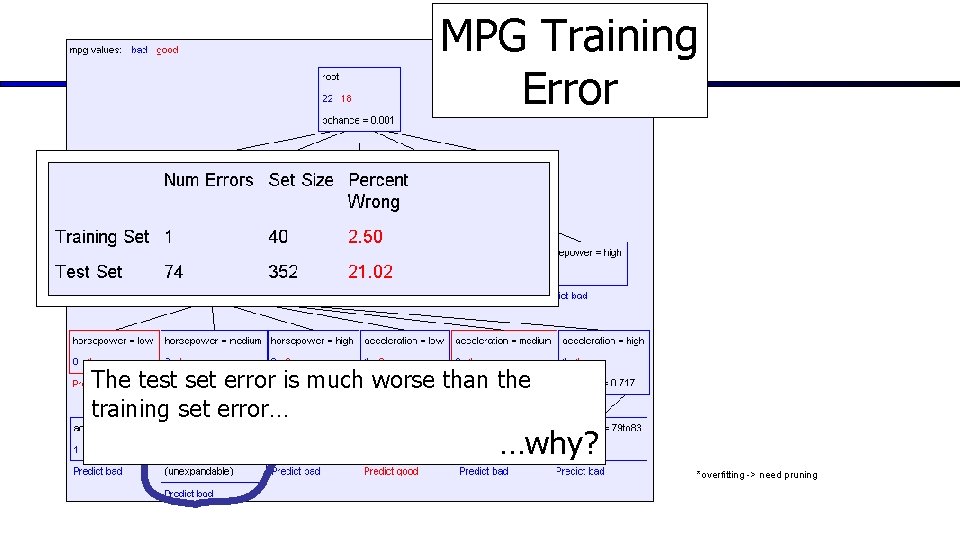
MPG Training Error The test set error is much worse than the training set error… …why? *overfitting -> need pruning
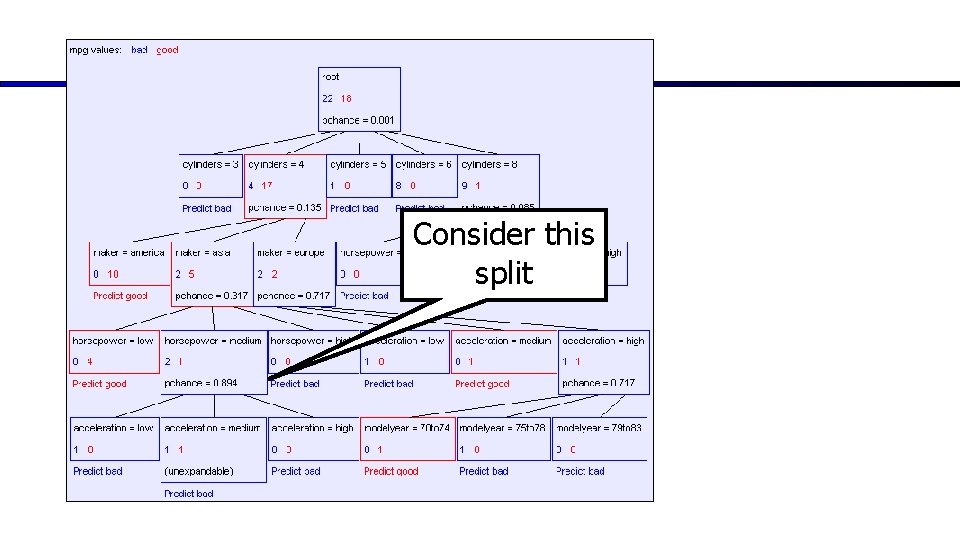
Consider this split
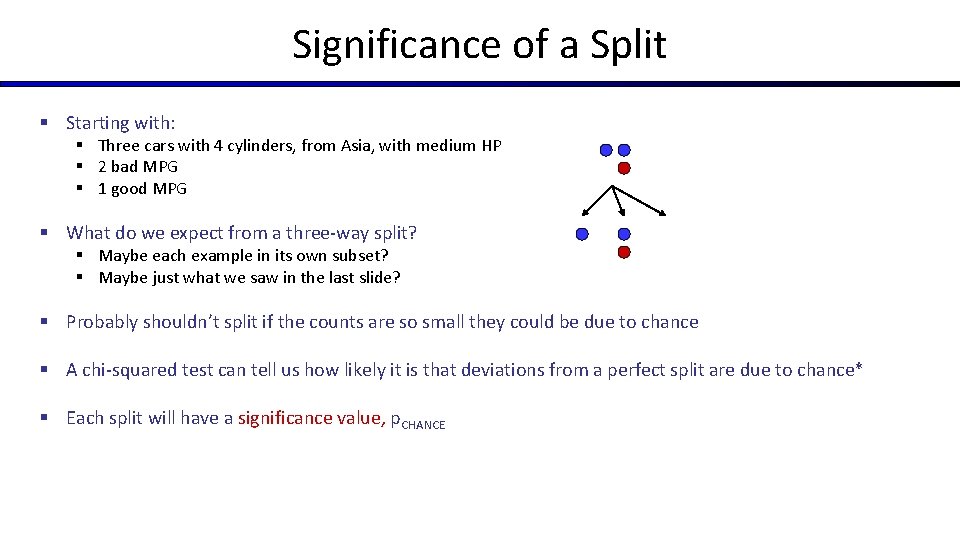
Significance of a Split § Starting with: § Three cars with 4 cylinders, from Asia, with medium HP § 2 bad MPG § 1 good MPG § What do we expect from a three-way split? § Maybe each example in its own subset? § Maybe just what we saw in the last slide? § Probably shouldn’t split if the counts are so small they could be due to chance § A chi-squared test can tell us how likely it is that deviations from a perfect split are due to chance* § Each split will have a significance value, p. CHANCE
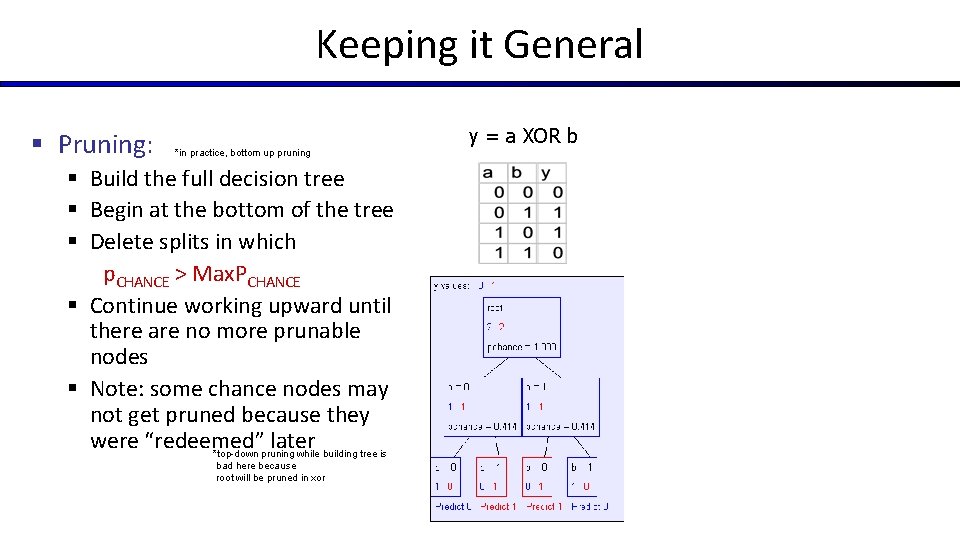
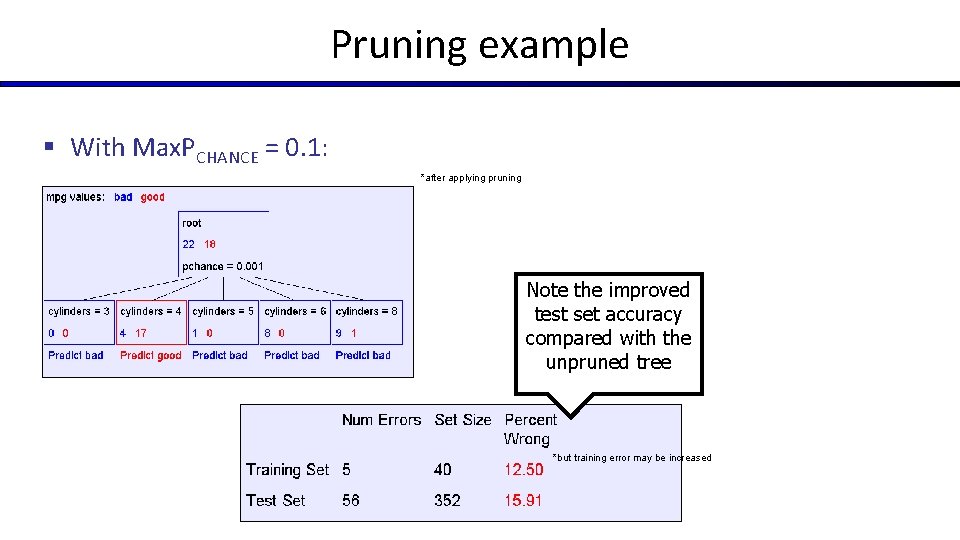
Keeping it General § Pruning: *in practice, bottom up pruning § Build the full decision tree § Begin at the bottom of the tree § Delete splits in which p. CHANCE > Max. PCHANCE § Continue working upward until there are no more prunable nodes § Note: some chance nodes may not get pruned because they were “redeemed” later *top-down pruning while building tree is bad here because root will be pruned in xor y = a XOR b
Pruning example § With Max. PCHANCE = 0. 1: *after applying pruning Note the improved test set accuracy compared with the unpruned tree *but training error may be increased
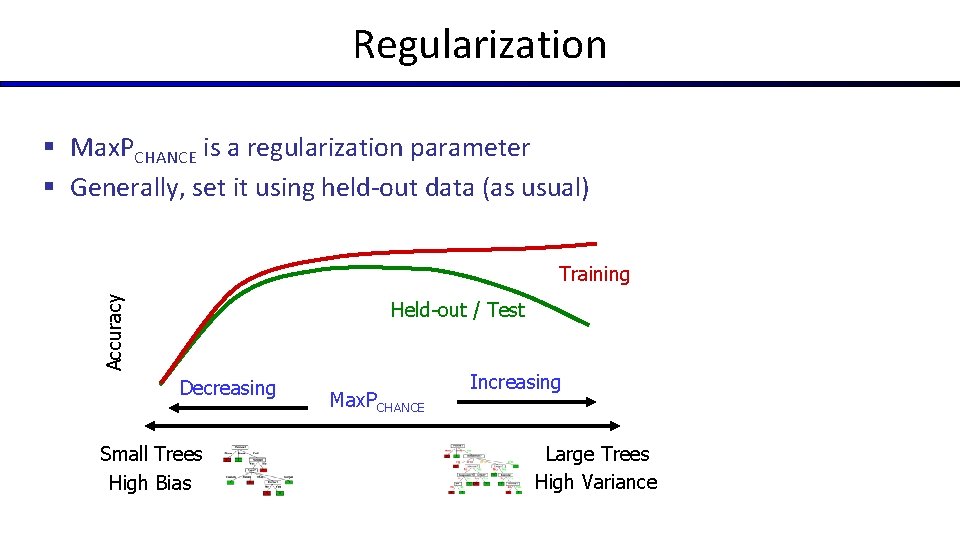
Regularization § Max. PCHANCE is a regularization parameter § Generally, set it using held-out data (as usual) Accuracy Training Held-out / Test Decreasing Small Trees High Bias Max. PCHANCE Increasing Large Trees High Variance
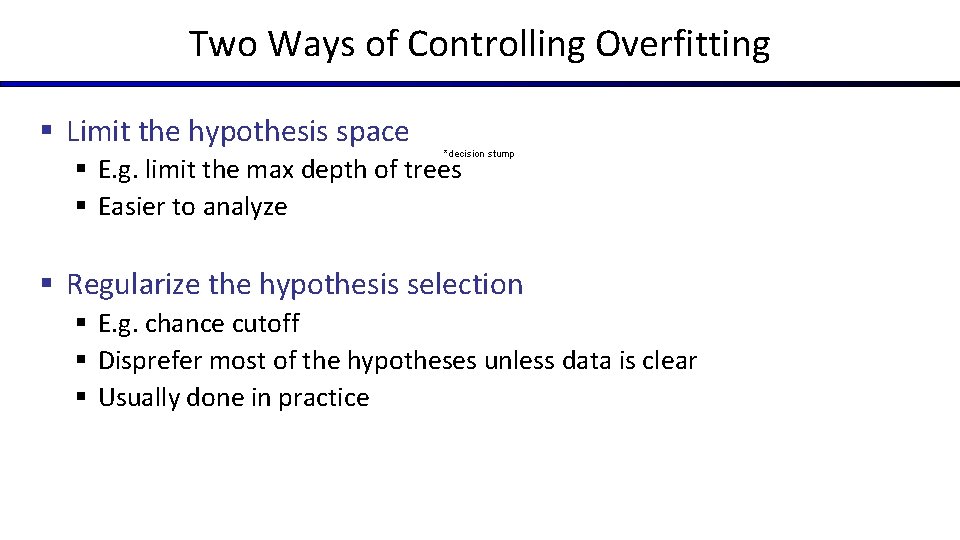
Two Ways of Controlling Overfitting § Limit the hypothesis space *decision stump § E. g. limit the max depth of trees § Easier to analyze § Regularize the hypothesis selection § E. g. chance cutoff § Disprefer most of the hypotheses unless data is clear § Usually done in practice