
Decision Trees Rich Caruana A Simple Decision Tree



![Popular Decision Tree Packages · ID 3 (ID 4, ID 5, …) [Quinlan] –](https://slidetodoc.com/presentation_image/4f1b8e9fb9ca0957fb62a3574a5bac43/image-45.jpg "Popular Decision Tree Packages · ID 3 (ID 4, ID 5, …) [Quinlan] –")
- Slides: 47
Decision Trees Rich Caruana
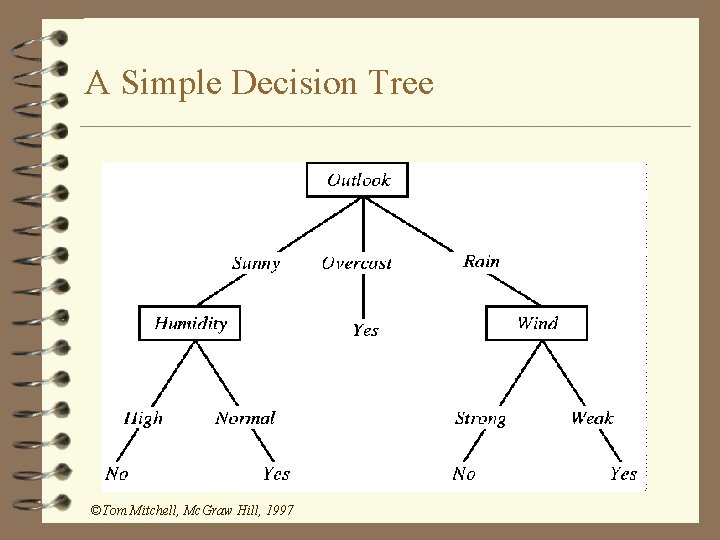
A Simple Decision Tree ©Tom Mitchell, Mc. Graw Hill, 1997
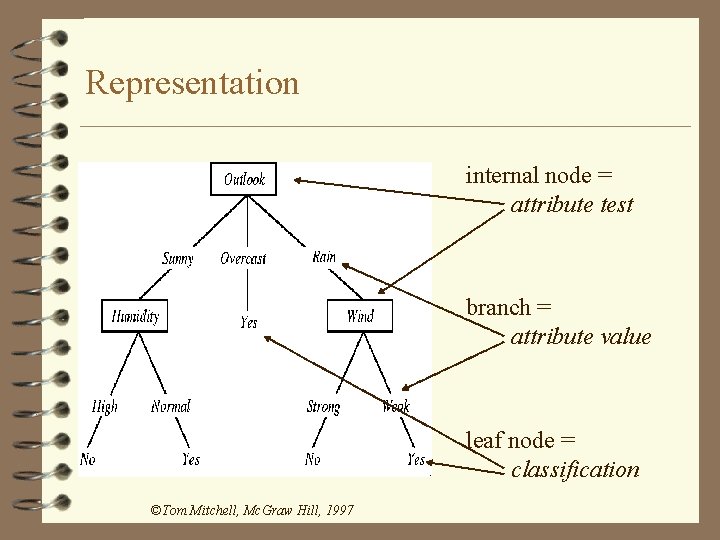
Representation internal node = attribute test branch = attribute value leaf node = classification ©Tom Mitchell, Mc. Graw Hill, 1997
A Real Decision Tree
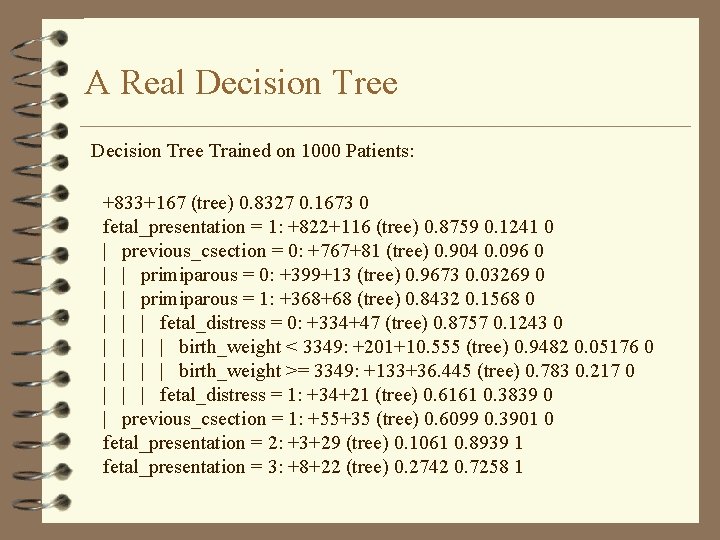
A Real Decision Tree Trained on 1000 Patients: +833+167 (tree) 0. 8327 0. 1673 0 fetal_presentation = 1: +822+116 (tree) 0. 8759 0. 1241 0 | previous_csection = 0: +767+81 (tree) 0. 904 0. 096 0 | | primiparous = 0: +399+13 (tree) 0. 9673 0. 03269 0 | | primiparous = 1: +368+68 (tree) 0. 8432 0. 1568 0 | | | fetal_distress = 0: +334+47 (tree) 0. 8757 0. 1243 0 | | birth_weight < 3349: +201+10. 555 (tree) 0. 9482 0. 05176 0 | | birth_weight >= 3349: +133+36. 445 (tree) 0. 783 0. 217 0 | | | fetal_distress = 1: +34+21 (tree) 0. 6161 0. 3839 0 | previous_csection = 1: +55+35 (tree) 0. 6099 0. 3901 0 fetal_presentation = 2: +3+29 (tree) 0. 1061 0. 8939 1 fetal_presentation = 3: +8+22 (tree) 0. 2742 0. 7258 1
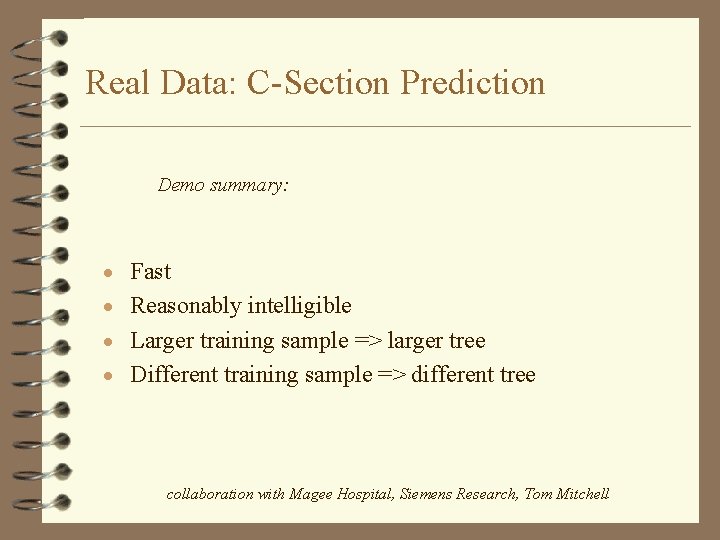
Real Data: C-Section Prediction Demo summary: · Fast · Reasonably intelligible · Larger training sample => larger tree · Different training sample => different tree collaboration with Magee Hospital, Siemens Research, Tom Mitchell
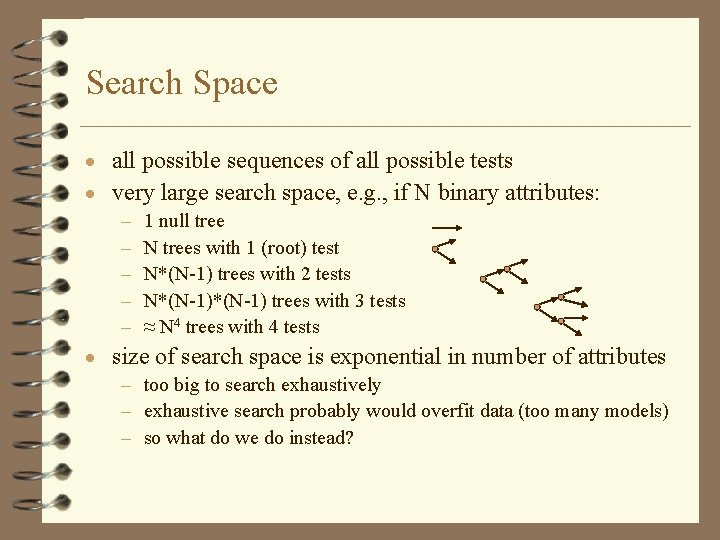
Search Space · all possible sequences of all possible tests · very large search space, e. g. , if N binary attributes: – – – 1 null tree N trees with 1 (root) test N*(N-1) trees with 2 tests N*(N-1) trees with 3 tests ≈ N 4 trees with 4 tests · size of search space is exponential in number of attributes – too big to search exhaustively – exhaustive search probably would overfit data (too many models) – so what do we do instead?
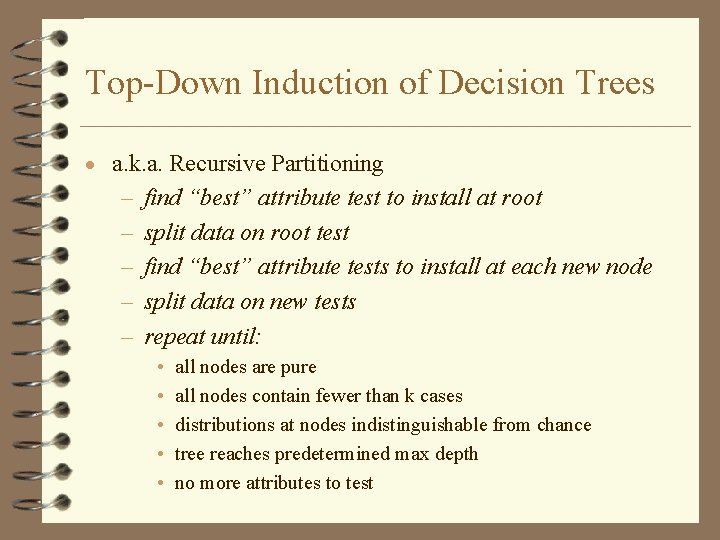
Top-Down Induction of Decision Trees · a. k. a. Recursive Partitioning – – – find “best” attribute test to install at root split data on root test find “best” attribute tests to install at each new node split data on new tests repeat until: • • • all nodes are pure all nodes contain fewer than k cases distributions at nodes indistinguishable from chance tree reaches predetermined max depth no more attributes to test
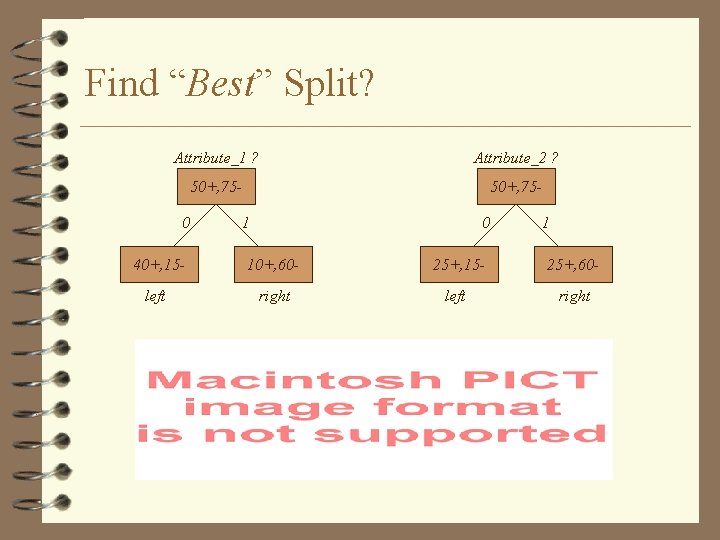
Find “Best” Split? Attribute_1 ? Attribute_2 ? 50+, 75 - 0 1 40+, 15 - 10+, 60 - 25+, 15 - 25+, 60 - left right
Splitting Rules · Information Gain = reduction in entropy due to splitting on an attribute · Entropy = expected number of bits needed to encode the class of a randomly drawn + or – example using the optimal info-theory coding
Entropy
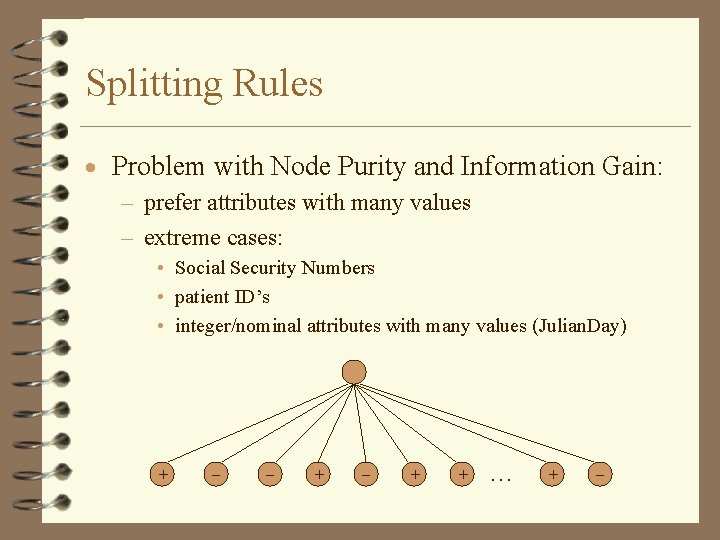
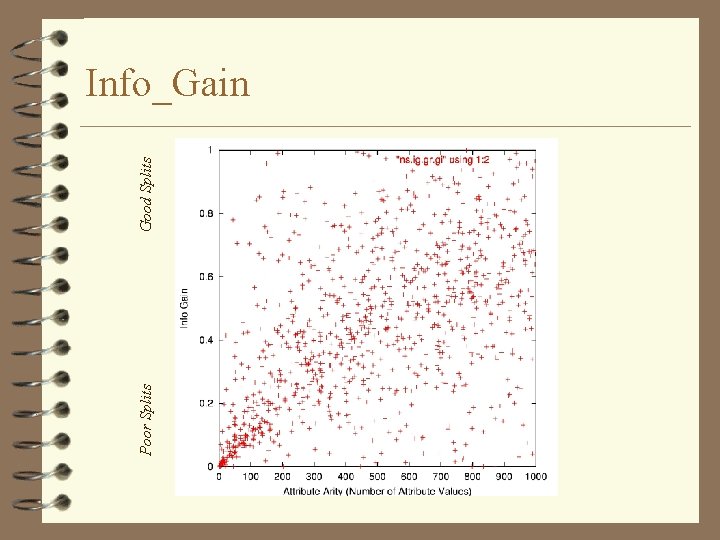
Splitting Rules · Problem with Node Purity and Information Gain: – prefer attributes with many values – extreme cases: • Social Security Numbers • patient ID’s • integer/nominal attributes with many values (Julian. Day) + – – + + . . . + –
Splitting Rules
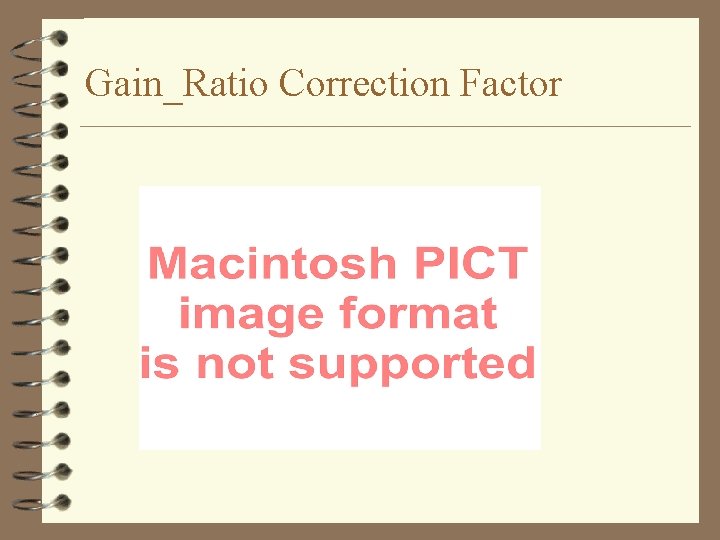
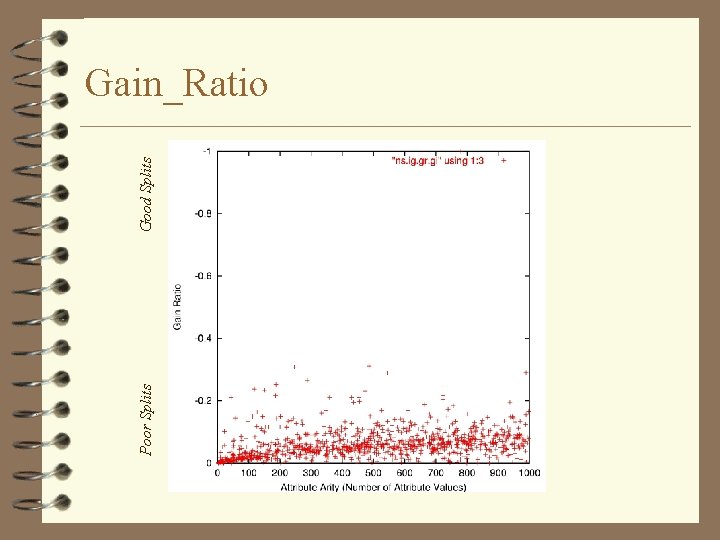
Gain_Ratio Correction Factor
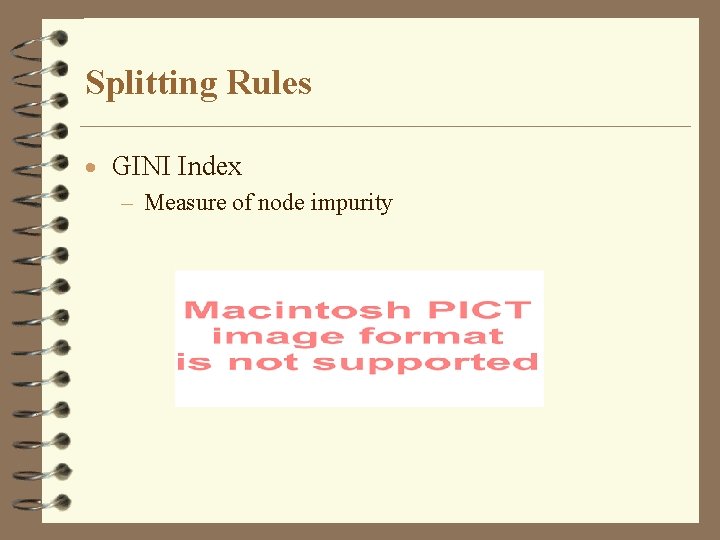
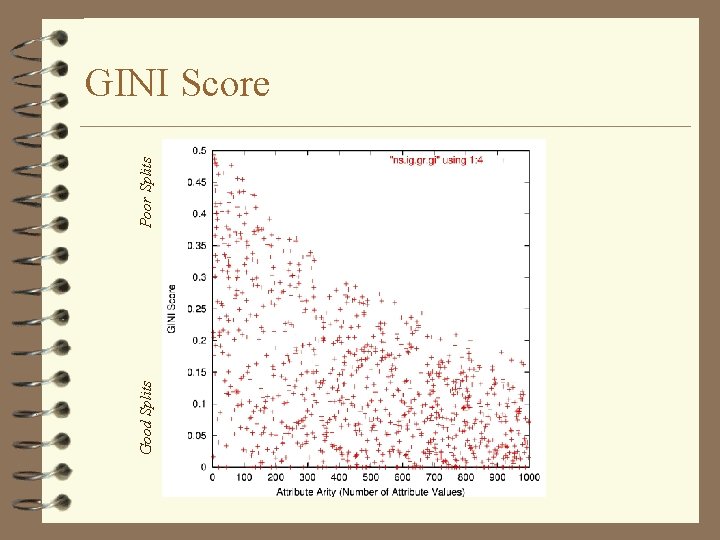
Splitting Rules · GINI Index – Measure of node impurity
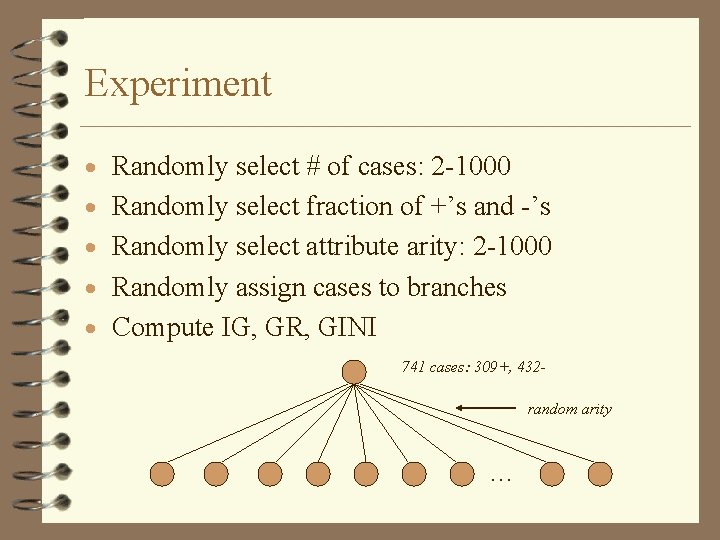
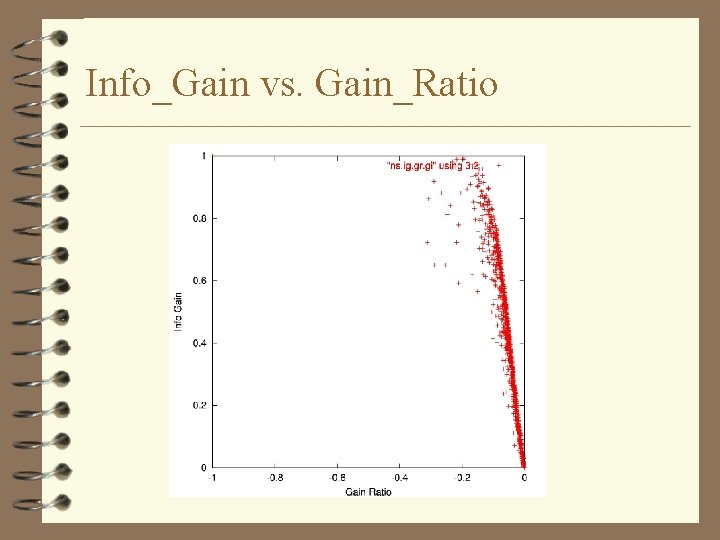
Experiment · Randomly select # of cases: 2 -1000 · Randomly select fraction of +’s and -’s · Randomly select attribute arity: 2 -1000 · Randomly assign cases to branches · Compute IG, GR, GINI 741 cases: 309+, 432 random arity . . .
Poor Splits Good Splits Info_Gain
Poor Splits Good Splits Gain_Ratio
Good Splits Poor Splits GINI Score
Info_Gain vs. Gain_Ratio
GINI Score vs. Gain_Ratio
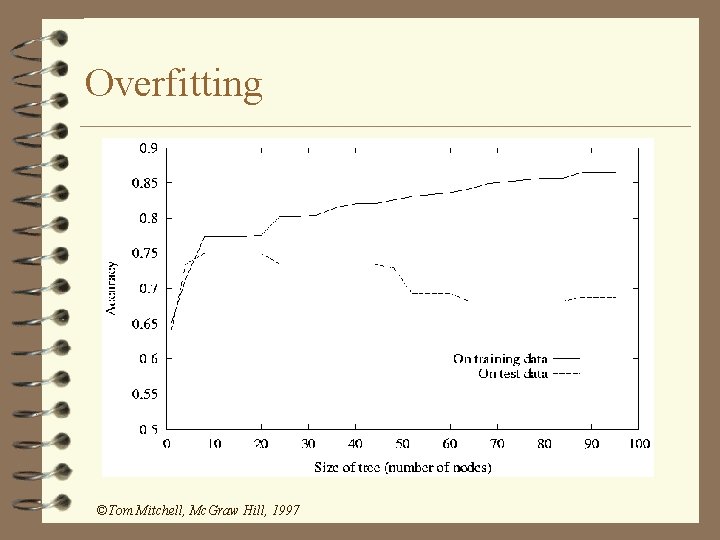
Overfitting ©Tom Mitchell, Mc. Graw Hill, 1997
Pre-Pruning (Early Stopping) · Evaluate splits before installing them: – don’t install splits that don’t look worthwhile – when no worthwhile splits to install, done · Seems right, but: – hard to properly evaluate split without seeing what splits would follow it (use lookahead? ) – some attributes useful only in combination with other attributes – suppose no single split looks good at root node?
Post-Pruning · Grow decision tree to full depth (no pre-pruning) · Prune-back full tree by eliminating splits that do not appear to be warranted statistically · Use train set, or an independent prune/test set, to evaluate splits · Stop pruning when remaining splits all appear to be warranted · Alternate approach: convert to rules, then prune rules
Greedy vs. Optimal · Optimal – Maximum expected accuracy (test set) – Minimum size tree – Minimum depth tree – Fewest attributes tested – Easiest to understand · Test order not always important for accuracy · Sometimes random splits perform well
Decision Tree Predictions · Classification · Simple probability · Smoothed probability · Probability with threshold(s)
Performance Measures · Accuracy – High accuracy doesn’t mean good performance – Accuracy can be misleading – What threshold to use for accuracy? · Root-Mean-Squared-Error · Other measures: ROC, Precision/Recall, …
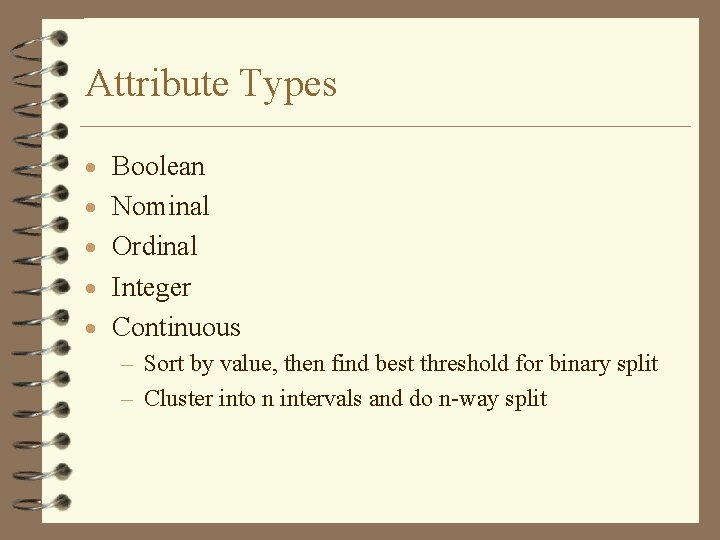
Attribute Types · Boolean · Nominal · Ordinal · Integer · Continuous – Sort by value, then find best threshold for binary split – Cluster into n intervals and do n-way split
Missing Attribute Values · Some data sets have many missing values
Regression Trees vs. Classification · Split criterion: minimize RMSE at node · Tree yields discrete set of predictions
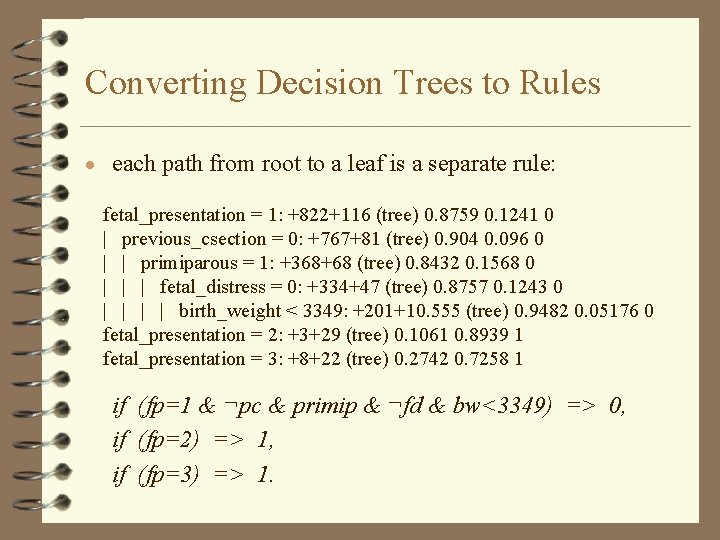
Converting Decision Trees to Rules · each path from root to a leaf is a separate rule: fetal_presentation = 1: +822+116 (tree) 0. 8759 0. 1241 0 | previous_csection = 0: +767+81 (tree) 0. 904 0. 096 0 | | primiparous = 1: +368+68 (tree) 0. 8432 0. 1568 0 | | | fetal_distress = 0: +334+47 (tree) 0. 8757 0. 1243 0 | | birth_weight < 3349: +201+10. 555 (tree) 0. 9482 0. 05176 0 fetal_presentation = 2: +3+29 (tree) 0. 1061 0. 8939 1 fetal_presentation = 3: +8+22 (tree) 0. 2742 0. 7258 1 if (fp=1 & ¬pc & primip & ¬fd & bw<3349) => 0, if (fp=2) => 1, if (fp=3) => 1.
Advantages of Decision Trees · TDIDT is relatively fast, even with large data sets (106) and many attributes (103) – advantage of recursive partitioning: only process all cases at root · Small-medium size trees usually intelligible · Can be converted to rules · TDIDT does feature selection · TDIDT often yields compact models (Occam’s Razor) · Decision tree representation is understandable
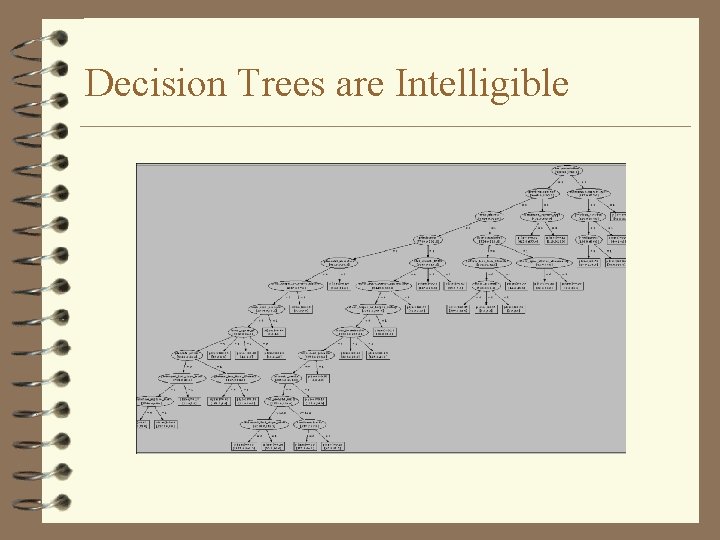
Decision Trees are Intelligible
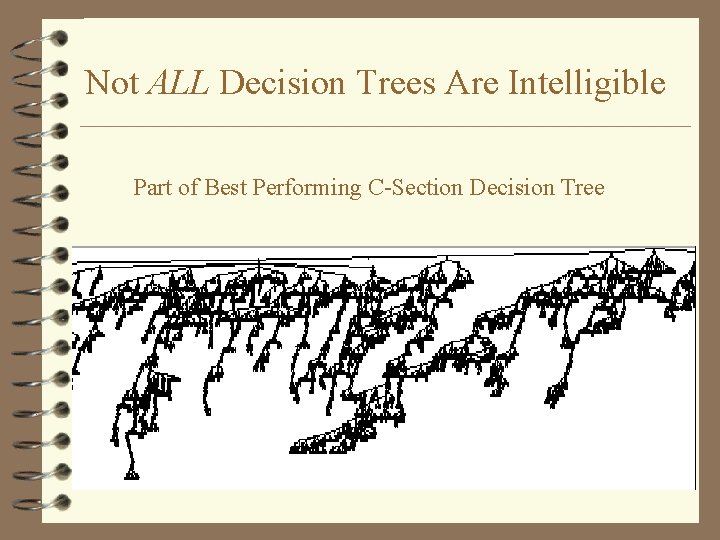
Not ALL Decision Trees Are Intelligible Part of Best Performing C-Section Decision Tree
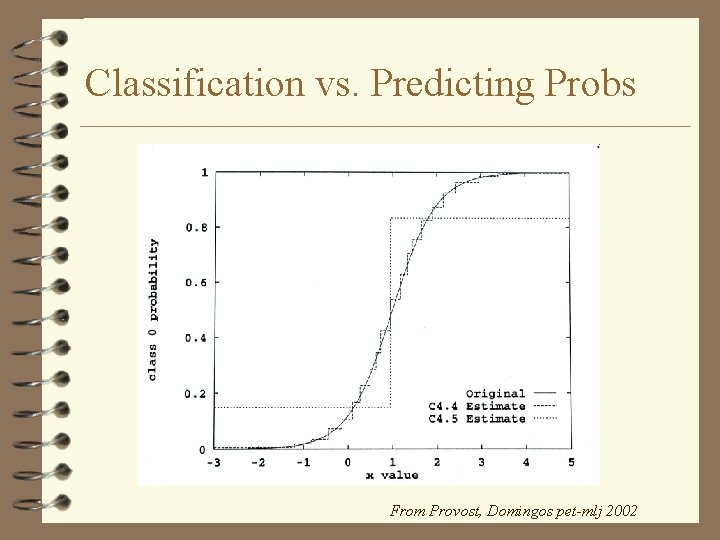
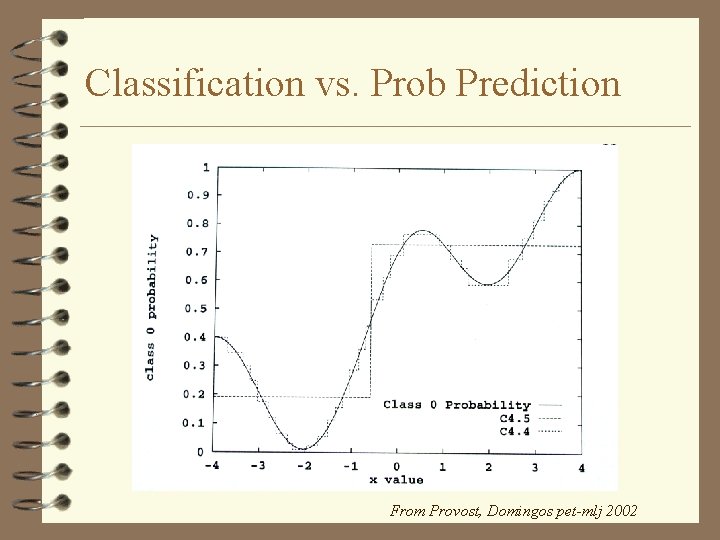
Predicting Probabilities with Trees · Small Tree – few leafs – few discrete probabilities · Large Tree – many leafs – few cases per leaf – few discrete probabilities – probability estimates based on small/noisy samples · What to do?
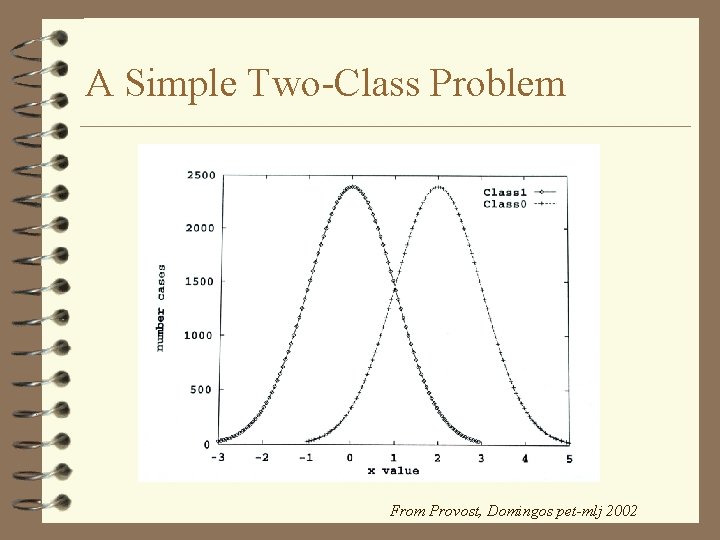
A Simple Two-Class Problem From Provost, Domingos pet-mlj 2002
Classification vs. Predicting Probs From Provost, Domingos pet-mlj 2002
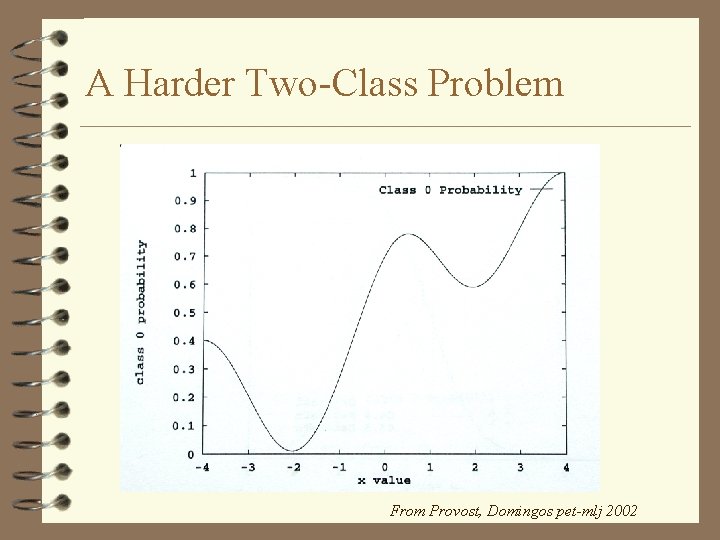
A Harder Two-Class Problem From Provost, Domingos pet-mlj 2002
Classification vs. Prob Prediction From Provost, Domingos pet-mlj 2002
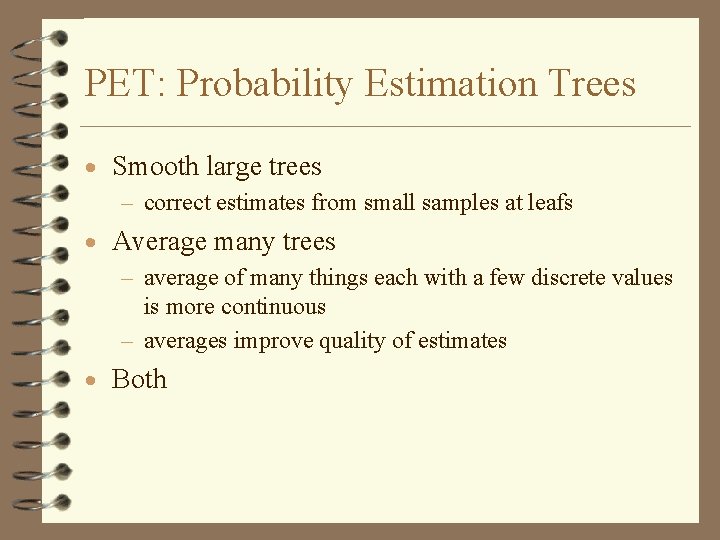
PET: Probability Estimation Trees · Smooth large trees – correct estimates from small samples at leafs · Average many trees – average of many things each with a few discrete values is more continuous – averages improve quality of estimates · Both
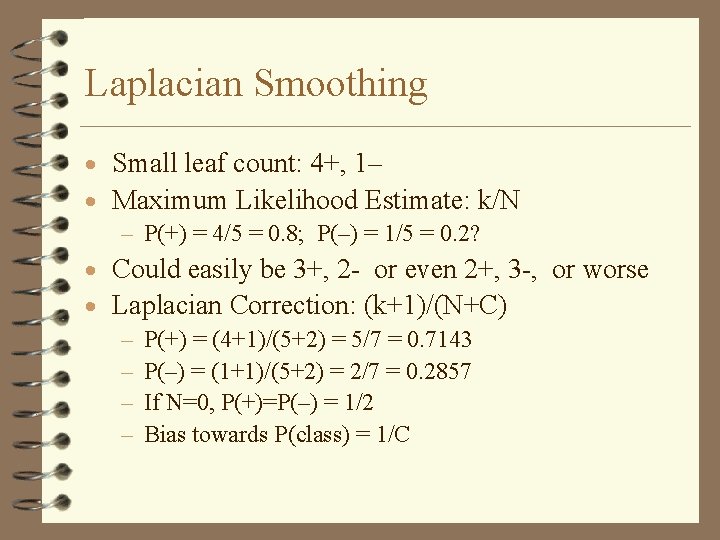
Laplacian Smoothing · Small leaf count: 4+, 1– · Maximum Likelihood Estimate: k/N – P(+) = 4/5 = 0. 8; P(–) = 1/5 = 0. 2? · Could easily be 3+, 2 - or even 2+, 3 -, or worse · Laplacian Correction: (k+1)/(N+C) – P(+) = (4+1)/(5+2) = 5/7 = 0. 7143 – P(–) = (1+1)/(5+2) = 2/7 = 0. 2857 – If N=0, P(+)=P(–) = 1/2 – Bias towards P(class) = 1/C
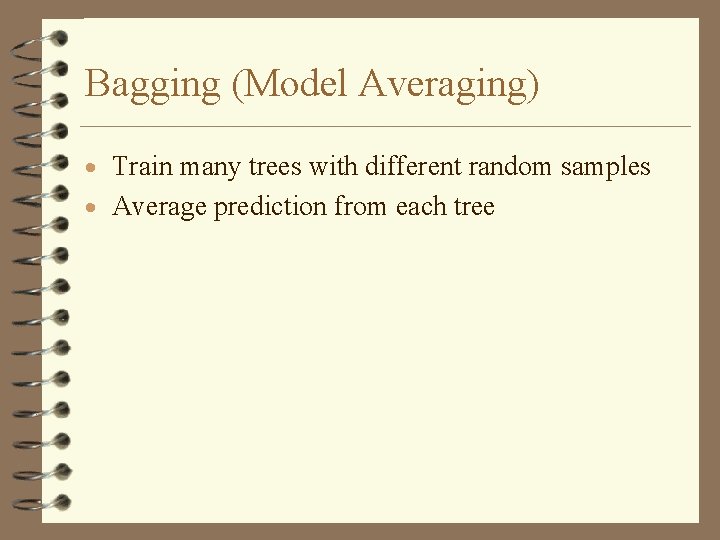
Bagging (Model Averaging) · Train many trees with different random samples · Average prediction from each tree
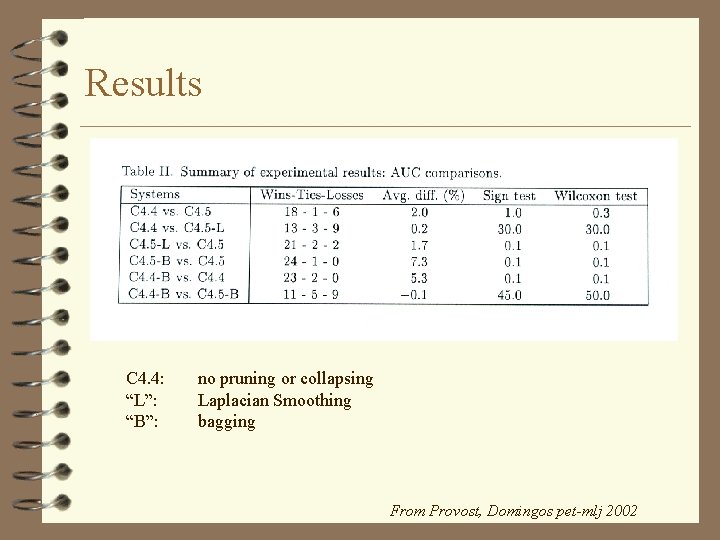
Results C 4. 4: “L”: “B”: no pruning or collapsing Laplacian Smoothing bagging From Provost, Domingos pet-mlj 2002
Weaknesses of Decision Trees · Large or complex trees can be just as unintelligible as other · · · · models Trees don’t easily represent some basic concepts such as M -of-N, parity, non-axis-aligned classes… Don’t hande real-valued parameters as well as Booleans If model depends on summing contribution of many different attributes, DTs probably won’t do well DTs that look very different can be same/similar Usually poor for predicting continuous values (regression) Propositional (as opposed to 1 st order) Recursive partitioning: run out of data fast as descend tree
Popular Decision Tree Packages · ID 3 (ID 4, ID 5, …) [Quinlan] – research code with many variations introduced to test new ideas · CART: Classification and Regression Trees [Breiman] – best known package to people outside machine learning – 1 st chapter of CART book is a good introduction to basic issues · C 4. 5 (C 5. 0) [Quinlan] – most popular package in machine learning community – both decision trees and rules · IND (INDuce) [Buntine] – decision trees for Bayesians (good at generating probabilities) – available from NASA Ames for use in U. S.
When to Use Decision Trees · Regression doesn’t work · Model intelligibility is important · Problem does not depend on many features – Modest subset of features contains relevant info – not vision · Speed of learning is important · Linear combinations of features not critical · Medium to large training sets
Current Research · Increasing representational power to include M-of-N splits, · · non-axis-parallel splits, perceptron-like splits, … Handling real-valued attributes better Using DTs to explain other models such as neural nets Incorporating background knowledge TDIDT on really large datasets – >> 106 training cases – >> 103 attributes · Better feature selection · Unequal attribute costs · Decision trees optimized for metrics other than accuracy