
Decision Trees on Map Reduce Decision Tree Learning


- Slides: 53
Decision Trees on Map. Reduce
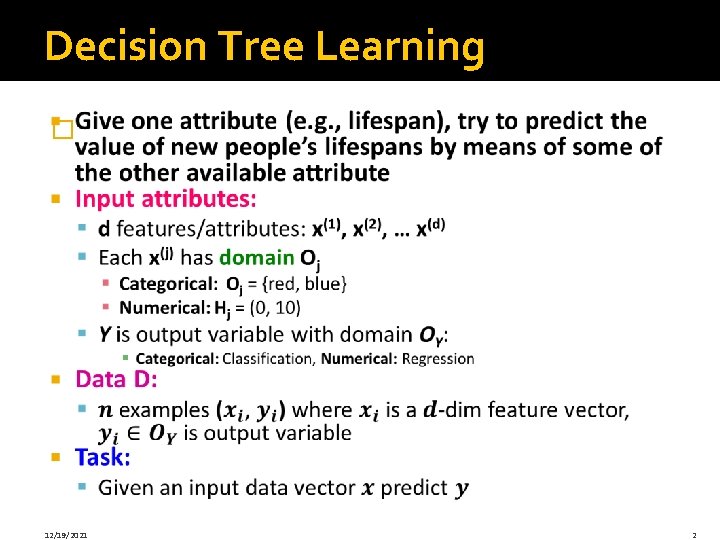
Decision Tree Learning � 12/19/2021 2
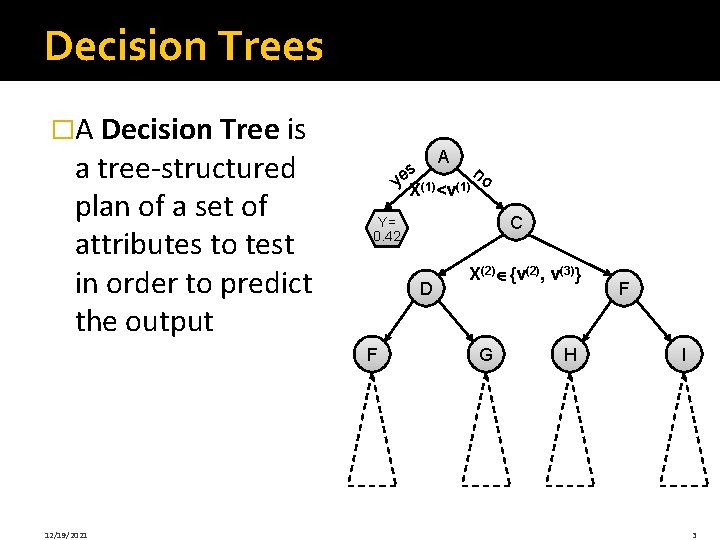
Decision Trees �A Decision Tree is a tree-structured plan of a set of attributes to test in order to predict the output A s n ye. X(1)<v(1) o D F 12/19/2021 C Y= 0. 42 X(2) {v(2), v(3)} G H F I 3
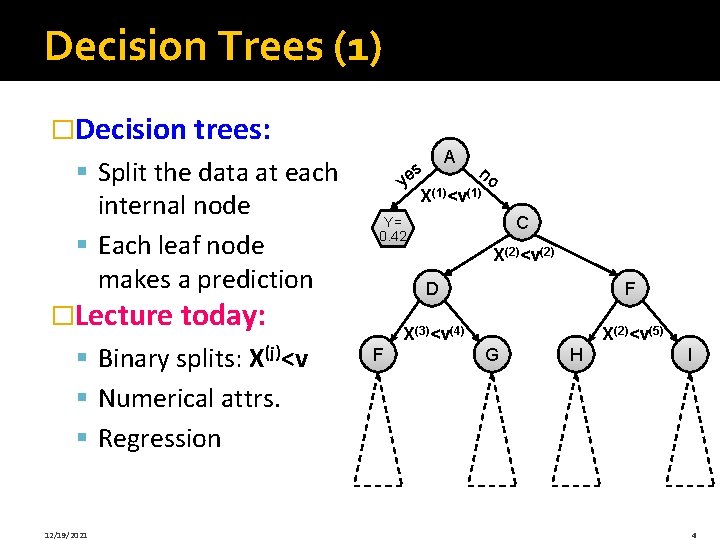
Decision Trees (1) �Decision trees: § Split the data at each internal node § Each leaf node makes a prediction A s n ye (1) o X <v X(2)<v(2) �Lecture today: § Binary splits: X(j)<v § Numerical attrs. § Regression 12/19/2021 C Y= 0. 42 F D F X(3)<v(4) X(2)<v(5) G H I 4
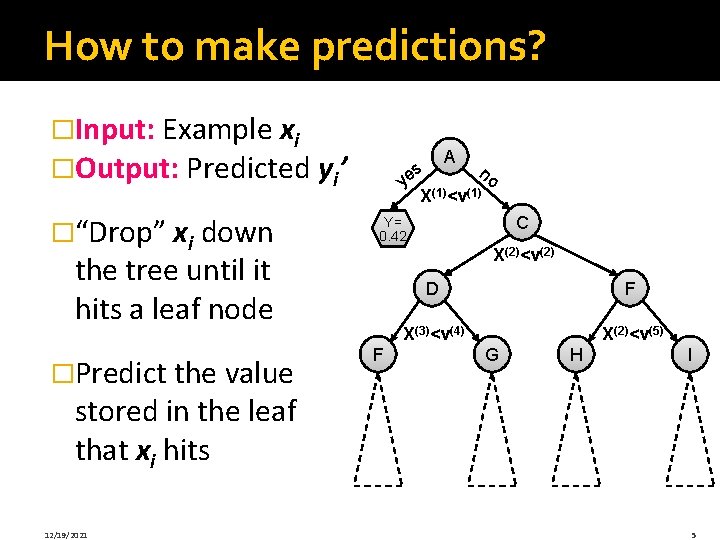
How to make predictions? �Input: Example xi �Output: Predicted yi’ �“Drop” xi down A s n ye (1) o X <v X(2)<v(2) the tree until it hits a leaf node �Predict the value C Y= 0. 42 F D F X(3)<v(4) X(2)<v(5) G H I stored in the leaf that xi hits 12/19/2021 5
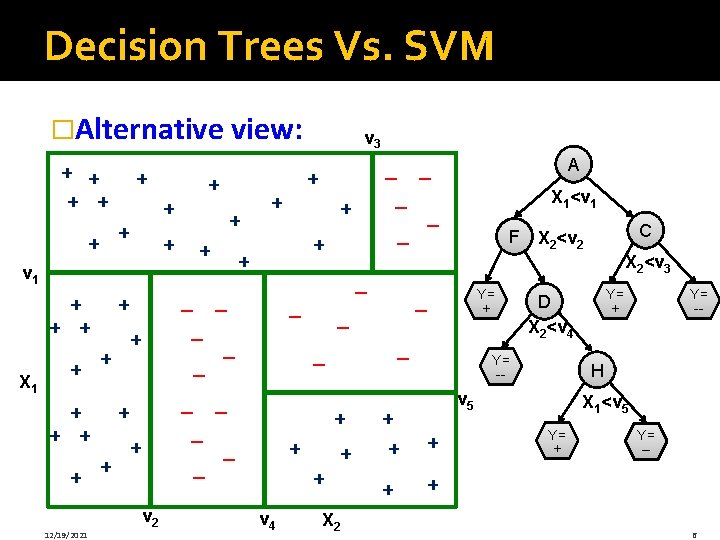
Decision Trees Vs. SVM �Alternative view: + + + + v 1 + + + X 1 + + + + 12/19/2021 + + v 2 + + + + – – – v 3 – – – + + v 4 X 1<v 1 X 2<v 3 Y= + – + + X 2 + + Y= -- H v 5 + Y= + D X 2<v 4 Y= -- + + C F X 2<v 2 – – – – A X 1<v 5 Y= + Y= -- 6
How to construct a tree?
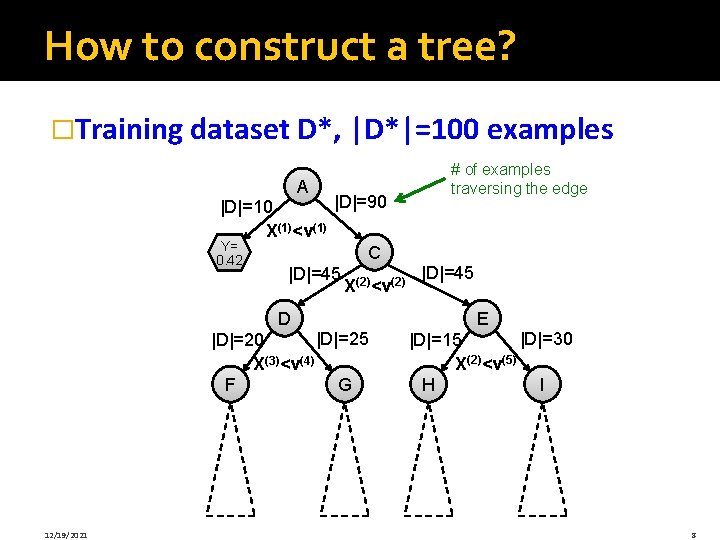
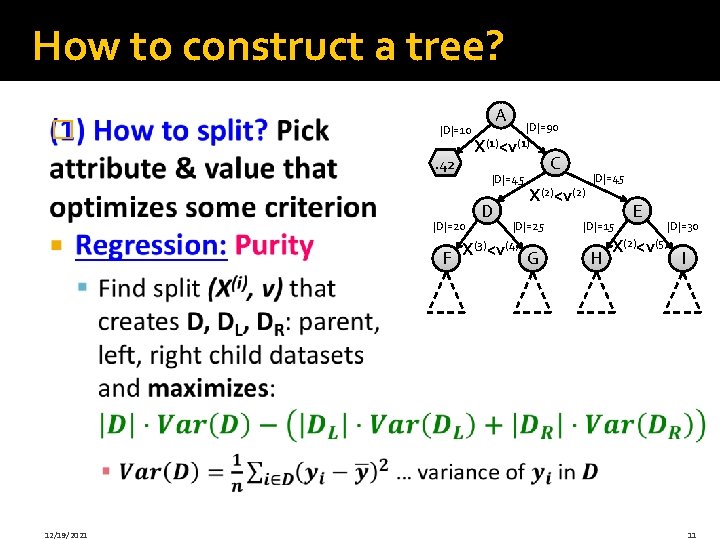
How to construct a tree? �Training dataset D*, |D*|=100 examples A # of examples traversing the edge |D|=90 |D|=10 X(1)<v(1) Y= B C 0. 42 |D|=45 (2) |D|=45 X <v D |D|=25 |D|=20 X(3)<v(4) F G 12/19/2021 E |D|=30 |D|=15 X(2)<v(5) H I 8
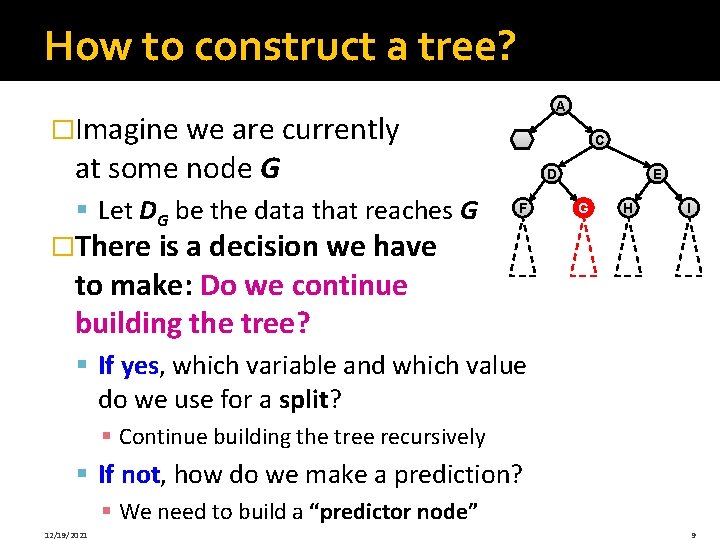
How to construct a tree? �Imagine we are currently at some node G § Let DG be the data that reaches G A B C D F E G H I �There is a decision we have to make: Do we continue building the tree? § If yes, which variable and which value do we use for a split? § Continue building the tree recursively § If not, how do we make a prediction? § We need to build a “predictor node” 12/19/2021 9
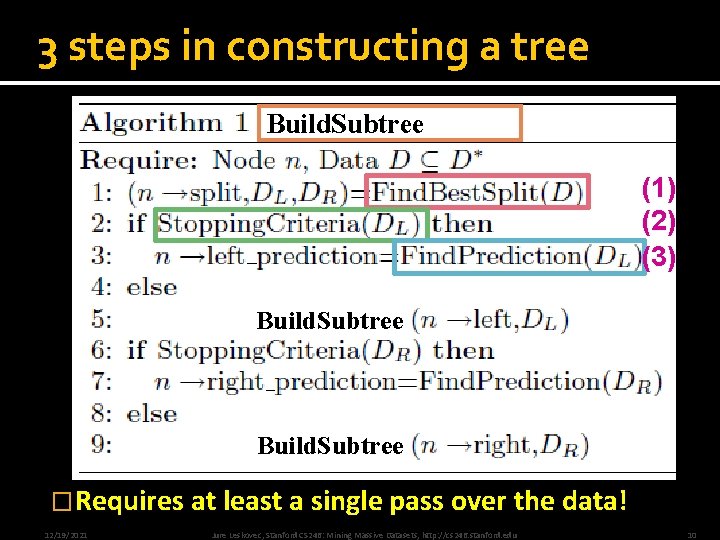
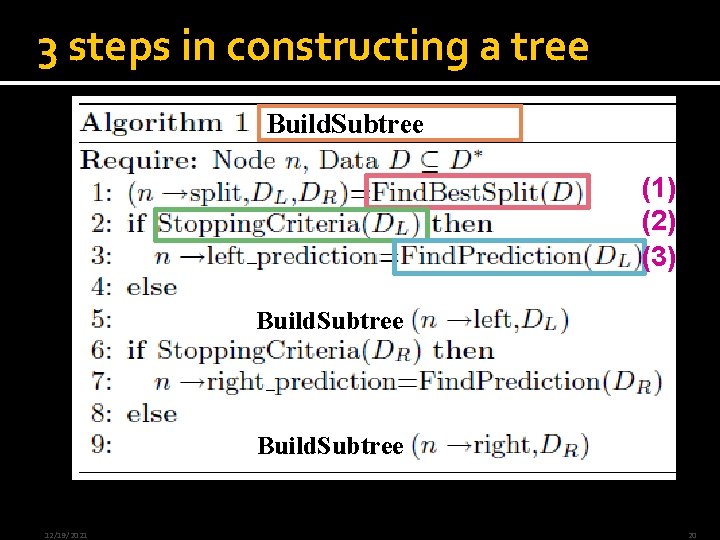
3 steps in constructing a tree Build. Subtree (1) (2) (3) Build. Subtree �Requires at least a single pass over the data! 12/19/2021 Jure Leskovec, Stanford CS 246: Mining Massive Datasets, http: //cs 246. stanford. edu 10
How to construct a tree? � |D|=10 B. 42 12/19/2021 |D|=90 X(1)<v(1) |D|=45 |D|=20 F A D C X(2)<v(2) |D|=25 X(3)<v(4) G |D|=45 H E |D|=30 X(2)<v(5) |D|=15 I 11
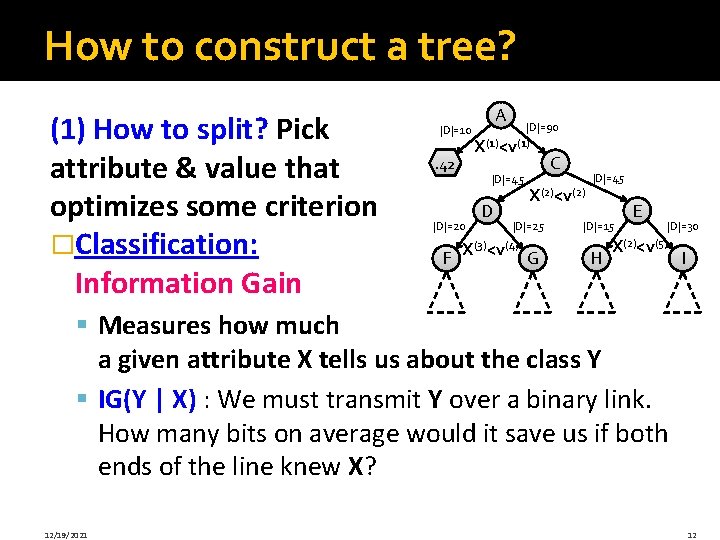
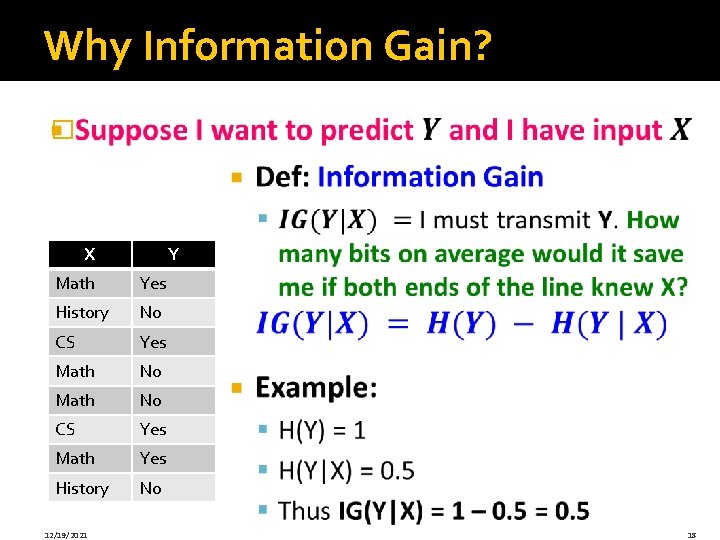
How to construct a tree? (1) How to split? Pick attribute & value that optimizes some criterion �Classification: Information Gain |D|=10 B. 42 |D|=90 X(1)<v(1) |D|=45 |D|=20 F A D C X(2)<v(2) |D|=25 X(3)<v(4) G |D|=45 H E |D|=30 X(2)<v(5) |D|=15 I § Measures how much a given attribute X tells us about the class Y § IG(Y | X) : We must transmit Y over a binary link. How many bits on average would it save us if both ends of the line knew X? 12/19/2021 12
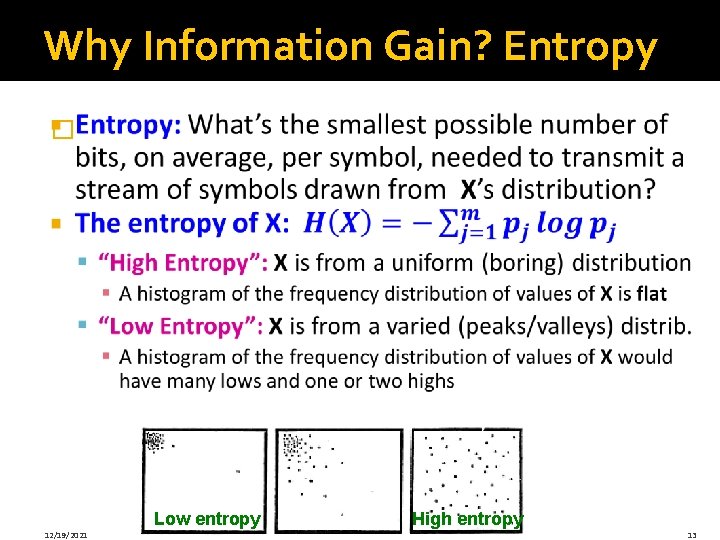
Why Information Gain? Entropy � Low entropy 12/19/2021 High entropy 13
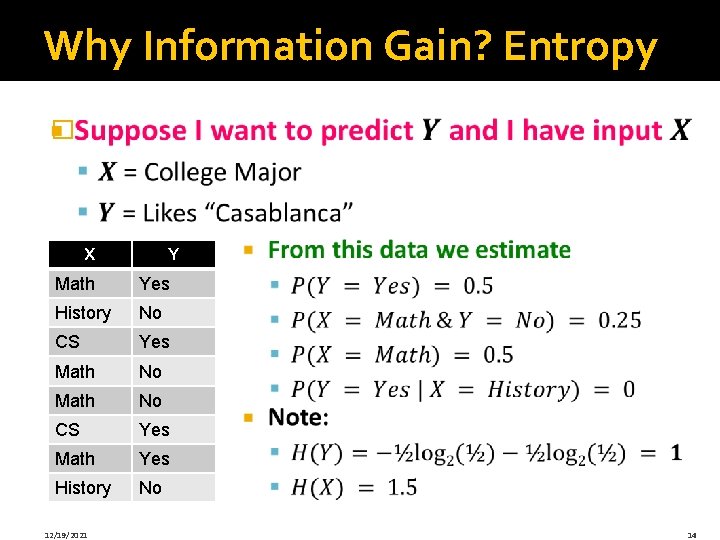
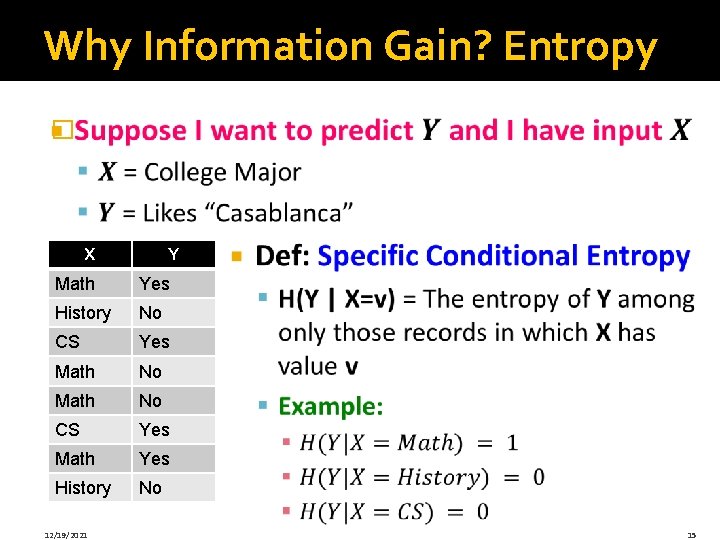
Why Information Gain? Entropy � X Y Math Yes History No CS Yes Math Yes History No 12/19/2021 14
Why Information Gain? Entropy � X Y Math Yes History No CS Yes Math Yes History No 12/19/2021 15
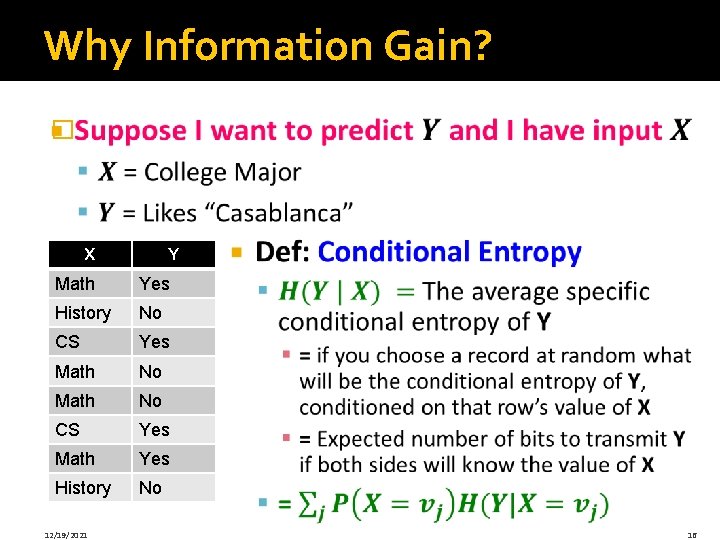
Why Information Gain? � X Y Math Yes History No CS Yes Math Yes History No 12/19/2021 16
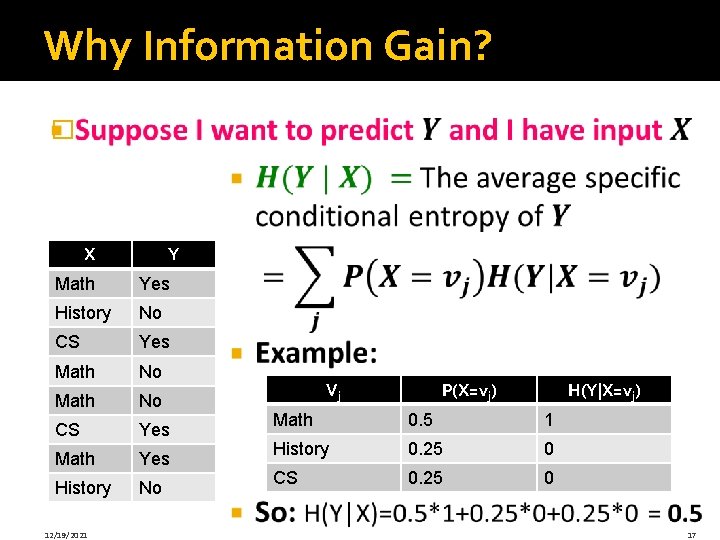
Why Information Gain? � X Y Math Yes History No CS Yes Math Yes History No 12/19/2021 Vj P(X=vj) H(Y|X=vj) Math 0. 5 1 History 0. 25 0 CS 0. 25 0 17
Why Information Gain? � X Y Math Yes History No CS Yes Math Yes History No 12/19/2021 18
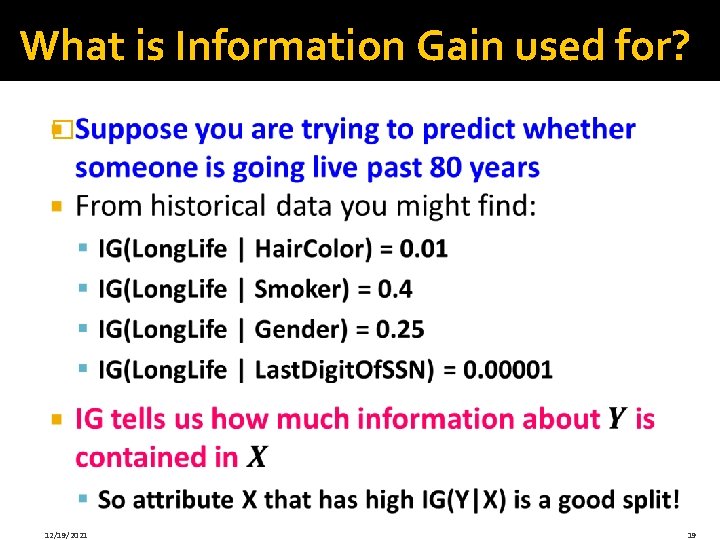
What is Information Gain used for? � 12/19/2021 19
3 steps in constructing a tree Build. Subtree (1) (2) (3) Build. Subtree 12/19/2021 20
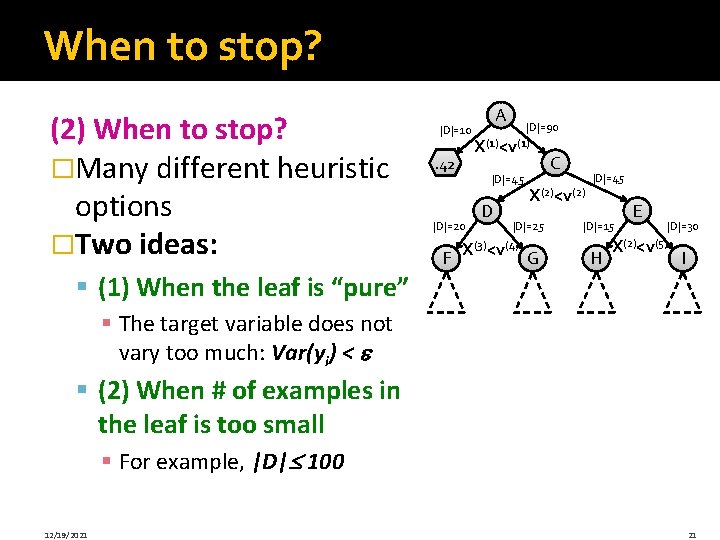
When to stop? (2) When to stop? �Many different heuristic options �Two ideas: § (1) When the leaf is “pure” |D|=10 B. 42 |D|=90 X(1)<v(1) |D|=45 |D|=20 F A D C X(2)<v(2) |D|=25 X(3)<v(4) G |D|=45 H E |D|=30 X(2)<v(5) |D|=15 I § The target variable does not vary too much: Var(yi) < § (2) When # of examples in the leaf is too small § For example, |D| 100 12/19/2021 21
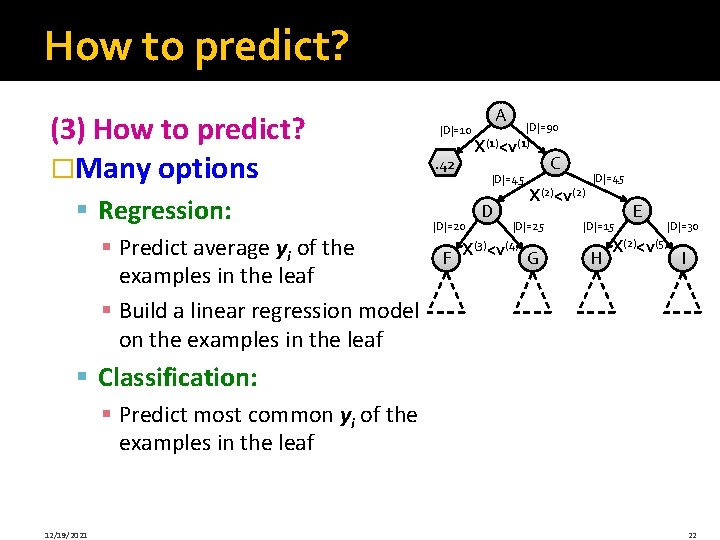
How to predict? (3) How to predict? �Many options § Regression: § Predict average yi of the examples in the leaf § Build a linear regression model on the examples in the leaf |D|=10 B. 42 |D|=90 X(1)<v(1) |D|=45 |D|=20 F A D C X(2)<v(2) |D|=25 X(3)<v(4) G |D|=45 H E |D|=30 X(2)<v(5) |D|=15 I § Classification: § Predict most common yi of the examples in the leaf 12/19/2021 22
Building Decision Trees Using Map. Reduce
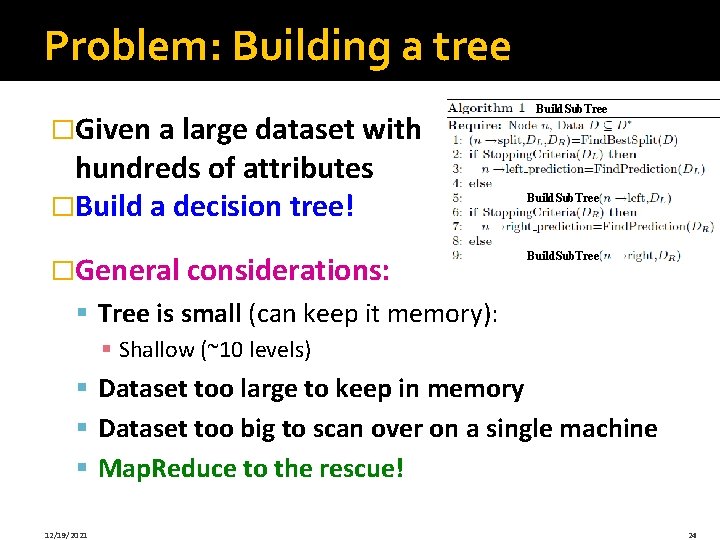
Problem: Building a tree �Given a large dataset with hundreds of attributes �Build a decision tree! �General considerations: Build. Sub. Tree § Tree is small (can keep it memory): § Shallow (~10 levels) § Dataset too large to keep in memory § Dataset too big to scan over on a single machine § Map. Reduce to the rescue! 12/19/2021 24
Today’s Lecture: PLANET Parallel Learner for Assembling Numerous Ensemble Trees [Panda et al. , VLDB ‘ 09] § A sequence of Map. Reduce jobs that builds a decision tree �Setting: § Hundreds of numerical (discrete & continuous, but not categorical) attributes § Target variable is numerical: Regression § Splits are binary: X(j) < v § Decision tree is small enough for each Mapper to keep it in memory § Data too large to keep in memory 12/19/2021 25
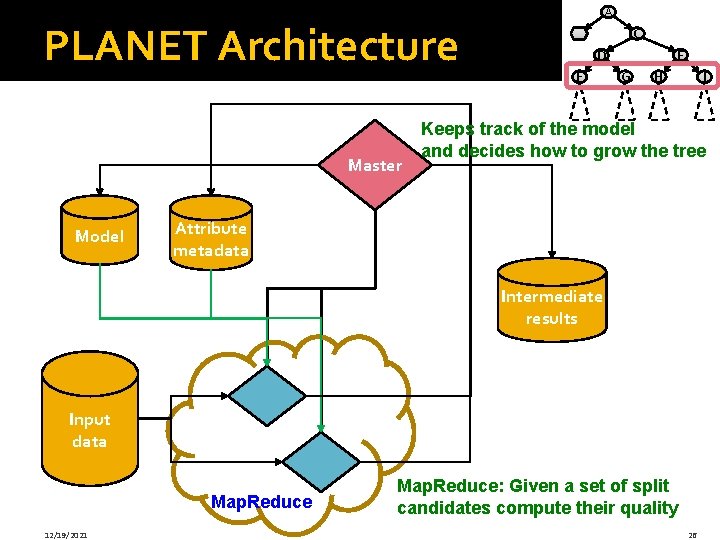
PLANET Architecture Master Model A B C D F E G H I Keeps track of the model and decides how to grow the tree Attribute metadata Intermediate results Input data Map. Reduce 12/19/2021 Map. Reduce: Given a set of split candidates compute their quality 26
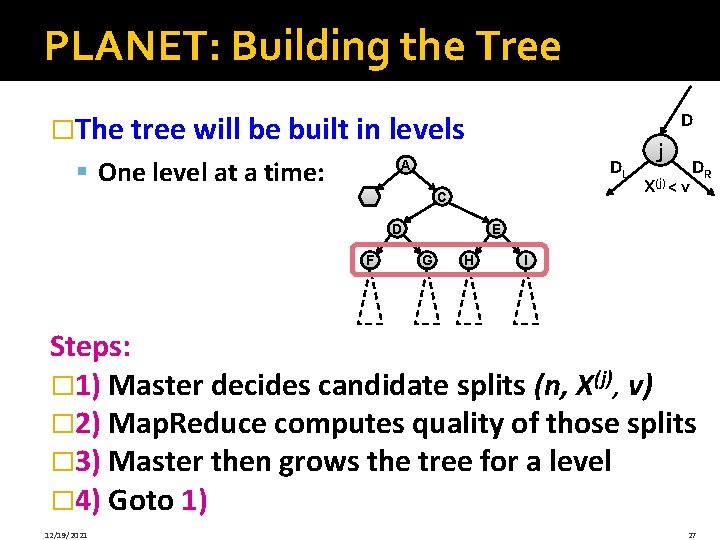
PLANET: Building the Tree �The tree will be built in levels § One level at a time: D DL A B C D F j X(j) < v DR E G H I Steps: � 1) Master decides candidate splits (n, X(j), v) � 2) Map. Reduce computes quality of those splits � 3) Master then grows the tree for a level � 4) Goto 1) 12/19/2021 27
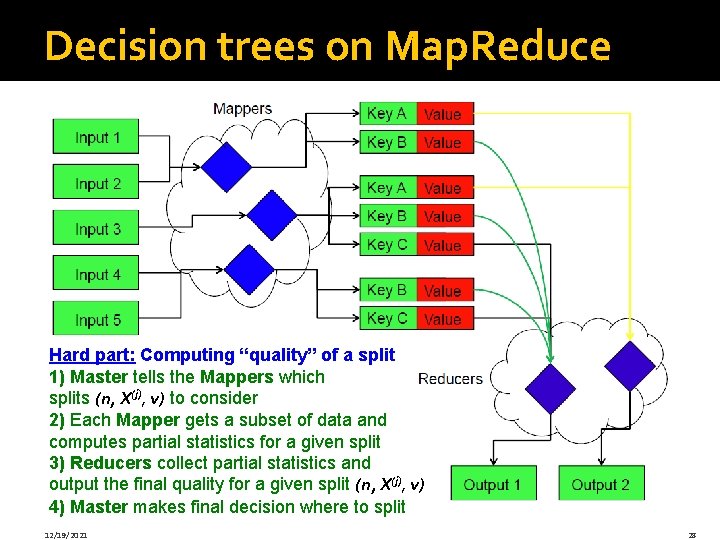
Decision trees on Map. Reduce Hard part: Computing “quality” of a split 1) Master tells the Mappers which splits (n, X(j), v) to consider 2) Each Mapper gets a subset of data and computes partial statistics for a given split 3) Reducers collect partial statistics and output the final quality for a given split (n, X(j), v) 4) Master makes final decision where to split 12/19/2021 28
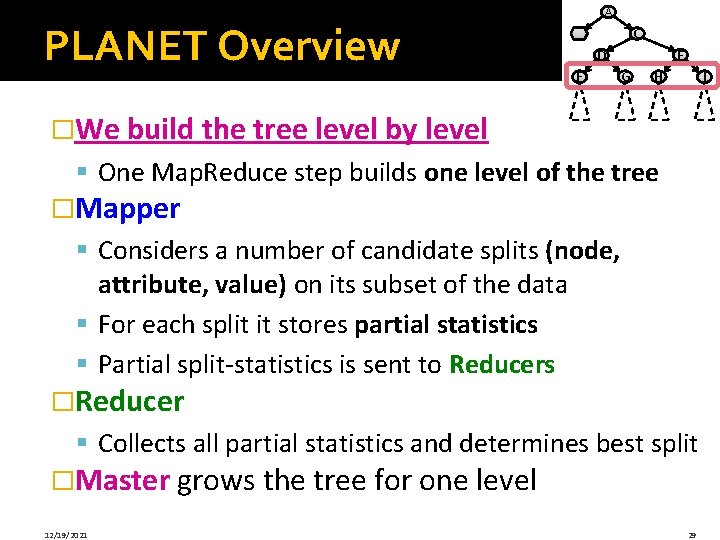
PLANET Overview A B C D F E G H I �We build the tree level by level § One Map. Reduce step builds one level of the tree �Mapper § Considers a number of candidate splits (node, attribute, value) on its subset of the data § For each split it stores partial statistics § Partial split-statistics is sent to Reducers �Reducer § Collects all partial statistics and determines best split �Master grows the tree for one level 12/19/2021 29
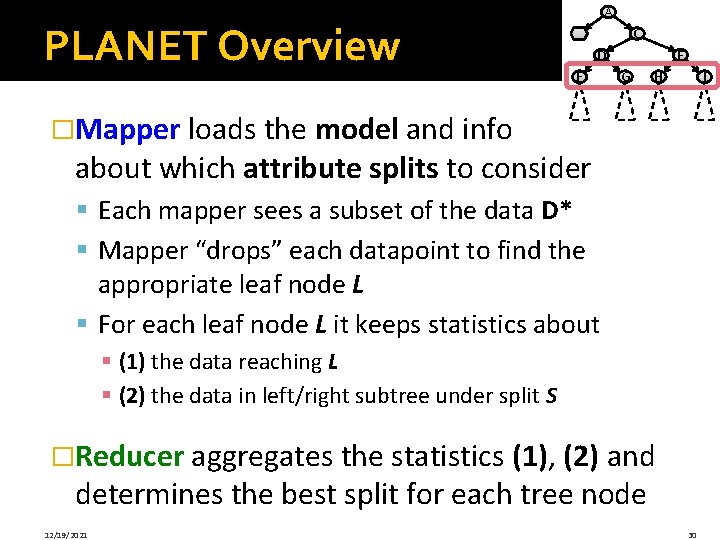
PLANET Overview A B C D F E G H I �Mapper loads the model and info about which attribute splits to consider § Each mapper sees a subset of the data D* § Mapper “drops” each datapoint to find the appropriate leaf node L § For each leaf node L it keeps statistics about § (1) the data reaching L § (2) the data in left/right subtree under split S �Reducer aggregates the statistics (1), (2) and determines the best split for each tree node 12/19/2021 30
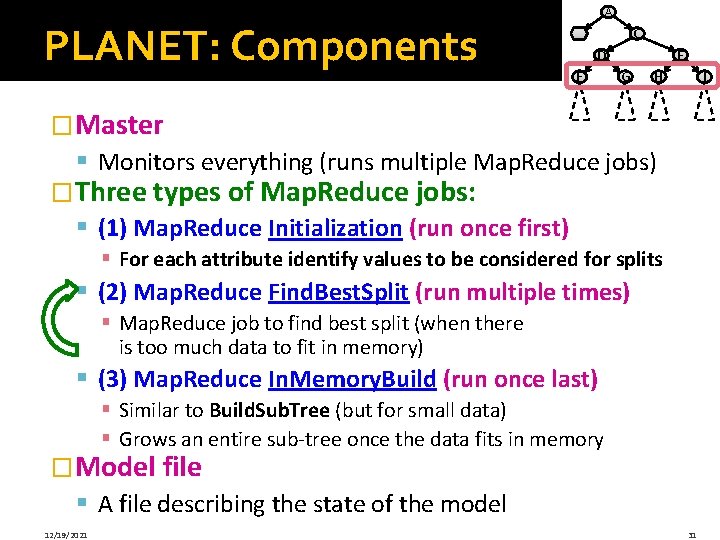
PLANET: Components A B C D F E G H I �Master § Monitors everything (runs multiple Map. Reduce jobs) �Three types of Map. Reduce jobs: § (1) Map. Reduce Initialization (run once first) § For each attribute identify values to be considered for splits § (2) Map. Reduce Find. Best. Split (run multiple times) § Map. Reduce job to find best split (when there is too much data to fit in memory) § (3) Map. Reduce In. Memory. Build (run once last) § Similar to Build. Sub. Tree (but for small data) § Grows an entire sub-tree once the data fits in memory �Model file § A file describing the state of the model 12/19/2021 31
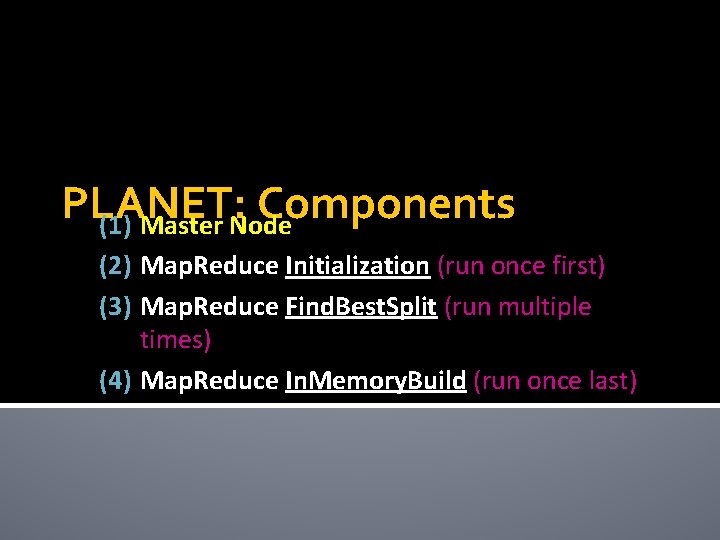
PLANET: Components (1) Master Node (2) Map. Reduce Initialization (run once first) (3) Map. Reduce Find. Best. Split (run multiple times) (4) Map. Reduce In. Memory. Build (run once last)
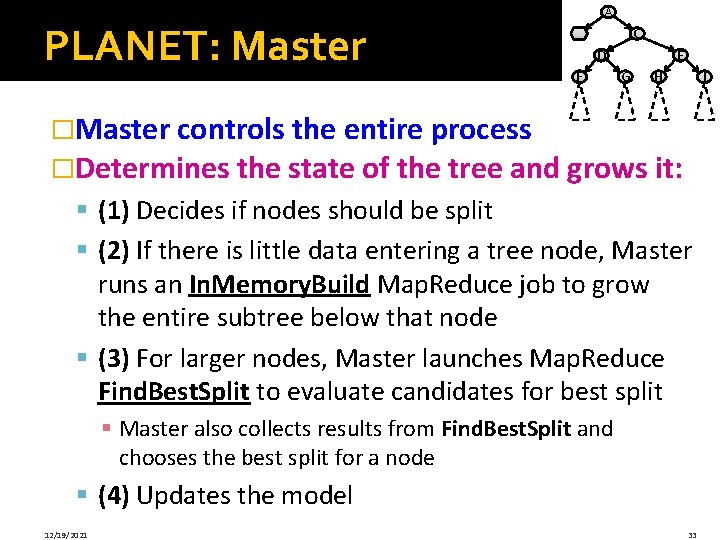
PLANET: Master A B C D F E G H I �Master controls the entire process �Determines the state of the tree and grows it: § (1) Decides if nodes should be split § (2) If there is little data entering a tree node, Master runs an In. Memory. Build Map. Reduce job to grow the entire subtree below that node § (3) For larger nodes, Master launches Map. Reduce Find. Best. Split to evaluate candidates for best split § Master also collects results from Find. Best. Split and chooses the best split for a node § (4) Updates the model 12/19/2021 33
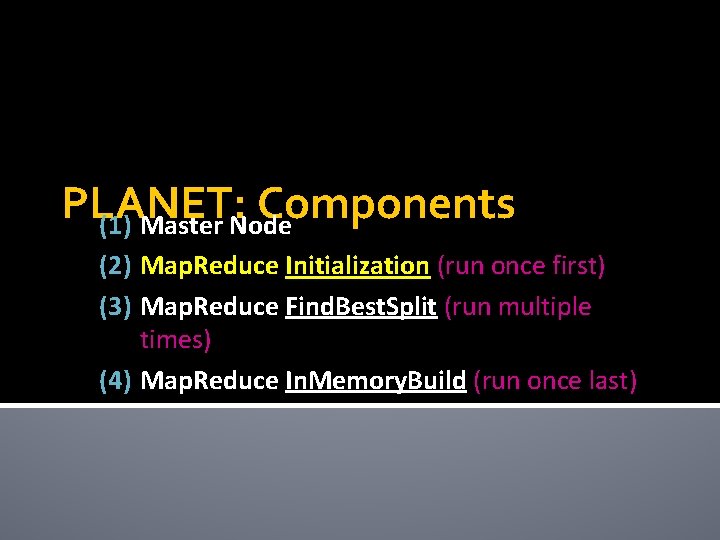
PLANET: Components (1) Master Node (2) Map. Reduce Initialization (run once first) (3) Map. Reduce Find. Best. Split (run multiple times) (4) Map. Reduce In. Memory. Build (run once last)
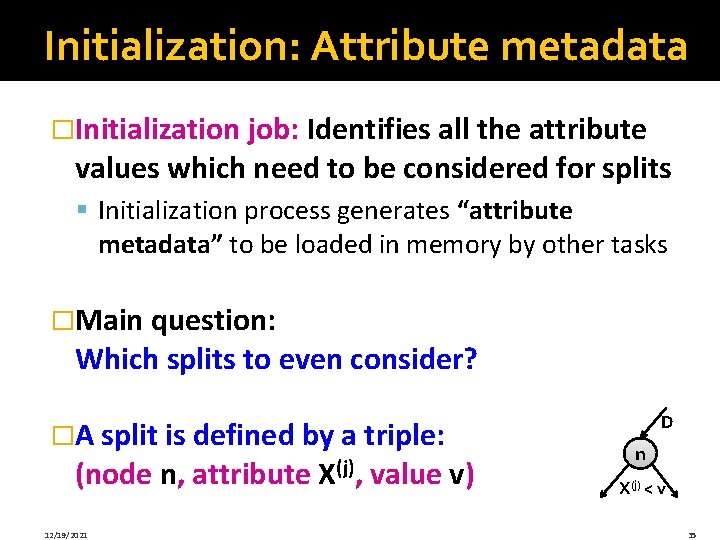
Initialization: Attribute metadata �Initialization job: Identifies all the attribute values which need to be considered for splits § Initialization process generates “attribute metadata” to be loaded in memory by other tasks �Main question: Which splits to even consider? �A split is defined by a triple: (node n, attribute 12/19/2021 X(j), value v) D n X(j) < v 35
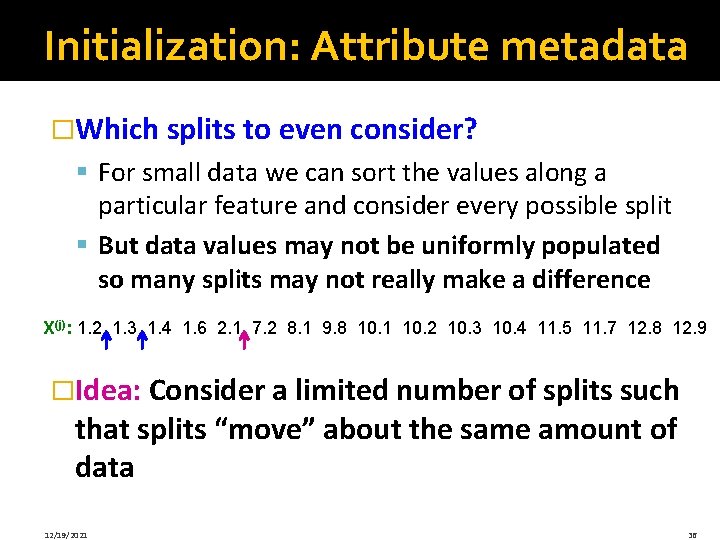
Initialization: Attribute metadata �Which splits to even consider? § For small data we can sort the values along a particular feature and consider every possible split § But data values may not be uniformly populated so many splits may not really make a difference X(j): 1. 2 1. 3 1. 4 1. 6 2. 1 7. 2 8. 1 9. 8 10. 1 10. 2 10. 3 10. 4 11. 5 11. 7 12. 8 12. 9 �Idea: Consider a limited number of splits such that splits “move” about the same amount of data 12/19/2021 36
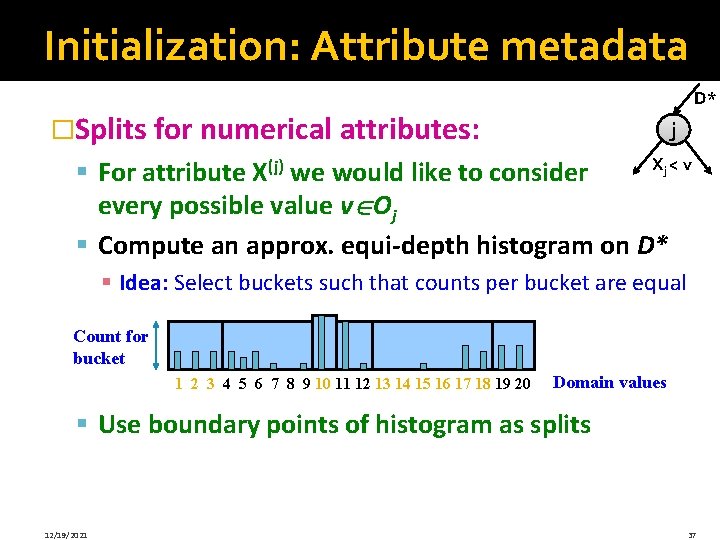
Initialization: Attribute metadata D* �Splits for numerical attributes: j Xj < v § For attribute X(j) we would like to consider every possible value v Oj § Compute an approx. equi-depth histogram on D* § Idea: Select buckets such that counts per bucket are equal Count for bucket 1 2 3 4 5 6 7 8 9 10 11 12 13 14 15 16 17 18 19 20 Domain values § Use boundary points of histogram as splits 12/19/2021 37
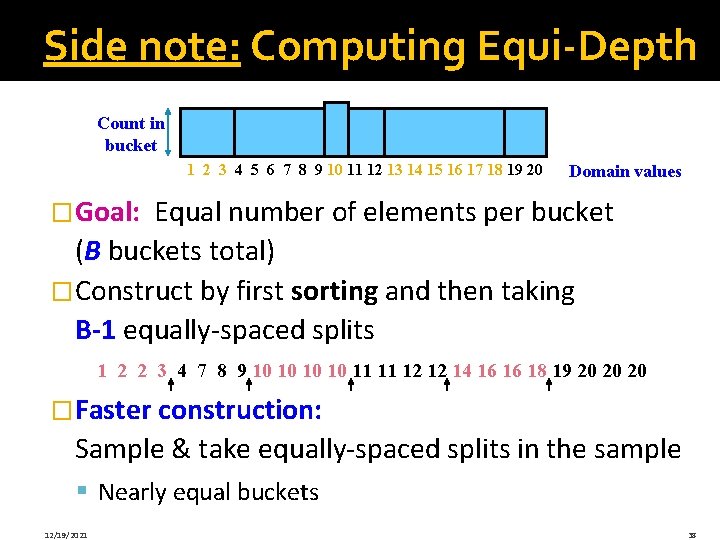
Side note: Computing Equi-Depth Count in bucket 1 2 3 4 5 6 7 8 9 10 11 12 13 14 15 16 17 18 19 20 Domain values �Goal: Equal number of elements per bucket (B buckets total) �Construct by first sorting and then taking B-1 equally-spaced splits 1 2 2 3 4 7 8 9 10 10 11 11 12 12 14 16 16 18 19 20 20 20 �Faster construction: Sample & take equally-spaced splits in the sample § Nearly equal buckets 12/19/2021 38
PLANET: Components (1) Master Node (2) Map. Reduce Initialization (run once first) (3) Map. Reduce Find. Best. Split (run multiple times) (4) Map. Reduce In. Memory. Build (run once last)
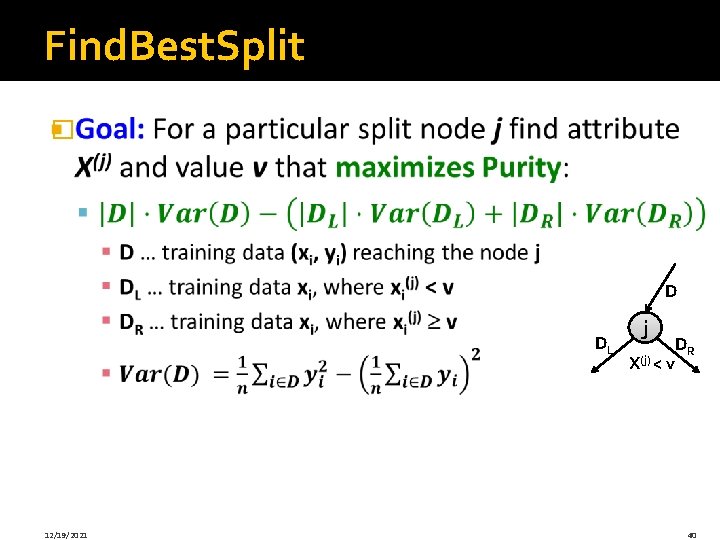
Find. Best. Split � D DL 12/19/2021 j X(j) < DR v 40
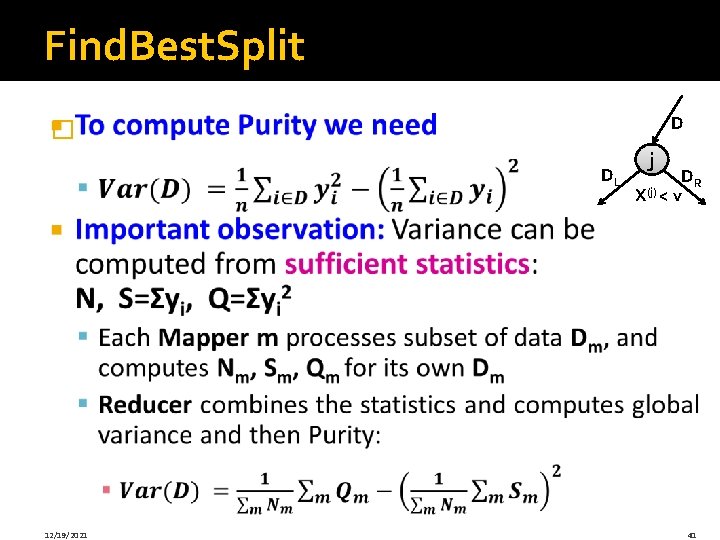
Find. Best. Split D � DL 12/19/2021 j X(j) < DR v 41
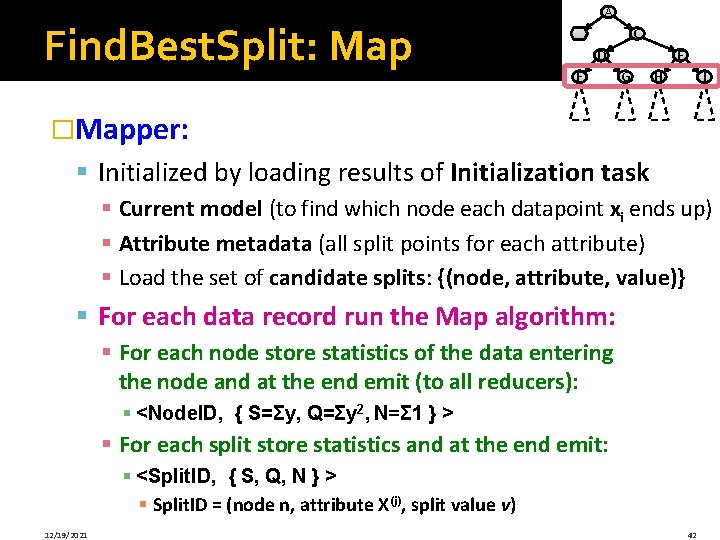
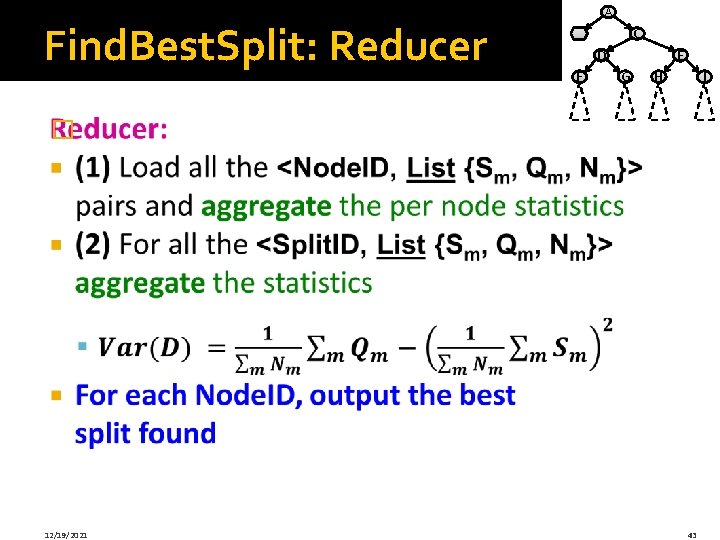
Find. Best. Split: Map A B C D F E G H I �Mapper: § Initialized by loading results of Initialization task § Current model (to find which node each datapoint xi ends up) § Attribute metadata (all split points for each attribute) § Load the set of candidate splits: {(node, attribute, value)} § For each data record run the Map algorithm: § For each node store statistics of the data entering the node and at the end emit (to all reducers): § <Node. ID, { S=Σy, Q=Σy 2, N=Σ 1 } > § For each split store statistics and at the end emit: § <Split. ID, { S, Q, N } > § Split. ID = (node n, attribute X(j), split value v) 12/19/2021 42
Find. Best. Split: Reducer A B C D F E G H I � 12/19/2021 43
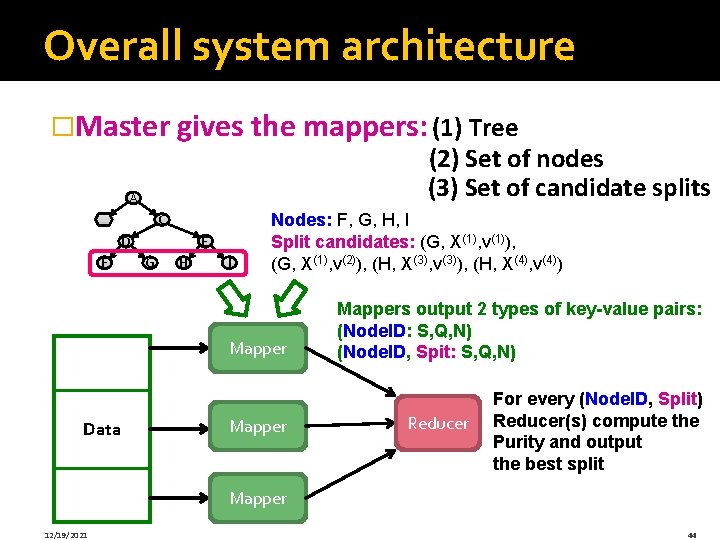
Overall system architecture �Master gives the mappers: (1) Tree (2) Set of nodes (3) Set of candidate splits A B C D F E G H I Nodes: F, G, H, I Split candidates: (G, X(1), v(1)), (G, X(1), v(2)), (H, X(3), v(3)), (H, X(4), v(4)) Mapper Data Mappers output 2 types of key-value pairs: (Node. ID: S, Q, N) (Node. ID, Spit: S, Q, N) Reducer For every (Node. ID, Split) Reducer(s) compute the Purity and output the best split Mapper 12/19/2021 44
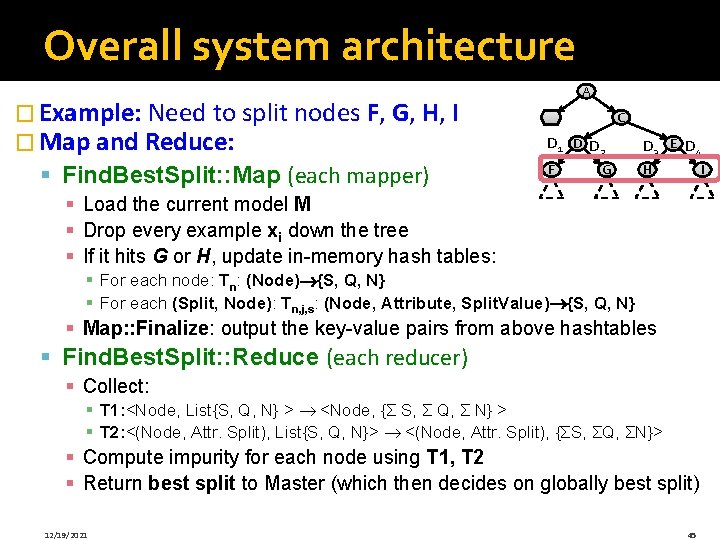
Overall system architecture � Example: Need to split nodes F, G, H, I � Map and Reduce: § Find. Best. Split: : Map (each mapper) A B C D 1 D D 2 D 3 E D 4 F H G I § Load the current model M § Drop every example xi down the tree § If it hits G or H, update in-memory hash tables: § For each node: Tn: (Node) {S, Q, N} § For each (Split, Node): Tn, j, s: (Node, Attribute, Split. Value) {S, Q, N} § Map: : Finalize: output the key-value pairs from above hashtables § Find. Best. Split: : Reduce (each reducer) § Collect: § T 1: <Node, List{S, Q, N} > <Node, {Σ S, Σ Q, Σ N} > § T 2: <(Node, Attr. Split), List{S, Q, N}> <(Node, Attr. Split), {ΣS, ΣQ, ΣN}> § Compute impurity for each node using T 1, T 2 § Return best split to Master (which then decides on globally best split) 12/19/2021 45
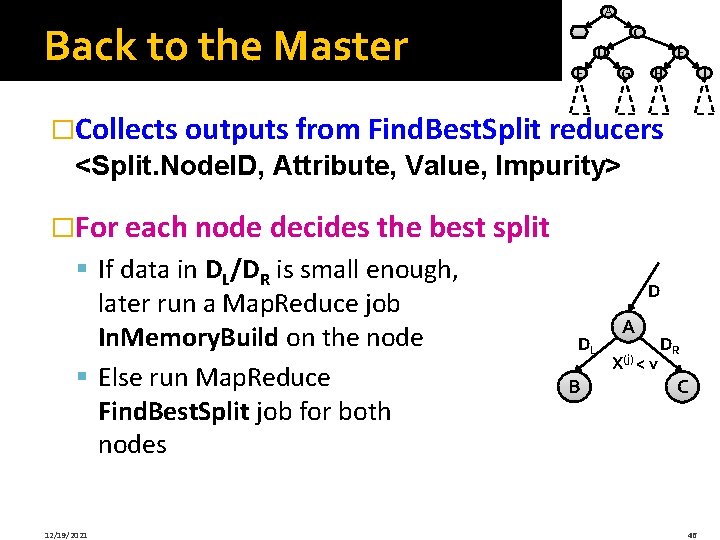
Back to the Master A B C D F E G H I �Collects outputs from Find. Best. Split reducers <Split. Node. ID, Attribute, Value, Impurity> �For each node decides the best split § If data in DL/DR is small enough, later run a Map. Reduce job In. Memory. Build on the node § Else run Map. Reduce Find. Best. Split job for both nodes 12/19/2021 D DL B A X(j) < v DR C 46
Decision Trees: Conclusion
Decision Trees �Decision trees are the single most popular data mining tool: § § § 12/19/2021 Easy to understand Easy to implement Easy to use Computationally cheap It’s possible to get in trouble with overfitting They do classification as well as regression! 48
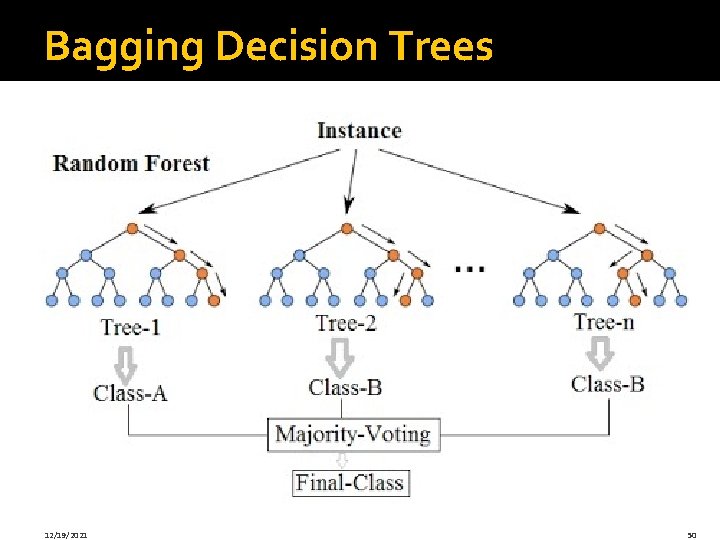
Learning Ensembles �Learn multiple trees and combine their predictions § Gives better performance in practice �Bagging: § Learns multiple trees over independent samples of the training data § For a dataset D on n data points: Create dataset D’ of n points but sample from D with replacement: § 33% points in D’ will be duplicates, 66% will be unique § Predictions from each tree are averaged to compute the final model prediction 12/19/2021 49
Bagging Decision Trees 12/19/2021 50
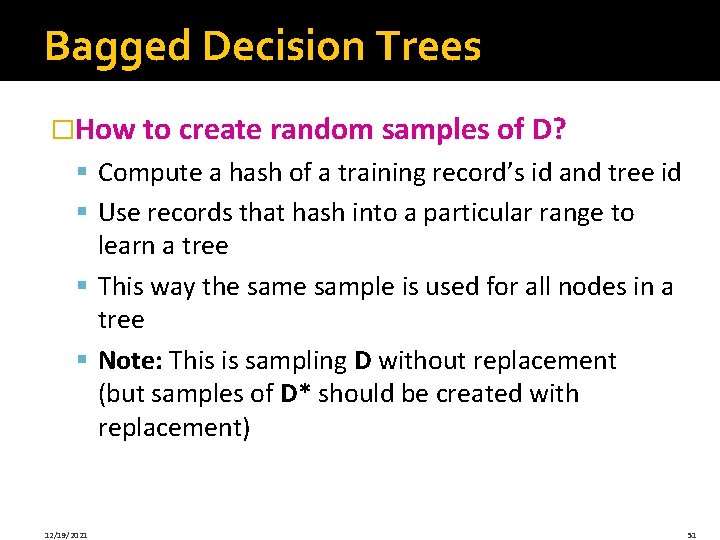
Bagged Decision Trees �How to create random samples of D? § Compute a hash of a training record’s id and tree id § Use records that hash into a particular range to learn a tree § This way the sample is used for all nodes in a tree § Note: This is sampling D without replacement (but samples of D* should be created with replacement) 12/19/2021 51
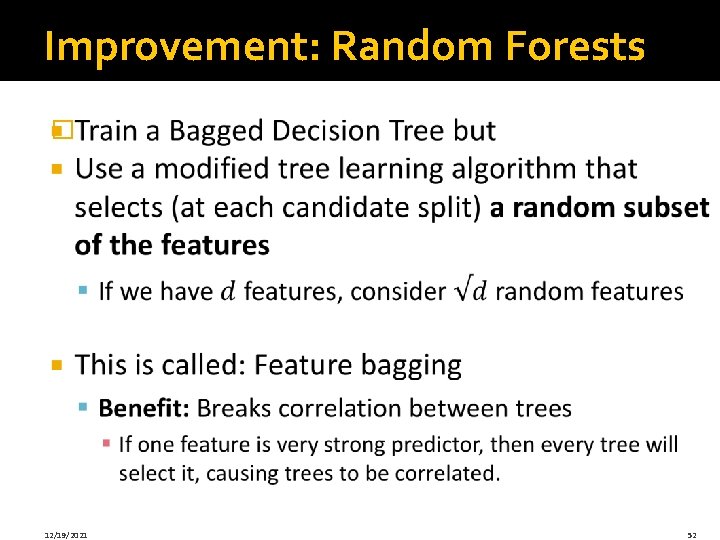
Improvement: Random Forests � 12/19/2021 52
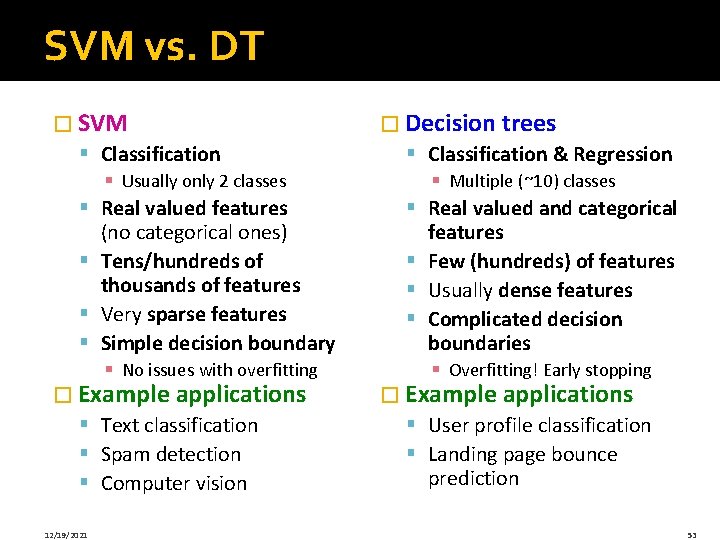
SVM vs. DT � SVM § Classification § Usually only 2 classes � Decision trees § Classification & Regression § Multiple (~10) classes § Real valued features (no categorical ones) § Tens/hundreds of thousands of features § Very sparse features § Simple decision boundary § Real valued and categorical features § Few (hundreds) of features § Usually dense features § Complicated decision boundaries § No issues with overfitting § Overfitting! Early stopping � Example applications § Text classification § Spam detection § Computer vision 12/19/2021 � Example applications § User profile classification § Landing page bounce prediction 53