
Decision Trees for Server Flow Authentication James P
- Slides: 16
Decision Trees for Server Flow Authentication James P. Early and Carla E. Brodley Purdue University West Lafayette, IN 47907 earlyjp@cerias. purdue. edu, brodley@ecn. purdue. edu September 24, 2003
Motivation • Port numbers can be unreliable for determining traffic type – Proxies – Port Remappers (e. g. , Anti. Firewall) – “Backdoored” services – User-installed services
Motivation • Strong reliance on port number – Firewall filtering rules – IDS signatures • Given a flow of packets from a server, can we identify the application?
Modeling Flow Behavior • • Capture operational characteristics Connection initialization data not required Payload data not required Intuition: Application protocols use the underlying TCP state mechanism in different ways, thus they can be differentiated
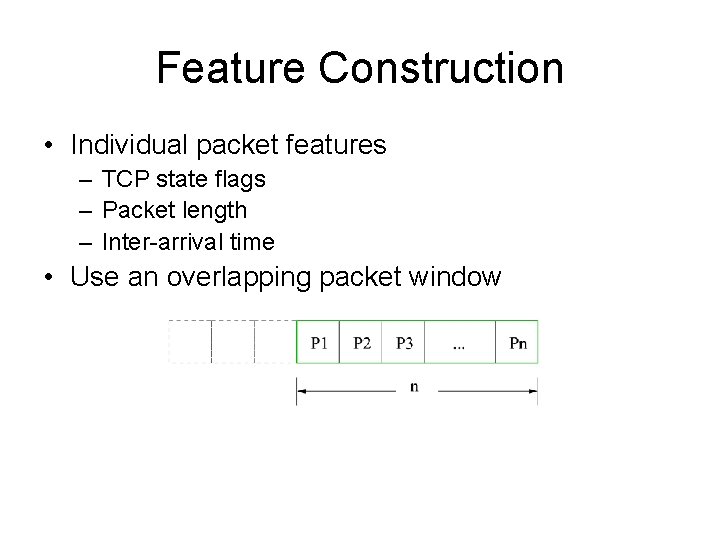
Feature Construction • Individual packet features – TCP state flags – Packet length – Inter-arrival time • Use an overlapping packet window
Supervised Learning • Train learner to classify unseen flows as one of k classes • Assumption: Policy specifies services for a host • Does flow match expected service?
Aggregate Flow Experiments • FTP, SSH, Telnet, SMTP, HTTP • Data sets (1999 Lincoln Labs) Training : Week 1 Test: Week 3 • Fifty flows / protocol • Packet window sizes: 10 to 1000 • Use C 5. 0 to build decision tree
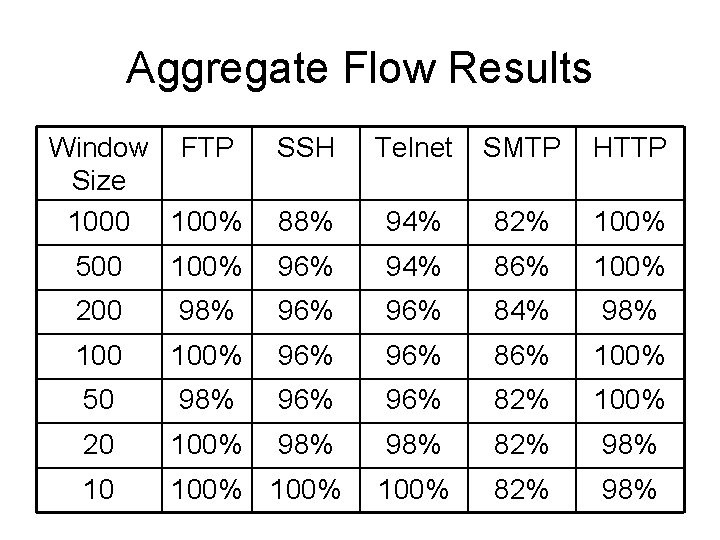
Aggregate Flow Results Window FTP Size 1000 100% SSH Telnet SMTP HTTP 88% 94% 82% 100% 500 100% 96% 94% 86% 100% 200 98% 96% 84% 98% 100% 96% 86% 100% 50 98% 96% 82% 100% 20 100% 98% 82% 98% 10 100% 82% 98%
Per-Host Flow Experiments • Operational characteristics of a host – Server implementation – OS platform • Five hosts with three or more services • Build decision trees (window size 100) • Classify unseen flows for same host
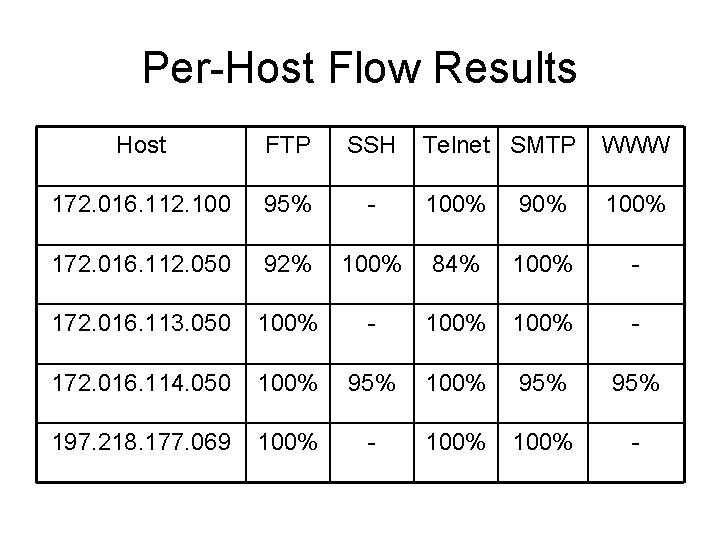
Per-Host Flow Results Host FTP SSH Telnet SMTP WWW 172. 016. 112. 100 95% - 100% 90% 100% 172. 016. 112. 050 92% 100% 84% 100% - 172. 016. 113. 050 100% - 172. 016. 114. 050 100% 95% 95% 197. 218. 177. 069 100% -
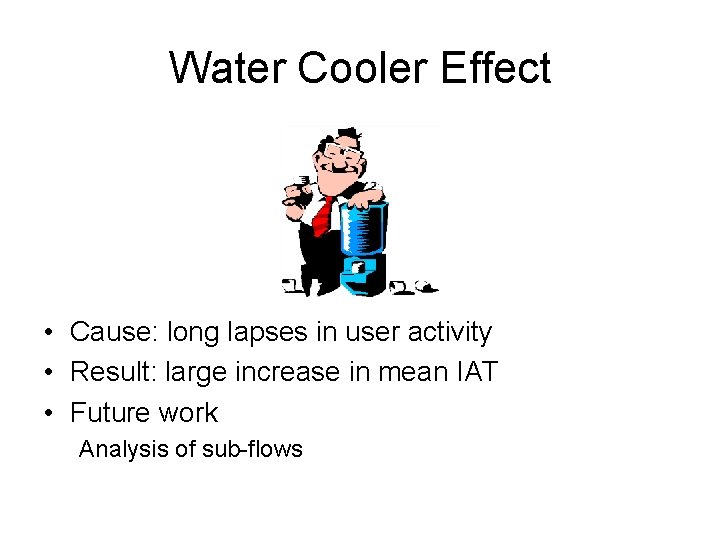
Water Cooler Effect • Cause: long lapses in user activity • Result: large increase in mean IAT • Future work Analysis of sub-flows
Experiments Using Live Traffic • Data collected from our test network • Augmented with file-sharing data (Kazaa) • Accuracy 85 -100% Comparable to synthetic data
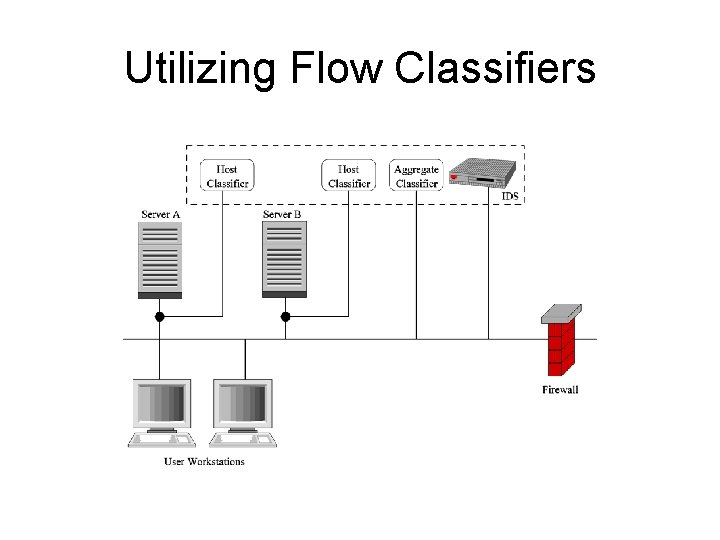
Utilizing Flow Classifiers
Subverting Classification • Water Cooler Effect • Extraneous TCP Flags (e. g. , URG) • Duplication of particular behavior unlikely
Related Work • “Flow Classification for Intrusion Detection” Tom Dunigan and George Ostrouchov, ORNL/TM-2001/115 (2000) • “Detection and Classification of TCP/IP Network Services” Tan, K. M. C. and Collie, B. S. , Proceedings of the 13 th Annual Computer Security Applications Conference (1997) • Signature Based – Connection – Payload
Conclusions • Designed features that model application behavior • Achieved high classification accuracy in real time • Future work – IDS integration – Mitigation of Water Cooler Effect – Attempts to subvert classification