
Decision Tree Pruning Methods Validation set withhold a
- Slides: 7
Decision Tree Pruning Methods • Validation set – withhold a subset (~1/3) of training data to use for pruning – Note: you should randomize the order of training examples
Reduced-Error Pruning • Classify examples in validation set – some might be errors • For each node: – Sum the errors over entire subtree – Calculate error on same example if converted to a leaf with majority class label • Prune node with highest reduction in error • Repeat until error no longer reduced
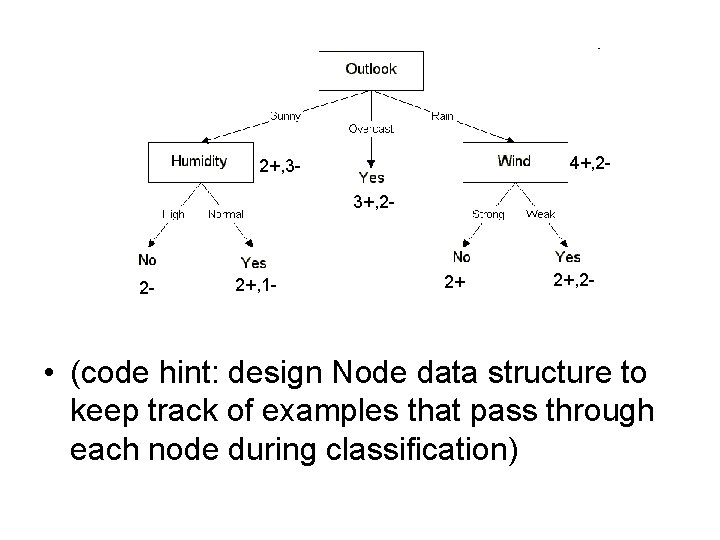
4+, 2 - 2+, 33+, 2 - 2 - 2+, 1 - 2+ 2+, 2 - • (code hint: design Node data structure to keep track of examples that pass through each node during classification)
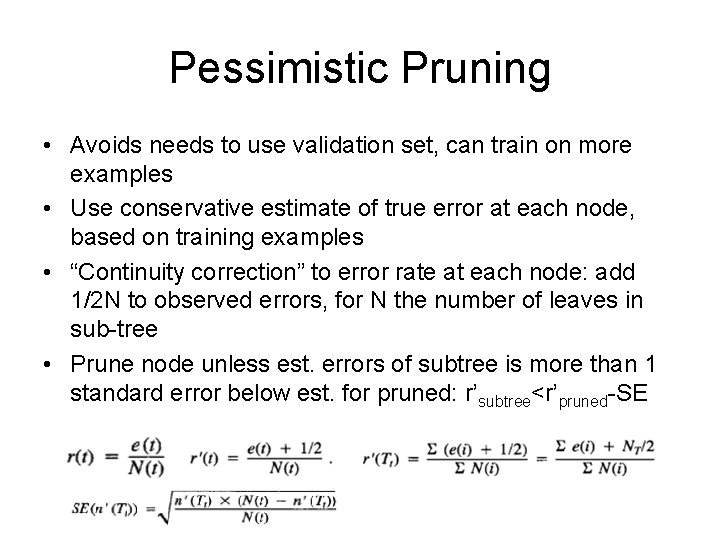
Pessimistic Pruning • Avoids needs to use validation set, can train on more examples • Use conservative estimate of true error at each node, based on training examples • “Continuity correction” to error rate at each node: add 1/2 N to observed errors, for N the number of leaves in sub-tree • Prune node unless est. errors of subtree is more than 1 standard error below est. for pruned: r’subtree<r’pruned-SE
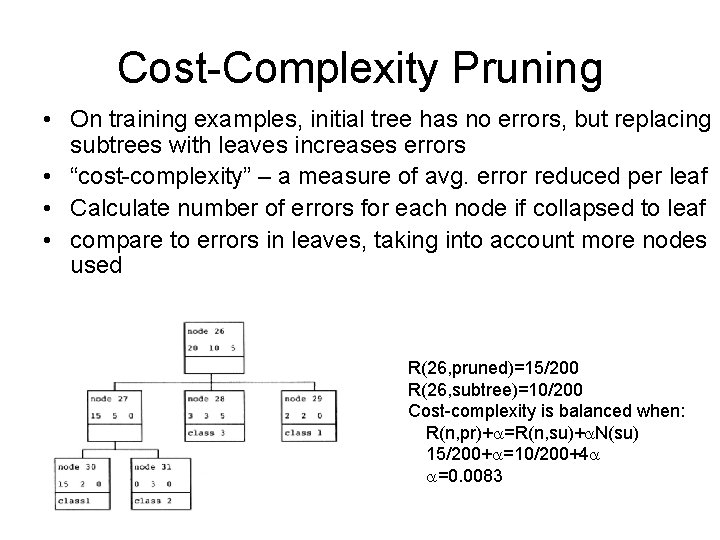
Cost-Complexity Pruning • On training examples, initial tree has no errors, but replacing subtrees with leaves increases errors • “cost-complexity” – a measure of avg. error reduced per leaf • Calculate number of errors for each node if collapsed to leaf • compare to errors in leaves, taking into account more nodes used R(26, pruned)=15/200 R(26, subtree)=10/200 Cost-complexity is balanced when: R(n, pr)+a=R(n, su)+a. N(su) 15/200+a=10/200+4 a a=0. 0083
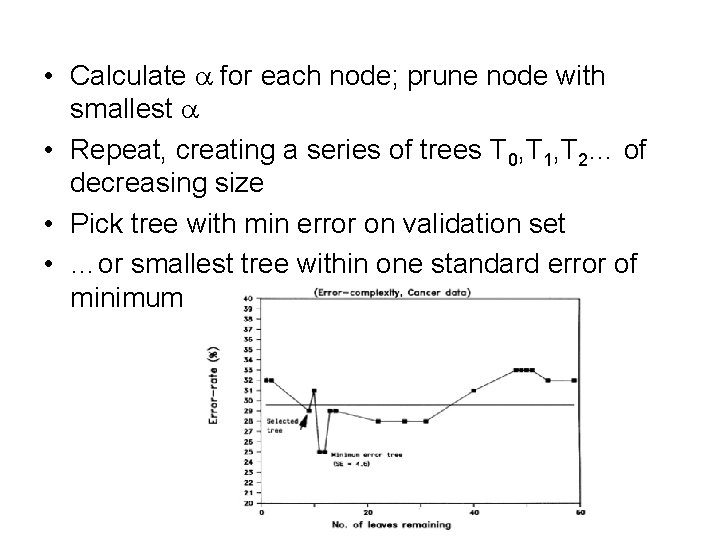
• Calculate a for each node; prune node with smallest a • Repeat, creating a series of trees T 0, T 1, T 2… of decreasing size • Pick tree with min error on validation set • …or smallest tree within one standard error of minimum
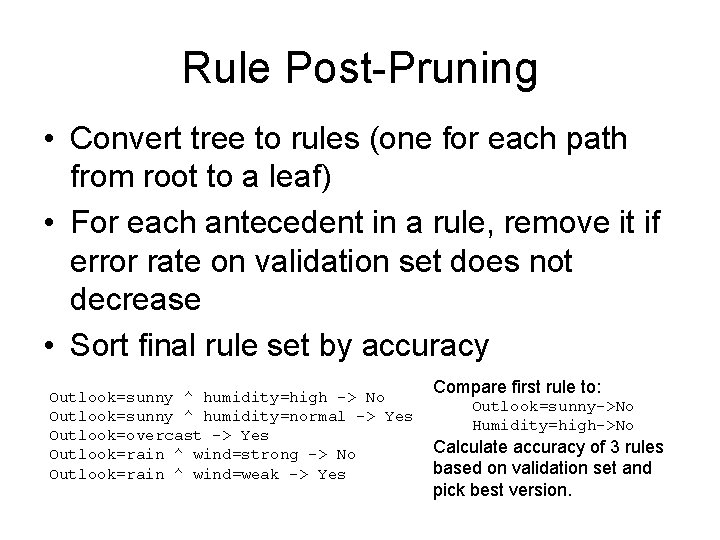
Rule Post-Pruning • Convert tree to rules (one for each path from root to a leaf) • For each antecedent in a rule, remove it if error rate on validation set does not decrease • Sort final rule set by accuracy Outlook=sunny ^ humidity=high -> No Outlook=sunny ^ humidity=normal -> Yes Outlook=overcast -> Yes Outlook=rain ^ wind=strong -> No Outlook=rain ^ wind=weak -> Yes Compare first rule to: Outlook=sunny->No Humidity=high->No Calculate accuracy of 3 rules based on validation set and pick best version.