
Decision Support Systems Concepts Methodologies and Technologies Learning
- Slides: 26
Decision Support Systems Concepts, Methodologies, and Technologies
Learning Objectives n n n Understand possible decision support system (DSS) configurations Understand the key differences and similarities between DSS and BI systems Describe DSS characteristics and capabilities Understand the essential definition of DSS Understand important DSS classifications Understand DSS components and how they integrate 1 -2 Modified from Decision Support Systems and Business Intelligence Systems 9 E.
Learning Objectives n n n 1 -3 n Describe the components and structure of each DSS component Explain Internet impacts on DSS (and vice versa) Explain the unique role of the user in DSS versus management information systems Describe DSS hardware and software platforms Become familiar with a DSS development language Understand current DSS issues Modified from Decision Support Systems and Business Intelligence Systems 9 E.
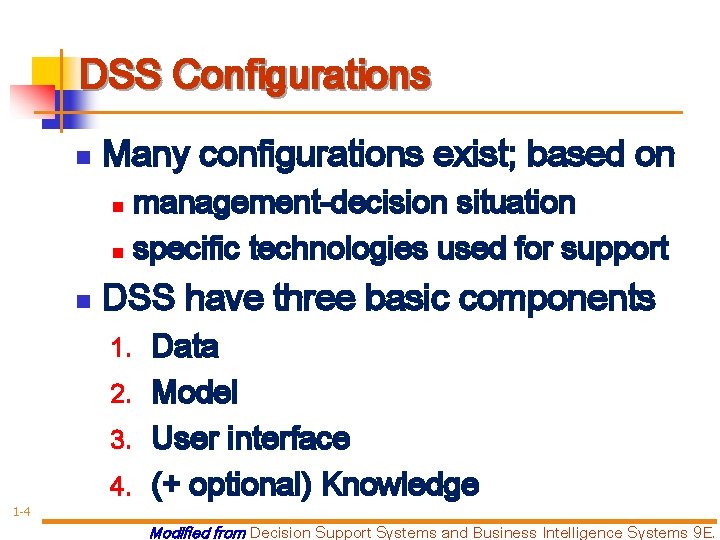
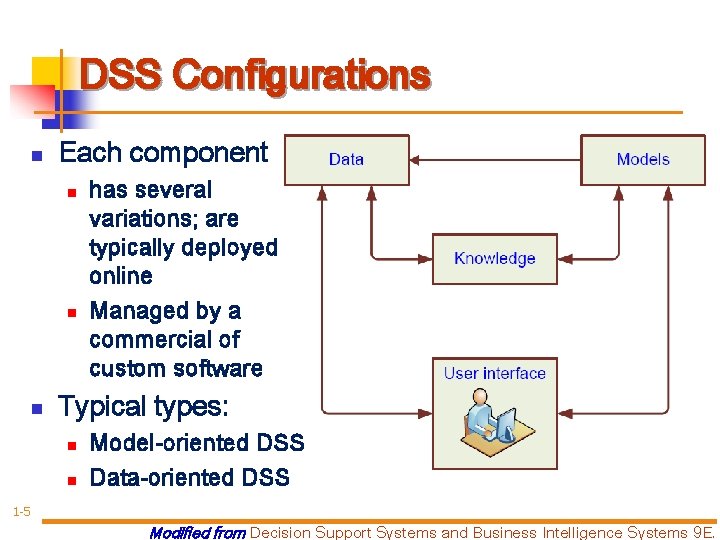
DSS Configurations n Many configurations exist; based on management-decision situation n specific technologies used for support n n DSS have three basic components Data 2. Model 3. User interface 4. (+ optional) Knowledge 1. 1 -4 Modified from Decision Support Systems and Business Intelligence Systems 9 E.
DSS Configurations n Each component n n n has several variations; are typically deployed online Managed by a commercial of custom software Typical types: n n Model-oriented DSS Data-oriented DSS 1 -5 Modified from Decision Support Systems and Business Intelligence Systems 9 E.
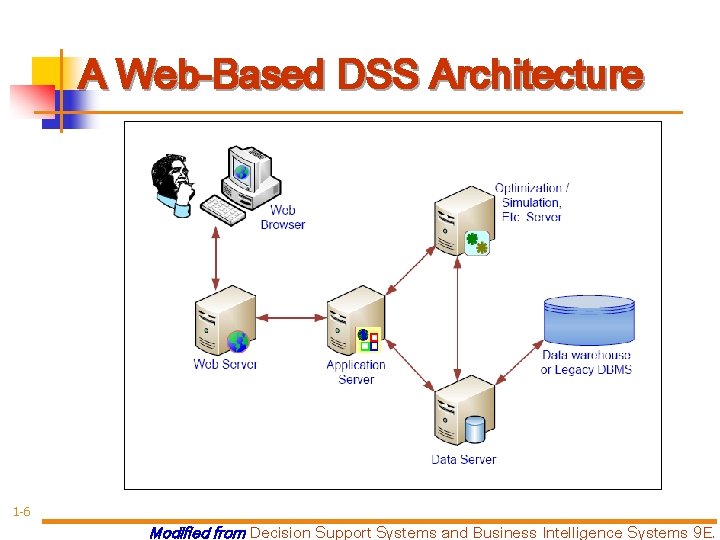
A Web-Based DSS Architecture 1 -6 Modified from Decision Support Systems and Business Intelligence Systems 9 E.
DSS Characteristics and Capabilities n DSS is not quite synonymous with BI n n DSS are generally built to solve a specific problem and include their own database(s) BI applications focus on reporting and identifying problems by scanning data stored in data warehouses Both systems generally include analytical tools (BI called business analytics systems) Although some may run locally as a spreadsheet, both DSS and BI uses Web 1 -7 Modified from Decision Support Systems and Business Intelligence Systems 9 E.
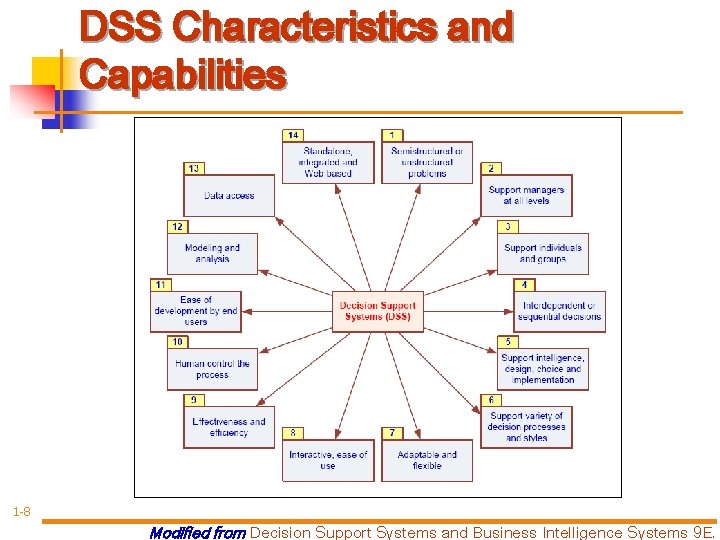
DSS Characteristics and Capabilities 1 -8 Modified from Decision Support Systems and Business Intelligence Systems 9 E.
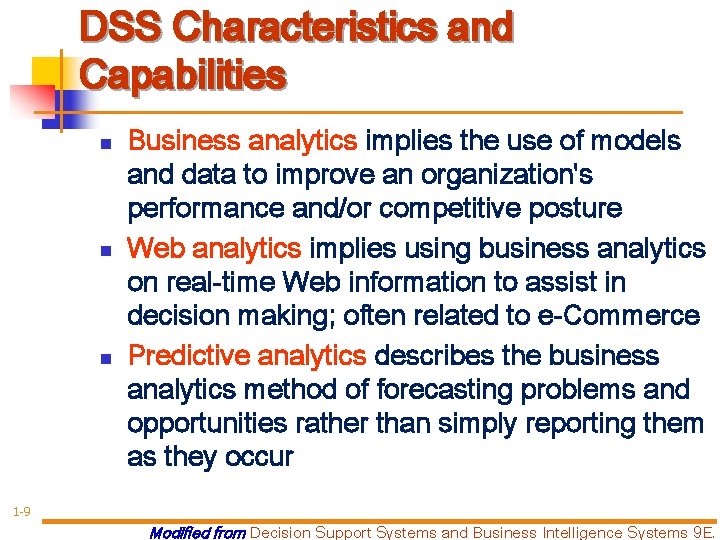
DSS Characteristics and Capabilities n n n Business analytics implies the use of models and data to improve an organization's performance and/or competitive posture Web analytics implies using business analytics on real-time Web information to assist in decision making; often related to e-Commerce Predictive analytics describes the business analytics method of forecasting problems and opportunities rather than simply reporting them as they occur 1 -9 Modified from Decision Support Systems and Business Intelligence Systems 9 E.
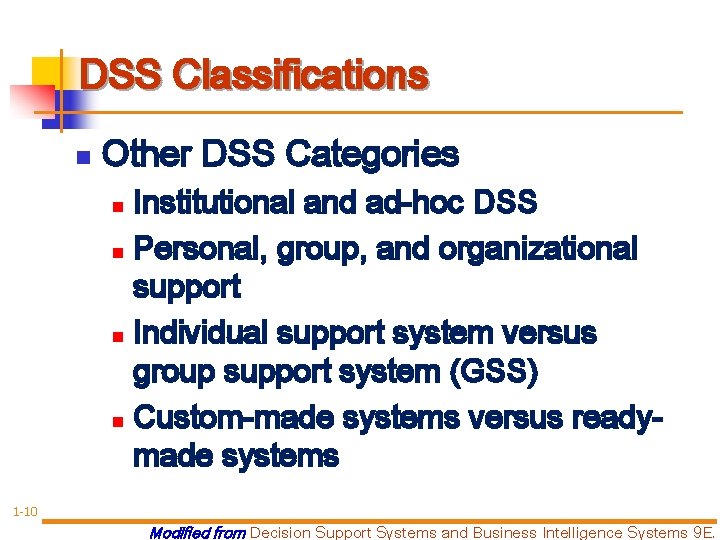
DSS Classifications n Other DSS Categories Institutional and ad-hoc DSS n Personal, group, and organizational support n Individual support system versus group support system (GSS) n Custom-made systems versus readymade systems n 1 -10 Modified from Decision Support Systems and Business Intelligence Systems 9 E.
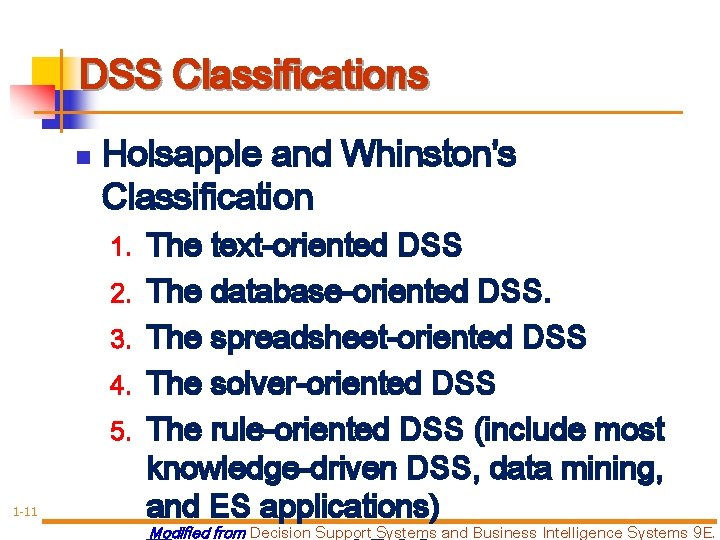
DSS Classifications n Holsapple and Whinston's Classification 1. 2. 3. 4. 5. 1 -11 The text-oriented DSS The database-oriented DSS. The spreadsheet-oriented DSS The solver-oriented DSS The rule-oriented DSS (include most knowledge-driven DSS, data mining, and ES applications) Modified from Decision Support Systems and Business Intelligence Systems 9 E.
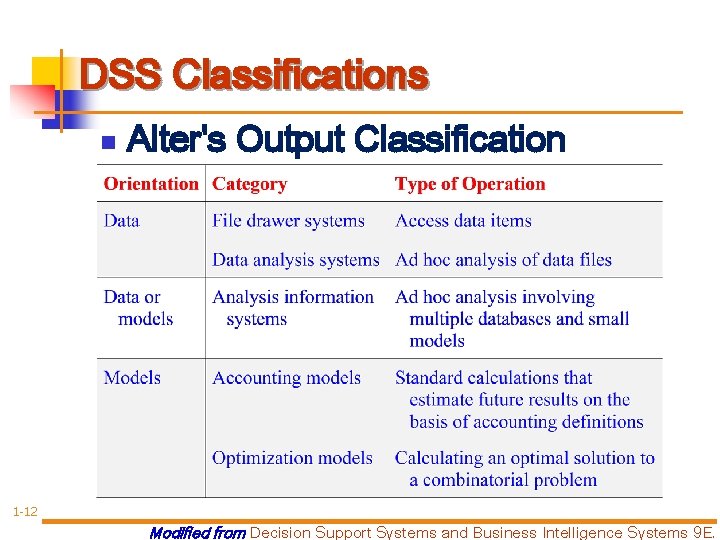
DSS Classifications n Alter's Output Classification 1 -12 Modified from Decision Support Systems and Business Intelligence Systems 9 E.
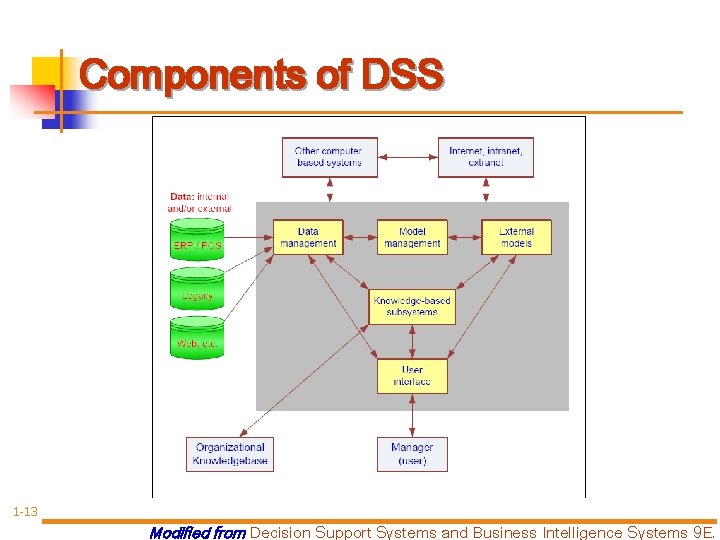
Components of DSS 1 -13 Modified from Decision Support Systems and Business Intelligence Systems 9 E.
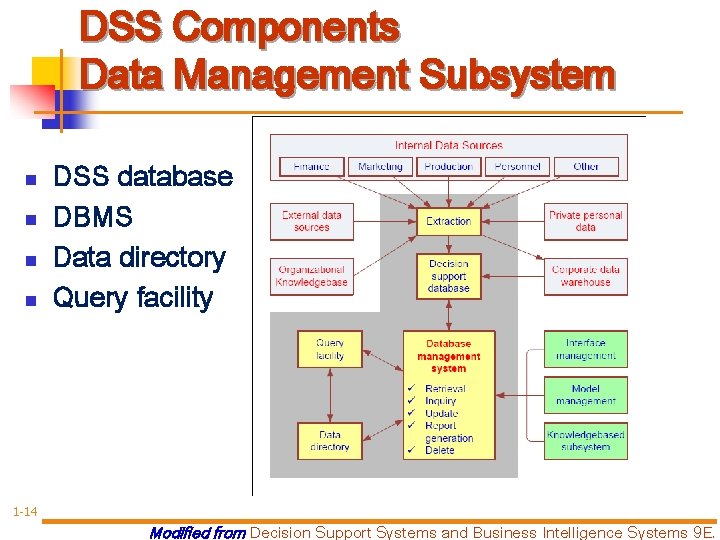
DSS Components Data Management Subsystem n n DSS database DBMS Data directory Query facility 1 -14 Modified from Decision Support Systems and Business Intelligence Systems 9 E.
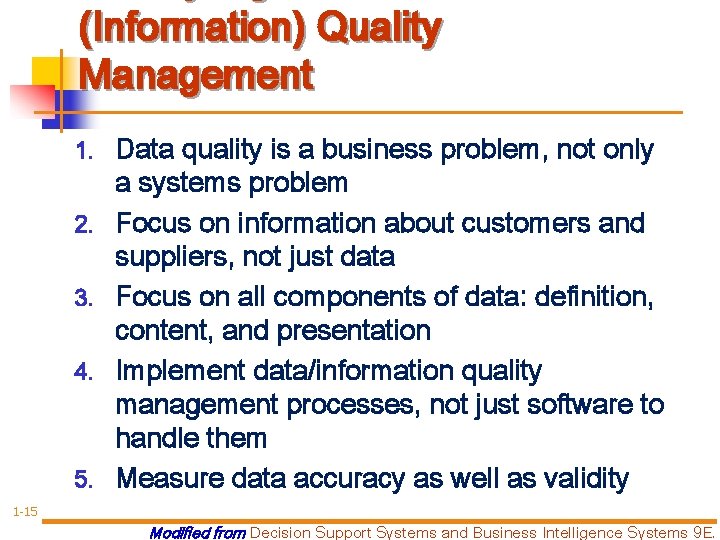
(Information) Quality Management 1. 2. 3. 4. 5. Data quality is a business problem, not only a systems problem Focus on information about customers and suppliers, not just data Focus on all components of data: definition, content, and presentation Implement data/information quality management processes, not just software to handle them Measure data accuracy as well as validity 1 -15 Modified from Decision Support Systems and Business Intelligence Systems 9 E.
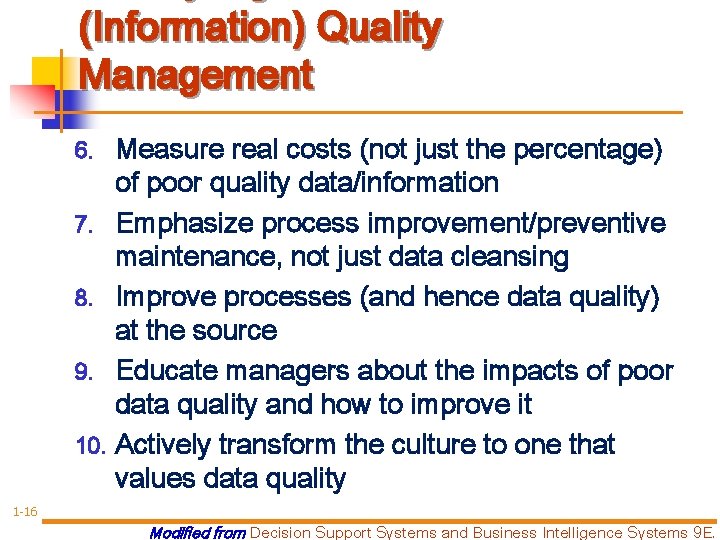
(Information) Quality Management 6. 7. 8. 9. 10. Measure real costs (not just the percentage) of poor quality data/information Emphasize process improvement/preventive maintenance, not just data cleansing Improve processes (and hence data quality) at the source Educate managers about the impacts of poor data quality and how to improve it Actively transform the culture to one that values data quality 1 -16 Modified from Decision Support Systems and Business Intelligence Systems 9 E.
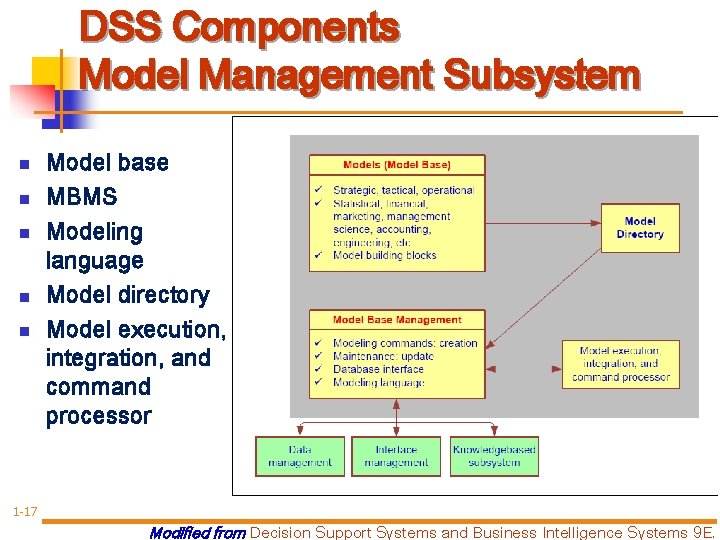
DSS Components Model Management Subsystem n n n Model base MBMS Modeling language Model directory Model execution, integration, and command processor 1 -17 Modified from Decision Support Systems and Business Intelligence Systems 9 E.
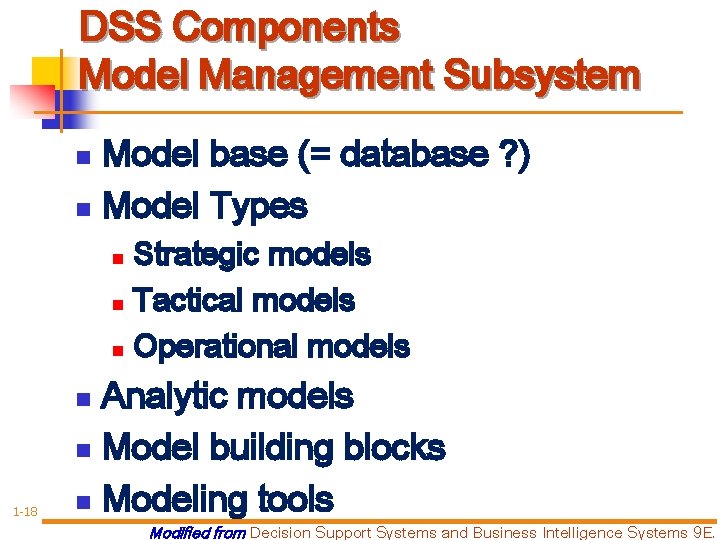
DSS Components Model Management Subsystem Model base (= database ? ) n Model Types n Strategic models n Tactical models n Operational models n Analytic models n Model building blocks n Modeling tools n 1 -18 Modified from Decision Support Systems and Business Intelligence Systems 9 E.
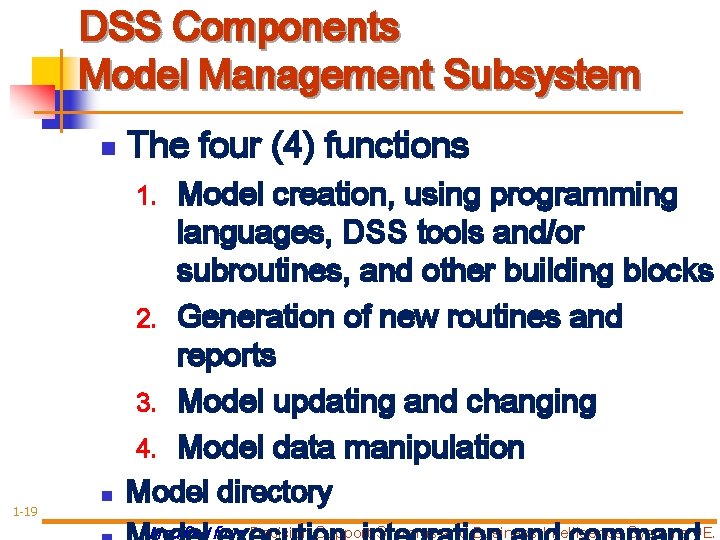
DSS Components Model Management Subsystem n The four (4) functions Model creation, using programming languages, DSS tools and/or subroutines, and other building blocks 2. Generation of new routines and reports 3. Model updating and changing 4. Model data manipulation 1. 1 -19 n Model directory Modified from Decision Support Systems and Business Intelligence Systems 9 E.
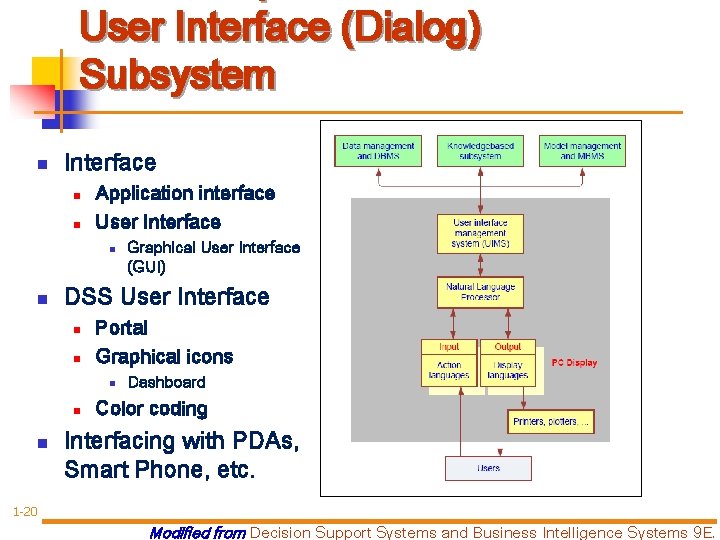
User Interface (Dialog) Subsystem n Interface n n Application interface User Interface n n DSS User Interface n n Portal Graphical icons n n n Graphical User Interface (GUI) Dashboard Color coding Interfacing with PDAs, Smart Phone, etc. 1 -20 Modified from Decision Support Systems and Business Intelligence Systems 9 E.
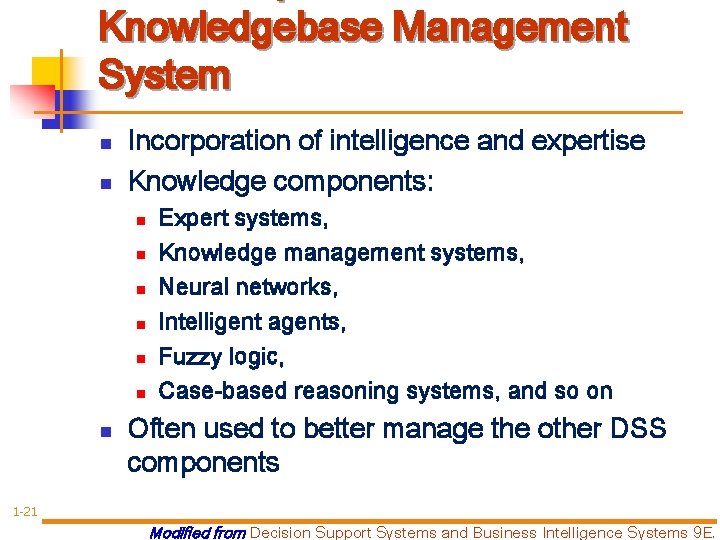
Knowledgebase Management System n n Incorporation of intelligence and expertise Knowledge components: n n n n Expert systems, Knowledge management systems, Neural networks, Intelligent agents, Fuzzy logic, Case-based reasoning systems, and so on Often used to better manage the other DSS components 1 -21 Modified from Decision Support Systems and Business Intelligence Systems 9 E.
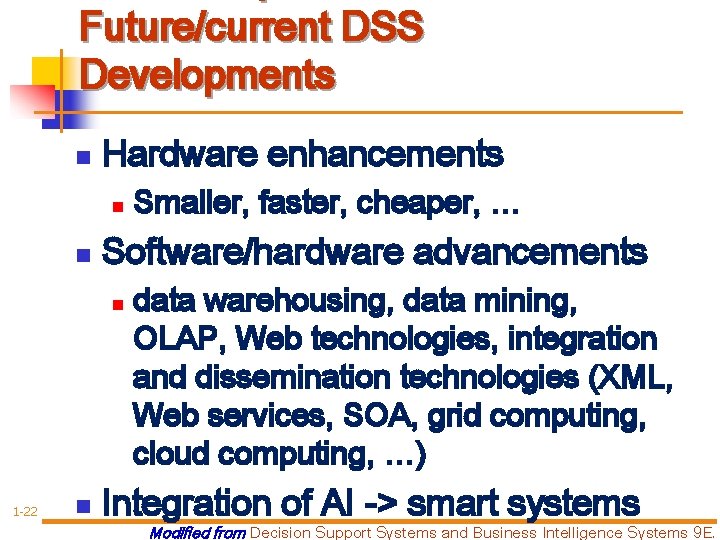
Future/current DSS Developments n Hardware enhancements n n Software/hardware advancements n 1 -22 n Smaller, faster, cheaper, … data warehousing, data mining, OLAP, Web technologies, integration and dissemination technologies (XML, Web services, SOA, grid computing, cloud computing, …) Integration of AI -> smart systems Modified from Decision Support Systems and Business Intelligence Systems 9 E.
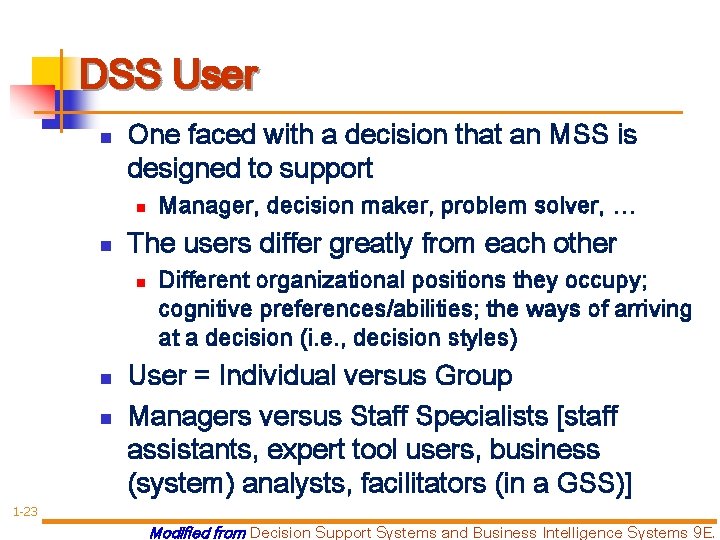
DSS User n One faced with a decision that an MSS is designed to support n n The users differ greatly from each other n n n Manager, decision maker, problem solver, … Different organizational positions they occupy; cognitive preferences/abilities; the ways of arriving at a decision (i. e. , decision styles) User = Individual versus Group Managers versus Staff Specialists [staff assistants, expert tool users, business (system) analysts, facilitators (in a GSS)] 1 -23 Modified from Decision Support Systems and Business Intelligence Systems 9 E.
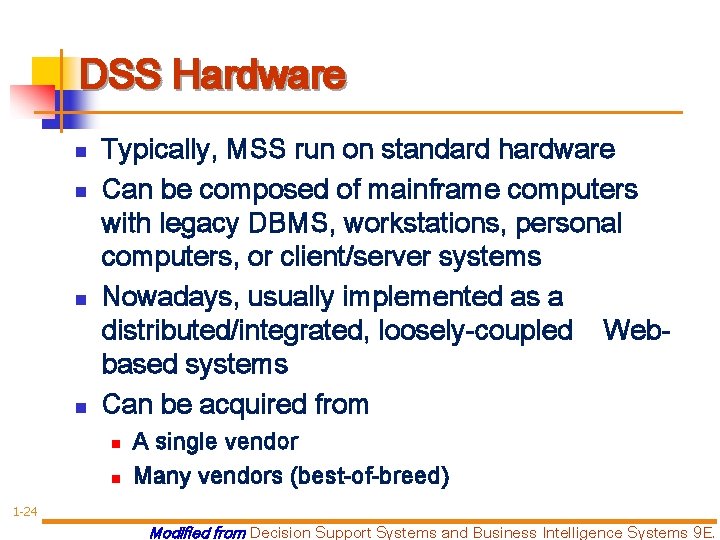
DSS Hardware n n Typically, MSS run on standard hardware Can be composed of mainframe computers with legacy DBMS, workstations, personal computers, or client/server systems Nowadays, usually implemented as a distributed/integrated, loosely-coupled Webbased systems Can be acquired from n n A single vendor Many vendors (best-of-breed) 1 -24 Modified from Decision Support Systems and Business Intelligence Systems 9 E.
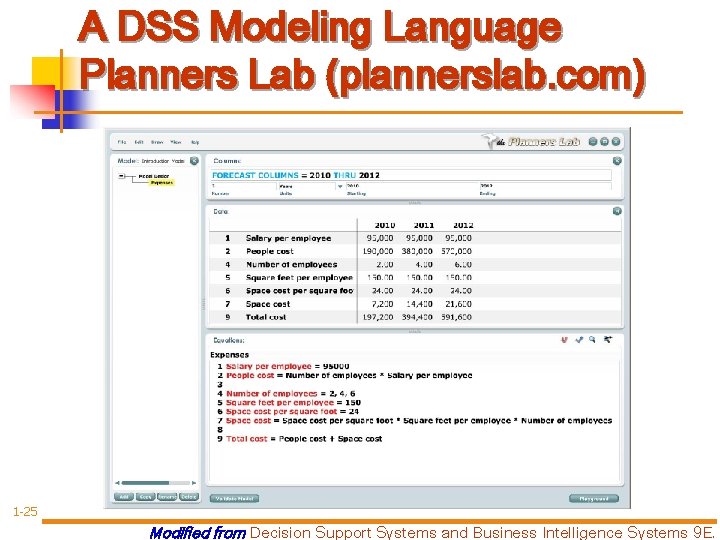
A DSS Modeling Language Planners Lab (plannerslab. com) 1 -25 Modified from Decision Support Systems and Business Intelligence Systems 9 E.
End of the Chapter n Questions / Comments… 1 -26 Modified from Decision Support Systems and Business Intelligence Systems 9 E.