
Decision support diagrams for public protective actions during
Decision support diagrams for public protective actions during nuclear emergencies 5 th NERIS Workshop, 3 -5 April 2019 Jan Johansson, Peder Kock, Anna Maria Blixt Buhr, Jonas Lindgren, Jonas Boson, Simon Karlsson
Responsibilities during nuclear emergencies Decision making – Decision making rests with the organisations normally responsible for the sector or the administrative region – The County Administrative Boards are responsible for decisions on civil protection (e. g. evacuation and sheltering) Advice – SSM is responsible for providing recommendations and expert advice on i. a. protective actions, dispersion prognosis, radiation monitoring and conditions at the NPP Licensee – A licensee is required to take prompt actions in order to classify the event, alert authorities, assess possible releases and restore the facility to a safe and stable state

Prerequisites Based on emergency class and estimated release magnitude Adapted to the possibilities for protective actions offered by the present emergency response planning Covers an event from facility emergency to termination of the emergency Decisions on protective actions primarily at predetermined distances Some protective actions to be implemented all around the NPP whereas others within the area at risk High threshold to terminate decided protective actions

Protective actions Precautionary evacuation Evacuation Sheltering ITB Relocation Actions to reduce inadvertent ingestion of radioactive substances on the skin Decontamination of people Medical care Food restrictions
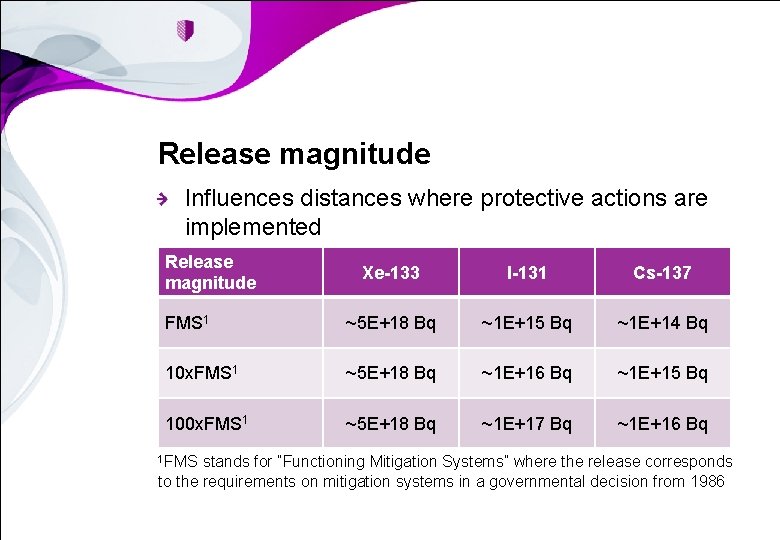
Release magnitude Influences distances where protective actions are implemented Release magnitude Xe-133 I-131 Cs-137 FMS 1 ~5 E+18 Bq ~1 E+15 Bq ~1 E+14 Bq 10 x. FMS 1 ~5 E+18 Bq ~1 E+16 Bq ~1 E+15 Bq 100 x. FMS 1 ~5 E+18 Bq ~1 E+17 Bq ~1 E+16 Bq 1 FMS stands for ”Functioning Mitigation Systems” where the release corresponds to the requirements on mitigation systems in a governmental decision from 1986
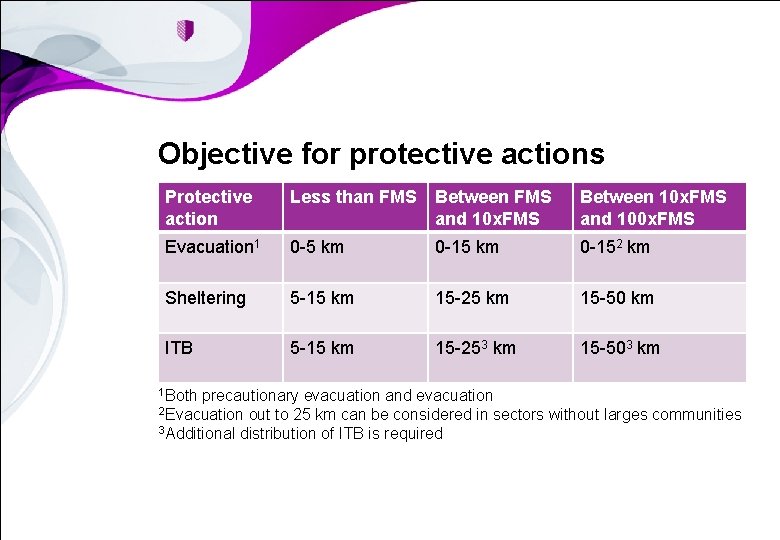
Objective for protective actions Protective action Less than FMS Between FMS and 10 x. FMS Between 10 x. FMS and 100 x. FMS Evacuation 1 0 -5 km 0 -152 km Sheltering 5 -15 km 15 -25 km 15 -50 km ITB 5 -15 km 15 -253 km 15 -503 km 1 Both precautionary evacuation and evacuation out to 25 km can be considered in sectors without larges communities 3 Additional distribution of ITB is required 2 Evacuation
Time to and duration of release Time to release – Influences the area affected by the release – Influences if complementary and additional ITB can be distributed – Influences when to recommend sheltering – Influences when to recommend intake of ITB – Influences when to recommend food restrictions Duration of release – Influences the area affected by the release – Influences when sheltering can/must be discontinued
Area at risk and adjustment of distances Area at risk – Area that may be affected by a release to such an extent that protective actions are necessary – Area at risk can cover certain sectors or the full circle around the NPP Adjustment of distances – Distances for evacuation, sheltering and ITB may be adjusted based on the actual weather situation – Adjusted distances based on dispersion prognosis and present release magnitude FMS, 10 x. FMS or 100 x. FMS
Questions? Contact: jan. johansson@ssm. se
- Slides: 9