
Decision Making Value Propositions and Project Failures Reality
- Slides: 10
Decision Making, Value Propositions, and Project Failures Reality and Responsibility INCOSE Las Vegas September 15 -18 Rick Dove dove@parshift. com Paradigm Shift International
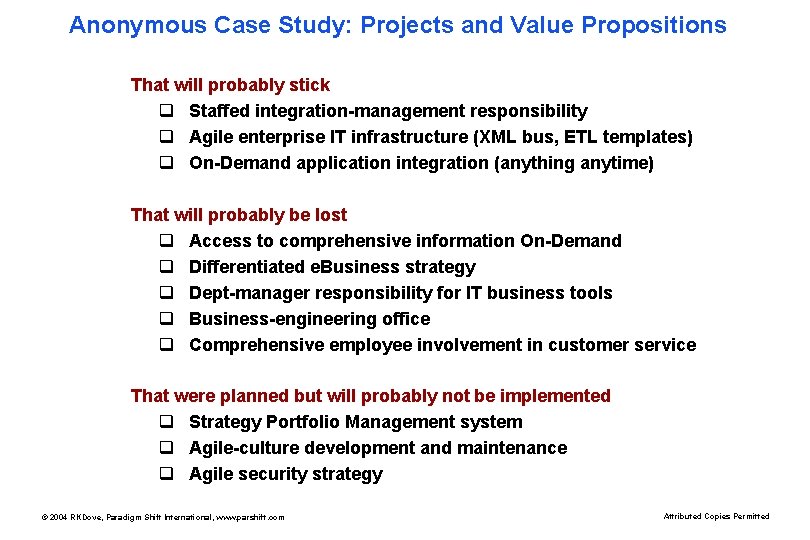
Anonymous Case Study: Projects and Value Propositions That will probably stick q Staffed integration-management responsibility q Agile enterprise IT infrastructure (XML bus, ETL templates) q On-Demand application integration (anything anytime) That will probably be lost q Access to comprehensive information On-Demand q Differentiated e. Business strategy q Dept-manager responsibility for IT business tools q Business-engineering office q Comprehensive employee involvement in customer service That were planned but will probably not be implemented q Strategy Portfolio Management system q Agile-culture development and maintenance q Agile security strategy © 2004 RKDove, Paradigm Shift International, www. parshift. com Attributed Copies Permitted
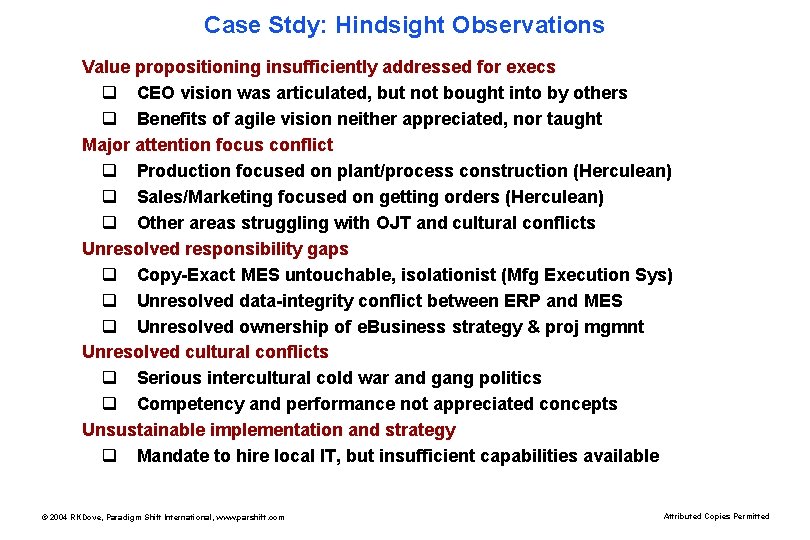
Case Stdy: Hindsight Observations Value propositioning insufficiently addressed for execs q CEO vision was articulated, but not bought into by others q Benefits of agile vision neither appreciated, nor taught Major attention focus conflict q Production focused on plant/process construction (Herculean) q Sales/Marketing focused on getting orders (Herculean) q Other areas struggling with OJT and cultural conflicts Unresolved responsibility gaps q Copy-Exact MES untouchable, isolationist (Mfg Execution Sys) q Unresolved data-integrity conflict between ERP and MES q Unresolved ownership of e. Business strategy & proj mgmnt Unresolved cultural conflicts q Serious intercultural cold war and gang politics q Competency and performance not appreciated concepts Unsustainable implementation and strategy q Mandate to hire local IT, but insufficient capabilities available © 2004 RKDove, Paradigm Shift International, www. parshift. com Attributed Copies Permitted
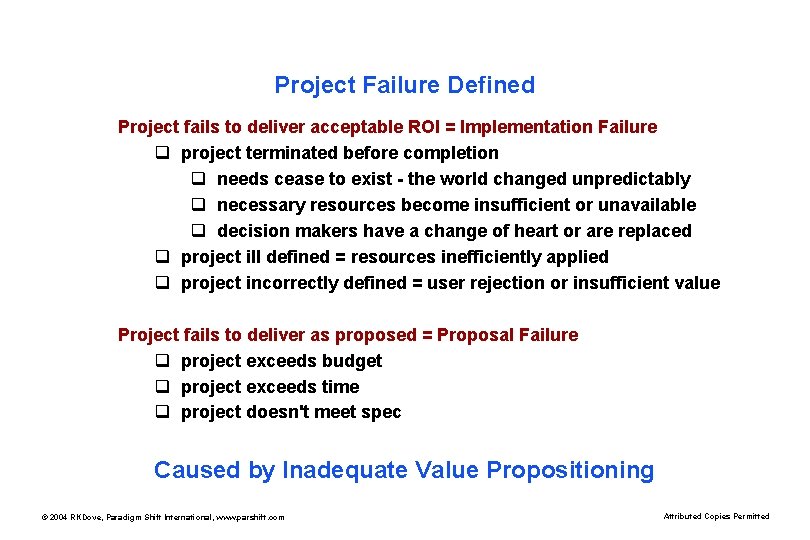
Project Failure Defined Project fails to deliver acceptable ROI = Implementation Failure q project terminated before completion q needs cease to exist - the world changed unpredictably q necessary resources become insufficient or unavailable q decision makers have a change of heart or are replaced q project ill defined = resources inefficiently applied q project incorrectly defined = user rejection or insufficient value Project fails to deliver as proposed = Proposal Failure q project exceeds budget q project exceeds time q project doesn't meet spec Caused by Inadequate Value Propositioning © 2004 RKDove, Paradigm Shift International, www. parshift. com Attributed Copies Permitted
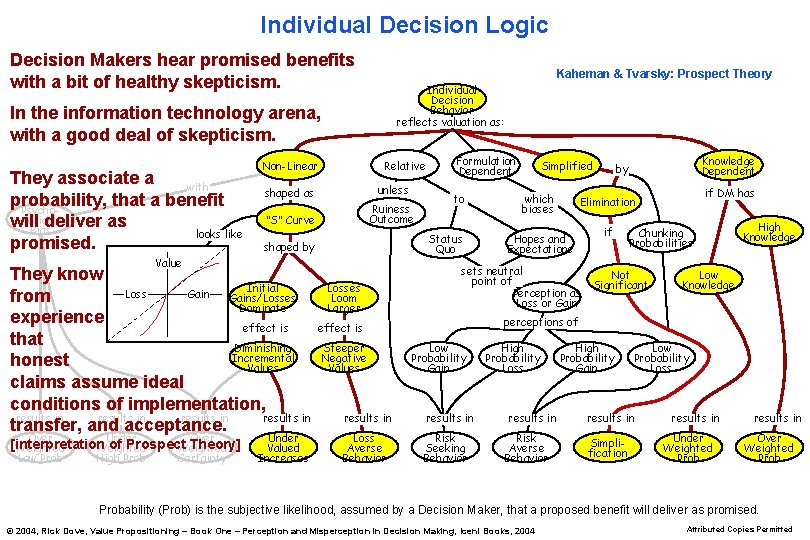
Individual Decision Logic Decision Makers hear promised benefits with a bit of healthy skepticism. Kaheman & Tvarsky: Prospect Theory Individual Decision Behavior reflects valuation as: In the information technology arena, with a good deal of skepticism. They associate a with probability, that a benefit Psychological will deliver as Bias looks like promised. Non-Linear Relative unless shaped as Ruiness Outcome "S" Curve Value Over Under Over Low Prob High Prob Certainty [interpretation of Prospect Theory] Weighted Under Valued Increases to Status Quo shaped by They know Initial Loss Gain from Gains/Losses Dominate experience effect is that Diminishing Incremental honest Values claims assume ideal conditions of implementation, results in transfer, and acceptance. Formulation Dependent Losses Loom Larger which biases Knowledge Dependent by if DM has Elimination Hopes and Expectations sets neutral point of Perception as Loss or Gain if Chunking Probabilities Not Significant High Knowledge Low Knowledge perceptions of effect is Steeper Negative Values Simplified Low Probability Gain results in Loss Averse Behavior Risk Seeking Behavior High Probability Loss results in Risk Averse Behavior High Probability Gain Low Probability Loss results in Simplification results in Under Weighted Prob results in Over Weighted Probability (Prob) is the subjective likelihood, assumed by a Decision Maker, that a proposed benefit will deliver as promised. © 2004, Rick Dove, Value Propositioning – Book One – Perception and Misperception in Decision Making, Iceni Books, 2004 Attributed Copies Permitted
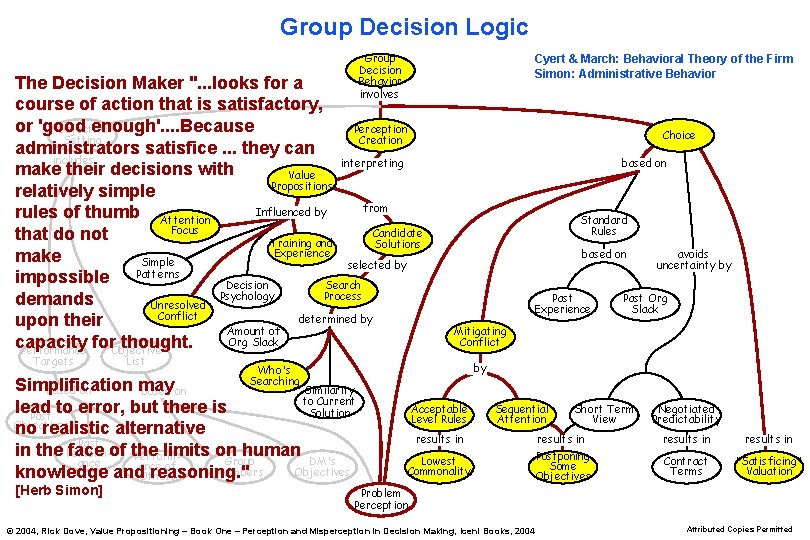
Group Decision Logic Group Decision Behavior involves The Decision Maker ". . . looks for a course of action that is satisfactory, or 'good enough'. . Because Objective Perception Setting Creation administrators satisfice. . . they can includes interpreting make their decisions with Value Propositions relatively simple from Influenced by rules of thumb Attention Focus Candidate that do not Training and Solutions Experience make Simple selected by Patterns impossible Decision Search Psychology Process demands Unresolved Conflict determined by upon their Amount of Org Slack capacity for. Objective thought. Performance Targets List Choice based on Standard Rules based on Past Experience avoids uncertainty by Past Org Slack Mitigating Conflict by Who's Searching Simplification may based on Similarity based on to Current lead to error, but there is Solution Past Objectives no realistic alternative Past in the Performface of the limits on human DM's Perform. Group ance of Members Objectives knowledge andance reasoning. " Others [Herb Simon] Cyert & March: Behavioral Theory of the Firm Simon: Administrative Behavior Acceptable Level Rules Sequential Attention Short Term View Negotiated Predictability results in Lowest Commonality Postponing Some Objectives Contract Terms "Satisficing" Valuation Problem Perception © 2004, Rick Dove, Value Propositioning – Book One – Perception and Misperception in Decision Making, Iceni Books, 2004 Attributed Copies Permitted
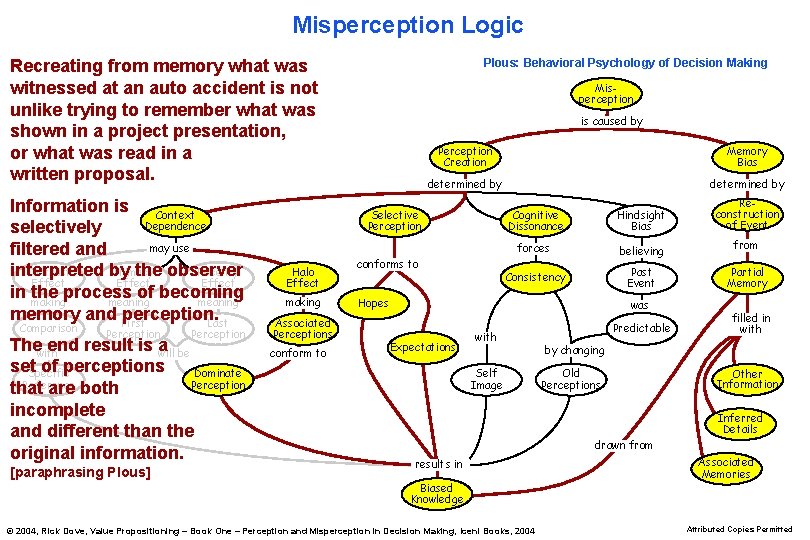
Misperception Logic Plous: Behavioral Psychology of Decision Making Recreating from memory what was witnessed at an auto accident is not unlike trying to remember what was shown in a project presentation, or what was read in a written proposal. Information is Context Dependence selectively may use filtered and Contrast Primacy Recency interpreted by the observer Effect in the process of becoming making meaning memory and First perception. Last Comparison Perception Thewith end result is will a be set. Specific of perceptions Dominate Reference Perception that are both incomplete and different than the original information. [paraphrasing Plous] Misperception is caused by Perception Creation Memory Bias determined by Selective Perception Halo Effect making Associated Perceptions conform to conforms to Cognitive Dissonance Hindsight Bias forces believing Consistency Past Event Hopes was Expectations with Self Image Predictable Reconstruction of Event from Partial Memory filled in with by changing Old Perceptions Other Information Inferred Details drawn from results in Biased Knowledge © 2004, Rick Dove, Value Propositioning – Book One – Perception and Misperception in Decision Making, Iceni Books, 2004 Associated Memories Attributed Copies Permitted
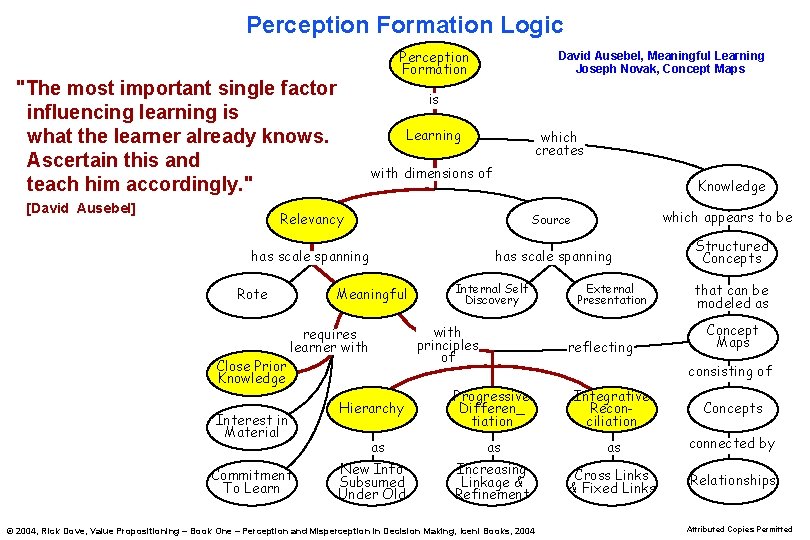
Perception Formation Logic Perception Formation "The most important single factor influencing learning is what the learner already knows. Ascertain this and teach him accordingly. " [David Ausebel] David Ausebel, Meaningful Learning Joseph Novak, Concept Maps is Learning which creates with dimensions of Knowledge which appears to be Relevancy Source has scale spanning Rote Close Prior Knowledge Meaningful with principles of requires learner with Interest in Material Commitment To Learn Internal Self Discovery Hierarchy as New Info Subsumed Under Old External Presentation reflecting Structured Concepts that can be modeled as Concept Maps consisting of Progressive Differen_ tiation Integrative Reconciliation Concepts as as connected by Increasing Linkage & Refinement Cross Links & Fixed Links Relationships © 2004, Rick Dove, Value Propositioning – Book One – Perception and Misperception in Decision Making, Iceni Books, 2004 Attributed Copies Permitted
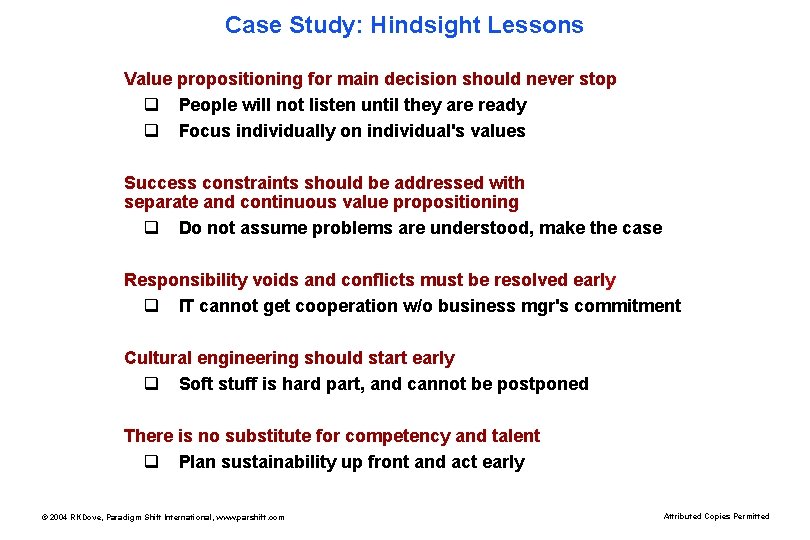
Case Study: Hindsight Lessons Value propositioning for main decision should never stop q People will not listen until they are ready q Focus individually on individual's values Success constraints should be addressed with separate and continuous value propositioning q Do not assume problems are understood, make the case Responsibility voids and conflicts must be resolved early q IT cannot get cooperation w/o business mgr's commitment Cultural engineering should start early q Soft stuff is hard part, and cannot be postponed There is no substitute for competency and talent q Plan sustainability up front and act early © 2004 RKDove, Paradigm Shift International, www. parshift. com Attributed Copies Permitted
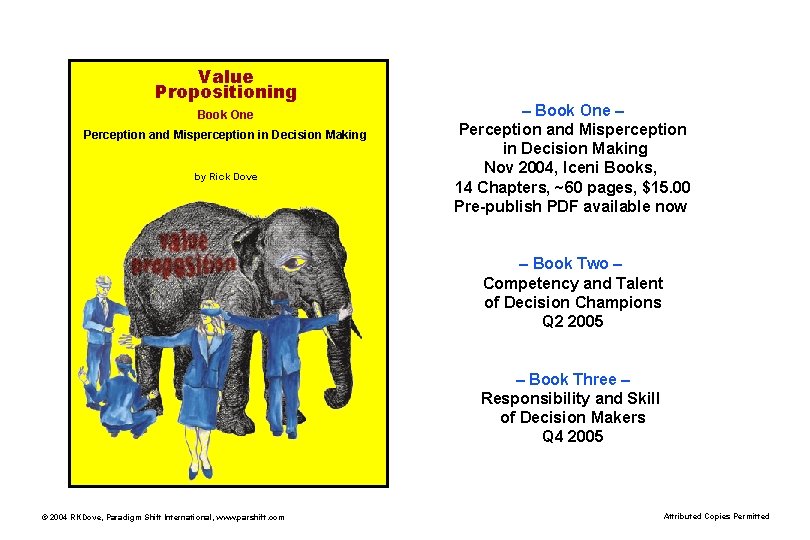
Value Propositioning Book One Perception and Misperception in Decision Making by Rick Dove – Book One – Perception and Misperception in Decision Making Nov 2004, Iceni Books, 14 Chapters, ~60 pages, $15. 00 Pre-publish PDF available now – Book Two – Competency and Talent of Decision Champions Q 2 2005 – Book Three – Responsibility and Skill of Decision Makers Q 4 2005 © 2004 RKDove, Paradigm Shift International, www. parshift. com Attributed Copies Permitted