
Decision making process basic options assessment Mercury Storage
Decision making process / basic options assessment Mercury Storage and Disposal LAC Two Countries Project Gustavo Solórzano Ochoa, Consultant Montevideo, Uruguay 28 -29 June 2011
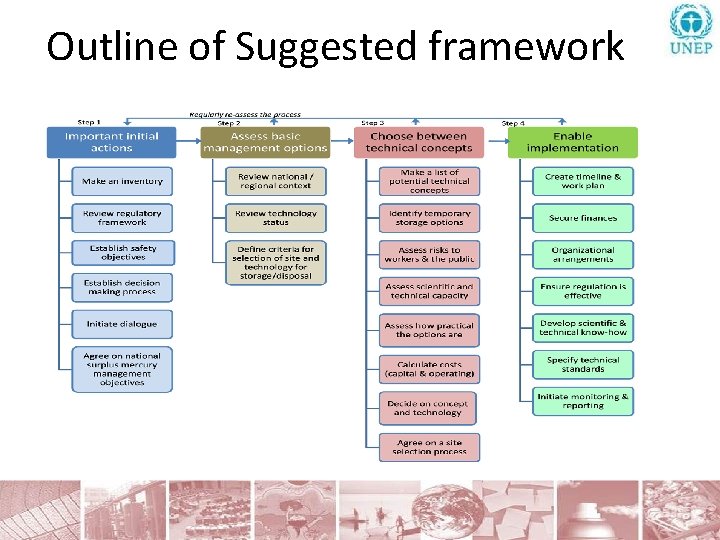
Outline of Suggested framework

Stage 1. Important initial actions Actions • Make an inventory • Review regulatory framework • Establish safety objectives • Establish decision making process • Initiate dialogue • Agree on national surplus mercury management objectives

Stage 1. Important initial actions 3. Establish safety objectives • Protection of human health • Protection of the environment • Protection beyond national borders • Protection of future generations • Burdens on future generations.

Stage 1. Important initial actions 4. Establish a decision making process • Identify any existing mechanisms for co-ordinating decisions about hazardous materials, public health and environmental protection Ø Commissions Ø Networks Ø Institutes, etc. • If they do not exist, create national interagency coordinating bodies (government, NGOs, industry, academy, etc. • Define stakeholders involved in the process

Stage 1. Important initial actions 4. Establish a decision making process • Define the roles of central and regional government departments as well as other official agencies, and other stakeholders (e. g. civil society and research institutions responsible for public health and environmental protection) • Establish any need for new organisations (expert panels, inspection teams, etc. • Decide on the nature and extent of stakeholder engagement etc. • At the end of the dialogue process, the objectives of the national surplus mercury management will be agreed upon
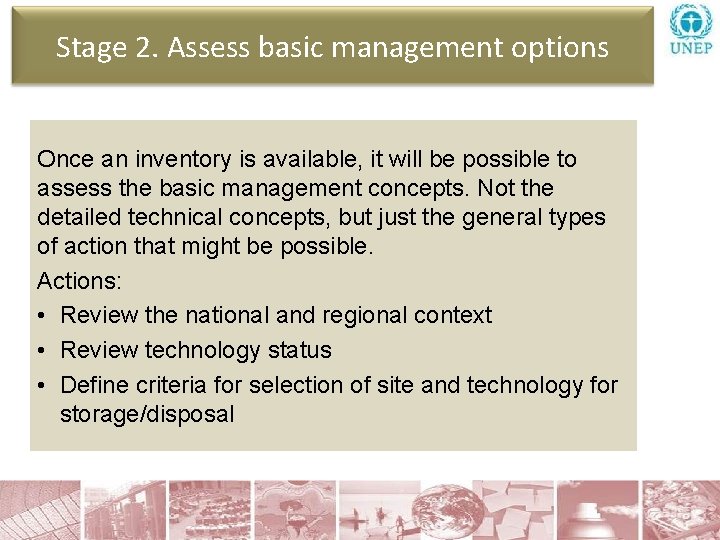
Stage 2. Assess basic management options Once an inventory is available, it will be possible to assess the basic management concepts. Not the detailed technical concepts, but just the general types of action that might be possible. Actions: • Review the national and regional context • Review technology status • Define criteria for selection of site and technology for storage/disposal
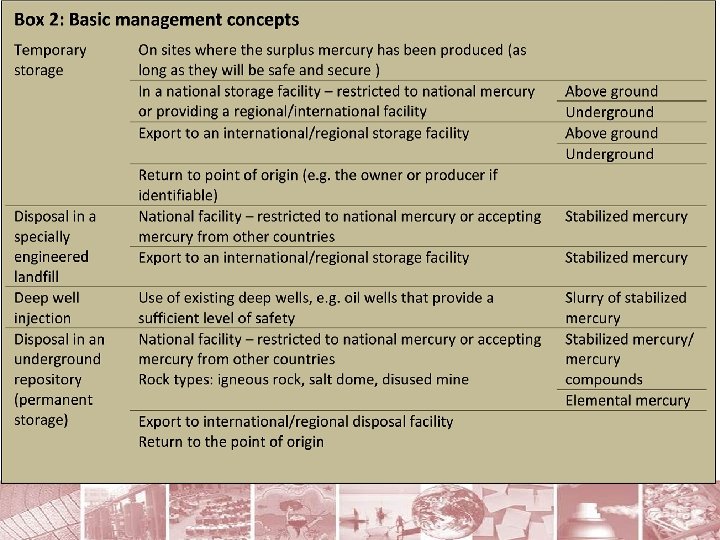
Stage 2. Assess basic management options Some of the basic management options may not be available due to: • political constraints • lack of resources • lack of suitable local geologies • the technology involved has not yet been demonstrated It is then important to consider: 1. Review the national /regional context 2. Review technology status

Stage 2. Assess basic management options 3. Define criteria for site selection & technology for storage/disposal For above ground facilities: · · · · Floodplains Unstable terrain Wetlands Unfavourable weather Groundwater conditions Earthquake zones Incompatible land use Karst soils
Stage 3. Choosing between technical concepts Actions • Make a list of potential technical options • Identify temporary storage options • Assess risks to workers and the public • Assess scientific and technical capacity
Stage 3. Choosing between technical concepts Actions • Estimate costs (capital and operating). • Assess how practical the options are • Decide on concept and technology • Agree on a site selection process
Stage 3. Choosing between technical concepts 1. Make a list of potential technical concepts It is possible that temporary storage will be the only safe option at present. It could imply a combination of technologies. 2. Identify temporary storage options Considering: • Action is before central storage/disposal facilities become available • Timescales for temporary storage • Environmental risk associated with no further action
Stage 3. Choosing between technical concepts 3. Assess risks to workers and the public • Includes hazards and associated risks from processing and transporting mercury, as well as the operating period of a store, and the post-closure period for a disposal facility. • Involves: ü identifying the hazards (chemical toxicity, structural stability) ü likelihood of harm • will require comparison with national and international safety standards • The significance of the risks may need to be compared to other environmental and human health risks • Actions should be proportionate and cost-effective with the overall goal of protecting human health and the environment.
Stage 3. Choosing between technical concepts 4. Assess scientific and technical capacity According to the roles and responsibilities of current owners of mercury, operators of facilities that may accept redundant mercury, regulators, etc. 5. Assess how practical the options are In terms of: • governance at the national and local level; • whether the regulatory framework can be implemented in practice; and • public acceptance of options.
Stage 3. Choosing between technical concepts 6. Calculate costs (capital and operating) • Cost estimates • Decide who bears them • Consequences A detailed cost analysis that could be the basis for an investment will only be possible after the selection of one or several potential sites
Stage 3. Choosing between technical concepts 7. Decide on concept and technology Includes a decision on whether each step of the handling/treatment/storage/disposal–chain for mercury, as well as the total system is acceptable. 8. Agree on a site selection process A site selection process is a structured and transparent procedure that guides decision makers and stakeholders through all steps between the fundamental decision to store or dispose surplus mercury and the final site selection.
Stage 3. Choosing between technical concepts 8. Agree on a site selection process The process could include elements like: • the desired output (i. e. identification of one/several suitable sites, timelines) • safety objectives • site selection criteria: minimum requirements and exclusion criteria • actors and responsibilities • timelines • steps of site identification, investigation and assessment • involvement of stakeholders • decision process (who will decide and necessary information)
Stage 4. Activities to enable implementation 1. Create timeline & work plan • Establishment of realistic timescales for implementation is essential • A work plan should be published and then regularly reviewed. 2. Secure finances • Decide who will bear the cost of surplus mercury management • Find a way to raise the necessary funds for investment
Stage 4. Activities to enable implementation 3. Organisational arrangements • Decide on roles and responsibilities • Identify a lead organisation responsible for the process and make this known. 4. Ensure regulation is effective • Check that the regulatory framework is appropriate. • Ensure that regulatory bodies are in place to make checks
Stage 4. Activities to enable implementation 5. Develop scientific & technical know-how • May involve regional/international cooperation • Operators of storage or disposal facilities must be adequately qualified and experienced. 6. Specify technical standards Includes environmental quality standards, as well as construction and health and safety standards 7. Initiate monitoring and reporting A responsible/qualified organisation undertakes an appropriate level of environmental monitoring
Thank you very much Division of Technology, Industry and Economics Chemicals Branch 11– 13 chemin des Anémones CH-1219 Châtelaine, Geneva, Switzerland Tel: +41 22 917 8111 Fax: +41 22 797 3460 E-mail: chemicals@unep. ch Web: www. chem. unep. ch
- Slides: 22