
Decision Making Higher Business Management Examples of Personal
Decision Making Higher Business Management

Examples of Personal Decisions – Will I stay in and wash my hair? – Will I go to the cinema with my friends? – Will I paint my bedroom? – Will I hang wallpaper on the walls? – Will I go to College locally? – Will I study and live in another town or city?
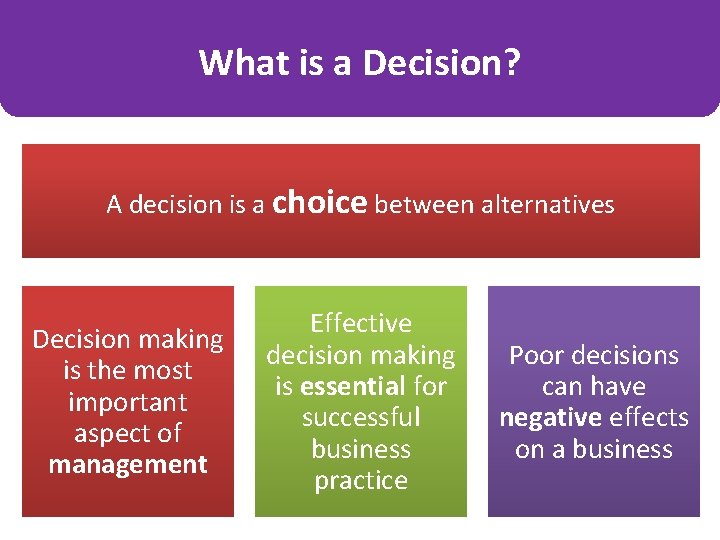
What is a Decision? A decision is a choice between alternatives Decision making is the most important aspect of management Effective decision making is essential for successful business practice Poor decisions can have negative effects on a business
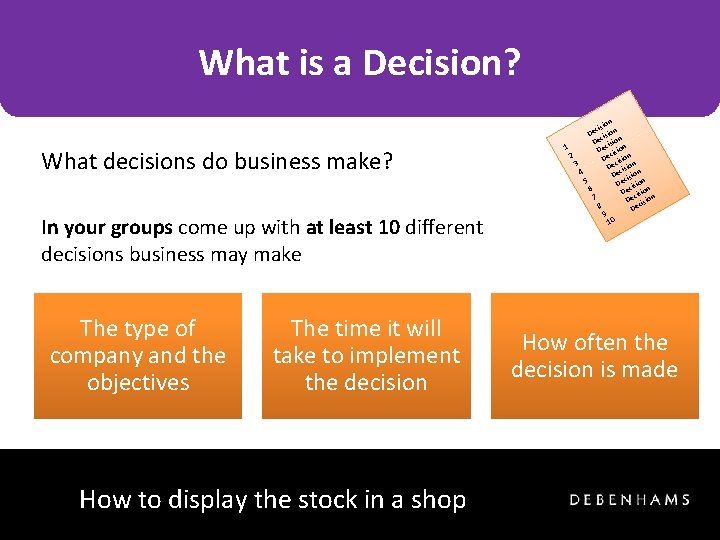
What is a Decision? What decisions do business make? In your groups come up with at least 10 different decisions business may make The type of company and the objectives The time it will take to implement the decision How to display the stock in a shop ion cis De cision 1. De cision 2. De cision 3. De cision 4. De cision 5. De cision 6. De cision 7. De cision 8. De 9. . 10 How often the decision is made

Decisions, Decisions! – Will I stay in and wash my hair? – SHORT-TERM DECISION (Low Risk) – Will I paint my bedroom? – MEDIUM-TERM DECISION (Medium Risk) – Will I go to College locally? – LONG-TERM DECISION (High Risk)
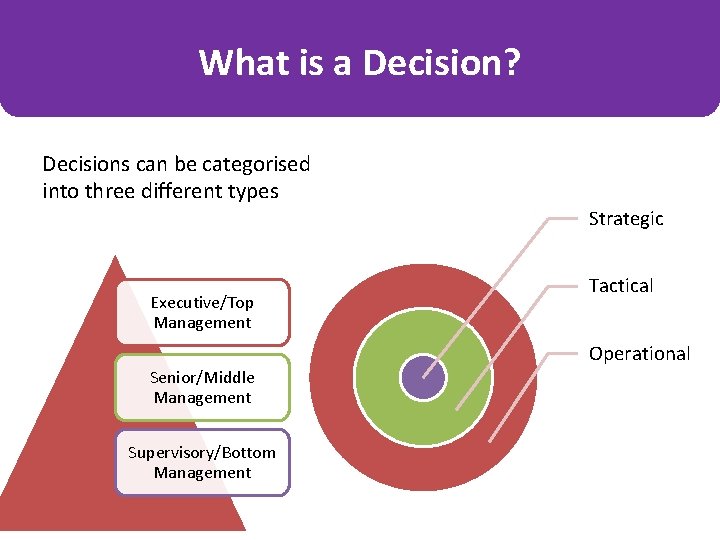
What is a Decision? Decisions can be categorised into three different types Strategic Executive/Top Management Tactical Operational Senior/Middle Management Supervisory/Bottom Management
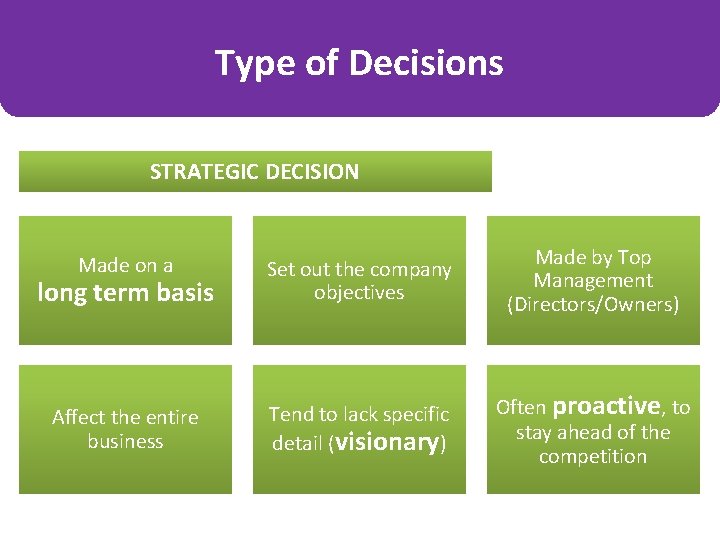
Type of Decisions STRATEGIC DECISION Made on a long term basis Set out the company objectives Made by Top Management (Directors/Owners) Affect the entire business Tend to lack specific detail (visionary) Often proactive, to stay ahead of the competition
Type of Decisions STRATEGIC DECISION What products the business will produce What sections of the market the business will aim for Where the business will be in 5 -10 years time
Type of Decisions TACTICAL DECISION Made on a monthly/yearly basis (medium term) Made by Middle Management Made to achieve the businesses main objectives Often very specific
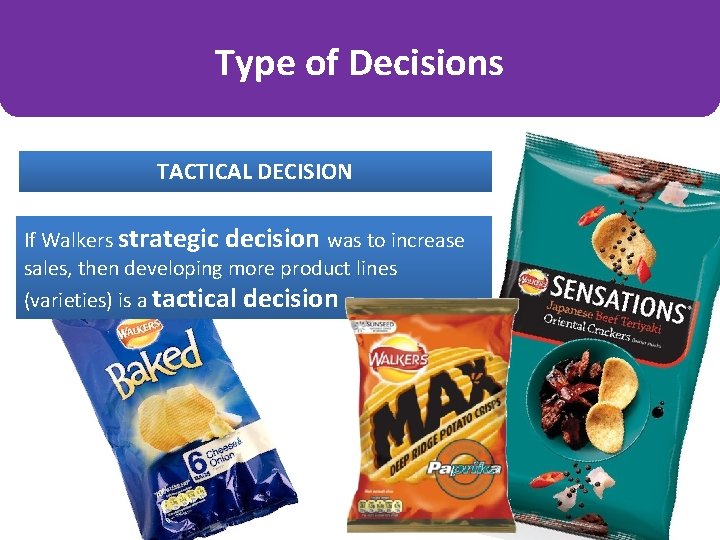
Type of Decisions TACTICAL DECISION If Walkers strategic decision was to increase sales, then developing more product lines (varieties) is a tactical decision
Type of Decisions TACTICAL DECISION Tesco needed to recruit more staff when it decided to offer bag packing services. This was to increase competitiveness against Sainsbury's 24/7 open hours.
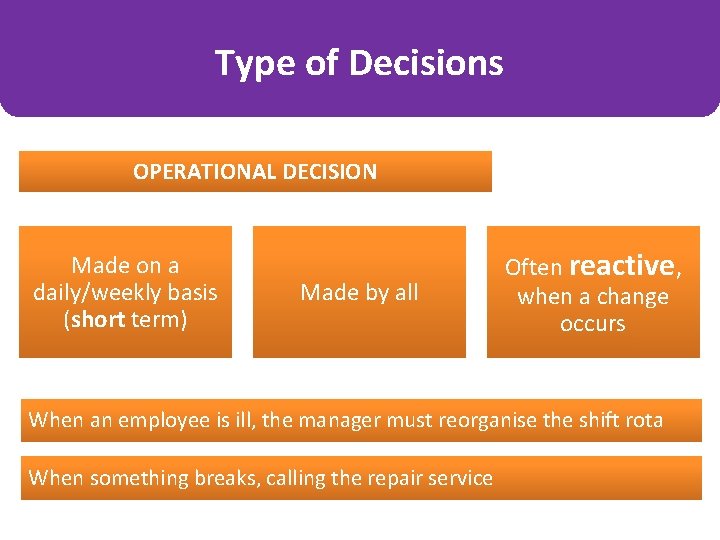
Type of Decisions OPERATIONAL DECISION Made on a daily/weekly basis (short term) Made by all Often reactive, when a change occurs When an employee is ill, the manager must reorganise the shift rota When something breaks, calling the repair service
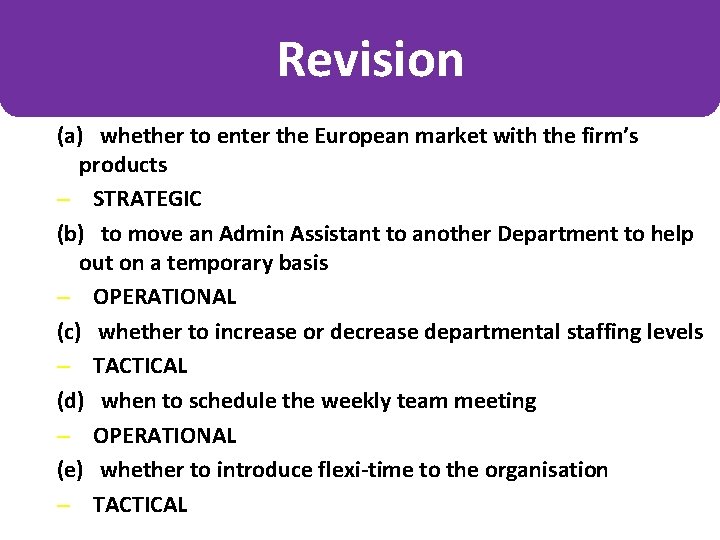
Revision (a) whether to enter the European market with the firm’s products – STRATEGIC (b) to move an Admin Assistant to another Department to help out on a temporary basis – OPERATIONAL (c) whether to increase or decrease departmental staffing levels – TACTICAL (d) when to schedule the weekly team meeting – OPERATIONAL (e) whether to introduce flexi-time to the organisation – TACTICAL
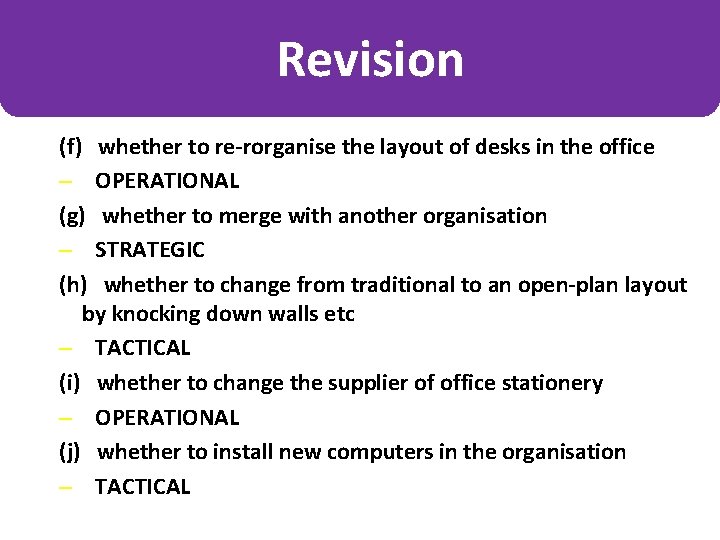
Revision (f) whether to re-rorganise the layout of desks in the office – OPERATIONAL (g) whether to merge with another organisation – STRATEGIC (h) whether to change from traditional to an open-plan layout by knocking down walls etc – TACTICAL (i) whether to change the supplier of office stationery – OPERATIONAL (j) whether to install new computers in the organisation – TACTICAL

Types of Decisions Your Task Using the 10 decisions you listed earlier: ion cis De cision 1. De cision 2. De cision 3. De cision 4. De cision 5. De cision 6. De cision 7. De cision 8. De 9. . 10 On your own decide if they are Strategic (s) Tactical (t) In your group compare your answers and discuss any inconsistent views Operational (o)
Questions -1 Some Key Terms • What is a Strategic Decision and give an example. • What is a Tactical Decision and give an example. • What is an Operational Decision and give an example.
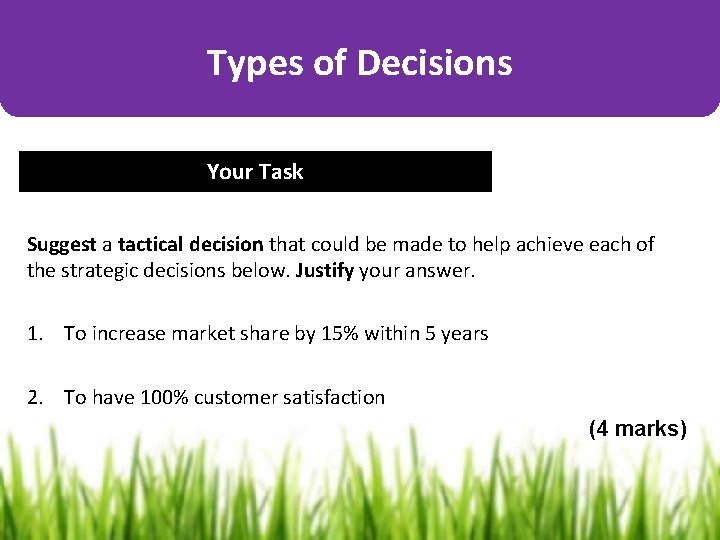
Types of Decisions Your Task Suggest a tactical decision that could be made to help achieve each of the strategic decisions below. Justify your answer. 1. To increase market share by 15% within 5 years 2. To have 100% customer satisfaction (4 marks)
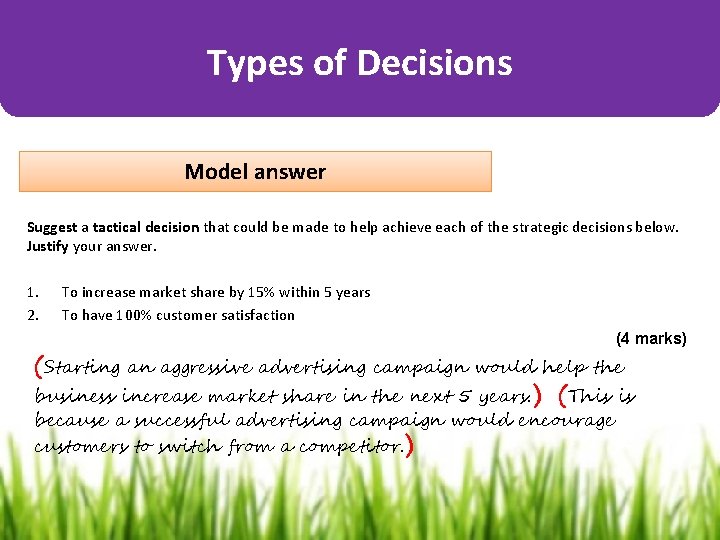
Types of Decisions Model answer Suggest a tactical decision that could be made to help achieve each of the strategic decisions below. Justify your answer. 1. 2. To increase market share by 15% within 5 years To have 100% customer satisfaction (4 marks) (Starting an aggressive advertising campaign would help the business increase market share in the next 5 years. ) (This is because a successful advertising campaign would encourage customers to switch from a competitor. )
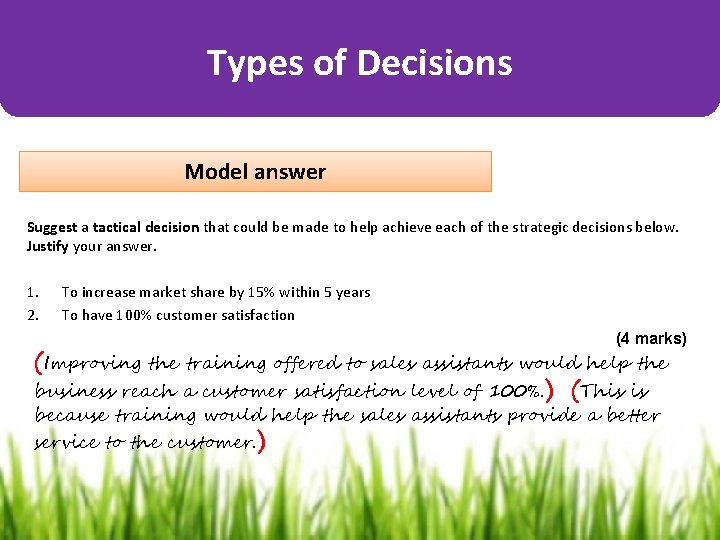
Types of Decisions Model answer Suggest a tactical decision that could be made to help achieve each of the strategic decisions below. Justify your answer. 1. 2. To increase market share by 15% within 5 years To have 100% customer satisfaction (4 marks) (Improving the training offered to sales assistants would help the business reach a customer satisfaction level of 100%. ) (This is because training would help the sales assistants provide a better service to the customer. )
Role of the Manager Your Task ger na er a M nag r Ma nage r 1. Ma nage r 2. Ma nage r 3. Ma nage r 4. Ma nage r 5. Ma nage r 6. Ma nage r 7. Ma nage 8. Ma 9. . 10 In your group discuss the duties and responsibilities of a manager. Think about everything a manager has to do. 1. 2. 3. Motivates staff. . . etc
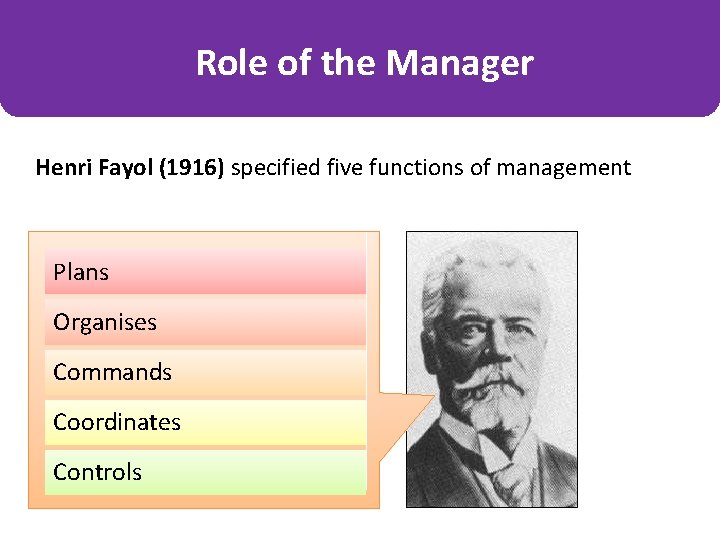
Role of the Manager Henri Fayol (1916) specified five functions of management Plans Organises Commands Coordinates Controls
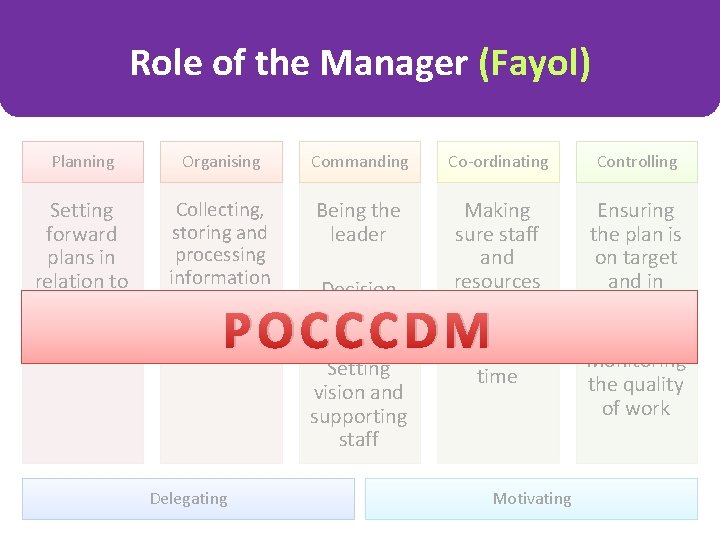
Role of the Manager (Fayol) Planning Organising Commanding Co-ordinating Controlling Setting forward plans in relation to the business objectives Collecting, storing and processing information Being the leader Making sure staff and resources are in the right place at the right time Ensuring the plan is on target and in budget Decision Making POCCCDM Setting vision and supporting staff Delegating Motivating Monitoring the quality of work
Describe the role of managers in achieving the objectives of an organisation. (6 marks)
Plans/sets objectives and the way they are to be achieved. Gives instruction to others to carry out the tasks. Takes responsibility for performance of organisation. Delegates authority to achieve objective/informs others of targets. Organises jobs within departments/brings together activities within the organisation/liase with other department heads. Controls/corrects activities of the organisation. Monitor/Analyse/Evaluate performance. Motivates staff. Acts as an information channel.
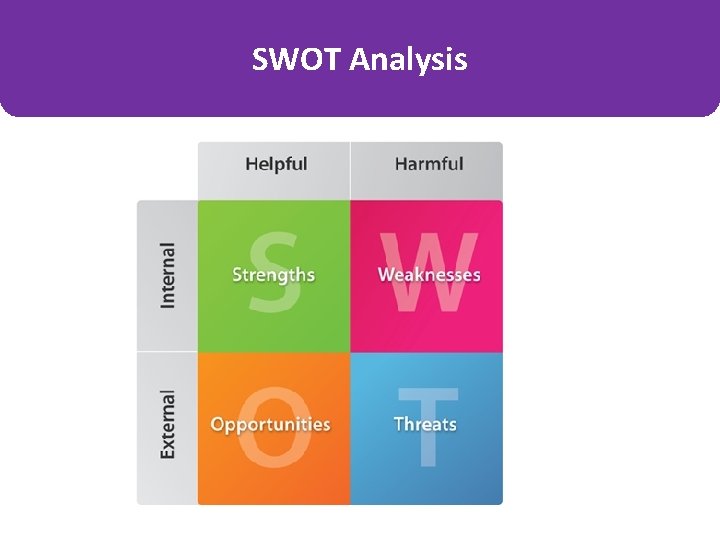
SWOT Analysis
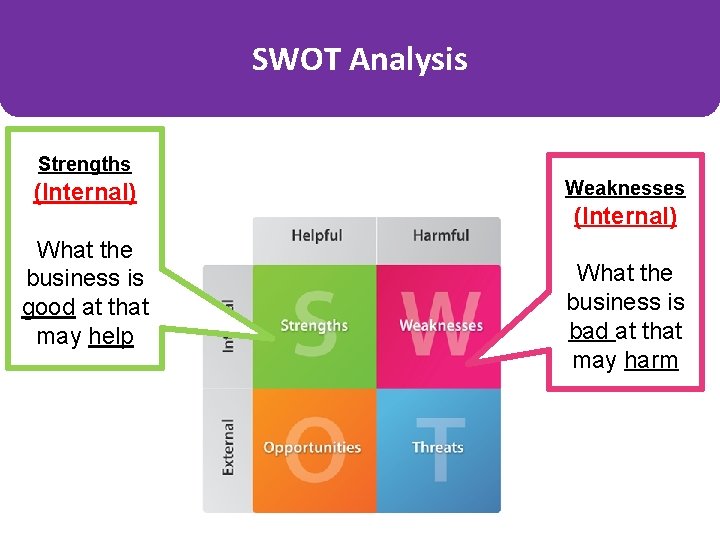
SWOT Analysis Strengths (Internal) What the business is good at that may help Weaknesses (Internal) What the business is bad at that may harm
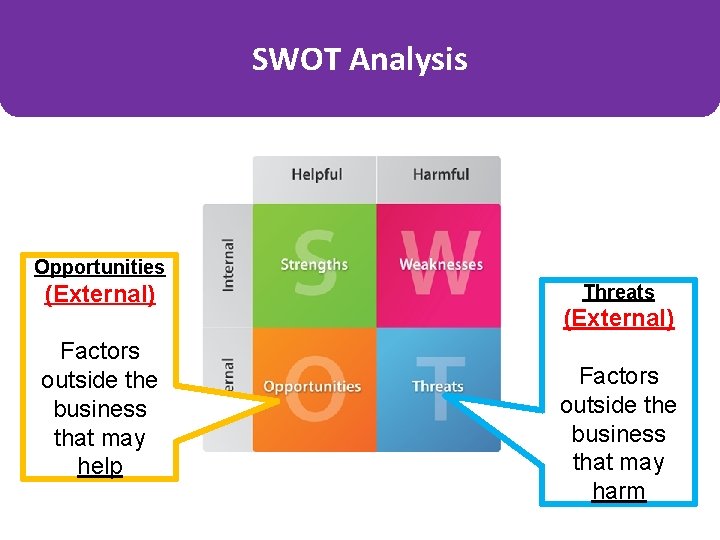
SWOT Analysis Opportunities (External) Factors outside the business that may help Threats (External) Factors outside the business that may harm
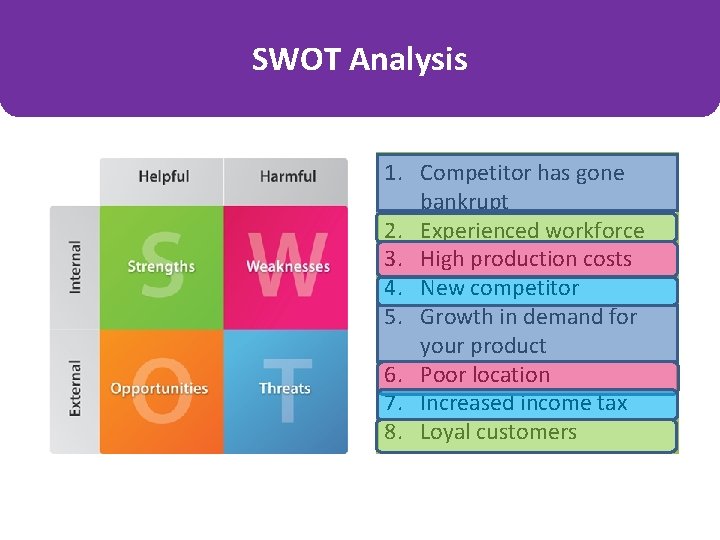
SWOT Analysis 1. Competitor has gone bankrupt 2. Experienced workforce 3. High production costs 4. New competitor 5. Growth in demand for your product 6. Poor location 7. Increased income tax 8. Loyal customers
SWOT Analysis § A planning tool § Assesses for potential risks and rewards § Considers effectiveness/success in relation to the business environment § Helps evaluate and adjust strategies § Helps a company to operate in a competitive environment.
Feature of a SWOT analysis § Usually shown in a grid § Although in an exam it may be best to use the SWOT headings § Bullet points under each heading are quick, easy and effective § Conclusions must be drawn § Conclusions drawn must be justified by the analysis
Purpose of a SWOT analysis § Identify strengths, weaknesses, opportunities and threats § Build on strengths, minimise weaknesses, grasp opportunities and avoid or counter threats § Assist with the decision making process § By identifying opportunities early the company can gain a competitive edge § Turn threats into opportunities § Turn weaknesses into strengths § Proactive decision making rather than reactive decision making
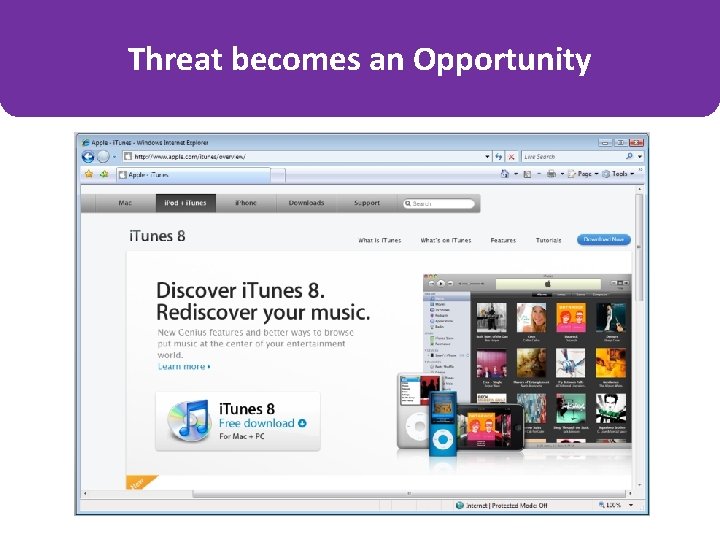
Threat becomes an Opportunity
Cast Study: Skoda Read the case study on Skoda carefully As you read note the: • Strengths • Weaknesses • Opportunities • Threats
Cast Study: Skoda Read the case study on Skoda carefully As you read, annotate the case study, highlighting the SWOT factors. • • • Create a SWOT analysis Bullet point under each heading List at least 5 Strengths, 3 Weaknesses, 2 Threats and 2 Opportunities From your SWOT suggest and justify how Skoda could: 1. 2. Improve their brand position. Increase sales and customer satisfaction. Based on your SWOT analysis: 1. What Weaknesses can be turned into Strengths and how? 2. How do you suggest Skoda overcomes potential threats?
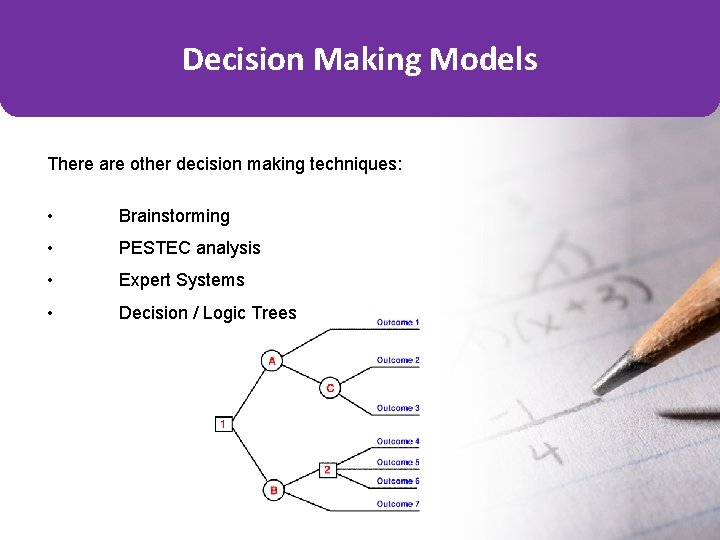
Decision Making Models There are other decision making techniques: • Brainstorming • PESTEC analysis • Expert Systems • Decision / Logic Trees
Benefits of the DM Models § No rash or hasty decisions are made, as time is taken to go through the decision making process § Better quality decisions are made, as decisions are based on gathered relevant information § Opportunity to explore alternatives § May enhance innovation, motivation and responsiveness by allowing employees to be involved in the decision making process.
Constraints of the DM Models • Time consuming, may slow the decision making process • Limited information available • Problems of generating and choosing between alternative solutions • Internal constraints: finance, policy, staff attitudes or resistance • External constraints: legislation, competitors, lack of technology • Stifles creativity
Quality Decision Making Why is it important to make high quality decisions? What factors influence the quality of decisions making? • • • The accuracy and quantity of information gathered Limited technology Staff training Risk taking Time and finance restrictions
- Slides: 38