
Decision Making Decisive How To Make Better Choices
Decision Making Decisive: How To Make Better Choices in Life and Work Chip Heath and Dan Heath, Crown Business, 2013
The Four Villains of Decision Making 1. Narrow framing: – 2. The tendency to define our choices too narrowly, to see them in binary terms. Confirmation bias: – To develop a quick belief about a situation and then seek out information that bolsters our belief.
3. Short-term emotion: We are governed in decision making by how we feel about a situation and not necessarily about the long-term effects of a decision. – 4. Overconfidence: People think they know more than they do about how the future will unfold. – • Punditry is the perfect example.

Making Good Decisions 1. Widen your options: (overcome narrow framing) – How can you expand your set of choices? • Rather than “either/or” binary options, uncover new options and think “this and that. ” 2. Reality-test your assumptions: (overcome confirmation bias) – How can you get outside your head and collect information that you can trust?

3. Attain distance before deciding: (overcome shortterm emotion) – Wait a couple of days—sleep on it. Use Ben Franklin’s method of making a long pros-and- cons list over several days, and then analyzing it objectively. 4. Prepare to be wrong: (overcome overconfidence) – Plan for an uncertain future – have a Plan B and Plan C.

W. R. A. P. • • Widen your options. Reality-test your assumptions. Attain distance before deciding. Prepare to be wrong.

Effective Decision Making Based on the book Smart Choices: A Practical Guide to Making Better Decisions, John S. Hammond, Ralph L. Keeney, Howard Raiffa, Harvard Business School Press, 1999.

The Eight Elements of Effective Decisions • • Problem Objectives Alternatives Consequences Tradeoffs Uncertainty Risk Tolerance Linked Decisions
• Problem – – Be creative about your problem definition Turn problems into opportunities Reexamine your problem definition as you go Maintain your perspective
• Objectives – Let your objectives be your guide • Objectives determine what information you seek. • Objectives can help you explain your choices to others. – Master the art of identifying objectives
• Alternatives – – – Don’t box yourself in with limited alternatives Use your objectives and ask “how? ” Set high aspirations Ask others for suggestions Give your subconscious time to operate • Incubate – Never stop looking for alternatives • Think outside the box, brainstorm
• Consequences – Compare alternatives using a consequences matrix – Use experts to help define consequences
• Tradeoffs – Use swaps – Determining the relative value of different consequences is the hard part
• Uncertainty – Use risk profiles to simplify decisions involving uncertainty • • What are the key uncertainties? What are the possible outcomes of these uncertainties? What are the chances of occurrence of each possible outcome? What are the consequences of each outcome? – Use experts to help define possible outcomes
• Uncertainty – Use a Decision Tree • Alternatives - Uncertainty - Consequences
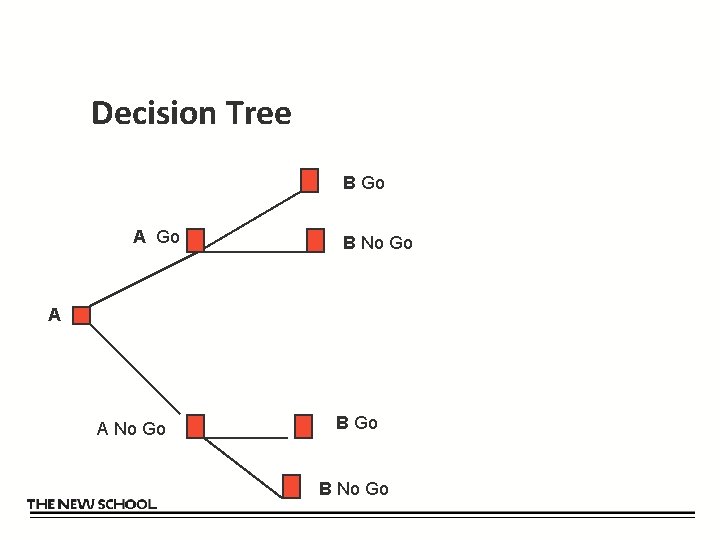
Decision Tree B Go A Go B No Go A A No Go B No Go
• Risk Tolerance – Understand calibrate your group’s tolerance to take risks – Incorporate your risk tolerance into all of your decisions
• Linked Decisions – Linked decisions are complex – Ask: “How will this decision affect other people, other departments, other divisions, partners, your industry? ”
Decision Making Summary • • • Problem Objectives Alternatives Consequences Tradeoffs – Uncertainty – Risk Tolerance – Linked Decisions
Seven Basic Rules 1. 2. 3. 4. 5. 6. 7. Make bold decisions that challenge the status quo Avoid choices that justify past bad decisions Check for faulty cause-and-effect reasoning Test your decisions with experiments (shoot bullets, not cannonballs) Root out unconscious prejudices Foster and address constructive criticism Defeat indecisiveness with clear accountability
- Slides: 20