
Decision Making Criteria Criteria are constantly used in


- Slides: 8
Decision Making Criteria
Criteria are constantly used in decision making. The nature of the decision will often determine the criteria used. People may have their own personal criteria, and often, organizational policies will dictate criteria to be used. In any event, have a clear picture of the criteria you will be using. Criteria can have sub-criteria, too. Every decision problem will have its own criteria. To stimulate your thinking, here are just some of the possible criteria you may use:
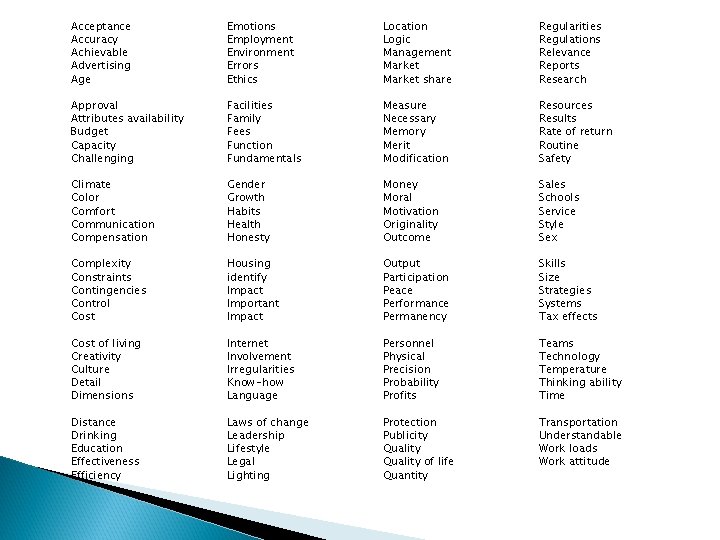
Acceptance Accuracy Achievable Advertising Age Emotions Employment Environment Errors Ethics Location Logic Management Market share Regularities Regulations Relevance Reports Research Approval Attributes availability Budget Capacity Challenging Facilities Family Fees Function Fundamentals Measure Necessary Memory Merit Modification Resources Results Rate of return Routine Safety Climate Color Comfort Communication Compensation Gender Growth Habits Health Honesty Money Moral Motivation Originality Outcome Sales Schools Service Style Sex Complexity Constraints Contingencies Control Cost Housing identify Impact Important Impact Output Participation Peace Performance Permanency Skills Size Strategies Systems Tax effects Cost of living Creativity Culture Detail Dimensions Internet Involvement Irregularities Know-how Language Personnel Physical Precision Probability Profits Teams Technology Temperature Thinking ability Time Distance Drinking Education Effectiveness Efficiency Laws of change Leadership Lifestyle Legal Lighting Protection Publicity Quality of life Quantity Transportation Understandable Work loads Work attitude
If the University is to become one of the top three public research universities in the world, and to achieve excellence in our coordinate campuses and other programs, we must more clearly align the University's mission to each of its colleges, departments, and other academic units as well as administrative functions and units. We need to ask what the essential support needs to be for core teaching, research, and public engagement and which programs and services no longer fit within our goals, reasonable expectations, and resources.
In order for the University of Minnesota to stay strong and vibrant we must be able to review programs and establish priorities based on well-established criteria. The criteria below, established over the past 20 years at the University, continue to provide a solid framework for such reviews. These seven criteria, taken together as a unified whole, offer useful measures to assess and improve the University.
� Centrality to Mission: A program or service is more highly valued if it contributes significantly to the core mission of the University. � Quality, Productivity, and Impact: A program or service should meet objective and evaluative standards of high quality, productivity, public engagement, and impact.
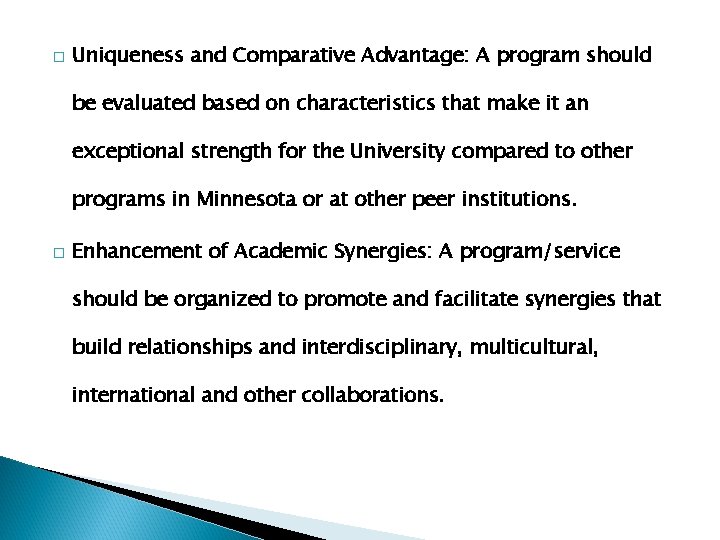
� Uniqueness and Comparative Advantage: A program should be evaluated based on characteristics that make it an exceptional strength for the University compared to other programs in Minnesota or at other peer institutions. � Enhancement of Academic Synergies: A program/service should be organized to promote and facilitate synergies that build relationships and interdisciplinary, multicultural, international and other collaborations.
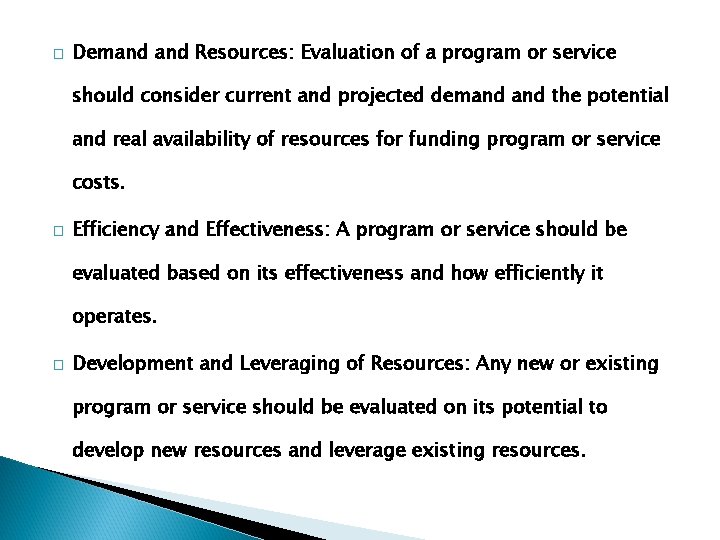
� Demand Resources: Evaluation of a program or service should consider current and projected demand the potential and real availability of resources for funding program or service costs. � Efficiency and Effectiveness: A program or service should be evaluated based on its effectiveness and how efficiently it operates. � Development and Leveraging of Resources: Any new or existing program or service should be evaluated on its potential to develop new resources and leverage existing resources.