
Decision Making as Applied to Selection of College

- Slides: 17
Decision Making as Applied to Selection of College Majors Joan V. Miller Instructional Support Facilitator Central Bucks School District M. Ed. Candidate College Student Affairs Pennsylvania State University
Project Rationale n Understanding the processes students employ to make educational decisions can strengthen the effectiveness of support provided by academic advisers.
Overview n n Decision Making Research on Decision Making Related to College Major Selection n Student Development/Transition n Supports
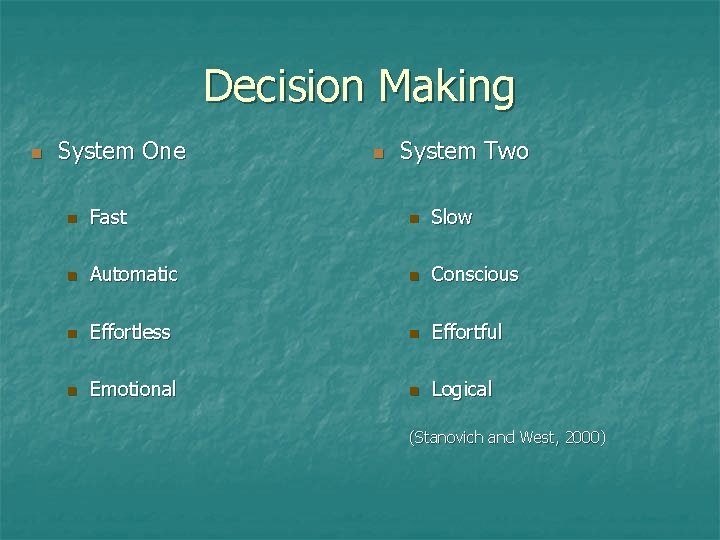
Decision Making n System One n System Two n Fast n Slow n Automatic n Conscious n Effortless n Effortful n Emotional n Logical (Stanovich and West, 2000)
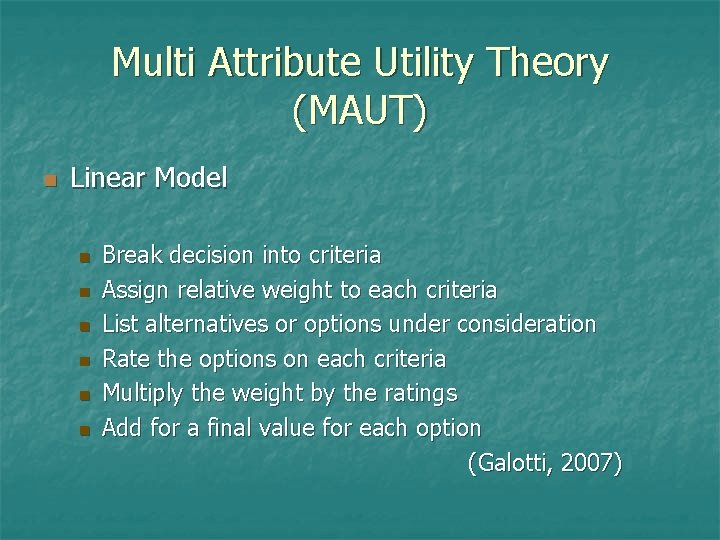
Multi Attribute Utility Theory (MAUT) n Linear Model n n n Break decision into criteria Assign relative weight to each criteria List alternatives or options under consideration Rate the options on each criteria Multiply the weight by the ratings Add for a final value for each option (Galotti, 2007)
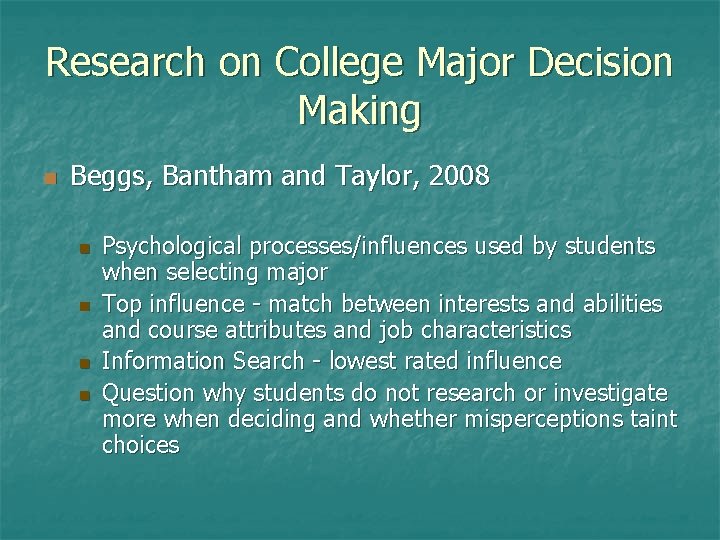
Research on College Major Decision Making n Beggs, Bantham and Taylor, 2008 n n Psychological processes/influences used by students when selecting major Top influence - match between interests and abilities and course attributes and job characteristics Information Search - lowest rated influence Question why students do not research or investigate more when deciding and whether misperceptions taint choices
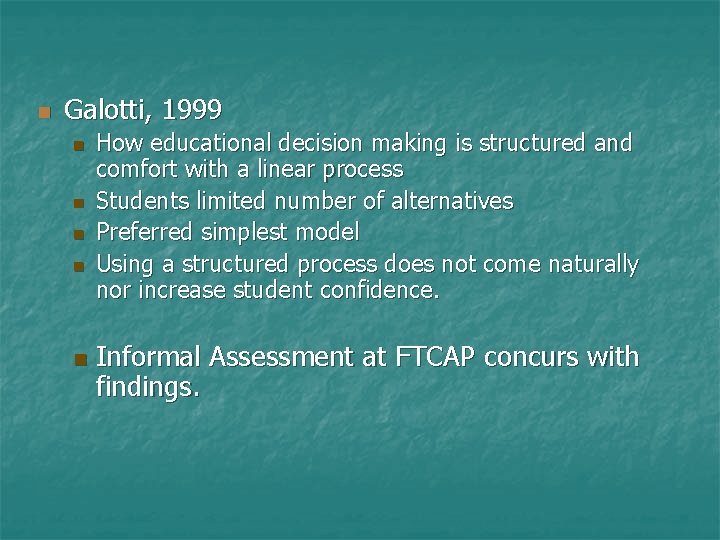
n Galotti, 1999 n n n How educational decision making is structured and comfort with a linear process Students limited number of alternatives Preferred simplest model Using a structured process does not come naturally nor increase student confidence. Informal Assessment at FTCAP concurs with findings.
Student Development Theories Suggest that a Student’s Developmental Level at Point of Decision Can Impact the Process and Outcome of Decision
n Erickson’s Identity vs. Identity Diffusion n Chickering’s vectors: n n Moving through Autonomy Toward Independence Developing Purpose n Perry’s Theory of Intellectual and Ethical Development n Schlossberg’s Transition Theory
n n Important to remember that there is value in how students interpret their experiences and how practitioners deal constructively with such differences in designing developmental responses. Interventions and support are needed to promote growth and the approach differs for each student based on their developmental needs. Evans, Forney, Guido, Patton & Renn, 2010
Supports from Theory n n n Developmental Instruction Model – (Knefelkamp, 1999) Reflective Conversations (Baxter Magolda & King, 2008) Coaching – Kegan (1994)
Supports from Research n Beggs, Bantham and Taylor, 2008 n n n Encourage searches for accurate information on which to base decisions Provide internet driven navigational resources Galotti, 1999 n n Assure students that indecision is natural Challenge students to explore widely Teach decision structuring processes Equate effort with effective decision making
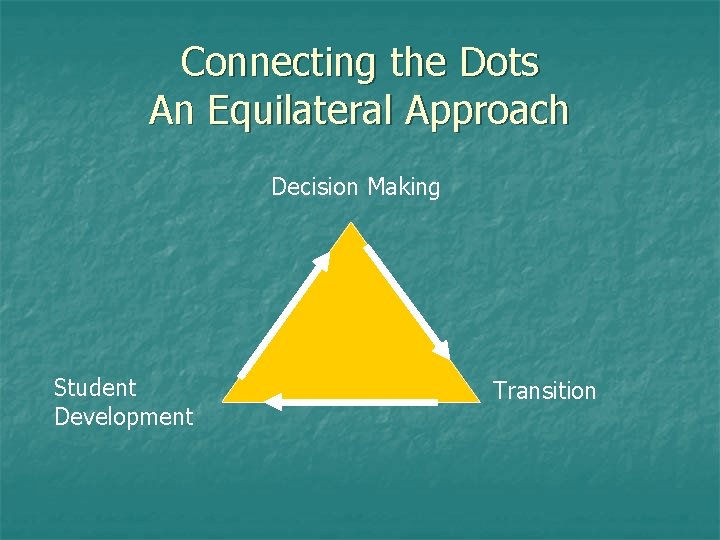
Connecting the Dots An Equilateral Approach Decision Making Student Development Transition
First Year Seminar n n n Provide atmosphere to foster both psychosocial and cognitive growth opportunities Teach and encourage self-reflective skills through discussion and journals to promote self-authorship Introduce linear decision structuring approaches Require students to develop learning outcomes for their educational decision making Introduce students to how general education can enhance their exploration Provide a forum for students to receive others’ perspectives when processing their educational decisions
Take Away Points n n n In FTCAP confirmation discussions, what we hear confirms that students often do not support their major decisions with information. We also see students with what appears to be a range of developmental skills related to decision making. The FTCAP presentation is consistent with the research suggestions of encouraging students to explore widely and assuring them that it is natural to be undecided or want to change.
Ideas for Follow up n n n How to best encourage students to support decisions with information searches Introduction to decision structuring First Year Seminars for students who demonstrate a high need for support
n. Questions? ? ? n. Thoughts? ? ?