
Decision Feedback Equalization in OFDM with Long Delay
Decision Feedback Equalization in OFDM with Long Delay Spreads Zeeshan Qureshi

Digital Video Broadcasting (DVB) l Rapidly becoming world-wide standard for digital TV l Being implemented in Europe, Australia, South Africa and India l Popularity due to: l l Bandwidth efficiency l Improved picture/sound quality l Additional programming options Utilizes OFDM to transmit over a Single Frequency Network (SFN) Model
SFN – Major Issues l Simultaneous transmission of same OFDM data from multiple transmitters l Receiver interprets a channel with a long Delay Spread l Delay spread longer than Cyclic Prefix causes increase in interference components (ISI; ICI) l Performance Degradation: Symbol recovery suffers due to interference

Conventional Solutions l Increase Cyclic Prefix length to Channel Delay Spread l l l Increases Symbol Overhead Degrades OFDM system efficiency Equalization in time-domain l l Complex Receiver Design Impractical to implement

Thesis Contribution l Implementation of a DFE-PIC based receiver configuration over OFDM channels with long delay spreads l Investigation of performance conventional OFDM receiver l Evaluation done via simulations l Allows performance improvement l Maintains efficiency of OFDM l Receiver implementation is simple gain over

Decision Feedback Equalizer (DFE) l l DFE is a non-linear equalizer Feedback filter: ISI cancellation using previous receiver decisions Feed-forward filter: ICI cancellation on the transmitted symbols Advantages: l l Performance comparable to the optimum demodulator but with much lower computational complexity Low noise enhancement
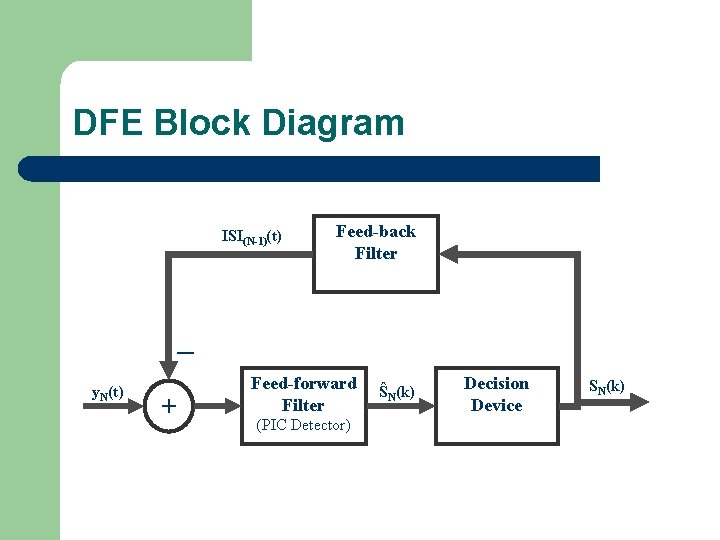
DFE Block Diagram ISI(N-1)(t) Feed-back Filter _ y. N(t) + Feed-forward Filter (PIC Detector) ŜN(k) Decision Device SN(k)
Parallel Interference Canceller (PIC) l l l PIC detector estimates and subtracts interference for each channel in parallel Stage-wise implementation Stage 0 uses matched filter to estimate symbol without removal of interference Later stages use the symbol estimates of the previous stage to estimate and remove interference components Advantages: l l Fast convergence Low complexity

PIC Block Diagram ỹ 0(t) Initial Observation Ż 0(k) Symbol Estimation + _ Ż 0(k) Symbol Estimation (Stage 0 Only) (Stages 1+) ICI(N-1)(k) Ŝ 0(k) Interference Estimation Ŝ(N-1)(k) ŜN(k)
Simulation Environment l QPSK Modulation l OFDM Symbol Transmission l Rayleigh Channel Model l Additive White Gaussian Noise (AWGN) l Channel Delay Spread as long as the OFDM Symbol length l Perfect Channel Estimation in Receiver l Single-Tap DFE implementation
Implemented Scenarios l l Response to System Parameter changes: l No. of ISI iterations l No. of PIC stages l Scaling of ICI components l Length of Channel Delay Spread Performance in simulated SFN channels l Inter-site Distance between Transmitters
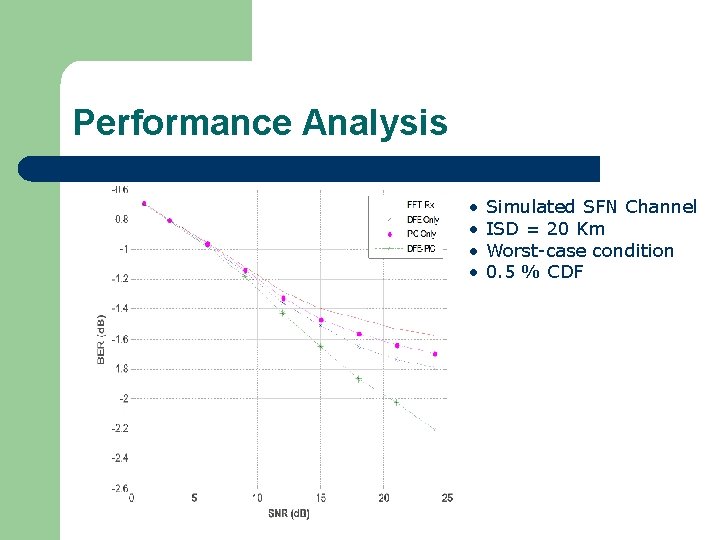
Performance Analysis • • Simulated SFN Channel ISD = 20 Km Worst-case condition 0. 5 % CDF
Final remarks l Highlights of the DFE-PIC receiver § Significant performance gain achieved over OFDM receiver § Preserves OFDM system efficiency § Compensation of interference effects due to long delay spread § Simple to implement in the receiver § Low computational complexity
The End Questions? Thank You!
- Slides: 14