
Decision Combination of Multiple Classifiers for Pattern Classification
Decision. Combination of Multiple Classifiers for Pattern Classification: Hybridization of Majority Voting and Divide and Conquer Techniques A. F. R. Rahman BCL Computers Inc. M. C. Fairhurst University of Kent Santa Clara, Calif, USA Canterbury, Kent, UK
Presentation Outline • • Multiple Expert Classification Majority Voting Technique Divide and Conquer Technique Concept of Hybridization Problem Selection (Database/Experts) Performance Discussion and Conclusion
Basic Problem Statement • Given a number of experts working on the same problem, is group decision superior to individual decisions?
Ghosts from the Past… • • • Jean-Charles de Borda (1781) N. C. de Condorcet (1785) Laplace (1795) Issac Todhunter (1865) C. L. Dodgson (Lewis Carrol) (1873) • M. W. Crofton (1885) • E. J. Nanson (1907) • Francis Galton (1907)
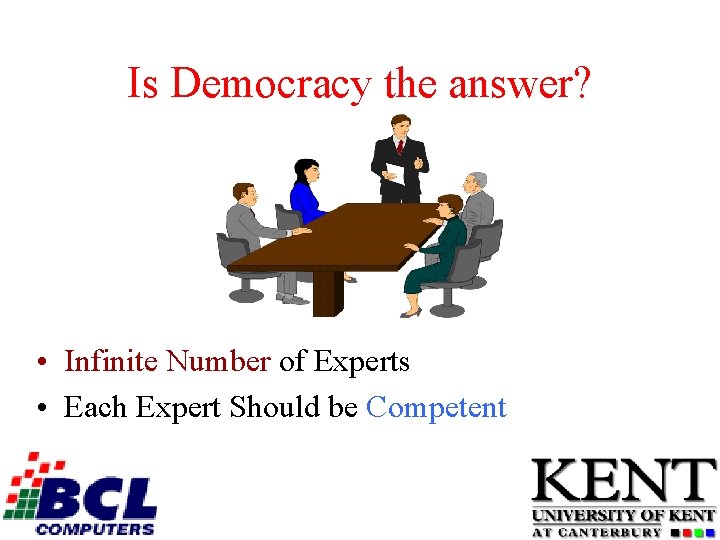
Is Democracy the answer? • Infinite Number of Experts • Each Expert Should be Competent
How Does It Relate to Pattern Classification? Each Expert has its: • Strengths and Weaknesses • Peculiarities • Fresh Approach to Feature Extraction • Fresh Approach to Classification • But NOT 100% Correct!
Practical Resource Constraints Unfortunately, We Have Limited • Number of Experts • Number of Training Samples • Feature Size • Classification Time • Memory Size
Solution • Clever Algorithms to Exploit Experts – Complimentary Information – Redundancy: Check and Balance – Simultaneous Use of Arbitrary Features and Classification Routines
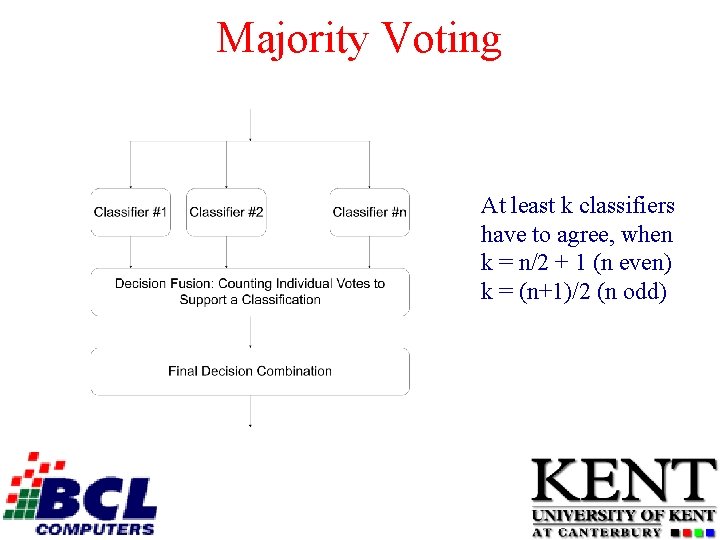
Majority Voting At least k classifiers have to agree, when k = n/2 + 1 (n even) k = (n+1)/2 (n odd)
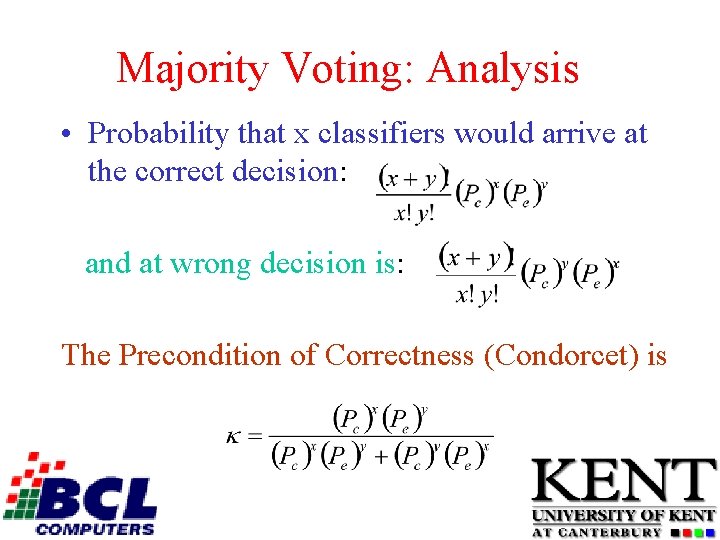
Majority Voting: Analysis • Probability that x classifiers would arrive at the correct decision: and at wrong decision is: The Precondition of Correctness (Condorcet) is
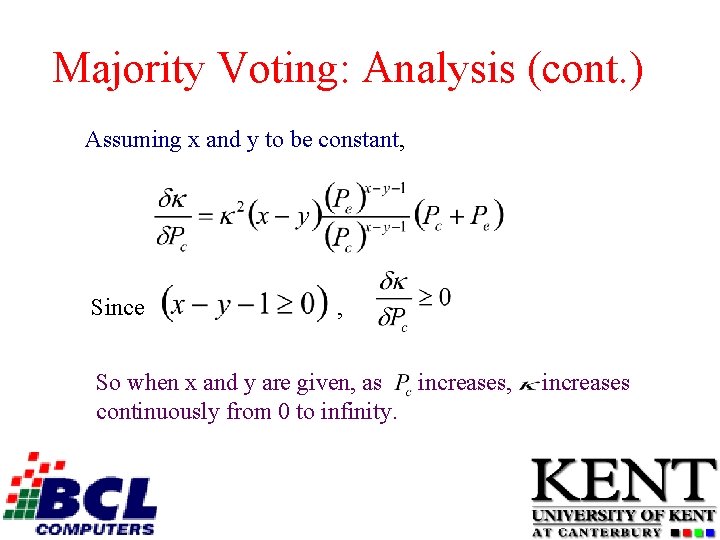
Majority Voting: Analysis (cont. ) Assuming x and y to be constant, Since , So when x and y are given, as increases, continuously from 0 to infinity. increases
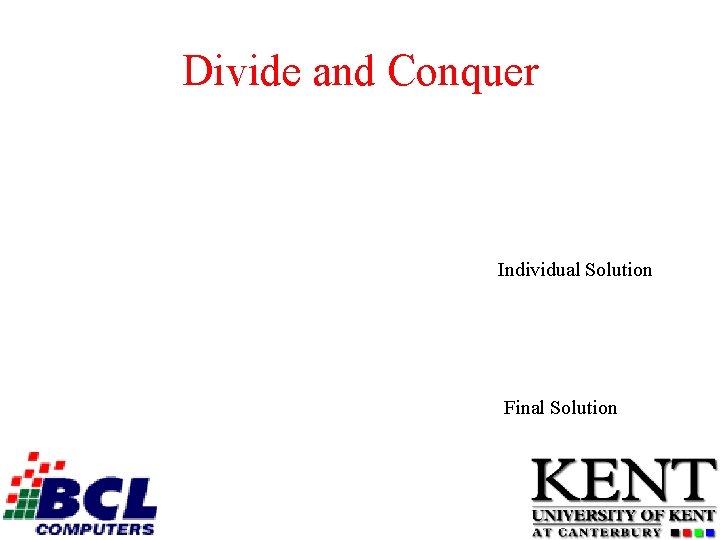
Divide and Conquer Individual Solution Final Solution
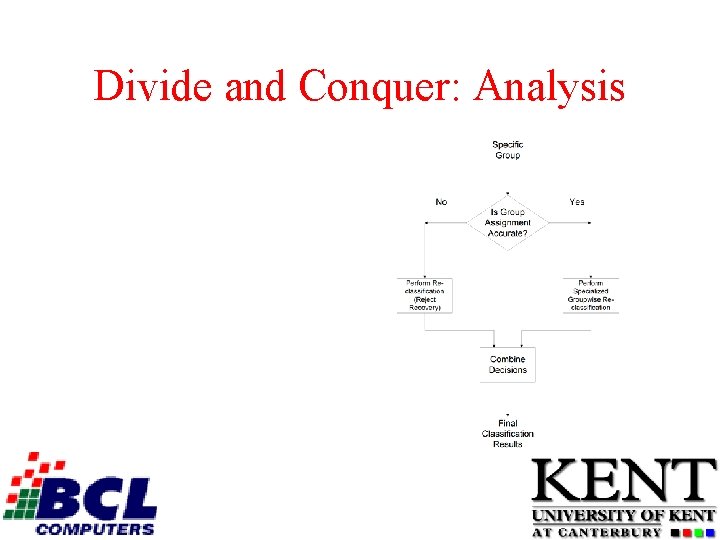
Divide and Conquer: Analysis
Combined Structure: Divide and Conquer with Consensus
Selection of a Database • • • Handwritten Characters (NIST) Collected off-line Total samples of over 10, 000 characters Size Normalized to 32 X 32 Numeral Classes 0 -9
Selected Classifiers • • Binary Weighted Scheme (BWS) Frequency Weighted Scheme (FWS) Multi-layered Perceptrons (MLP) Moment based Pattern Classifier (MPC) (using Maximum Likelihood Method)
Performance of Individual Classifiers
Performance of Decision Combination Methods
Implementation of Divide and Conquer with Consensus
Performance of the Proposed Method
Comparison of Throughput
Throughput of Combination Methods
Conclusion • Group Decisions Are often SUPERIOR to Individual Decisions • Multiple Expert Solutions can be Made more Robust by incorporating a priori information about the task domain • Multiple Expert Solutions Does NOT automatically mean a Slower System!
- Slides: 23