
Deciphering Welsh Names in a Latin Document The
- Slides: 70
Deciphering Welsh Names in a Latin Document
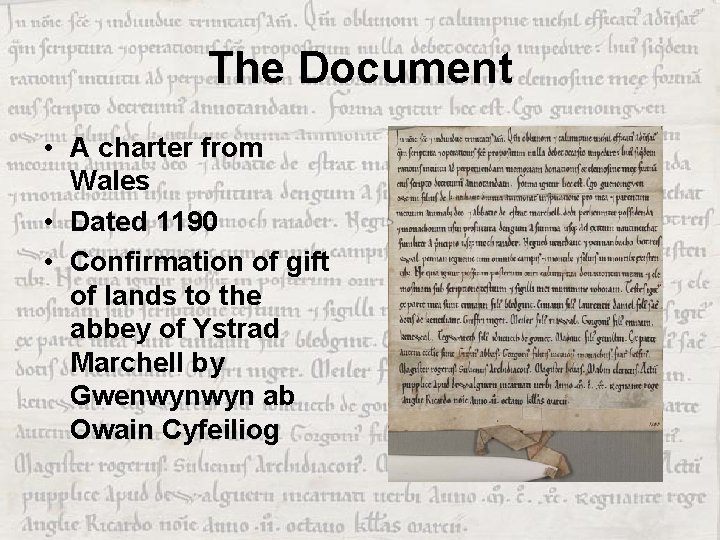
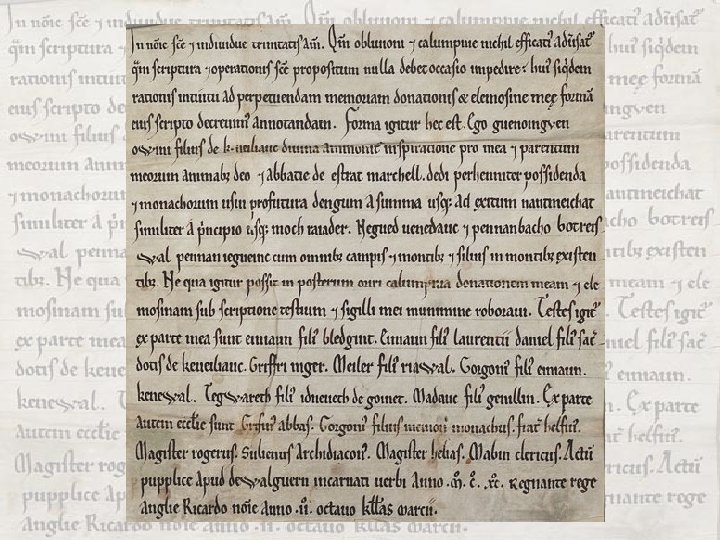
The Document • A charter from Wales • Dated 1190 • Confirmation of gift of lands to the abbey of Ystrad Marchell by Gwenwynwyn ab Owain Cyfeiliog
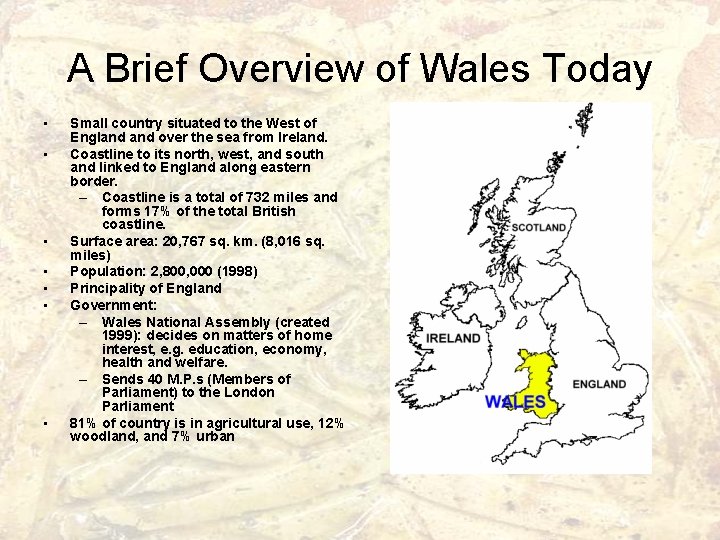
A Brief Overview of Wales Today • • Small country situated to the West of England over the sea from Ireland. Coastline to its north, west, and south and linked to England along eastern border. – Coastline is a total of 732 miles and forms 17% of the total British coastline. Surface area: 20, 767 sq. km. (8, 016 sq. miles) Population: 2, 800, 000 (1998) Principality of England Government: – Wales National Assembly (created 1999): decides on matters of home interest, e. g. education, economy, health and welfare. – Sends 40 M. P. s (Members of Parliament) to the London Parliament 81% of country is in agricultural use, 12% woodland, and 7% urban
Early History of Wales • The Iron Age (1000 BC): – inhabitants grouped themselves into large hill forts for protection – Practiced mixed, settled farming – Worked extensive copper mines – Advanced metalworking seems to have been introduced as a result of contact with the Halstatt culture of Austria.
Early History of Wales • The Celts (500 -100 BC): – Celtic languages arrived in Britain – New religions entered Britain, particularly that of the Druids, the guardians of tradition and learning. The Druids: • Glorified the pursuits of war, feasting and horsemanship • Controlled the calendar and the planting of crops • Presided over the religious festivals and rituals that honored local deities
Early History of Wales • The Romans – 55 BC: Julius Caesar leads first Roman invasion of the British Isles (Britannia), but there is no significant occupation. – 43 AD: Romans begin permanent settlements in eastern territories of Britain and a long series of battles with the native Celtic tribes. Their superior military discipline and leadership, aided by a carefully organized system of forts, eventually led to their triumph. – 383 AD: Magnus Maximus, the commander of the Roman armies in Britain, left Britain, taking most of the Roman army with him in an attempt to overthrow Gratian as Emperor. – Introduced writing to Wales; also had influences on the Welsh language.
Early History of Wales • The Saxons – 410 AD: Invited by the Romano-British to settle in Britain in exchange for their help against the invasion of the Picts. – 450 AD: Saxons begin coming over in larger numbers and attempting to build their own kingdoms in Britain. – 650 AD: Most of what would become England is under Saxon control. – 750 AD: Offa, King of Mercia orders the building of a dyke from sea to sea. Offa’s Dyke essentially defines the Welsh English border today.
Early History of Wales • The Vikings – 793 AD: The first Viking raid on Britain. – 856: The Welsh king, Rhodri Fawr, killed the Viking leader, the “black pagan” Horme, restricting Danish occupation of Wales to a few scattered ports and trading posts. – 890: Welsh rulers acknowledge the overlordship of Alfred of Wessex – 928: Hywel Dda presents Welsh Law to the Pope for his blessing
Early History of Wales • The Reign of Gruffud ap Llewelyn (1039 -1063) – The only Welsh ruler to unite the ancient kingdoms of the whole of Wales under his authority. – His alliance with English rulers brought peace to Wales for a quarter of a century.
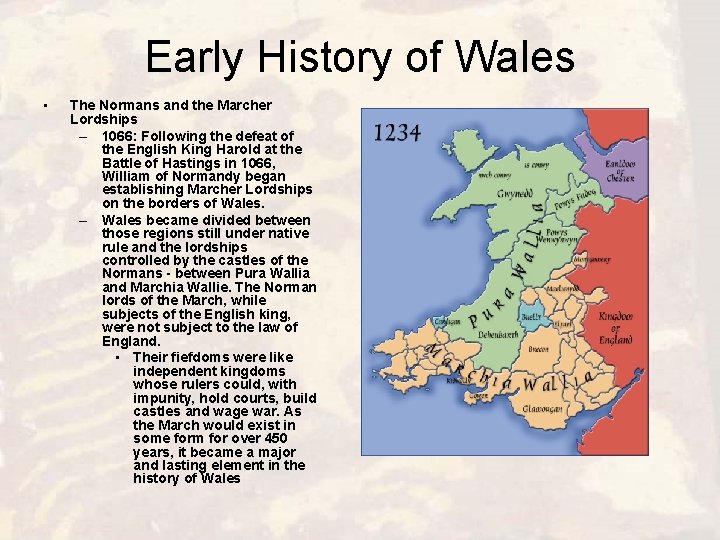
Early History of Wales • The Normans and the Marcher Lordships – 1066: Following the defeat of the English King Harold at the Battle of Hastings in 1066, William of Normandy began establishing Marcher Lordships on the borders of Wales. – Wales became divided between those regions still under native rule and the lordships controlled by the castles of the Normans - between Pura Wallia and Marchia Wallie. The Norman lords of the March, while subjects of the English king, were not subject to the law of England. • Their fiefdoms were like independent kingdoms whose rulers could, with impunity, hold courts, build castles and wage war. As the March would exist in some form for over 450 years, it became a major and lasting element in the history of Wales
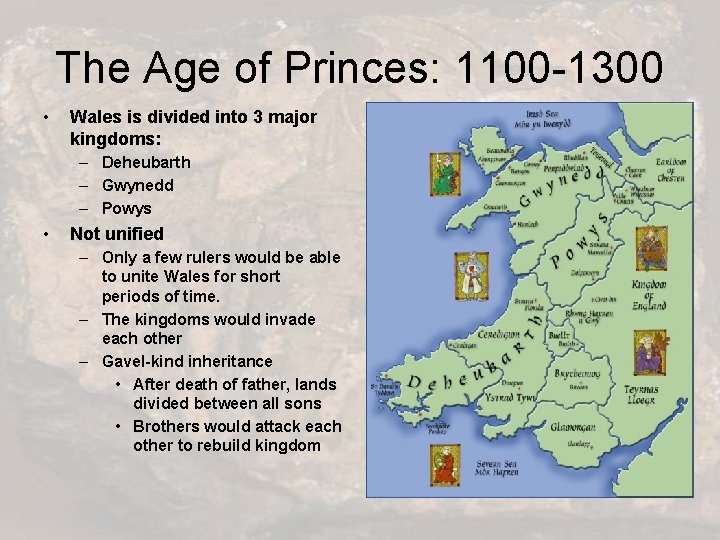
The Age of Princes: 1100 -1300 • Wales is divided into 3 major kingdoms: – Deheubarth – Gwynedd – Powys • Not unified – Only a few rulers would be able to unite Wales for short periods of time. – The kingdoms would invade each other – Gavel-kind inheritance • After death of father, lands divided between all sons • Brothers would attack each other to rebuild kingdom
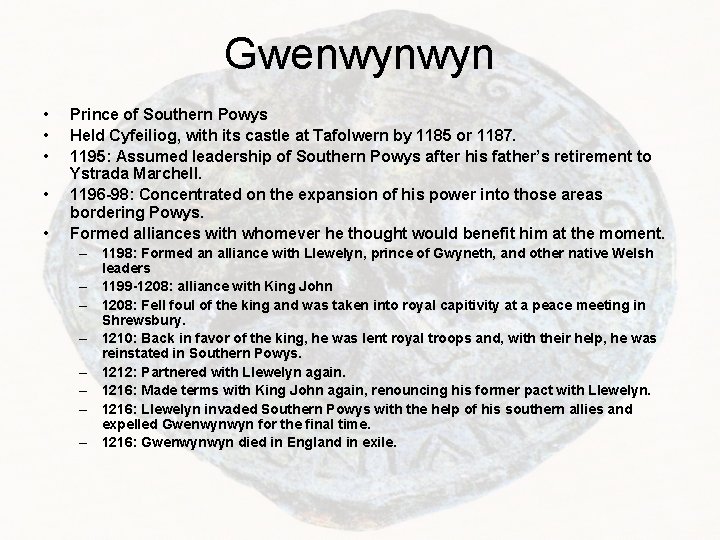
Gwenwynwyn • • • Prince of Southern Powys Held Cyfeiliog, with its castle at Tafolwern by 1185 or 1187. 1195: Assumed leadership of Southern Powys after his father’s retirement to Ystrada Marchell. 1196 -98: Concentrated on the expansion of his power into those areas bordering Powys. Formed alliances with whomever he thought would benefit him at the moment. – 1198: Formed an alliance with Llewelyn, prince of Gwyneth, and other native Welsh leaders – 1199 -1208: alliance with King John – 1208: Fell foul of the king and was taken into royal capitivity at a peace meeting in Shrewsbury. – 1210: Back in favor of the king, he was lent royal troops and, with their help, he was reinstated in Southern Powys. – 1212: Partnered with Llewelyn again. – 1216: Made terms with King John again, renouncing his former pact with Llewelyn. – 1216: Llewelyn invaded Southern Powys with the help of his southern allies and expelled Gwenwynwyn for the final time. – 1216: Gwenwynwyn died in England in exile.
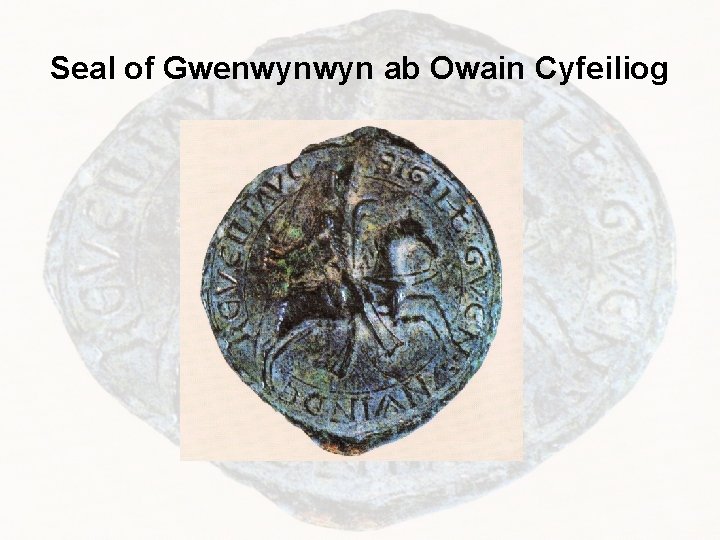
Seal of Gwenwynwyn ab Owain Cyfeiliog
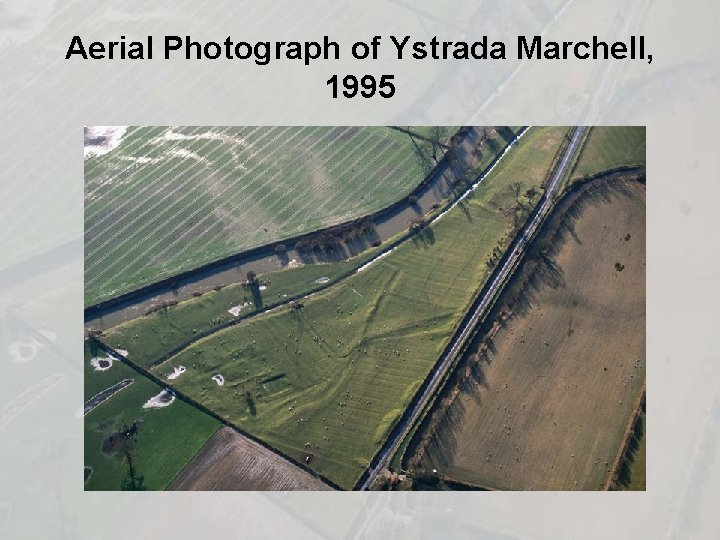
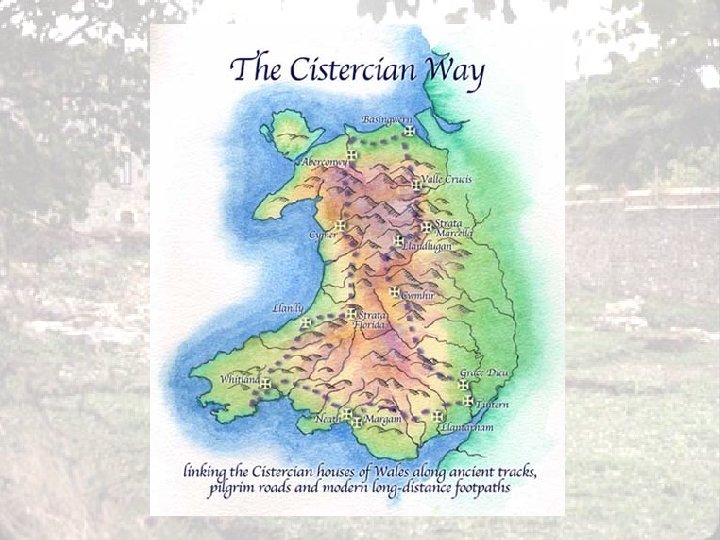
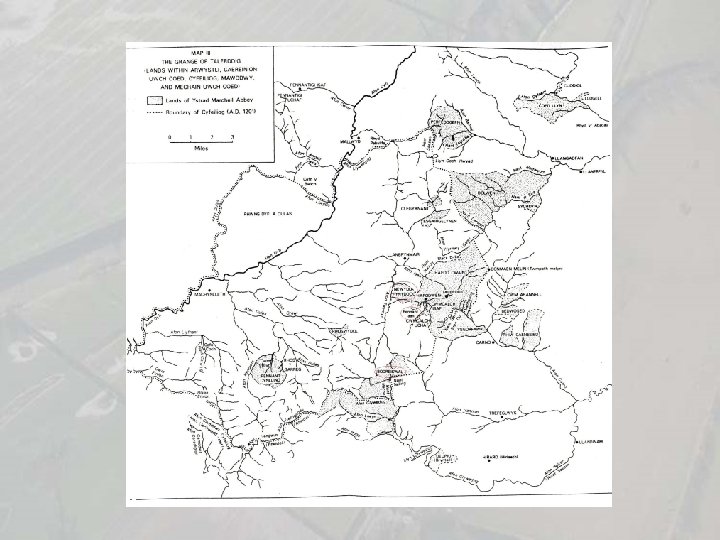
Ystrad Marchell • Largest Cistercian monastery in Wales • Founded by Gwenwynwyn’s father, Owain Cyfeiliog, in 1170 as a daughter house of Whitland Abbey. • It was a Welsh monastery with Welsh monks – this caused problems during the wars between Wales and England. – The Welsh monks were transferred to another monastery and replaced with English monks. • Shut down in 1536 • Nothing remains of it today.
Aerial Photograph of Ystrada Marchell, 1995
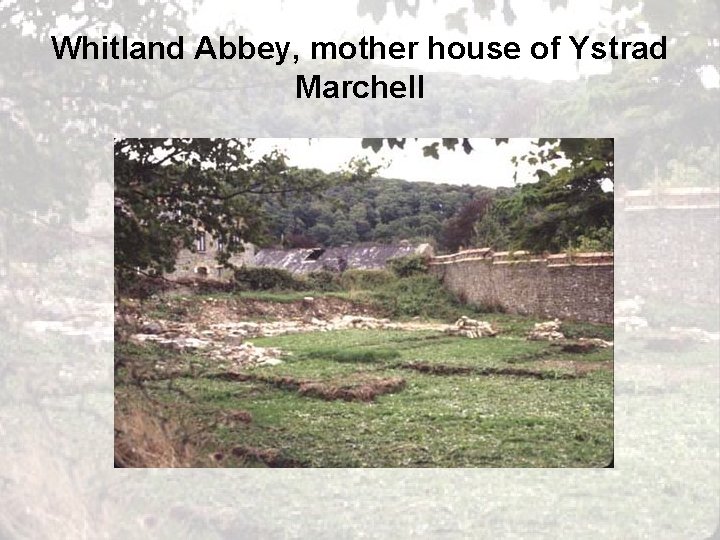
Whitland Abbey, mother house of Ystrad Marchell
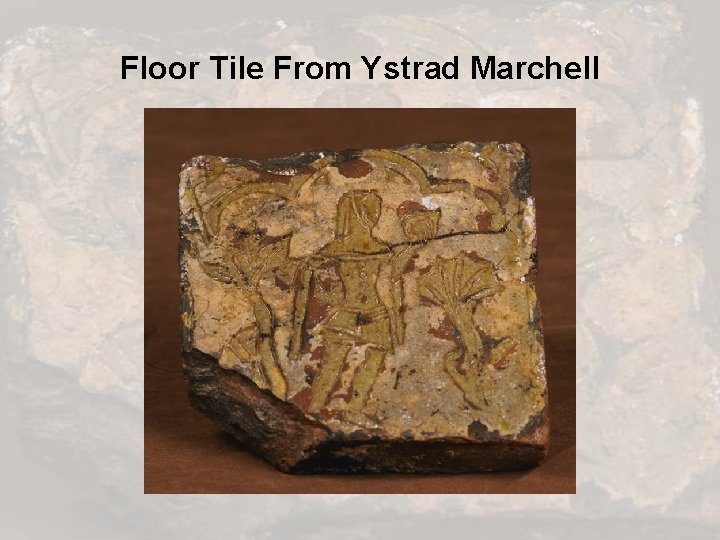
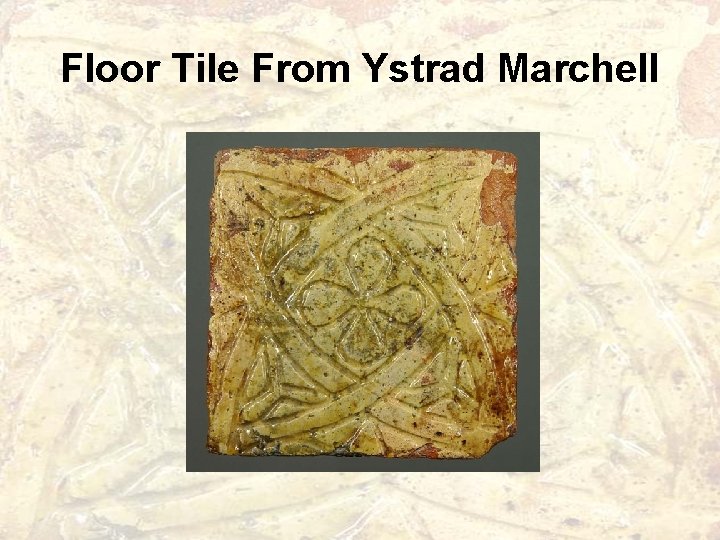
Floor Tile From Ystrad Marchell
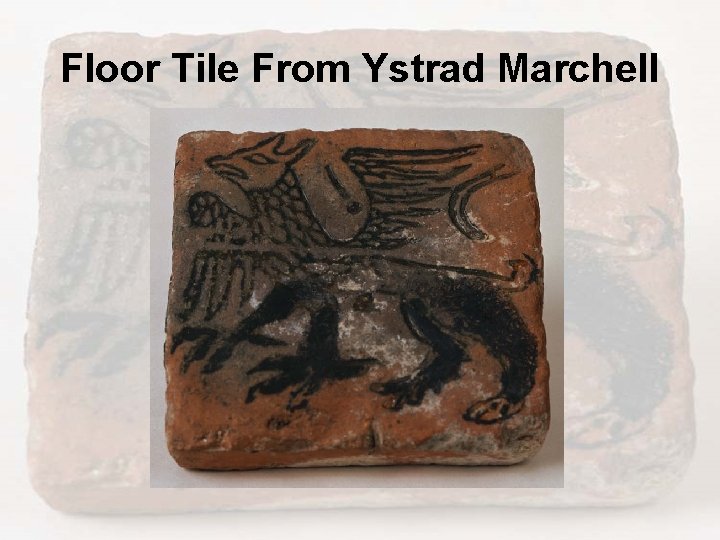
Floor Tile From Ystrad Marchell
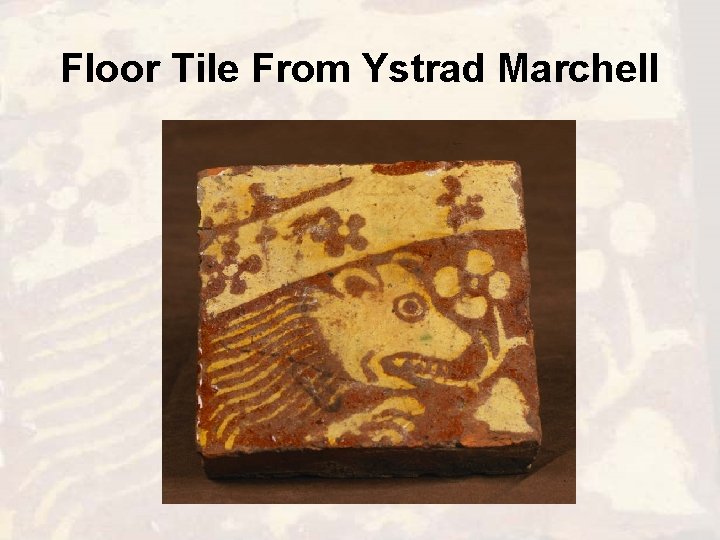
Floor Tile From Ystrad Marchell
Floor Tile From Ystrad Marchell
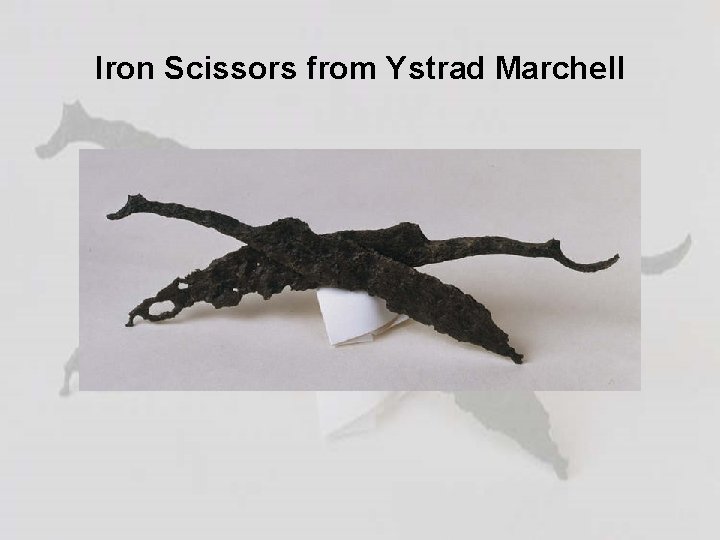
Iron Scissors from Ystrad Marchell
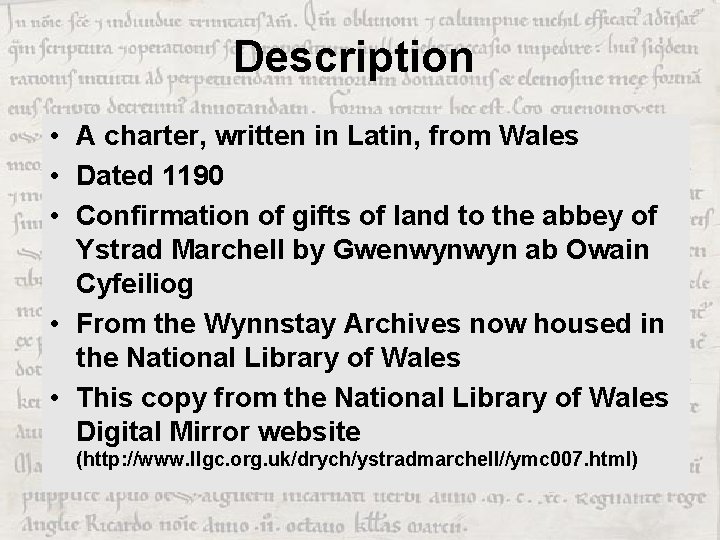
Description • A charter, written in Latin, from Wales • Dated 1190 • Confirmation of gifts of land to the abbey of Ystrad Marchell by Gwenwynwyn ab Owain Cyfeiliog • From the Wynnstay Archives now housed in the National Library of Wales • This copy from the National Library of Wales Digital Mirror website (http: //www. llgc. org. uk/drych/ystradmarchell//ymc 007. html)
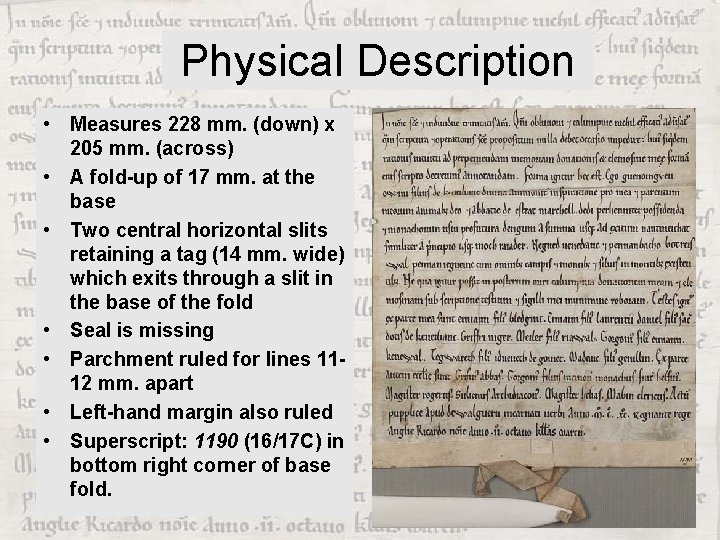
Physical Description • Measures 228 mm. (down) x 205 mm. (across) • A fold-up of 17 mm. at the base • Two central horizontal slits retaining a tag (14 mm. wide) which exits through a slit in the base of the fold • Seal is missing • Parchment ruled for lines 1112 mm. apart • Left-hand margin also ruled • Superscript: 1190 (16/17 C) in bottom right corner of base fold.
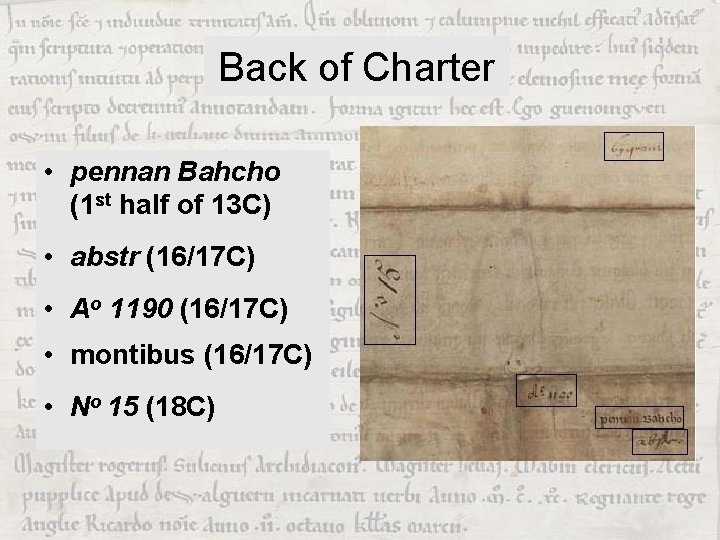
Back of Charter • pennan Bahcho (1 st half of 13 C) • abstr (16/17 C) • Ao 1190 (16/17 C) • montibus (16/17 C) • No 15 (18 C)
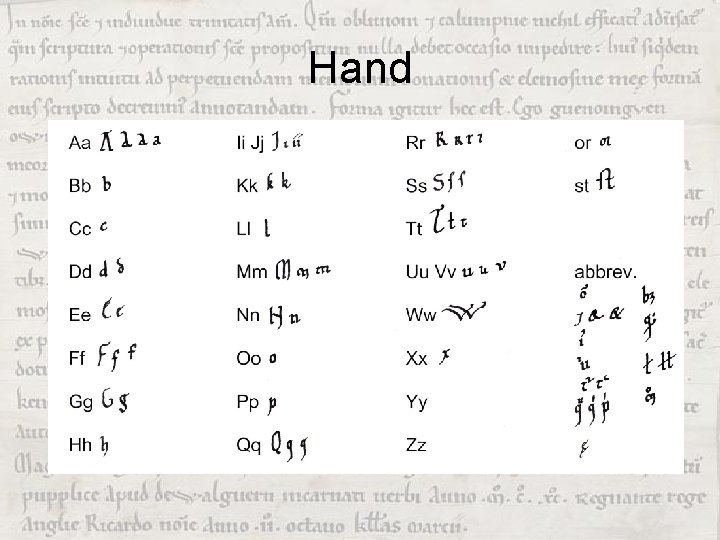
Hand
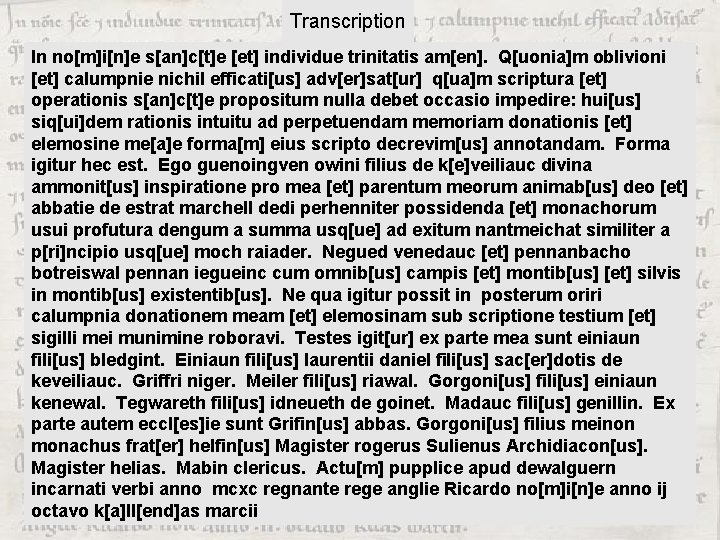
Transcription In no[m]i[n]e s[an]c[t]e [et] individue trinitatis am[en]. Q[uonia]m oblivioni [et] calumpnie nichil efficati[us] adv[er]sat[ur] q[ua]m scriptura [et] operationis s[an]c[t]e propositum nulla debet occasio impedire: hui[us] siq[ui]dem rationis intuitu ad perpetuendam memoriam donationis [et] elemosine me[a]e forma[m] eius scripto decrevim[us] annotandam. Forma igitur hec est. Ego guenoingven owini filius de k[e]veiliauc divina ammonit[us] inspiratione pro mea [et] parentum meorum animab[us] deo [et] abbatie de estrat marchell dedi perhenniter possidenda [et] monachorum usui profutura dengum a summa usq[ue] ad exitum nantmeichat similiter a p[ri]ncipio usq[ue] moch raiader. Negued venedauc [et] pennanbacho botreiswal pennan iegueinc cum omnib[us] campis [et] montib[us] [et] silvis in montib[us] existentib[us]. Ne qua igitur possit in posterum oriri calumpnia donationem meam [et] elemosinam sub scriptione testium [et] sigilli mei munimine roboravi. Testes igit[ur] ex parte mea sunt einiaun fili[us] bledgint. Einiaun fili[us] laurentii daniel fili[us] sac[er]dotis de keveiliauc. Griffri niger. Meiler fili[us] riawal. Gorgoni[us] fili[us] einiaun kenewal. Tegwareth fili[us] idneueth de goinet. Madauc fili[us] genillin. Ex parte autem eccl[es]ie sunt Grifin[us] abbas. Gorgoni[us] filius meinon monachus frat[er] helfin[us] Magister rogerus Sulienus Archidiacon[us]. Magister helias. Mabin clericus. Actu[m] pupplice apud dewalguern incarnati verbi anno mcxc regnante rege anglie Ricardo no[m]i[n]e anno ij octavo k[a]ll[end]as marcii
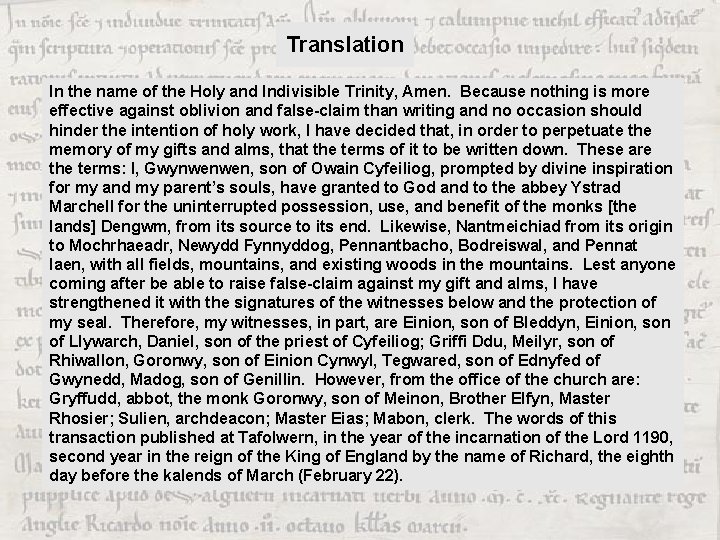
Translation In the name of the Holy and Indivisible Trinity, Amen. Because nothing is more effective against oblivion and false-claim than writing and no occasion should hinder the intention of holy work, I have decided that, in order to perpetuate the memory of my gifts and alms, that the terms of it to be written down. These are the terms: I, Gwynwenwen, son of Owain Cyfeiliog, prompted by divine inspiration for my and my parent’s souls, have granted to God and to the abbey Ystrad Marchell for the uninterrupted possession, use, and benefit of the monks [the lands] Dengwm, from its source to its end. Likewise, Nantmeichiad from its origin to Mochrhaeadr, Newydd Fynnyddog, Pennantbacho, Bodreiswal, and Pennat Iaen, with all fields, mountains, and existing woods in the mountains. Lest anyone coming after be able to raise false-claim against my gift and alms, I have strengthened it with the signatures of the witnesses below and the protection of my seal. Therefore, my witnesses, in part, are Einion, son of Bleddyn, Einion, son of Llywarch, Daniel, son of the priest of Cyfeiliog; Griffi Ddu, Meilyr, son of Rhiwallon, Goronwy, son of Einion Cynwyl, Tegwared, son of Ednyfed of Gwynedd, Madog, son of Genillin. However, from the office of the church are: Gryffudd, abbot, the monk Goronwy, son of Meinon, Brother Elfyn, Master Rhosier; Sulien, archdeacon; Master Eias; Mabon, clerk. The words of this transaction published at Tafolwern, in the year of the incarnation of the Lord 1190, second year in the reign of the King of England by the name of Richard, the eighth day before the kalends of March (February 22).
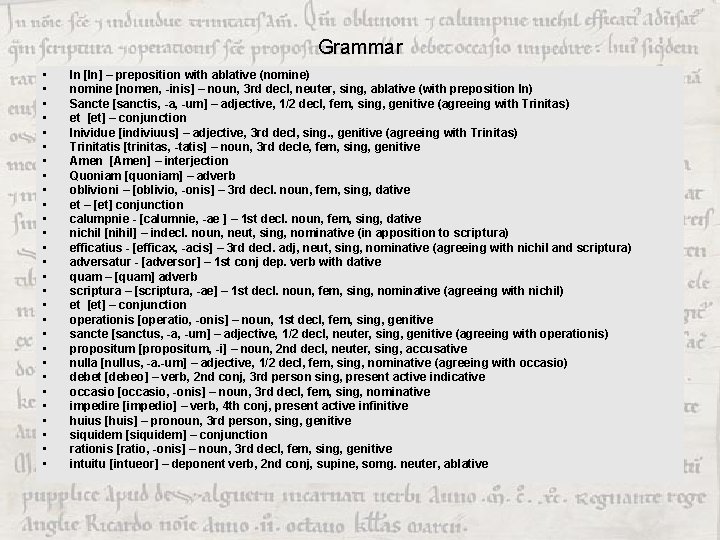
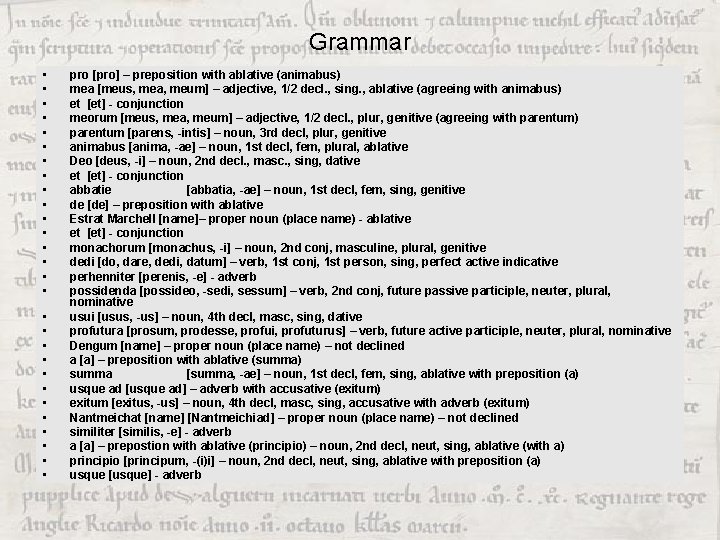
Grammar • • • • • • • In [In] – preposition with ablative (nomine) nomine [nomen, -inis] – noun, 3 rd decl, neuter, sing, ablative (with preposition In) Sancte [sanctis, -a, -um] – adjective, 1/2 decl, fem, sing, genitive (agreeing with Trinitas) et [et] – conjunction Inividue [indiviuus] – adjective, 3 rd decl, sing. , genitive (agreeing with Trinitas) Trinitatis [trinitas, -tatis] – noun, 3 rd decle, fem, sing, genitive Amen [Amen] – interjection Quoniam [quoniam] – adverb oblivioni – [oblivio, -onis] – 3 rd decl. noun, fem, sing, dative et – [et] conjunction calumpnie - [calumnie, -ae ] – 1 st decl. noun, fem, sing, dative nichil [nihil] – indecl. noun, neut, sing, nominative (in apposition to scriptura) efficatius - [efficax, -acis] – 3 rd decl. adj, neut, sing, nominative (agreeing with nichil and scriptura) adversatur - [adversor] – 1 st conj dep. verb with dative quam – [quam] adverb scriptura – [scriptura, -ae] – 1 st decl. noun, fem, sing, nominative (agreeing with nichil) et [et] – conjunction operationis [operatio, -onis] – noun, 1 st decl, fem, sing, genitive sancte [sanctus, -a, -um] – adjective, 1/2 decl, neuter, sing, genitive (agreeing with operationis) propositum [propositum, -i] – noun, 2 nd decl, neuter, sing, accusative nulla [nullus, -a. -um] – adjective, 1/2 decl, fem, sing, nominative (agreeing with occasio) debet [debeo] – verb, 2 nd conj, 3 rd person sing, present active indicative occasio [occasio, -onis] – noun, 3 rd decl, fem, sing, nominative impedire [impedio] – verb, 4 th conj, present active infinitive huius [huis] – pronoun, 3 rd person, sing, genitive siquidem [siquidem] – conjunction rationis [ratio, -onis] – noun, 3 rd decl, fem, sing, genitive intuitu [intueor] – deponent verb, 2 nd conj, supine, somg. neuter, ablative
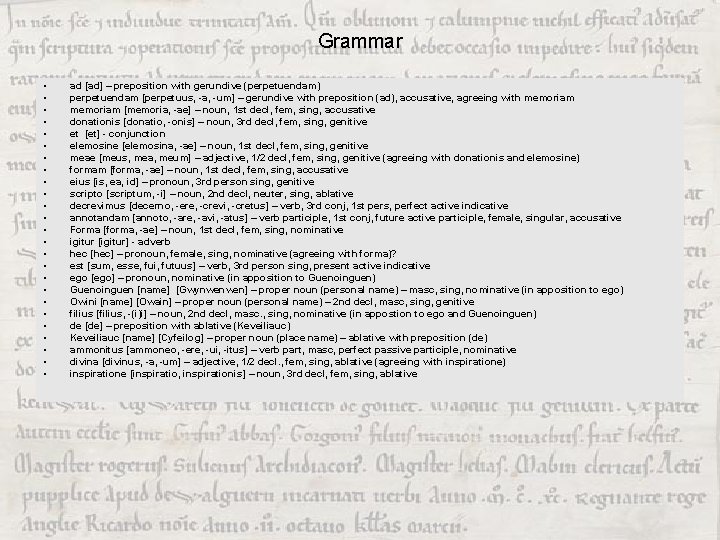
Grammar • • • • • • • ad [ad] – preposition with gerundive (perpetuendam) perpetuendam [perpetuus, -a, -um] – gerundive with preposition (ad), accusative, agreeing with memoriam [memoria, -ae] – noun, 1 st decl, fem, sing, accusative donationis [donatio, -onis] – noun, 3 rd decl, fem, sing, genitive et [et] - conjunction elemosine [elemosina, -ae] – noun, 1 st decl, fem, sing, genitive meae [meus, mea, meum] – adjective, 1/2 decl, fem, sing, genitive (agreeing with donationis and elemosine) formam [forma, -ae] – noun, 1 st decl, fem, sing, accusative eius [is, ea, id] – pronoun, 3 rd person sing, genitive scripto [scriptum, -i] – noun, 2 nd decl, neuter, sing, ablative decrevimus [decerno, -ere, -crevi, -cretus] – verb, 3 rd conj, 1 st pers, perfect active indicative annotandam [annoto, -are, -avi, -atus] – verb participle, 1 st conj, future active participle, female, singular, accusative Forma [forma, -ae] – noun, 1 st decl, fem, sing, nominative igitur [igitur] - adverb hec [hec] – pronoun, female, sing, nominative (agreeing with forma)? est [sum, esse, fui, futuus] – verb, 3 rd person sing, present active indicative ego [ego] – pronoun, nominative (in apposition to Guenoinguen) Guenoinguen [name] [Gwynwenwen] – proper noun (personal name) – masc, sing, nominative (in apposition to ego) Owini [name] [Owain] – proper noun (personal name) – 2 nd decl, masc, sing, genitive filius [filius, -(i)i] – noun, 2 nd decl, masc. , sing, nominative (in appostion to ego and Guenoinguen) de [de] – preposition with ablative (Keveiliauc) Keveiliauc [name] [Cyfeilog] – proper noun (place name) – ablative with preposition (de) ammonitus [ammoneo, -ere, -ui, -itus] – verb part, masc, perfect passive participle, nominative divina [divinus, -a, -um] – adjective, 1/2 decl. , fem, sing, ablative (agreeing with inspiratione) inspiratione [inspiratio, inspirationis] – noun, 3 rd decl, fem, sing, ablative
Grammar • • • • • • • pro [pro] – preposition with ablative (animabus) mea [meus, mea, meum] – adjective, 1/2 decl. , sing. , ablative (agreeing with animabus) et [et] - conjunction meorum [meus, mea, meum] – adjective, 1/2 decl. , plur, genitive (agreeing with parentum) parentum [parens, -intis] – noun, 3 rd decl, plur, genitive animabus [anima, -ae] – noun, 1 st decl, fem, plural, ablative Deo [deus, -i] – noun, 2 nd decl. , masc. , sing, dative et [et] - conjunction abbatie [abbatia, -ae] – noun, 1 st decl, fem, sing, genitive de [de] – preposition with ablative Estrat Marchell [name]– proper noun (place name) - ablative et [et] - conjunction monachorum [monachus, -i] – noun, 2 nd conj, masculine, plural, genitive dedi [do, dare, dedi, datum] – verb, 1 st conj, 1 st person, sing, perfect active indicative perhenniter [perenis, -e] - adverb possidenda [possideo, -sedi, sessum] – verb, 2 nd conj, future passive participle, neuter, plural, nominative usui [usus, -us] – noun, 4 th decl, masc, sing, dative profutura [prosum, prodesse, profui, profuturus] – verb, future active participle, neuter, plural, nominative Dengum [name] – proper noun (place name) – not declined a [a] – preposition with ablative (summa) summa [summa, -ae] – noun, 1 st decl, fem, sing, ablative with preposition (a) usque ad [usque ad] – adverb with accusative (exitum) exitum [exitus, -us] – noun, 4 th decl, masc, sing, accusative with adverb (exitum) Nantmeichat [name] [Nantmeichiad] – proper noun (place name) – not declined similiter [similis, -e] - adverb a [a] – prepostion with ablative (principio) – noun, 2 nd decl, neut, sing, ablative (with a) principio [principum, -(i)i] – noun, 2 nd decl, neut, sing, ablative with preposition (a) usque [usque] - adverb
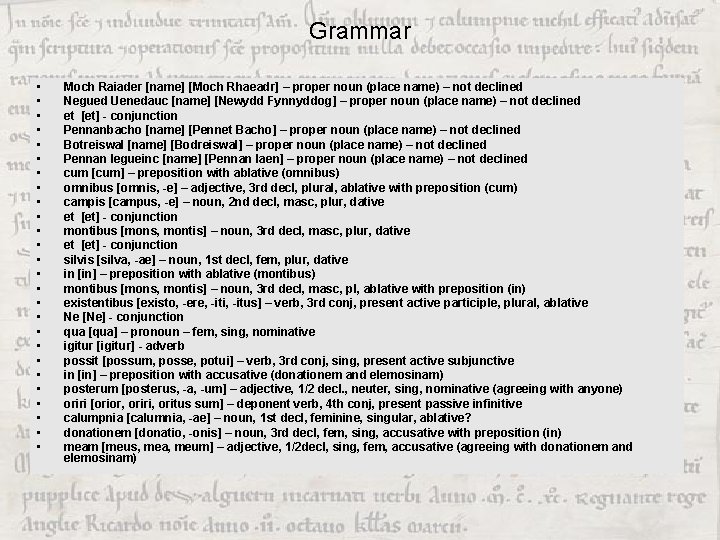
Grammar • • • • • • • Moch Raiader [name] [Moch Rhaeadr] – proper noun (place name) – not declined Negued Uenedauc [name] [Newydd Fynnyddog] – proper noun (place name) – not declined et [et] - conjunction Pennanbacho [name] [Pennet Bacho] – proper noun (place name) – not declined Botreiswal [name] [Bodreiswal] – proper noun (place name) – not declined Pennan Iegueinc [name] [Pennan Iaen] – proper noun (place name) – not declined cum [cum] – preposition with ablative (omnibus) omnibus [omnis, -e] – adjective, 3 rd decl, plural, ablative with preposition (cum) campis [campus, -e] – noun, 2 nd decl, masc, plur, dative et [et] - conjunction montibus [mons, montis] – noun, 3 rd decl, masc, plur, dative et [et] - conjunction silvis [silva, -ae] – noun, 1 st decl, fem, plur, dative in [in] – preposition with ablative (montibus) montibus [mons, montis] – noun, 3 rd decl, masc, pl, ablative with preposition (in) existentibus [existo, -ere, -iti, -itus] – verb, 3 rd conj, present active participle, plural, ablative Ne [Ne] - conjunction qua [qua] – pronoun – fem, sing, nominative igitur [igitur] - adverb possit [possum, posse, potui] – verb, 3 rd conj, sing, present active subjunctive in [in] – preposition with accusative (donationem and elemosinam) posterum [posterus, -a, -um] – adjective, 1/2 decl. , neuter, sing, nominative (agreeing with anyone) oriri [orior, oriri, oritus sum] – deponent verb, 4 th conj, present passive infinitive calumpnia [calumnia, -ae] – noun, 1 st decl, feminine, singular, ablative? donationem [donatio, -onis] – noun, 3 rd decl, fem, sing, accusative with preposition (in) meam [meus, mea, meum] – adjective, 1/2 decl, sing, fem, accusative (agreeing with donationem and elemosinam)
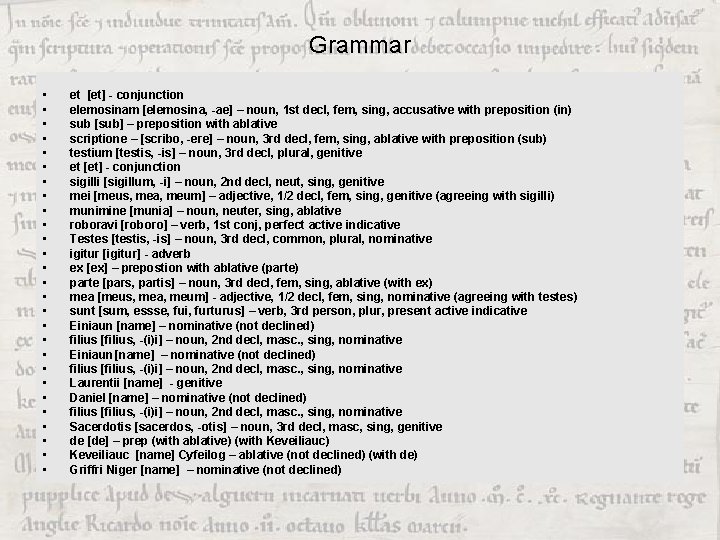
Grammar • • • • • • • et [et] - conjunction elemosinam [elemosina, -ae] – noun, 1 st decl, fem, sing, accusative with preposition (in) sub [sub] – preposition with ablative scriptione – [scribo, -ere] – noun, 3 rd decl, fem, sing, ablative with preposition (sub) testium [testis, -is] – noun, 3 rd decl, plural, genitive et [et] - conjunction sigilli [sigillum, -i] – noun, 2 nd decl, neut, sing, genitive mei [meus, mea, meum] – adjective, 1/2 decl, fem, sing, genitive (agreeing with sigilli) munimine [munia] – noun, neuter, sing, ablative roboravi [roboro] – verb, 1 st conj, perfect active indicative Testes [testis, -is] – noun, 3 rd decl, common, plural, nominative igitur [igitur] - adverb ex [ex] – prepostion with ablative (parte) parte [pars, partis] – noun, 3 rd decl, fem, sing, ablative (with ex) mea [meus, mea, meum] - adjective, 1/2 decl, fem, sing, nominative (agreeing with testes) sunt [sum, essse, fui, furturus] – verb, 3 rd person, plur, present active indicative Einiaun [name] – nominative (not declined) filius [filius, -(i)i] – noun, 2 nd decl, masc. , sing, nominative Laurentii [name] - genitive Daniel [name] – nominative (not declined) filius [filius, -(i)i] – noun, 2 nd decl, masc. , sing, nominative Sacerdotis [sacerdos, -otis] – noun, 3 rd decl, masc, sing, genitive de [de] – prep (with ablative) (with Keveiliauc) Keveiliauc [name] Cyfeilog – ablative (not declined) (with de) Griffri Niger [name] – nominative (not declined)
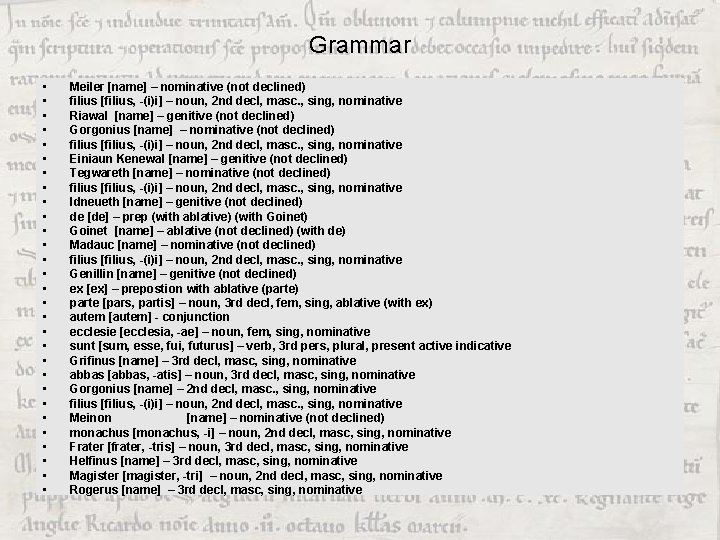
Grammar • • • • • • • • Meiler [name] – nominative (not declined) filius [filius, -(i)i] – noun, 2 nd decl, masc. , sing, nominative Riawal [name] – genitive (not declined) Gorgonius [name] – nominative (not declined) filius [filius, -(i)i] – noun, 2 nd decl, masc. , sing, nominative Einiaun Kenewal [name] – genitive (not declined) Tegwareth [name] – nominative (not declined) filius [filius, -(i)i] – noun, 2 nd decl, masc. , sing, nominative Idneueth [name] – genitive (not declined) de [de] – prep (with ablative) (with Goinet) Goinet [name] – ablative (not declined) (with de) Madauc [name] – nominative (not declined) filius [filius, -(i)i] – noun, 2 nd decl, masc. , sing, nominative Genillin [name] – genitive (not declined) ex [ex] – prepostion with ablative (parte) parte [pars, partis] – noun, 3 rd decl, fem, sing, ablative (with ex) autem [autem] - conjunction ecclesie [ecclesia, -ae] – noun, fem, sing, nominative sunt [sum, esse, fui, futurus] – verb, 3 rd pers, plural, present active indicative Grifinus [name] – 3 rd decl, masc, sing, nominative abbas [abbas, -atis] – noun, 3 rd decl, masc, sing, nominative Gorgonius [name] – 2 nd decl, masc. , sing, nominative filius [filius, -(i)i] – noun, 2 nd decl, masc. , sing, nominative Meinon [name] – nominative (not declined) monachus [monachus, -i] – noun, 2 nd decl, masc, sing, nominative Frater [frater, -tris] – noun, 3 rd decl, masc, sing, nominative Helfinus [name] – 3 rd decl, masc, sing, nominative Magister [magister, -tri] – noun, 2 nd decl, masc, sing, nominative Rogerus [name] – 3 rd decl, masc, sing, nominative
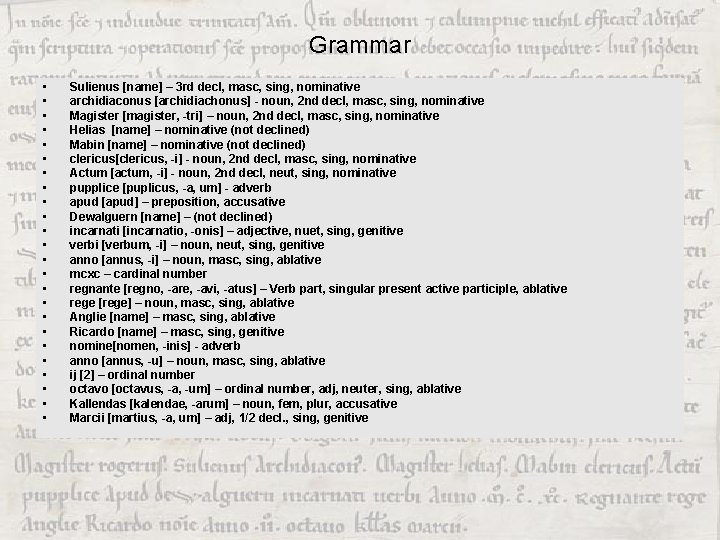
Grammar • • • • • • Sulienus [name] – 3 rd decl, masc, sing, nominative archidiaconus [archidiachonus] - noun, 2 nd decl, masc, sing, nominative Magister [magister, -tri] – noun, 2 nd decl, masc, sing, nominative Helias [name] – nominative (not declined) Mabin [name] – nominative (not declined) clericus[clericus, -i] - noun, 2 nd decl, masc, sing, nominative Actum [actum, -i] - noun, 2 nd decl, neut, sing, nominative pupplice [puplicus, -a, um] - adverb apud [apud] – preposition, accusative Dewalguern [name] – (not declined) incarnati [incarnatio, -onis] – adjective, nuet, sing, genitive verbi [verbum, -i] – noun, neut, sing, genitive anno [annus, -i] – noun, masc, sing, ablative mcxc – cardinal number regnante [regno, -are, -avi, -atus] – Verb part, singular present active participle, ablative rege [rege] – noun, masc, sing, ablative Anglie [name] – masc, sing, ablative Ricardo [name] – masc, sing, genitive nomine[nomen, -inis] - adverb anno [annus, -u] – noun, masc, sing, ablative ij [2] – ordinal number octavo [octavus, -a, -um] – ordinal number, adj, neuter, sing, ablative Kallendas [kalendae, -arum] – noun, fem, plur, accusative Marcii [martius, -a, um] – adj, 1/2 decl. , sing, genitive
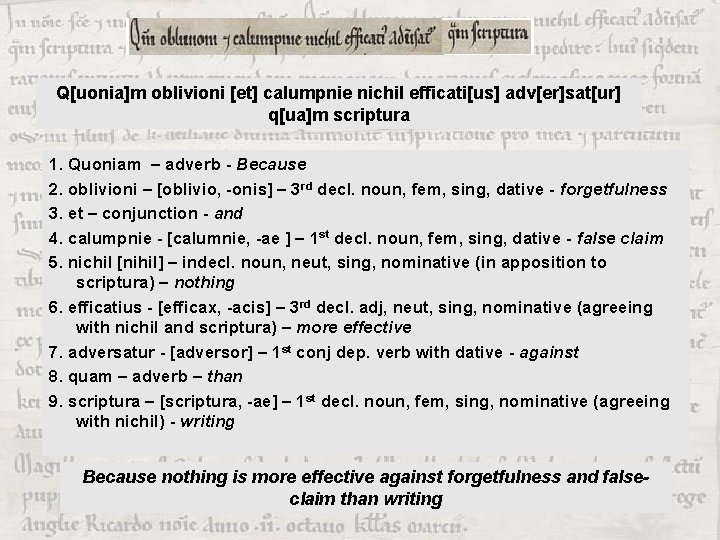
Q[uonia]m oblivioni [et] calumpnie nichil efficati[us] adv[er]sat[ur] q[ua]m scriptura 1. Quoniam – adverb - Because 2. oblivioni – [oblivio, -onis] – 3 rd decl. noun, fem, sing, dative - forgetfulness 3. et – conjunction - and 4. calumpnie - [calumnie, -ae ] – 1 st decl. noun, fem, sing, dative - false claim 5. nichil [nihil] – indecl. noun, neut, sing, nominative (in apposition to scriptura) – nothing 6. efficatius - [efficax, -acis] – 3 rd decl. adj, neut, sing, nominative (agreeing with nichil and scriptura) – more effective 7. adversatur - [adversor] – 1 st conj dep. verb with dative - against 8. quam – adverb – than 9. scriptura – [scriptura, -ae] – 1 st decl. noun, fem, sing, nominative (agreeing with nichil) - writing Because nothing is more effective against forgetfulness and falseclaim than writing
Research in Wales • Documents in Wales can be in at least 4 different languages: – Welsh – English – French – Latin
Welsh Language • Of the languages spoken in the British Isles, Welsh has been there the longest • Member of the Celtic branch of the Indo-European language family • Two groups of Celtic languages: – Brythonic • Welsh • Breton – spoken in Brittany • Cornish – spoken in Cornwall – Goidelic • Irish • Scottish Gaelic • Manx
Welsh Language • • • 1536: Act of Annexation – Wales is legally incorporated into England – English is the sole official language 1549: Act of Uniformity – required all acts of public worship to be conducted in English instead of Latin. – its goal was to cement the Protestant Reformation started by Henry VII among the mass of the population, but it hurt the Welsh language. 1563: Elizabeth I enacted legislation requiring all churches in Wales to have Welsh translations of the Book of Common Prayer and of the Bible by 1567. – aim was to spread the Protestant word amongst them (as opposed to Catholicism) and get the Welsh on the side of England. – The texts were place side by side in Welsh and English so that the Welsh could learn English (and eventually abandon Welsh). – inadvertantly saved the Welsh language.
Welsh Language • • 1847 Report on Education in Wales – denounced Welsh for lack of knowledge of English – Welsh children punished for speaking Welsh in schools after 1870, when primary education was made compulsory, English became the only language of education in Wales. End of 19 th century: influx of English-speakers into Wales 20 th Century – started with 50% of Wales able to speak Welsh – approximately 20, 000 Welsh speakers killed in World War I – in the following 20 years, about 250, 000 Welsh speakers emigrated out of Wales – approximately 6, 000 Welsh speakers killed in World War II – During World War II, about 20% of the Welsh population (abt 500, 000) able to speak Welsh – After World War II, the first Welsh medium primary schools were established
Welsh Language • • 20 th Century (con’t) – The Welsh Language Society established in 1962 – 1971: Welsh medium playground movement established (Welsh preschool) – mid-1990’s: Welsh a compulsory subject in almost all English medium schools. – By the end of the 20 th century • around 450 primary schools were teaching Welsh • around 50 secondary schools teaching some subjects in Welsh, and about 25 schools teach mainly in Welsh. Today – 25% of Welsh primary schools are now Welsh medium schools – Large movement for everyone to Welsh, adults as well as children.
Welsh Language through the Ages • 550 -800: Early Welsh • 800 -1150: Old Welsh • 1150 -1400: Middle Welsh • 1400 -1600: Early Modern Welsh • 1600 -now: Modern Welsh
Types of Welsh • • Bardic Welsh Literary Welsh Cymraeg Byw (“Living Welsh”) Colloquial Welsh
Bardic Welsh • Earliest written Welsh • Language of the old bards of Welsh • The bards were an important part of the Welsh culture, creating odes and poetry for the princes • When Wales no longer had princes, the bards switched to the gentry
Literary Welsh • An artificial language • Anyone who knows how to read it, whether Welsh speakers or not, has been taught. • Consciously planned and designed to standardize the written language at the time of the translation of the Bible into Welsh (sixteenth century), with a deliberate disregard for native speech of ordinary people. • Not the same as written Welsh – literary Welsh is a particular type of artificial Welsh, while written Welsh can be any type of Welsh in written form.
Cymraeg Byw -- “Living Welsh” • An attempt in the 1960’s and 1970’s to create a “standardized” colloquial Welsh • Also essentially an artificial construct • Tried to be a compromise not only between the different dialects of Colloquial Welsh, but also between them and Literary Welsh, from which certain characteristics were imported.
Colloquial Welsh • • • Native, everyday spoken language Native speakers have acquired it automatically from childhood and have an intuitive feel for what sounds ‘right’ or ‘wrong’ 2 major dialects – North – South All dialects can be understood by most Welsh speakers Major Differences between North and South dialects – Vocabulary – Pronunciation – Syntax (sentence structure)
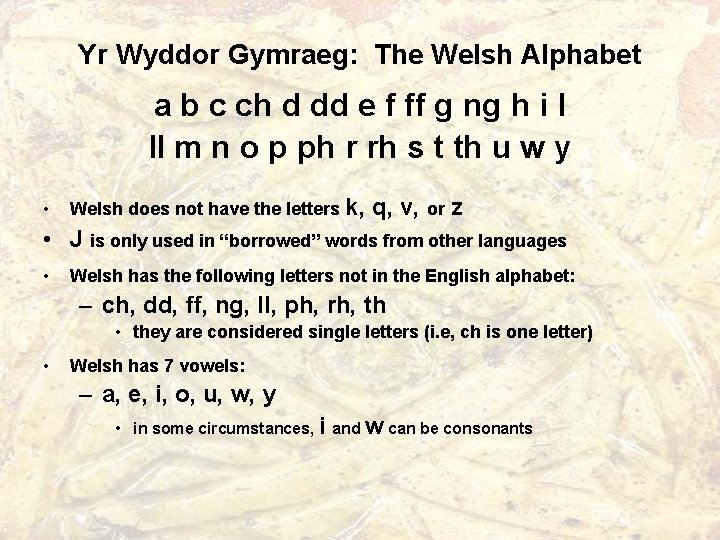
Yr Wyddor Gymraeg: The Welsh Alphabet a b c ch d dd e f ff g ng h i l ll m n o p ph r rh s t th u w y • Welsh does not have the letters k, q, v, or z • J is only used in “borrowed” words from other languages • Welsh has the following letters not in the English alphabet: – ch, dd, ff, ng, ll, ph, rh, th • they are considered single letters (i. e, ch is one letter) • Welsh has 7 vowels: – a, e, i, o, u, w, y • in some circumstances, i and w can be consonants
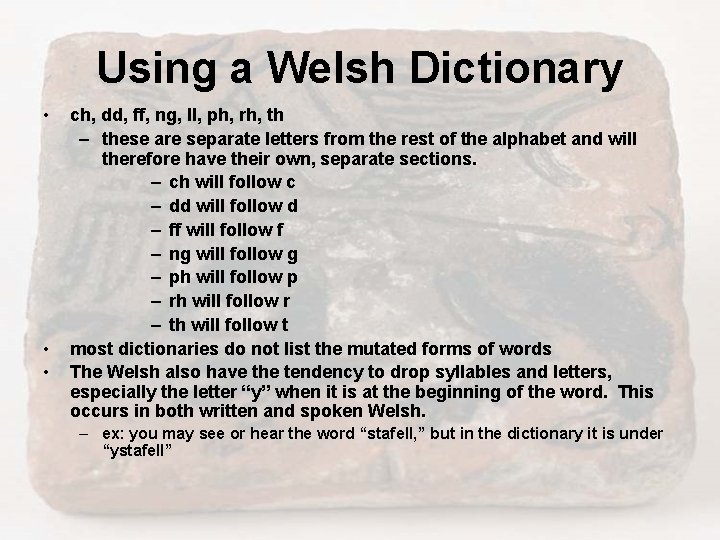
Using a Welsh Dictionary • • • ch, dd, ff, ng, ll, ph, rh, th – these are separate letters from the rest of the alphabet and will therefore have their own, separate sections. – ch will follow c – dd will follow d – ff will follow f – ng will follow g – ph will follow p – rh will follow r – th will follow t most dictionaries do not list the mutated forms of words The Welsh also have the tendency to drop syllables and letters, especially the letter “y” when it is at the beginning of the word. This occurs in both written and spoken Welsh. – ex: you may see or hear the word “stafell, ” but in the dictionary it is under “ystafell”
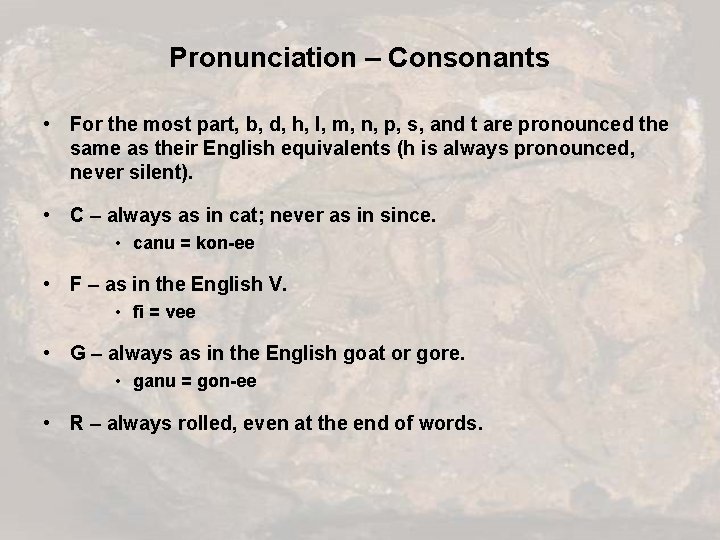
Pronunciation – Consonants • For the most part, b, d, h, l, m, n, p, s, and t are pronounced the same as their English equivalents (h is always pronounced, never silent). • C – always as in cat; never as in since. • canu = kon-ee • F – as in the English V. • fi = vee • G – always as in the English goat or gore. • ganu = gon-ee • R – always rolled, even at the end of words.
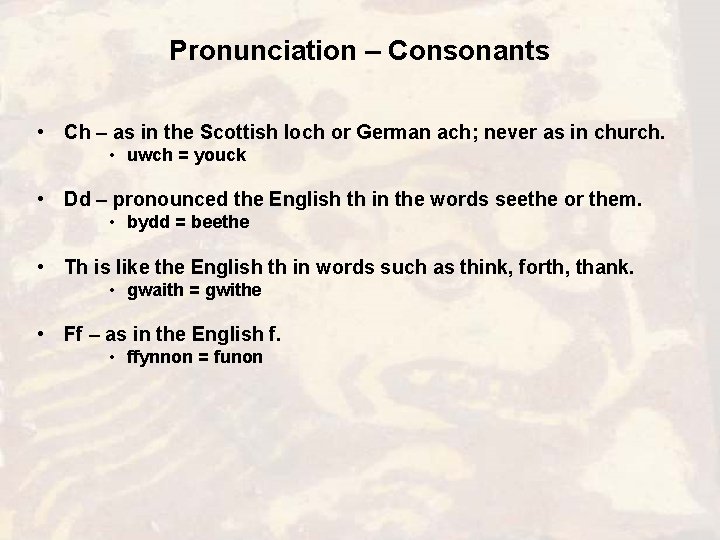
Pronunciation – Consonants • Ch – as in the Scottish loch or German ach; never as in church. • uwch = youck • Dd – pronounced the English th in the words seethe or them. • bydd = beethe • Th is like the English th in words such as think, forth, thank. • gwaith = gwithe • Ff – as in the English f. • ffynnon = funon
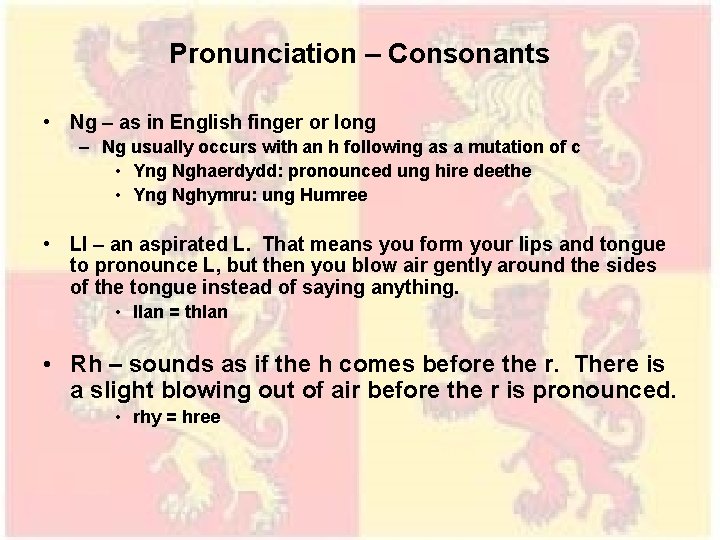
Pronunciation – Consonants • Ng – as in English finger or long – Ng usually occurs with an h following as a mutation of c • Yng Nghaerdydd: pronounced ung hire deethe • Yng Nghymru: ung Humree • Ll – an aspirated L. That means you form your lips and tongue to pronounce L, but then you blow air gently around the sides of the tongue instead of saying anything. • llan = thlan • Rh – sounds as if the h comes before the r. There is a slight blowing out of air before the r is pronounced. • rhy = hree
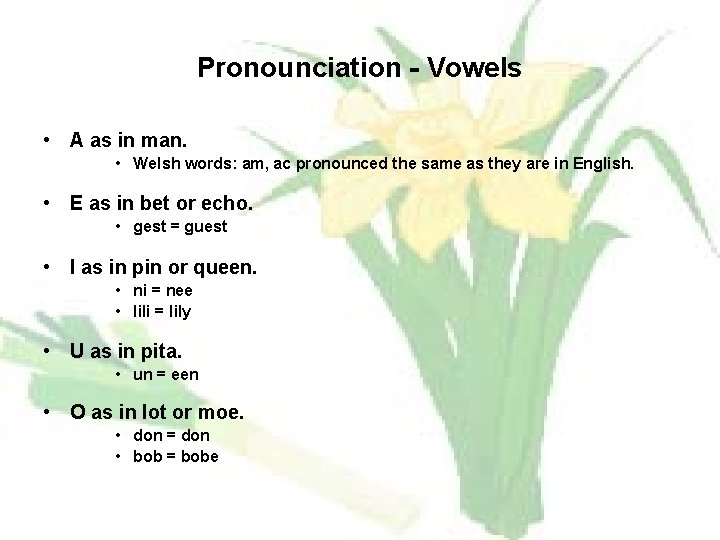
Pronounciation - Vowels • A as in man. • Welsh words: am, ac pronounced the same as they are in English. • E as in bet or echo. • gest = guest • I as in pin or queen. • ni = nee • lili = lily • U as in pita. • un = een • O as in lot or moe. • don = don • bob = bobe
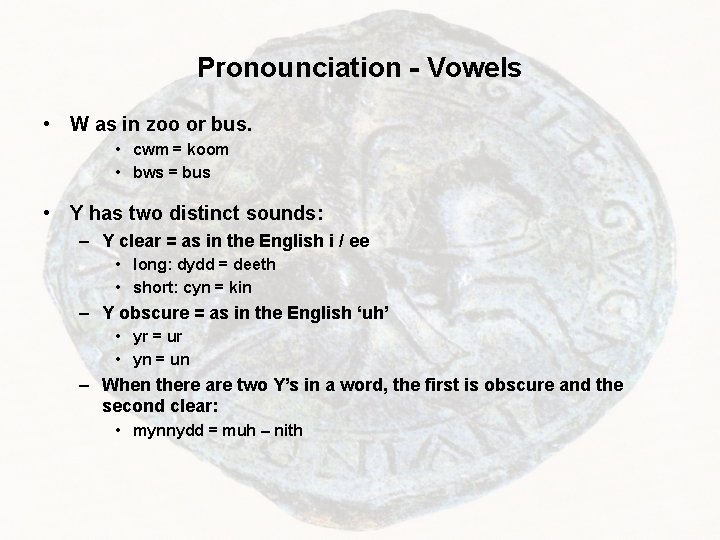
Pronounciation - Vowels • W as in zoo or bus. • cwm = koom • bws = bus • Y has two distinct sounds: – Y clear = as in the English i / ee • long: dydd = deeth • short: cyn = kin – Y obscure = as in the English ‘uh’ • yr = ur • yn = un – When there are two Y’s in a word, the first is obscure and the second clear: • mynnydd = muh – nith
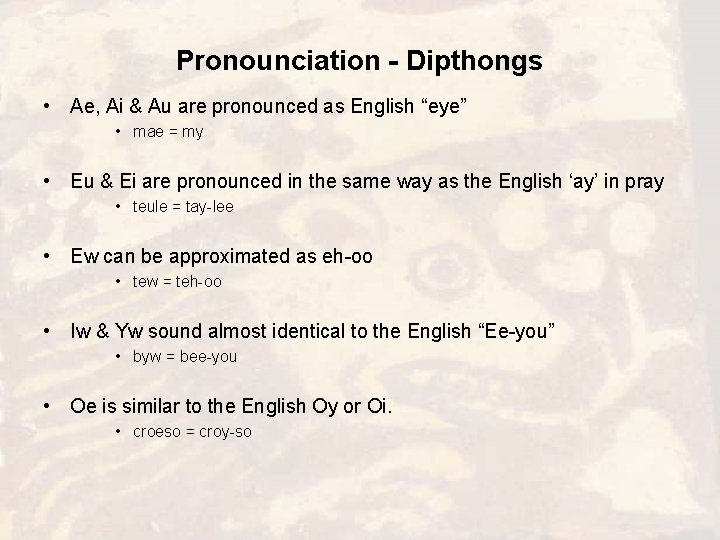
Pronounciation - Dipthongs • Ae, Ai & Au are pronounced as English “eye” • mae = my • Eu & Ei are pronounced in the same way as the English ‘ay’ in pray • teule = tay-lee • Ew can be approximated as eh-oo • tew = teh-oo • Iw & Yw sound almost identical to the English “Ee-you” • byw = bee-you • Oe is similar to the English Oy or Oi. • croeso = croy-so
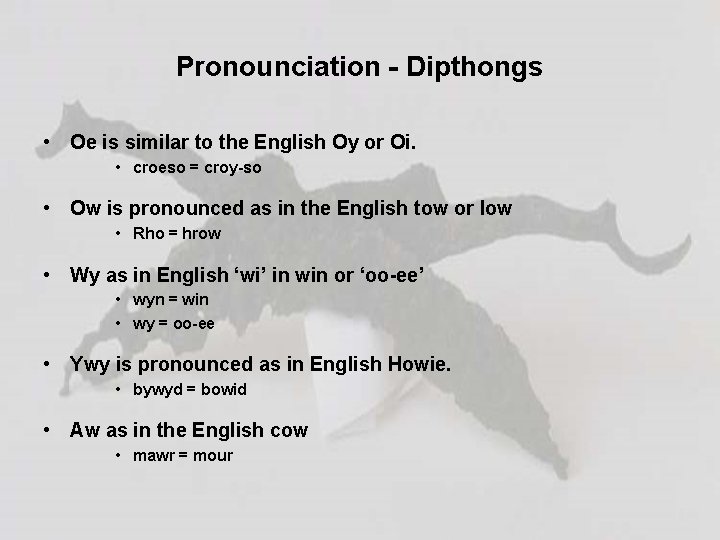
Pronounciation - Dipthongs • Oe is similar to the English Oy or Oi. • croeso = croy-so • Ow is pronounced as in the English tow or low • Rho = hrow • Wy as in English ‘wi’ in win or ‘oo-ee’ • wyn = win • wy = oo-ee • Ywy is pronounced as in English Howie. • bywyd = bowid • Aw as in the English cow • mawr = mour
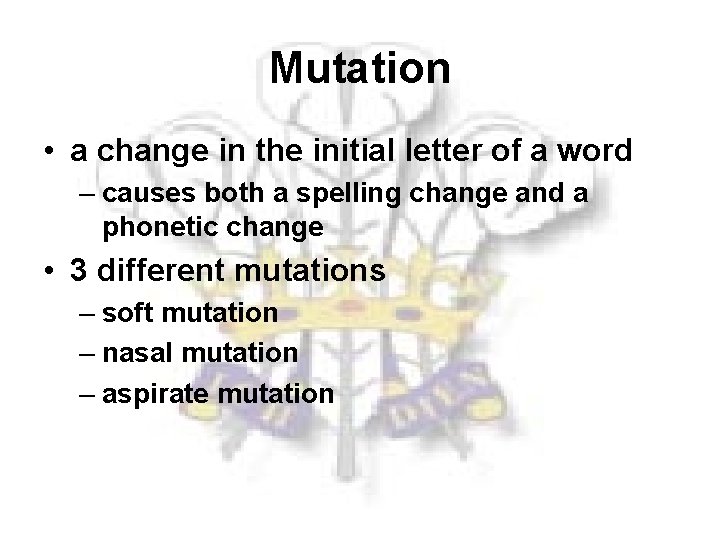
Mutation • a change in the initial letter of a word – causes both a spelling change and a phonetic change • 3 different mutations – soft mutation – nasal mutation – aspirate mutation
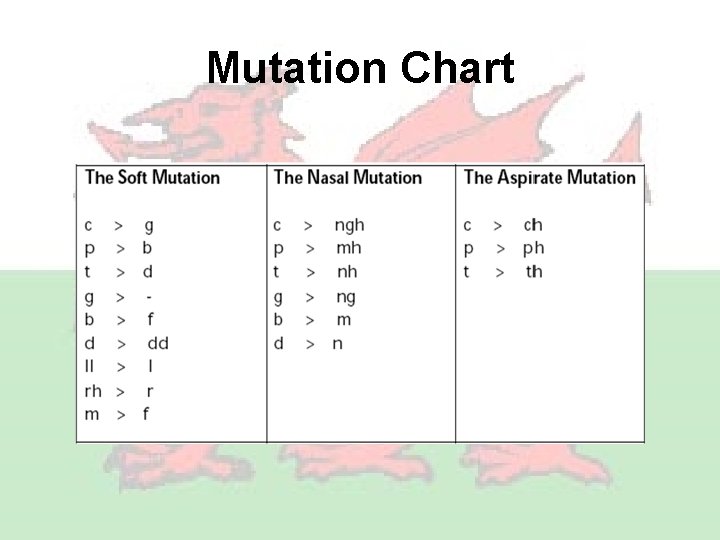
Mutation Chart
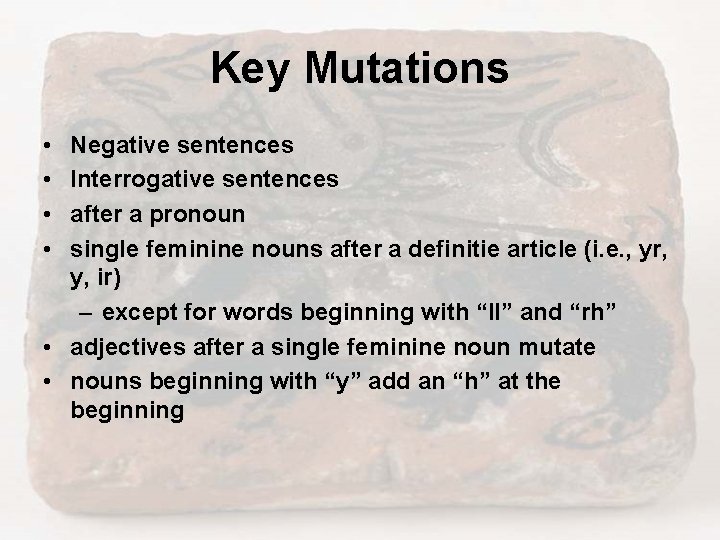
Key Mutations • • Negative sentences Interrogative sentences after a pronoun single feminine nouns after a definitie article (i. e. , yr, y, ir) – except for words beginning with “ll” and “rh” • adjectives after a single feminine noun mutate • nouns beginning with “y” add an “h” at the beginning
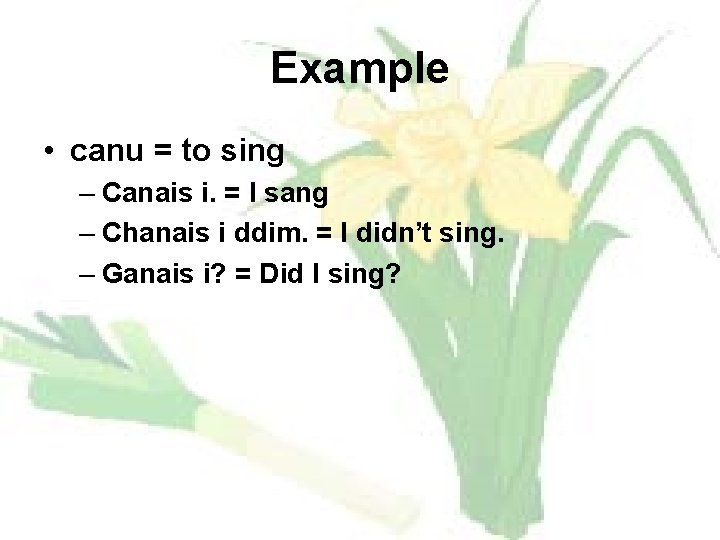
Example • canu = to sing – Canais i. = I sang – Chanais i ddim. = I didn’t sing. – Ganais i? = Did I sing?
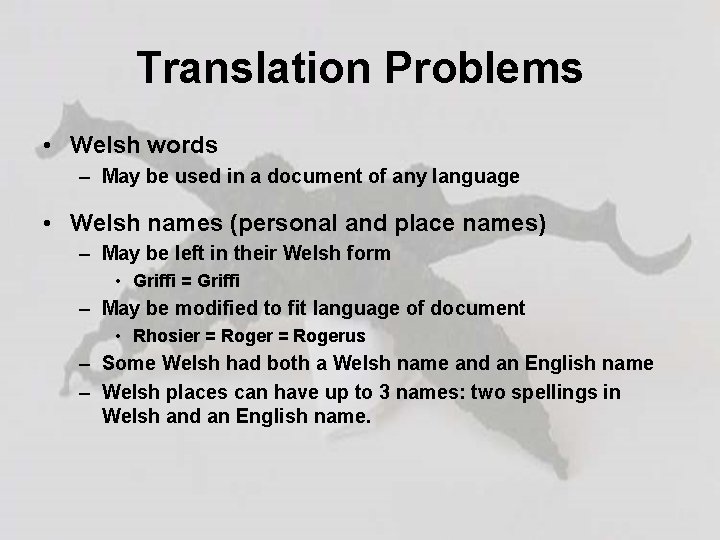
Translation Problems • Welsh words – May be used in a document of any language • Welsh names (personal and place names) – May be left in their Welsh form • Griffi = Griffi – May be modified to fit language of document • Rhosier = Rogerus – Some Welsh had both a Welsh name and an English name – Welsh places can have up to 3 names: two spellings in Welsh and an English name.
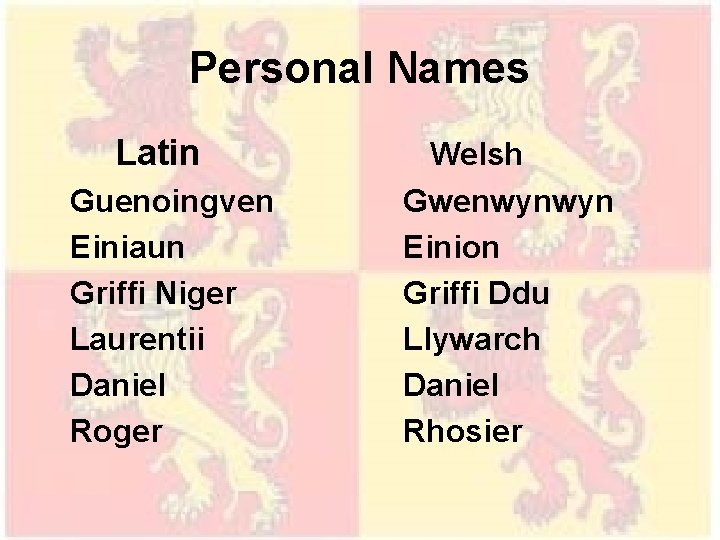
Personal Names Latin Guenoingven Einiaun Griffi Niger Laurentii Daniel Roger Welsh Gwenwynwyn Einion Griffi Ddu Llywarch Daniel Rhosier
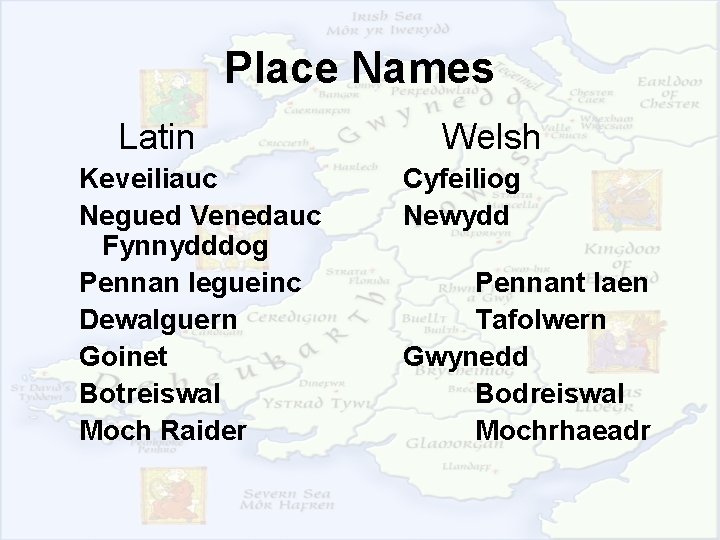
Place Names Latin Keveiliauc Negued Venedauc Fynnydddog Pennan Iegueinc Dewalguern Goinet Botreiswal Moch Raider Welsh Cyfeiliog Newydd Pennant Iaen Tafolwern Gwynedd Bodreiswal Mochrhaeadr
Deciphering the Names • Is it a Welsh name in Welsh form? • Was it spelled phonetically? • Was it “Anglicized” or “Latinized”?
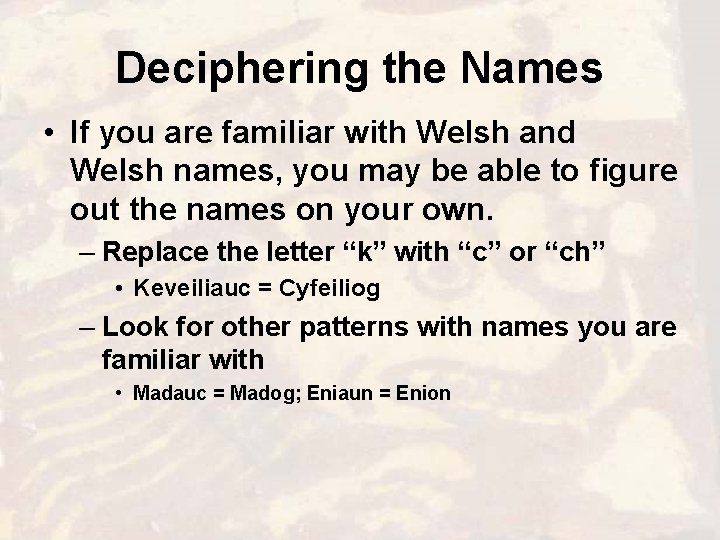
Deciphering the Names • If you are familiar with Welsh and Welsh names, you may be able to figure out the names on your own. – Replace the letter “k” with “c” or “ch” • Keveiliauc = Cyfeiliog – Look for other patterns with names you are familiar with • Madauc = Madog; Eniaun = Enion
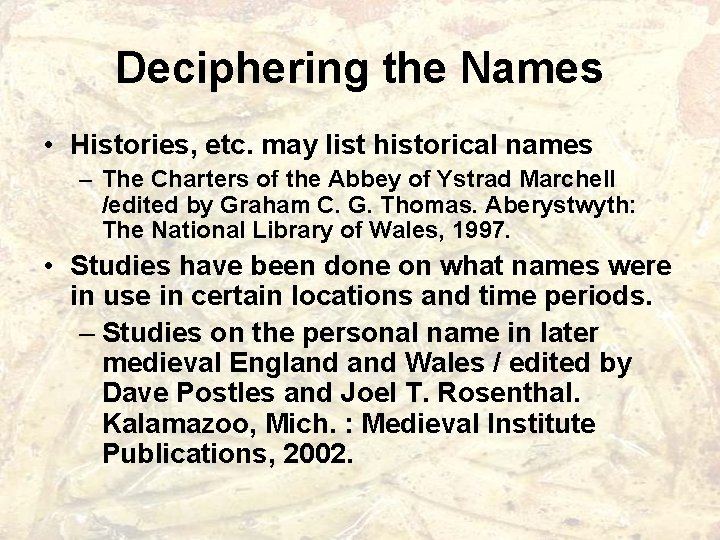
Deciphering the Names • Histories, etc. may list historical names – The Charters of the Abbey of Ystrad Marchell /edited by Graham C. G. Thomas. Aberystwyth: The National Library of Wales, 1997. • Studies have been done on what names were in use in certain locations and time periods. – Studies on the personal name in later medieval England Wales / edited by Dave Postles and Joel T. Rosenthal. Kalamazoo, Mich. : Medieval Institute Publications, 2002.
Sources • • • BBC Wales (http: //www. bbc. co. uk/wales/) Britannica Online (http: //www. britannia. com/celtic/wales/timeline/tl 07. html) The Cistercian Way (http: //cistercian-way. newport. ac. uk/) Davies, Elwyn (1967). A Gazetteer of Welsh Place-Names. Cardiff: University of Wales Press. Digital Mirror (http: //www. llgc. org. uk/drych/index_s. htm) Gathering the Jewels (http: //www. gtj. org. uk/) Gruffud, Heini (2003). Beginner’s Welsh. New York: Hippocrene Books. King, Gareth. (2003). Modern Welsh: A comprehensive grammar (2 nd ed). London: Routledge. Pryce, Huw (2005). The Acts of Welsh Rulers, 1120 -1283. Cardiff: University of Wales Press. Thomas, Graham C. G. (1997). The Charters of the Ystrad Marchell. Aberystwyth: National Library of Wales. Turvey, Roger. (2002). The Welsh Princes, 1063 -1283. London: Pearson Education.
Hwyl Fawr