
DeceptiveFalseUnfair Advertising Introduction to Consumer Law Consumers are
- Slides: 16
Deceptive/False/Unfair Advertising
Introduction to Consumer Law • Consumers are people who buy or use goods or services • In the US federal and state laws exist to protect consumers from businesses that want to trick or take advantage of them
FTC • The FTC has the power to prohibit unfair or deceptive trade practices- such as false advertising-and can take legal action to stop such practices.
Texas State Law • The Texas Legislature enacted the Texas Deceptive Trade Practices Consumer Protection Act. • The Attorney General is authorized to enforce the Act • What is an attorney general? the principal legal officer who represents a country or a state in legal proceedings and gives legal advice to the government. • Texas Attorney General: Ken Paxton
DTPA- Deceptive Trade Practice Act • The purpose of this Act is to protect consumers against false, misleading, and deceptive business practices, unconscionable actions, and breaches of warranty and to provide efficient and economical procedures to secure such protection.
DTPA claim • In order to bring a claim under the DTPA, the plaintiff must prove that (1) plaintiff is a consumer, (2) there has been a violation of the act, and (3) the violation was the producing cause of plaintiff’s damages.
• Deceptive advertising is a violation of the DTPA.
What Makes Advertising Deceptive? An advertisement is deceptive if it contains a statement (or omits information) that: • is likely to mislead consumers acting reasonably under the circumstances • is material, which means its important to the consumer’s decision to buy or use the product
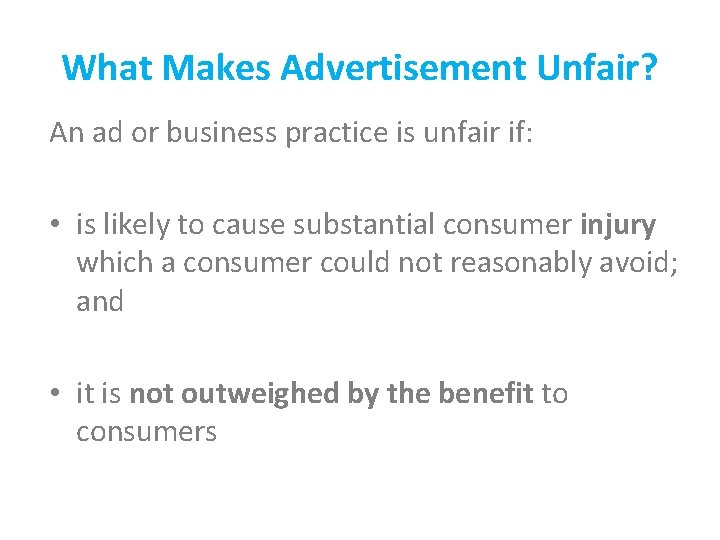
What Makes Advertisement Unfair? An ad or business practice is unfair if: • is likely to cause substantial consumer injury which a consumer could not reasonably avoid; and • it is not outweighed by the benefit to consumers
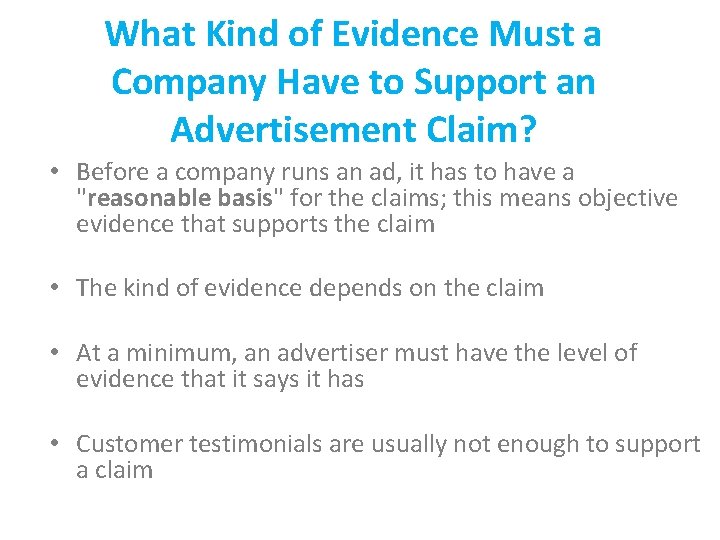
What Kind of Evidence Must a Company Have to Support an Advertisement Claim? • Before a company runs an ad, it has to have a "reasonable basis" for the claims; this means objective evidence that supports the claim • The kind of evidence depends on the claim • At a minimum, an advertiser must have the level of evidence that it says it has • Customer testimonials are usually not enough to support a claim
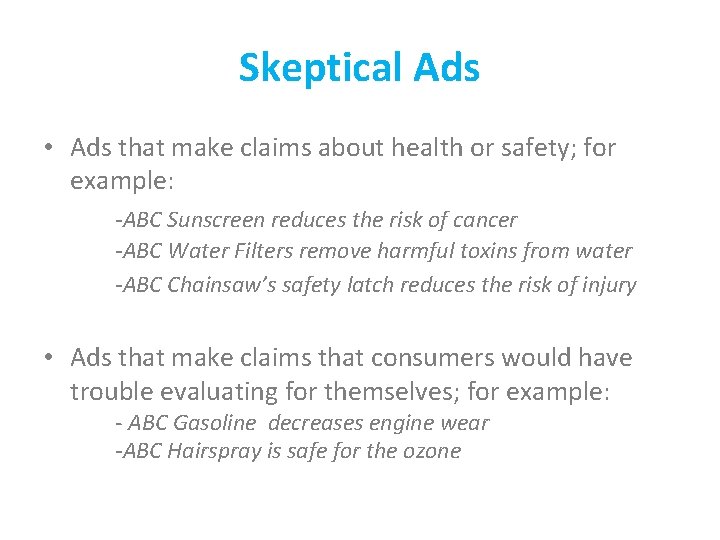
Skeptical Ads • Ads that make claims about health or safety; for example: -ABC Sunscreen reduces the risk of cancer -ABC Water Filters remove harmful toxins from water -ABC Chainsaw’s safety latch reduces the risk of injury • Ads that make claims that consumers would have trouble evaluating for themselves; for example: - ABC Gasoline decreases engine wear -ABC Hairspray is safe for the ozone
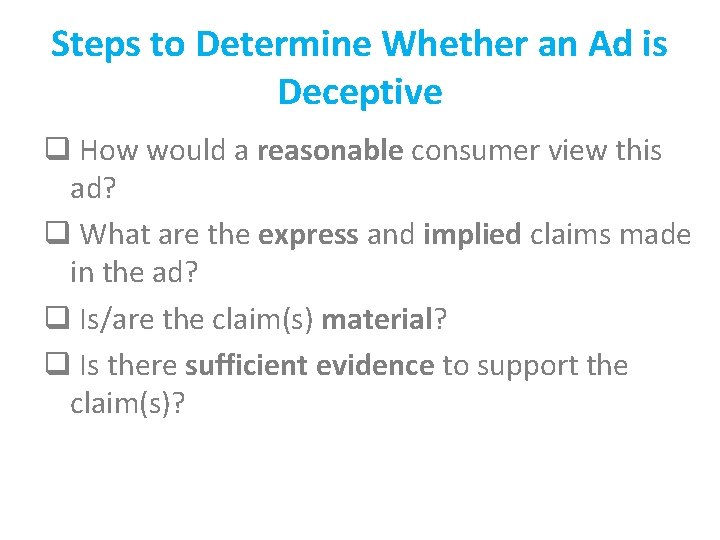
Steps to Determine Whether an Ad is Deceptive q How would a reasonable consumer view this ad? q What are the express and implied claims made in the ad? q Is/are the claim(s) material? q Is there sufficient evidence to support the claim(s)?
Deceptive Advertising in Action, in Washington http: //www. king 5. com/news/get-jesse/WAattorney-general-T-Mobile-contract-free 204765901. html
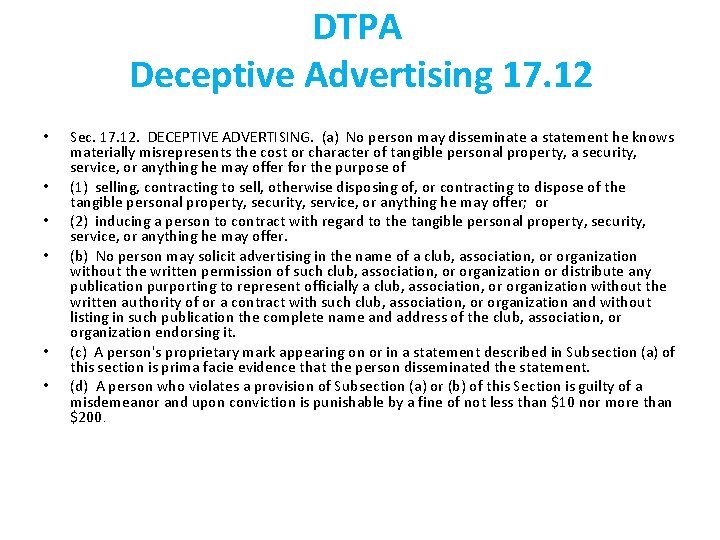
DTPA Deceptive Advertising 17. 12 • • • Sec. 17. 12. DECEPTIVE ADVERTISING. (a) No person may disseminate a statement he knows materially misrepresents the cost or character of tangible personal property, a security, service, or anything he may offer for the purpose of (1) selling, contracting to sell, otherwise disposing of, or contracting to dispose of the tangible personal property, security, service, or anything he may offer; or (2) inducing a person to contract with regard to the tangible personal property, security, service, or anything he may offer. (b) No person may solicit advertising in the name of a club, association, or organization without the written permission of such club, association, or organization or distribute any publication purporting to represent officially a club, association, or organization without the written authority of or a contract with such club, association, or organization and without listing in such publication the complete name and address of the club, association, or organization endorsing it. (c) A person's proprietary mark appearing on or in a statement described in Subsection (a) of this section is prima facie evidence that the person disseminated the statement. (d) A person who violates a provision of Subsection (a) or (b) of this Section is guilty of a misdemeanor and upon conviction is punishable by a fine of not less than $10 nor more than $200.
Applying the Statute • Did T-Mobile disseminate a statement? • Did T-Mobile knowingly misrepresent the cost or character of tangible property, a security, service, or anything being offered for the purpose of 17. 12(a)(1) and 17. 12(a)(2)
Filing a Complaint – Texas https: //texasattorneygeneral. gov/cpd/file-aconsumer-complaint