
DECENTRALIZATION AND RURAL SERVICES MESSAGES FROM RECENT RESEARCH





- Slides: 29
DECENTRALIZATION AND RURAL SERVICES: MESSAGES FROM RECENT RESEARCH AND PRACTICE Graham B. Kerr Community Based Rural Development Advisor The World Bank Regional Seminar on “Decentralization and Participation for Sustainable Rural Development in Southern Africa” October 26 -30, 1998
The Challenges for US • 1. 3 billion still living in poverty -800 million in rural areas • Significant growth in number of mouths to be fed
Why is rural development not happening? • • • Rural poor have little political power Urban bias in the policy environment Agriculture seen as a declining sector Falling food prices Aid fatigue in the agriculture sector Integrated rural development programs have failed
Why Decentralize? • improve access to and quality of services • give local communities control of resources to invest in projects they care about -- often education, health, infrastructure and other growth enhancing services • create conditions for bargaining, increase information flows, increase efficiency • empower under-represented groups, such as local entrepreneurs to be politically active
What is decentralization ? • The transfer of authority and responsibility for some government functions from central government to intermediate and local governments, and often to communities and the private sector Messages: gkerr
Decentralization: A Dynamic Institution • Deconcentration -- central staff to localities • Delegation -- to parastatals • Devolution -- to lower levels of government • Privatization -- to private firms
Decentralization is here to stay • globalization -- changing role of the state • growth of local democracy -- power sharing • professionalization of local capacity • it is now a country strategy rather than a donor strategy Messages: gkerr
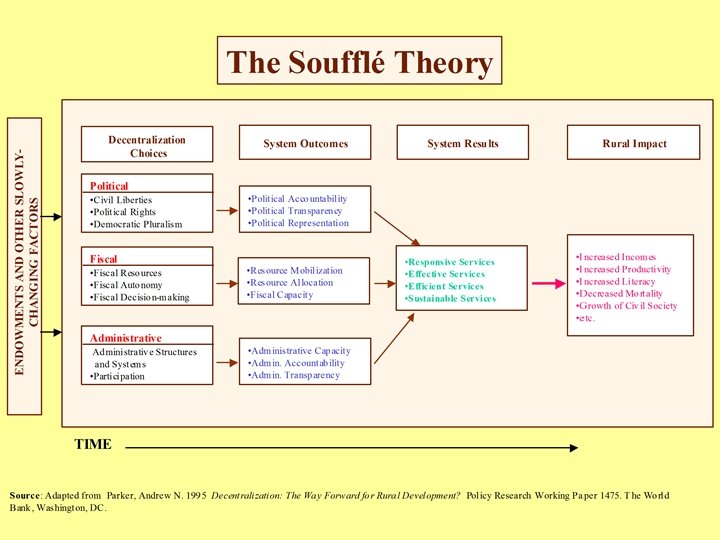
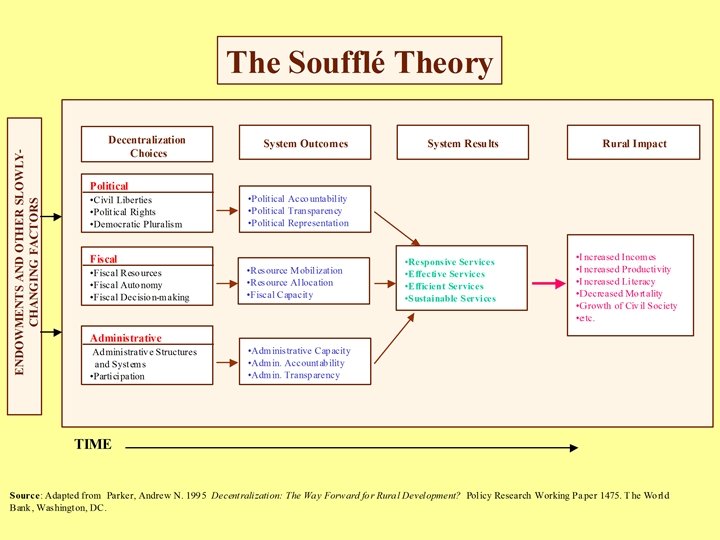
BUT there are pitfalls • Decentralization has often failed • -- often not even really started -de jure vs. de facto • it matters how it is done • Soufflé theory -- three dimensions of decentralization Messages: gkerr
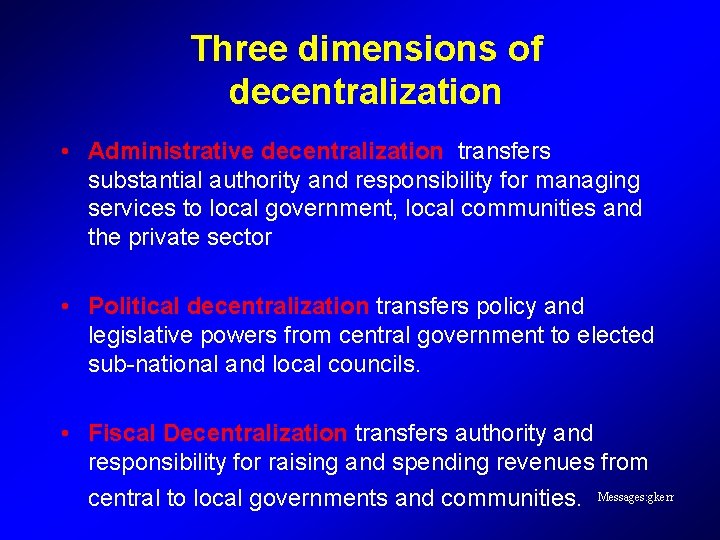
Three dimensions of decentralization • Administrative decentralization transfers substantial authority and responsibility for managing services to local government, local communities and the private sector • Political decentralization transfers policy and legislative powers from central government to elected sub-national and local councils. • Fiscal Decentralization transfers authority and responsibility for raising and spending revenues from central to local governments and communities. Messages: gkerr
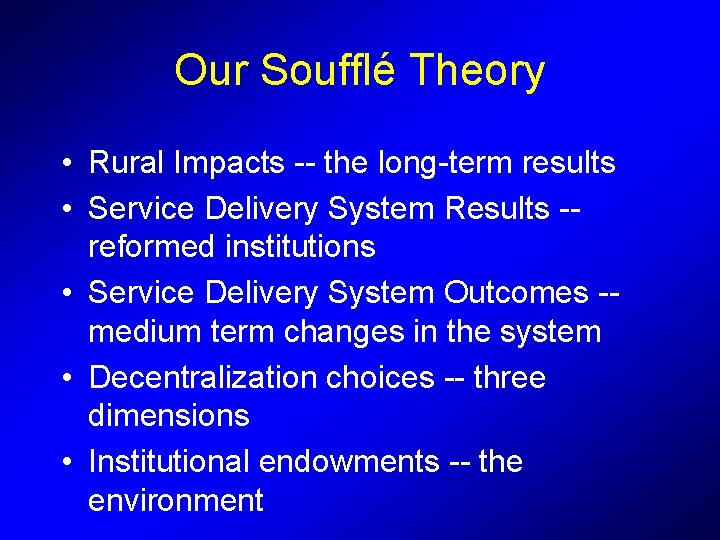
Our Soufflé Theory • Rural Impacts -- the long-term results • Service Delivery System Results -reformed institutions • Service Delivery System Outcomes -medium term changes in the system • Decentralization choices -- three dimensions • Institutional endowments -- the environment
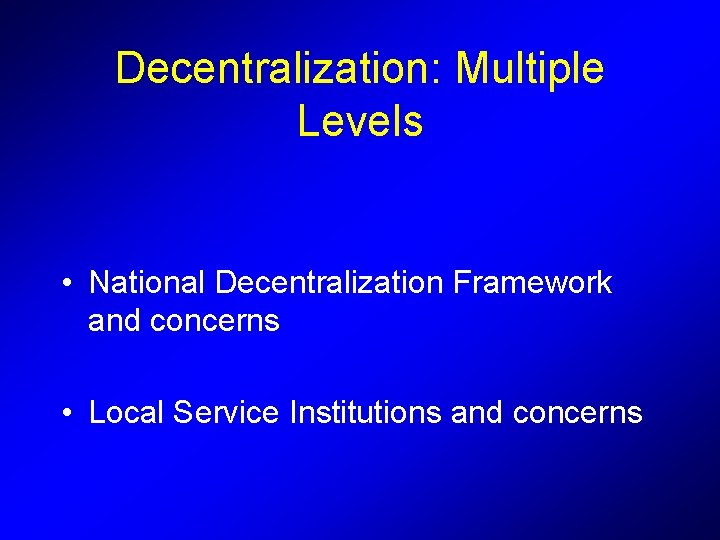
Decentralization: Multiple Levels • National Decentralization Framework and concerns • Local Service Institutions and concerns
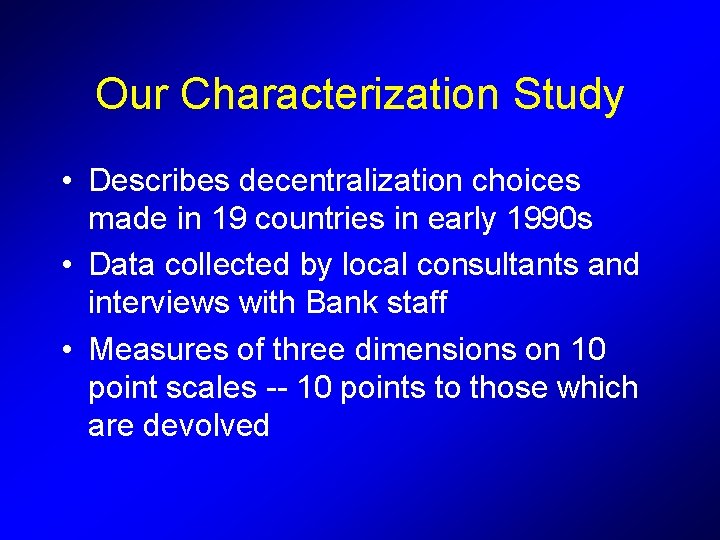
Our Characterization Study • Describes decentralization choices made in 19 countries in early 1990 s • Data collected by local consultants and interviews with Bank staff • Measures of three dimensions on 10 point scales -- 10 points to those which are devolved
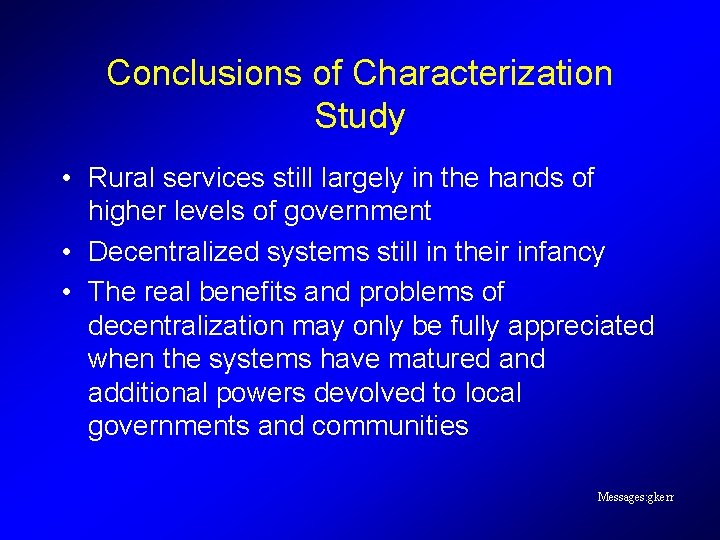
Conclusions of Characterization Study • Rural services still largely in the hands of higher levels of government • Decentralized systems still in their infancy • The real benefits and problems of decentralization may only be fully appreciated when the systems have matured and additional powers devolved to local governments and communities Messages: gkerr
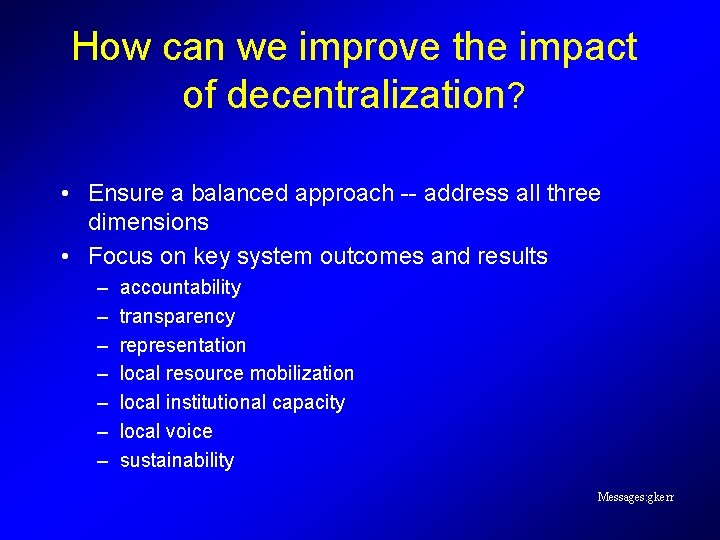
How can we improve the impact of decentralization? • Ensure a balanced approach -- address all three dimensions • Focus on key system outcomes and results – – – – accountability transparency representation local resource mobilization local institutional capacity local voice sustainability Messages: gkerr
Political Representation? • Develop policies to – encourage local competitive political system – ensure that local politicians represent local groups – enable local NGOs for disadvantaged groups Messages: gkerr
Political Accountability? • Design programs so that – service providers are accountable to local elected councils and their local clients – local elected councils are accountable to their constituents Messages: gkerr
Fiscal Devolution? • Policy dialogue to ensure – central government devolves appropriate fiscal authority – fiscal policies and procedures in place for each level of government – local governments assume authority and enact appropriate, responsible policies – fiscal discipline -- checks and balances are built into the system Messages: gkerr
Fiscal Capacity and Accountability? • Design programs so that – fiscal transfer schemes are transparent, predictable, and local units have appropriate level of autonomy – local units build their capacity to implement their fiscal responsibilities – systems to mobilize local resources are enhanced Messages: gkerr
Administrative Decentralization? • Deconcentration is only the first stage of administrative decentralization and may hinder further progress • Delegation of administration to civil society is important Messages: gkerr
Administrative Capacity? • Design programs so that: – local managerial and technical expertise is recognized and used – local knowledge is incorporated into program -- voice
Administrative Accountability and Transparency? • Design programs so that – planning, budgeting and spending are public and open – contract laws and procedures are adequate – information systems are built into the program – local press is included in the project process Messages: gkerr
Final Messages • Decentralization has potential • Decentralization is not happening with rural services • Focus on increasing accountability to local clients, increasing responsiveness, building political, fiscal and administrative capacity
Thank you