
DECENT WORK FRAMEWORK Shigeru Wada ILO Bangkok Decent
DECENT WORK FRAMEWORK Shigeru Wada ILO Bangkok
Decent Work Brings together individual aspirations and society’s goals
Some statistics in the world of work 1. 2 B live in poverty 1 B unemployed and underemployed Half of world population live in less than $2/day 250 -260 M children are child laborers 30 M work in EPZs 3, 500 die daily of work-related illnesses and accidents. 90 M people work or live outside their own country
average Workers in Asia/Pacific? -Food at least 3 times a day -Own house -Education for children -Healthy family -Permanent and secure job -Some savings -Some recreation -More……. .
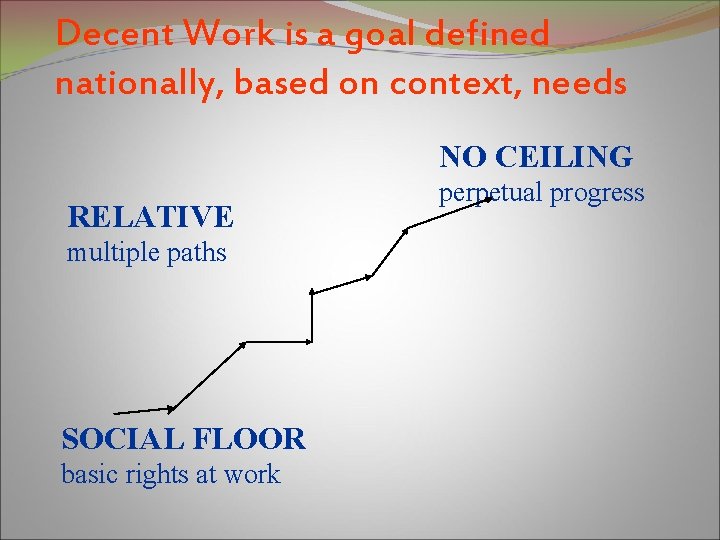
Decent Work is a goal defined nationally, based on context, needs NO CEILING RELATIVE multiple paths SOCIAL FLOOR basic rights at work perpetual progress
Social floor: basic rights at work ØFreedom of association, expression ØFreedom from discrimination ØFreedom from forced labour ØRight of children to develop fully, learn Enabling rights - empower all those who work. Freedom of choice and contract- consistent with market economies and democracies. Equality - all have rights.
Decent work: advances economic and social goals Poverty reduction among the working poor Global competitiveness Productivity Equity and social stability
Decent work deficits create and reinforce poverty Insecure, irregular income Long hours of work, yet meagre earnings Bad working conditions-worsens poor health, risks Vulnerability to risks (no social insurance, no assets) Working children - generations of poverty Forced labour - trapped in exploitation Discrimination, exclusion from productive resources, opportunities Few choices, powerlessness, no voice
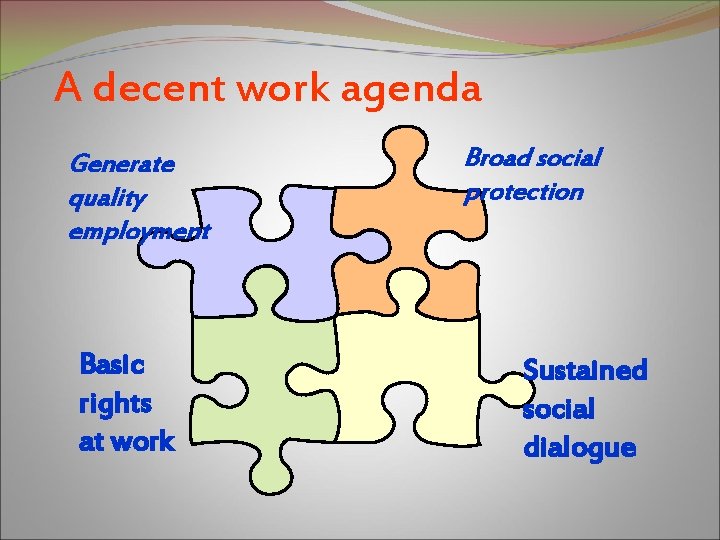
A decent work agenda Generate quality employment Basic rights at work Broad social protection Sustained social dialogue
Realize basic rights at work Legal and policy frameworks Institutions to implement and monitor
Generating good quality employment Macro economic policies Sector policies Inclusive labour market policies Work organization that encourages performance
Broad social protection Private and public arrangements Long range benefits Reduce workers’ insecurity, facilitate occupational & sectoral mobility Minimize costs to families, communities, governments Help economies to recover from shocks
Sustained social dialogue Legal and institutional infrastructure for negotiation, collective bargaining Minimize social conflicts Increases potential for positive-sum outcomes between « conflicting » interests
Decent Work The goal of decent work connects with people’s hopes to obtain productive work in conditions of freedom, equity, security & human dignity. It is about jobs & future prospects; about sound working conditions; about balancing work and family life, putting children through school or getting them out of child labour. It is about gender equality, equal recognition, & enabling women to make choices & take control of their lives. It is about your personal abilities to compete in the market place, keep up with new technological skills & remain healthy.
Decent work…… It is about not being discriminated against, it is about having a voice in your work-place and in your community. In the most extreme situations it is about moving from subsistence to existence. For many, it is the primary route out of poverty. For many others, it is about realizing personal aspirations in their daily existence and about solidarity with others. And everywhere, and for everybody, Decent Work is about securing human dignity.
Asian Decent Work Decade 2006 -2015 14 th Asian Regional Meeting, 2006, Busan, Korea The ILO’s Asia Pacific members have committed themselves to an Asian Decent Work Decade (20062015), and in doing so reaffirmed their commitment to achieving full, productive and decent employment for all their people by 2015 15 th Asia-Pacific Regional Meeting, April 2011, to do mid-term evaluation of the ADWD
Decent Work Country Programmes The ILO member states are creating their own national Decent Work Country Programmes (DWCP), which set out appropriate, individual goals, in order to reflect the different economic, social and development of each country.
Five Priorities of ADWD Increasing competitiveness, productivity and jobs Improving labour market governance Extending social protection Eliminating child labour and creating opportunities for young people Improved management of labour migration
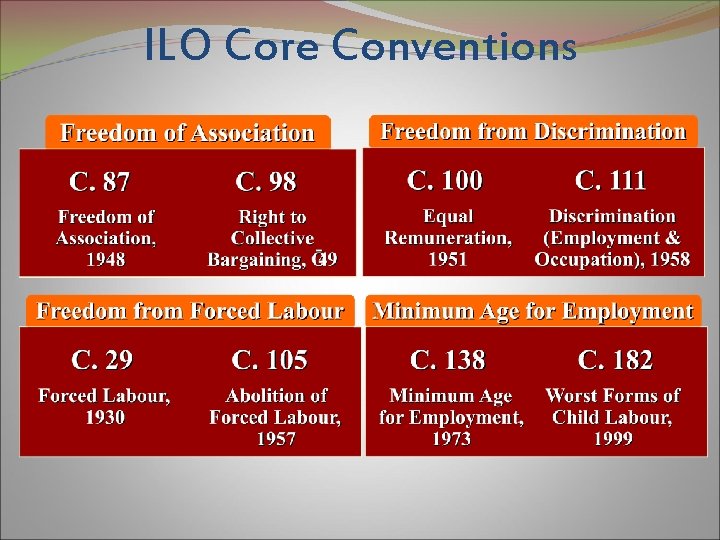
ILO Core Conventions

Thank you very much!
- Slides: 20