
December 2021 Inverse Normal calculations LO Given the
December 2021 Inverse Normal calculations LO: Given the percentage area under the curve, find the value corresponding to it To find the mean and standard deviation. www. mathssupport. org

Inverse normal calculations Sometimes you are given the percentage area under the curve, i. e. the probability or the proportion, and you are asked to find the value corresponding to it. This is called an inverse normal calculation. Always make a sketch to illustrate the information given. You must always remember to use the area to the left when using your GDC. If you are given the area to the right of the value, you must subtract this from 1 (or 100%) before using your GDC. 95% 5% For example, an area of 5% above a certain value means there is an area of 95% below it. You can use the GDC to find this value. The calculator has a function called inverse Normal which will do this. www. mathssupport. org
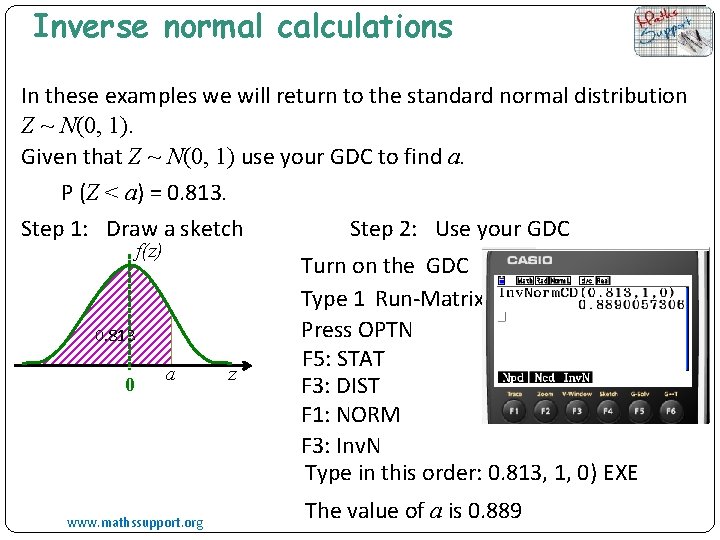
Inverse normal calculations In these examples we will return to the standard normal distribution Z ~ N(0, 1). Given that Z ~ N(0, 1) use your GDC to find a. P (Z < a) = 0. 813. Step 1: Draw a sketch f(z) 0. 813 0 a www. mathssupport. org z Step 2: Use your GDC Turn on the GDC Type 1 Run-Matrix Press OPTN F 5: STAT F 3: DIST F 1: NORM F 3: Inv. N Type in this order: 0. 813, 1, 0) EXE The value of a is 0. 889
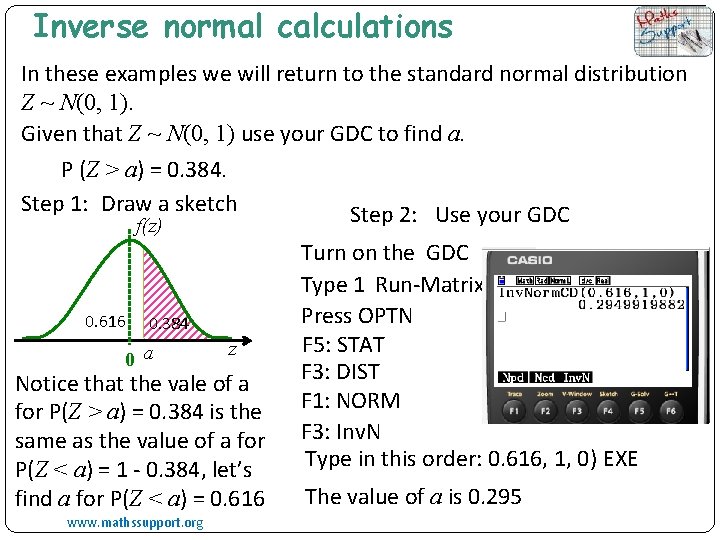
Inverse normal calculations In these examples we will return to the standard normal distribution Z ~ N(0, 1). Given that Z ~ N(0, 1) use your GDC to find a. P (Z > a) = 0. 384. Step 1: Draw a sketch Step 2: Use your GDC f(z) 0. 616 0. 384 0 a z Notice that the vale of a for P(Z > a) = 0. 384 is the same as the value of a for P(Z < a) = 1 - 0. 384, let’s find a for P(Z < a) = 0. 616 www. mathssupport. org Turn on the GDC Type 1 Run-Matrix Press OPTN F 5: STAT F 3: DIST F 1: NORM F 3: Inv. N Type in this order: 0. 616, 1, 0) EXE The value of a is 0. 295

Inverse normal calculations In these examples we will return to the standard normal distribution Z ~ N(0, 1). Given that Z ~ N(0, 1) use your GDC to find a. P (Z > a) = 0. 384. Using an alternative method Step 1: Draw a sketch f(z) 0. 384 0 a z Notice that the area for P(Z > a) = 0. 384 is in the right side of the curve www. mathssupport. org Step 2: Use your GDC Turn on the GDC Type 2 Statistics F 5: DIST F 1: NORM F 3: Inv. N Type in this order: Data: F 2 Variable Tail: F 2 Right Area: 0. 384 EXE : EXE 1 : 0 EXE The value of a is 0. 295

Inverse normal calculations In these examples we will return to the standard normal distribution Z ~ N(0, 1). Given that Z ~ N(0, 1) use your GDC to find a. P (–a < Z < a) = 0. 42. Step 1: Draw a sketch f(z) 0. 42 0. 29 –a 0 a z Notice that the vale of a can be found if we know the area in the left side www. mathssupport. org Step 2: Use your GDC Turn on the GDC Type 1 Run-Matrix Press OPTN F 5: STAT F 3: DIST F 1: NORM F 3: Inv. N Type in this order: 0. 29, 1, 0) EXE The value of –a is – 0. 553 The value of a is 0. 553
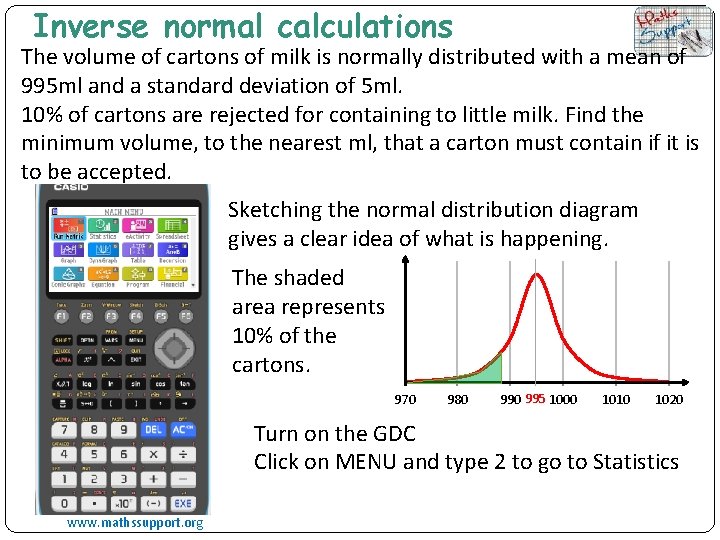
Inverse normal calculations The volume of cartons of milk is normally distributed with a mean of 995 ml and a standard deviation of 5 ml. 10% of cartons are rejected for containing to little milk. Find the minimum volume, to the nearest ml, that a carton must contain if it is to be accepted. Sketching the normal distribution diagram gives a clear idea of what is happening. The shaded area represents 10% of the cartons. 970 980 995 1000 1010 1020 Turn on the GDC Click on MENU and type 2 to go to Statistics www. mathssupport. org
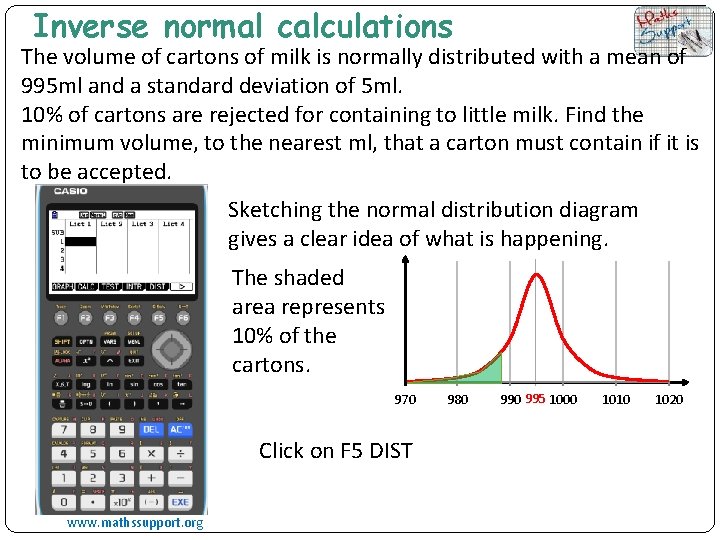
Inverse normal calculations The volume of cartons of milk is normally distributed with a mean of 995 ml and a standard deviation of 5 ml. 10% of cartons are rejected for containing to little milk. Find the minimum volume, to the nearest ml, that a carton must contain if it is to be accepted. Sketching the normal distribution diagram gives a clear idea of what is happening. The shaded area represents 10% of the cartons. 970 Click on F 5 DIST www. mathssupport. org 980 995 1000 1010 1020
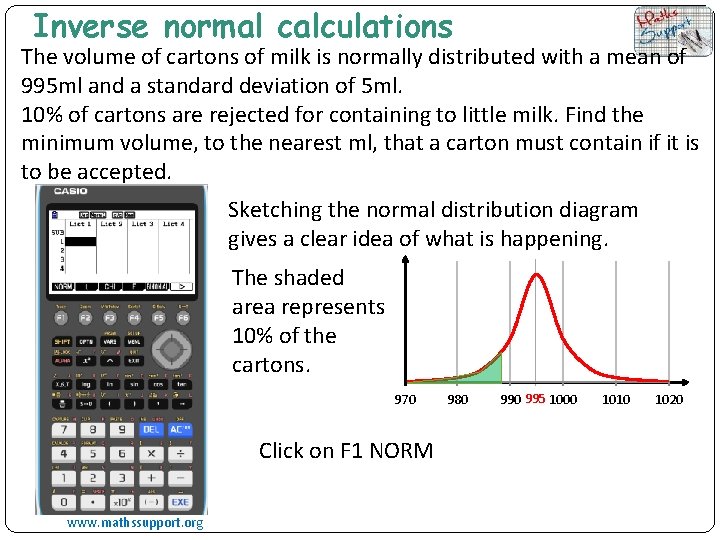
Inverse normal calculations The volume of cartons of milk is normally distributed with a mean of 995 ml and a standard deviation of 5 ml. 10% of cartons are rejected for containing to little milk. Find the minimum volume, to the nearest ml, that a carton must contain if it is to be accepted. Sketching the normal distribution diagram gives a clear idea of what is happening. The shaded area represents 10% of the cartons. 970 Click on F 1 NORM www. mathssupport. org 980 995 1000 1010 1020
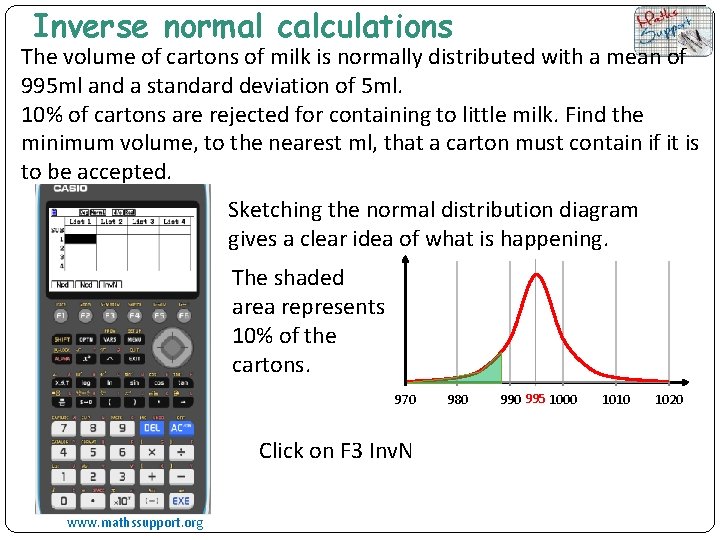
Inverse normal calculations The volume of cartons of milk is normally distributed with a mean of 995 ml and a standard deviation of 5 ml. 10% of cartons are rejected for containing to little milk. Find the minimum volume, to the nearest ml, that a carton must contain if it is to be accepted. Sketching the normal distribution diagram gives a clear idea of what is happening. The shaded area represents 10% of the cartons. 970 Click on F 3 Inv. N www. mathssupport. org 980 995 1000 1010 1020
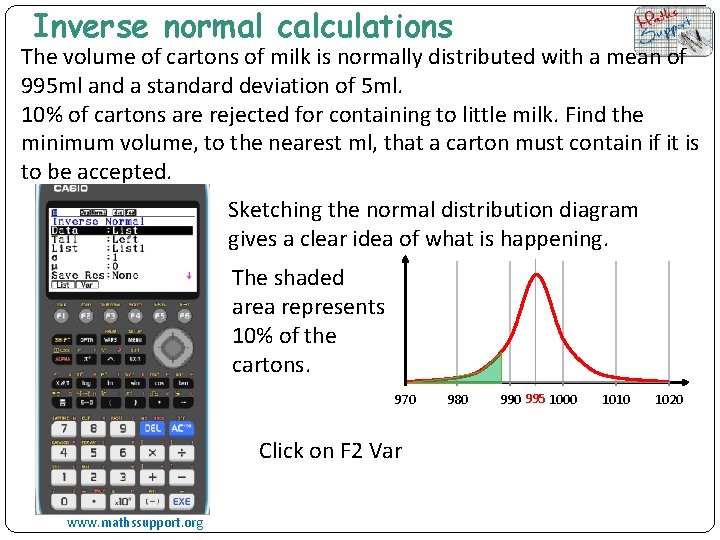
Inverse normal calculations The volume of cartons of milk is normally distributed with a mean of 995 ml and a standard deviation of 5 ml. 10% of cartons are rejected for containing to little milk. Find the minimum volume, to the nearest ml, that a carton must contain if it is to be accepted. Sketching the normal distribution diagram gives a clear idea of what is happening. The shaded area represents 10% of the cartons. 970 Click on F 2 Var www. mathssupport. org 980 995 1000 1010 1020

Inverse normal calculations The volume of cartons of milk is normally distributed with a mean of 995 ml and a standard deviation of 5 ml. 10% of cartons are rejected for containing to little milk. Find the minimum volume, to the nearest ml, that a carton must contain if it is to be accepted. Sketching the normal distribution diagram gives a clear idea of what is happening. www. mathssupport. org The shaded area represents 10% of the cartons. Tail: Left: 970 980 995 1000 1010 1020 Now type the information from the problem: Area: 0. 1 EXE : 5 EXE : 995 EXE
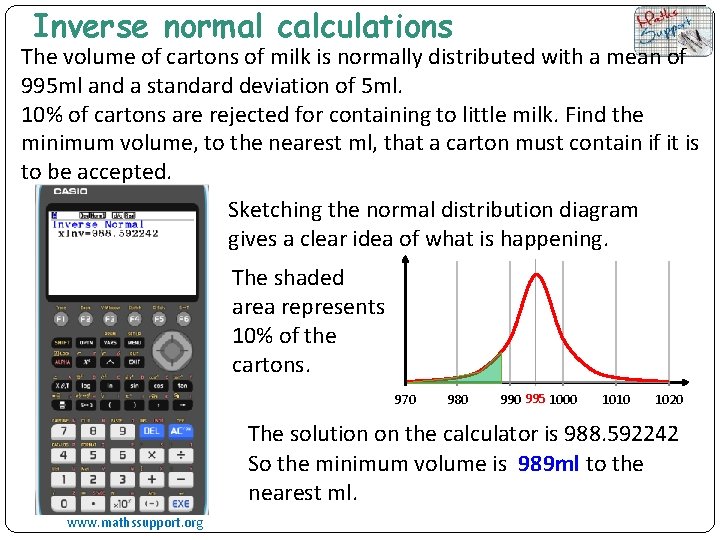
Inverse normal calculations The volume of cartons of milk is normally distributed with a mean of 995 ml and a standard deviation of 5 ml. 10% of cartons are rejected for containing to little milk. Find the minimum volume, to the nearest ml, that a carton must contain if it is to be accepted. Sketching the normal distribution diagram gives a clear idea of what is happening. The shaded area represents 10% of the cartons. 970 980 995 1000 1010 1020 The solution on the calculator is 988. 592242 So the minimum volume is 989 ml to the nearest ml. www. mathssupport. org
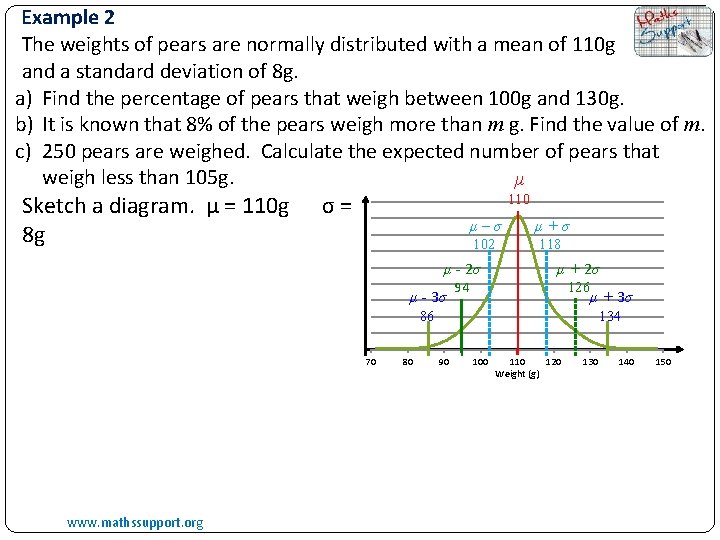
Example 2 The weights of pears are normally distributed with a mean of 110 g and a standard deviation of 8 g. a) Find the percentage of pears that weigh between 100 g and 130 g. b) It is known that 8% of the pears weigh more than m g. Find the value of m. c) 250 pears are weighed. Calculate the expected number of pears that weigh less than 105 g. μ Sketch a diagram. μ = 110 g 8 g σ= 110 μ–σ μ+σ 102 118 μ - 2σ μ - 3σ 94 μ + 2σ 126 μ + 3σ 86 70 www. mathssupport. org 80 134 90 100 110 120 Weight (g) 130 140 150
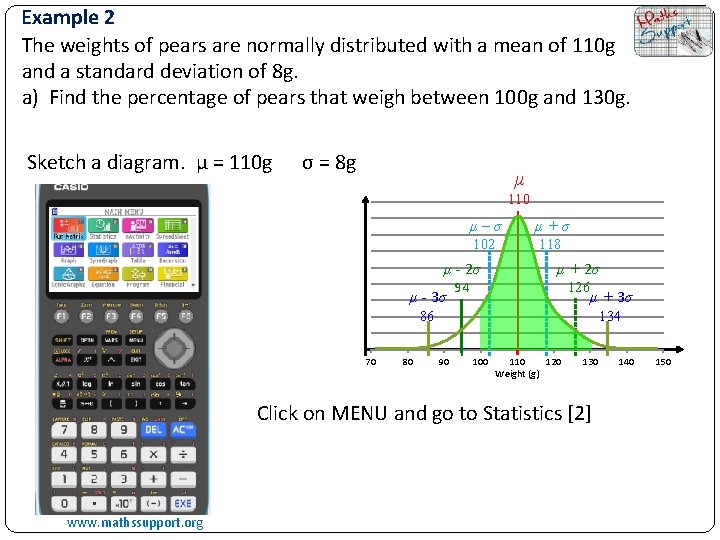
Example 2 The weights of pears are normally distributed with a mean of 110 g and a standard deviation of 8 g. a) Find the percentage of pears that weigh between 100 g and 130 g. Sketch a diagram. μ = 110 g σ = 8 g μ 110 μ–σ μ+σ 102 118 μ - 2σ μ - 3σ 94 μ + 2σ 126 μ + 3σ 86 70 80 134 90 100 110 120 Weight (g) 130 Click on MENU and go to Statistics [2] www. mathssupport. org 140 150
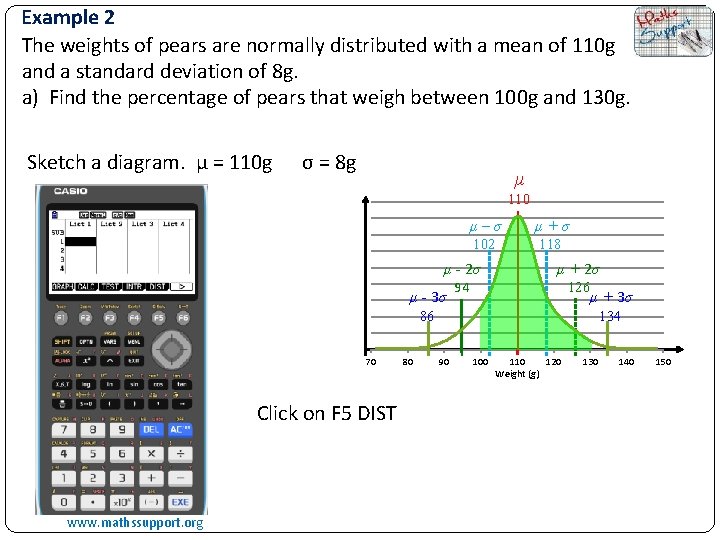
Example 2 The weights of pears are normally distributed with a mean of 110 g and a standard deviation of 8 g. a) Find the percentage of pears that weigh between 100 g and 130 g. Sketch a diagram. μ = 110 g σ = 8 g μ 110 μ–σ μ+σ 102 118 μ - 2σ μ - 3σ 94 μ + 2σ 126 μ + 3σ 86 70 Click on F 5 DIST www. mathssupport. org 80 134 90 100 110 120 Weight (g) 130 140 150
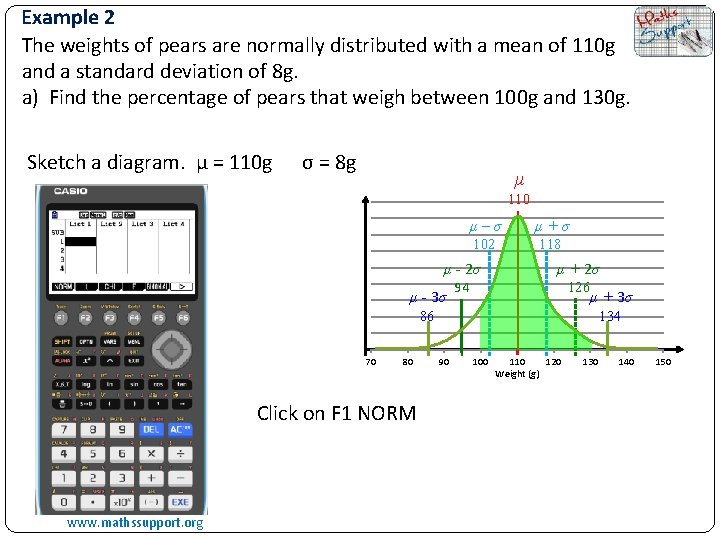
Example 2 The weights of pears are normally distributed with a mean of 110 g and a standard deviation of 8 g. a) Find the percentage of pears that weigh between 100 g and 130 g. Sketch a diagram. μ = 110 g σ = 8 g μ 110 μ–σ μ+σ 102 118 μ - 2σ μ - 3σ 94 μ + 2σ 126 μ + 3σ 86 70 80 Click on F 1 NORM www. mathssupport. org 134 90 100 110 120 Weight (g) 130 140 150
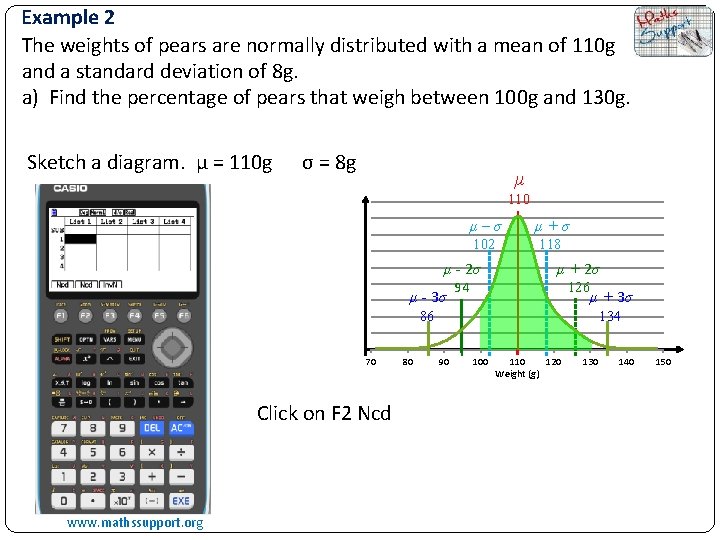
Example 2 The weights of pears are normally distributed with a mean of 110 g and a standard deviation of 8 g. a) Find the percentage of pears that weigh between 100 g and 130 g. Sketch a diagram. μ = 110 g σ = 8 g μ 110 μ–σ μ+σ 102 118 μ - 2σ μ - 3σ 94 μ + 2σ 126 μ + 3σ 86 70 Click on F 2 Ncd www. mathssupport. org 80 134 90 100 110 120 Weight (g) 130 140 150
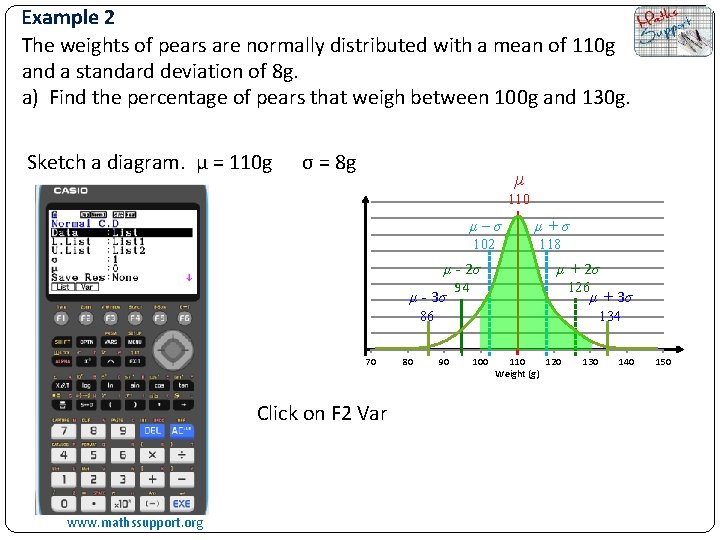
Example 2 The weights of pears are normally distributed with a mean of 110 g and a standard deviation of 8 g. a) Find the percentage of pears that weigh between 100 g and 130 g. Sketch a diagram. μ = 110 g σ = 8 g μ 110 μ–σ μ+σ 102 118 μ - 2σ μ - 3σ 94 μ + 2σ 126 μ + 3σ 86 70 Click on F 2 Var www. mathssupport. org 80 134 90 100 110 120 Weight (g) 130 140 150
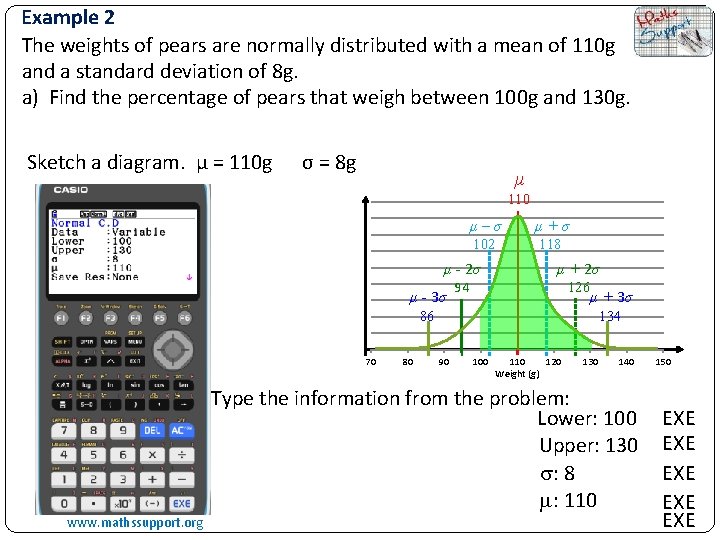
Example 2 The weights of pears are normally distributed with a mean of 110 g and a standard deviation of 8 g. a) Find the percentage of pears that weigh between 100 g and 130 g. Sketch a diagram. μ = 110 g σ = 8 g μ 110 μ–σ μ+σ 102 118 μ - 2σ μ - 3σ 94 μ + 2σ 126 μ + 3σ 86 70 80 134 90 100 110 120 Weight (g) 130 140 Type the information from the problem: Lower: 100 Upper: 130 : 8 : 110 www. mathssupport. org 150 EXE EXE EXE
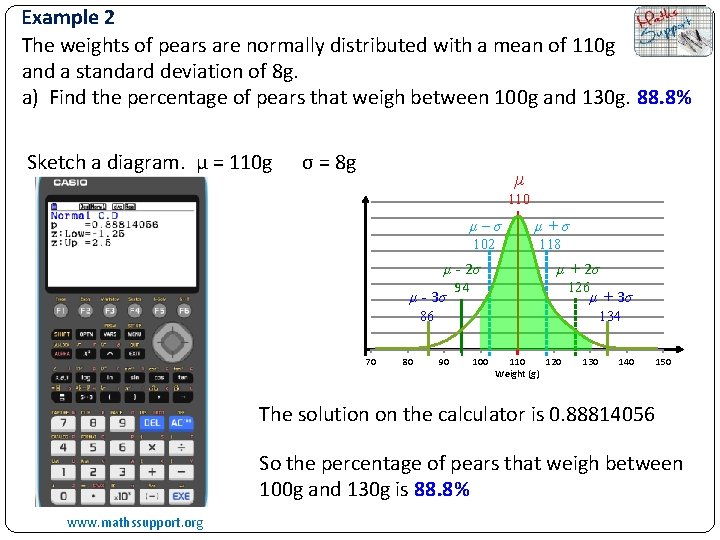
Example 2 The weights of pears are normally distributed with a mean of 110 g and a standard deviation of 8 g. a) Find the percentage of pears that weigh between 100 g and 130 g. 88. 8% Sketch a diagram. μ = 110 g σ = 8 g μ 110 μ–σ μ+σ 102 118 μ - 2σ μ - 3σ 94 μ + 2σ 126 μ + 3σ 86 70 80 134 90 100 110 120 Weight (g) 130 140 150 The solution on the calculator is 0. 88814056 So the percentage of pears that weigh between 100 g and 130 g is 88. 8% www. mathssupport. org
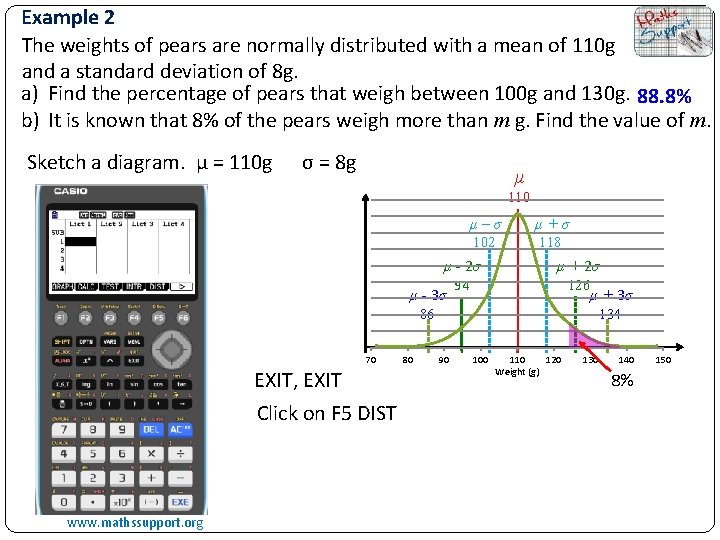
Example 2 The weights of pears are normally distributed with a mean of 110 g and a standard deviation of 8 g. a) Find the percentage of pears that weigh between 100 g and 130 g. 88. 8% b) It is known that 8% of the pears weigh more than m g. Find the value of m. Sketch a diagram. μ = 110 g σ = 8 g μ 110 μ–σ μ+σ 102 118 μ - 2σ μ - 3σ 94 μ + 2σ 126 μ + 3σ 86 70 EXIT, EXIT Click on F 5 DIST www. mathssupport. org 80 134 90 100 110 120 Weight (g) 130 140 8% 150
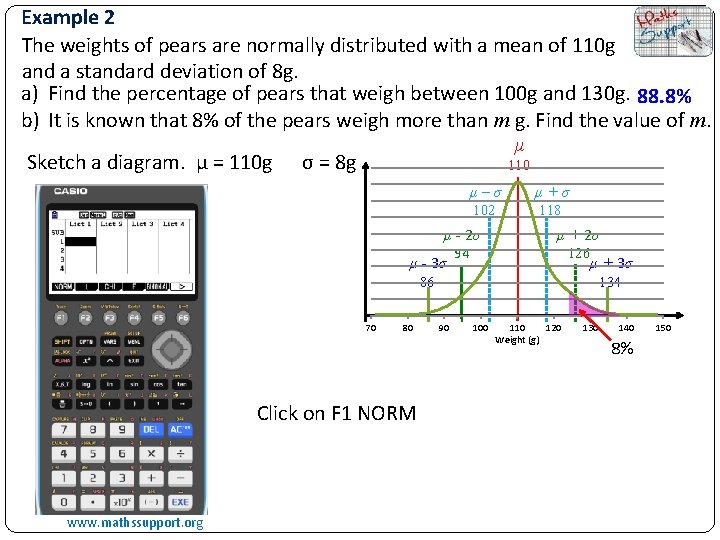
Example 2 The weights of pears are normally distributed with a mean of 110 g and a standard deviation of 8 g. a) Find the percentage of pears that weigh between 100 g and 130 g. 88. 8% b) It is known that 8% of the pears weigh more than m g. Find the value of m. Sketch a diagram. μ = 110 g μ σ = 8 g 110 μ–σ μ+σ 102 118 μ - 2σ μ - 3σ 94 μ + 2σ 126 μ + 3σ 86 70 80 Click on F 1 NORM www. mathssupport. org 134 90 100 110 120 Weight (g) 130 140 8% 150
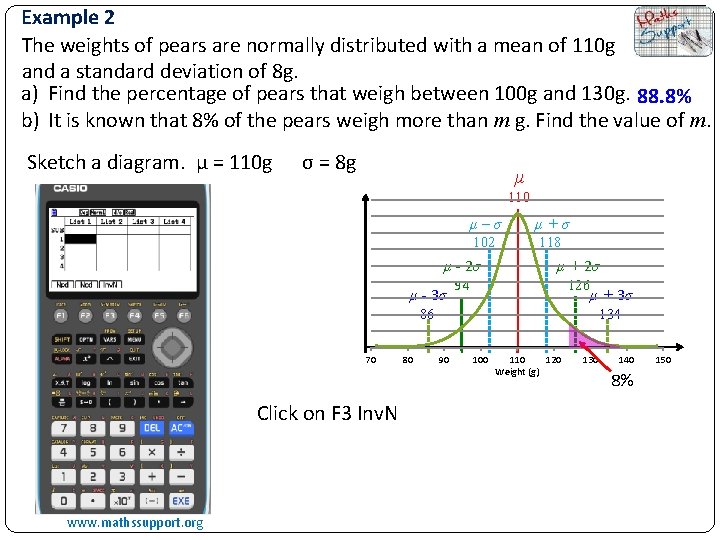
Example 2 The weights of pears are normally distributed with a mean of 110 g and a standard deviation of 8 g. a) Find the percentage of pears that weigh between 100 g and 130 g. 88. 8% b) It is known that 8% of the pears weigh more than m g. Find the value of m. Sketch a diagram. μ = 110 g σ = 8 g μ 110 μ–σ μ+σ 102 118 μ - 2σ μ - 3σ 94 μ + 2σ 126 μ + 3σ 86 70 Click on F 3 Inv. N www. mathssupport. org 80 134 90 100 110 120 Weight (g) 130 140 8% 150
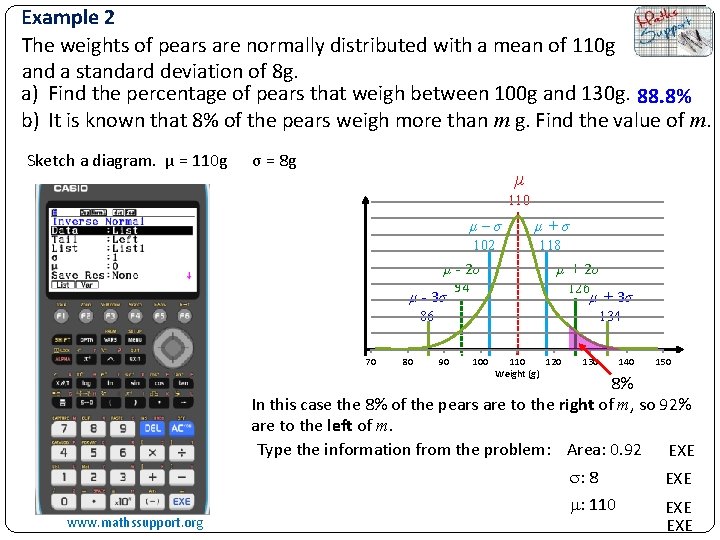
Example 2 The weights of pears are normally distributed with a mean of 110 g and a standard deviation of 8 g. a) Find the percentage of pears that weigh between 100 g and 130 g. 88. 8% b) It is known that 8% of the pears weigh more than m g. Find the value of m. Sketch a diagram. μ = 110 g σ = 8 g μ 110 μ–σ μ+σ 102 118 μ - 2σ μ - 3σ 94 μ + 2σ 126 μ + 3σ 86 70 80 134 90 100 110 120 Weight (g) 130 140 150 8% In this case the 8% of the pears are to the right of m, so 92% are to the left of m. Type the information from the problem: Area: 0. 92 EXE www. mathssupport. org : 8 : 110 EXE EXE
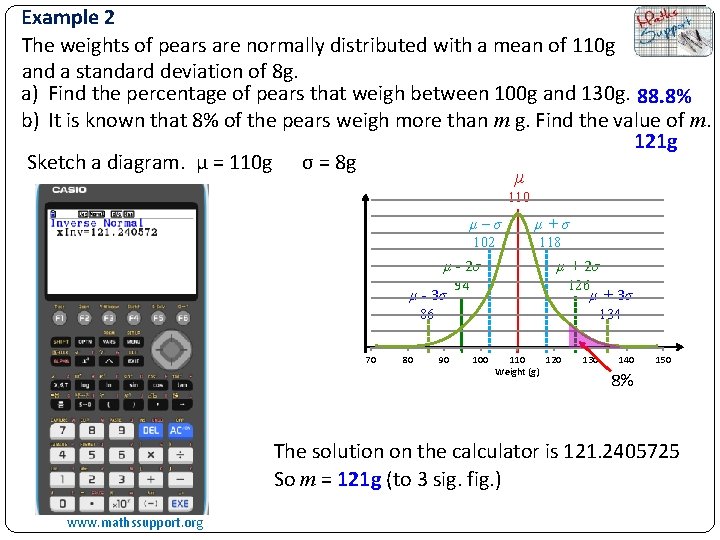
Example 2 The weights of pears are normally distributed with a mean of 110 g and a standard deviation of 8 g. a) Find the percentage of pears that weigh between 100 g and 130 g. 88. 8% b) It is known that 8% of the pears weigh more than m g. Find the value of m. 121 g Sketch a diagram. μ = 110 g σ = 8 g μ 110 μ–σ μ+σ 102 118 μ - 2σ μ - 3σ 94 μ + 2σ 126 μ + 3σ 86 70 80 134 90 100 110 120 Weight (g) 130 140 150 8% The solution on the calculator is 121. 2405725 So m = 121 g (to 3 sig. fig. ) www. mathssupport. org
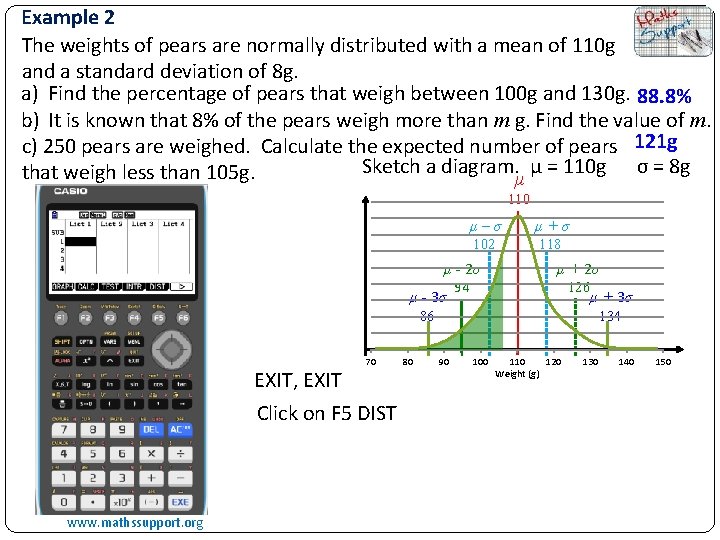
Example 2 The weights of pears are normally distributed with a mean of 110 g and a standard deviation of 8 g. a) Find the percentage of pears that weigh between 100 g and 130 g. 88. 8% b) It is known that 8% of the pears weigh more than m g. Find the value of m. c) 250 pears are weighed. Calculate the expected number of pears 121 g Sketch a diagram. μ = 110 g σ = 8 g that weigh less than 105 g. μ 110 μ–σ μ+σ 102 118 μ - 2σ μ - 3σ 94 μ + 2σ 126 μ + 3σ 86 70 EXIT, EXIT Click on F 5 DIST www. mathssupport. org 80 134 90 100 110 120 Weight (g) 130 140 150
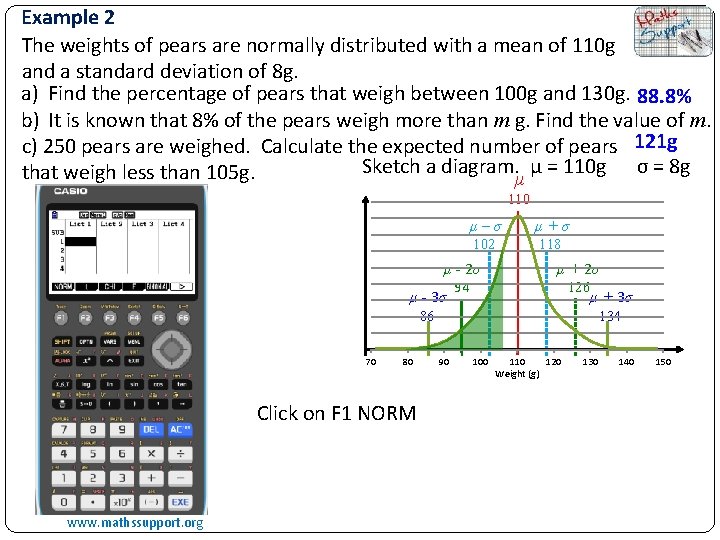
Example 2 The weights of pears are normally distributed with a mean of 110 g and a standard deviation of 8 g. a) Find the percentage of pears that weigh between 100 g and 130 g. 88. 8% b) It is known that 8% of the pears weigh more than m g. Find the value of m. c) 250 pears are weighed. Calculate the expected number of pears 121 g Sketch a diagram. μ = 110 g σ = 8 g that weigh less than 105 g. μ 110 μ–σ μ+σ 102 118 μ - 2σ μ - 3σ 94 μ + 2σ 126 μ + 3σ 86 70 80 Click on F 1 NORM www. mathssupport. org 134 90 100 110 120 Weight (g) 130 140 150
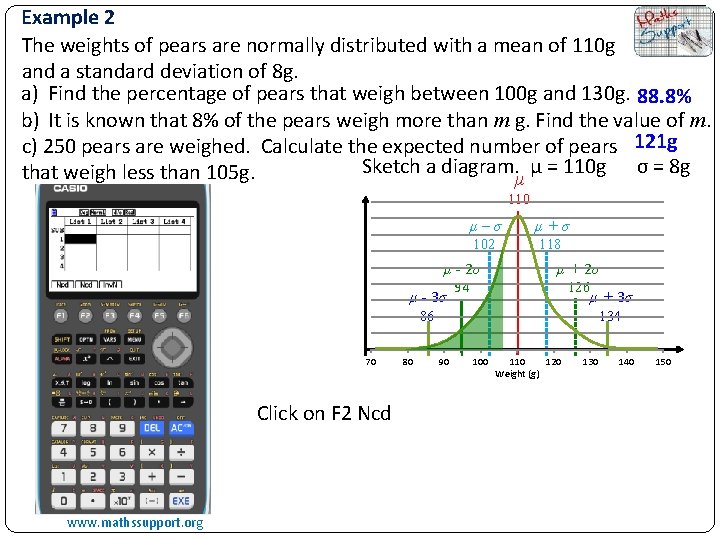
Example 2 The weights of pears are normally distributed with a mean of 110 g and a standard deviation of 8 g. a) Find the percentage of pears that weigh between 100 g and 130 g. 88. 8% b) It is known that 8% of the pears weigh more than m g. Find the value of m. c) 250 pears are weighed. Calculate the expected number of pears 121 g Sketch a diagram. μ = 110 g σ = 8 g that weigh less than 105 g. μ 110 μ–σ μ+σ 102 118 μ - 2σ μ - 3σ 94 μ + 2σ 126 μ + 3σ 86 70 Click on F 2 Ncd www. mathssupport. org 80 134 90 100 110 120 Weight (g) 130 140 150
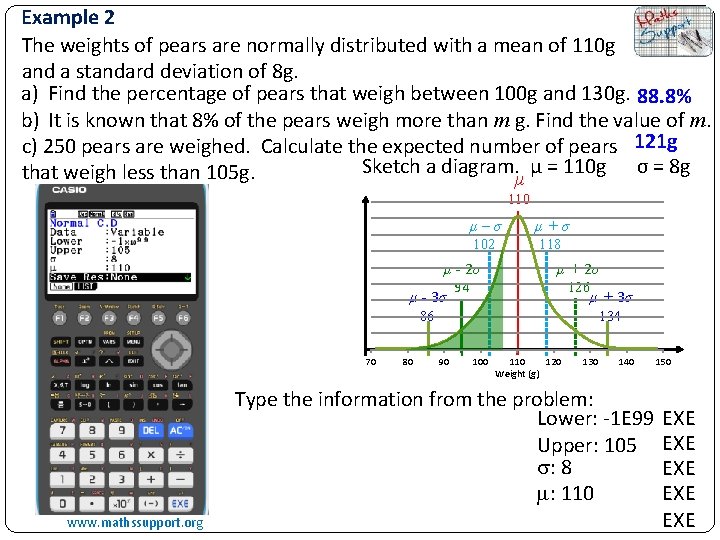
Example 2 The weights of pears are normally distributed with a mean of 110 g and a standard deviation of 8 g. a) Find the percentage of pears that weigh between 100 g and 130 g. 88. 8% b) It is known that 8% of the pears weigh more than m g. Find the value of m. c) 250 pears are weighed. Calculate the expected number of pears 121 g Sketch a diagram. μ = 110 g σ = 8 g that weigh less than 105 g. μ 110 μ–σ μ+σ 102 118 μ - 2σ μ - 3σ 94 μ + 2σ 126 μ + 3σ 86 70 80 134 90 100 110 120 Weight (g) 130 140 Type the information from the problem: Lower: -1 E 99 Upper: 105 : 8 : 110 www. mathssupport. org 150 EXE EXE EXE
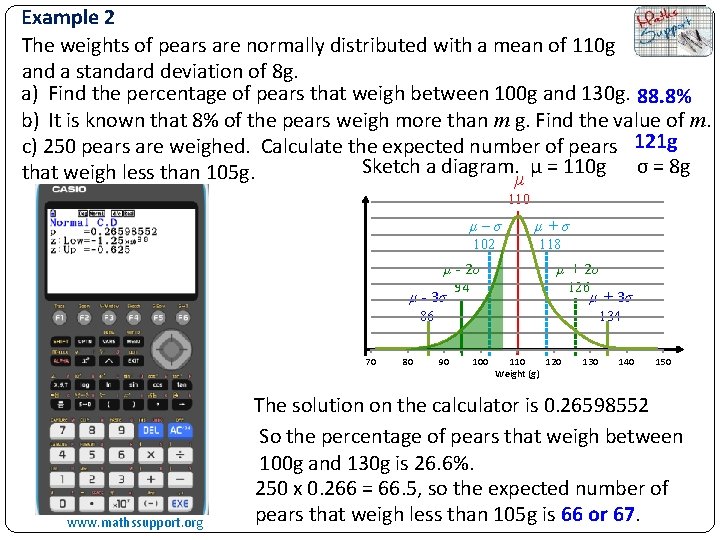
Example 2 The weights of pears are normally distributed with a mean of 110 g and a standard deviation of 8 g. a) Find the percentage of pears that weigh between 100 g and 130 g. 88. 8% b) It is known that 8% of the pears weigh more than m g. Find the value of m. c) 250 pears are weighed. Calculate the expected number of pears 121 g Sketch a diagram. μ = 110 g σ = 8 g that weigh less than 105 g. μ 110 μ–σ μ+σ 102 118 μ - 2σ μ - 3σ 94 μ + 2σ 126 μ + 3σ 86 70 www. mathssupport. org 80 134 90 100 110 120 Weight (g) 130 140 150 The solution on the calculator is 0. 26598552 So the percentage of pears that weigh between 100 g and 130 g is 26. 6%. 250 x 0. 266 = 66. 5, so the expected number of pears that weigh less than 105 g is 66 or 67.

Thank you for using resources from For more resources visit our website https: //www. mathssupport. org If you have a special request, drop us an email info@mathssupport. org www. mathssupport. org
- Slides: 32