
December 2021 Define recycle LAST LESSON Describe what
December 2021 Define recycle. LAST LESSON Describe what you would observe happens to the mass when you burn a strip of magnesium) LAST YEAR Recall the process of Phytomining LAST WEEK Recall the equation for incomplete combustion. LAST TOPIC Challenge: Create 2 questions where the answer requires the use of at least two key words in an explanation
December 2021 Using Resources Revision December 2021
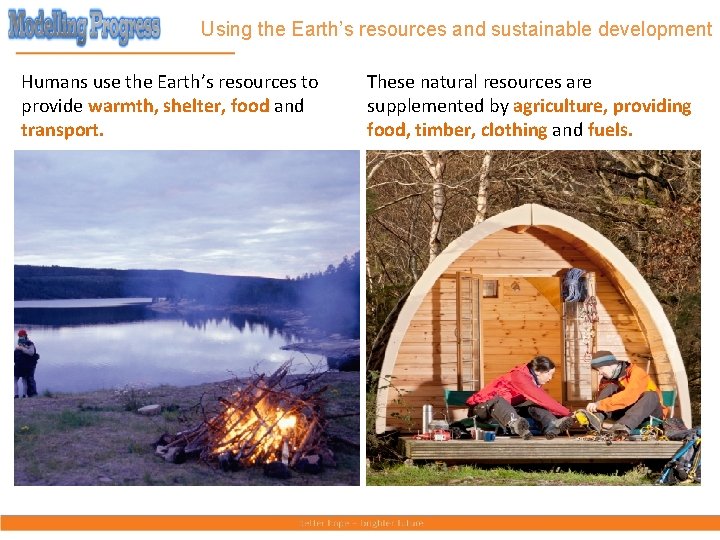
Using the Earth’s resources and sustainable development Humans use the Earth’s resources to provide warmth, shelter, food and transport. These natural resources are supplemented by agriculture, providing food, timber, clothing and fuels.

Using the Earth’s resources and sustainable development Finite resources (there is only a limited supply of them) from the Earth, oceans and atmosphere are processed to provide energy and materials
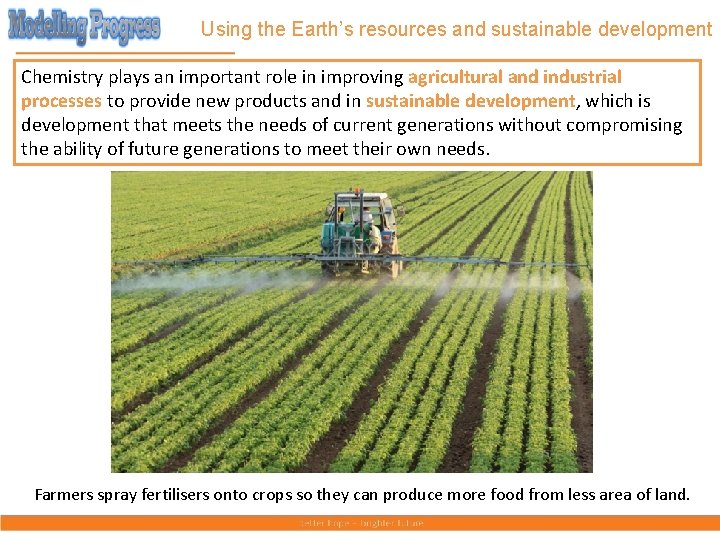
Using the Earth’s resources and sustainable development Chemistry plays an important role in improving agricultural and industrial processes to provide new products and in sustainable development, which is development that meets the needs of current generations without compromising the ability of future generations to meet their own needs. Farmers spray fertilisers onto crops so they can produce more food from less area of land.

Using the Earth’s resources and sustainable development– Question. IT 1. Describe two ways that humans use the Earth’s natural resources. 2. Explain what the term finite means and give an example. 3. What three areas do humans process finite resources from? 4. What is meant by the term sustainable development?
Using the Earth’s resources and sustainable development – Answer. IT 1. Describe two ways that humans use the Earth’s natural resources. any two from warmth/ shelter/ food/ transport. 2. Explain what the term finite means and give an example. finite – being used up faster than it is made, any suitable example. 3. What three areas do humans process finite resources from? Earth, oceans and the atmosphere. 4. What is meant by the term sustainable development? the development that meets the needs of current generations without compromising the ability of future generations to meet their own needs.
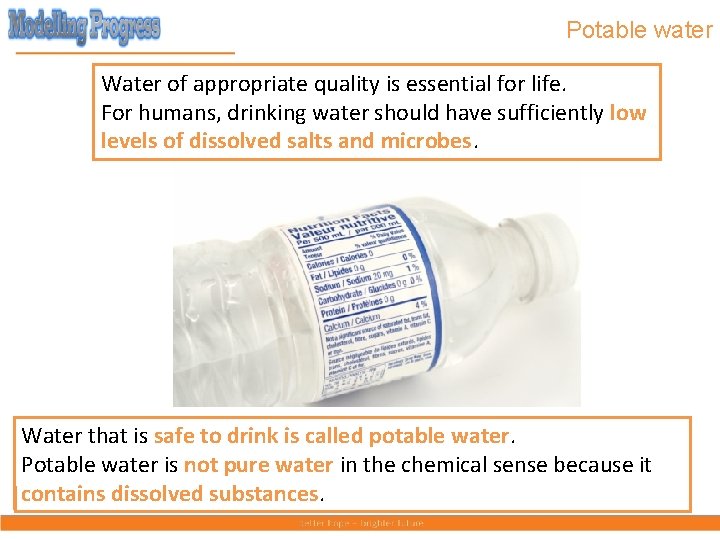
Potable water Water of appropriate quality is essential for life. For humans, drinking water should have sufficiently low levels of dissolved salts and microbes. Water that is safe to drink is called potable water. Potable water is not pure water in the chemical sense because it contains dissolved substances.
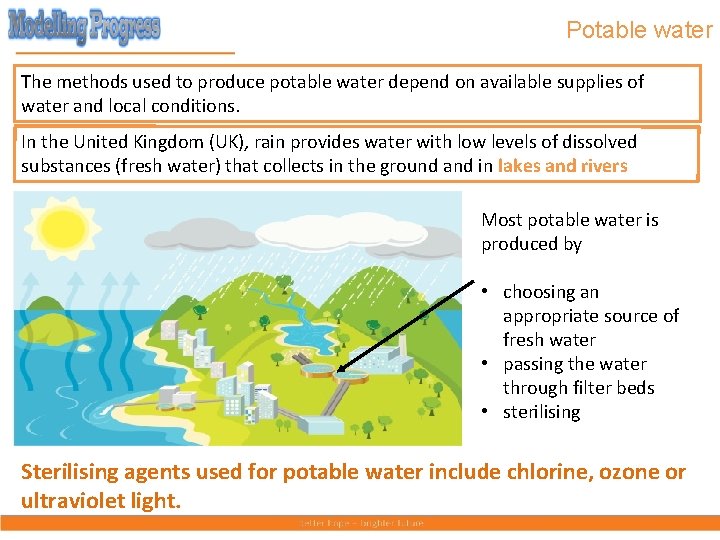
Potable water The methods used to produce potable water depend on available supplies of water and local conditions. In the United Kingdom (UK), rain provides water with low levels of dissolved substances (fresh water) that collects in the ground and in lakes and rivers Most potable water is produced by • choosing an appropriate source of fresh water • passing the water through filter beds • sterilising Sterilising agents used for potable water include chlorine, ozone or ultraviolet light.
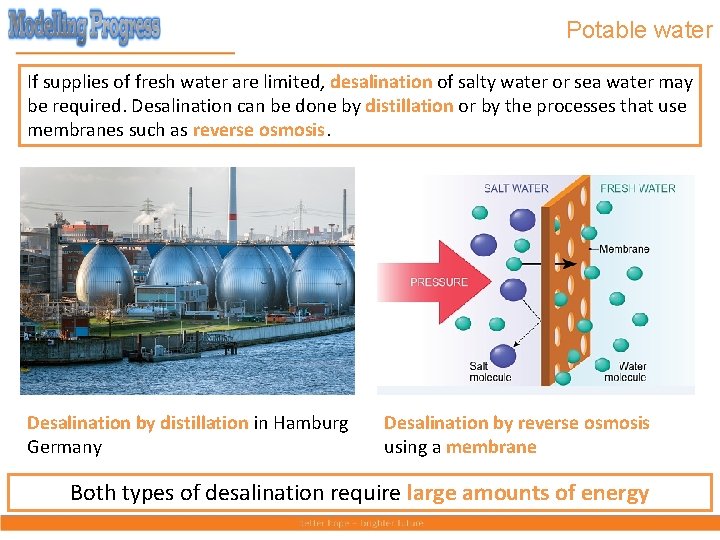
Potable water If supplies of fresh water are limited, desalination of salty water or sea water may be required. Desalination can be done by distillation or by the processes that use membranes such as reverse osmosis. Desalination by distillation in Hamburg Germany Desalination by reverse osmosis using a membrane Both types of desalination require large amounts of energy
Potable water - Question. IT 1. Why is potable water not described as pure water by scientists? 2. What does the method used to produce potable water depend upon? 3. How is most potable water in the UK produced? 4. What two methods can be used for the desalination of salty water?
Potable water - Answer. IT 1. What Why is potable water not described as pure water by scientists? It contains dissolved substances. 2. What does the method used to produce potable water depend upon? available supplies of water and local conditions. 3. How is most potable water in the UK produced? choosing an appropriate source of fresh water passing the water through filter beds sterilising. 4. What two methods can be used for the desalination of salty water? distillation reverse osmosis.
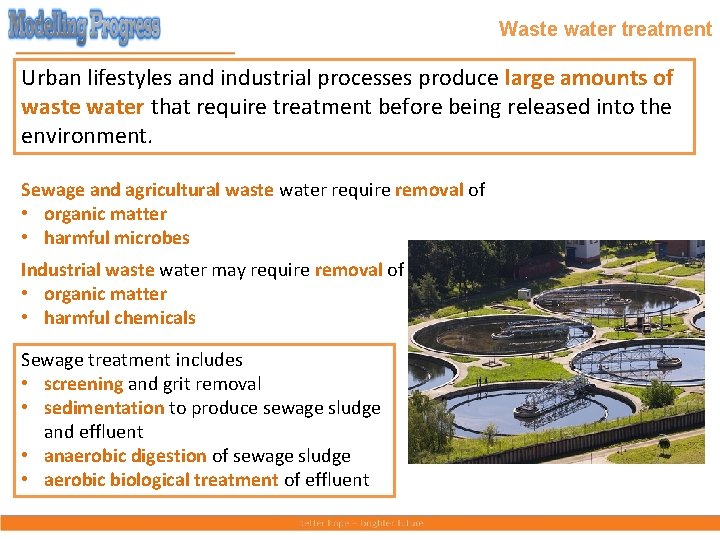
Waste water treatment Urban lifestyles and industrial processes produce large amounts of waste water that require treatment before being released into the environment. Sewage and agricultural waste water require removal of • organic matter • harmful microbes Industrial waste water may require removal of • organic matter • harmful chemicals Sewage treatment includes • screening and grit removal • sedimentation to produce sewage sludge and effluent • anaerobic digestion of sewage sludge • aerobic biological treatment of effluent
Waste water treatment – Answer. IT 1. What needs to be removed from sewage and agricultural waste water? 2. What needs to be removed from industrial waste water? 3. What are the four stages in the treatment of sewage?
Waste water treatment – Answer. IT 1. What needs to be removed from sewage and agricultural waste water? Organic matter and harmful microbes. 2. What needs to be removed from industrial waste water? Organic matter and harmful chemicals. 3. What are the four stages in the treatment of sewage? screening and grit removal sedimentation to produce sewage sludge and effluent anaerobic digestion of sewage sludge aerobic biological treatment of effluent.
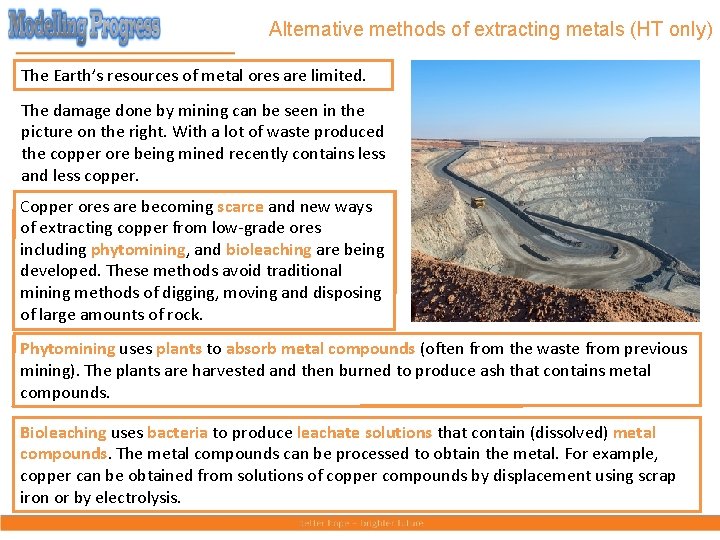
Alternative methods of extracting metals (HT only) The Earth’s resources of metal ores are limited. The damage done by mining can be seen in the picture on the right. With a lot of waste produced the copper ore being mined recently contains less and less copper. Copper ores are becoming scarce and new ways of extracting copper from low-grade ores including phytomining, and bioleaching are being developed. These methods avoid traditional mining methods of digging, moving and disposing of large amounts of rock. Phytomining uses plants to absorb metal compounds (often from the waste from previous mining). The plants are harvested and then burned to produce ash that contains metal compounds. Bioleaching uses bacteria to produce leachate solutions that contain (dissolved) metal compounds. The metal compounds can be processed to obtain the metal. For example, copper can be obtained from solutions of copper compounds by displacement using scrap iron or by electrolysis.
Alternative methods of extracting metals (HT only)- Answer. IT 1. What type of ores can phytomining and bioleaching be used on? 2. Why are phytomining and bioleaching used? 3. How does phytomining extract metals? 4. Bioleaching uses bacteria to make leachate solutions that contain metal compounds, describe two ways the metals are extracted from these solutions.
Alternative methods of extracting metals (HT only)- Answer. IT 1. What type of ores can phytomining and bioleaching be used on? low-grade ores 2. Why are phytomining and bioleaching used? Avoids traditional mining methods of digging, moving and disposing of large amounts of rock. 3. How does phytomining extract metals? Uses plants to absorb metal compounds the plants are harvested and burned this produces ash that contains metal compounds.
Alternative methods of extracting metals (HT only)- Answer. IT 4. Bioleaching uses bacteria to make leachate solutions that contain metal compounds, describe two ways the metals are extracted from these solutions. displacement using scrap iron electrolysis.
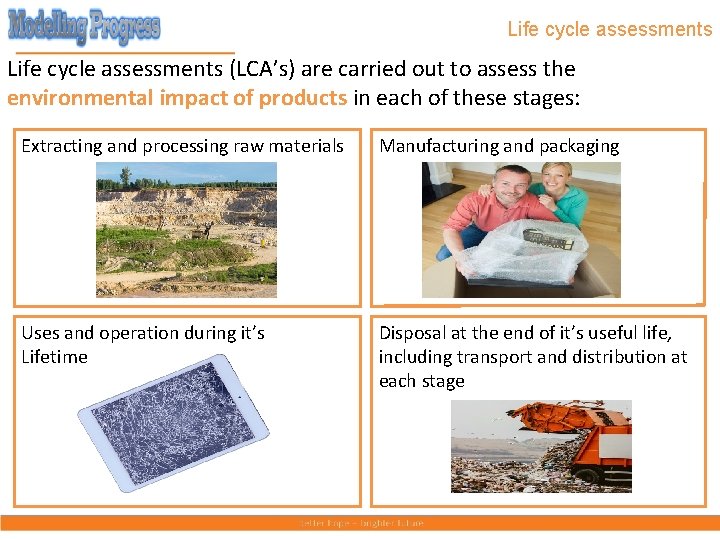
Life cycle assessments (LCA’s) are carried out to assess the environmental impact of products in each of these stages: Extracting and processing raw materials Manufacturing and packaging Uses and operation during it’s Lifetime Disposal at the end of it’s useful life, including transport and distribution at each stage
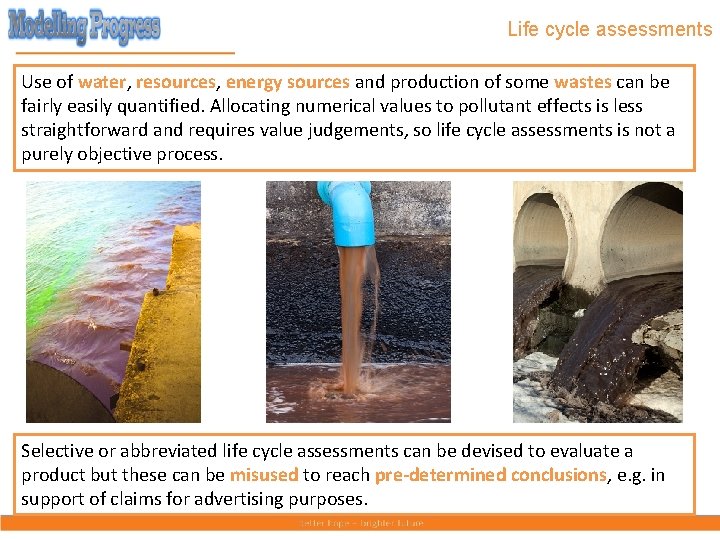
Life cycle assessments Use of water, resources, energy sources and production of some wastes can be fairly easily quantified. Allocating numerical values to pollutant effects is less straightforward and requires value judgements, so life cycle assessments is not a purely objective process. Selective or abbreviated life cycle assessments can be devised to evaluate a product but these can be misused to reach pre-determined conclusions, e. g. in support of claims for advertising purposes.
Life cycle assessments - Question. IT 1. Life cycle assessments are carried out to assess the environmental impact of what stages of a product? 2. What areas of life cycle assessments can be easily quantified? 3. Why are value judgements needed in the production of life cycle assessments?
Life cycle assessments - Answer. IT 1. Life cycle assessments are carried out to assess the environmental impact of what stages of a product? extracting and processing raw materials manufacturing and packaging use and operation during its lifetime disposal at the end of its useful life. 2. What areas of life cycle assessments can be easily quantified? water, resources, energy sources and production of some wastes. 3. Why are value judgements needed in the production of life cycle assessments? numerical values need to be allocated.
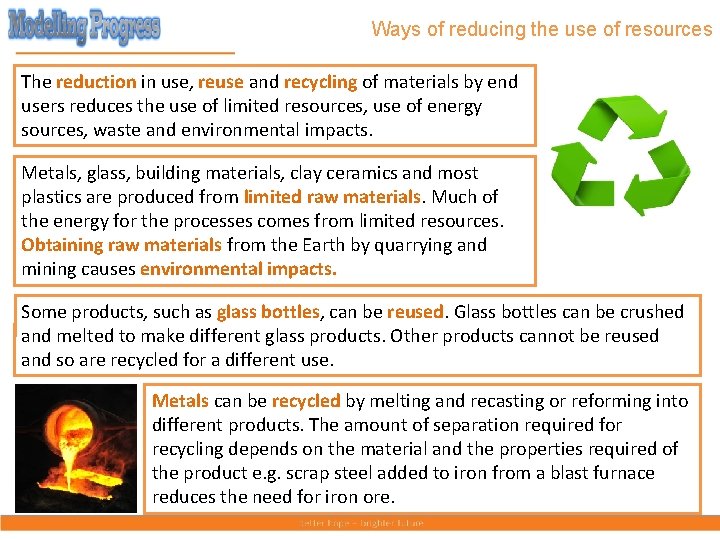
Ways of reducing the use of resources The reduction in use, reuse and recycling of materials by end users reduces the use of limited resources, use of energy sources, waste and environmental impacts. Metals, glass, building materials, clay ceramics and most plastics are produced from limited raw materials. Much of the energy for the processes comes from limited resources. Obtaining raw materials from the Earth by quarrying and mining causes environmental impacts. Some products, such as glass bottles, can be reused. Glass bottles can be crushed and melted to make different glass products. Other products cannot be reused and so are recycled for a different use. Metals can be recycled by melting and recasting or reforming into different products. The amount of separation required for recycling depends on the material and the properties required of the product e. g. scrap steel added to iron from a blast furnace reduces the need for iron ore.
Ways of reducing the use of resources - Question. IT 1. Name three things that reduce the use of limited resources. 2. Name three materials produced from limited resources. 3. Other than reusing how are glass bottles recycled 4. How are metals recycled?
Ways of reducing the use of resources - Answer. IT 1. Name three things that reduce the use of limited resources. reuse, reduction in use and recycling. 2. Name three materials produced from limited resources. any three from metals/glass/building materials/ceramics/plastics/any reasonable. 3. Other than reusing how are glass bottles recycled crushed and melted. 4. How are metals recycled? melting and recasting.
- Slides: 26