
December 15 2014 Growth Mindset Effective Feedback Growth
December 15, 2014 Growth Mindset Effective Feedback
Growth Mindset Video �What is the growth mindset and why does it matter for ALL of our Scholars? �Whole Class Conversation
Vertical Team �How does the architecture of the growth mindset? OLM represent �How does the architecture of a unit represent the growth mindset and how will this ensure that we meet the needs of ALL scholars? (take notes on the architecture anchor)
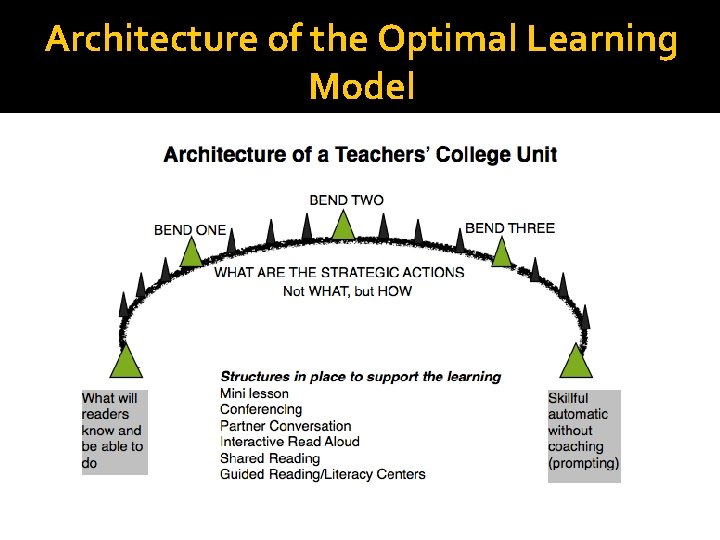
Architecture of the Optimal Learning Model
Effective Feedback Decades of education research support the idea that by teaching less and providing more feedback, we can produce greater learning. (see Bransford, Brown, & Cocking, 2000; Hattie, 2008; Marzano, Pickering, & Pollock, 2001)
What Does the Research Say? Academic feedback is more strongly and consistently related to achievement than any other teaching behavior…. This relationship is consistent regardless of grade, socioeconomic status, race, or school setting…. When feedback and corrective procedures are used, most students can attain the same level of achievement as the top 20% of students. ” � ~ Bellon, Bellon & Blank
What Does the Research Say? “Feedback seems to work well in so many situations that it led researcher John Hattie (1992) to make the following comment after analyzing almost 8, 000 studies: ‘The most powerful single modification that enhances achievement is feedback. The simplest prescription for improving education must be dollops of feedback. ’” ~ Robert Marzano
Effective Feedback is…. . Goal-referenced—Clear Vision of Excellence Tangible and Transparent Actionable User-friendly (specific and personalized); Timely Ongoing Consistent
Two approaches to Feedback In 1996 Pat Tunstall and Caroline Gipps developed a typology of teacher feedback by recording and classifying the feedback given by teachers to their students. They classified feedback as either: evaluative – involving a value judgment or descriptive – describing what the student said or did, and providing guidance for improvement
Evaluative feedback involves a judgment by the teacher based on implicit or explicit norms. Evaluative feedback may take the form of: Approval: “That’s a good essay. ” “You’ve done well. ” Disapproval: “That’s not good enough. ” Reward: Gold stars Punishment: “Write it out again. ”
An emphasis on evaluative feedback can affect how students feel about themselves. �It can make the good students feel better (and possibly complacent) �and the less able students feel worse (and the more sure that they will never be able to succeed. )
Descriptive feedback is the MOST Effective Descriptive feedback: �focuses on identified learning outcomes and makes specific reference to the student’s achievement. �looks towards improvement. An example of descriptive feedback: “That’s a good introduction because you have covered the main points we discussed at the beginning. Now … which points do you think you should expand on? ”
Feedback is information about how we are doing in our efforts to reach a goal. � Here are some other examples of feedback: A friend tells me, "You know, when you put it that way and speak in that softer tone of voice, it makes me feel better. " A reader comments on my short story, "The first few paragraphs kept my full attention. The scene painted was vivid and interesting. But then the dialogue became hard to follow; as a reader, I was confused about who was talking, and the sequence of actions was puzzling, so I became less engaged. " A baseball coach tells me, "Each time you swung and missed, you raised your head as you swung so you didn't really have your eye on the ball. On the one you hit hard, you kept your head down and saw the ball. "
Rewrite the evaluative statements into descriptive feedback �Page 4 in your notecatcher
Where are we going? �Clarity—Vision of Excellence Big Skill and strategic actions are communicated to the learners and clear to the teacher. ▪ Anchor chart ▪ Rubric Page 5 notecatcher
Research the Learner Where is this learner now? How will we close the gap?
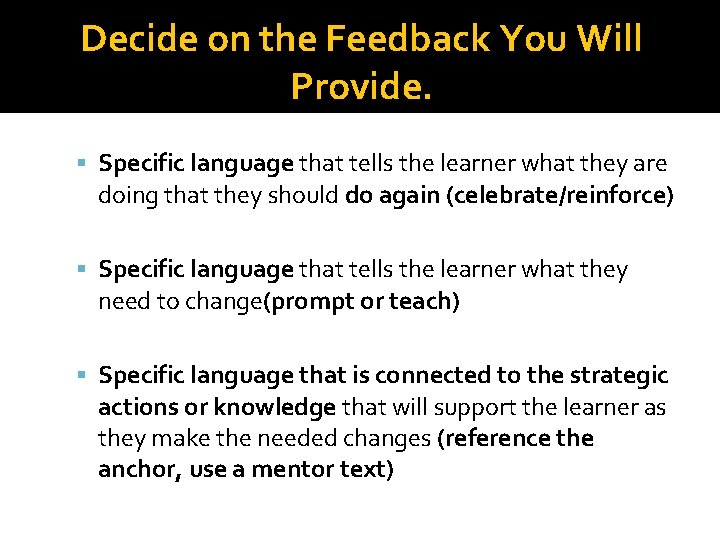
Decide on the Feedback You Will Provide. Specific language that tells the learner what they are doing that they should do again (celebrate/reinforce) Specific language that tells the learner what they need to change(prompt or teach) Specific language that is connected to the strategic actions or knowledge that will support the learner as they make the needed changes (reference the anchor, use a mentor text)
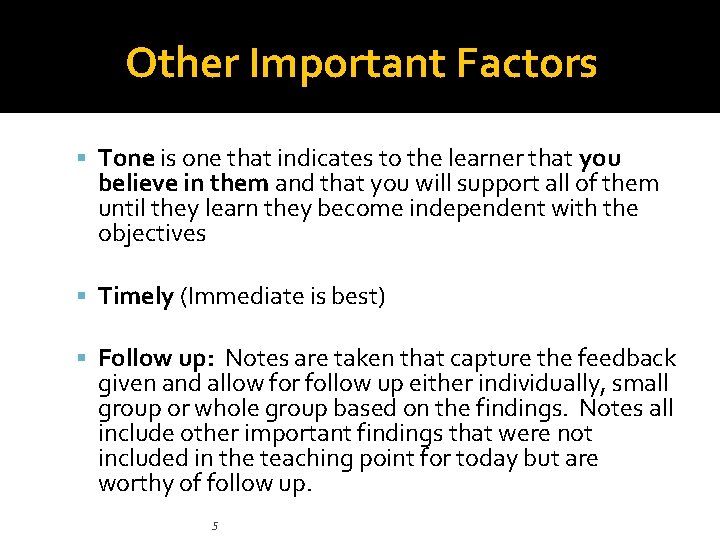
Other Important Factors Tone is one that indicates to the learner that you believe in them and that you will support all of them until they learn they become independent with the objectives Timely (Immediate is best) Follow up: Notes are taken that capture the feedback given and allow for follow up either individually, small group or whole group based on the findings. Notes all include other important findings that were not included in the teaching point for today but are worthy of follow up. 5
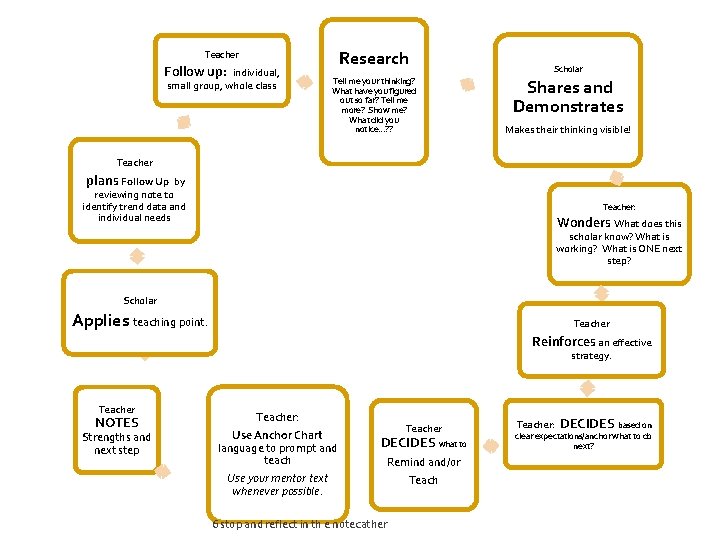
Research Teacher Follow up: individual, small group, whole class Tell me your thinking? What have you figured out so far? Tell me more? Show me? What did you notice. . . ? ? Scholar Shares and Demonstrates Makes their thinking visible! Teacher plans Follow Up by reviewing note to identify trend data and individual needs Teacher: Wonders What does this scholar know? What is working? What is ONE next step? Scholar Applies teaching point. Teacher: Reinforces an effective strategy. Teacher NOTES Strengths and next step Teacher: Use Anchor Chart language to prompt and teach Teacher DECIDES what to Use your mentor text whenever possible. 6 stop and reflect in th e notecather Remind and/or Teacher: DECIDES based on clear expectations/anchor what to do next?
Accountable Talk Over-listening to provide effective feedback
Intentional Over-Listening � Teacher is in a constant stance of inquiry! � The art of over-listening and assessing to determine the best next step to keep the conversation going and build habits is essential to scholar success. � Listen, Research and Decide: Should I prompt? Should I reinforce? Should I teach/model? � Role of facilitator changes over time as habits are built to automaticity.
Clarity: Create a Vision of Excellence �Read annotate the Accountable talk cheat sheet, and before during and after reading thinking habits and the common core standards for speaking and listening. � Define the Purpose �Define the vision of excellence clearly so that all feedback can be grounded in that shared vision. �What information can we glean from overlistening? (content, SFMP and comprehension and collaboration) Page 7, 8, 9 in the note-catcher and the accountable talk cheat sheet
Effective Feedback Cycle �Reflection: 5 minutes at the end of each conversation ▪ How did our conversation go today? ▪ What habits did we use well? ▪ What can we improve on? �Observation/Feedback Cycle--Overlistening Habits of discussion Comprehension Strategies/Thinking Habits Common Core Standards: Reading/Content
Research/Decide/Reinforce/ Remind/Re-teach �What do they know? (Reinforce) �What do they need to know? (Remind and/or Re-teach) �Share: Lift the group by sharing your findings from over-listening
Practice— Page 9 and 10 in the note-catcher http: //vimeo. com/album/2777084/video/55965892: An Inquiry Group of Students Synthesize their Findings on the Clothing Worn by Pilgrims and Cavaliers (3 -5): Book Club/Inquiry Group � http: //vimeo. com/55954403 � What habits have they internalized? � What would you reinforce? � What would your teaching point or next steps be?
Writing About Reading Think, Talk, Write
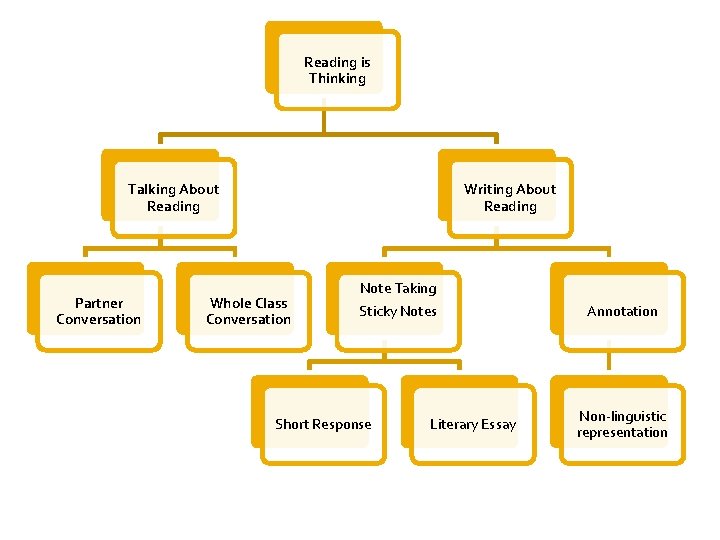
Reading is Thinking Talking About Reading Partner Conversation Writing About Reading Whole Class Conversation Note Taking Sticky Notes Short Response Literary Essay Annotation Non-linguistic representation
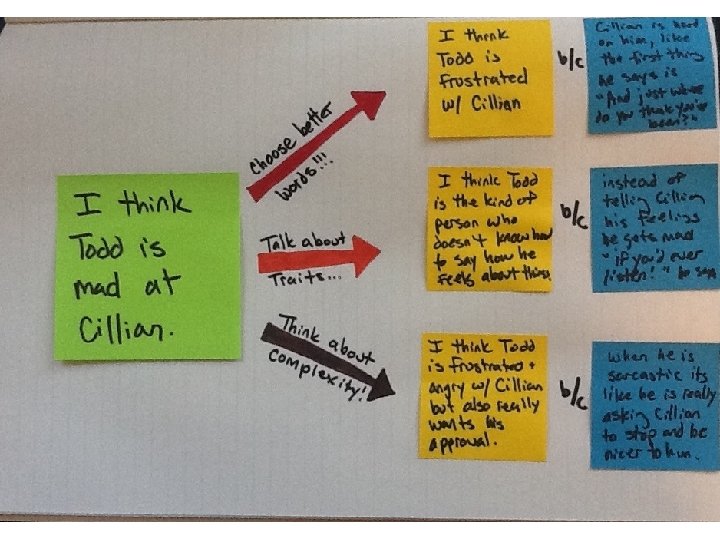
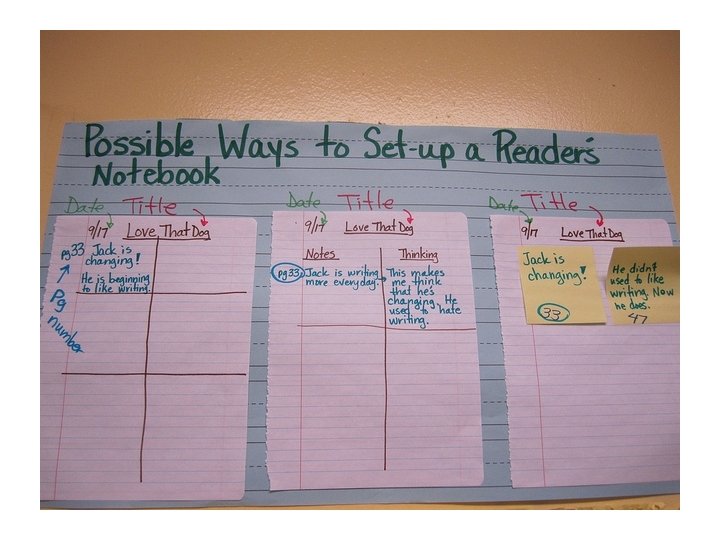
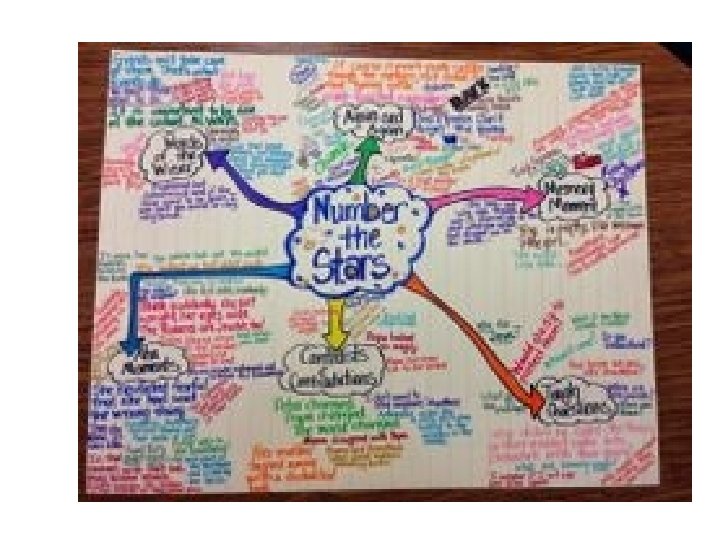
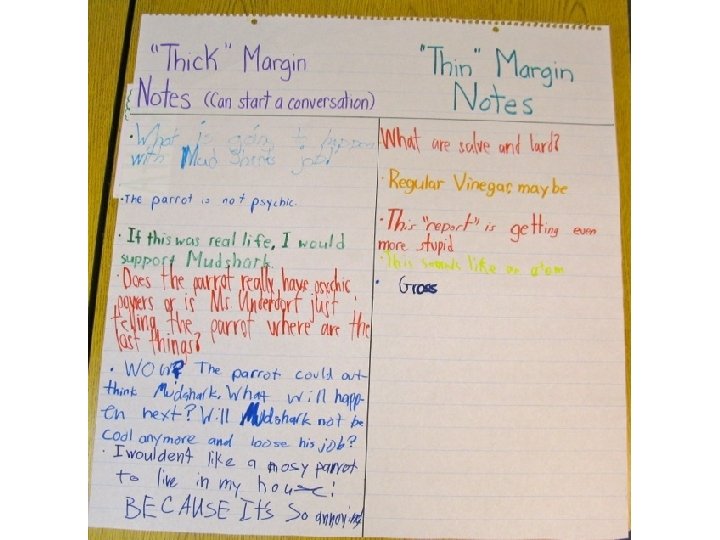
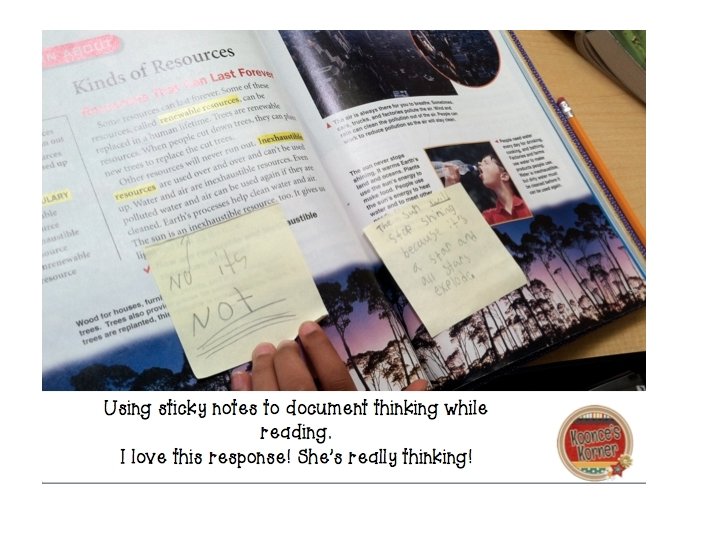
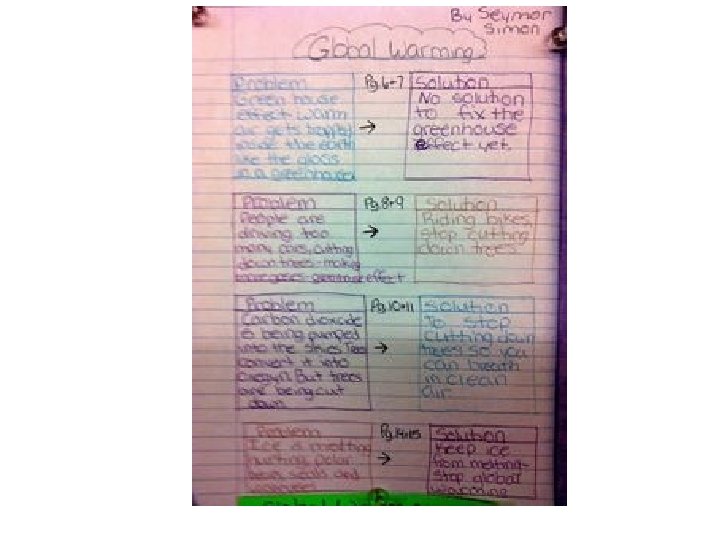
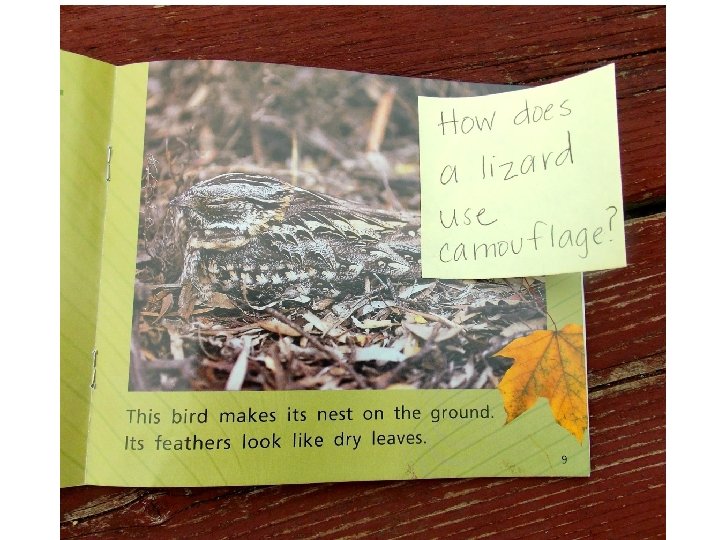
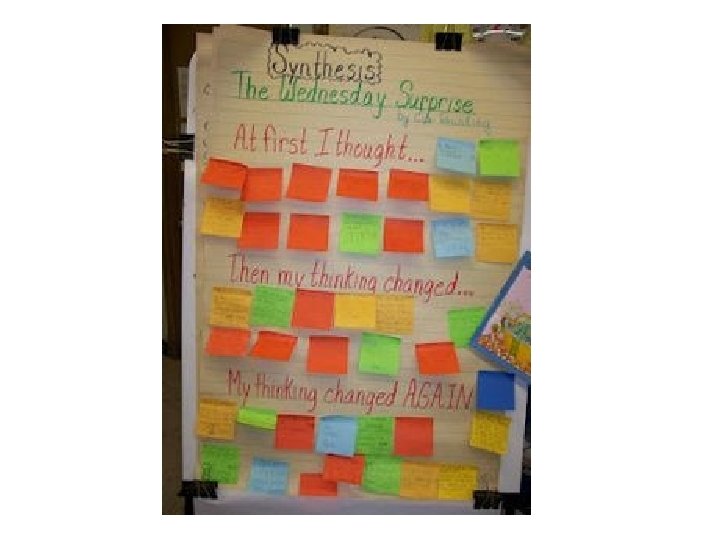
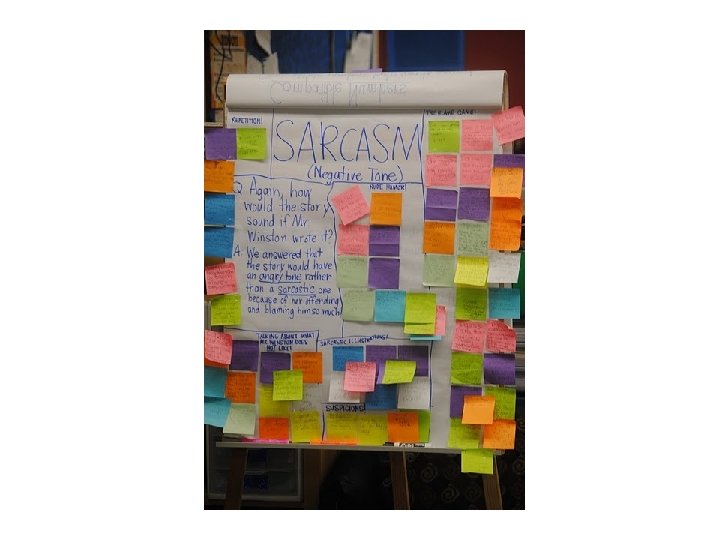
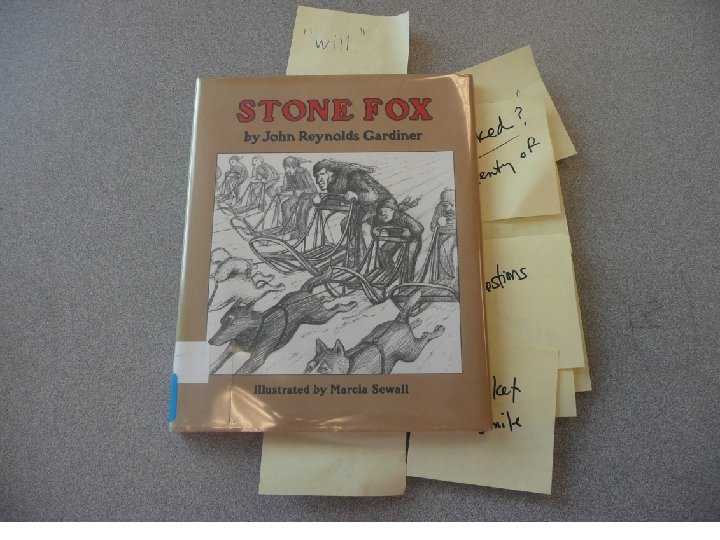
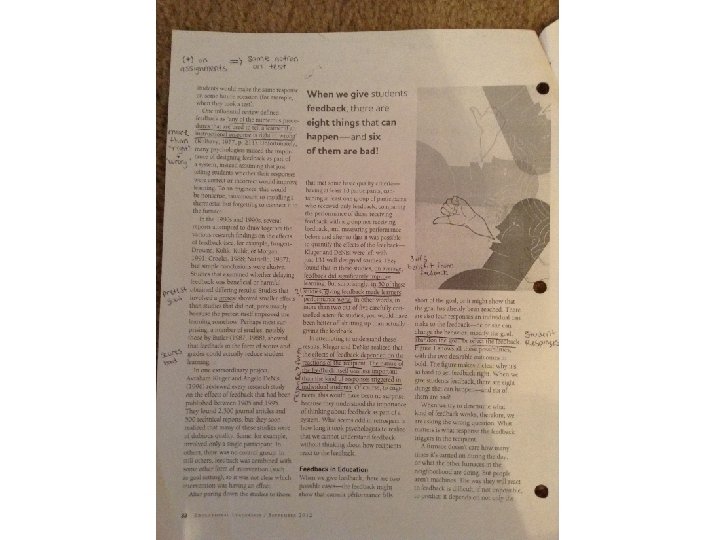
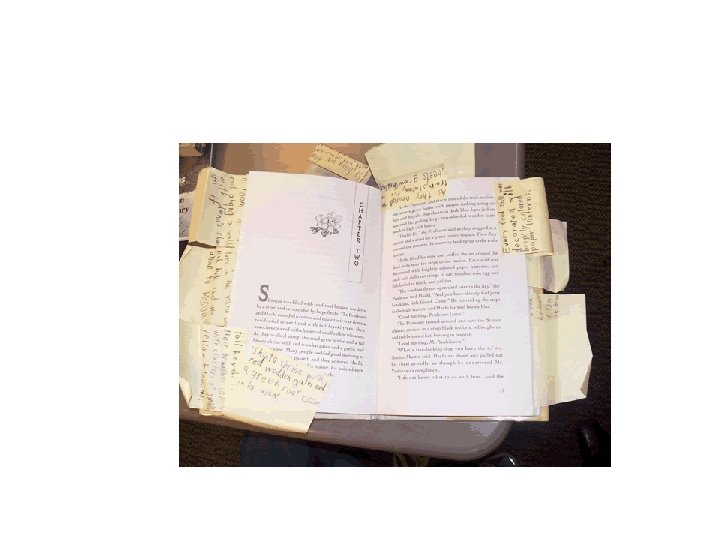
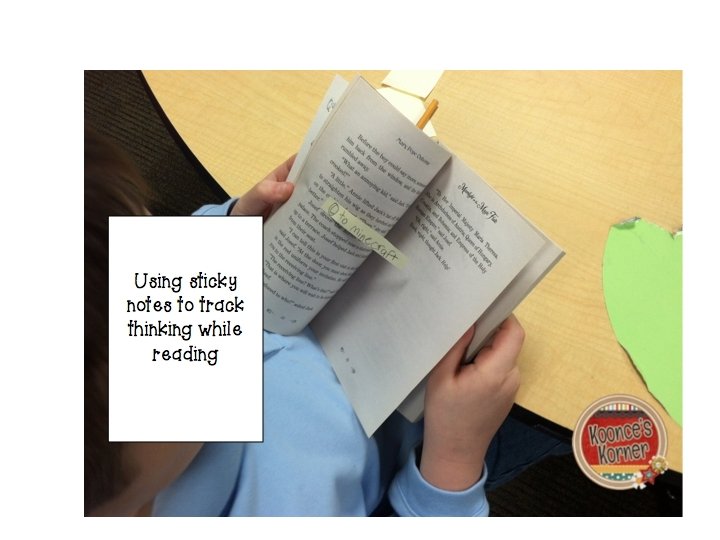
Writing About Reading �The vision of excellence for writing about reading is specific to the grade level and unit of study. �In upcoming unit unpacking we will define the vision of excellence for the next unit.
Providing Effective Feedback in the Structures of the Reading Workshop Reading Logs
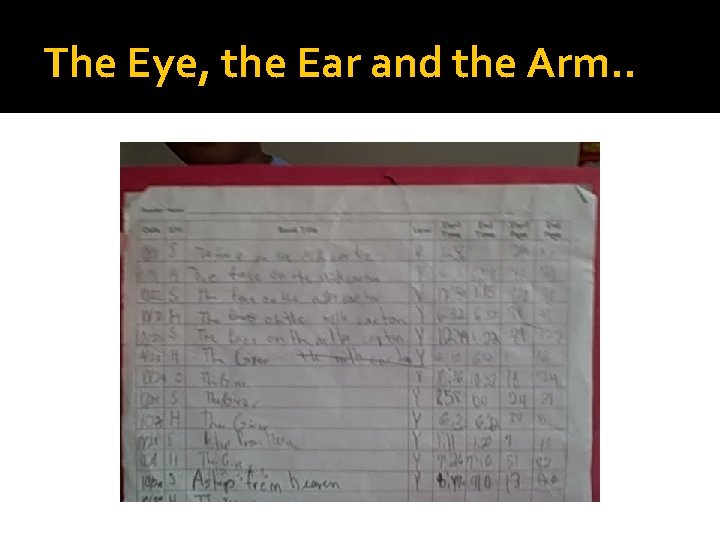
Tracking your Reading Life Reading Log �Why? Define the Purpose �How? Tools �Data Source �Read annotate the handout to get clarity of the vision of excellence
I am the kind of reader who…
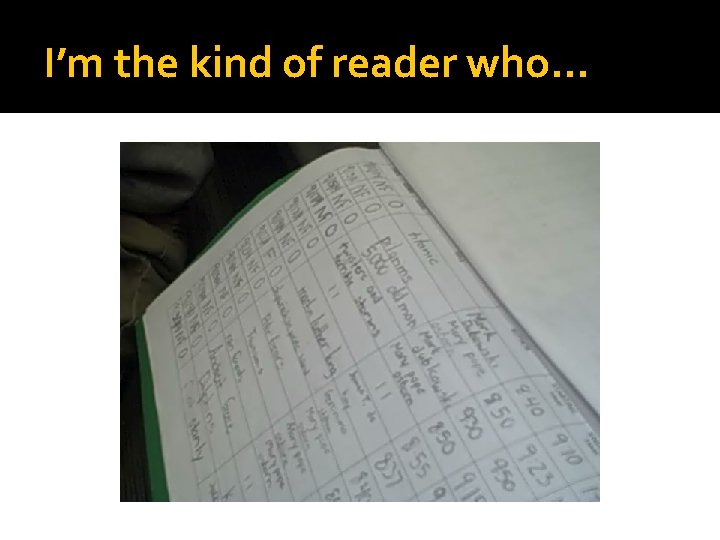
I’m the kind of reader who…
I’m the kind of reader who…
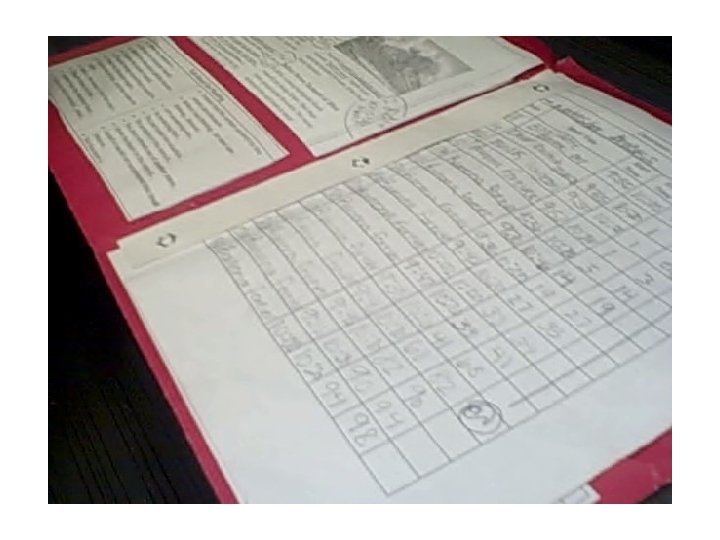
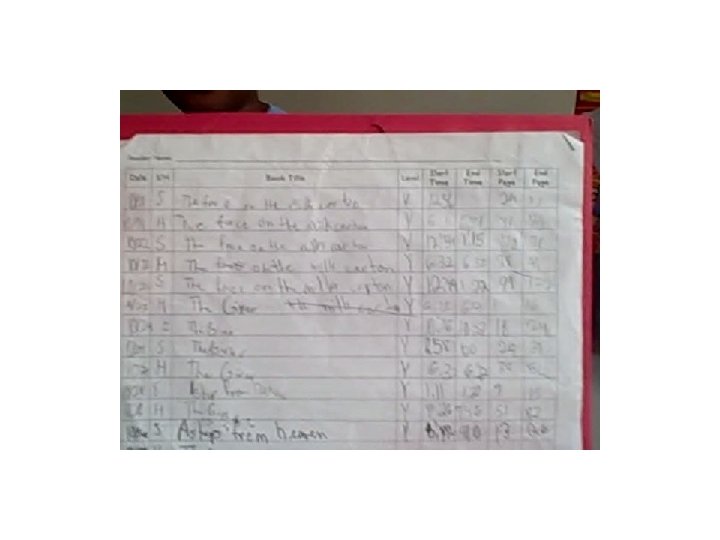
Video �How does the teacher and the students use the reading to increase awareness and set goals.
Research �What does the reader know? �What does the reader need? �What feedback will you give to close the gap between where they are and the vision of excellence?
Providing Effective Feedback in the structures of the Workshop Classroom Conferencing
Classroom Tour �http: //www. youtube. com/watch? v=Z 3 s. Uo. V 2 po 3 w 13: 40 � Notice the way the teacher organizes her tools. �What will the impact of this planning be on scholars? On the teacher?
Staying Organzed �Clipboard-2 -3 weeks of conference notes organized by class. Use these to find patterns, trends and make decisions for the whole group and to plan follow up conferences for individuals. �Binder Student level data looking at individuals growth over time.
Clip Board �Workshop Plan �Conference labels �Mini-anchors �Class list for observational data collection
Data Binder �Section for each reader �Start of the year reading data with graph �Benchmark Data �Individual conferencing data �other
Conference Bag-Kit �Mentor Texts �White board and marker �Copies of relevant anchors �Clip board �Sticky notes �Etc…
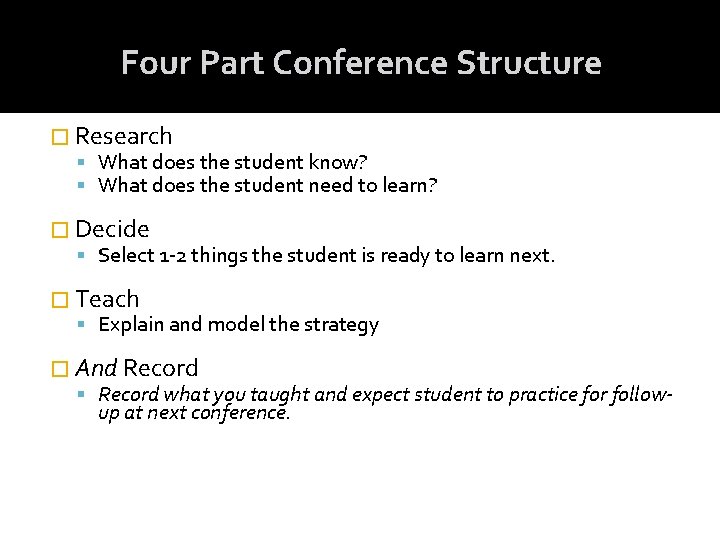
Four Part Conference Structure � Research What does the student know? What does the student need to learn? � Decide Select 1 -2 things the student is ready to learn next. � Teach Explain and model the strategy � And Record what you taught and expect student to practice for followup at next conference.
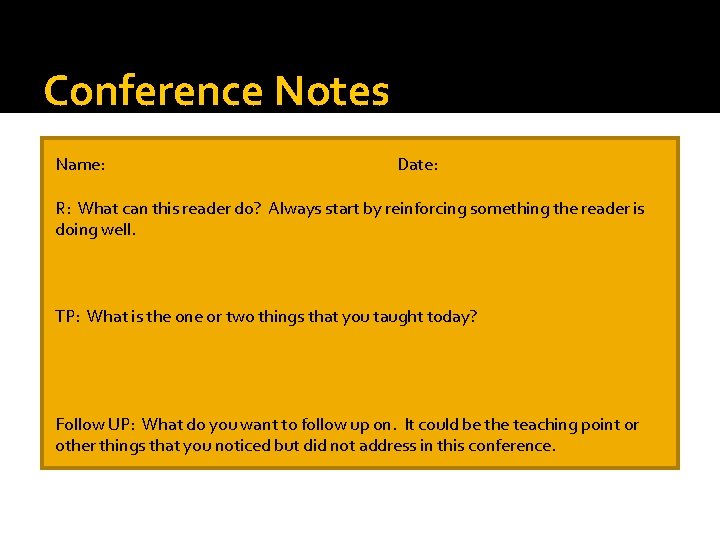
Conference Notes Name: Date: R: What can this reader do? Always start by reinforcing something the reader is doing well. TP: What is the one or two things that you taught today? Follow UP: What do you want to follow up on. It could be the teaching point or other things that you noticed but did not address in this conference.
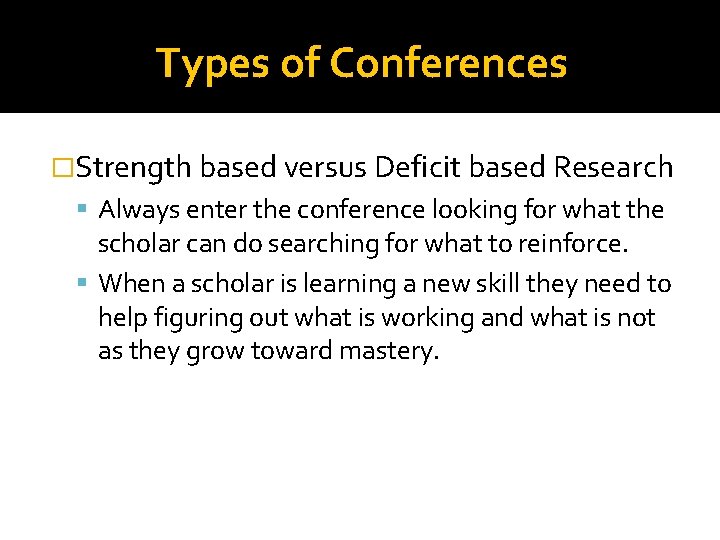
Types of Conferences �Strength based versus Deficit based Research Always enter the conference looking for what the scholar can do searching for what to reinforce. When a scholar is learning a new skill they need to help figuring out what is working and what is not as they grow toward mastery.
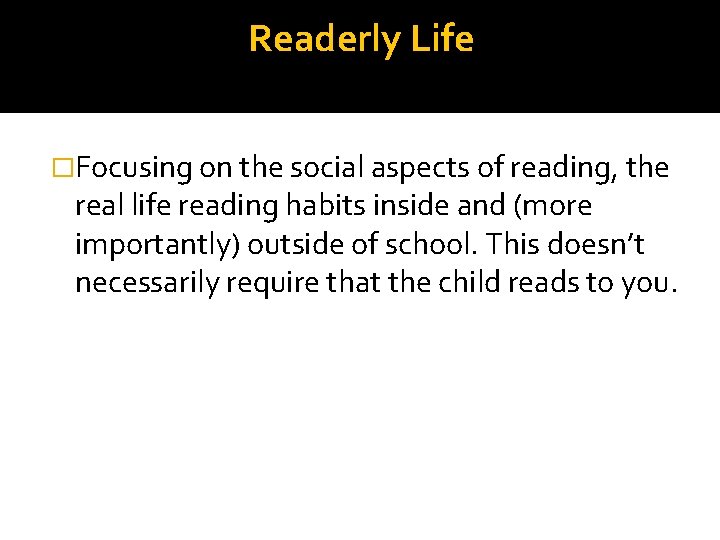
Readerly Life �Focusing on the social aspects of reading, the real life reading habits inside and (more importantly) outside of school. This doesn’t necessarily require that the child reads to you.
Book Choice �Conversations around making appropriate book choices choose appropriate books so that children spend less time choosing and more time reading. Of course, these conversations with individuals should be accompanied (or preceded) by group talks and mini-lessons on book choice.
Making Meaning �These conferences focus on how the reader makes meaning of what she reads, how she monitors for sense, and what she does when meaning breaks down.
Print/skill �This is where you address the real print work. You might assess what the reader needs after having her read to you while you take a running record. Or you might just offer a strategy after having had the child read aloud to you.
Process �This is the work of the reading. you do when reading? ” “What is it
Practice �Watch the videos and in your note-catcher name what you would do. �Reinforce �Remind �Re-teach �Follow up.
Kindergarten
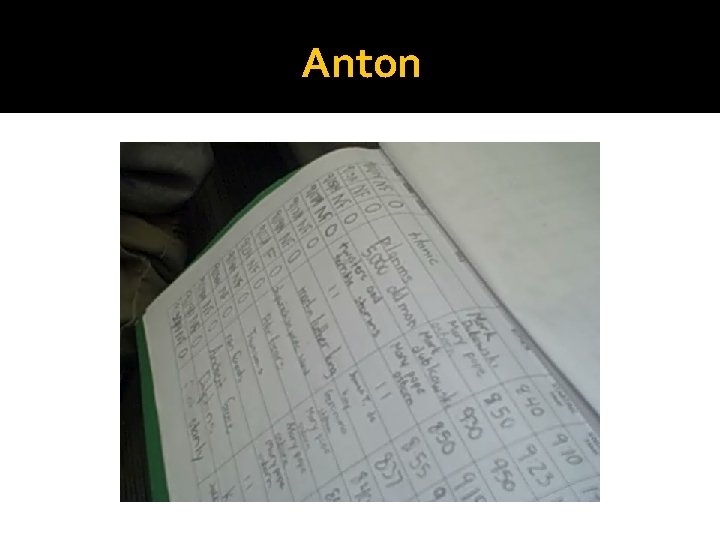
Anton
Sixth Grade
Eighth Grade Reader
The Eye, the Ear and the Arm. .
Totally JOE
Orlando
Exit Ticket and Reflection
- Slides: 73