
December 13 2018 Tools and resources for oxygen
December 13, 2018 Tools and resources for oxygen system planning and procurement Zachary Clemence Kathryn Geskermann Kanishk Gupta Mike Ruffo Lisa Smith
Workshop overview • • • Why oxygen? Overview of oxygen sources Quantification Total cost of ownership Other considerations Discussion • Worksheet activity • Importance of technical specifications • Overview of UNICEF-WHO resources for oxygen therapy products • UNICEF procurement overview • Open discussion on challenges— 10 minutes
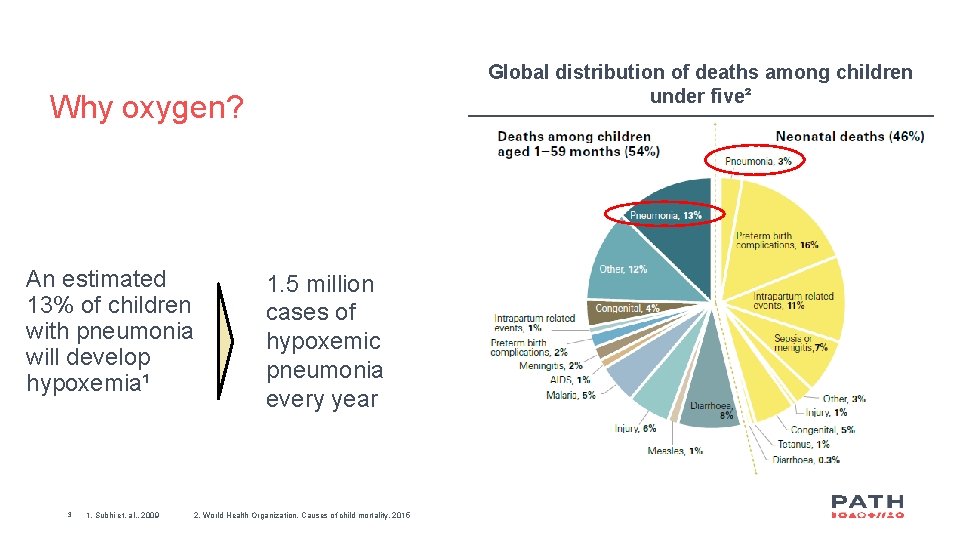
Global distribution of deaths among children under five² Why oxygen? An estimated 13% of children with pneumonia will develop hypoxemia¹ 3 1. Subhi et. al. , 2009 1. 5 million cases of hypoxemic pneumonia every year 2. World Health Organization, Causes of child mortality, 2015
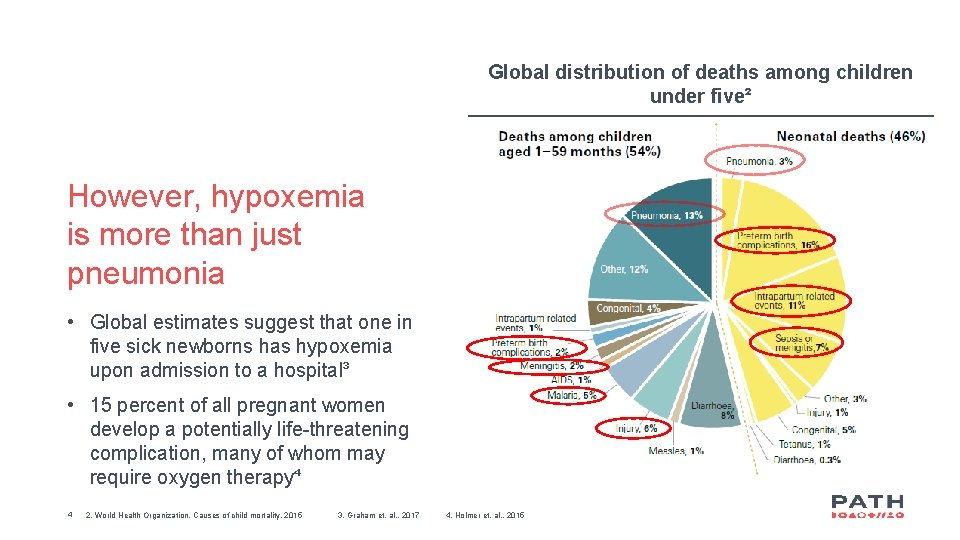
Global distribution of deaths among children under five² However, hypoxemia is more than just pneumonia • Global estimates suggest that one in five sick newborns has hypoxemia upon admission to a hospital³ • 15 percent of all pregnant women develop a potentially life-threatening complication, many of whom may require oxygen therapy⁴ 4 2. World Health Organization, Causes of child mortality, 2015 3. Graham et. al. , 2017 4. Holmer et. al. , 2015
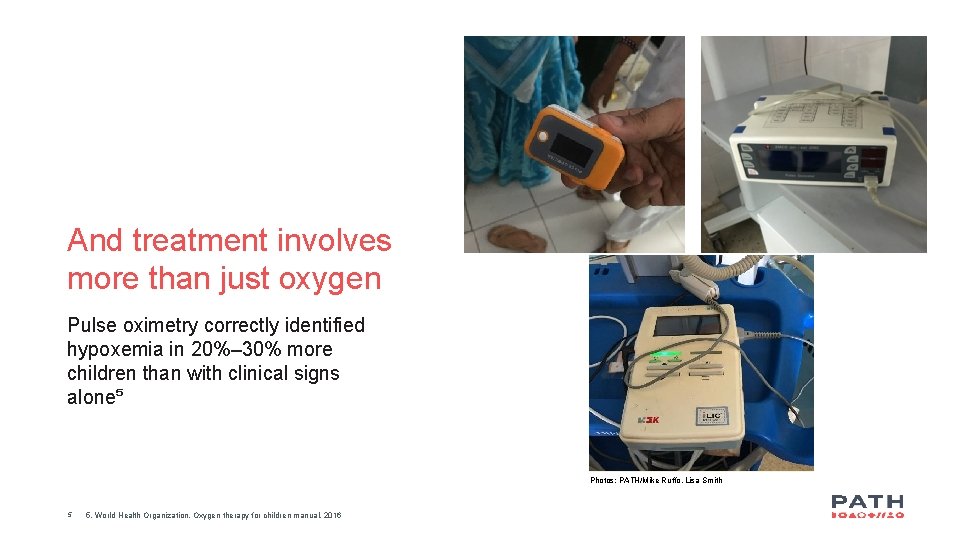
And treatment involves more than just oxygen Pulse oximetry correctly identified hypoxemia in 20%– 30% more children than with clinical signs alone⁵ Photos: PATH/Mike Ruffo, Lisa Smith 5 5. World Health Organization, Oxygen therapy for children manual, 2016
… you are the administrator of a district hospital. Your hospital has almost 800 beds and oxygen is provided by a mix of manifold systems and bedside cylinders. Budgeting and planning is based on average past use. The deliveries usually Imagine… arrive each week, but sometimes there are periods where the facilities have no oxygen due to supply issues. You are concerned about the impact that lack of oxygen has on the facility’s ability to treat patients effectively. You’ve heard about oxygen plants as an option for more consistency, but you don’t know if it’s a good option for your district. How do you decide what oxygen system is best for your facility? 6
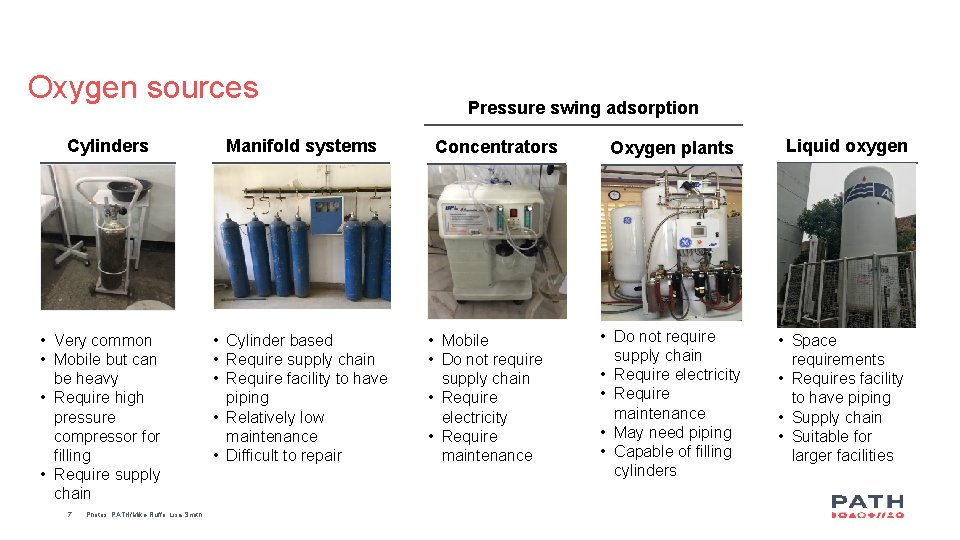
Oxygen sources Cylinders • Very common • Mobile but can be heavy • Require high pressure compressor filling • Require supply chain 7 Photos: PATH/Mike Ruffo, Lisa Smith Manifold systems • Cylinder based • Require supply chain • Require facility to have piping • Relatively low maintenance • Difficult to repair Pressure swing adsorption Concentrators • Mobile • Do not require supply chain • Require electricity • Require maintenance Oxygen plants • Do not require supply chain • Require electricity • Require maintenance • May need piping • Capable of filling cylinders Liquid oxygen • Space requirements • Requires facility to have piping • Supply chain • Suitable for larger facilities
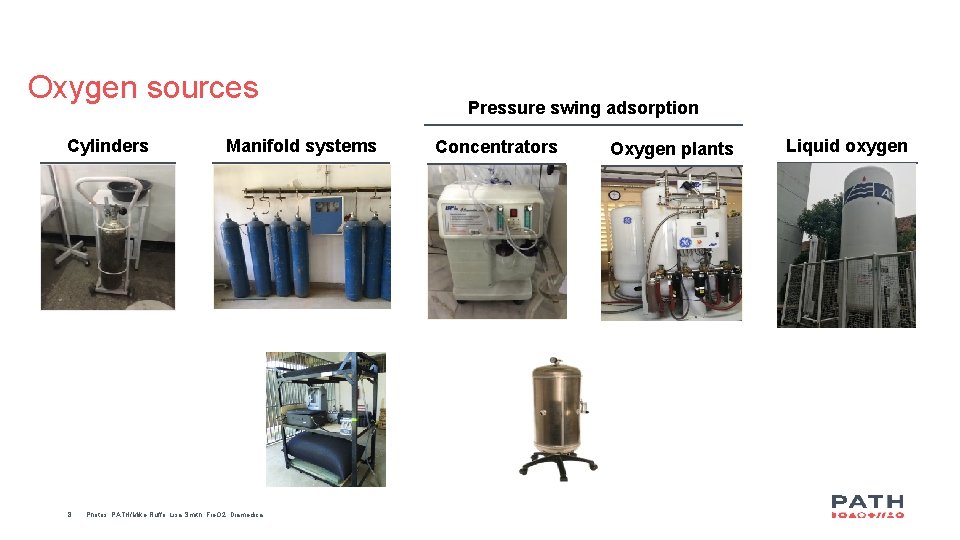
Oxygen sources Cylinders 8 Manifold systems Photos: PATH/Mike Ruffo, Lisa Smith, Fre. O 2, Diamedica Pressure swing adsorption Concentrators Oxygen plants Liquid oxygen
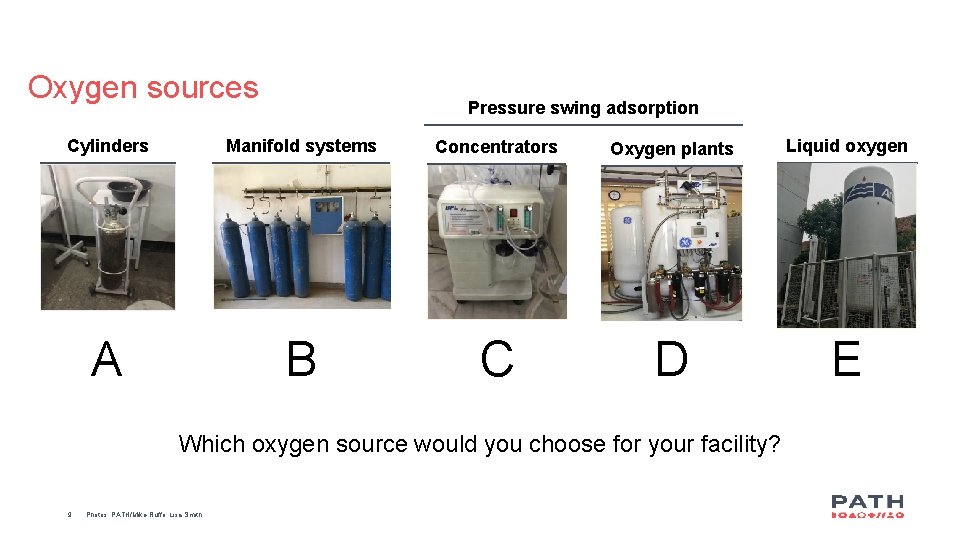
Oxygen sources Pressure swing adsorption Cylinders Manifold systems Concentrators Oxygen plants Liquid oxygen A B C D E Which oxygen source would you choose for your facility? 9 Photos: PATH/Mike Ruffo, Lisa Smith
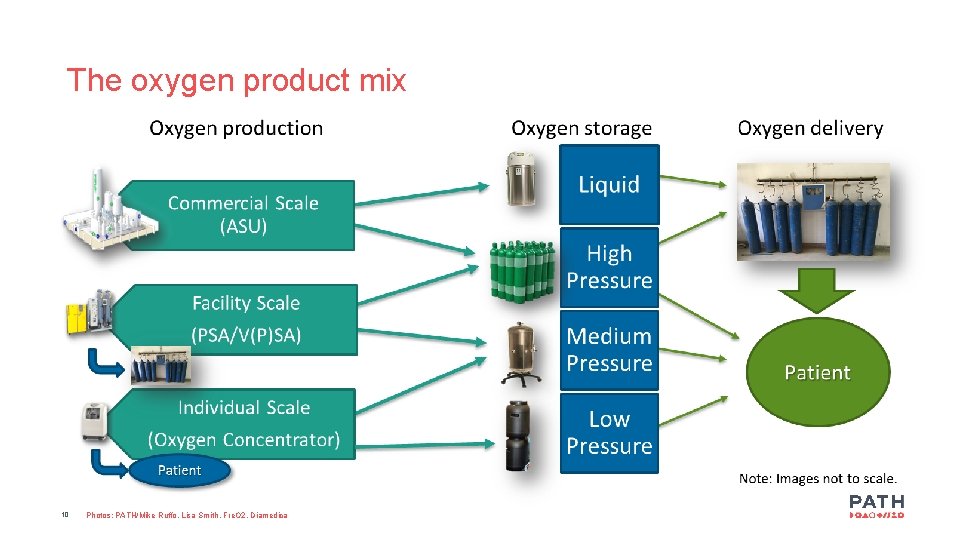
The oxygen product mix 10 Photos: PATH/Mike Ruffo, Lisa Smith, Fre. O 2, Diamedica
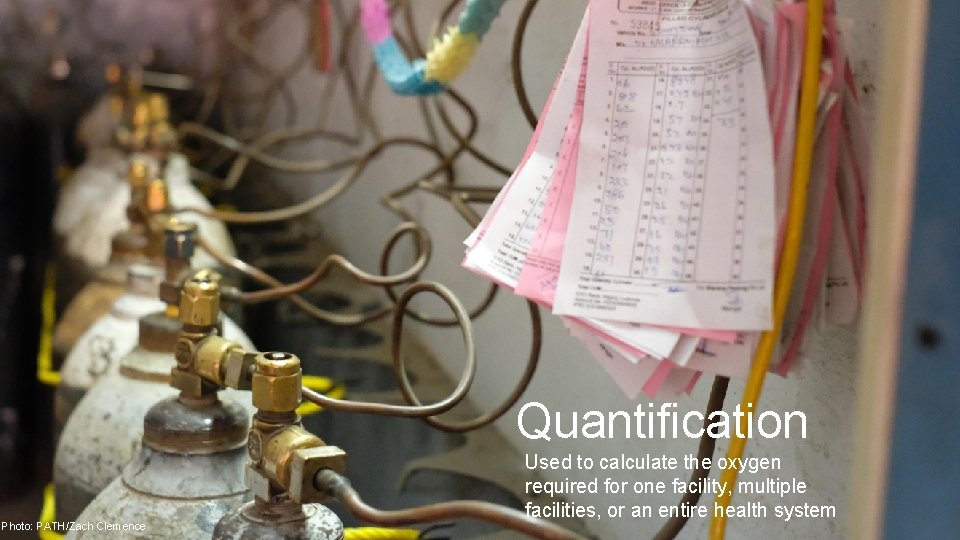
Quantification 11 Photo: PATH/Zach Clemence Used to calculate the oxygen required for one facility, multiple facilities, or an entire health system
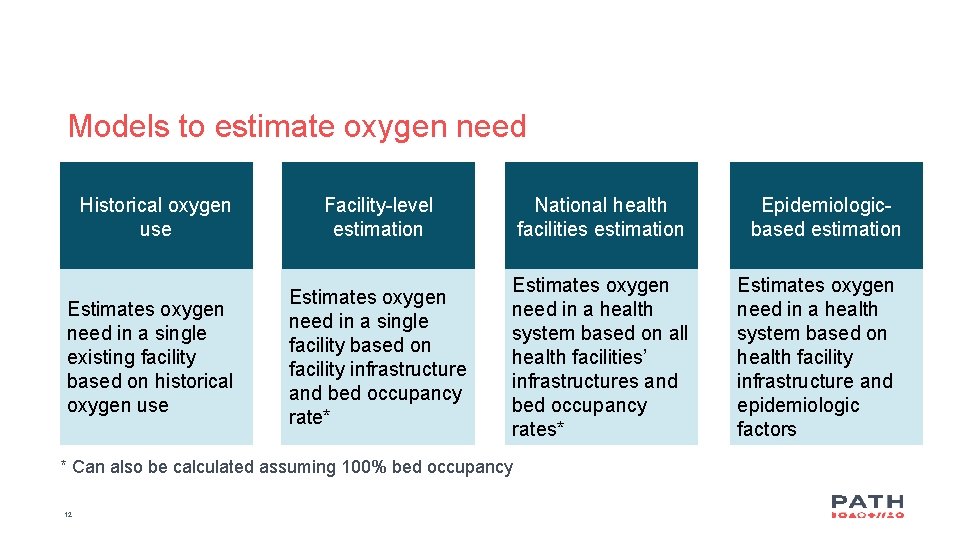
Models to estimate oxygen need Historical oxygen use Facility-level estimation National health facilities estimation Estimates oxygen need in a single existing facility based on historical oxygen use Estimates oxygen need in a single facility based on facility infrastructure and bed occupancy rate* Estimates oxygen need in a health system based on all health facilities’ infrastructures and bed occupancy rates* * Can also be calculated assuming 100% bed occupancy 12 Epidemiologicbased estimation Estimates oxygen need in a health system based on health facility infrastructure and epidemiologic factors
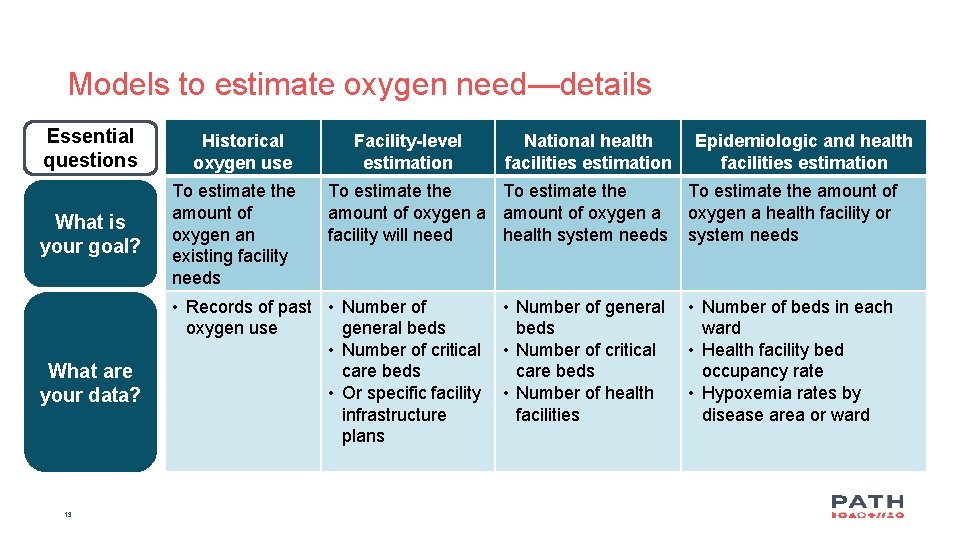
Models to estimate oxygen need—details Essential questions Historical oxygen use What is your goal? To estimate the amount of oxygen an existing facility needs What are your data? 13 Facility-level estimation National health facilities estimation To estimate the amount of oxygen a facility will need health system needs • Records of past • Number of oxygen use general beds • Number of critical care beds • Or specific facility infrastructure plans • Number of general beds • Number of critical care beds • Number of health facilities Epidemiologic and health facilities estimation To estimate the amount of oxygen a health facility or system needs • Number of beds in each ward • Health facility bed occupancy rate • Hypoxemia rates by disease area or ward
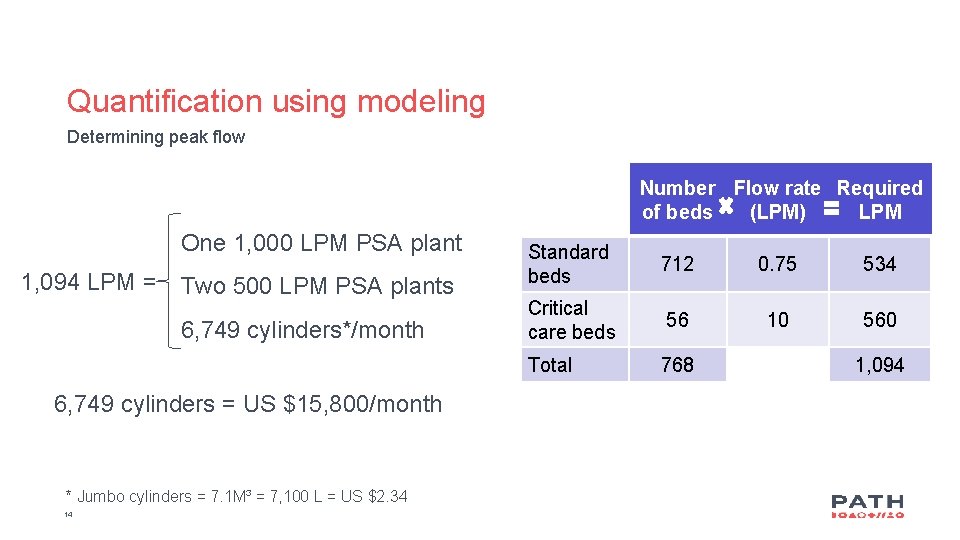
Quantification using modeling Determining peak flow Number Flow rate Required of beds (LPM) LPM One 1, 000 LPM PSA plant 1, 094 LPM = Two 500 LPM PSA plants 6, 749 cylinders*/month 6, 749 cylinders = US $15, 800/month * Jumbo cylinders = 7. 1 M³ = 7, 100 L = US $2. 34 14 Standard beds 712 0. 75 534 Critical care beds 56 10 560 Total 768 1, 094
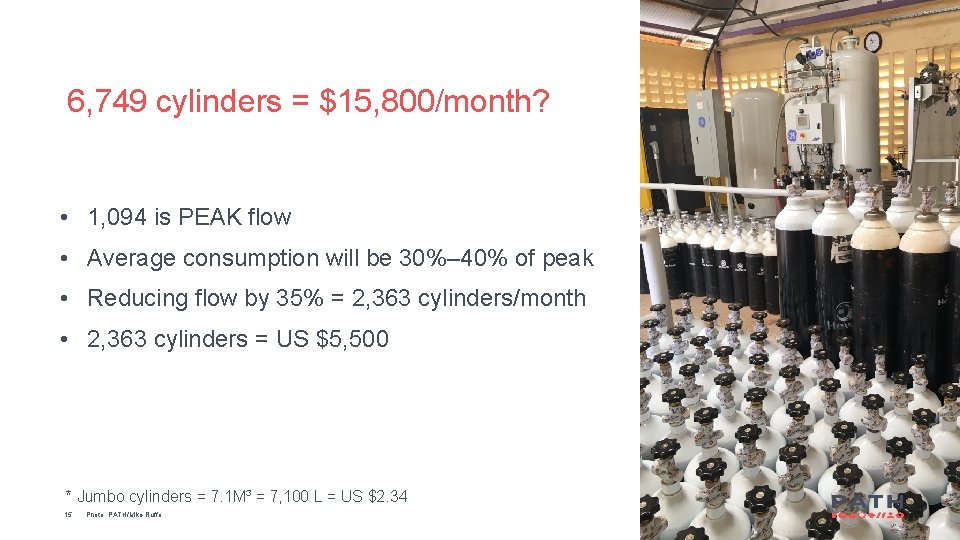
6, 749 cylinders = $15, 800/month? • 1, 094 is PEAK flow • Average consumption will be 30%– 40% of peak • Reducing flow by 35% = 2, 363 cylinders/month • 2, 363 cylinders = US $5, 500 * Jumbo cylinders = 7. 1 M³ = 7, 100 L = US $2. 34 15 Photo: PATH/Mike Ruffo
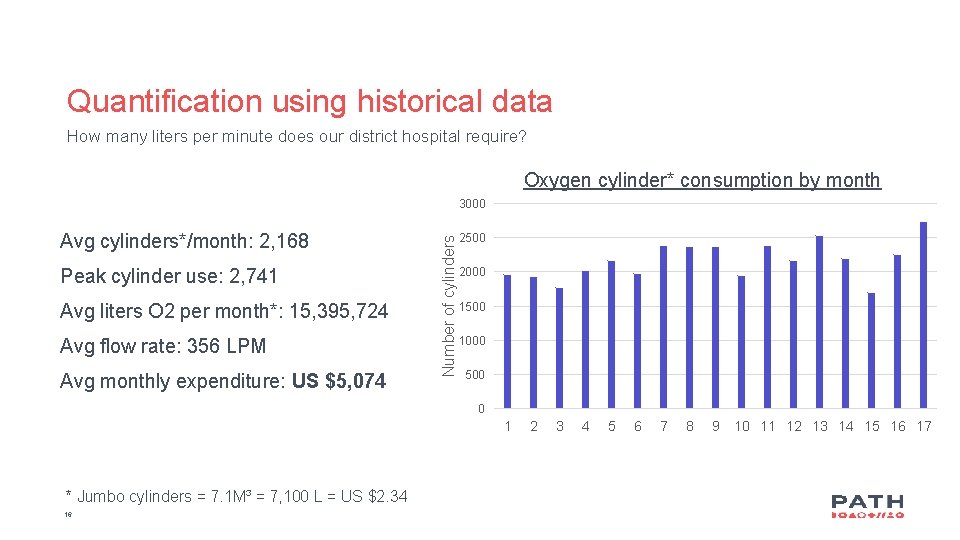
Quantification using historical data How many liters per minute does our district hospital require? Oxygen cylinder* consumption by month Avg cylinders*/month: 2, 168 Peak cylinder use: 2, 741 Avg liters O 2 per month*: 15, 395, 724 Avg flow rate: 356 LPM Avg monthly expenditure: US $5, 074 Number of cylinders 3000 2500 2000 1500 1000 500 0 1 * Jumbo cylinders = 7. 1 M³ = 7, 100 L = US $2. 34 16 2 3 4 5 6 7 8 9 10 11 12 13 14 15 16 17
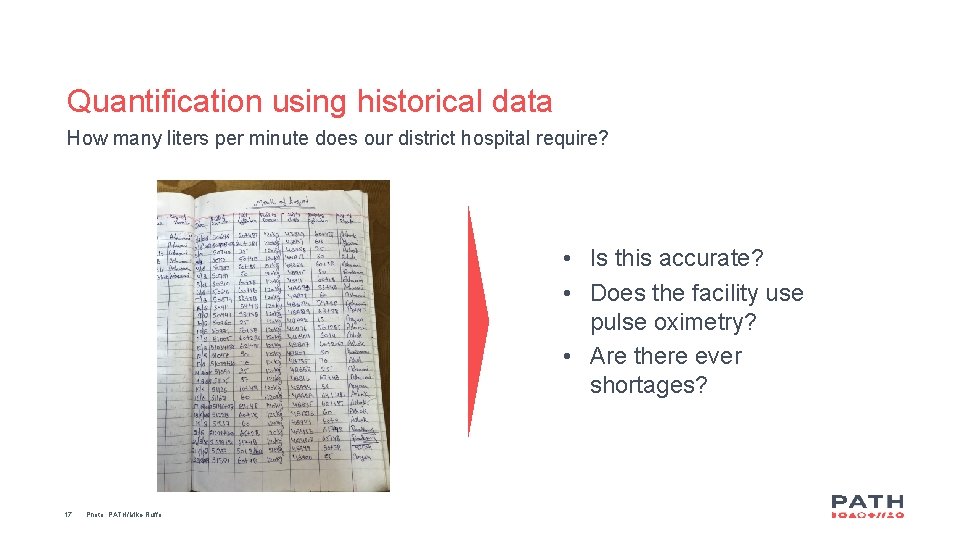
Quantification using historical data How many liters per minute does our district hospital require? • Is this accurate? • Does the facility use pulse oximetry? • Are there ever shortages? 17 Photo: PATH/Mike Ruffo
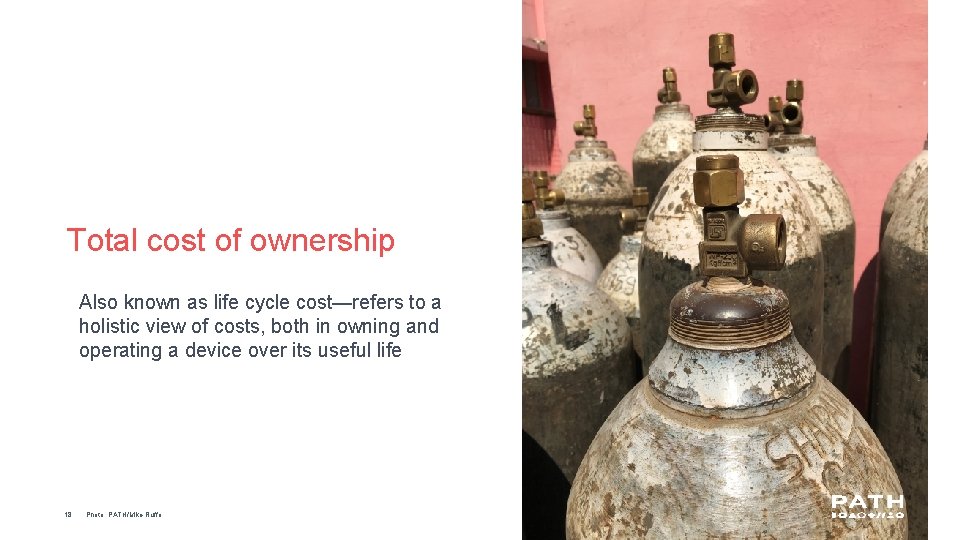
Total cost of ownership Also known as life cycle cost—refers to a holistic view of costs, both in owning and operating a device over its useful life 18 Photo: PATH/Mike Ruffo
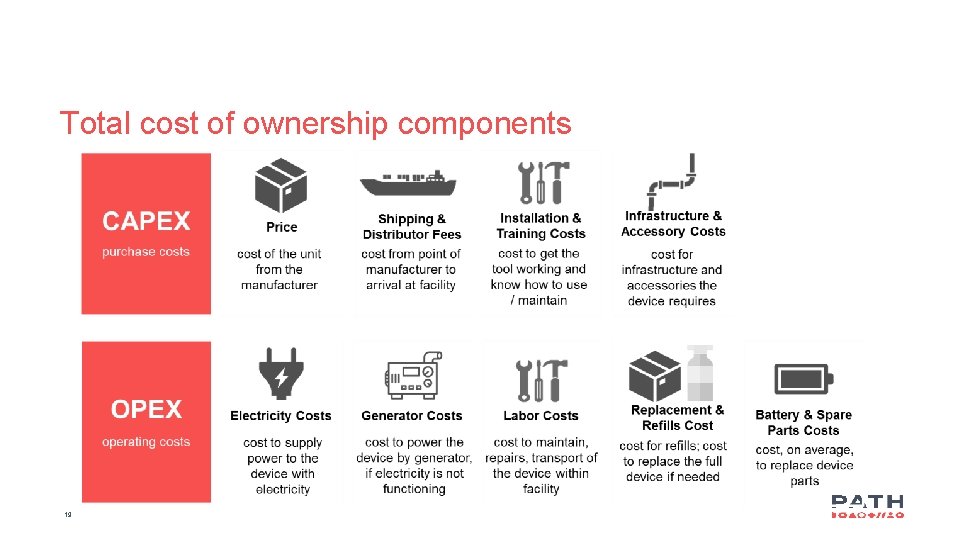
Total cost of ownership components 19
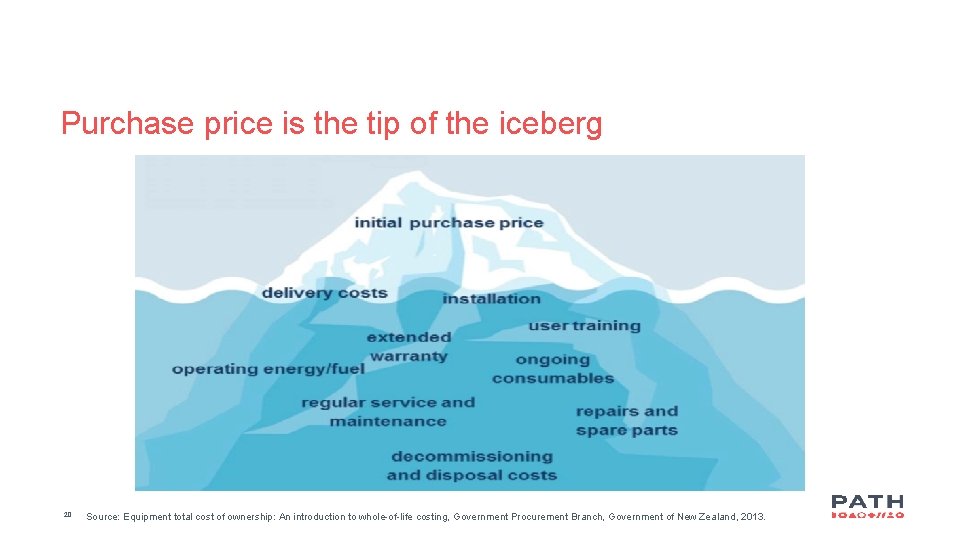
Purchase price is the tip of the iceberg 20 Source: Equipment total cost of ownership: An introduction to whole-of-life costing, Government Procurement Branch, Government of New Zealand, 2013.
Total cost of ownership tool USER AIM To help decision-makers make appropriate oxygen device and pulse oximeter purchase and budget decisions based on need, facility conditions, and total cost of ownership f(x) 1. Showcase the costs of each device type to meet the needs across facilities FUNCTION 21 Procurement decision-maker (for example, District Health Officer): of medical devices at a subnational and national levels; limited budget and time; minimal understanding about oxygen devices 2. Enable planning and budgeting across device types and facilities
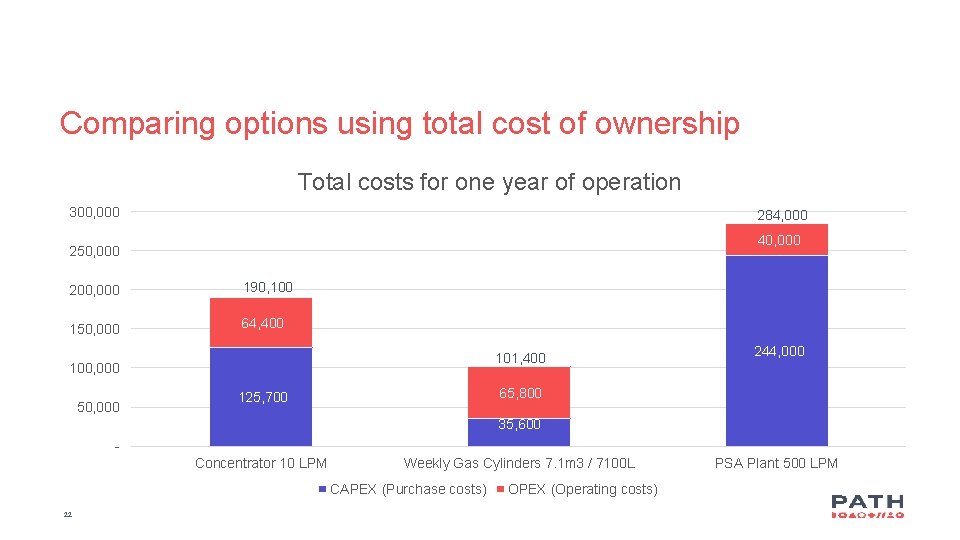
Comparing options using total cost of ownership Total costs for one year of operation 300, 000 284, 000 40, 000 250, 000 200, 000 190, 100 150, 000 64, 400 101, 400 100, 000 50, 000 244, 000 65, 800 125, 700 35, 600 Concentrator 10 LPM Weekly Gas Cylinders 7. 1 m 3 / 7100 L CAPEX (Purchase costs) 22 OPEX (Operating costs) PSA Plant 500 LPM
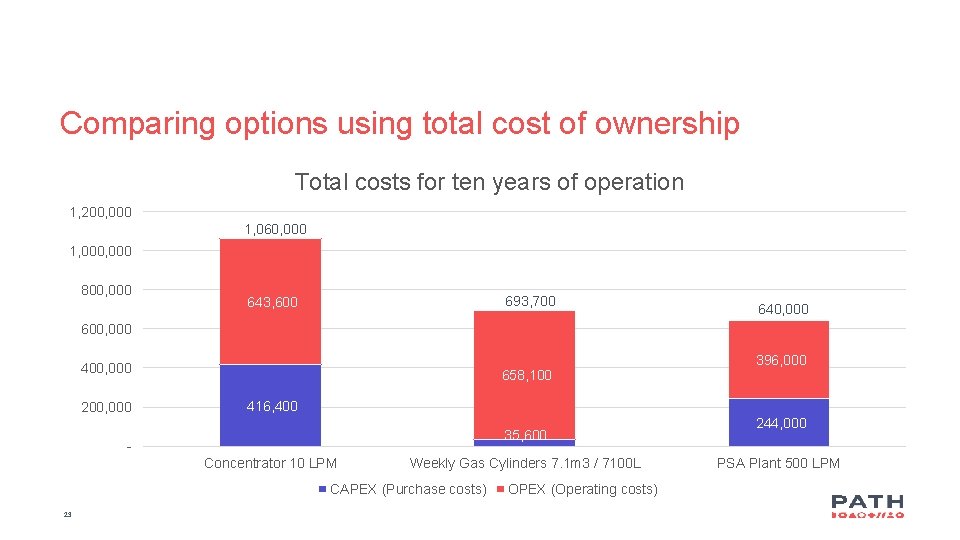
Comparing options using total cost of ownership Total costs for ten years of operation 1, 200, 000 1, 060, 000 1, 000 800, 000 693, 700 643, 600 640, 000 600, 000 400, 000 200, 000 658, 100 416, 400 35, 600 Concentrator 10 LPM Weekly Gas Cylinders 7. 1 m 3 / 7100 L CAPEX (Purchase costs) 23 396, 000 OPEX (Operating costs) 244, 000 PSA Plant 500 LPM
Cost components for PSA plant at ten years 24
Cost components for cylinder at ten years 25
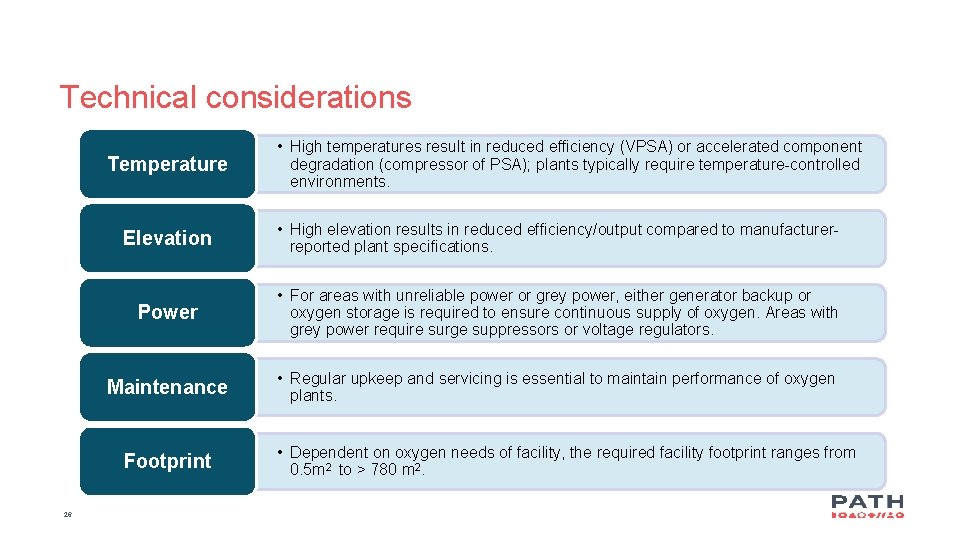
Technical considerations Temperature Elevation • High elevation results in reduced efficiency/output compared to manufacturerreported plant specifications. Power • For areas with unreliable power or grey power, either generator backup or oxygen storage is required to ensure continuous supply of oxygen. Areas with grey power require surge suppressors or voltage regulators. Maintenance • Regular upkeep and servicing is essential to maintain performance of oxygen plants. Footprint 26 • High temperatures result in reduced efficiency (VPSA) or accelerated component degradation (compressor of PSA); plants typically require temperature-controlled environments. • Dependent on oxygen needs of facility, the required facility footprint ranges from 0. 5 m 2 to > 780 m 2.
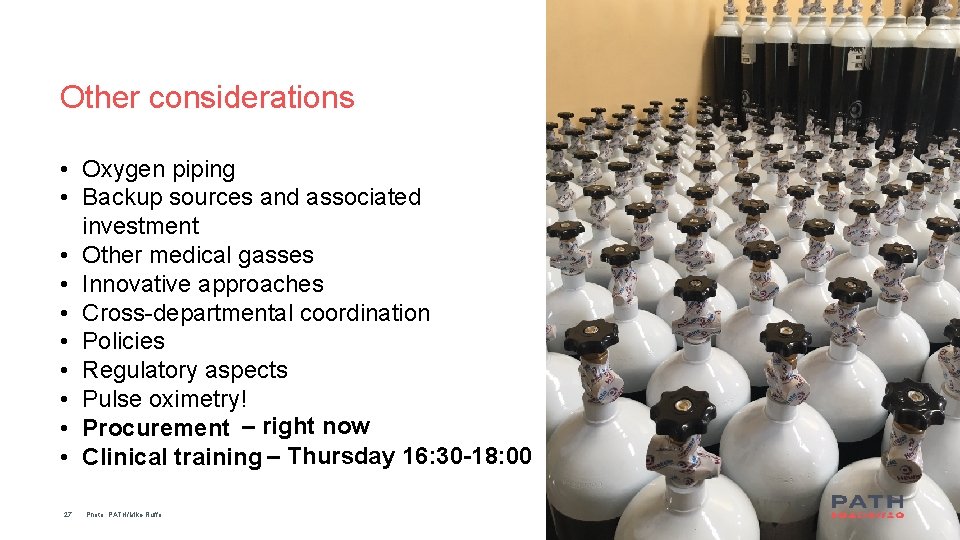
Other considerations • Oxygen piping • Backup sources and associated investment • Other medical gasses • Innovative approaches • Cross-departmental coordination • Policies • Regulatory aspects • Pulse oximetry! • Procurement – right now • Clinical training – Thursday 16: 30 -18: 00 27 Photo: PATH/Mike Ruffo
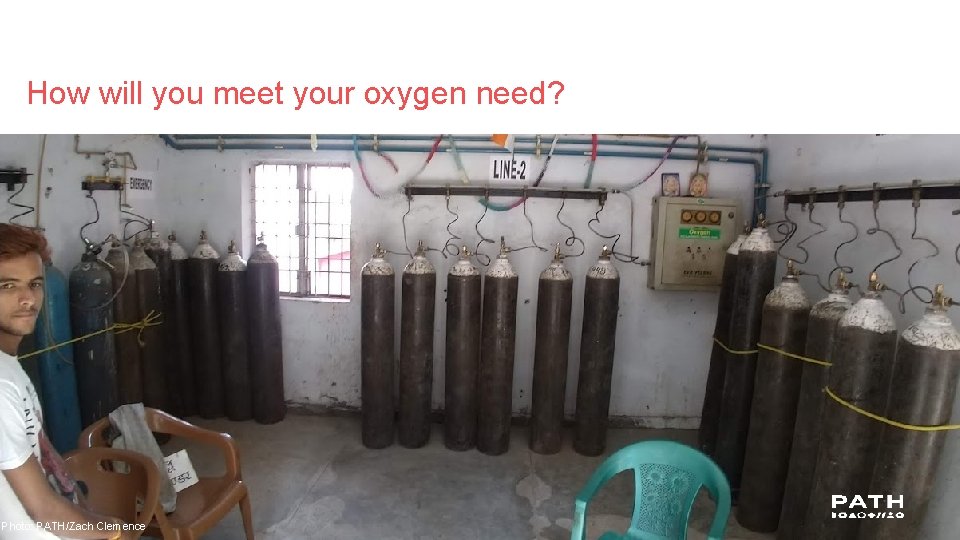
How will you meet your oxygen need? 28 Photo: PATH/Zach Clemence

Source of funding: The Bill & Melinda Gates Foundation
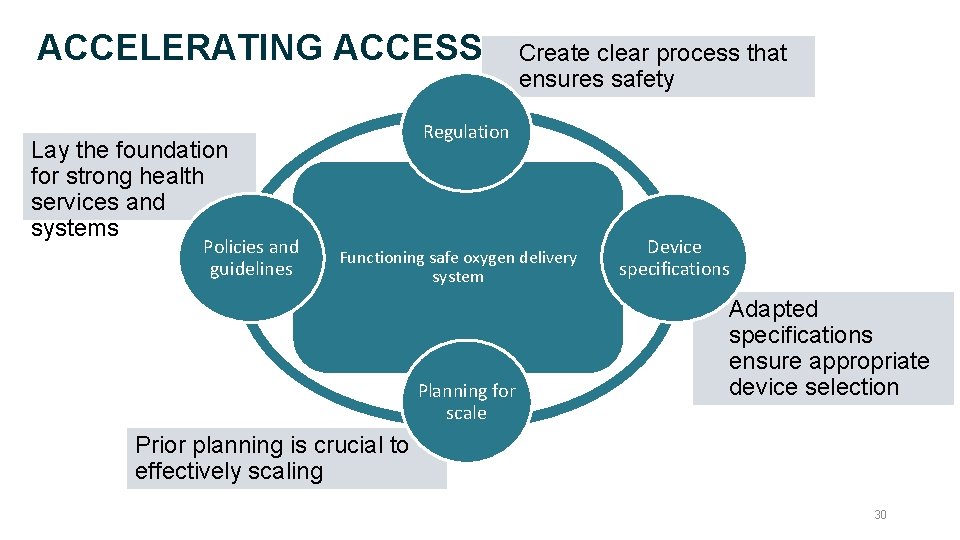
ACCELERATING ACCESS Regulation Lay the foundation for strong health services and systems Policies and guidelines Create clear process that ensures safety Functioning safe oxygen delivery system Planning for scale Device specifications Adapted specifications ensure appropriate device selection Prior planning is crucial to effectively scaling 30
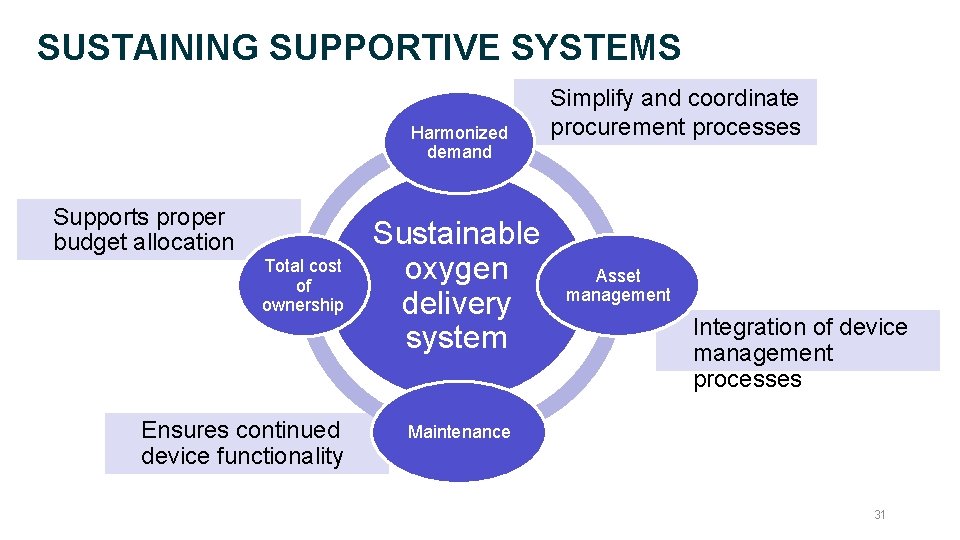
SUSTAINING SUPPORTIVE SYSTEMS Harmonized demand Supports proper budget allocation Total cost of ownership Ensures continued device functionality Sustainable oxygen delivery system Simplify and coordinate procurement processes Asset management Integration of device management processes Maintenance 31
- Slides: 31