
Deccan Trap Volcanic Province Stratigraphy of Dike Swarms
- Slides: 10
Deccan Trap Volcanic Province Stratigraphy of Dike Swarms and Deccan Formations Joshua Vance GEO 310 Stratigraphy
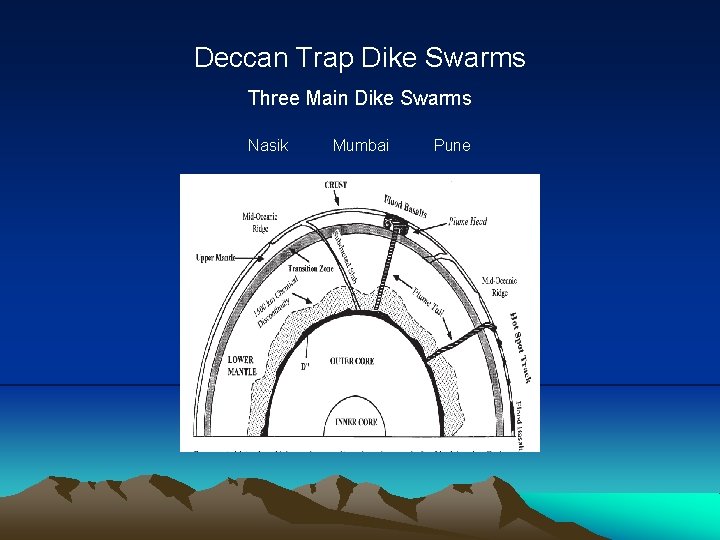
Deccan Trap Mantle Plume Theory Tholeiitic magma from deep within the mantle rose to the surface Dike swarms created broad shield-volcano like structures Episodic volcanism erupting large volumes of magma rapidly Main episodes were tholeiitic with alkalic and carbonatitic episodes before and after Magma erupted between 65 – 62 Ma (Cretaceous – Paleocene) 90% of magma erupted within 0. 5 million years (K-T Boundary)
Deccan Trap Volcanic Province Chemostratigraphy Formations are the fundamental units Members are sub-divisions of Formations Sub-groups are sets of mineralogical and geochemical similar formations Formations determined by mineralogy and geochemistry Formations have relatively homogenous mineralogy and geochemistry Formations are distinct from adjacent rock units Formations boundaries are based on mineralogical or geochemical changes Formations must have a sufficient thickness to be mappable Formations must be traceable from outcrop to outcrop
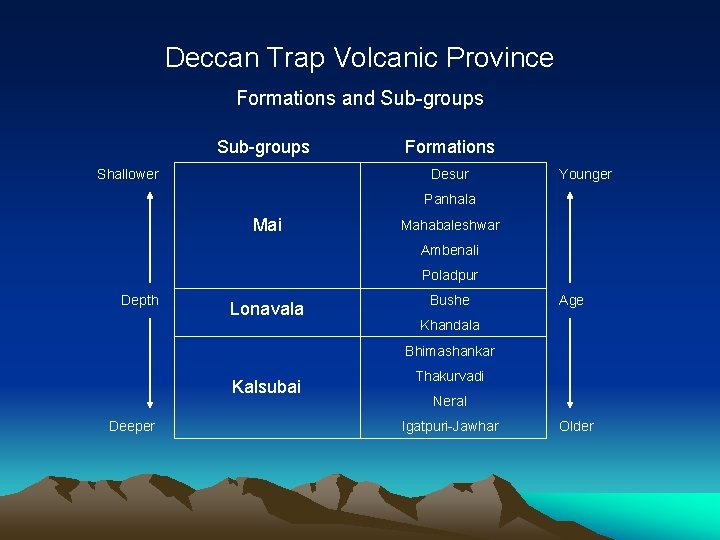
Deccan Trap Volcanic Province Formations and Sub-groups Shallower Formations Desur Younger Panhala Mai Mahabaleshwar Ambenali Poladpur Depth Lonavala Bushe Age Khandala Bhimashankar Kalsubai Deeper Thakurvadi Neral Igatpuri-Jawhar Older
Deccan Trap Dike Swarms Three Main Dike Swarms Nasik Mumbai Pune
Sangamner Dikes in the Western Ghats Geology Positive relief features (humps or spines) due to resistance to erosion Thickness ranging from 1 – 18 meters Approximate dip ranging between 70˚ and 80˚ Occurrence in pairs Chilled margins Strong preferred orientation NE - SW
Sangamner Dikes in the Western Ghats Comparison Between Dikes and Deccan Formations Physical Stratigraphy - Sangamner dikes intrude formations of the Mai and Lonavala sub-groups therefore they could not have been the source for the Kalsubai formations Mineralogy and Geochemistry - Tholeiitic Composition - Plagioclase Phenocrysts - Major, minor, and trace elements Isotope Ratios - 87 Sr/86 Sr ratios
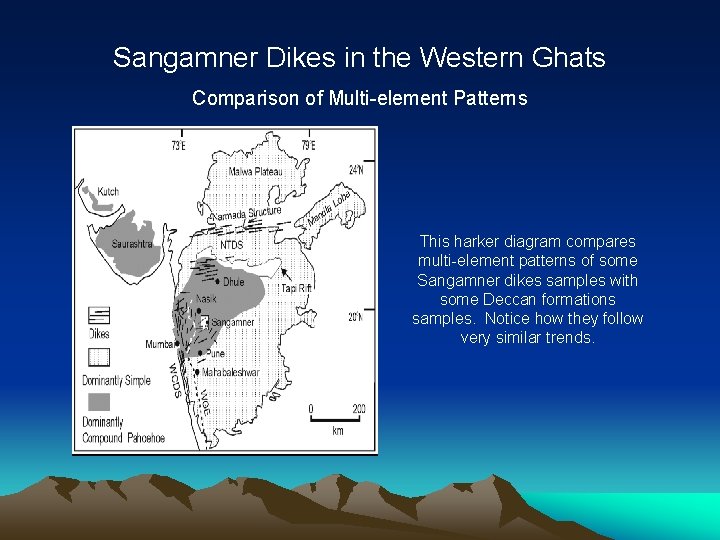
Sangamner Dikes in the Western Ghats Comparison of Multi-element Patterns This harker diagram compares multi-element patterns of some Sangamner dikes samples with some Deccan formations samples. Notice how they follow very similar trends.
Sangamner Dikes in the Western Ghats Conclusions Positive relief features (humps or spines) due to resistance to erosion Thickness ranging from 1 – 18 meters Approximate dip ranging between 70˚ and 80˚ Occurrence in pairs Chilled margins Strong preferred orientation NE - SW
Acknowledgments Bondre N. R. et al. “Geology and Geochemistry of the Sangamner Mafic Dike Swarm, Western Deccan Volcanic Province, India: Implications for Regional Stratigraphy. ” Journal of Geology. vol 114. 2006. pp 155 – 170. Gore, Pamela. “Stratigraphy and Lithologic Correlation. ” 2004. <http: //www. gpc. edu/~pgore/geology/historical_lab/stratigraphy. php > Pande, Kanchan et al. “ 40 Ar – 39 Ar Age of a Lava Flow from the Bhimashankar Formation, Giravali Ghat, Deccan Traps. ” Proc. Indian Acad. Sci. 113. no 4. December 2004. pp 755 – 758. Sen, Gautam. “Generation of Deccan Trap Magmas. ” Proc. Indian Acad. Sci. 110. no 4. December 2001. pp 409 – 431. Sheth, Hetu. “The Deccan Beyond the Plume Hypothesis. ” 29 August 2006. < http: //www. mantleplumes. org/Deccan. html > Sheth, Hetu. “Building a Continental Flood Basalt Province: Key Significance of the Deccan Trap Dyke Swarms. ” < http: //www. geos. iitb. ac. in/sheth-varanasi. pdf >