
Decarbonization and Automation Wolfgang Kstinger UNECE Innovation in
Decarbonization and Automation Wolfgang Köstinger UNECE - Innovation in the railways, Geneva, Nov. 2018
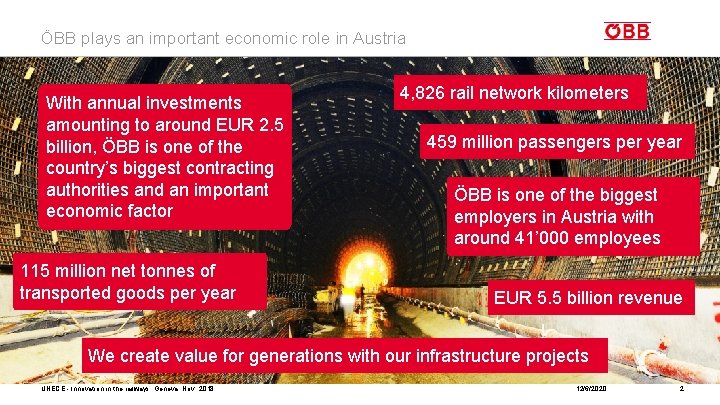
ÖBB plays an important economic role in Austria With annual investments amounting to around EUR 2. 5 billion, ÖBB is one of the country’s biggest contracting authorities and an important economic factor 115 million net tonnes of transported goods per year 4, 826 rail network kilometers 459 million passengers per year ÖBB is one of the biggest employers in Austria with around 41’ 000 employees EUR 5. 5 billion revenue We create value for generations with our infrastructure projects UNECE - Innovation in the railways, Geneva, Nov. 2018 12/6/2020 2
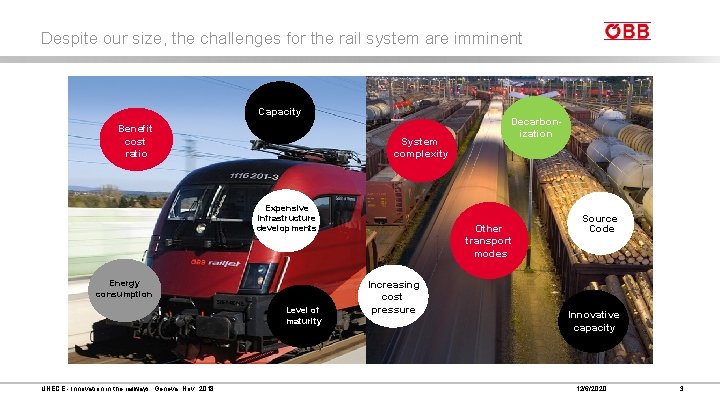
Despite our size, the challenges for the rail system are imminent Capacity Benefit cost ratio System complexity Expensive infrastructure developments Energy consumption Level of maturity UNECE - Innovation in the railways, Geneva, Nov. 2018 Decarbonization Other transport modes Increasing cost pressure Source Code Innovative capacity 12/6/2020 3
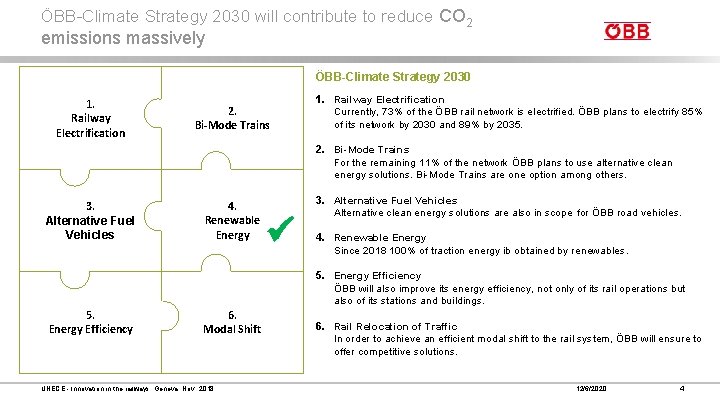
ÖBB-Climate Strategy 2030 will contribute to reduce CO 2 emissions massively ÖBB-Climate Strategy 2030 1. Railway Electrification 2. Bi-Mode Trains 1. Railway Electrification Currently, 73% of the ÖBB rail network is electrified. ÖBB plans to electrify 85% of its network by 2030 and 89% by 2035. 2. Bi-Mode Trains For the remaining 11% of the network ÖBB plans to use alternative clean energy solutions. Bi-Mode Trains are one option among others. 3. Alternative Fuel Vehicles 4. Renewable Energy 3. Alternative Fuel Vehicles Alternative clean energy solutions are also in scope for ÖBB road vehicles. 4. Renewable Energy Since 2018 100% of traction energy ib obtained by renewables. 5. Energy Efficiency ÖBB will also improve its energy efficiency, not only of its rail operations but also of its stations and buildings. 5. Energy Efficiency 6. Modal Shift UNECE - Innovation in the railways, Geneva, Nov. 2018 6. Rail Relocation of Traffic In order to achieve an efficient modal shift to the rail system, ÖBB will ensure to offer competitive solutions. 12/6/2020 4
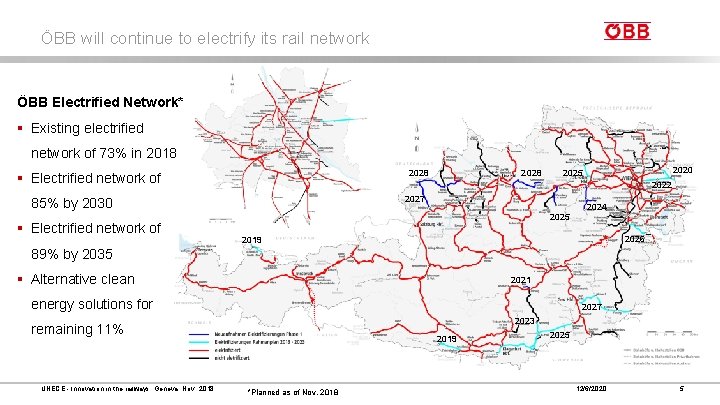
ÖBB will continue to electrify its rail network ÖBB Electrified Network* § Existing electrified network of 73% in 2018 2020 2025 2022 2027 85% by 2030 § Electrified network of 2028 § Electrified network of 2025 2024 2026 2019 89% by 2035 § Alternative clean 2021 energy solutions for 2027 2023 remaining 11% UNECE - Innovation in the railways, Geneva, Nov. 2018 2019 *Planned as of Nov. 2018 2025 12/6/2020 5
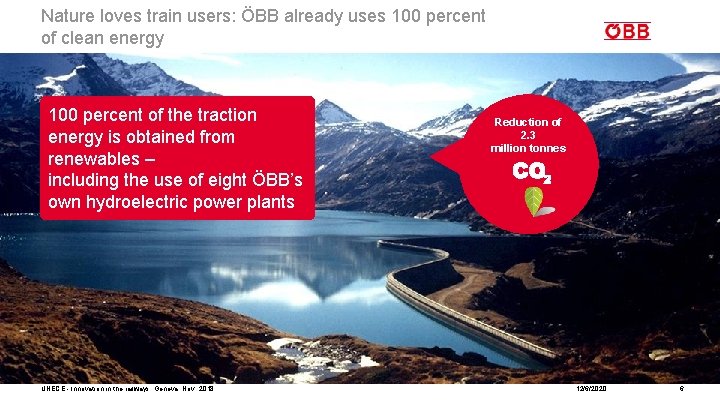
Nature loves train users: ÖBB already uses 100 percent of clean energy The Cargo Group operates between ÖBBRail is one of Europe’s most punctual 100 North percent of the traction Overall the Sea, Mediterranean Sea and reliable rail operators. energy is obtained from Black Sea – with subsidiaries and partner punctuality renewables – networks and beyond. is 96. 3%. in Europe Reduction of 2. 3 million tonnes including the use of eight ÖBB’s own hydroelectric power plants UNECE - Innovation in the railways, Geneva, Nov. 2018 12/6/2020 6
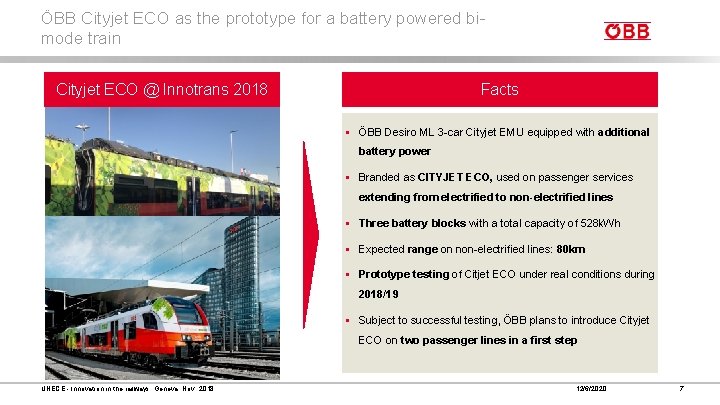
ÖBB Cityjet ECO as the prototype for a battery powered bimode train Cityjet ECO @ Innotrans 2018 Facts § ÖBB Desiro ML 3 -car Cityjet EMU equipped with additional battery power § Branded as CITYJET ECO, used on passenger services extending from electrified to non-electrified lines § Three battery blocks with a total capacity of 528 k. Wh § Expected range on non-electrified lines: 80 km § Prototype testing of Citjet ECO under real conditions during 2018/19 § Subject to successful testing, ÖBB plans to introduce Cityjet ECO on two passenger lines in a first step UNECE - Innovation in the railways, Geneva, Nov. 2018 12/6/2020 7
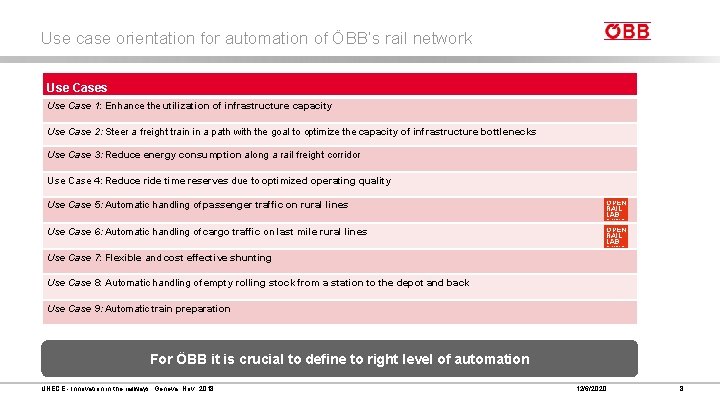
Use case orientation for automation of ÖBB‘s rail network Use Cases Use Case 1: Enhance the utilization of infrastructure capacity Use Case 2: Steer a freight train in a path with the goal to optimize the capacity of infrastructure bottlenecks Use Case 3: Reduce energy consumption along a rail freight corridor Use Case 4: Reduce ride time reserves due to optimized operating quality Use Case 5: Automatic handling of passenger traffic on rural lines Use Case 6: Automatic handling of cargo traffic on last mile rural lines Use Case 7: Flexible and cost effective shunting Use Case 8: Automatic handling of empty rolling stock from a station to the depot and back Use Case 9: Automatic train preparation For ÖBB it is crucial to define to right level of automation UNECE - Innovation in the railways, Geneva, Nov. 2018 12/6/2020 8
What we want to achieve with automation of the rail network System tuning § Increase usage of infrastructure § Increase capacity § Reduce energy § Optimize operating quality § Smoothing of train speed curve Gain experience with piloting Next Generation Train Protection System UNECE - Innovation in the railways, Geneva, Nov. 2018 12/6/2020 9
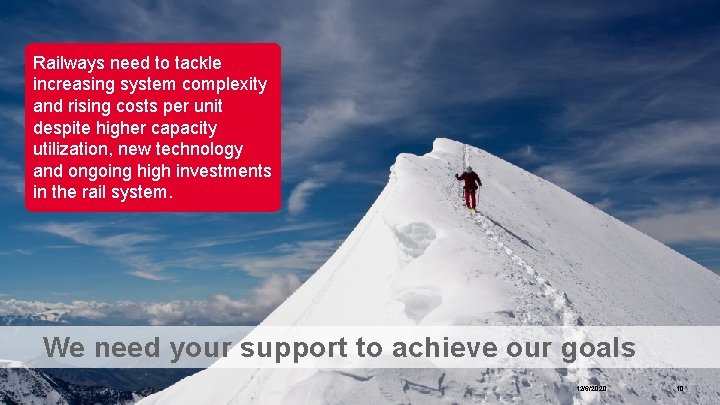
Railways need to tackle increasing system complexity and rising costs per unit despite higher capacity utilization, new technology and ongoing high investments in the rail system. We need your support to achieve our goals UNECE - Innovation in the railways, Geneva, Nov. 2018 12/6/2020 10
Thank you for your attention UNECE - Innovation in the railways, Geneva, Nov. 2018 12/6/2020 11
- Slides: 11