
Decadimenti rari radiativi e leptonici del mesone B
Decadimenti rari radiativi e leptonici del mesone B Risultati più recenti dalle B -factory F. Bucci INFN-Pisa Collaborazione Ba. Bar XV IFAE Lecce, 23 -26 Aprile 2003
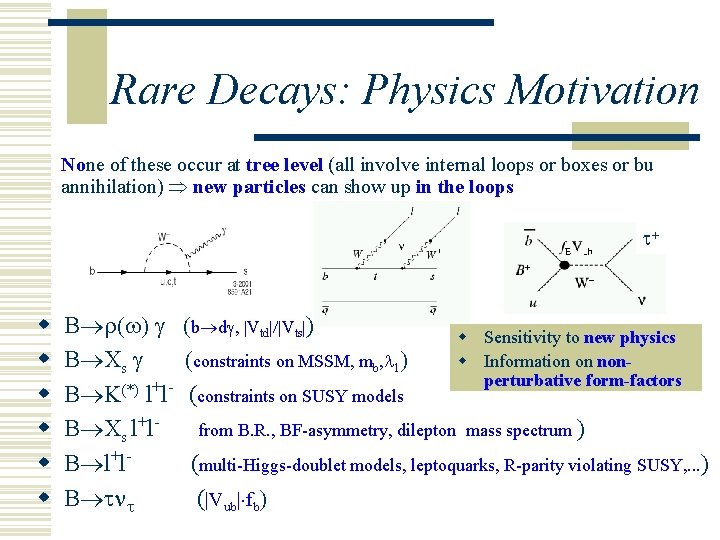
Rare Decays: Physics Motivation None of these occur at tree level (all involve internal loops or boxes or bu annihilation) new particles can show up in the loops t+ w w w B r(w) g B Xs g B K(*) l+l. B Xs l+l. B tnt (b dg, |Vtd| |Vts|) (constraints on MSSM, mb, l 1) (constraints on SUSY models w Sensitivity to new physics w Information on nonperturbative form-factors from B. R. , BF-asymmetry, dilepton mass spectrum ) (multi-Higgs-doublet models, leptoquarks, R-parity violating SUSY, . . . ) (|Vub| fb)
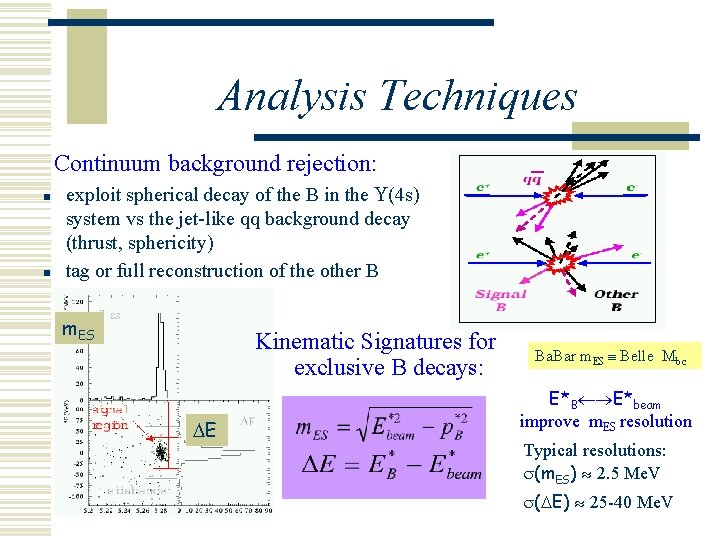
Analysis Techniques Continuum background rejection: n n exploit spherical decay of the B in the U(4 s) system vs the jet-like qq background decay (thrust, sphericity) tag or full reconstruction of the other B m. ES Kinematic Signatures for exclusive B decays: DE Ba. Bar m. ES Belle Mbc E*B E*beam improve m. ES resolution Typical resolutions: s(m. ES) 2. 5 Me. V s(DE) 25 -40 Me. V
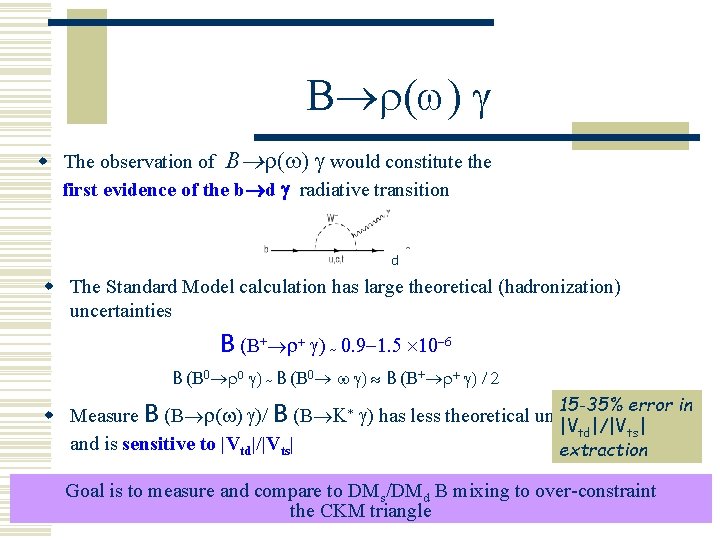
B r(w) g w The observation of B r(w) g would constitute the first evidence of the b d g radiative transition d w The Standard Model calculation has large theoretical (hadronization) uncertainties B (B+ r+ g) 0. 9 -1. 5 10 -6 B (B 0 r 0 g) B (B 0 w g) B (B+ r+ g) 2 15 -35% error in w Measure B (B r(w) g) B (B K* g) has less theoretical uncertainty |Vtd|/|Vts| and is sensitive to |Vtd|/|Vts| extraction Goal is to measure and compare to DMs/DMd B mixing to over-constraint the CKM triangle

B r(w) g Experimental Challenges: § B(B r(w) g) 1/50 B(B K* g) Gr 3 G K* § Background: § l Continuum with high energy g from p 0(h) decay or ISR B K* g with K misidentified as a l B rp 0, b s g l p Belle use a kinematic veto on charged K mass as well as particle ID information Ba. Bar (Belle) combine continuum rejection variables in a neural net (Fisher discriminant ) to reduce continuum Ba. Bar use particle ID in DIRC to reduce kaon misidentification to 1%
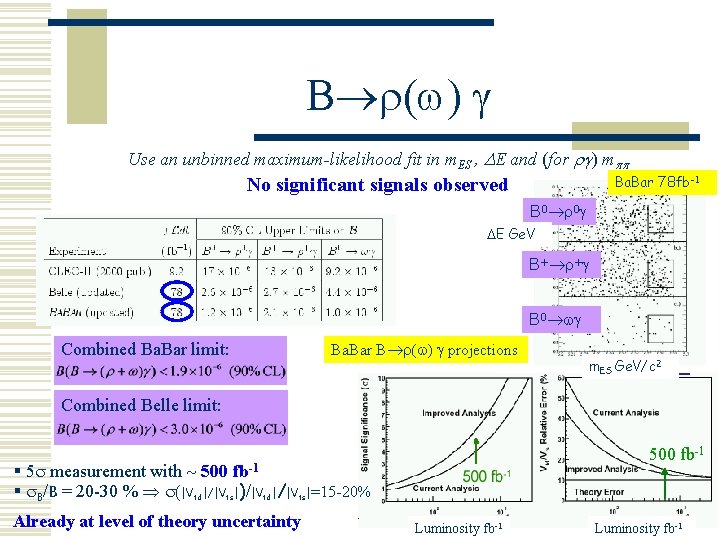
B r(w) g Use an unbinned maximum-likelihood fit in m. ES , DE and (for rg) mpp Ba. Bar 78 fb-1 No significant signals observed B 0 r 0 g DE Ge. V B+ r+g B 0 wg Combined Ba. Bar limit: Ba. Bar B r(w) g projections m. ES Ge. V/c 2 Combined Belle limit: 500 fb-1 § 5 s measurement with 500 fb-1 § s. B/B = 20 -30 % s(|Vtd|/|Vts|)/|Vtd|/|Vts|=15 -20% Already at level of theory uncertainty Luminosity fb-1
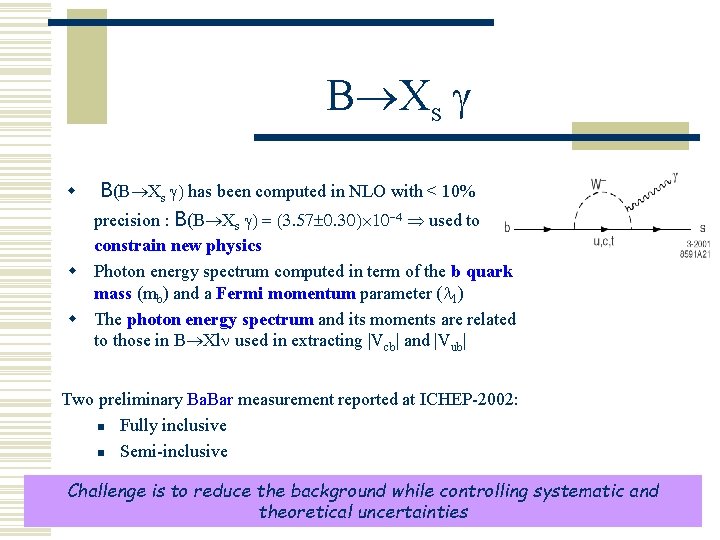
B Xs g w B(B Xs g) has been computed in NLO with < 10% precision : B(B Xs g) = (3. 57 0. 30) 10 -4 used to constrain new physics w Photon energy spectrum computed in term of the b quark mass (mb) and a Fermi momentum parameter (l 1) w The photon energy spectrum and its moments are related to those in B Xln used in extracting |Vcb| and |Vub| Two preliminary Ba. Bar measurement reported at ICHEP-2002: n Fully inclusive n Semi-inclusive Challenge is to reduce the background while controlling systematic and theoretical uncertainties
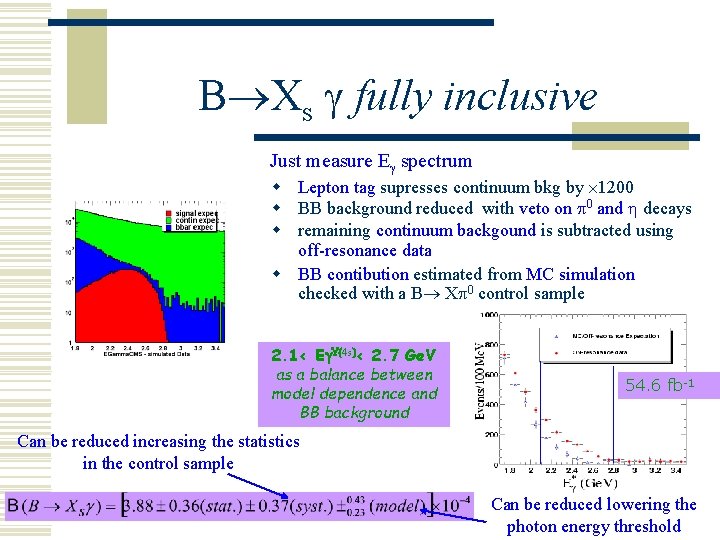
B Xs g fully inclusive Just measure Eg spectrum w Lepton tag supresses continuum bkg by 1200 w BB background reduced with veto on p 0 and h decays w remaining continuum backgound is subtracted using off-resonance data w BB contibution estimated from MC simulation checked with a B Xp 0 control sample 2. 1< Eg. U(4 s)< 2. 7 Ge. V as a balance between model dependence and BB background 54. 6 fb-1 Can be reduced increasing the statistics in the control sample Can be reduced lowering the photon energy threshold
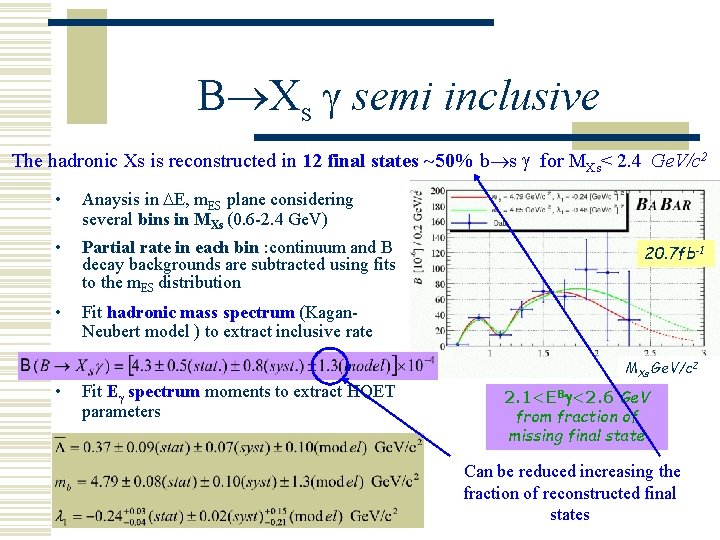
B Xs g semi inclusive The hadronic Xs is reconstructed in 12 final states 50% b s g for MXs< 2. 4 Ge. V/c 2 • Anaysis in DE, m. ES plane considering several bins in MXs (0. 6 -2. 4 Ge. V) • Partial rate in each bin : continuum and B decay backgrounds are subtracted using fits to the m. ES distribution • Fit hadronic mass spectrum (Kagan. Neubert model ) to extract inclusive rate 20. 7 fb-1 MXs Ge. V/c 2 • Fit Eg spectrum moments to extract HQET parameters 2. 1<EBg<2. 6 Ge. V from fraction of missing final state Can be reduced increasing the fraction of reconstructed final states
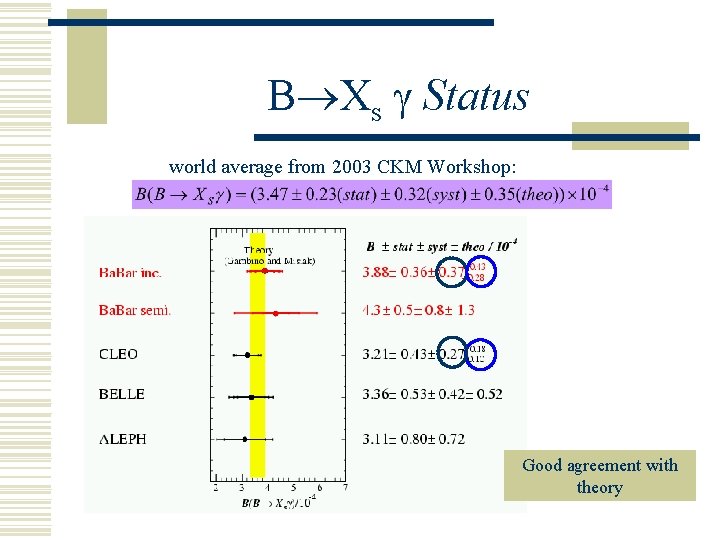
B Xs g Status world average from 2003 CKM Workshop: Good agreement with theory
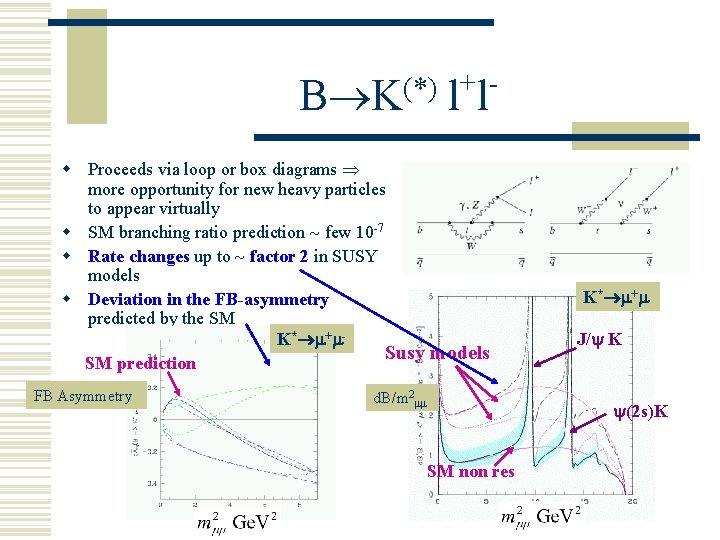
+ (*) B K l l w Proceeds via loop or box diagrams more opportunity for new heavy particles to appear virtually w SM branching ratio prediction few 10 -7 w Rate changes up to factor 2 in SUSY models w Deviation in the FB-asymmetry predicted by the SM K* m+m. Susy models SM prediction FB Asymmetry d. B/m 2 mm K* m+m J/y K y(2 s)K SM non res
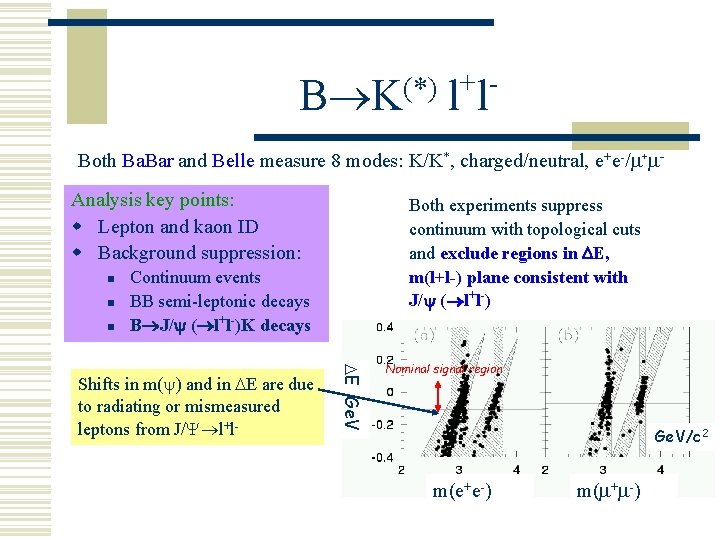
+ (*) B K l l Both Ba. Bar and Belle measure 8 modes: K/K*, charged/neutral, e+e-/m+m. Analysis key points: w Lepton and kaon ID w Background suppression: n n n Both experiments suppress continuum with topological cuts and exclude regions in DE, m(l+l-) plane consistent with J/y ( l+l-) Continuum events BB semi-leptonic decays B J/y ( l+l-)K decays DE Ge. V Shifts in m(y) and in DE are due to radiating or mismeasured leptons from J/Y l+l- Nominal signal region Ge. V/c 2 m(e+e-) m(m+m-)
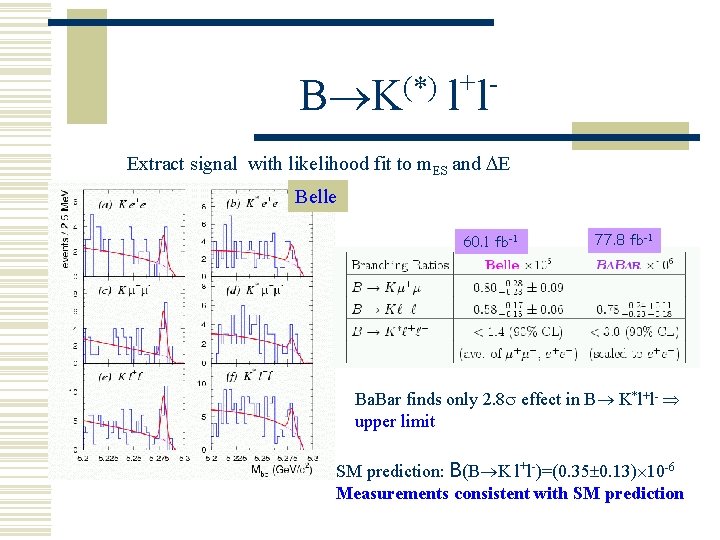
+ (*) B K l l Extract signal with likelihood fit to m. ES and DE Belle 60. 1 fb-1 77. 8 fb-1 Ba. Bar finds only 2. 8 s effect in B K*l+l- upper limit SM prediction: B(B K l+l-)=(0. 35 0. 13) 10 -6 Measurements consistent with SM prediction
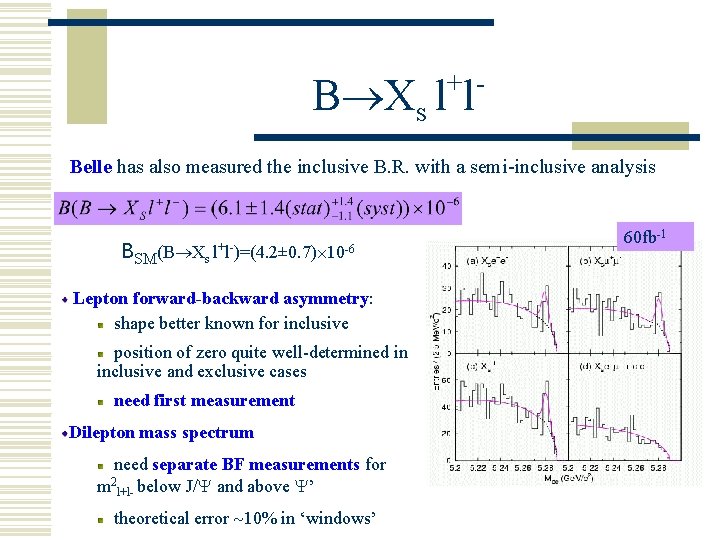
+ - B Xs l l Belle has also measured the inclusive B. R. with a semi-inclusive analysis BSM(B Xs l l )=(4. 2± 0. 7) 10 -6 + - Lepton forward-backward asymmetry: shape better known for inclusive position of zero quite well-determined in inclusive and exclusive cases need first measurement Dilepton mass spectrum need separate BF measurements for m 2 l+l- below J/Y and above Y’ theoretical error 10% in ‘windows’ 60 fb-1
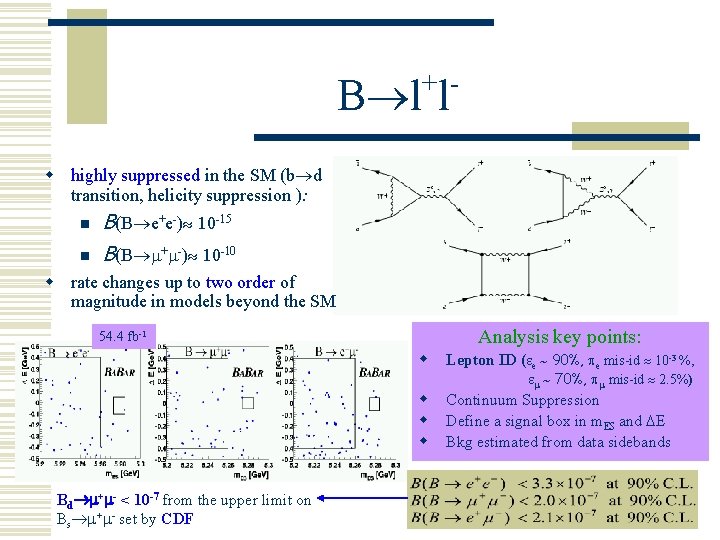
+ - B l l w highly suppressed in the SM (b d transition, helicity suppression ): n n B(B e+e-) 10 -15 B(B m+m-) 10 -10 w rate changes up to two order of magnitude in models beyond the SM Analysis key points: 54. 4 fb-1 Bd m+m- < 10 -7 from the upper limit on Bs m+m- set by CDF w Lepton ID (ee 90%, pe mis-id 10 -3 %, w w w Continuum Suppression Define a signal box in m. ES and DE Bkg estimated from data sidebands em 70%, pm mis-id 2. 5%)
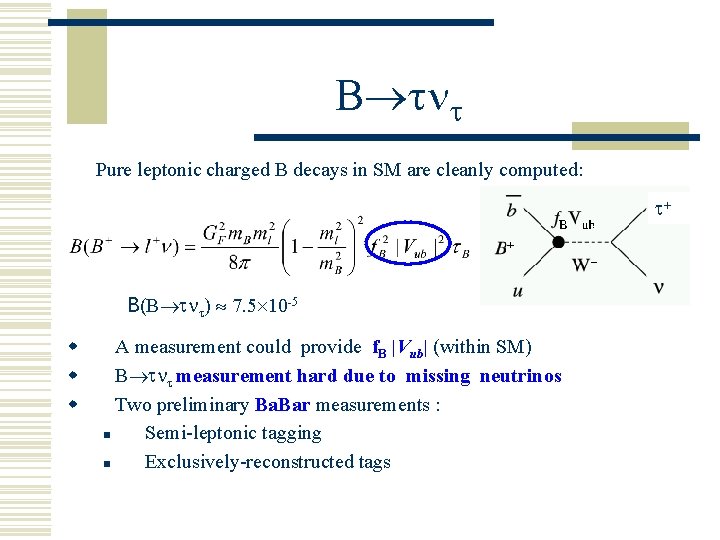
B tnt Pure leptonic charged B decays in SM are cleanly computed: t+ B(B tnt) 7. 5 10 -5 w w w A measurement could provide f. B |Vub| (within SM) B tnt measurement hard due to missing neutrinos Two preliminary Ba. Bar measurements : n Semi-leptonic tagging n Exclusively-reconstructed tags
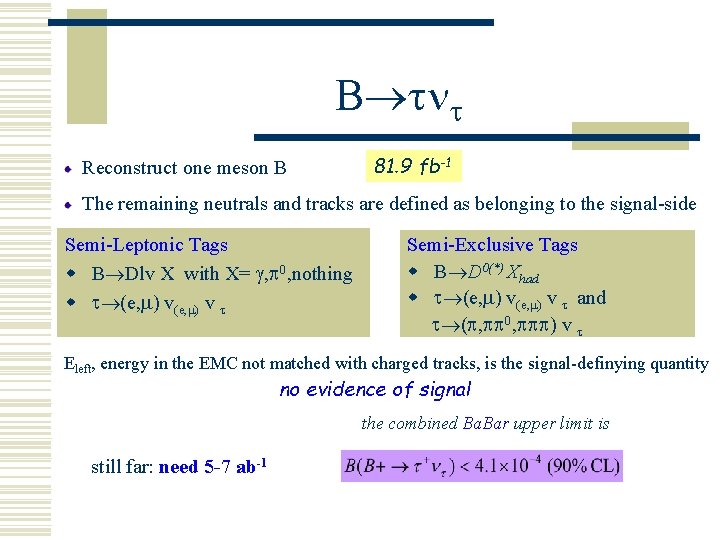
B tnt Reconstruct one meson B 81. 9 fb-1 The remaining neutrals and tracks are defined as belonging to the signal-side Semi-Leptonic Tags w B Dlv X with X= g, p 0, nothing w t (e, m) v t Semi-Exclusive Tags w B D 0(*) Xhad w t (e, m) v t and t (p, pp 0, ppp) v t Eleft, energy in the EMC not matched with charged tracks, is the signal-definying quantity no evidence of signal the combined Ba. Bar upper limit is still far: need 5 -7 ab-1
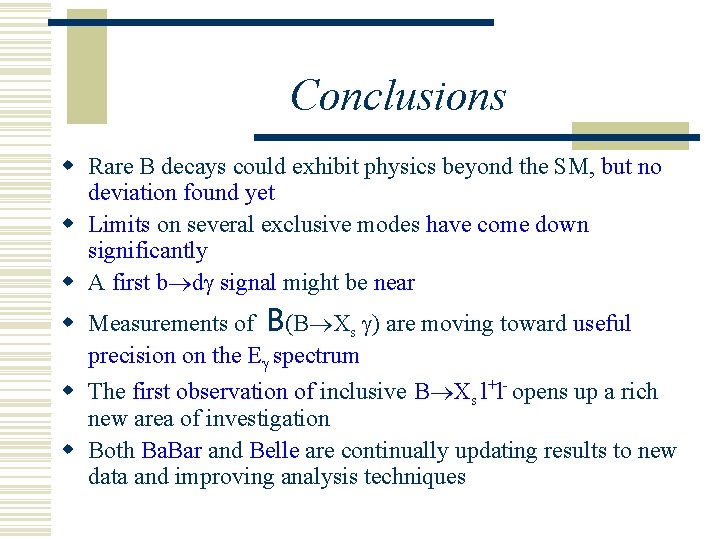
Conclusions w Rare B decays could exhibit physics beyond the SM, but no deviation found yet w Limits on several exclusive modes have come down significantly w A first b dg signal might be near w Measurements of B(B Xs g) are moving toward useful precision on the Eg spectrum w The first observation of inclusive B Xs l+l- opens up a rich new area of investigation w Both Ba. Bar and Belle are continually updating results to new data and improving analysis techniques
- Slides: 18